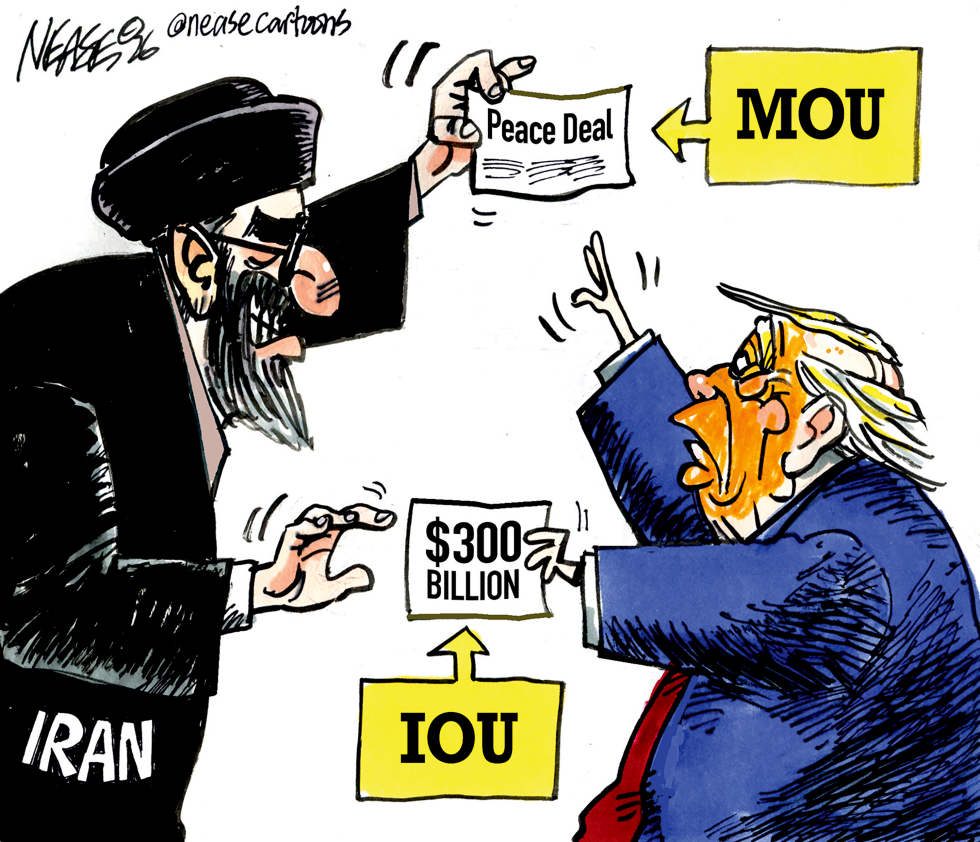
Nease, a Canadian cartoonist, examines the hidden costs of the peace agreements being brokered by Trump across multiple conflict zones. The cartoon suggests that peace achieved through coercion and abandonment of allies carries enormous human costs. The accounting metaphor frames diplomacy as a transactional exercise with losers.
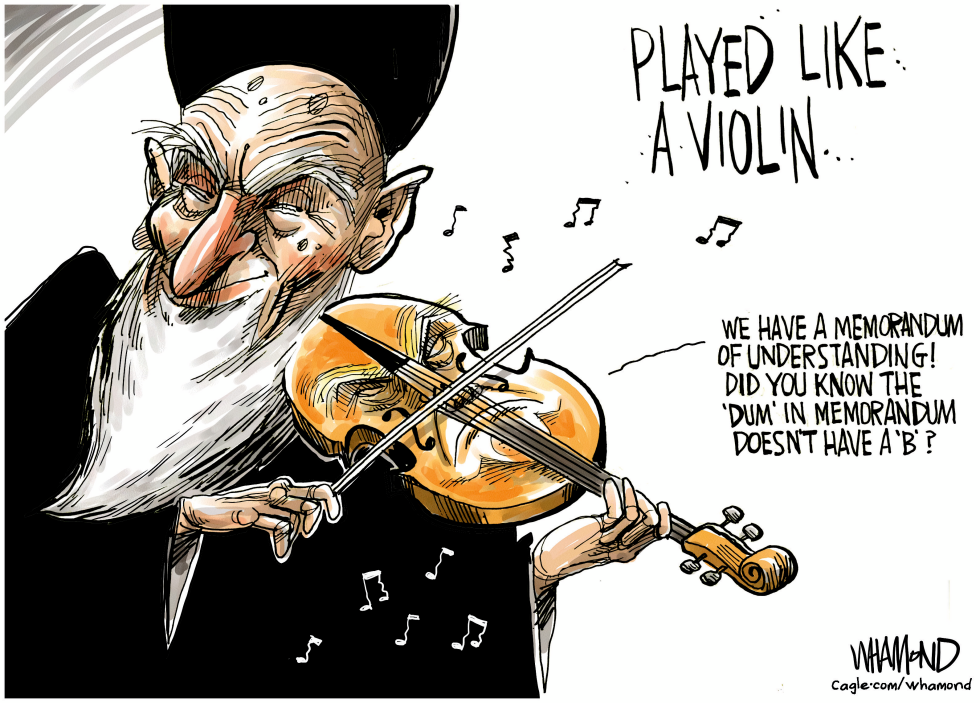
The image shows a bearded cleric in black attire playing a violin. Text above reads played like a violin. A speech bubble questions the spelling of memorandum. Musical notes float nearby.
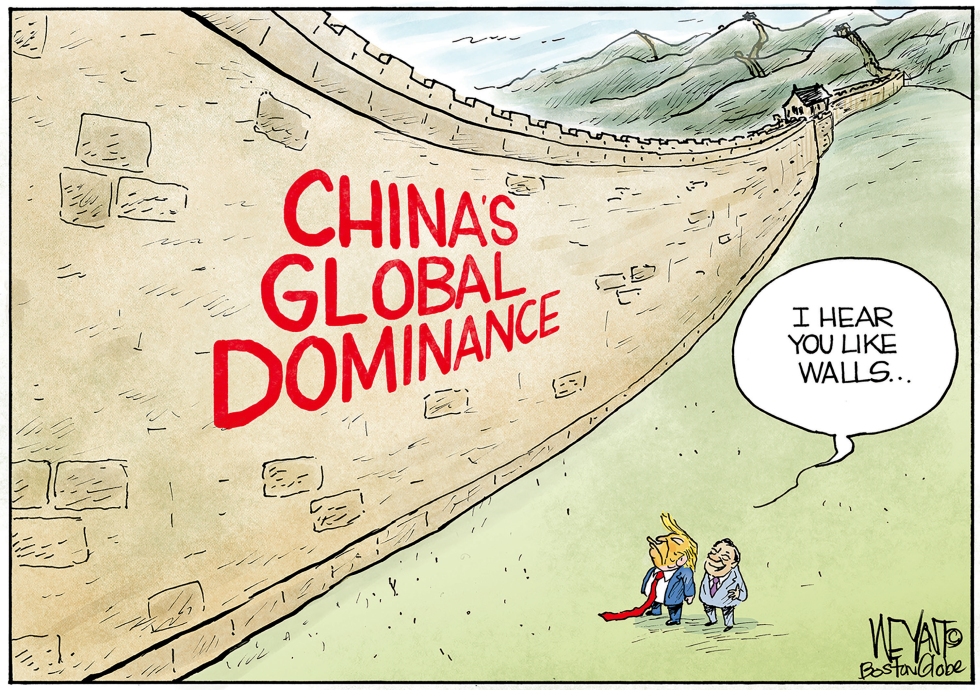
The image shows a massive stone wall curving across hills labeled in red text China's global dominance. At the bottom right two men in suits stand on grass one with yellow hair and red tie. A speech bubble extends from the second man stating I hear you like walls. The wall has watchtowers and the background shows green hills under a blue sky.
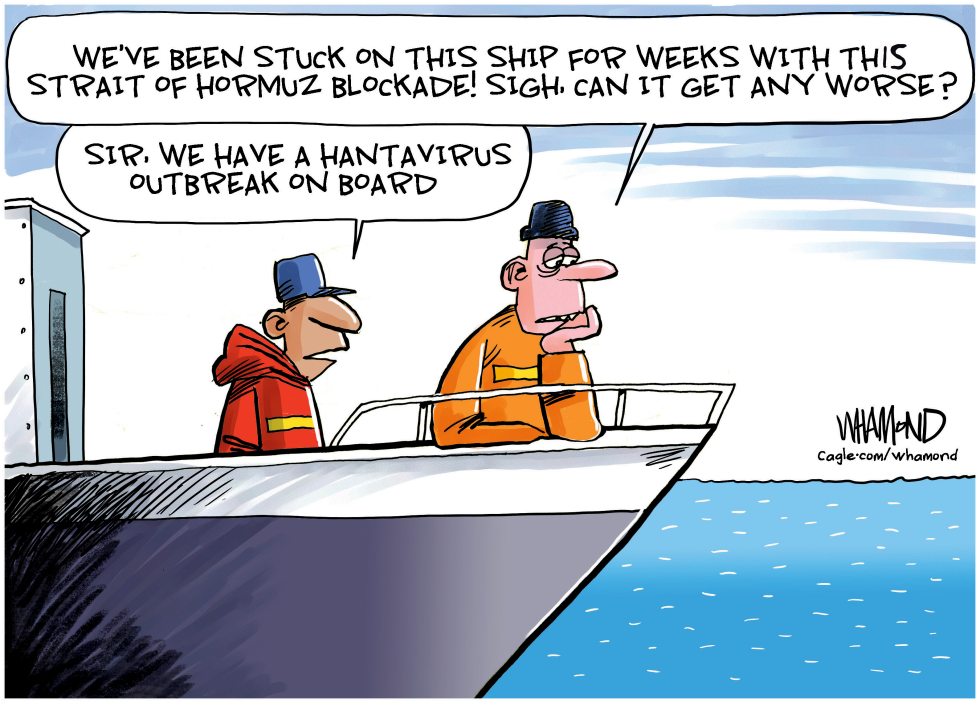
The cartoon depicts two sailors aboard a ship trapped in the Strait of Hormuz due to a naval blockade. One laments the weeks-long delay and wonders if conditions can worsen. The other reports a hantavirus outbreak on board. The image responds to ongoing tensions involving Iran and disruptions to global oil routes. As of the May 2026 publication date, the blockade has halted tanker traffic and strained energy markets. The added health crisis underscores the compounding risks for crews and supply chains. The visual ties geopolitical conflict directly to immediate human and economic consequences.
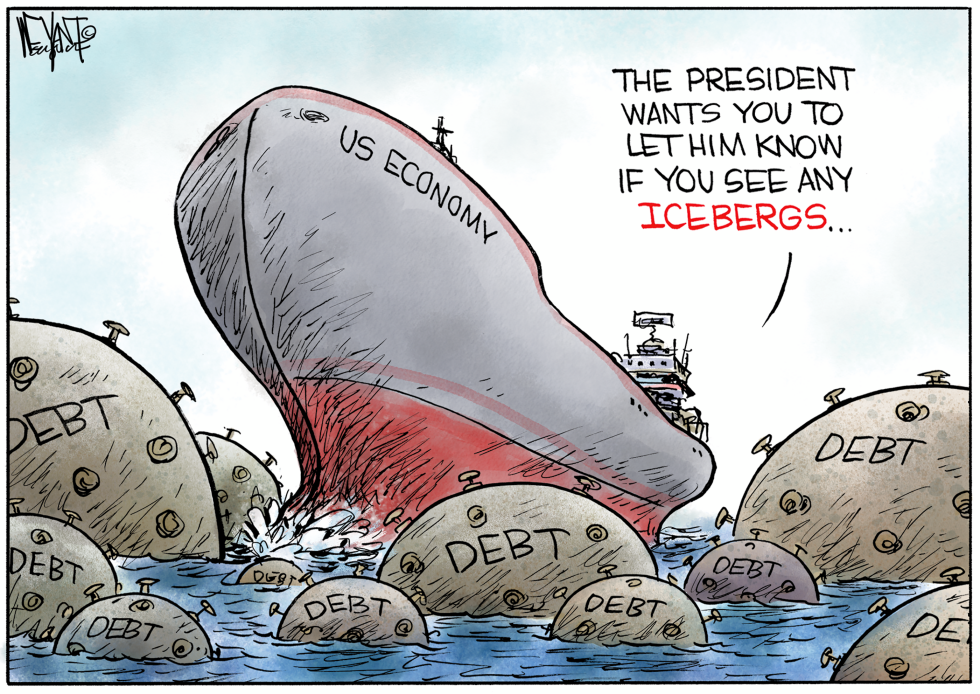
This political cartoon illustrates the US Economy as a massive ship labeled accordingly, dramatically sinking after colliding with numerous icebergs each marked 'DEBT.' A speech bubble from the ship warns to alert the president about icebergs, evoking the Titanic disaster in a clear metaphor for economic peril. Incorporating tags such as economy, debt, budget, inflation, prices, and costs, the image critiques fiscal irresponsibility. The artwork by Christopher Weyant uses simple lines and colors to emphasize the collision's impact, with water splashing and the ship's hull damaged. Such cartoons often highlight how mounting debt threatens stability, drawing parallels to historical maritime tragedies for satirical effect. The composition places the ship at an angle, surrounded by floating debt bergs, underscoring inevitable crisis if warnings go unheeded.
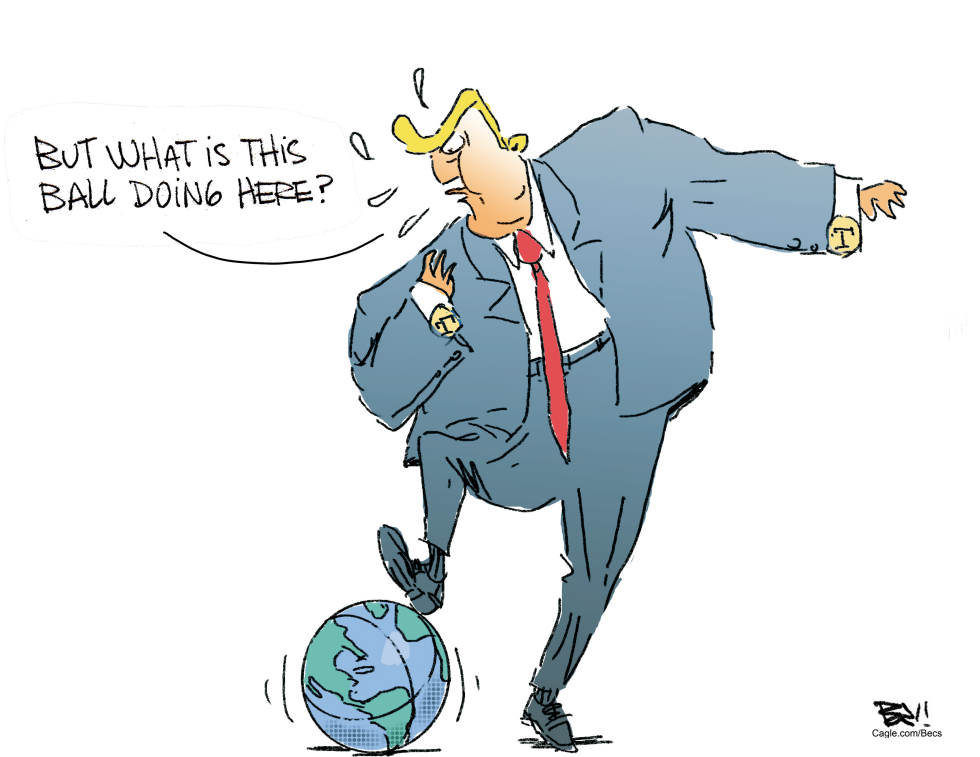
On May 10 2026 Donald Trump appears in a cartoon kicking a globe shaped like a soccer ball. The former president looks down in confusion at the ball near his foot. A speech bubble shows him asking what the ball is doing there. The image coincides with the upcoming 2026 World Cup tournament. The cartoon highlights Trump's apparent disconnect from the sporting event.
Arend van Dam's cartoon shows a gray battleship marked USA, complete with guns and missiles, driven by a figure in a suit at the wheel, as it goes over a waterfall between rocky cliffs under a blue sky. The image captures the essence of strategy failure in the Strait of Hormuz, tying into themes of Iran, ayatollahs, war, battleship mishaps, Middle East conflicts, oil, gas, energy, and economy. Such visuals often poke at misguided military moves, where the ship's plunge represents a dramatic downfall in strategic planning. The dry humor lies in the absurdity of a warship treating a strait like a river rapid, underscoring potential economic fallout from regional tensions. Cartoons like this thrive on clear, exaggerated metaphors that resonate with readers familiar with global news.
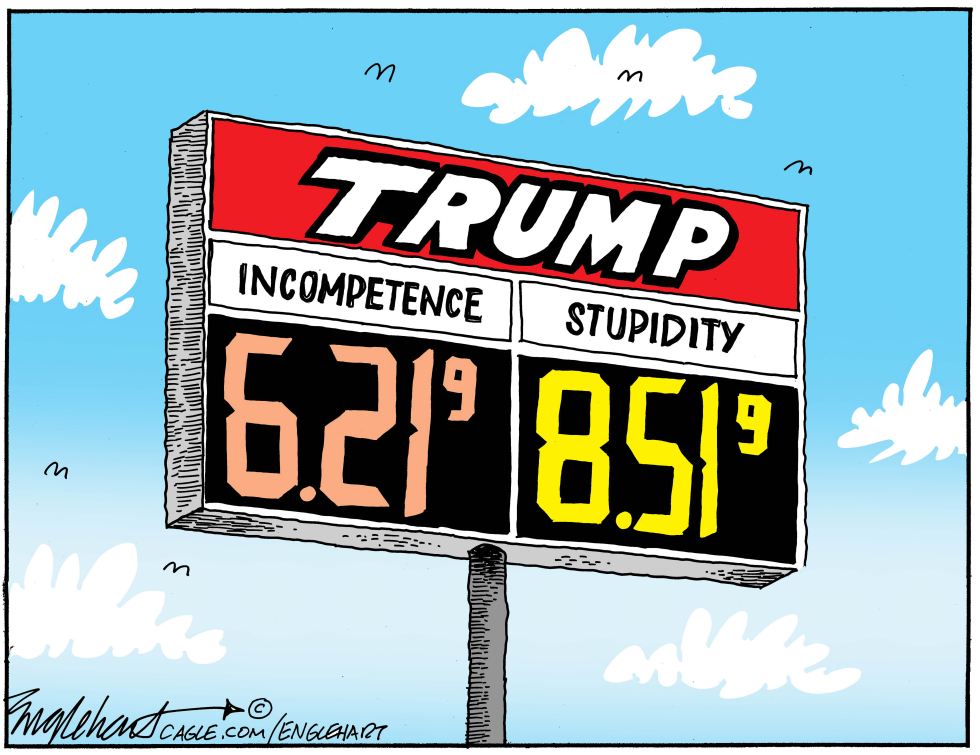
Bob Englehart's cartoon features a gas station sign with Trump at the top, showing prices for incompetence at 6.21⁹ and stupidity at 8.51⁹ against a blue sky with clouds. The tags Trump, Iran War, gas prices, gasoline, and gallon frame the visual pun. Such cartoons often tie political figures to everyday economic pains like fuel costs. The dry humor lands on how leadership flaws inflate prices, making it relatable for readers hit by pump shocks. With no characters, just the sign, it keeps the message direct. Tags like incompetence and stupidity drive the satire home, poking at perceived policy missteps without overcomplicating the scene.
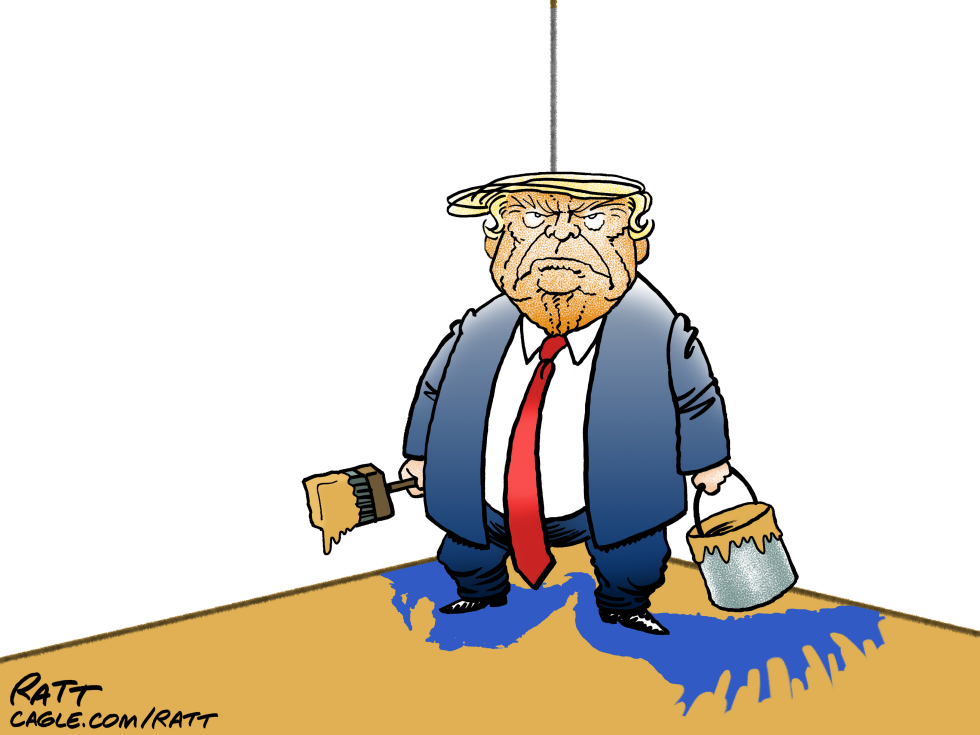
Donald Trump appears in a 2026 editorial image holding a paintbrush and bucket while standing on a blue painted area resembling the Strait of Hormuz. The scene responds to ongoing concerns over Iranian oil routes, potential conflict, and resulting effects on global oil and gas prices. The visual shows the figure applying paint that creates a path leading to restricted movement.
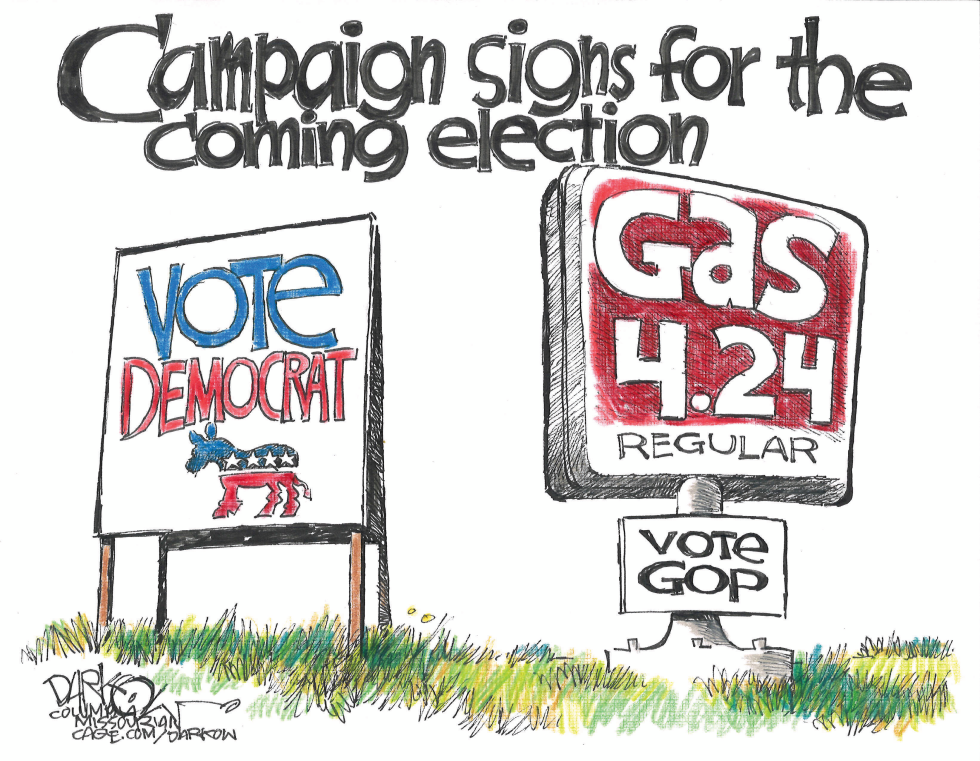
John Darkow's cartoon shows campaign signs for the coming election, with a straightforward Vote Democrat board featuring a blue donkey symbol, contrasted by a gas station-style sign advertising GAS 4.24 REGULAR and a small Vote GOP placard below. The image ties into 2026 midterms themes, highlighting gas prices, affordability, inflation, Strait of Hormuz tensions, cost of living pressures, and party strategies. The dry humor points to how economic issues like fuel costs become central in political advertising, with the GOP sign mimicking a bargain price to appeal to voters frustrated by rising expenses. This setup captures the insider view of how cartoons simplify complex voter concerns into visual punches.
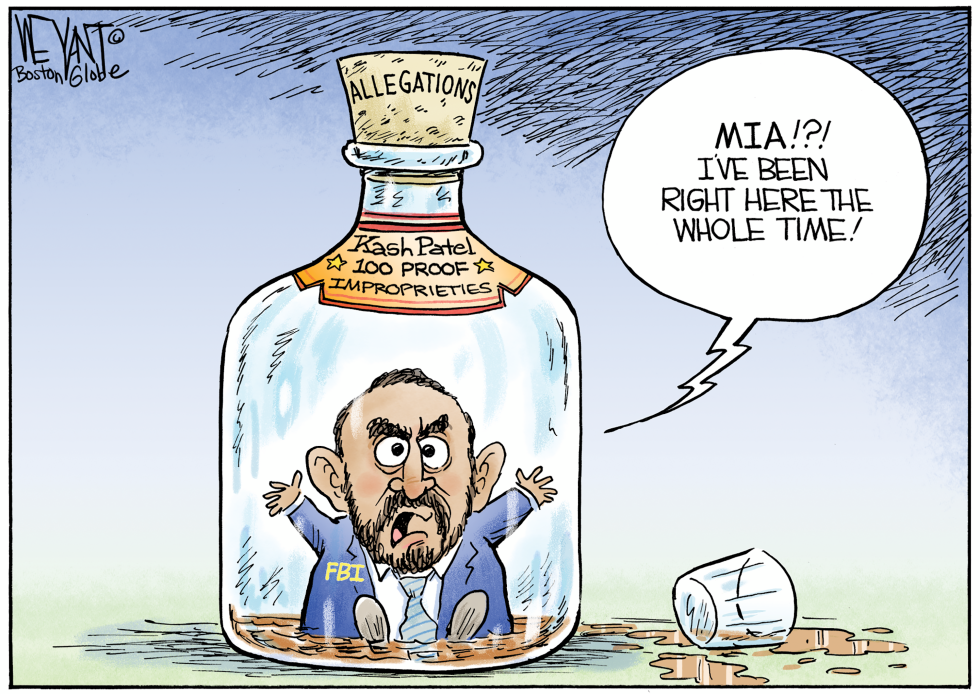
Christopher Weyant's cartoon captures Kash Patel trapped inside a large bottle labeled 'Kash Patel 100 Proof Improprieties,' with the cork marked 'Allegations.' The figure, dressed in a suit with 'FBI' on the sleeve, raises arms and shouts in a speech bubble: 'MIA!?! I've been right here the whole time!' A tipped-over glass spills liquid nearby. Tags like FBI, Kash Patel, alcoholic, allegations, bottle, and fail underscore the visual pun on being 'in the bottle,' tying into themes of inept leadership and ongoing controversies in domestic policy and criminal justice.
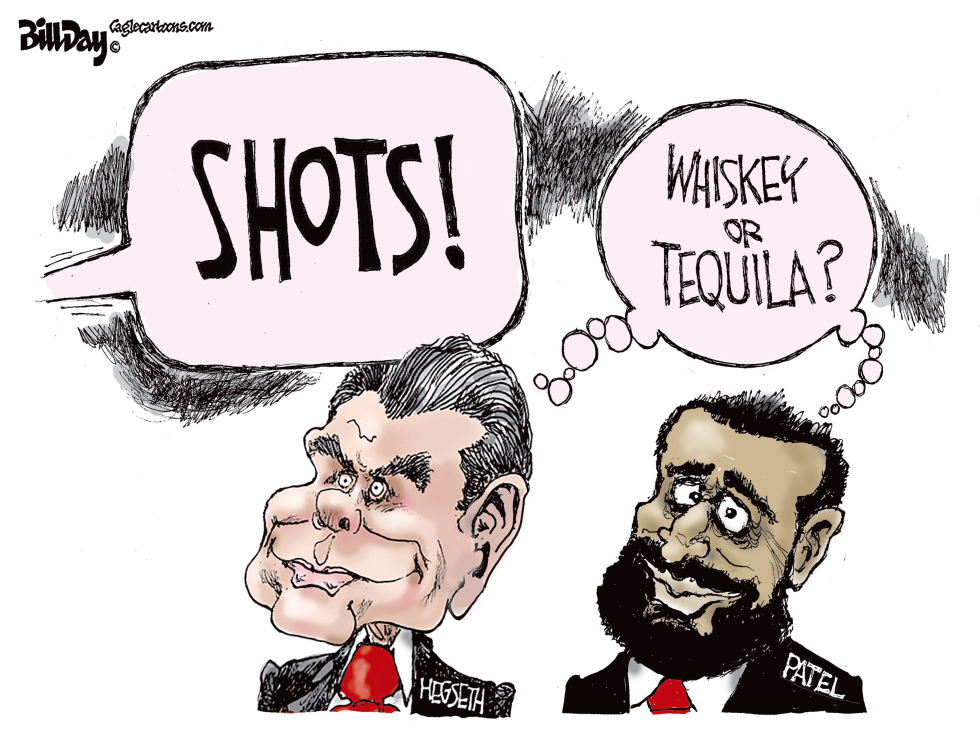
Bill Day's cartoon captures two suited figures, labeled Hegseth and Patel, in a moment of apparent revelry. Hegseth, on the left, bellows 'SHOTS!' from a speech bubble, his expression intense and caricatured. Patel, to the right, responds with a thought bubble pondering 'WHISKEY or TEQUILA?', his face drawn with wide eyes and a beard. The artwork, signed by Bill Day and linked to CagleCartoons.com, uses simple lines and shading for a classic political cartoon style. Tags such as shots, whiskey, tequila, Hegseth, Patel, and correspondence dinner frame the scene, suggesting a lighthearted jab at social or political gatherings. The white background keeps focus on the characters and their dialogue, emphasizing the pun on 'shots' without additional context or props visible.
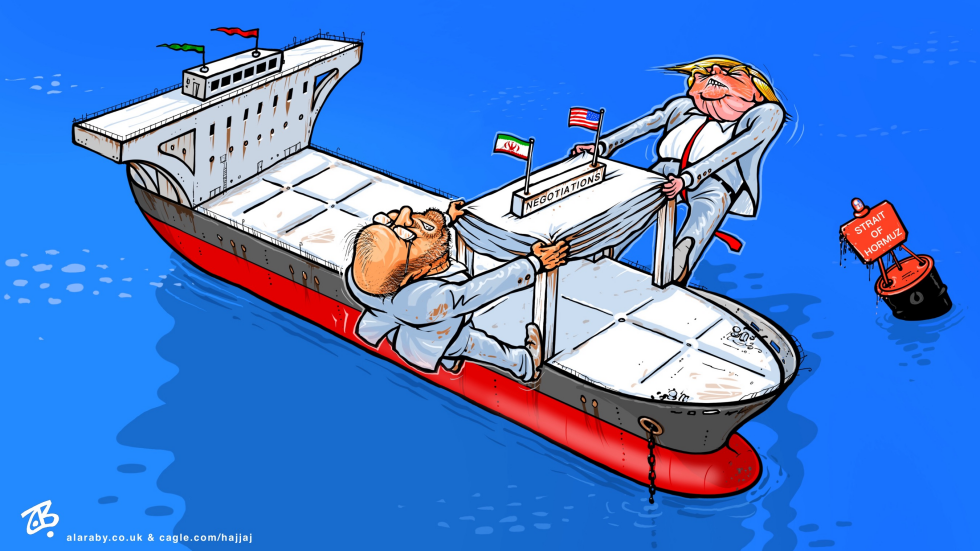
Emad Hajjaj\'s cartoon captures the tense Hormuz Strait negotiations between Trump and an Iranian figure on a massive tanker ship flying US and Iran flags. The scene shows them balancing a \'NEGOTIATIONS\' table on the tilting vessel, with an anchor chain and a leaking \'Strait of Hormuz\' buoy spilling oil. This Gulf war satire highlights the precarious talks amid potential sea block, where the ship appears damaged and unstable. Tags like ship, anchor, Gulf, war, tanker, talks underscore the maritime conflict theme. The dry humor lies in the literal sinking of diplomatic efforts.
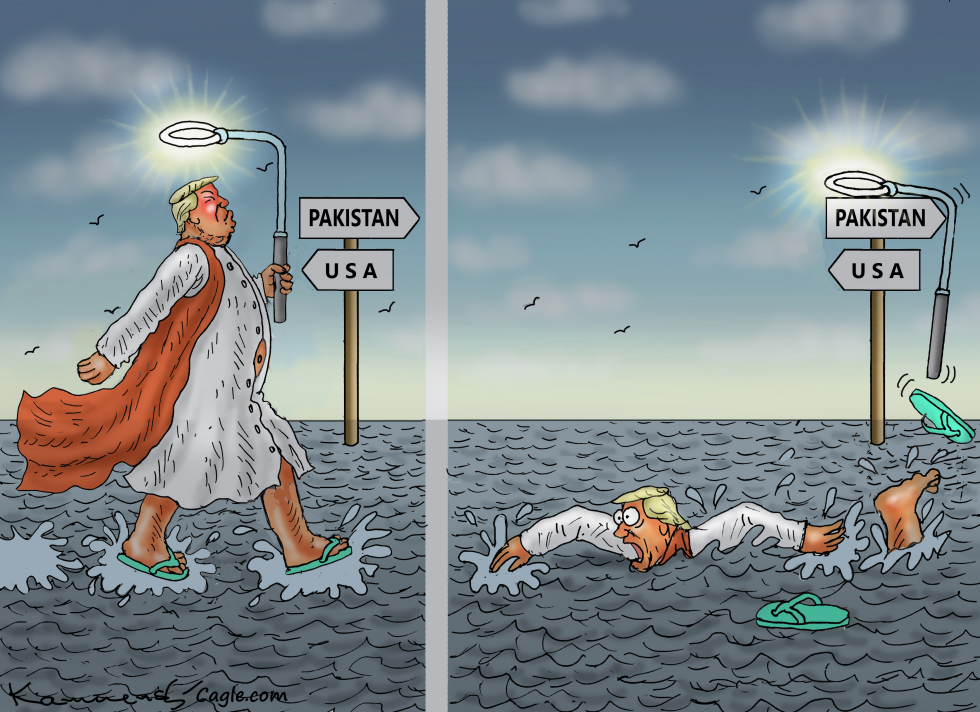
Marian Kamensky\'s cartoon captures Trump with a halo, striding across the sea in robes and flip-flops toward signs pointing to Pakistan and USA, evoking peace talks amid Hormuz strife. The satire turns sharp as Trump, embodying fascism and MAGA terror, plunges into the waves, desperately swimming while his flip-flop floats away and the signpost topples. This two-panel setup underscores the hubris of political figures tackling international relations, blending humor with critique of overreaching ambitions in U.S.-Pakistan dynamics. The artwork\'s clean lines and exaggerated expressions amplify the dry wit, making it a pointed commentary on failed diplomacy and self-proclaimed savior complexes in global politics.
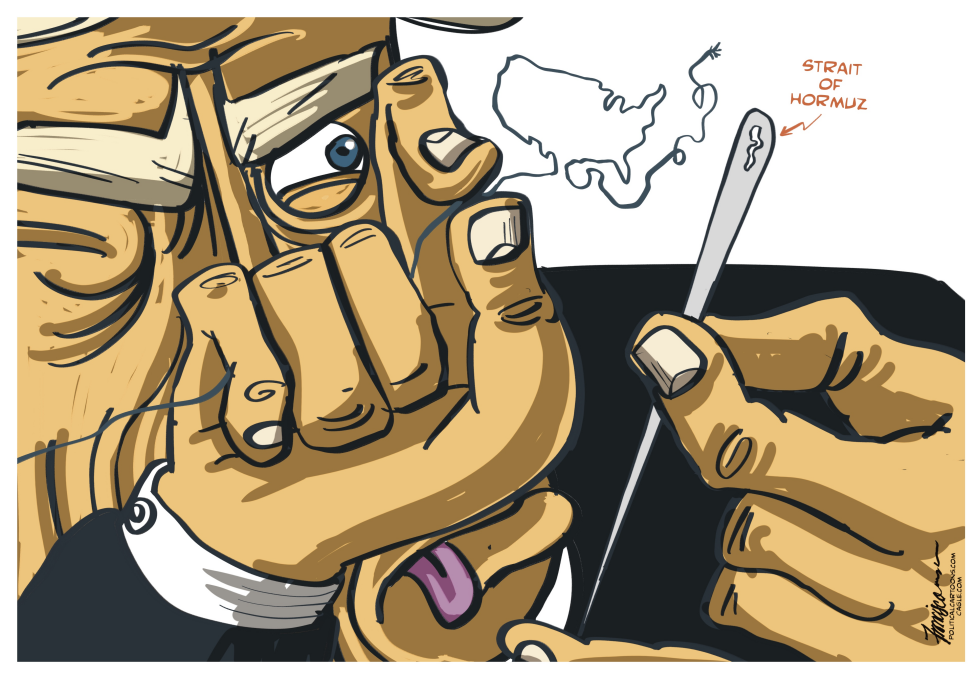
Manny Francisco\'s cartoon captures a close-up of a man with a bandage over one eye, tongue out in concentration, holding a needle labeled Strait of Hormuz. The thread resembles the USA map, with smoke trailing. Tags like Trump, president, USA, Strait of Hormuz, political satire underscore the image. It depicts careful maneuvering, as if sewing with precision. The dark background emphasizes the focused action. This piece from 2026 comments on delicate international affairs without overt symbolism beyond the visible elements. Artistic style is straightforward, with bold lines and minimal color.