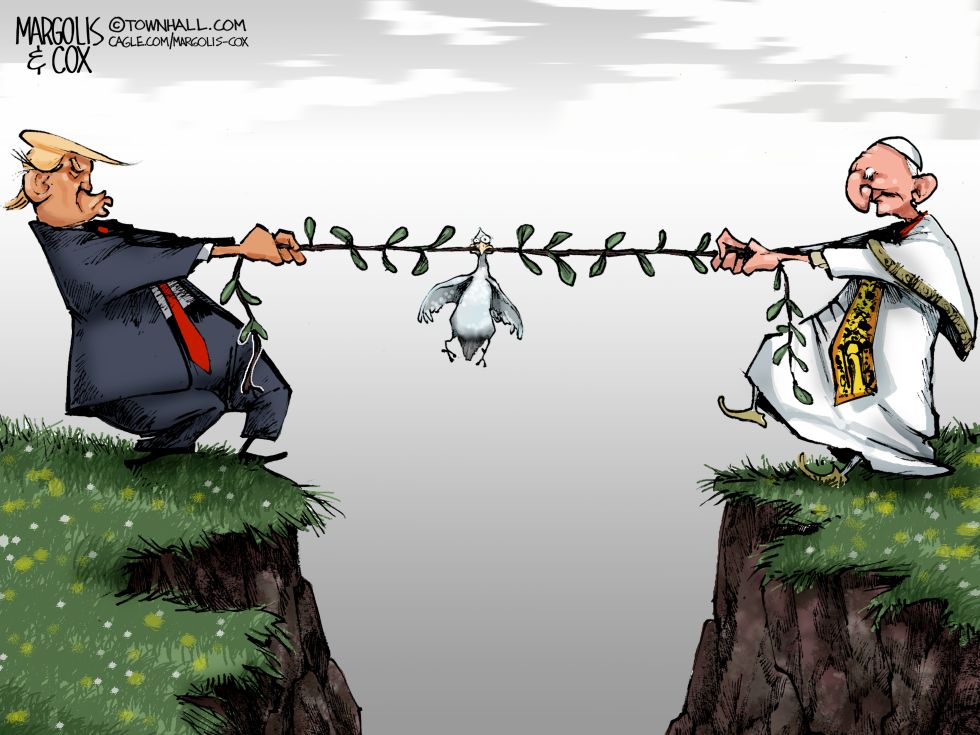
The cartoon shows a caricature of President Trump on one grassy cliff, gripping a vine with leaves that connects to a white dove in the center, while a figure resembling Pope Leo stands on the opposite cliff, also pulling the vine. They face each other across a deep chasm, with cloudy skies above. Tags like war, peace, dove, Iran, Middle East, and Church underscore the visual tension. The artists, Margolis & Cox, place their signature prominently. This setup captures a straightforward conflict over a peace symbol, without hidden layers. The dove hangs upside down, wings slightly spread, as the two figures strain. No emotions or backstories are added; it's just the visible pull between suited man and robed leader.
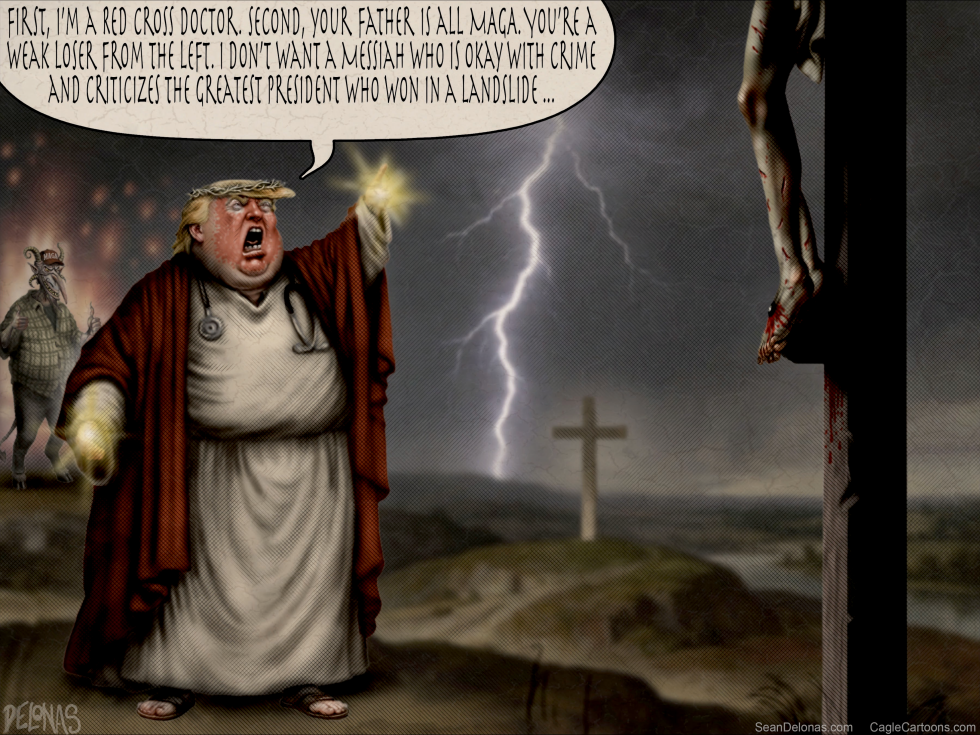
Delonas places Trump in a crucifixion scene, robed with stethoscope, rejecting the messiah as a weak leftist. Stormy skies and a demon add drama, blending politics and religion for dry satire. Tags like Trump, Jesus, Crucifixion highlight the bold commentary on leadership cults.
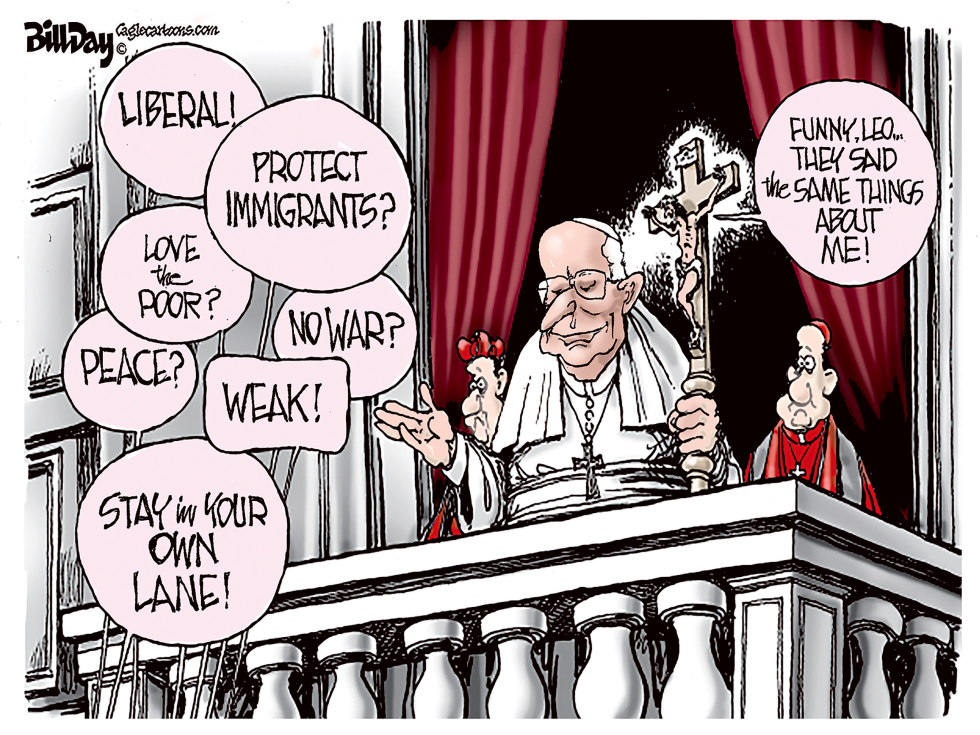
Bill Day's political cartoon shows a central pope figure on a balcony, holding a cross staff, surrounded by speech bubbles accusing liberal views like protect immigrants, love the poor, peace, no war, weak. A side figure remarks on funny Leo saying the same things about me, drawing a clear visual parallel. The composition uses red curtains and clerical attire for a Vatican setting, emphasizing satire on church politics. Tags include political cartoon pope francis, bill day cartoon, pope leo comparison, conservative backlash pope, anti-war pope, catholic church politics.
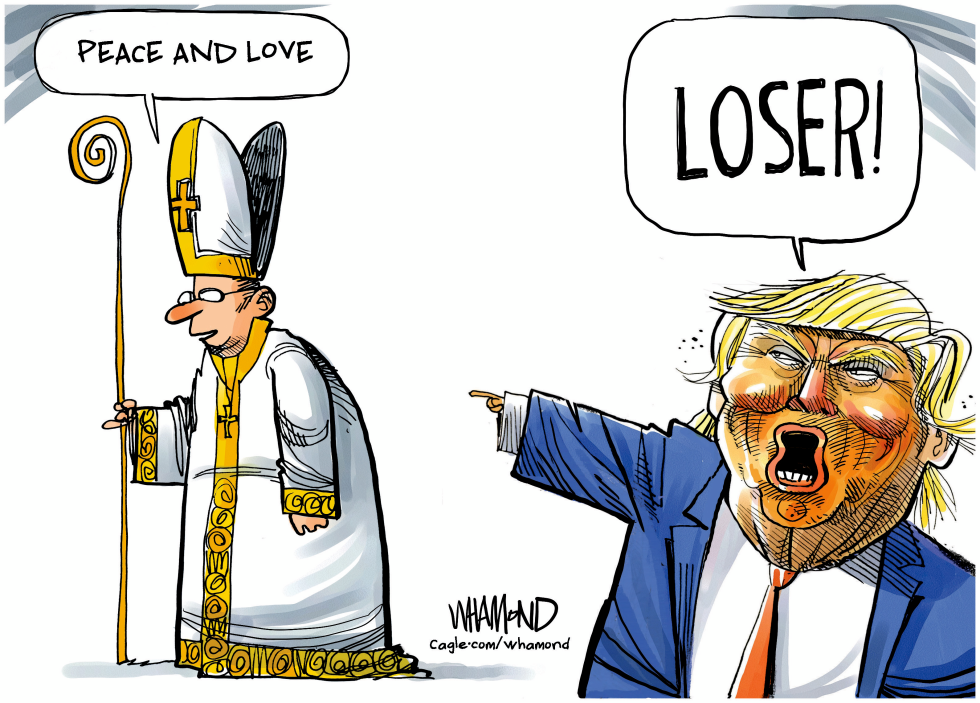
Dave Whamond's political cartoon captures Donald Trump in a blue suit, pointing aggressively and shouting 'loser' at a figure resembling the Pope, dressed in white robes with a tall mitre and holding a crozier, who calmly utters 'peace and love.' This satirical illustration underscores Trump's bombastic personality clashing with symbols of compassion and spirituality. The simple composition, with speech bubbles dominating the scene, amplifies the humor in the contrast between aggression and serenity. Tags like political cartoon Trump Pope, satirical illustration Trump insults religious leader, and cartoon Trump calls Pope loser emphasize the editorial bite. Such cartoons thrive in syndication for their timely jab at public figures. The dry wit lies in the exaggerated expressions, making it shareable across social media platforms.
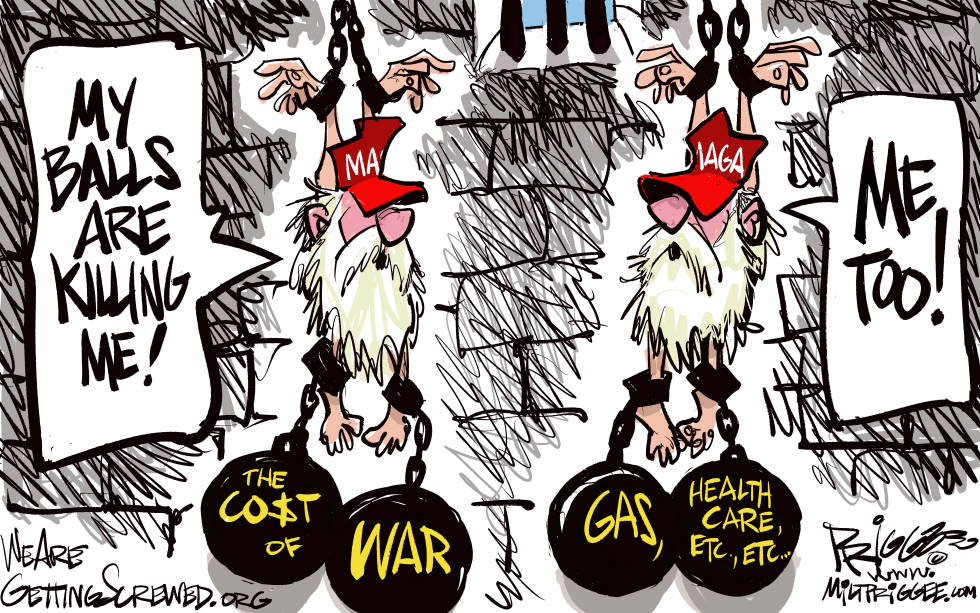
The cartoon shows two figures with white beards and red hats labeled parts of 'MAGA,' suspended upside down by chains from their ankles. Heavy black balls hang below, marked 'THE COST OF WAR,' 'GAS,' 'HEALTH CARE, ETC, ETC...' One figure speaks of balls killing him, the other agrees. Tags like MAGA, inflation, cost of living, healthcare, gas prices, Trump frame the visible elements. The drawing style is sketchy, with a dark background suggesting a dungeon. Signatures and a website appear at the bottom.
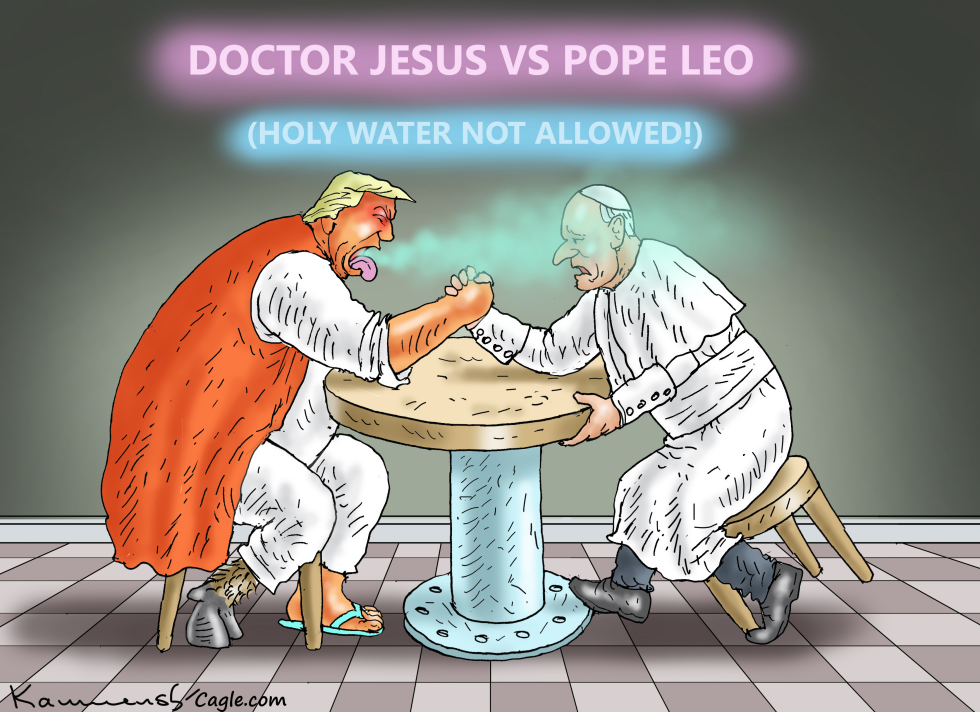
The image shows two figures engaged in arm wrestling, labeled as Doctor Jesus and Pope Leo, with a neon sign overhead stating 'DOCTOR JESUS VS POPE LEO' and a note that holy water is not allowed. Doctor Jesus appears with blonde hair, an orange cape, white robe, and sandals, while Pope Leo wears traditional white papal attire and shoes. A small elephant figure peeks from under Doctor Jesus's robe, and mist surrounds Pope Leo's head. The scene unfolds on a checkered floor with stools and a round table. This setup captures a direct, humorous confrontation between the caricatured holy figures, emphasizing the ban on holy water in their matchup. The artist's signature, Kamensky/Cagle.com, appears at the bottom.
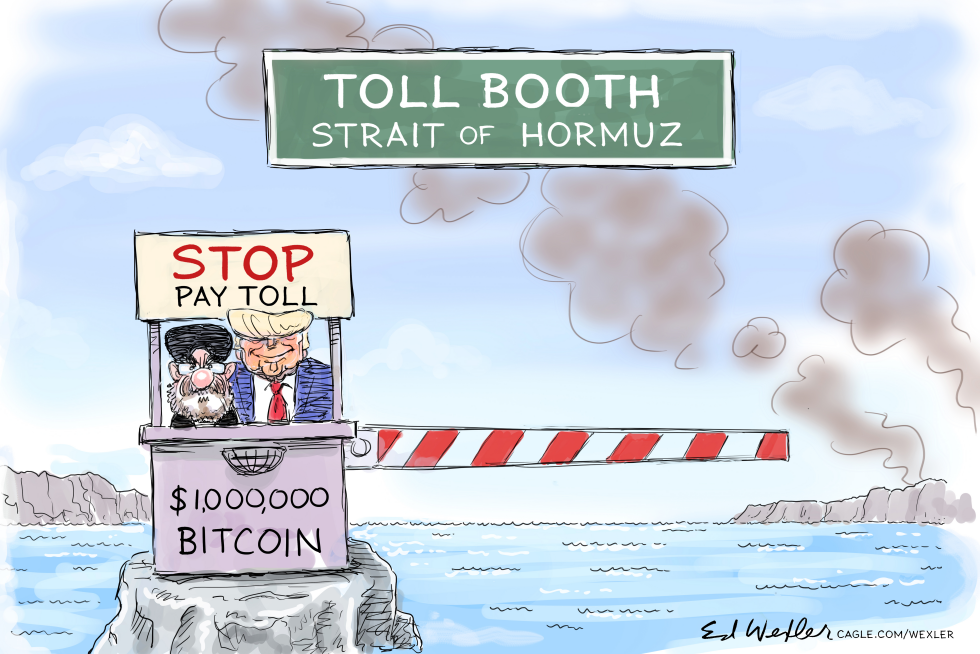
Ed Wexler\\\'s cartoon captures a toll booth in the Strait of Hormuz, where figures resembling Trump and the Ayatollah enforce a $1,000,000 Bitcoin toll. Smoke rises from what look like mines in the water, blending tags like Iran, Strait of Hormuz, tolls, Bitcoin, Trump, Ayatollah, and crypto into a sharp commentary. The barrier arm blocks passage, emphasizing control over this vital shipping lane. It\\\'s a straightforward jab at geopolitical tensions, with the toll sign demanding payment to proceed. No hidden layers here, just clear visuals tying economic pressures to digital currency in a contested area. The dry humor shines through in the absurdity of a Bitcoin booth amid potential explosions.
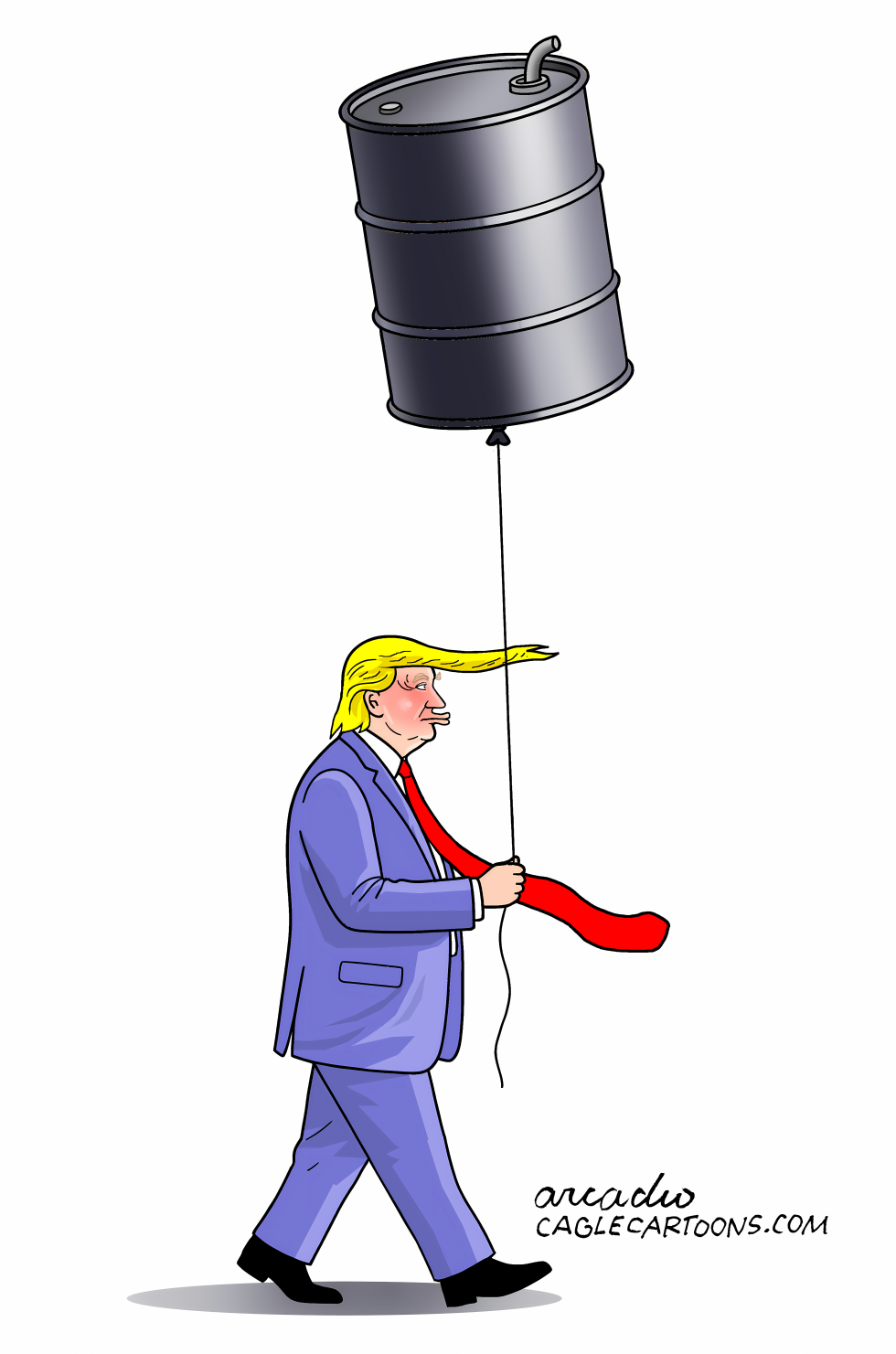
Arcadio Esquivel's cartoon captures Trump striding forward, his red tie extending upward to hold a massive oil barrel aloft like a helium balloon, with his yellow hair streaming behind. The simplicity highlights themes of Trump, oil prices, inflation, Hormuz, energy, and midterm elections. Such visuals often comment on economic pressures without words, relying on exaggerated features for recognition. Cartoonists like Esquivel use minimalism to drive points home, here linking a political figure to rising costs in a direct, unambiguous way. The white background keeps focus on the central elements, making the satire pop for viewers.
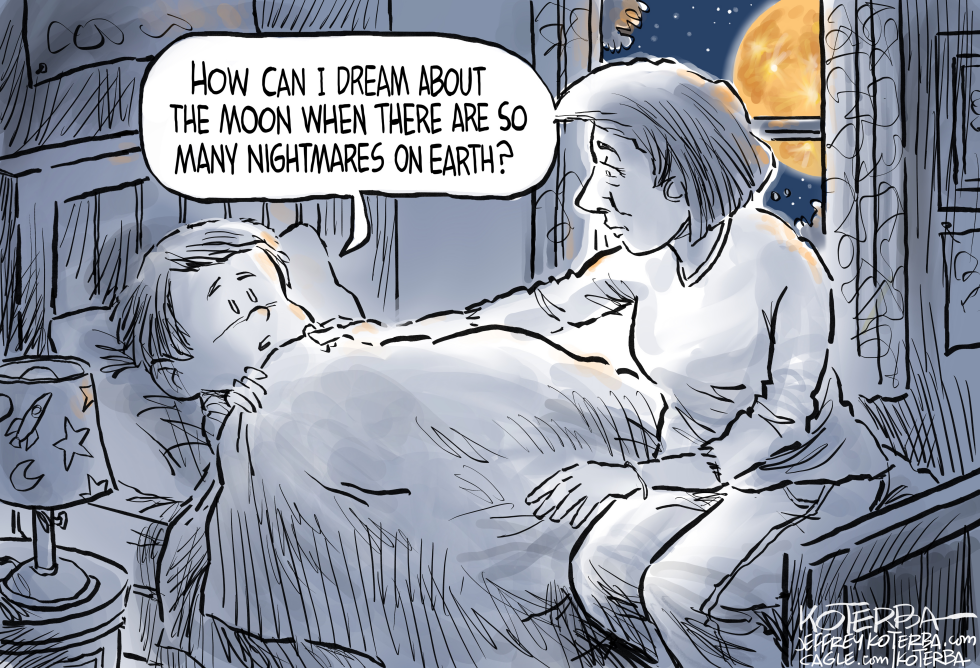
This poignant political cartoon depicts a child in bed, gazing toward a window framing a massive orange moon against a starry night sky, while confiding in a seated adult figure. The child's speech bubble reads: 'How Can I Dream About The Moon When There Are So Many Nightmares On Earth?' A bedside lamp with a star design illuminates the scene. Through this setup, the artwork satirizes how youth anxiety from global issues—like wars, climate woes, and social upheavals—stifles big dreams and aspirations. It's a clever commentary on how earthly nightmares eclipse celestial hopes, blending humor with insight into modern parenthood and childhood innocence lost. Tags: political cartoon, child nightmares, moon dreams, earth troubles, satirical illustration, youth anxiety, global chaos.
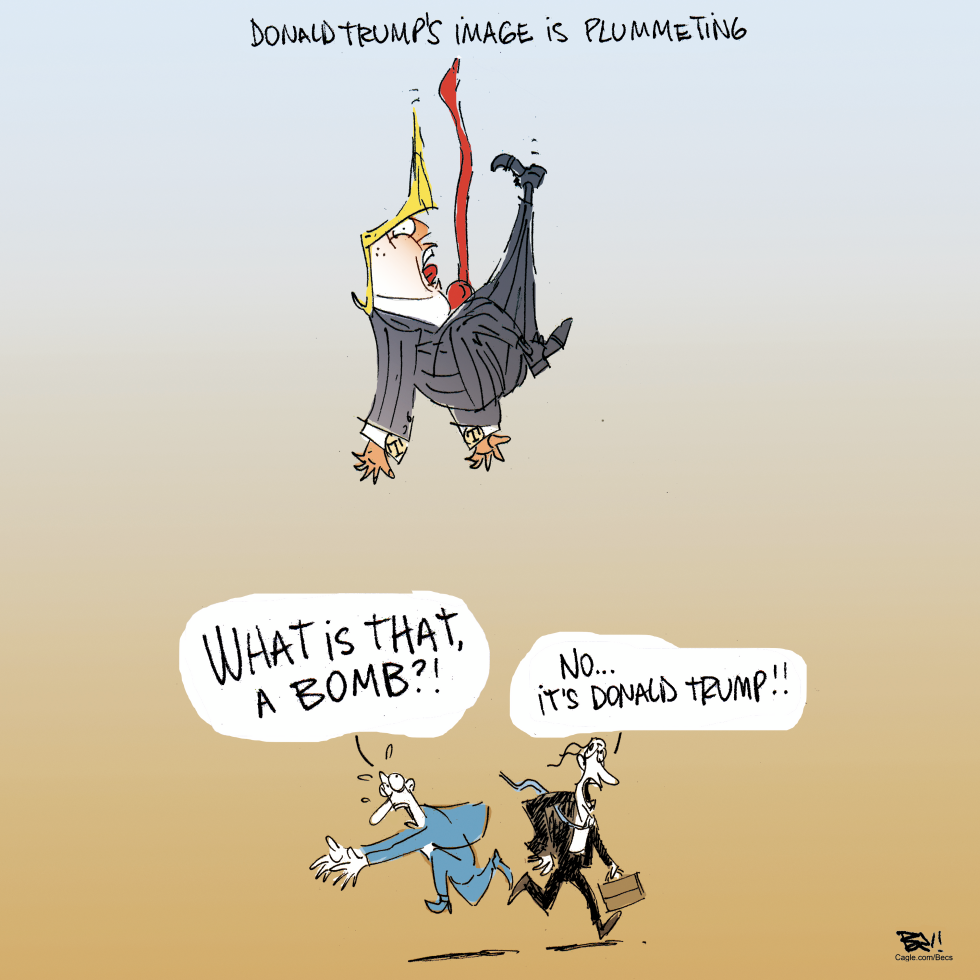
The cartoon depicts a figure with yellow hair and red tie, clearly caricaturing Donald Trump, diving headfirst from the sky like a falling bomb, mouth agape and limbs flailing. Below, two suited men run in panic, one asking if it's a bomb, the other identifying it as Trump. The title declares 'Donald Trumps Image is Plummeting,' playing on the pun of falling popularity. This piece skewers the Trump administration in the US for saying one thing then another, coming off as perverse and arrogant. It portrays him as thinking he's a king, the absolute tyrant of the world, with Europe and the world fed up. The dry humor lands through the visual metaphor, emphasizing global exasperation.
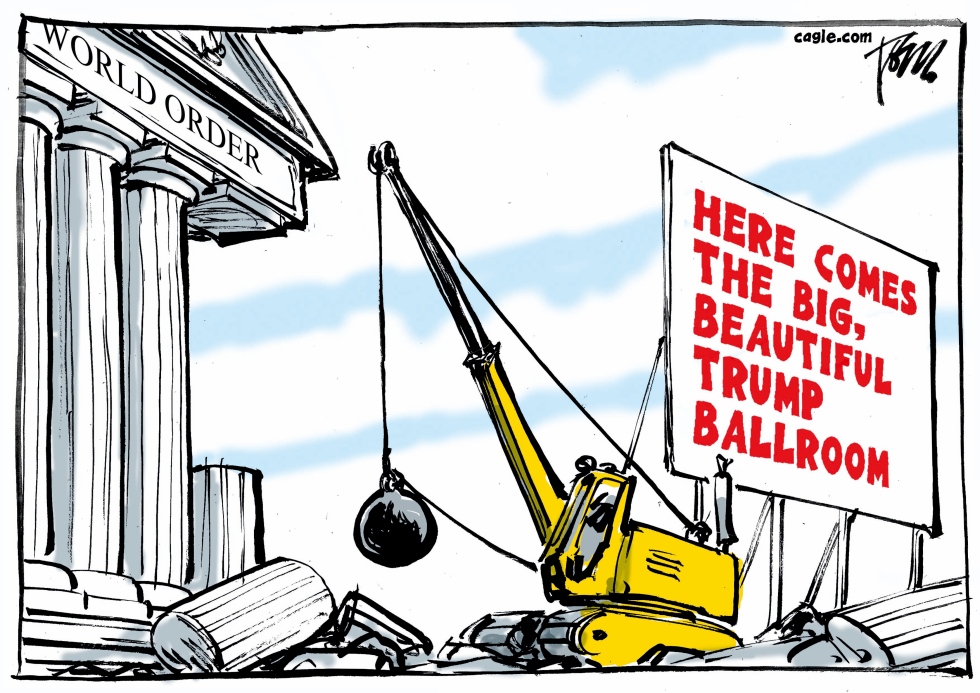
The cartoon depicts a classical building labeled 'World Order' being demolished by a yellow crane's wrecking ball, with debris scattering below and a prominent sign announcing 'Here Comes the Big, Beautiful, Trump Ballroom.' Tags like world order, NATO rift, allies, unreliable, chaos, and tariffs underscore the imagery of disruption. The scene captures a straightforward visual metaphor for upheaval, with broken columns and rubble emphasizing destruction. No characters appear, keeping the focus on structural collapse. Europe and Asia tags suggest broader implications, while the dry humor lies in rebranding ruin as a luxurious ballroom. Oil prices and economy tags tie into the fallout, making it a pointed commentary on global shifts.
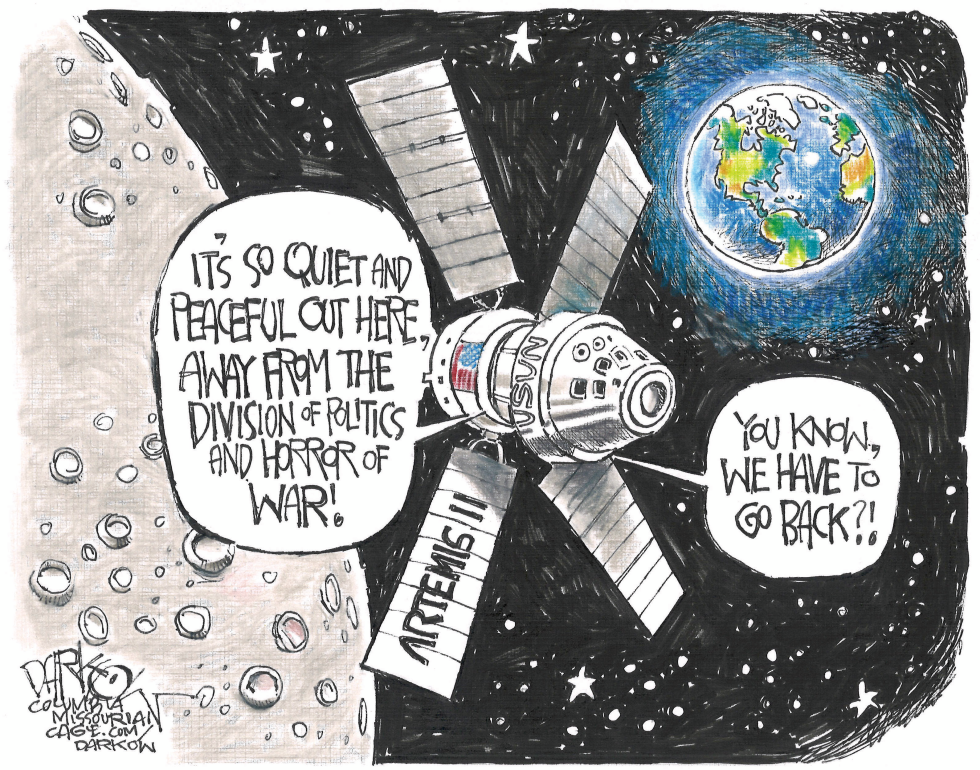
This Daryl Cagle political cartoon analysis features the Artemis II spacecraft floating in serene space, with Earth glowing in the background and the moon nearby. The left speech bubble extols the quiet peace away from division of politics and horror of war, while the right one resignedly notes the need to go back. It's a satirical cartoon on politics and war division, poking fun at how space exploration escaping earthly conflicts offers temporary respite. The NASA Artemis program humor illustration underscores the irony of advanced space missions contrasting with unresolved human divisions on Earth. Through this humorous take on returning to political division, the cartoon cleverly comments on the allure of peaceful space vs chaotic Earth without delving into specifics.
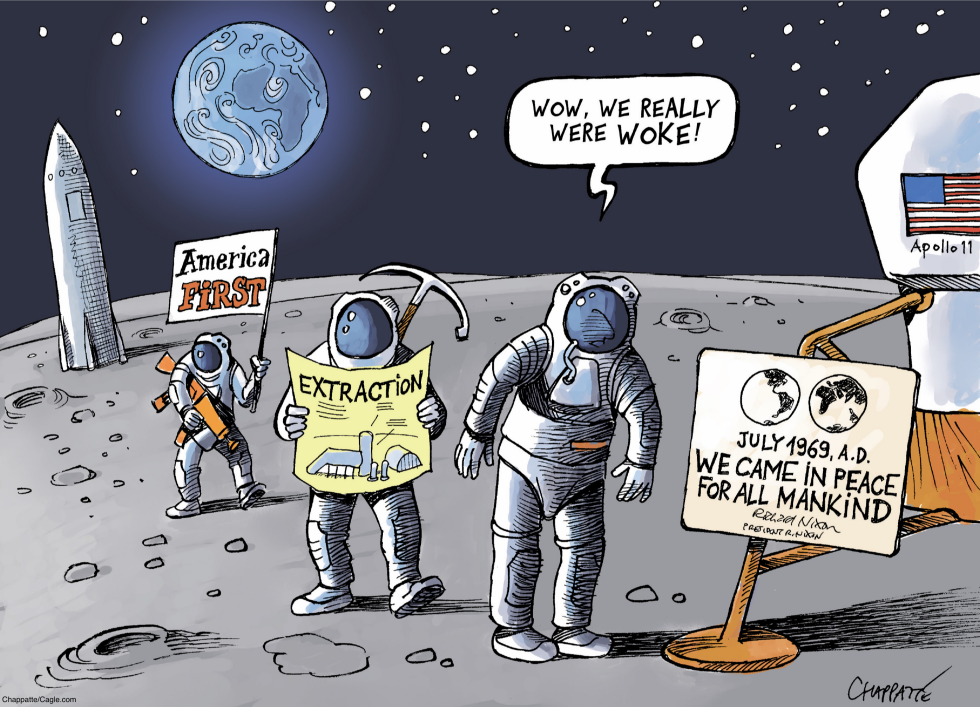
The cartoon shows three astronauts on the moon\\\\\\\'s surface, with Earth visible in the background. One holds a sign reading America First while carrying a weapon, another grips a document titled Extraction with a mining diagram, and the third wields a pickaxe next to a plaque stating We came in peace for all mankind from July 1969 A.D. near the Apollo 11 lander flagged with the US stars and stripes. A speech bubble declares Wow, we really were woke! The scene captures space race satire, lunar exploration humor, political cartoon commentary on shifting priorities from global peace to nationalistic resource grabs, all in Patrick Chappatte\\\\\\\'s style.
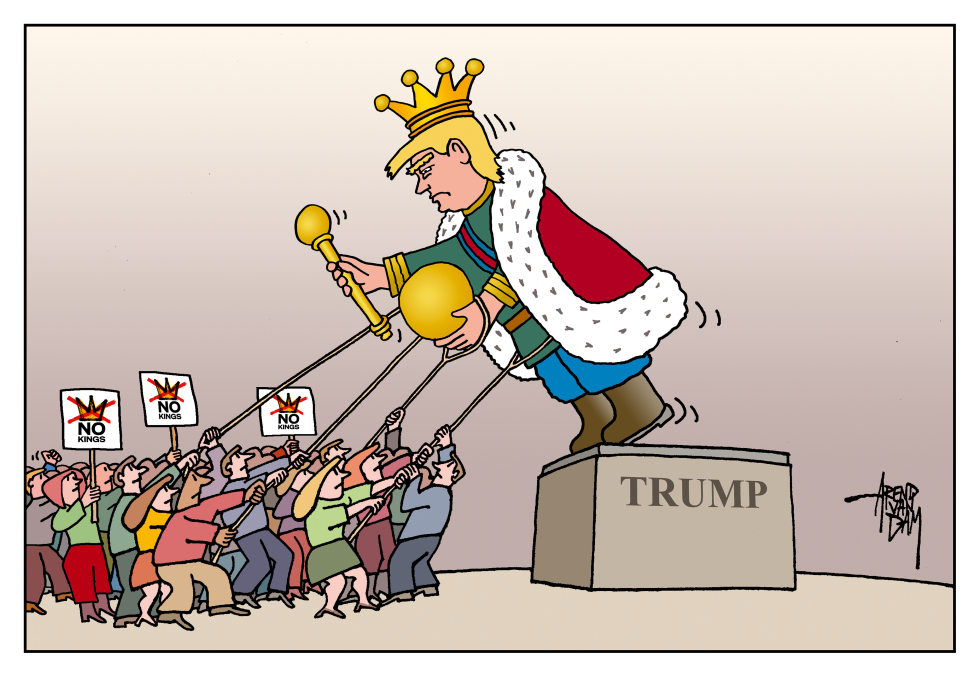
Arend van Dam's cartoon depicts a massive figure resembling Donald Trump, adorned with a crown and royal robe, perched atop a pedestal marked 'TRUMP.' A diverse group of protesters, holding signs reading 'NO KINGS,' 'NO,' and another 'NO,' tug on ropes attached to the figure's scepter, causing it to tilt as if being toppled in an act of resistance. The scene evokes themes of USA democracy clashing with autocracy, portraying a symbolic revolution against a would-be king or dictator. Protests and demonstrations fill the foreground, highlighting public outcry against unchecked power. Dated 2026, the artwork underscores ongoing concerns about authoritarian tendencies in politics.
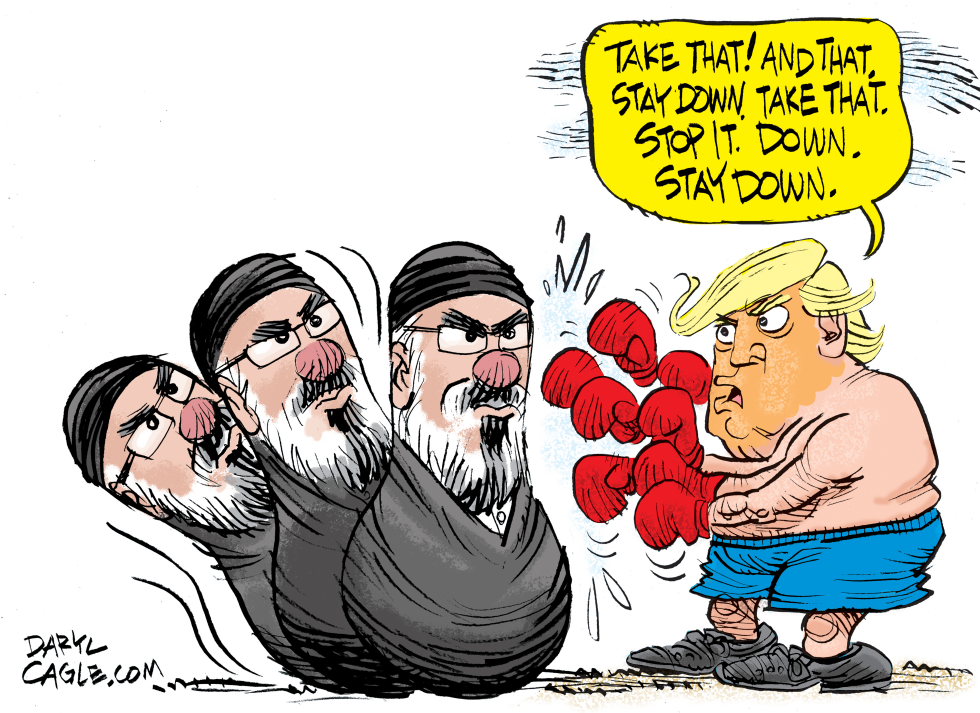
The cartoon shows Donald Trump, shirtless and wearing boxing gloves, repeatedly striking a large bop bag shaped like an Iranian cleric. Multiple faces of bearded men in turbans appear on the bag, which rebounds after each punch. A speech bubble captures Trump's frustrated commands for the figure to stay down. The image responds to reports of a new Iranian supreme leader and U.S. efforts against the regime in early 2026. It highlights the perceived futility of direct confrontations with Iran's leadership structure.