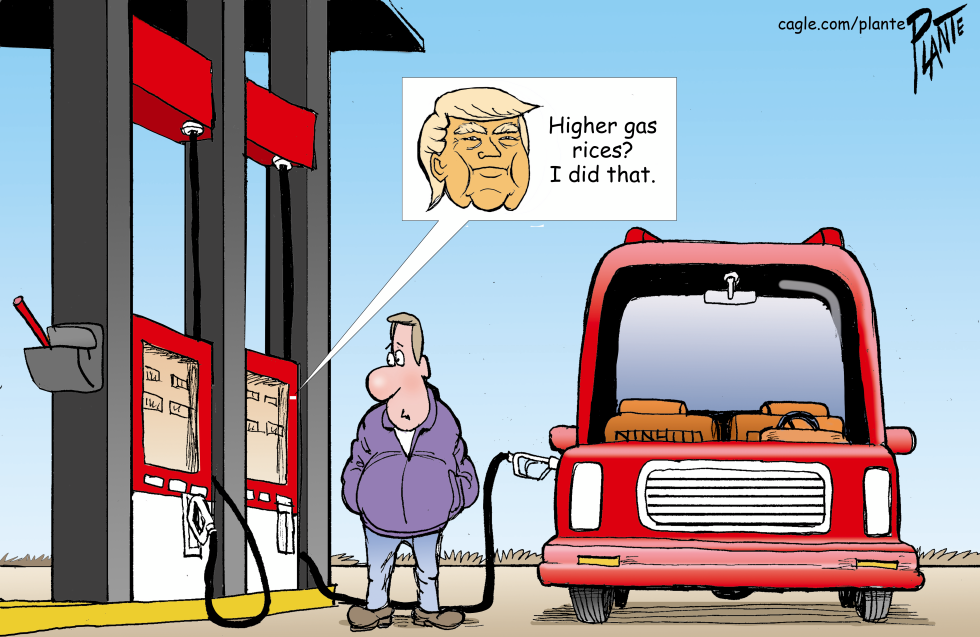
Bruce Plante's cartoon shows a gas pump topped with President Donald J. Trump's head, smirking as it says, 'Higher gas rices? I did that,' while a driver fuels his red truck. The image ties into tags like higher gas prices, war, Iran, Israel, Middle East, and energy crisis, poking at Trump's potential role in escalating fuel costs through foreign policy missteps. It's a straightforward jab, clear in its satire without overcomplicating the visuals. The dry humor lands on the absurdity of a politician claiming credit for economic pain at the pump. With tags covering UAE, Saudi Arabia, and other regional players, the cartoon nods to broader geopolitical tensions driving oil prices up. Editors see these kinds of cartoons circulate well when gas prices spike, reminding readers of the human cost in everyday routines.
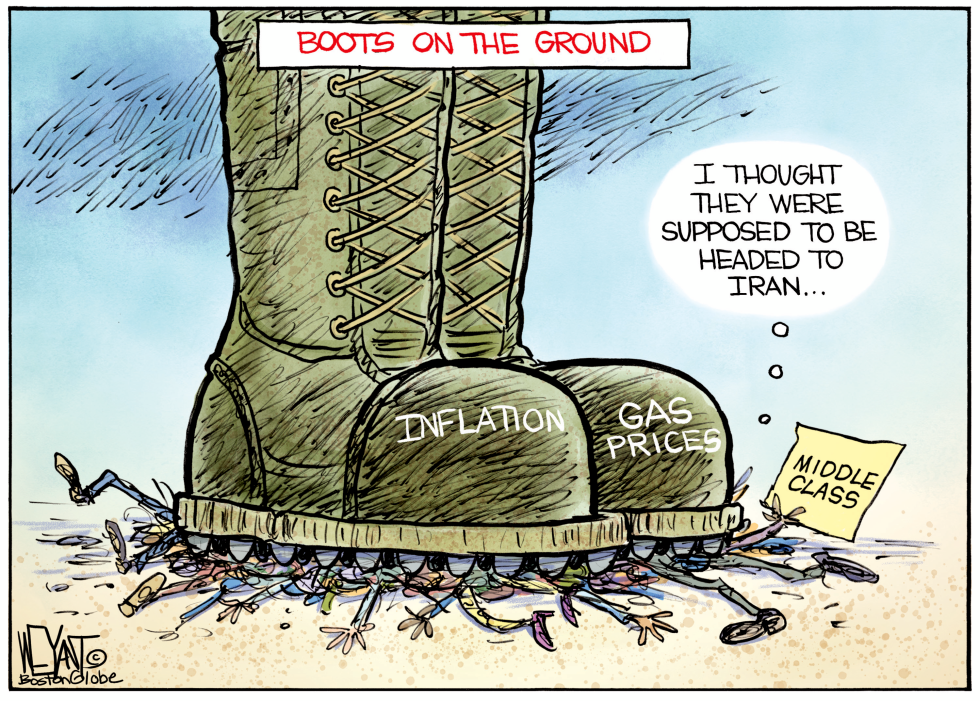
The cartoon shows a pair of massive military boots dominating the scene, one labeled 'Inflation' and the other 'Gas Prices,' as they crush small human figures on the ground, with a sign reading 'Middle Class' among them. A speech bubble from one of the crushed figures says, 'I thought they were supposed to be headed to Iran...' The title 'Boots on the Ground' sits at the top. This setup uses dry humor to highlight misplaced priorities in war, economy, inflation, gas prices, middle class, and Iran. The sandy ground and stormy sky add to the chaotic feel, tying into tags like Trump, negotiation, Strait of Hormuz, and domestic policy impacts.
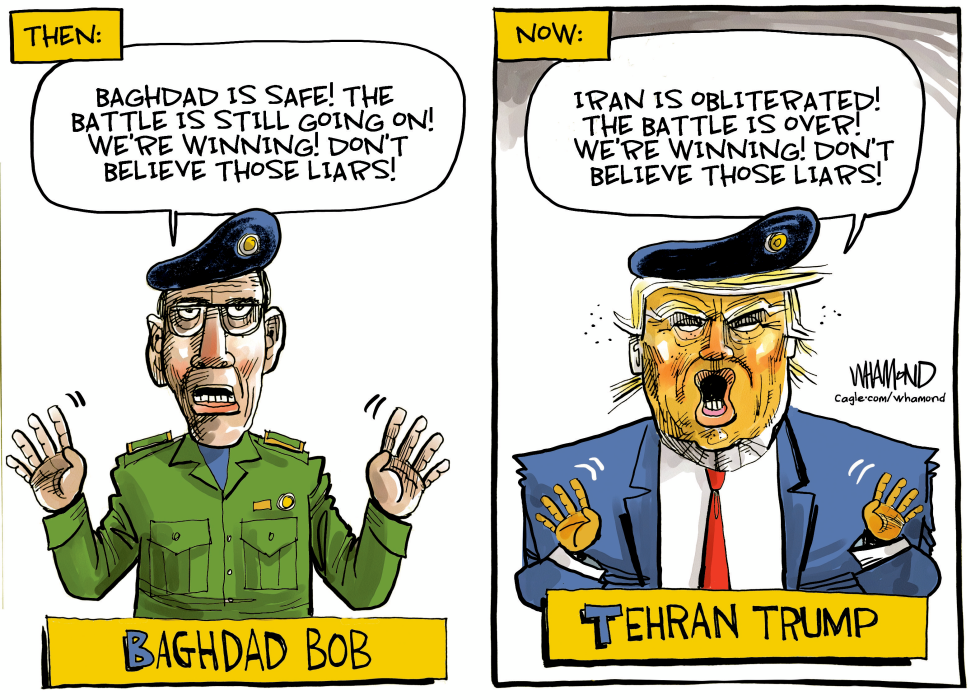
Dave Whamond's political cartoon splits into 'Then' and 'Now' panels, showing Baghdad Bob in military garb proclaiming Baghdad's safety and ongoing victory, dismissing liars. On the right, a Trump-like figure dubbed Tehran Trump, wearing a beret and suit, declares Iran obliterated and battle over, again urging disbelief in liars. The satire underscores parallels in propaganda and denialism, with tags like political satire, Trump caricature, Iraq War reference, Iran conflict, misinformation leaders, and historical parallel. This visual commentary critiques how figures twist realities in wartime narratives, blending dry humor with sharp observation on political exaggeration.
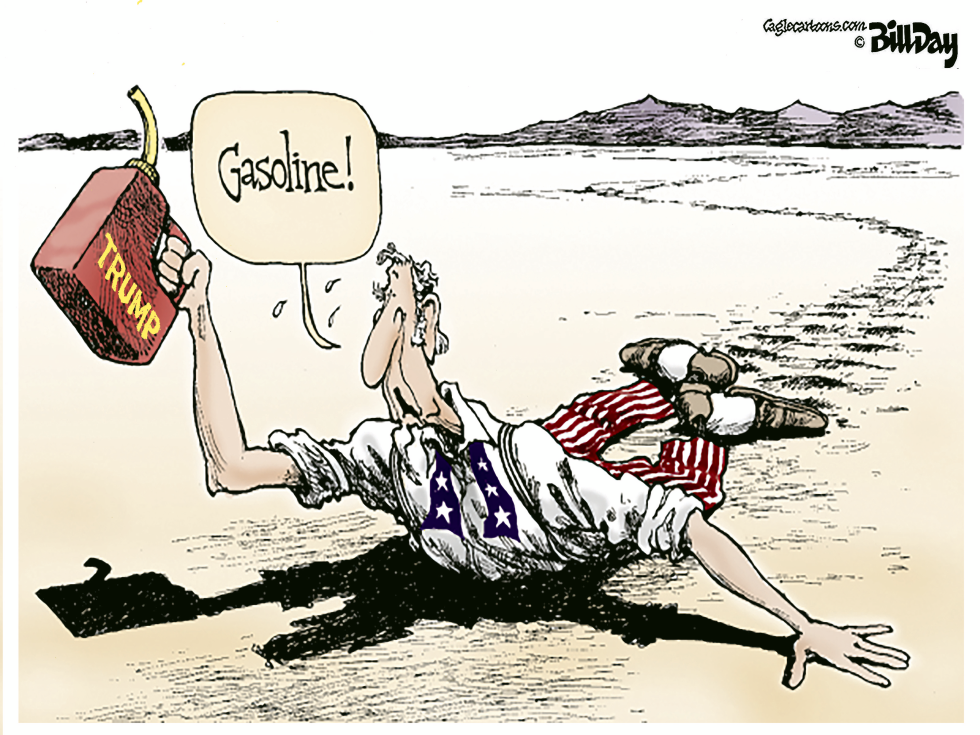
Bill Day's cartoon shows Uncle Sam in American flag attire, crawling through a sandy desert with distant mountains, his trail marking exhaustion. He grips a red gas can labeled Trump, spout dripping, and yells 'Gasoline!' in a speech bubble. The scene captures desperation for fuel, tying into political satire on energy policies. Tags like political cartoon Trump gasoline, Uncle Sam crawling desert Trump gas can, satirical cartoon high gas prices Trump, Bill Day political cartoon 2026, American flag outfit man needing gasoline, and desert survival political satire Trump underscore the visual punch.
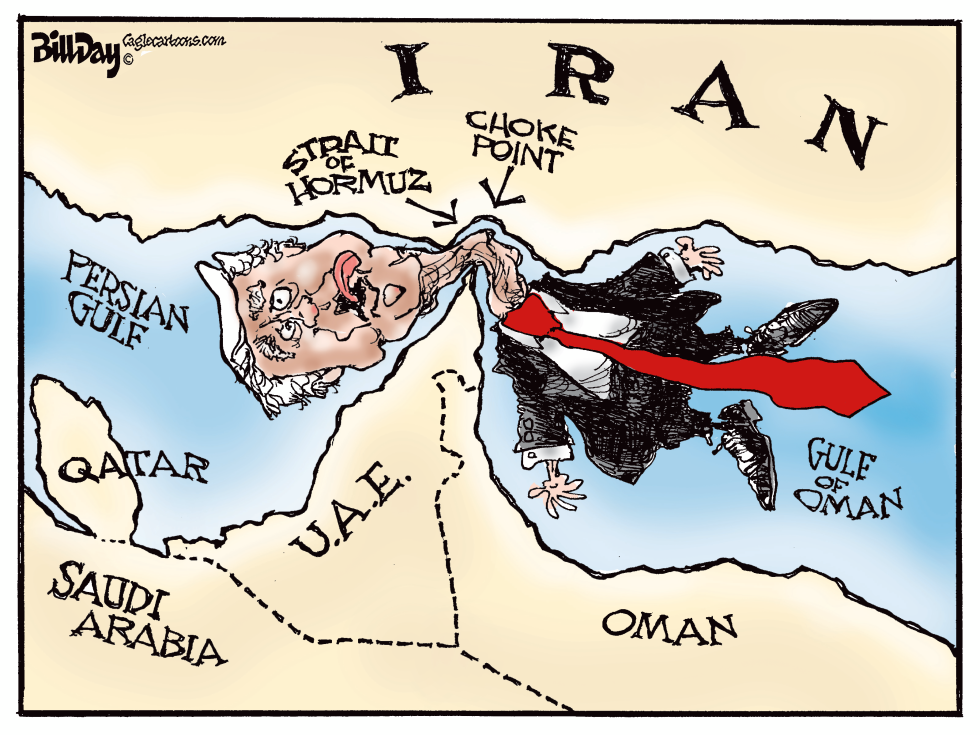
Dive into this Bill Day creation where the map of Iran morphs into a menacing hand at the Strait of Hormuz choke point, gripping a flailing figure in a suit and red tie, symbolizing tension in the Persian Gulf. Surrounding nations like Saudi Arabia, UAE, Qatar, Oman, and the Gulf of Oman frame the scene, highlighting the strategic choke point. This political cartoon Iran Strait of Hormuz captures the essence of Middle East satire, with Iran's form literally choking the strait, a nod to real-world frictions without delving into unshown depths. The irreverent style pokes fun at power plays, making the geopolitical humor both insightful and shareable in editorial circles.
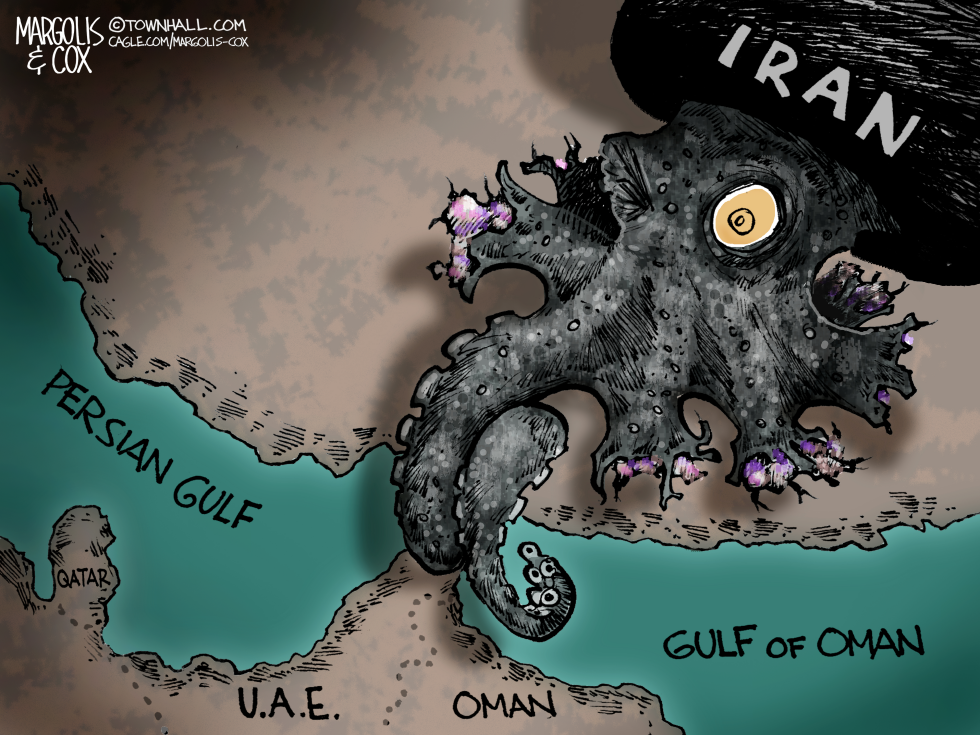
Cartoons like this one from Margolis and Cox cut straight to the absurdity of international posturing. Here, an oversized octopus labeled 'Iran' looms over a simplified map of the Persian Gulf and Gulf of Oman, its tentacles coiling tightly around the Strait of Hormuz. The creature's single eye glares out, while purple-tipped suckers grip the landmasses labeled Qatar, UAE, and Oman. It's a classic visual metaphor for control, poking at Iran's threats to block this crucial oil route. waterway. Such images remind editors how satire distills complex geopolitics into something shareable, even if the humor lands dry as desert sand. With tags like Iran Strait of Hormuz blockade, Persian Gulf tension, octopus metaphor, Middle East satire, oil route choke, and strategic dominance, the piece fits neatly into discussions of global energy security.
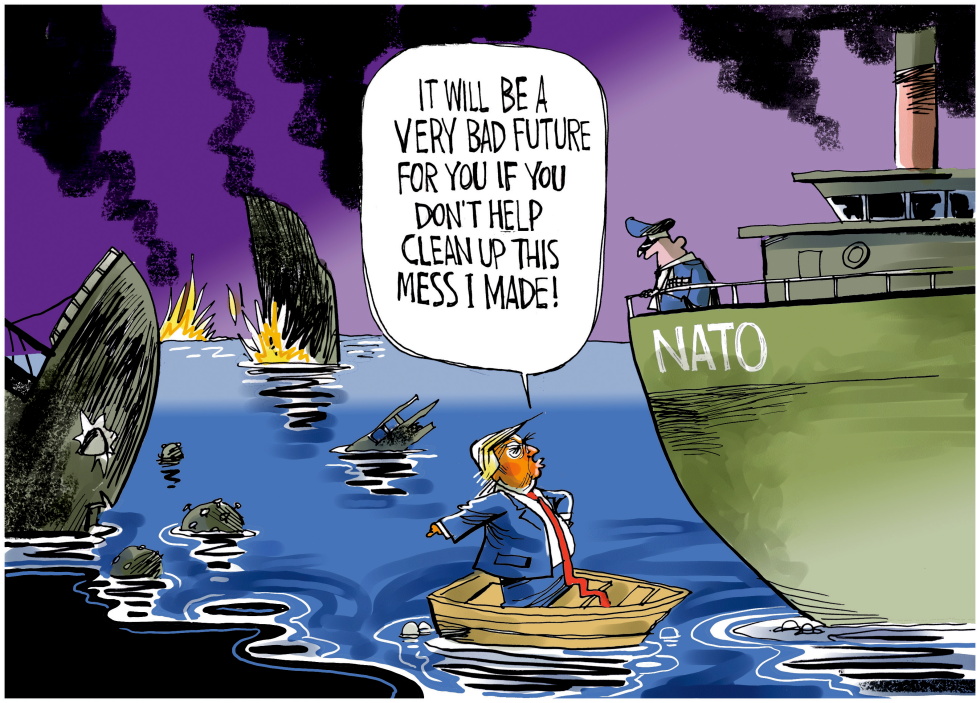
Dave Whamond's cartoon shows a caricature of Donald Trump in a small rowboat, suit and tie askew, shouting threats at a massive green ship labeled NATO. A uniformed figure leans over the railing, watching impassively. Surrounding them are sinking ships with stars, flames bursting from hulls, black smoke curling into a purple sky. The dark water is littered with debris. Trump's speech bubble warns of a bad future if allies don't clean up his mess. This setup nails trump demands, nato alliance, political satire, foreign policy mess, alliance tensions, and satirical caricature with sharp lines and exaggerated features typical of editorial cartoons.
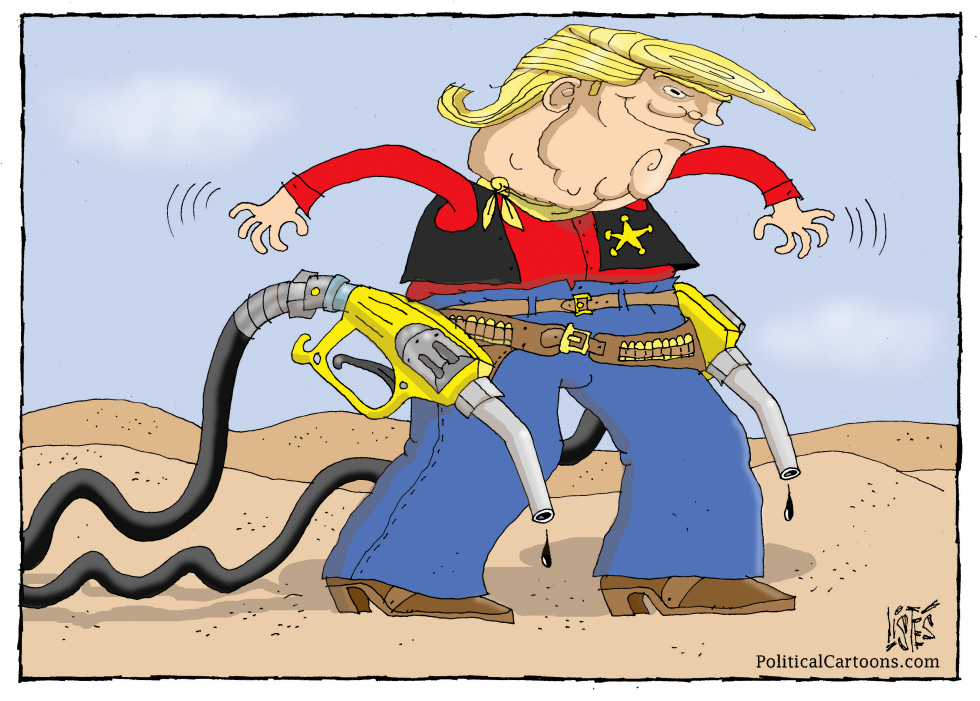
The March 2026 cartoon depicts President Trump as a sheriff in a desert landscape with a gas pump hose attached to his body. Fuel drips from the nozzle onto the sand while the long hose trails behind. The image responds to ongoing concerns over global oil supplies and potential disruptions tied to Iran. Publication occurs during heightened attention to energy markets and U.S. foreign policy in the Middle East.
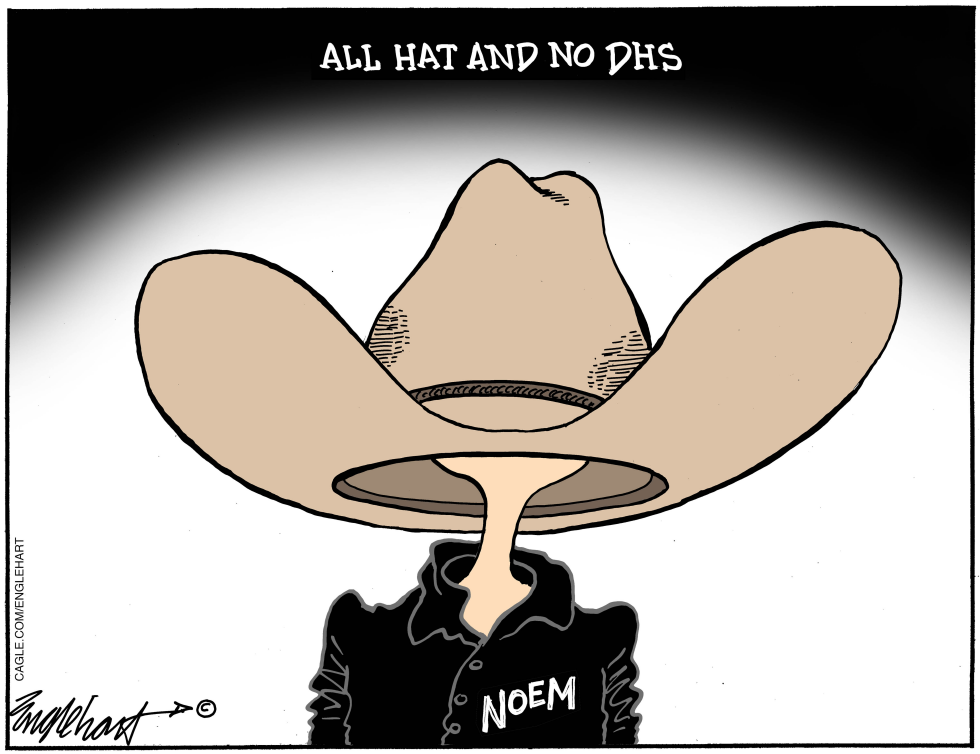
This biting political cartoon depicts Kristi Noem as an oversized cowboy hat swallowing a diminutive figure labeled 'NOEM,' with the punny title 'All Hat And No DHS.' It skewers the South Dakota governor's rumored bid for DHS Secretary in the Trump administration, playing on the idiom 'all hat and no cattle' to suggest she's all style and no substance for homeland security. Amid Republican politics buzz, the satirical art highlights Noem's political ambition clashing with reality, as border security and immigration policy debates rage on. The humorous critique captures the essence of GOP figures jockeying for positions, making it a viral-worthy jab at cabinet rumors and failed aspirations.
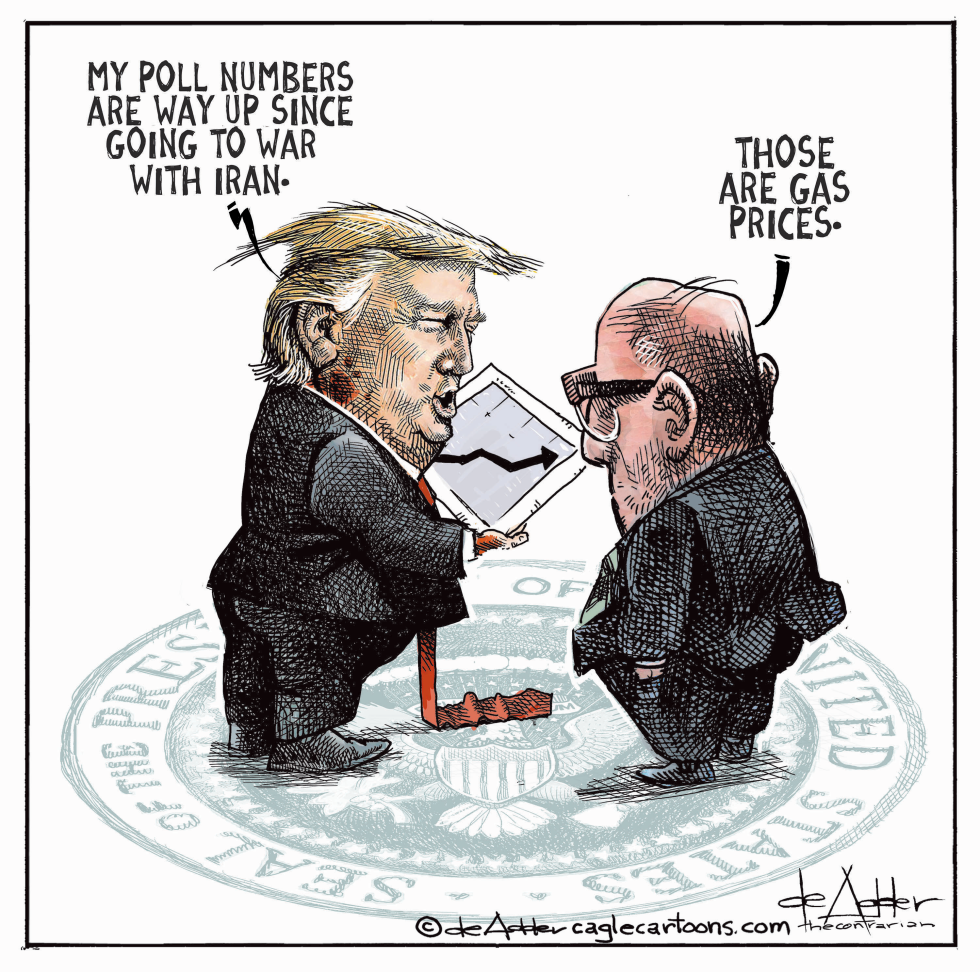
This sharp political cartoon by Michael de Adder captures Donald Trump triumphantly holding a chart of upward trends, claiming his poll numbers have skyrocketed since going to war with Iran. However, a bespectacled Dick Cheney corrects him, revealing those are actually gas prices soaring. The satire highlights the ironic consequences of Middle East conflict on the US economy, blending humor with commentary on presidential approval ratings tied to foreign policy blunders. Incorporating elements of US politics, oil prices, and war economy, the image stands on the presidential seal, emphasizing official folly. It's a witty jab at how leaders might misread economic fallout as personal gains, perfect for editorial discussions on satire and current events.
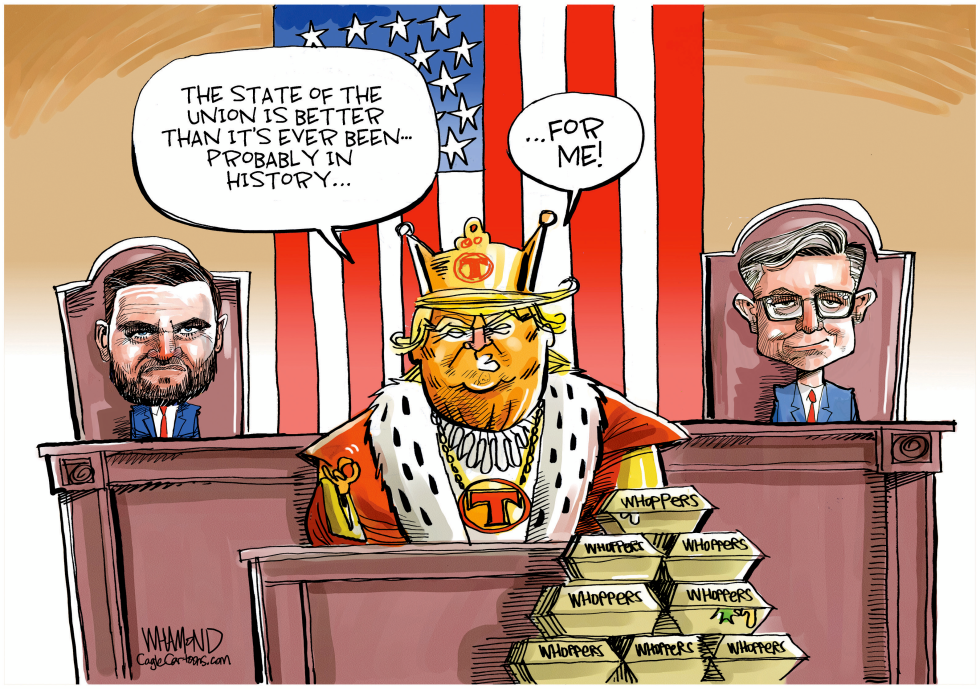
This political cartoon depicts a central figure dressed as a king, complete with a crown marked 'T,' seated at a podium with an American flag backdrop. He speaks in a bubble: 'The state of the Union is better than it's ever been... Probably in history...' while a smaller bubble adds '...For ME!' A tall stack of items labeled 'Whoppers' sits on the desk. Two other men flank him, one bearded on the left, one bespectacled on the right, both in suits. The scene uses tags like State of the Union, Trump, King, Congress, lies, and whoppers to satirize exaggerated claims in a straightforward, visible manner without hidden inferences.
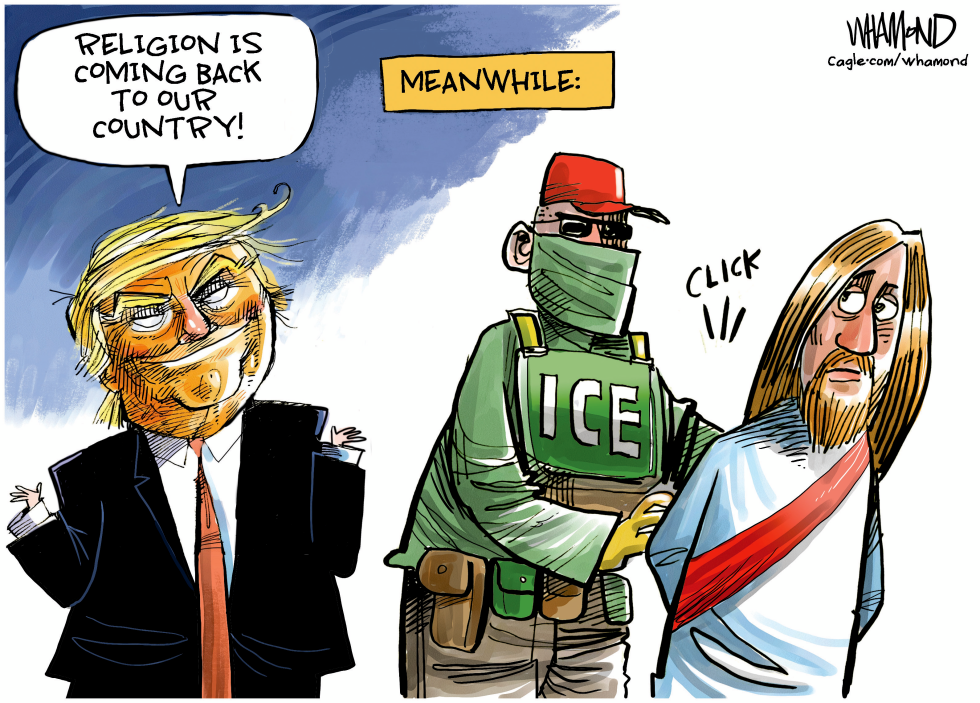
Dave Whamond's cartoon captures Trump religion cartoon essence with the former president boldly stating religion's return to America. Meanwhile, an ICE agent is shown handcuffing a figure resembling Jesus, complete with long hair, beard, and robes, in a clear ICE deporting Jesus satire. This piece dives into political cartoon religion America themes, poking at immigration policy religion hypocrisy. The dry humor shines through the contrast between Trump's proclamation and the 'meanwhile' scene of deportation. Such satirical take on US immigration and faith often sparks debate on religious revival and deportation. Overall, it's a pointed commentary on blending faith with strict border controls.
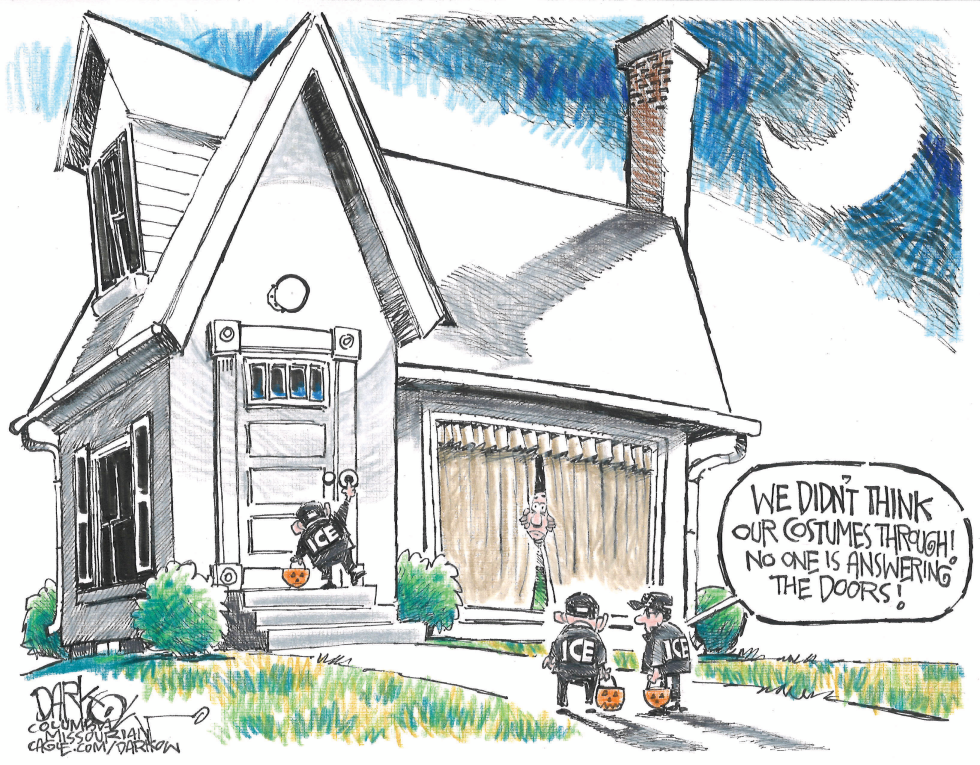
On October 8 2025 John Darkow depicts ICE agents trick or treating at a house. Their uniforms cause residents to avoid answering doors on Halloween night. The scene highlights public reluctance toward immigration enforcement actions.