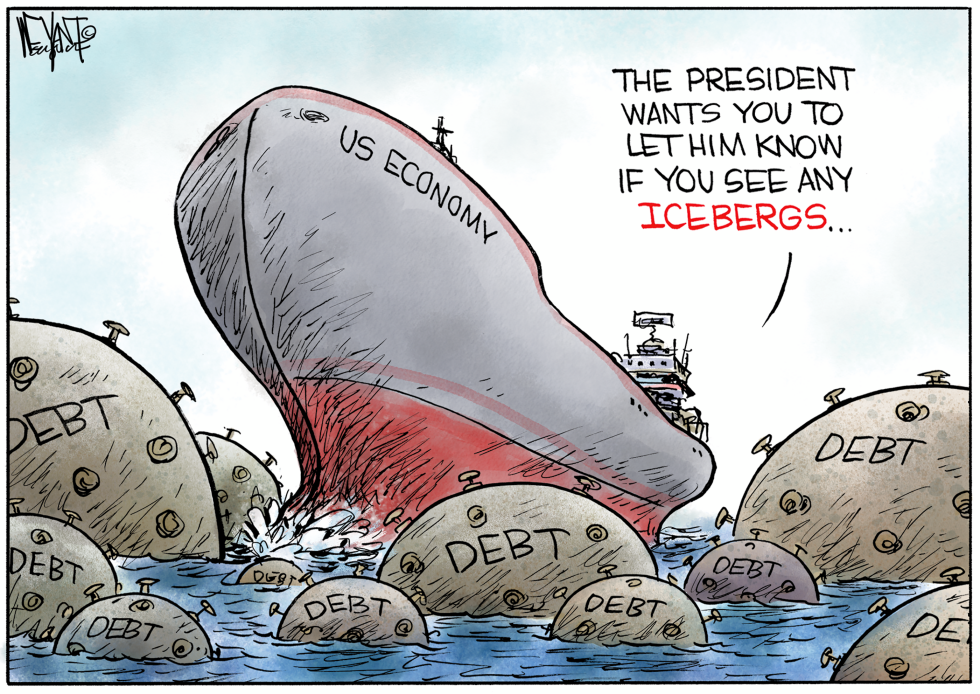
This political cartoon illustrates the US Economy as a massive ship labeled accordingly, dramatically sinking after colliding with numerous icebergs each marked 'DEBT.' A speech bubble from the ship warns to alert the president about icebergs, evoking the Titanic disaster in a clear metaphor for economic peril. Incorporating tags such as economy, debt, budget, inflation, prices, and costs, the image critiques fiscal irresponsibility. The artwork by Christopher Weyant uses simple lines and colors to emphasize the collision's impact, with water splashing and the ship's hull damaged. Such cartoons often highlight how mounting debt threatens stability, drawing parallels to historical maritime tragedies for satirical effect. The composition places the ship at an angle, surrounded by floating debt bergs, underscoring inevitable crisis if warnings go unheeded.
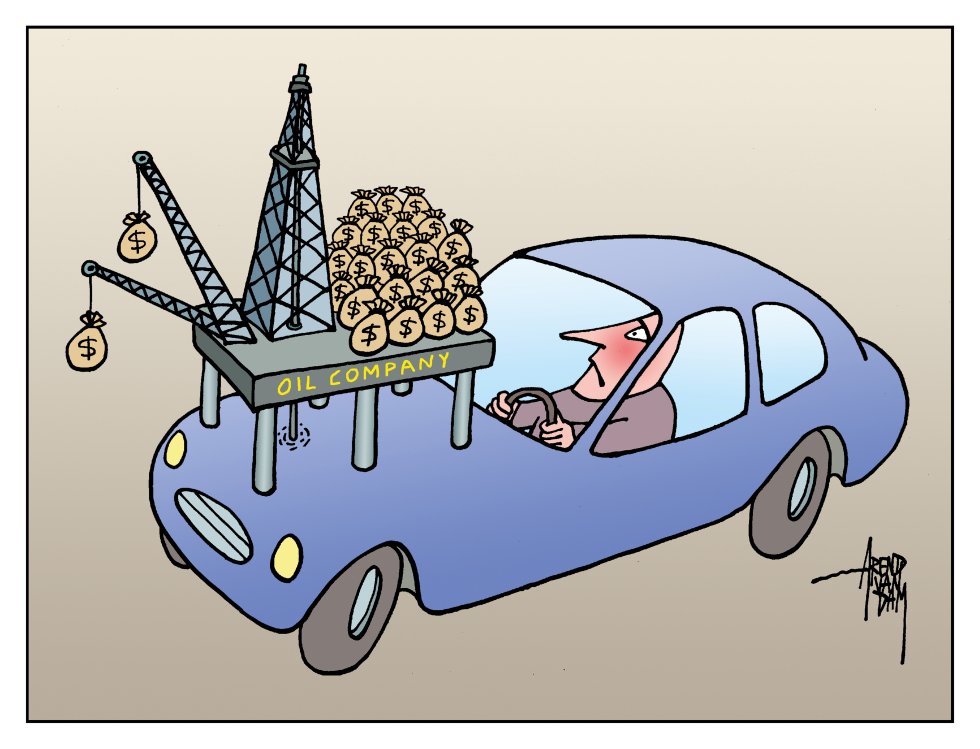
In this pointed political cartoon, an oil company platform sits atop a blue car, loaded with piles of dollar-sign money bags, while cranes dangle more profits. The frustrated motorist grips the wheel, face red with anger, illustrating how excessive profits from oil companies crush consumers at the pump. Tags like excessive profits, motorists, fuel, petrol, and refuel capture the essence, with Iran and Strait of Hormuz hinting at geopolitical tensions driving prices. This visual satire underscores the disparity between corporate windfalls and everyday drivers' pain, a timeless theme in energy politics.
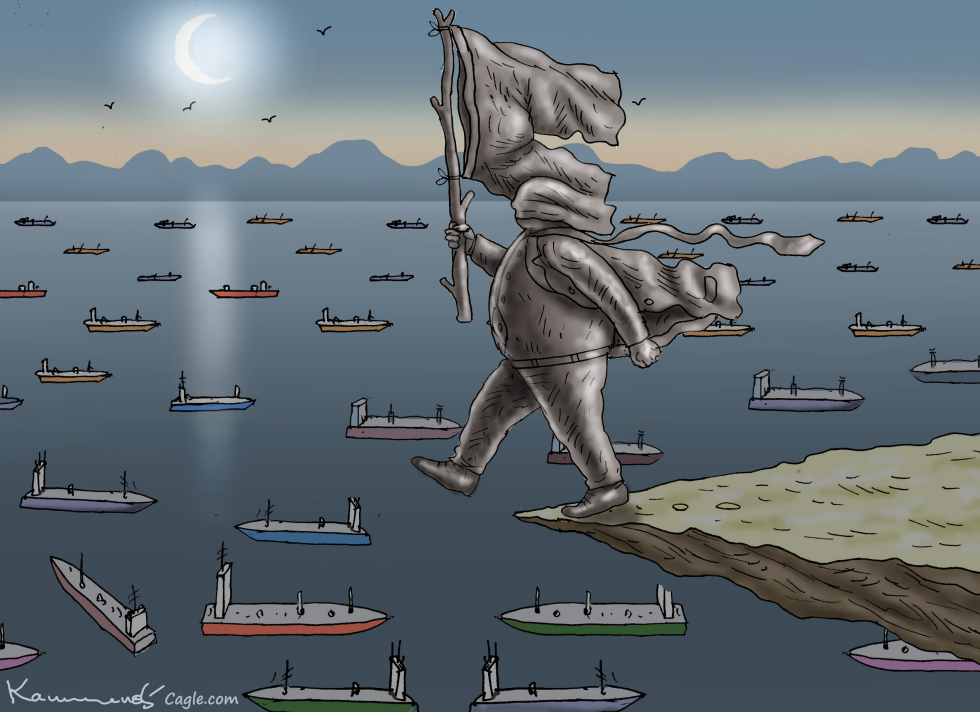
The cartoon shows a large, gray, statue-like figure with a hooded cloak, gripping a flag on a pole, as it steps forward off a cliff's edge. Below stretches a dark sea filled with many small ships of various colors, scattered across the water. In the background, mountains rise against a sky with a crescent moon and flying birds. The image, tagged with Banksy, Trumo, Hormuz, fascism, patriotism, and Maga terror, captures a moment of precarious advance. Artist Marian Kamensky signs it at the bottom left, linking to Cagle.com. This setup highlights a bold, unyielding march into potential downfall amid a busy maritime scene.
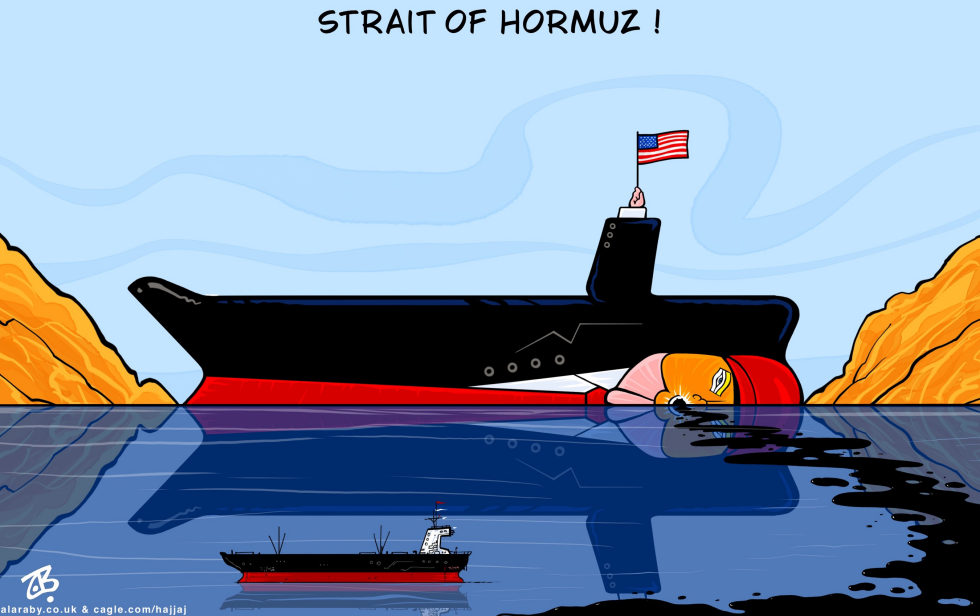
Emad Hajjaj's cartoon depicts a large black submarine with a red hull, stuck between orange landmasses in the Strait of Hormuz, its bow featuring an orange face with yellow hair and a red tie, clearly caricaturing Donald Trump. An American flag flies atop the vessel, while black oil spills into the blue water, reflecting the ship. Below, a smaller black tanker with a white figure onboard sails through the oily sea, tagged with Persian, Gulf, Sea, Tanker, Oil, War. The image satirizes US involvement in Middle East conflicts, particularly Iran war scenarios, without overreaching into hidden meanings. The composition is straightforward, with clear lines and bold colors emphasizing the blockage.
Arend van Dam's cartoon shows a gray battleship marked USA, complete with guns and missiles, driven by a figure in a suit at the wheel, as it goes over a waterfall between rocky cliffs under a blue sky. The image captures the essence of strategy failure in the Strait of Hormuz, tying into themes of Iran, ayatollahs, war, battleship mishaps, Middle East conflicts, oil, gas, energy, and economy. Such visuals often poke at misguided military moves, where the ship's plunge represents a dramatic downfall in strategic planning. The dry humor lies in the absurdity of a warship treating a strait like a river rapid, underscoring potential economic fallout from regional tensions. Cartoons like this thrive on clear, exaggerated metaphors that resonate with readers familiar with global news.
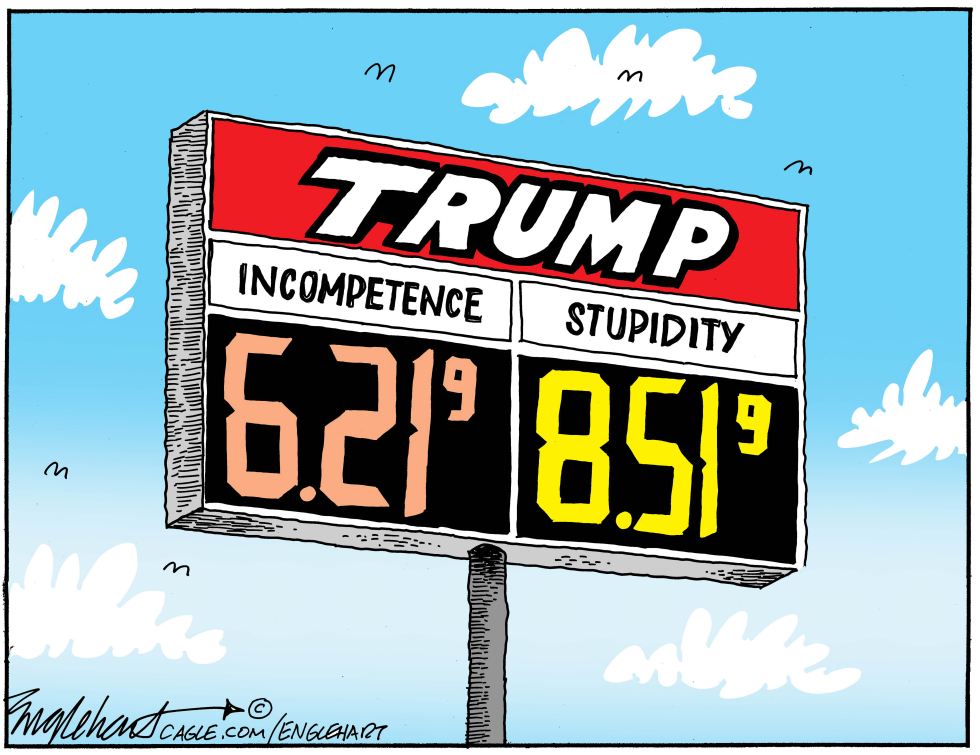
Bob Englehart's cartoon features a gas station sign with Trump at the top, showing prices for incompetence at 6.21⁹ and stupidity at 8.51⁹ against a blue sky with clouds. The tags Trump, Iran War, gas prices, gasoline, and gallon frame the visual pun. Such cartoons often tie political figures to everyday economic pains like fuel costs. The dry humor lands on how leadership flaws inflate prices, making it relatable for readers hit by pump shocks. With no characters, just the sign, it keeps the message direct. Tags like incompetence and stupidity drive the satire home, poking at perceived policy missteps without overcomplicating the scene.
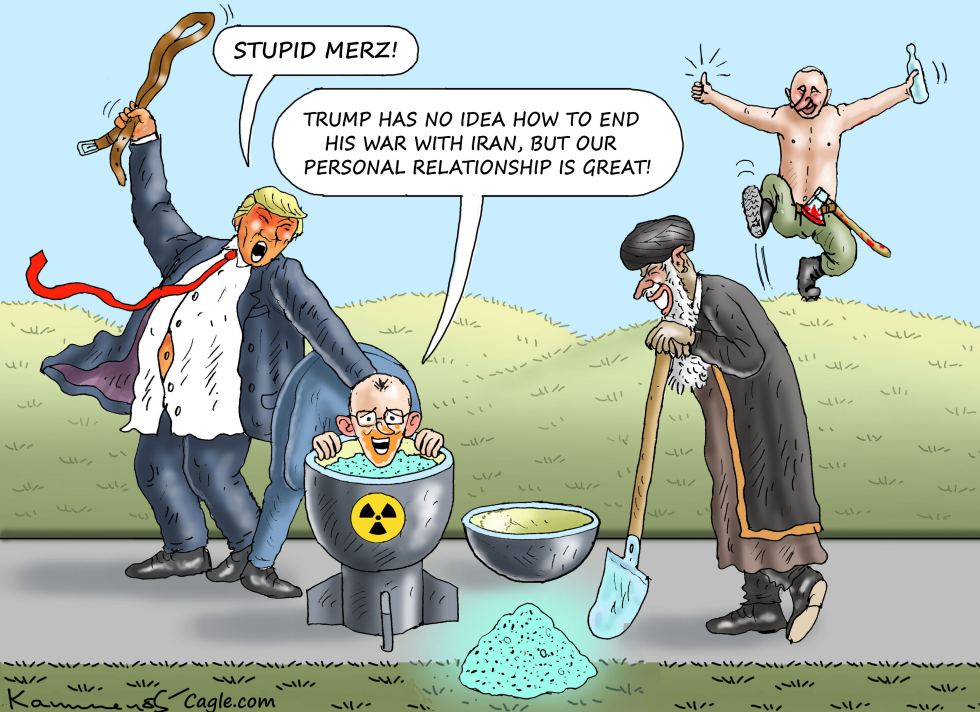
The cartoon depicts a red-faced Trump, tie askew, raising a belt to strike a bald, bespectacled man labeled Merz whose head pokes from a nuclear bomb-shaped vat of blue liquid. An elderly bearded man in turban and robe uses a shovel to scoop more blue material from a bowl, while a shirtless, axe-wielding figure resembling Putin jumps in approval, bottle in hand, speech bubble praising the great personal relationship amid Trump's cluelessness on ending his Iran war. Tags like Trump, Merz, Iran War, Middle East, Fascism, Maga Terror, Hormuz underscore the satirical jab at geopolitical follies, with dry humor poking at failed diplomacy and bizarre alliances in this Kamensky creation for Cagle.com.
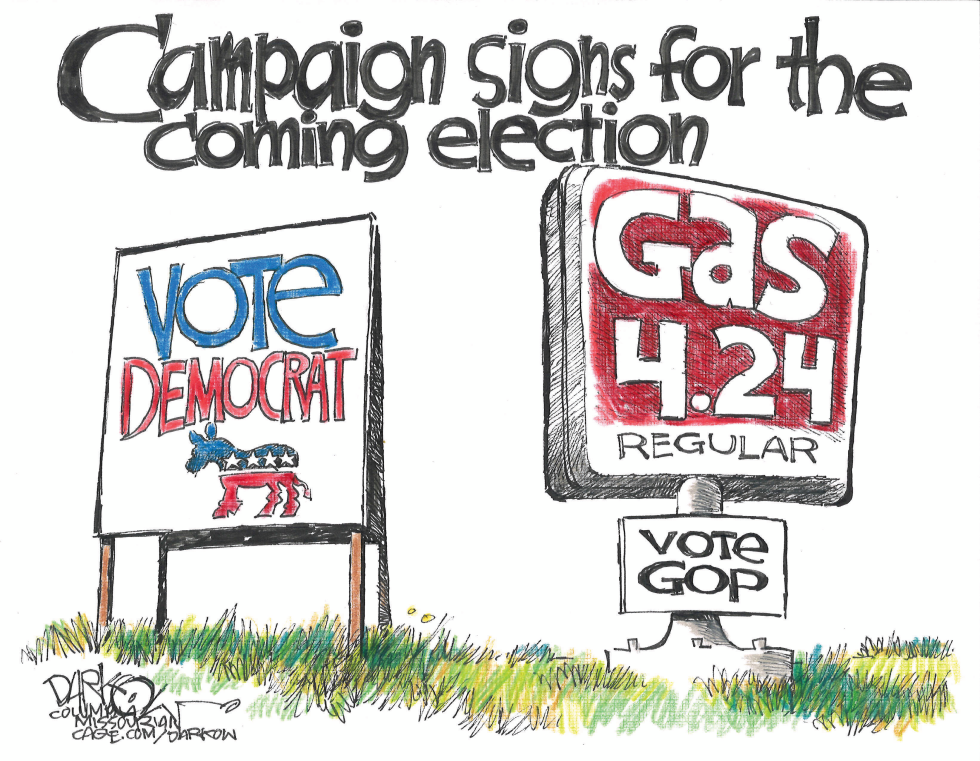
John Darkow's cartoon shows campaign signs for the coming election, with a straightforward Vote Democrat board featuring a blue donkey symbol, contrasted by a gas station-style sign advertising GAS 4.24 REGULAR and a small Vote GOP placard below. The image ties into 2026 midterms themes, highlighting gas prices, affordability, inflation, Strait of Hormuz tensions, cost of living pressures, and party strategies. The dry humor points to how economic issues like fuel costs become central in political advertising, with the GOP sign mimicking a bargain price to appeal to voters frustrated by rising expenses. This setup captures the insider view of how cartoons simplify complex voter concerns into visual punches.
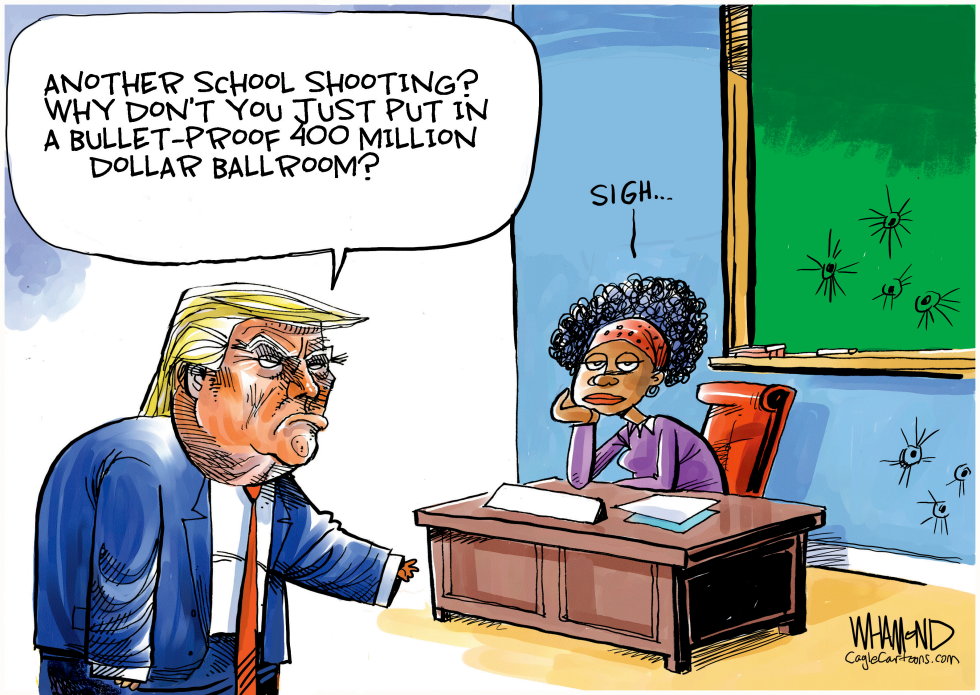
Dave Whamond's cartoon captures a man resembling a political figure leaning over a desk in a classroom, suggesting a bullet-proof 400 million dollar ballroom as a fix for another school shooting. The woman at the desk sighs in response, with a green blackboard showing marks that look like bullet impacts. Tags like school shootings, national issue, security, guns, education, and bullet proof underscore the satire on misplaced priorities, where vanity projects like a top secret ballroom or Trump bunker get funding justifications, echoing build the wall rhetoric and emergency exemptions amid issues like WHCD shooting.
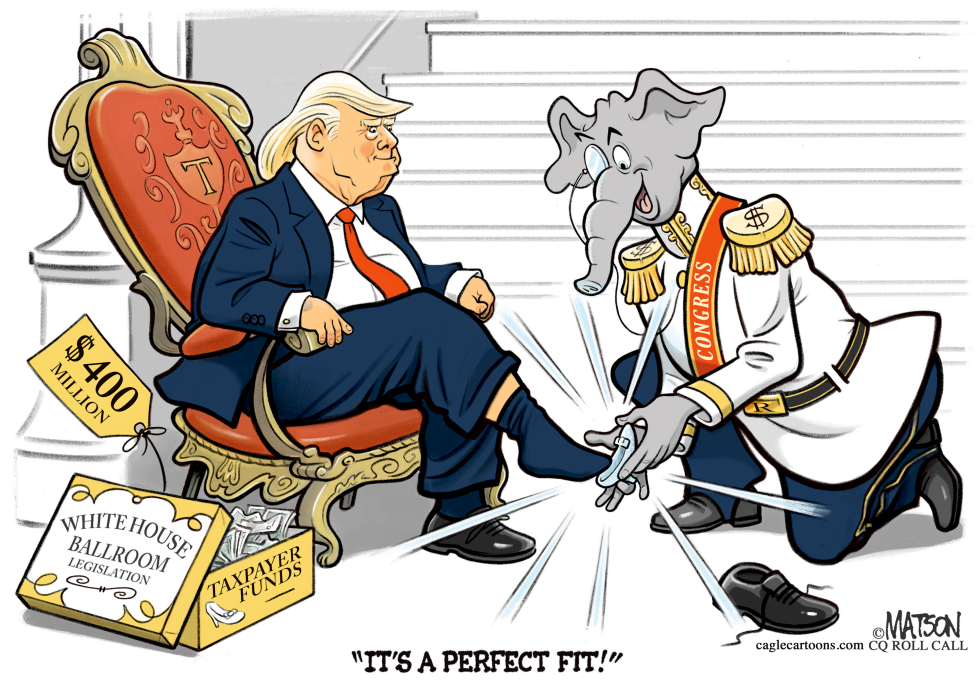
RJ Matson's cartoon depicts President Trump as Cinderella, lounging on a throne while a grinning Congress elephant, adorned with a sash and dollar-sign epaulets, slips a black shoe onto his foot, exclaiming 'It's a perfect fit!!' A box labeled 'White House Ballroom' overflows with 'Taxpayer Funds,' and a $400 million tag dangles nearby. This sharp satire targets Congressional Republicans' approval of hefty taxpayer funding for White House upgrades, echoing the fairy tale but with a political twist on government spending and Donald Trump's influence. The White House Correspondents Association Dinner at the Hilton Hotel lurks in the background tags, highlighting budget priorities amid fiscal debates.
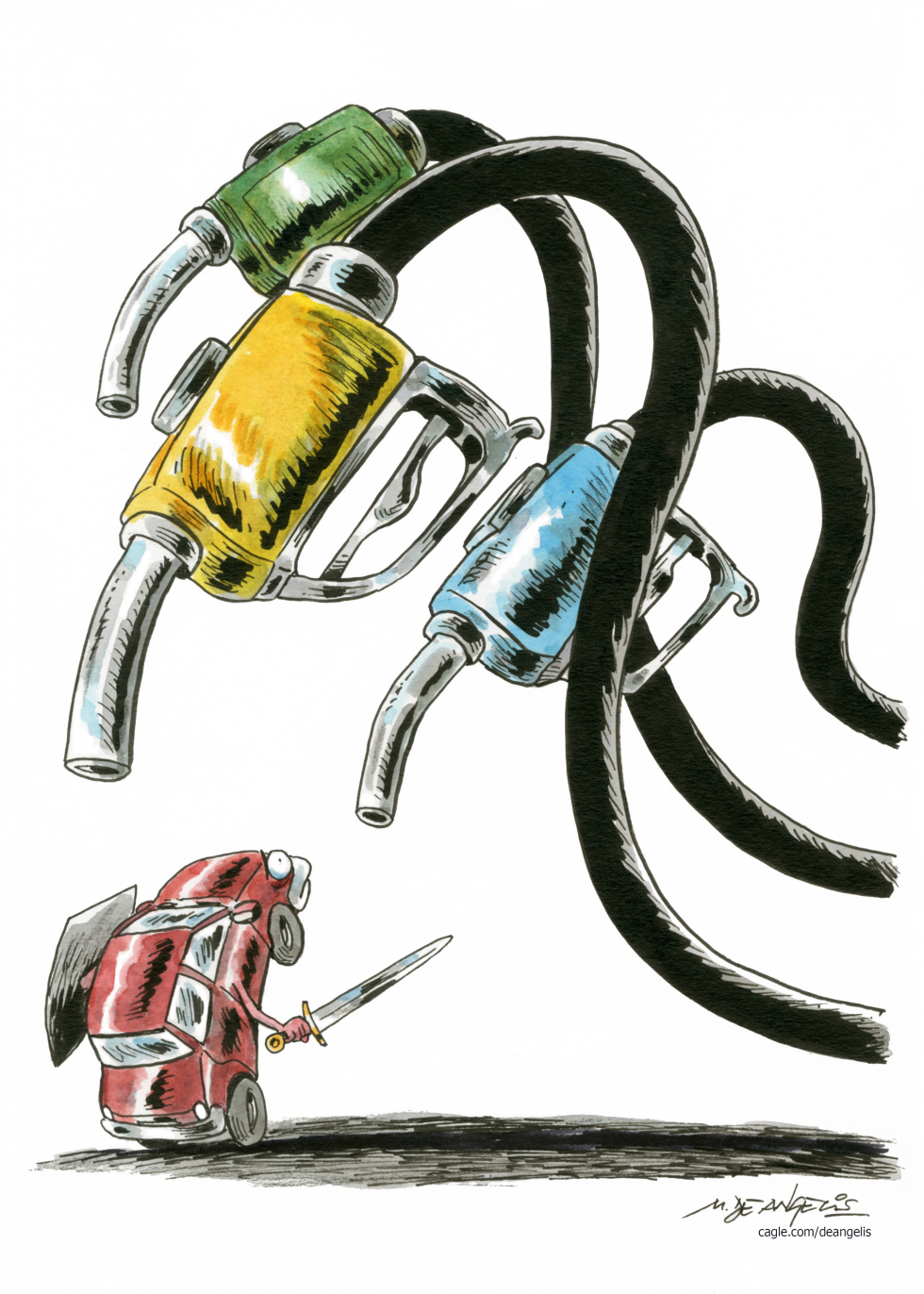
Marco De Angelis draws a clever twist on the ancient HYDRA myth, where a plucky red CAR, sword in hand, squares off against a beastly creature formed by three FUEL pump nozzles—green, yellow, and blue—attached to writhing black hoses. The scene plays on the endless battles drivers face with soaring OIL PRICES and FUEL costs, tying into broader ECONOMY woes. Tags like TRANSPORTATION, TRADE, WAR, CRISIS, IRAN, USA, and HORMUZ hint at real-world tensions in the Strait of Hormuz, where geopolitical strife disrupts global OIL supplies. It's a sharp commentary on how these issues regenerate like hydra heads, making every victory temporary in the fight against economic pressures.
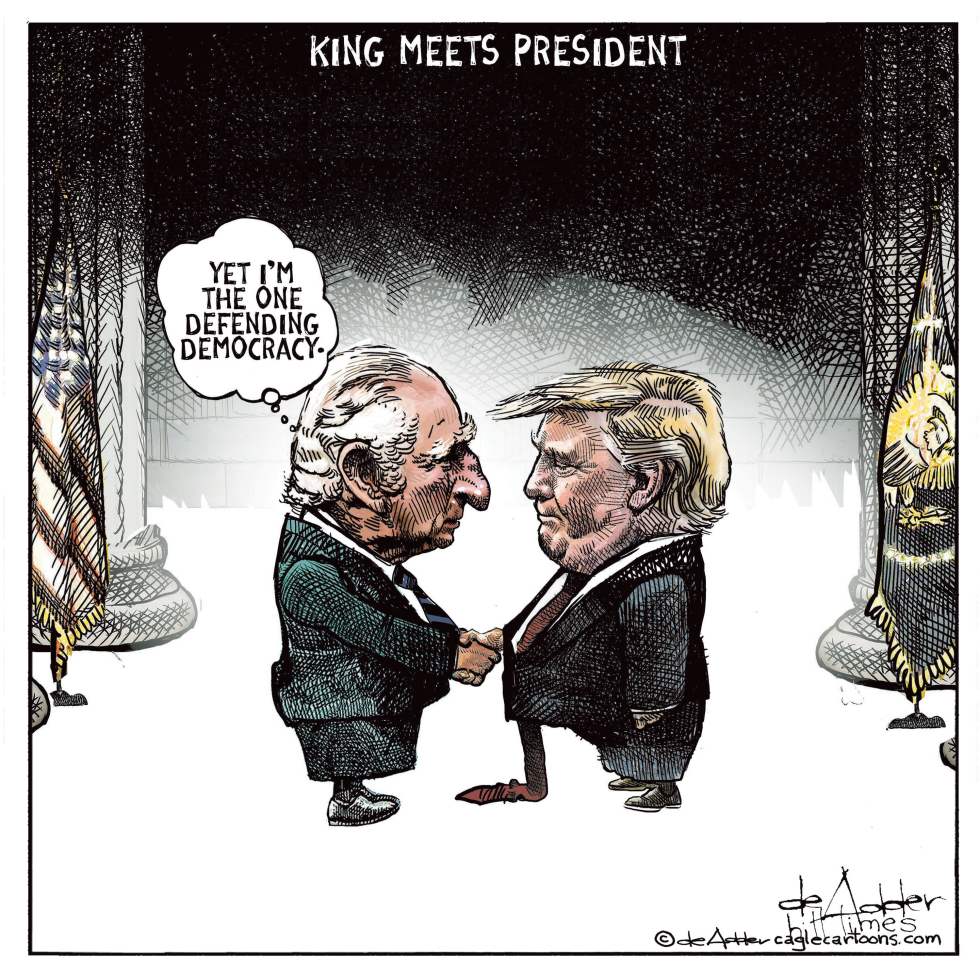
Michael de Adder's cartoon captures a handshake between King Charles and President Trump, set against American and implied British flags in a White House-like scene. The title 'KING MEETS PRESIDENT' tops the image, with Charles saying, 'Yet I'm the one defending democracy.' Tags like UK, United Kingdom, States, America, White House, Visit, State underscore the diplomatic theme. This satire touches on trade, tariffs, and economy without overreaching into unseen motives. The dry humor lies in the visual irony of two leaders in suits, one royal and one presidential, amid formal backdrops. Artistic style uses crosshatching for depth, keeping focus on the central exchange.
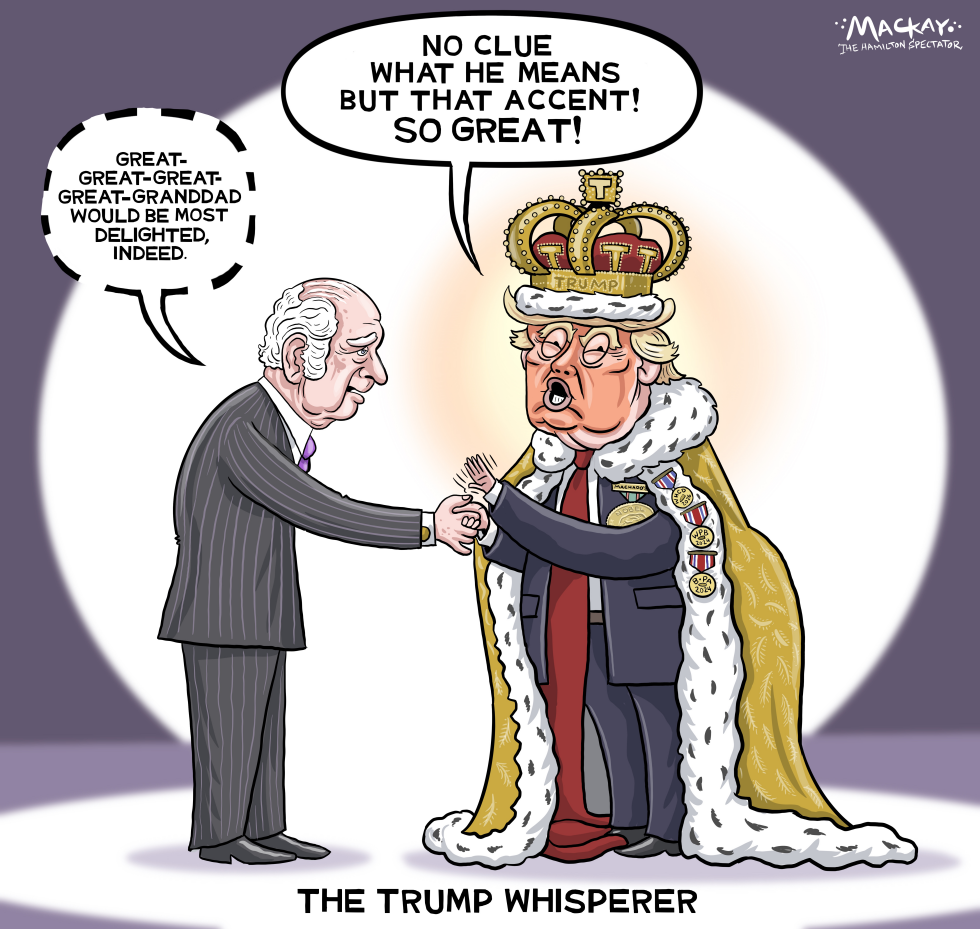
Graeme MacKay's cartoon depicts King Charles III leaning in to whisper a message from King George III to a regally dressed President Trump, who misinterprets it due to the accent. Tagged with USA, Canada, UK, the image explores monarchy, diplomacy, and alliance themes. Trump's crown labeled with his name adds symbolism of self-aggrandizement, while the 'Trump Whisperer' caption underscores the tension in this leadership encounter. Historical nods to tradition and stability contrast with modern visit dynamics, blending respect and satire in a visually striking composition.
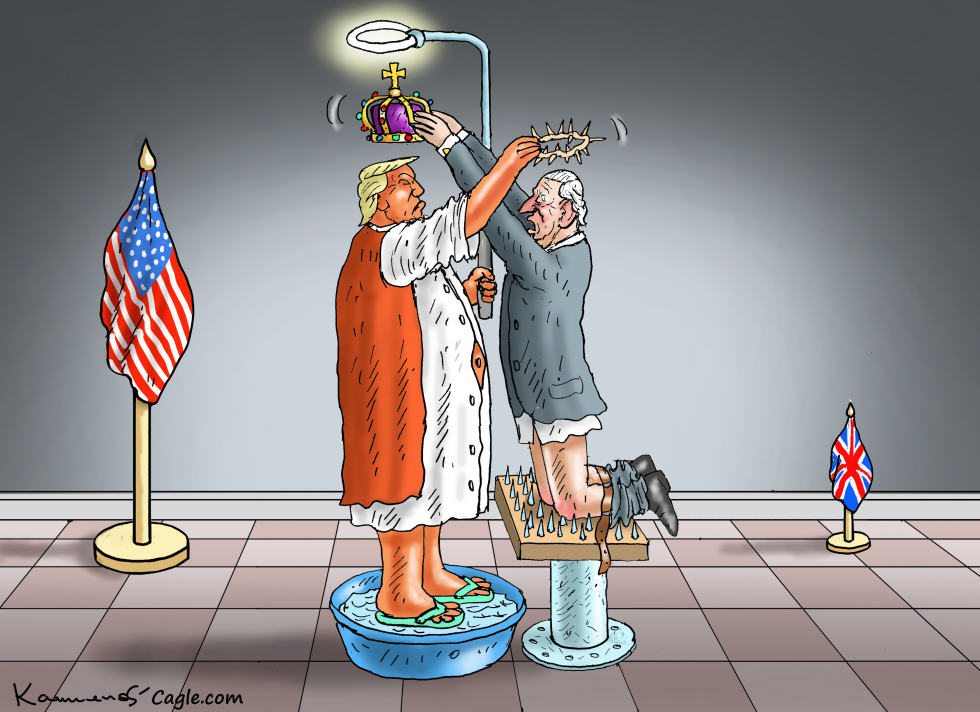
Marian Kamensky's cartoon depicts Trump holding a jeweled crown over King Charles's head while King Charles extends a crown of thorns, set against US and UK flags. The image, tagged Trump, King Charles, MAGA terror, Doctor Jesus, fascism, shows King Charles in a suit with pants down, standing in a basin on a spiked stool. This setup underscores themes of painful power exchanges, with Trump in a robe-like garment. The dark background and illuminated halo add to the satirical edge, commenting on political alliances and suffering in leadership.
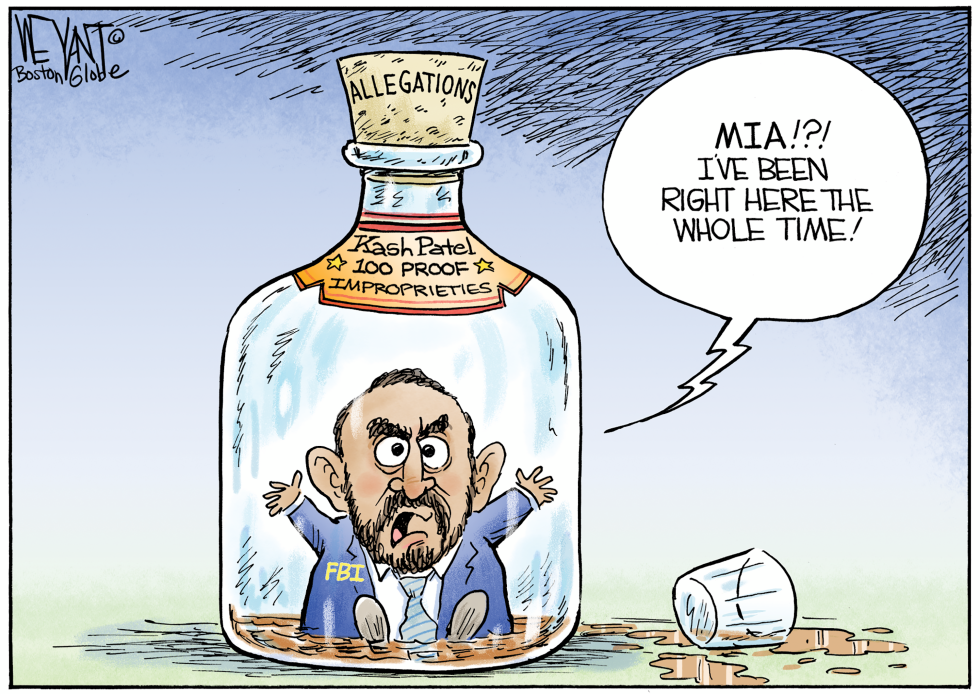
Christopher Weyant's cartoon captures Kash Patel trapped inside a large bottle labeled 'Kash Patel 100 Proof Improprieties,' with the cork marked 'Allegations.' The figure, dressed in a suit with 'FBI' on the sleeve, raises arms and shouts in a speech bubble: 'MIA!?! I've been right here the whole time!' A tipped-over glass spills liquid nearby. Tags like FBI, Kash Patel, alcoholic, allegations, bottle, and fail underscore the visual pun on being 'in the bottle,' tying into themes of inept leadership and ongoing controversies in domestic policy and criminal justice.