Arend van Dam's cartoon shows a gray battleship marked USA, complete with guns and missiles, driven by a figure in a suit at the wheel, as it goes over a waterfall between rocky cliffs under a blue sky. The image captures the essence of strategy failure in the Strait of Hormuz, tying into themes of Iran, ayatollahs, war, battleship mishaps, Middle East conflicts, oil, gas, energy, and economy. Such visuals often poke at misguided military moves, where the ship's plunge represents a dramatic downfall in strategic planning. The dry humor lies in the absurdity of a warship treating a strait like a river rapid, underscoring potential economic fallout from regional tensions. Cartoons like this thrive on clear, exaggerated metaphors that resonate with readers familiar with global news.
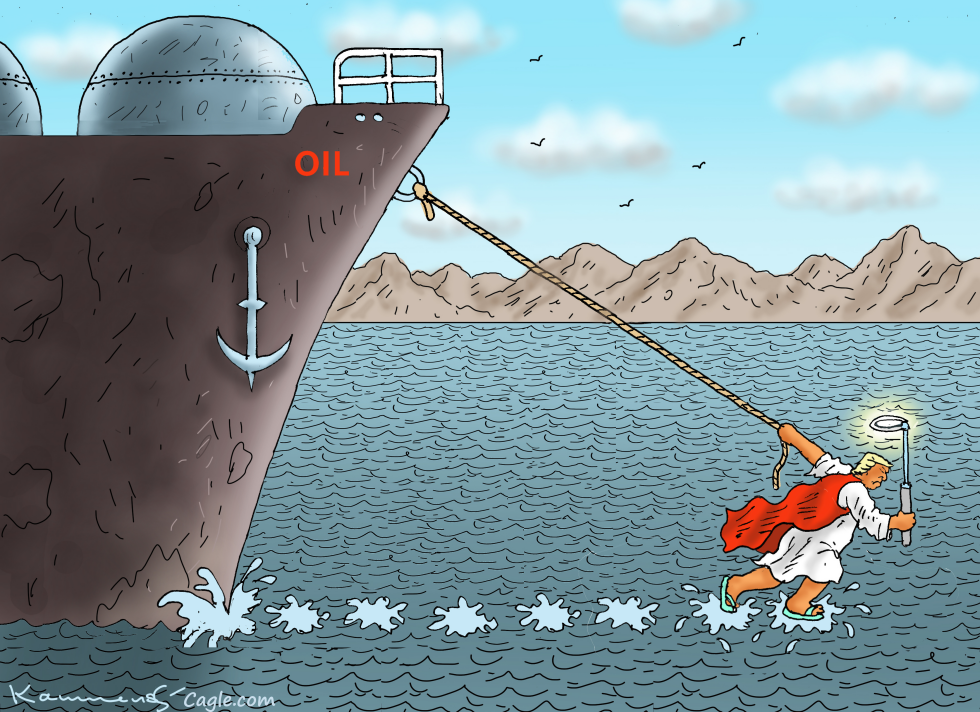
The image depicts a figure dressed in a white robe and red cape, complete with a glowing halo, running across the water while pulling a large oil tanker marked 'OIL' with a rope. He holds a golf club in one hand, splashing water with each step against a backdrop of mountains and a clear sky. This setup draws on tags like Trump, Hormuz, Iran, oil war, MAGA terror, and fascism to satirize political figures intervening in global oil crises. The cartoon's composition emphasizes the absurdity of a divine savior tackling economic and geopolitical issues, with birds flying overhead and distant peaks suggesting a Middle Eastern strait. Kamensky's style brings dry humor to the forefront, poking at notions of messianic leadership in turbulent times.
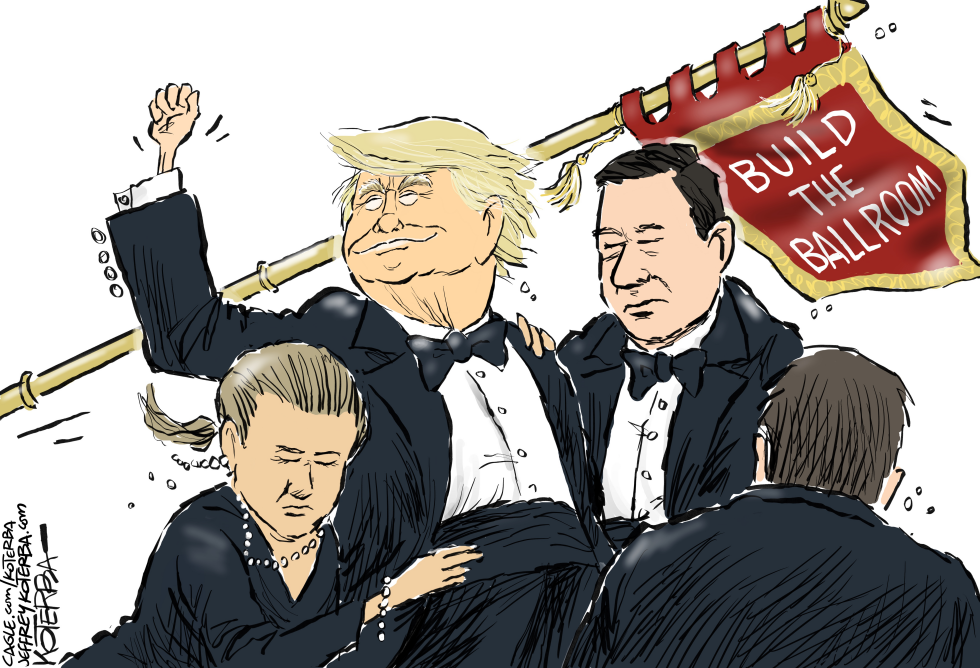
Jeff Koterba draws Trump in tuxedo, fist raised high, gripping a flagpole with a red banner proclaiming 'Build the Ballroom.' Surrounded by figures in formal wear, the scene captures a moment in a Washington ballroom, tagging into press and journalism themes. The cartoon nods to an assassination attempt in Butler, with secret service elements visible. Trump's caricature dominates, his expression set as agents cluster around. This piece fits into White House Correspondents' Dinner aftermath, blending fist symbolism with ballroom absurdity. Tags like flag and tuxedo underscore the satirical take on political resilience.
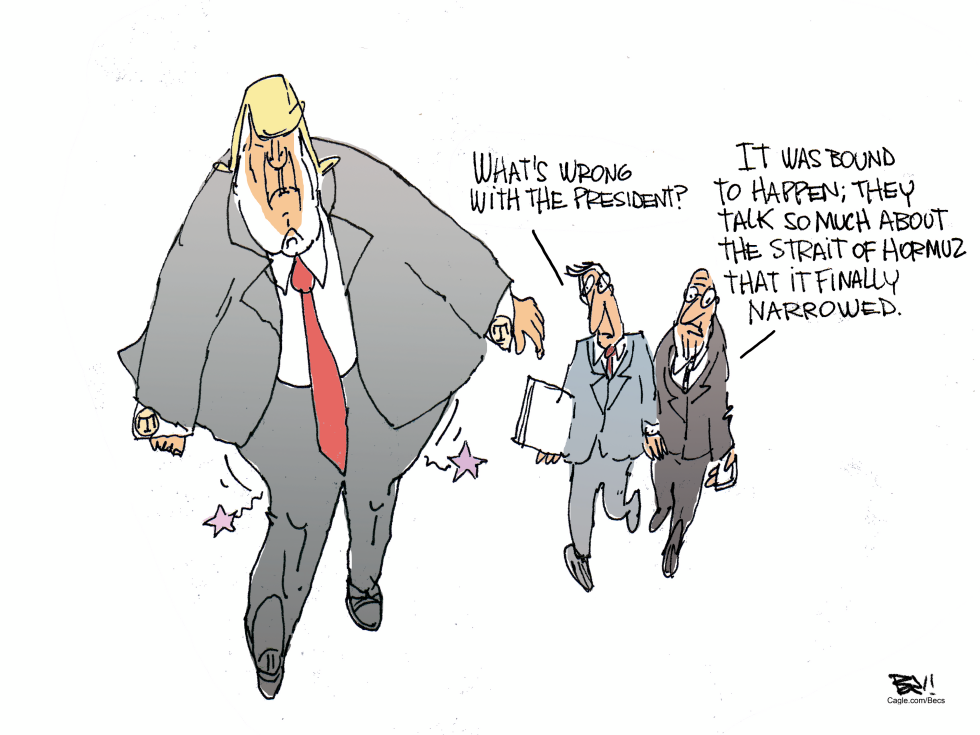
Becs captures the Donald Trump Administration's fixation on the Strait of Hormuz in a cartoon where the president appears stricken, with aides commenting on the inevitable 'narrowing' due to endless talk. This US War satire ties into oil dependencies, Iran tensions, and price per barrel fluctuations, showing a large Trump figure clutching his side amid a pun on geopolitical chokepoints. The image underscores how constant rhetoric about the strait leads to comedic physical distress, blending humor with commentary on foreign policy obsessions.
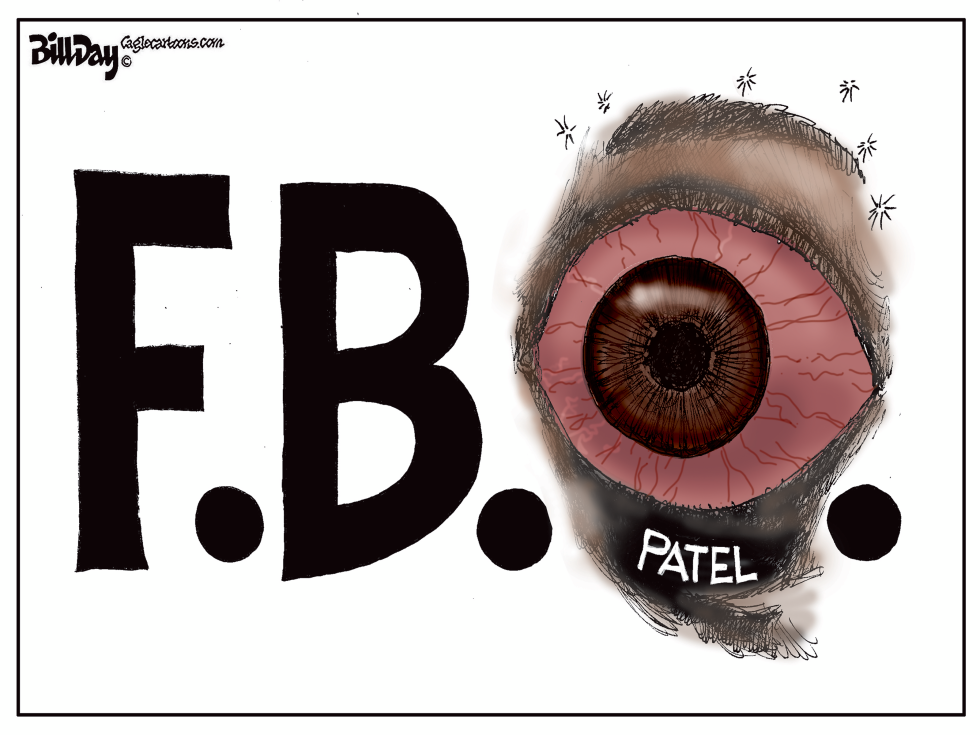
Bill Day's cartoon features the letters F.B.I. with a veiny, bloodshot eye replacing the 'I', and the word Patel scrawled beneath it, evoking themes of booze and drinking. Stars sparkle above the eye, adding to the sense of disorientation or absence. This piece, tagged with Patel, FBI, booze, drinking, absent, and drunk, offers a straightforward jab at a figure's rumored state. In the world of political cartoons, such direct visuals cut through the noise, reminding editors that simplicity often packs the biggest punch. Day's style here is classic, with rough lines emphasizing the eye's intoxicated look, making it shareable for those following nomination sagas.
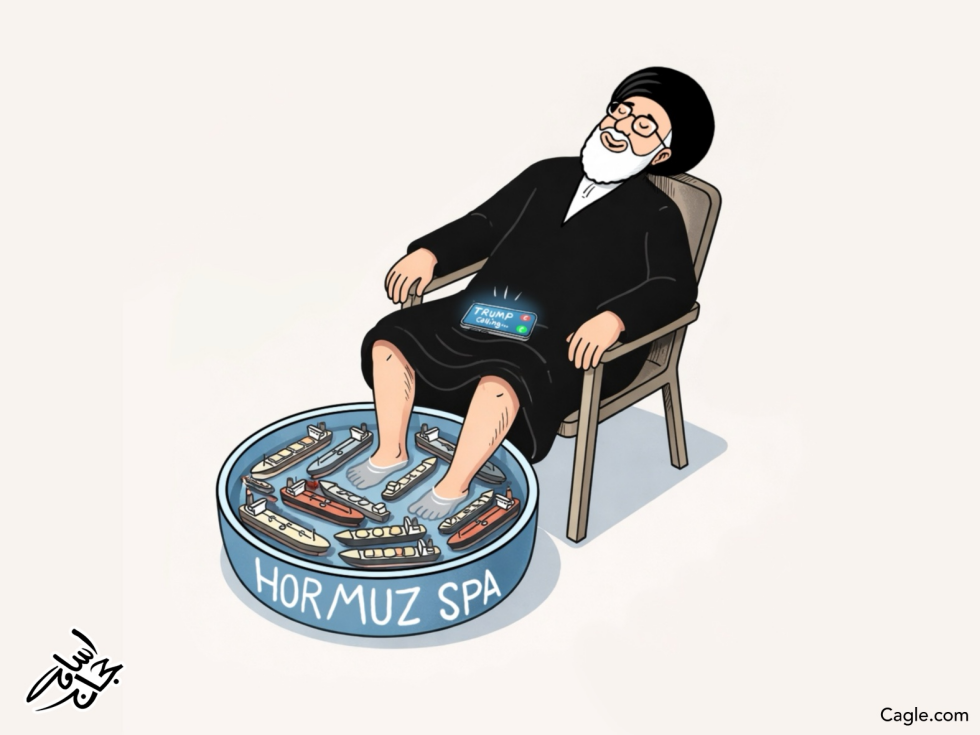
Osama Hajjaj draws an Iranian leader, resembling a cleric in black robes and turban, slouched in a chair with feet immersed in a blue basin labeled Hormuz Spa. Tiny ships float around his feet, evoking the Strait of Hormuz. A phone on his lap displays Trump with a green light, implying a call or alert. The scene captures dry satire on Iran-Trump relations, with the spa pun highlighting control over vital shipping lanes. Tags like Hormuz, Iran, Donald Trump, spa, and political cartoon underscore the humor in geopolitical friction.
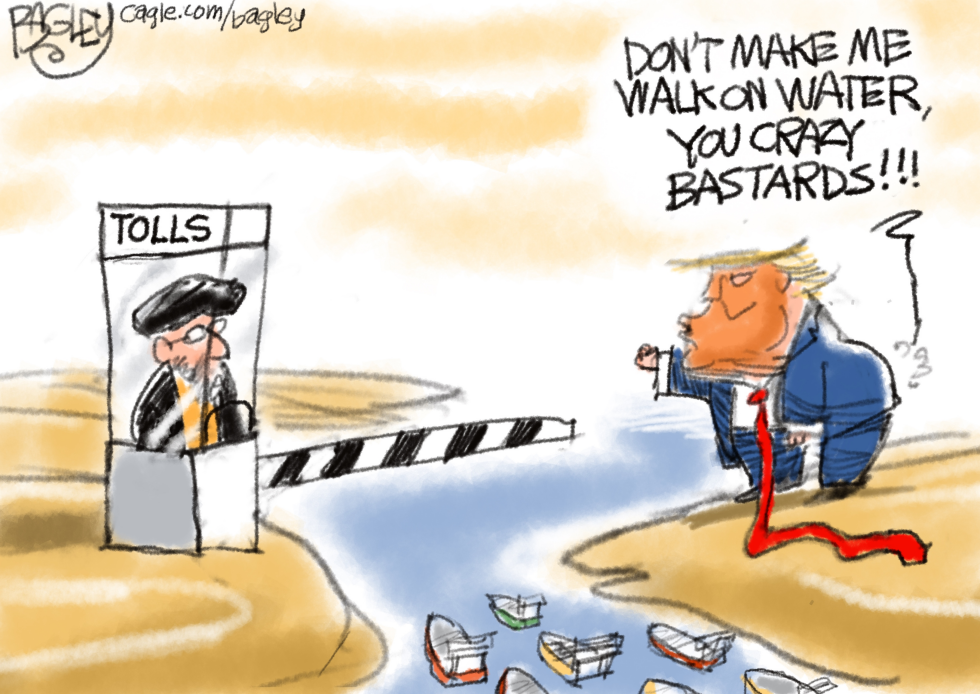
Donald Trump stands at the edge of a body of water confronting a toll booth operated by a figure resembling Ayatollah Khamenei. Small tankers sit in the water below while Trump issues a warning about walking on water. The scene references shipping routes through the Strait of Hormuz and surrounding nations.
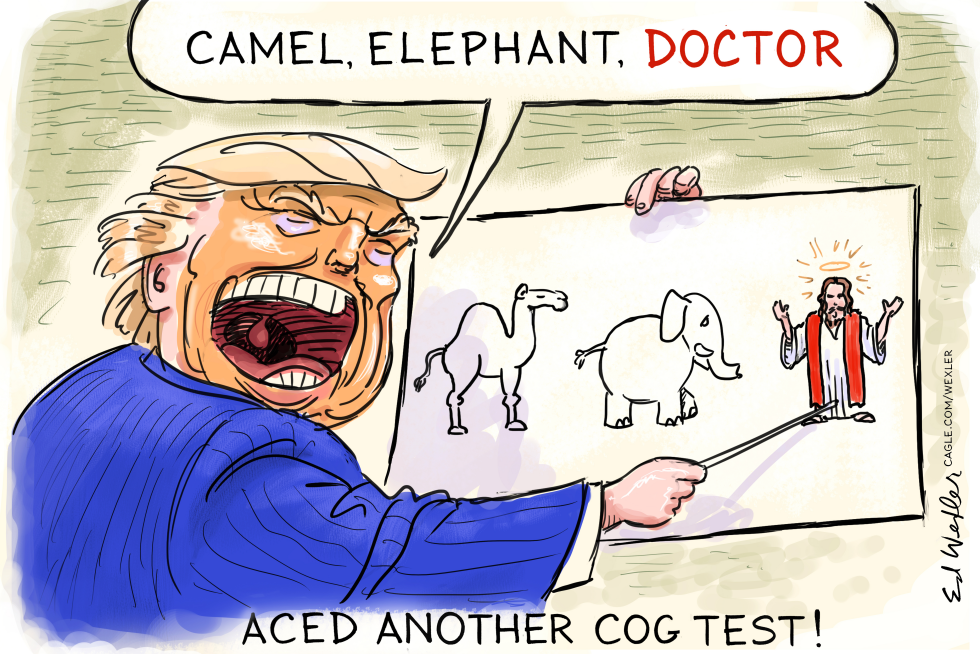
Ed Wexler's political cartoon captures Trump in a moment of satirical glory, mouth agape as he shouts 'Camel. Elephant. Doctor.' while pointing to a flipchart with crude drawings: a camel, an elephant, and a haloed Jesus figure in red robes, arms raised. The caption below reads 'Aced Another Cog Test!' blending Trump's real-life boasts about cognitive exams with absurd humor. Tags like Trump cognitive test, satirical illustration, Ed Wexler cartoon, Trump elephant camel doctor, humor Trump mental acuity, and political humor Trump health claims underscore the cartoon's sharp commentary on public perceptions of Trump's mental sharpness, delivered in classic cartoon style that's direct and unsparing.
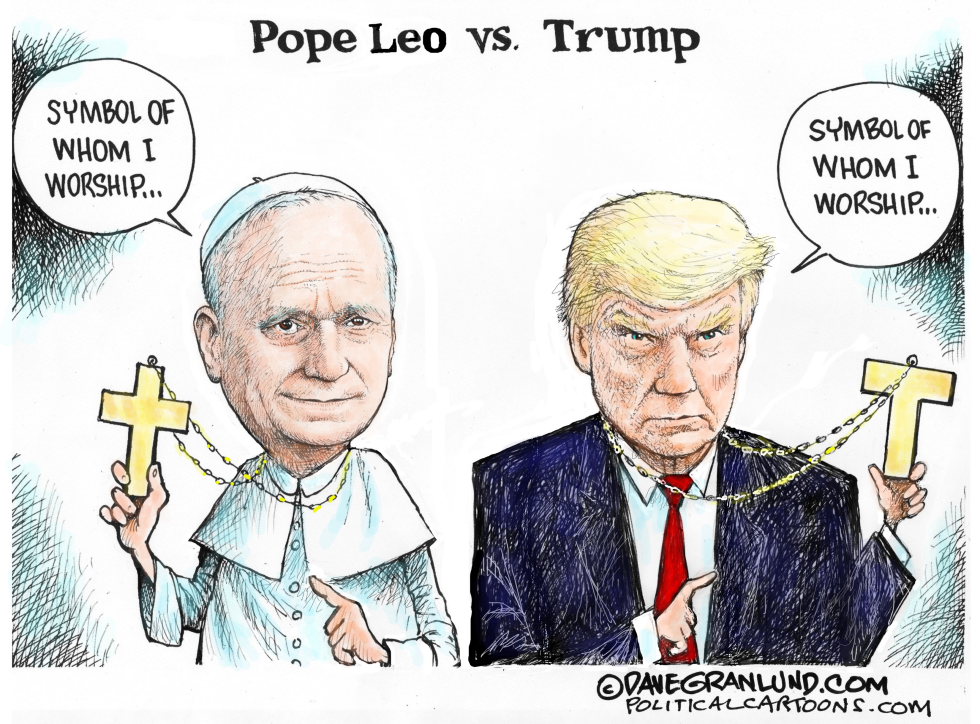
Dave Granlund's cartoon titled 'Pope Leo vs. Trump' features the pontiff holding a cross with the speech bubble 'Symbol of Whom I Worship...', directly contrasting Trump's figure gripping a 'T' pendant and echoing the same phrase. This setup underscores criticism against war, with Pope Leo positioned as a peace advocate facing off against Trump's self-referential symbol. Tags like insults pope, not a fan, Vatican, Catholics, and Christians amplify the satirical jab at political hubris invading religious spheres. The image stays simple, focusing on the two figures and their held items to drive home the point without added clutter.
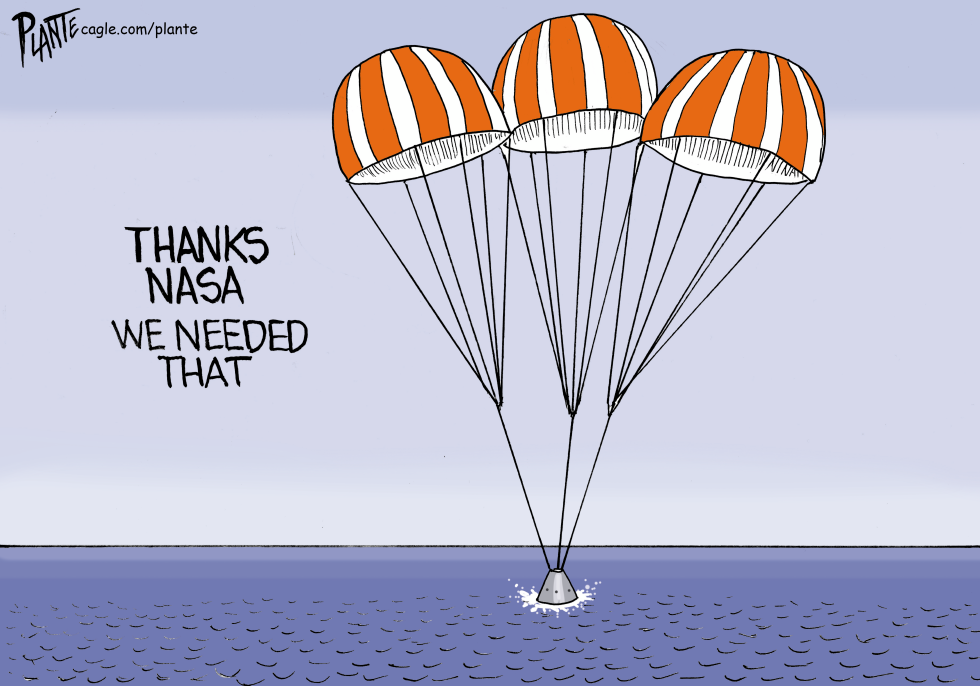
Bruce Plante\'s cartoon captures a space capsule\'s splashdown, complete with three orange and white striped parachutes guiding it to a blue ocean teeming with black fish-like forms. The prominent text \'Thanks NASA We Needed That\' adds a layer of sarcasm, typical in editorial illustrations commenting on high-profile events like the Artemis II mission. The simple composition, with a light blue sky and wavy ocean surface, emphasizes the moment of impact, shown by a small splash at the capsule\'s base. This piece fits into the tradition of political cartoons that highlight public sentiments toward government projects, using minimal elements for maximum impact. The artist\'s signature and website appear in the top left, grounding it in syndicated cartoon style.
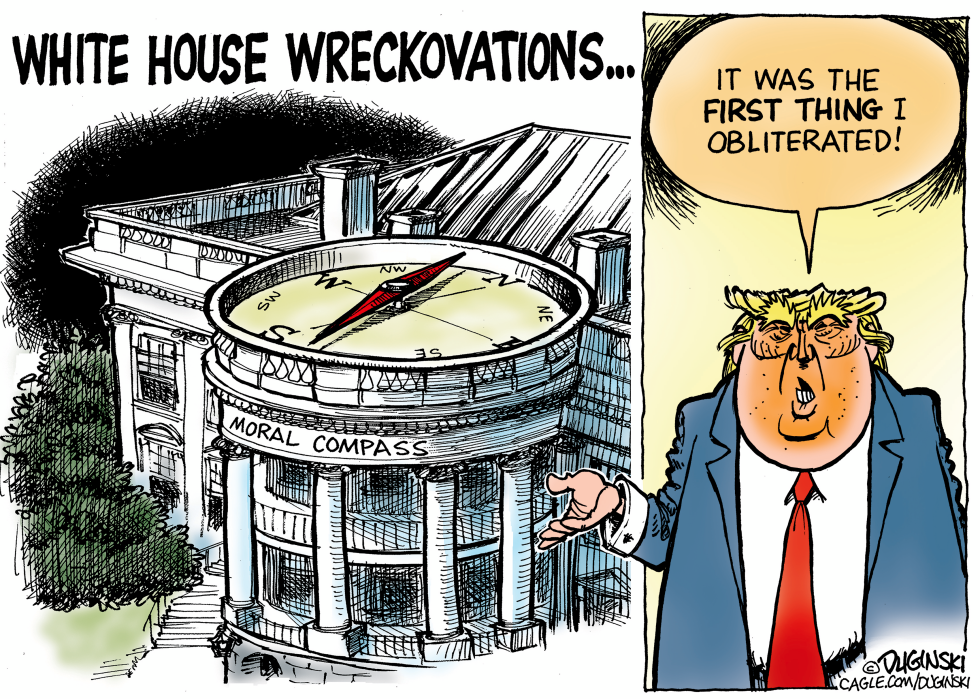
Paul Duginski's cartoon shows a caricatured Trump gesturing proudly while speaking about obliterating the moral compass, a large dome-like structure labeled 'Moral Compass' with directional arrows, placed on the White House roof. The title 'White House Wreckovations' plays on renovations, suggesting destructive changes. Tags including president, MAGA, White House, demolition, morality, ethics, obliteration, Republicans, and Iran war frame the image as a critique of ethical standards in politics. The scene captures a dark night setting with part of the building and trees visible, emphasizing the theme of moral destruction in Washington.
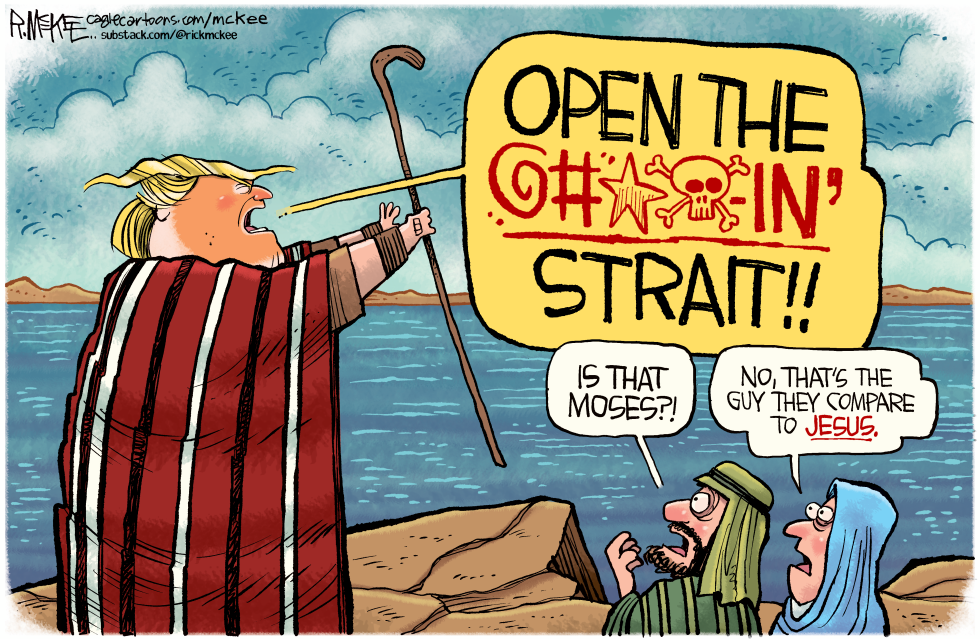
Rick McKee's cartoon depicts a blond-haired man resembling Donald Trump, dressed in red robes, holding a staff and yelling 'OPEN THE C@#*in' STRAIT!!' at a body of water, evoking the Moses parting the Red Sea scene. In the foreground, two ancient-dressed figures converse: one asks if it's Moges, the other clarifies it's the guy compared to Jesus. The image ties into tags like Trump, Easter, Iran, Israel, war, Strait of Hormuz, blending biblical imagery with modern political satire on Trump's self-comparisons and international tensions. The censored profanity adds a layer of obscenity to the parody, set against a desert landscape with clouds.
John Darkow's cartoon captures the Artemis II crew gazing through their spacecraft window at the far side of the moon, where craters frame an unexpected sight: the Midvale School for the Gifted from Gary Larson's The Far Side, complete with a striped-shirted figure fumbling at a 'pull' door on stairs. Tagged with artemis ii, moon flyby, far side, gary larson, nasa, space, and science, the image blends real space exploration with absurd humor. One crew member exclaims excitement, labeled with Artemis II Crew and NASA markings. This satire highlights the blend of high-stakes missions and pop culture whimsy, poking fun at what astronauts might hope to find beyond the visible lunar surface. The dry wit underscores how science fiction tropes collide with actual programs like Artemis II.
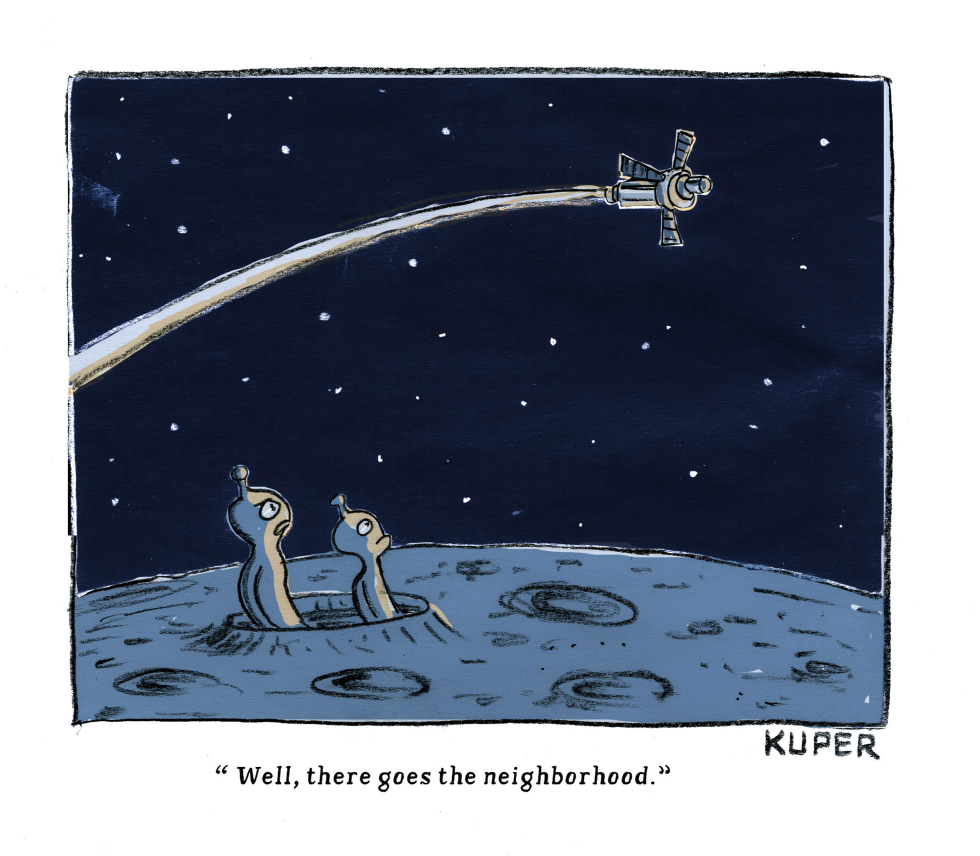
Peter Kuper's cartoon shows two blob-shaped aliens peeking from a crater on the moon's surface, eyes fixed on a departing rocketship trailing exhaust. The dark side of the moon setting includes craters and a starry sky, with the caption 'Well, there goes the neighborhood.' Tags like Artemis II, astronauts, Canada, United States NASA, dark side of the moon, and orbiting highlight the satirical take on human space exploration intruding on alien territory. The image pokes fun at the idea of extraterrestrials reacting to NASA's mission, blending science, data, and humorous alienation.
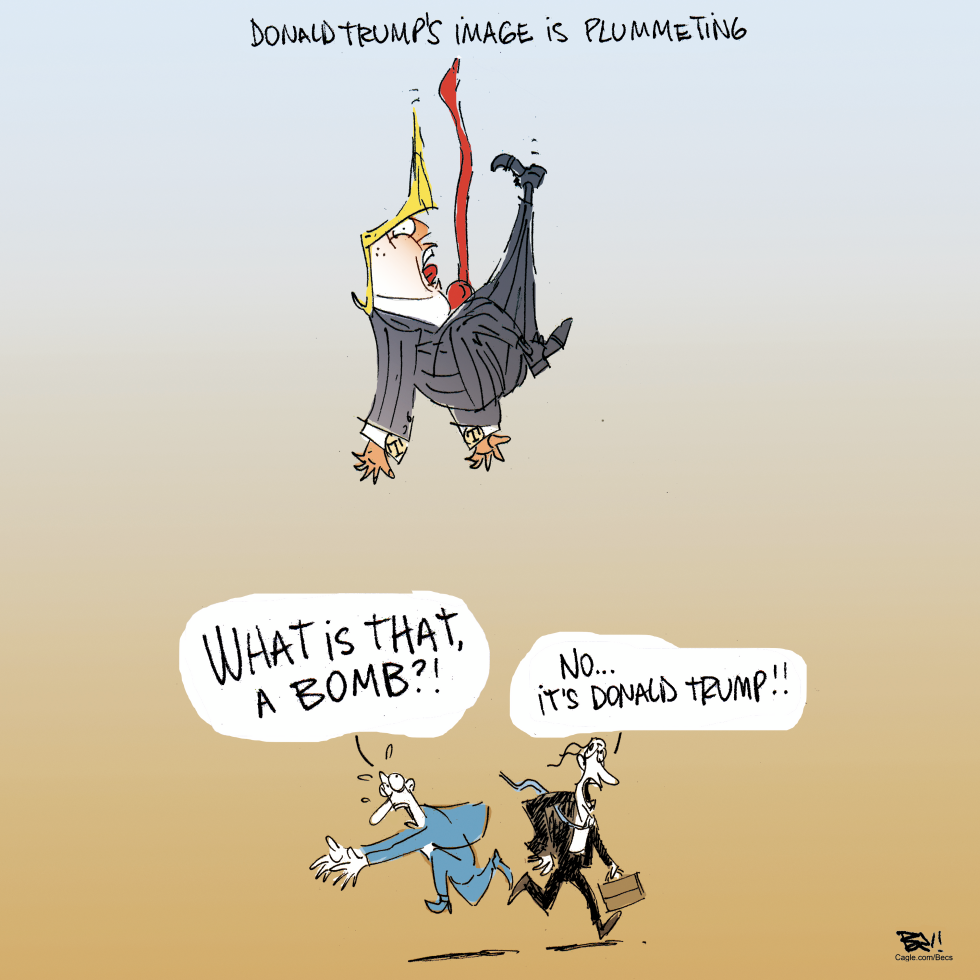
The cartoon depicts a figure with yellow hair and red tie, clearly caricaturing Donald Trump, diving headfirst from the sky like a falling bomb, mouth agape and limbs flailing. Below, two suited men run in panic, one asking if it's a bomb, the other identifying it as Trump. The title declares 'Donald Trumps Image is Plummeting,' playing on the pun of falling popularity. This piece skewers the Trump administration in the US for saying one thing then another, coming off as perverse and arrogant. It portrays him as thinking he's a king, the absolute tyrant of the world, with Europe and the world fed up. The dry humor lands through the visual metaphor, emphasizing global exasperation.