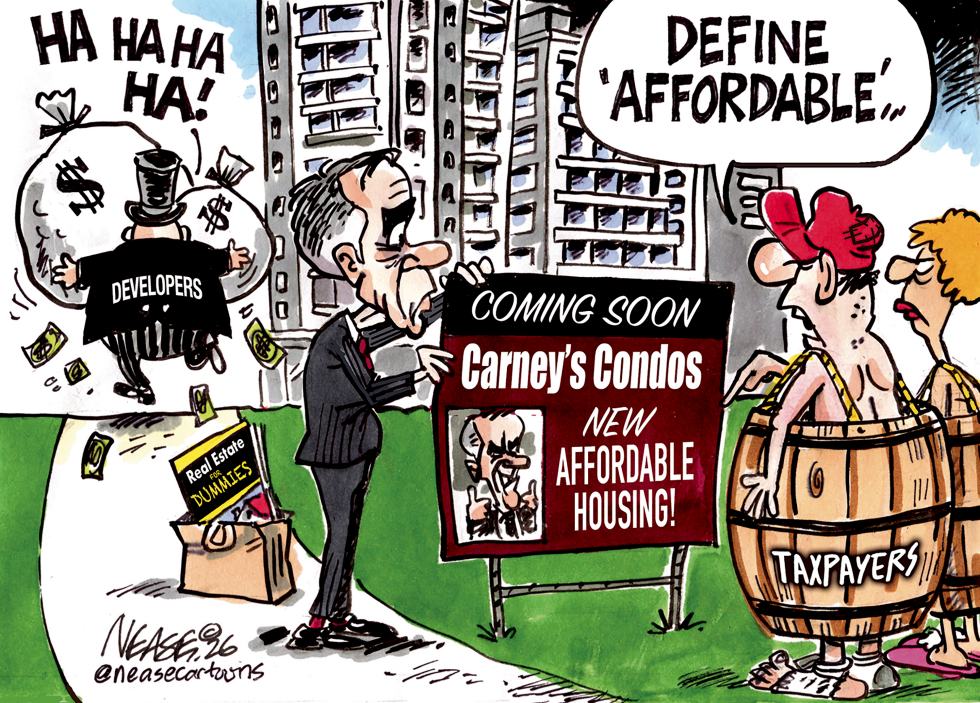
A real estate sign for Carney's Condos promotes new affordable housing. Developers in top hats collect money while laughing. Two taxpayers trapped in barrels question the definition of affordable. A book on real estate basics sits on the ground near high rise buildings.
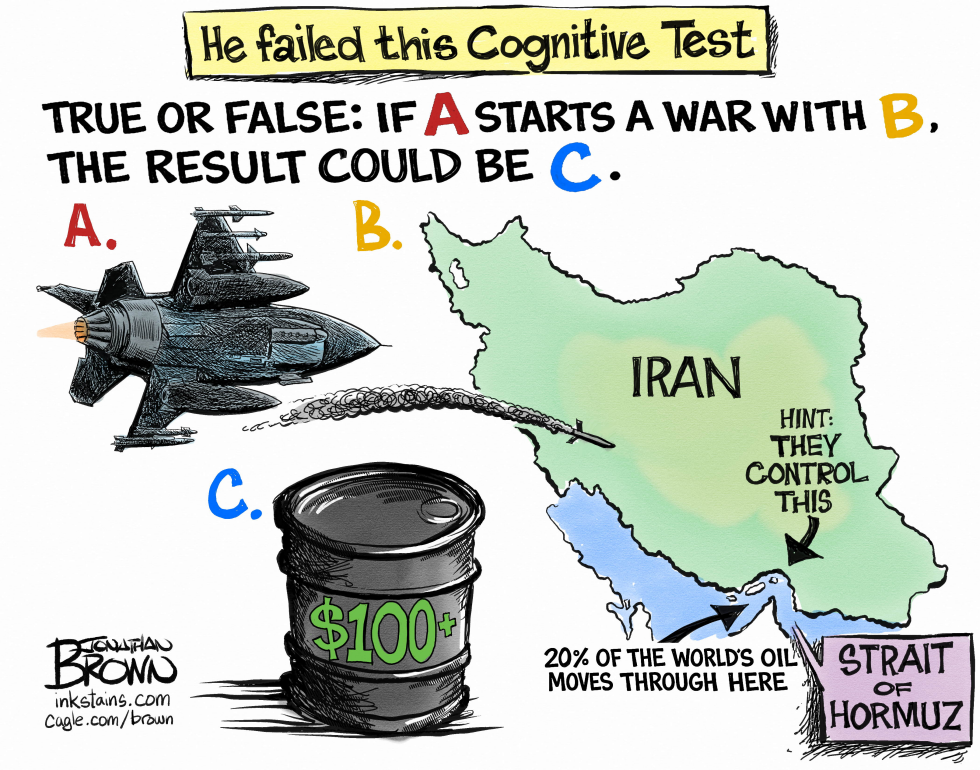
Jonathan Brown's cartoon presents a stark true-or-false cognitive test: if A (a fighter jet) starts a war with B (Iran), the result could be C (an oil barrel marked $100+). The map of Iran includes a hint pointing to the Strait of Hormuz, noting that 20% of the world's oil moves through there, underscoring control over this chokepoint. Tags such as cognitive test, war in Iran, oil prices, Strait of Hormuz, gas prices, and cost of war frame the satire. The artwork warns of economic fallout from conflict, with the jet trailing toward Iran and the oil barrel symbolizing surging costs. This piece captures geopolitical tensions in a simple, visual riddle.
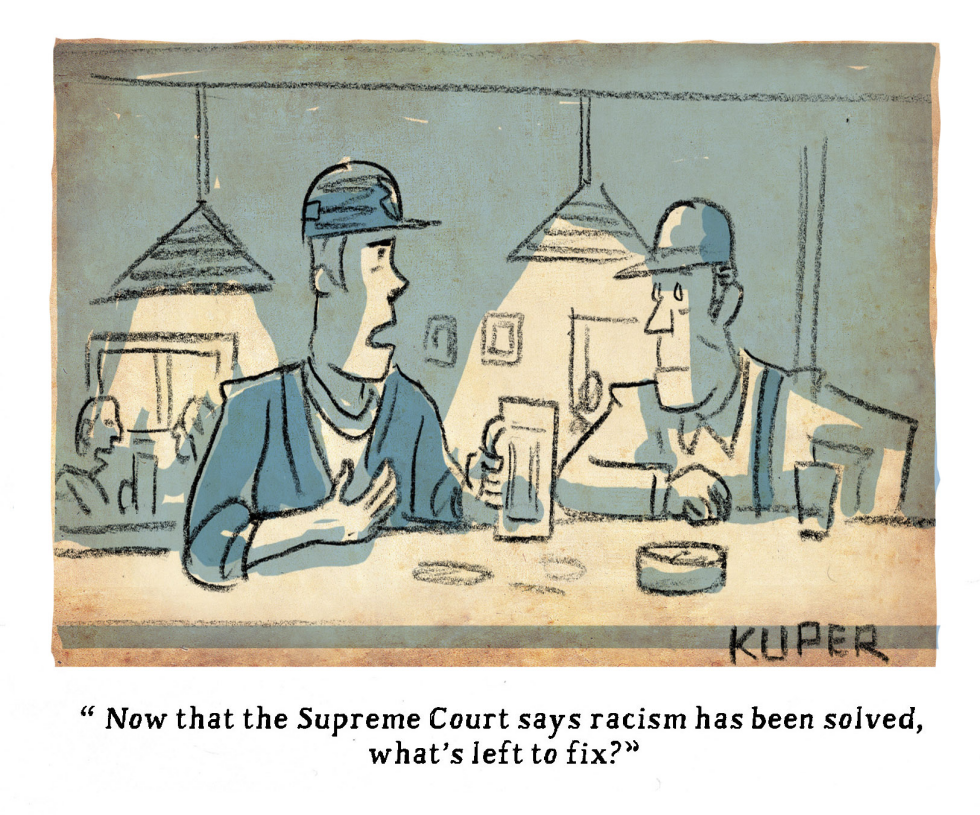
The cartoon depicts two men at a bar reacting to a Supreme Court decision on the Voting Rights Act. One asks what is left to fix now that racism is declared solved. The image responds to recent rulings affecting redistricting and voter access in states like Louisiana. Justices including Roberts and Thomas are referenced in related tags. The piece highlights ongoing debates over race and electoral rules.
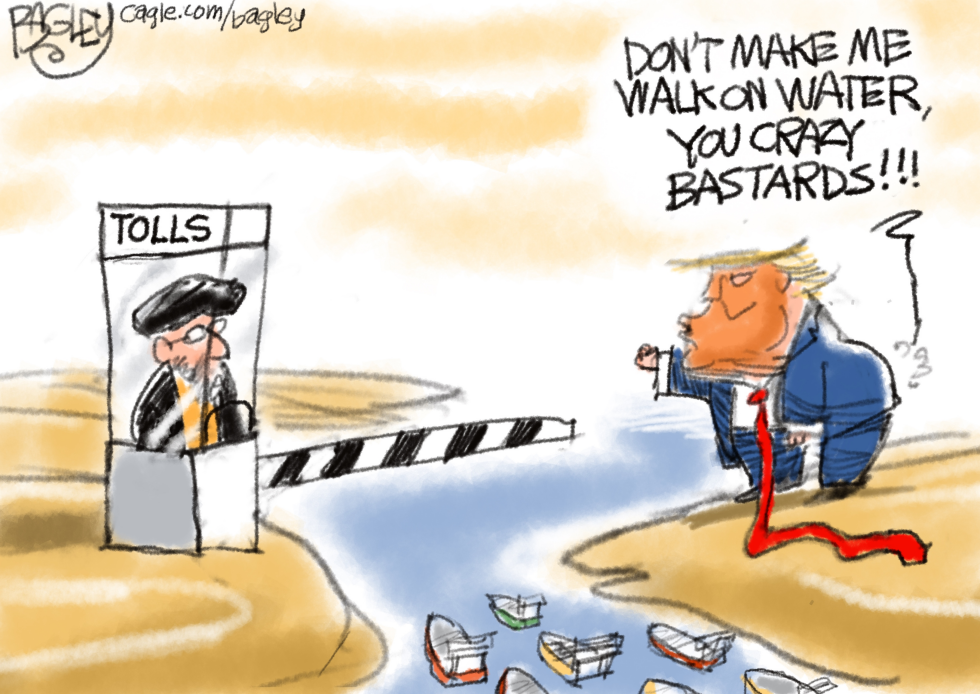
Donald Trump stands at the edge of a body of water confronting a toll booth operated by a figure resembling Ayatollah Khamenei. Small tankers sit in the water below while Trump issues a warning about walking on water. The scene references shipping routes through the Strait of Hormuz and surrounding nations.
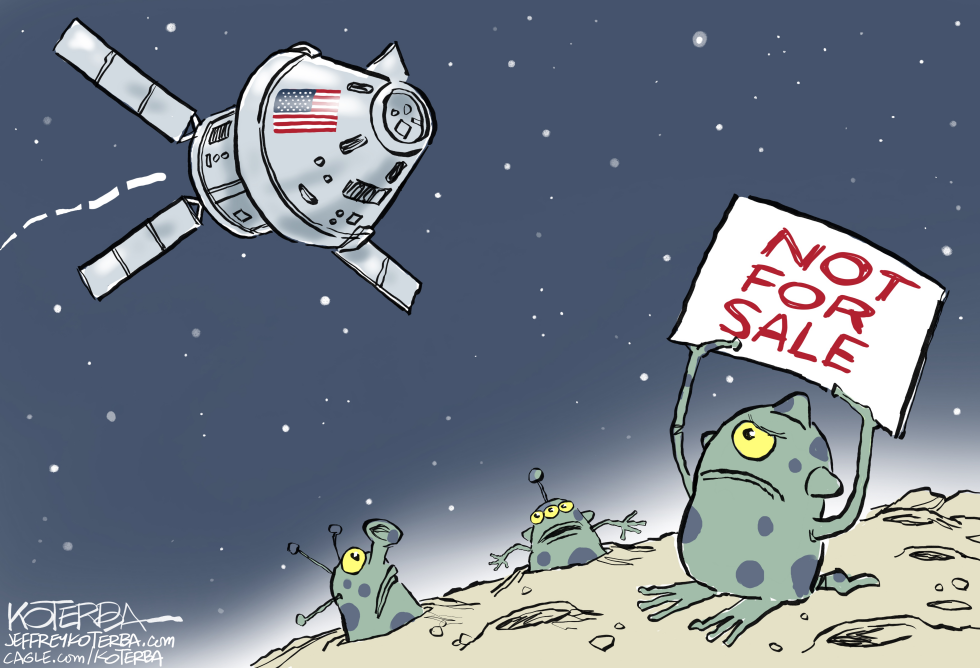
This political cartoon depicts green aliens on a sandy, moon-like surface, with one holding a \'NOT FOR SALE\' sign in red letters, facing a flying spacecraft adorned with an American flag and solar panels. The starry night sky background enhances the space exploration satire, while the trail behind the ship suggests approach. Incorporating elements like cartoon monsters, property rights protest, and US imperialism humor, the image offers an irreverent take on cosmic real estate. The artist\'s signature in the bottom left adds authenticity to this insightful editorial illustration, poking fun at human ambitions in outer space.
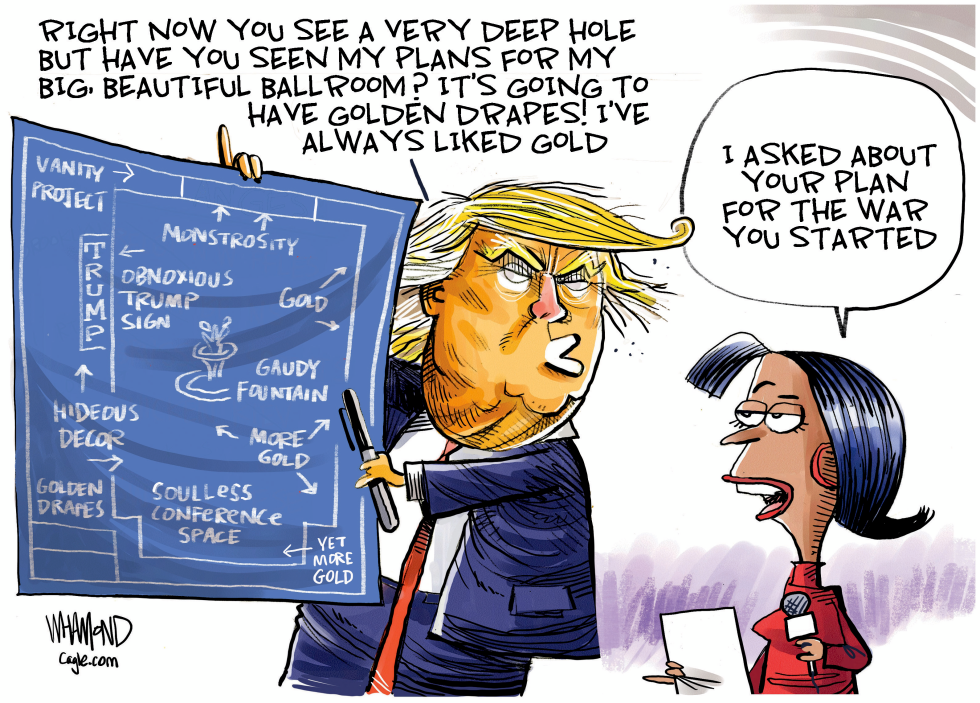
Dave Whamond's cartoon captures Trump in a classic pose, holding up a blueprint riddled with tags like vanity project, monstrosity, Trump obnoxious Trump sign, gaudy fountain, hideous decor, golden drapes, soulless conference space, and repeated calls for more gold. The scene unfolds with Trump enthusiastically describing a very deep hole for his big beautiful ballroom, emphasizing his love for golden drapes. A female reporter, microphone in hand, points out the mismatch, stating she asked about the plan for the war he started. This setup skewers Trump's apparent lack of strategy, turning serious inquiries about Iran war, no endgame, quagmire, military campaign, regime change, and improvising into a punchline about frivolous vanity. The dry humor lands on the contradictions, with Trump's focus on gaudy aesthetics over critical issues like troops in danger and boots on ground.
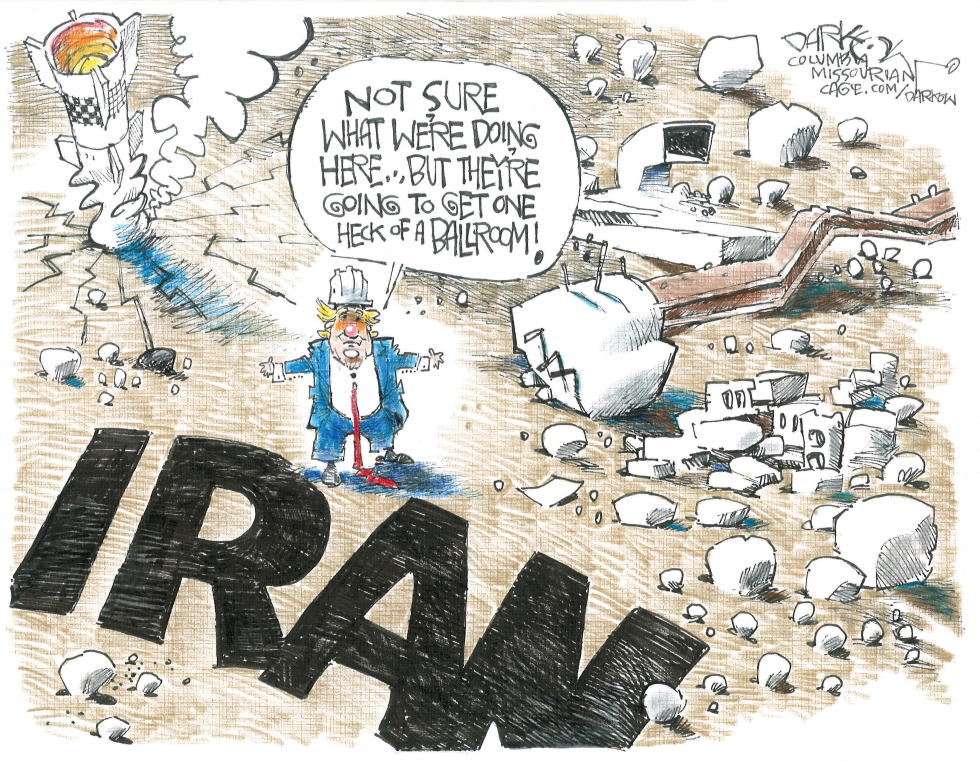
This biting political cartoon features a caricatured Donald Trump in a construction hard hat, overlooking a bombed-out landscape labeled 'IRAN,' with a missile launching in the background. His speech bubble confesses confusion over US actions but promises 'one heck of a ballroom,' a sly pun on Trump's real estate empire clashing with foreign policy blunders. Incorporating tags like political satire, Trump caricature, Iran nuclear program, US-Iran relations, geopolitical humor, and Trump hotel pun, the image mocks the haphazard withdrawal from the nuclear deal, suggesting it paves the way for Iran's nuclear ambitions while Trump envisions luxury redevelopment. The ruined buildings and debris emphasize the destructive fallout, blending humor with insightful critique on Middle East instability.
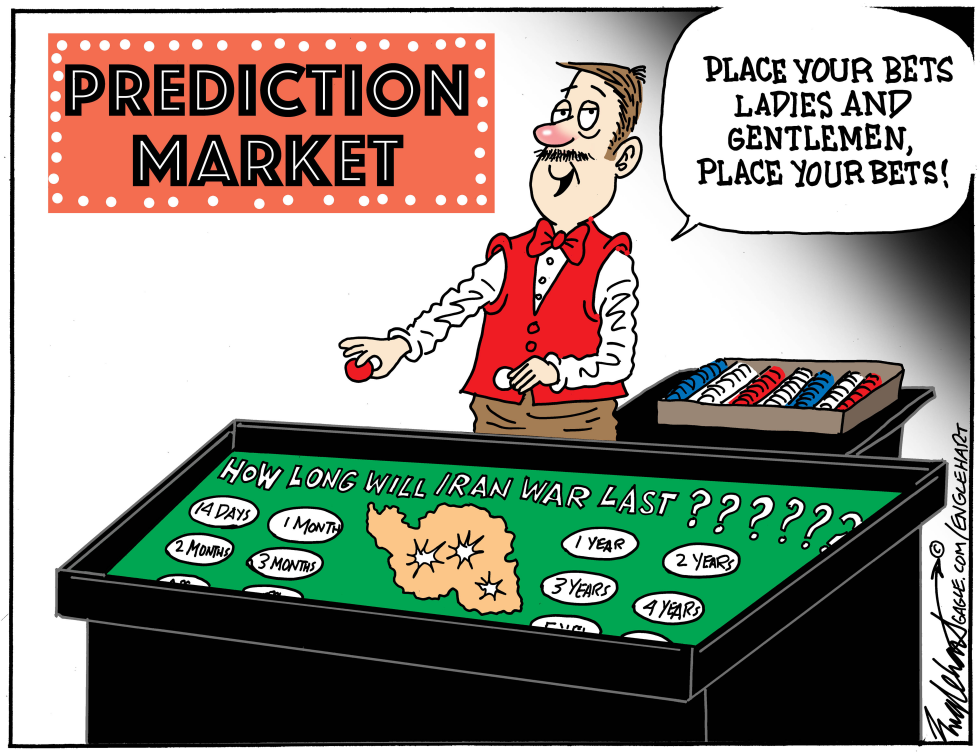
In a biting political cartoon, a smirking croupier oversees a prediction market table shaped like Iran, complete with explosion graphics, where punters can wager on war duration options ranging from 14 days to 5 years. This satirical take skewers the commodification of geopolitical betting, turning grave matters like Iran war into casino-style gambles. By blending elements of gambling on war with Middle East conflict, the artwork highlights the absurdity of prediction markets applied to real-world crises, offering humorous yet insightful commentary on how society speculates on political humor and potential catastrophes. The irreverent style underscores the folly of treating war length wager as just another market fluctuation.
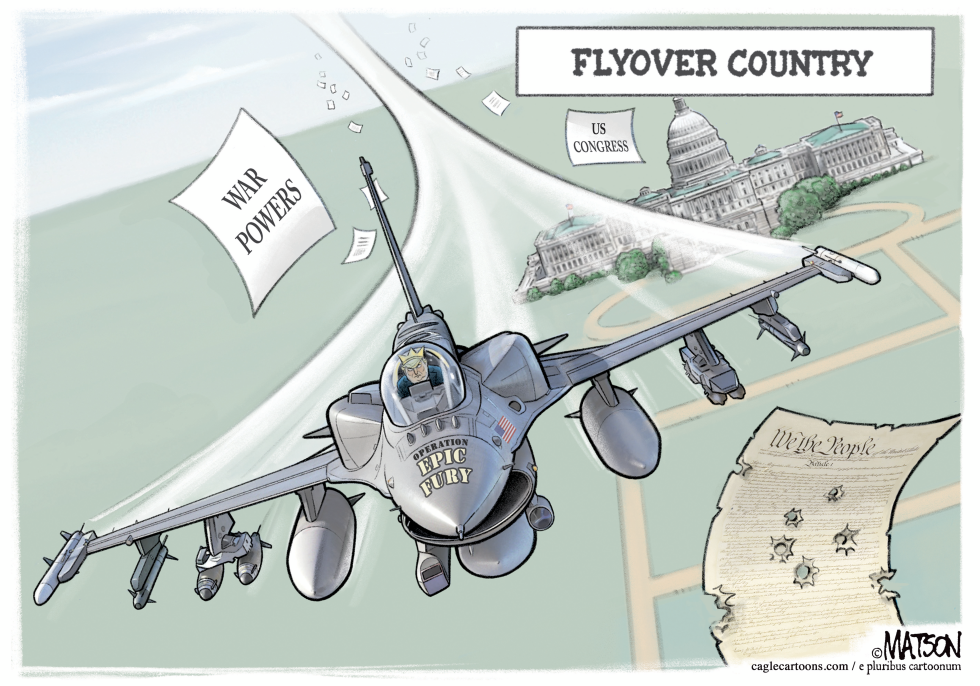
This sharp political cartoon captures the essence of executive overreach, with a fighter jet dubbed 'Epic Fury' zooming past US Congress, discarding war powers documents like confetti over flyover country. The torn US Constitution riddled with bullet holes symbolizes the erosion of constitutional principles amid unchecked military actions. Tags like political cartoon, war powers, US Congress, flyover country, US Constitution, and executive power underscore the satire on how presidents often sidestep legislative approval for wars, leaving the heartland—flyover country—to bear the brunt. It's a humorous yet insightful critique of the power imbalance in Washington, where the Capitol is just a scenic detour on the path to conflict.
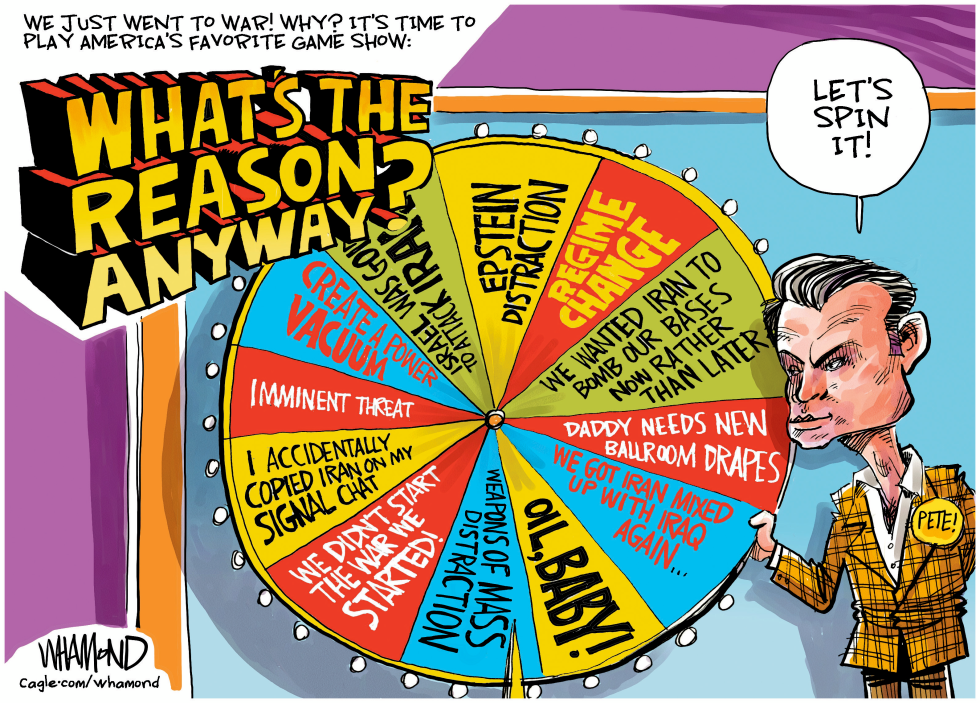
Dive into this biting political cartoon where America's war decisions are reduced to a game show parody wheel, featuring options like 'Imminent Threat,' 'Oil, Baby!,' and 'Regime Change.' The irreverent satire targets US foreign policy, highlighting how military interventions often spin on flimsy pretexts, from accidental escalations to resource grabs. With a host eagerly spinning the wheel, the artwork cleverly critiques the absurdity of war justifications, blending humor with insightful commentary on geopolitical cynicism. Tags like political cartoon, war justifications, and military intervention humor underscore its viral potential in today's polarized discourse.
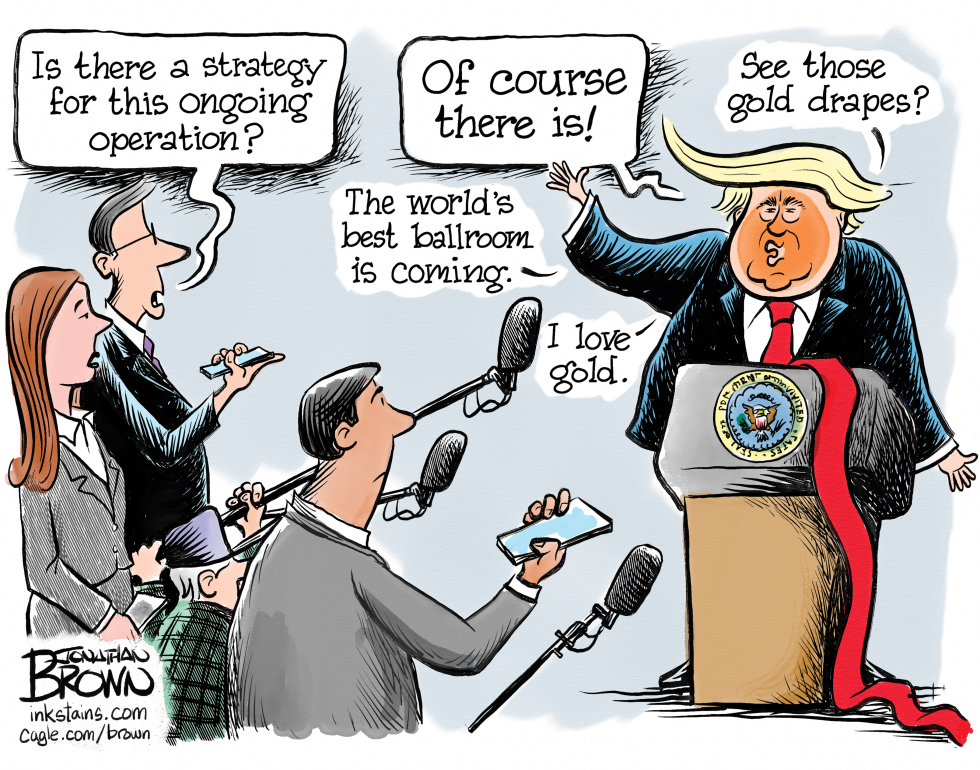
Jonathan Brown's cartoon captures a press conference scene where a figure resembling Trump stands at a podium with a presidential seal, gesturing toward imagined gold drapes. Reporters ask about strategy for an ongoing operation, likely tied to tags like War in Iran and Iran War. The response shifts focus to a coming ballroom, emphasizing love for gold in a White House setting. This satirical piece uses dry humor to point out misplaced priorities in strategy discussions. The artwork features exaggerated features and speech bubbles, common in political cartoons, poking fun at leadership styles amid tags like Strategy and Ballroom.
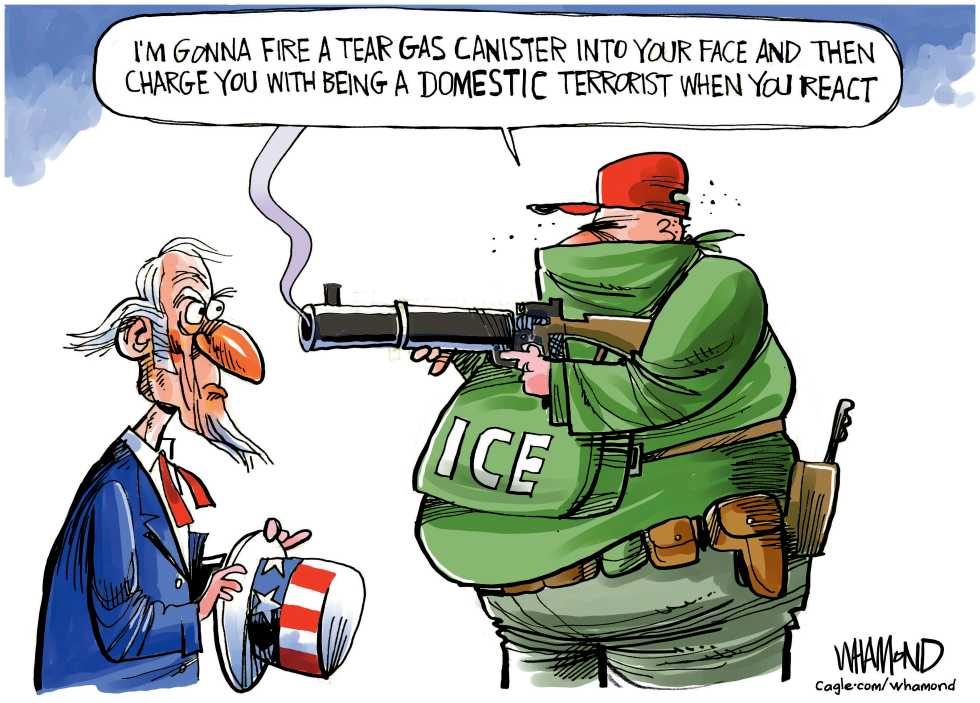
In this sharp political cartoon by Whamond, a bloated ICE agent, donning a red cap and green uniform, points a tear gas launcher directly at Uncle Sam's face, uttering a chilling threat to fire and then charge the iconic American symbol with being a domestic terrorist upon reaction. The imagery critiques government overreach, immigration enforcement tactics, and the weaponization of labels like domestic terrorism to stifle protest suppression and civil liberties. Uncle Sam, holding his stars-and-stripes top hat, represents the nation's foundational values under assault, while the ICE figure embodies authoritarian tactics in border patrol. This editorial cartoon underscores the tension between law enforcement critique and human rights, making it a timely piece on political humor amid ongoing debates on freedom of speech.
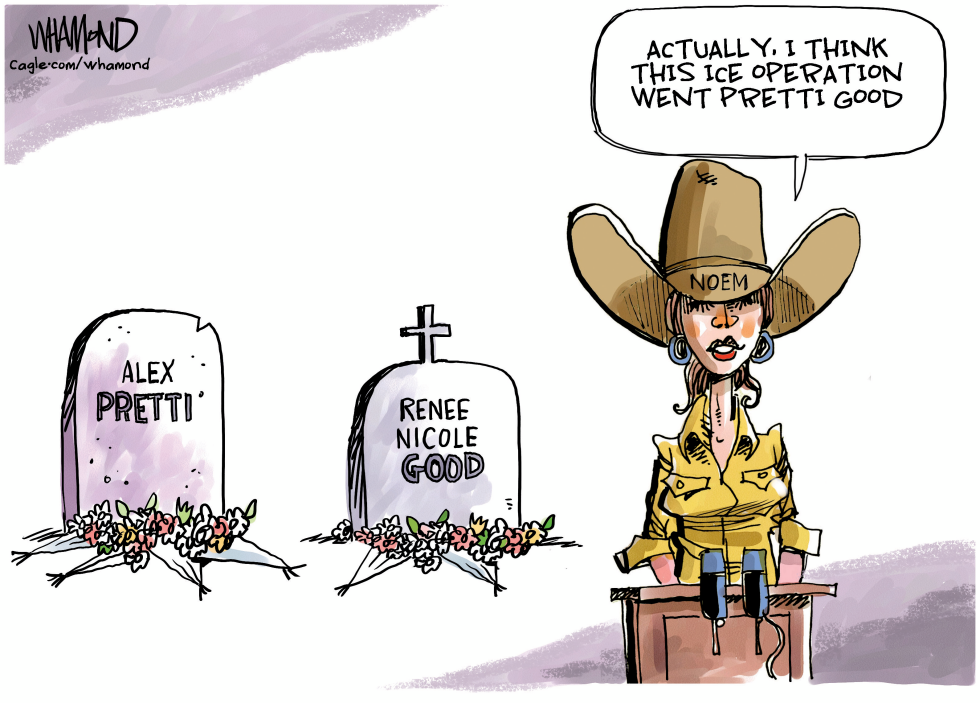
This political cartoon by Whamond features South Dakota Governor Kristi Noem, a prominent Republican and potential Trump ally, wearing a cowboy hat labeled 'NOEM' and speaking at a podium. She declares, 'Actually, I think this ICE operation went pretty good,' while standing beside two gravestones inscribed with 'Alex Pretti' and 'Renee Nicole Good,' adorned with flowers. The image satirizes immigration enforcement, border policy, and the human cost of deportation, highlighting perceived political callousness toward migrant deaths. Through humor and irony, it critiques how politicians like Noem might downplay tragedies in ICE operations, making it a sharp editorial cartoon on current Republican stances.
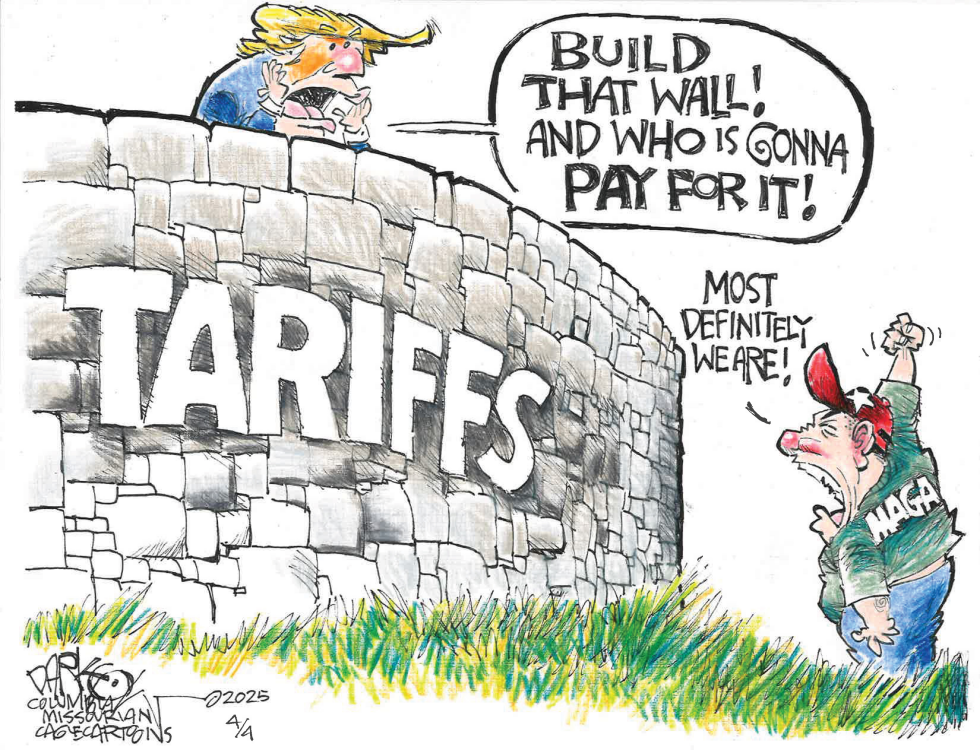
The cartoon shows a blond-haired man atop a stone wall marked 'TARIFFS,' shouting 'Build that wall! And who is gonna pay for it!' A red-hatted figure in a 'MAGA' shirt below responds 'Most definitely we are!' This setup draws a parallel to familiar chants, underscoring tariffs as a burden on consumers. Tags like Trump, tariffs, build the wall, MAGA, inflation, economy, trade war, backfire, and recession frame the scene. The dry humor lies in the obvious irony, where supporters unwittingly acknowledge the cost. Composition keeps it simple, with grassy base and bold lettering for impact. Such cartoons thrive on timely policy jabs, making this one sharable amid ongoing trade debates.
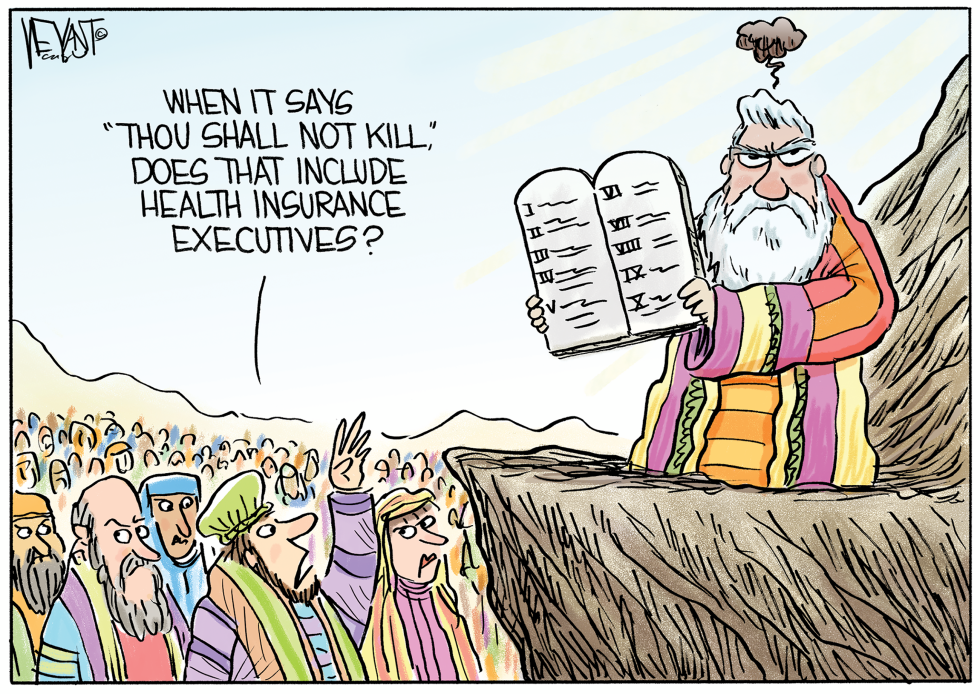
The cartoon shows Moses atop a rocky peak, stone tablets in hand, with Roman numerals visible on them. A crowd of robed figures gathers below, one raising a hand. The question in the speech bubble ties the ancient commandment to modern frustration with health insurance executives. This piece uses biblical imagery to critique the health care system, where denials and costs can feel life-threatening. The dry humor underscores public anger toward corporate figures in insurance, making a pointed satirical statement without overt violence.