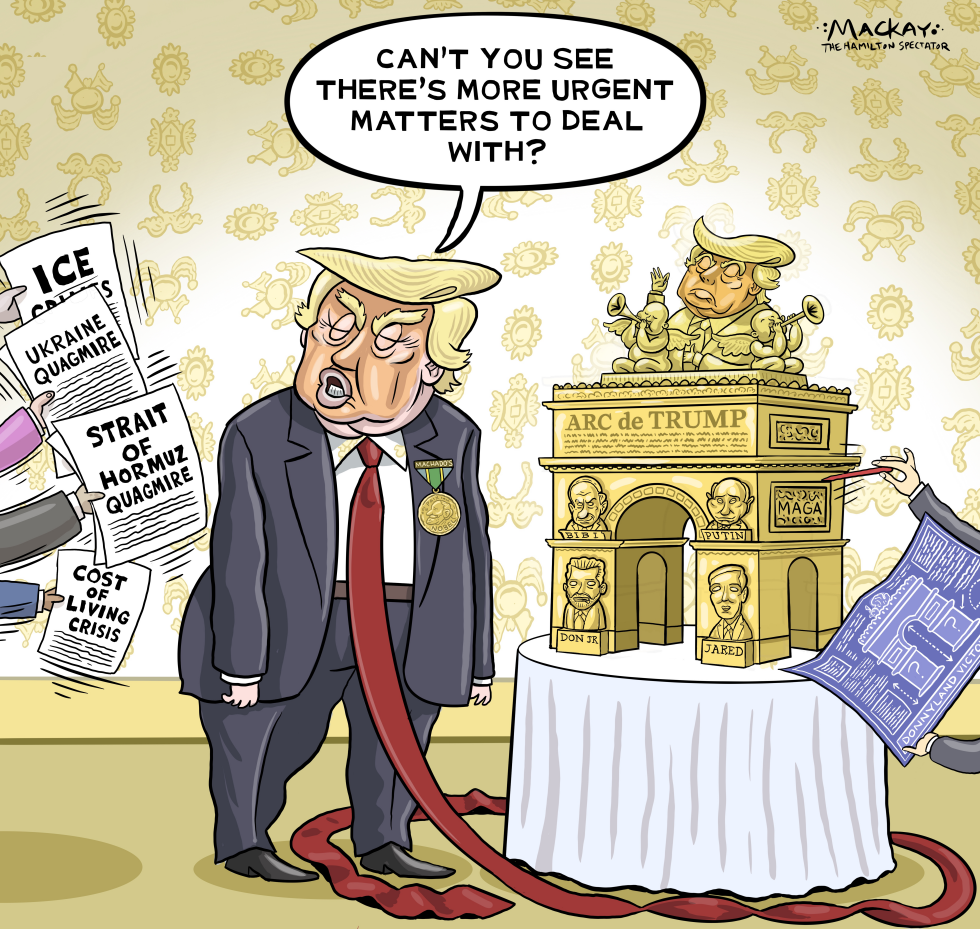
Graeme MacKay\'s cartoon depicts Donald Trump absorbed in unveiling a golden Arc de Trump, a parody of the Arc de Triomphe, topped with his own figure and cherubs, while ignoring flying papers labeled with crises like ICE crisis, Ukraine quagmire, Strait of Hormuz quagmire, and cost of living crisis. The monument includes busts of Don Jr, Ivanka, MAGA, and Jared, emphasizing Trump\'s priorities on vanity over urgent matters. A hand unveils blueprints for Donald J. Trump Arc de Victoire, highlighting the satire on legacy obsession amid global quagmires. The dry humor underscores how such self-focus distracts from real-world affordability and international issues, a common theme in editorial cartoons critiquing political figures.
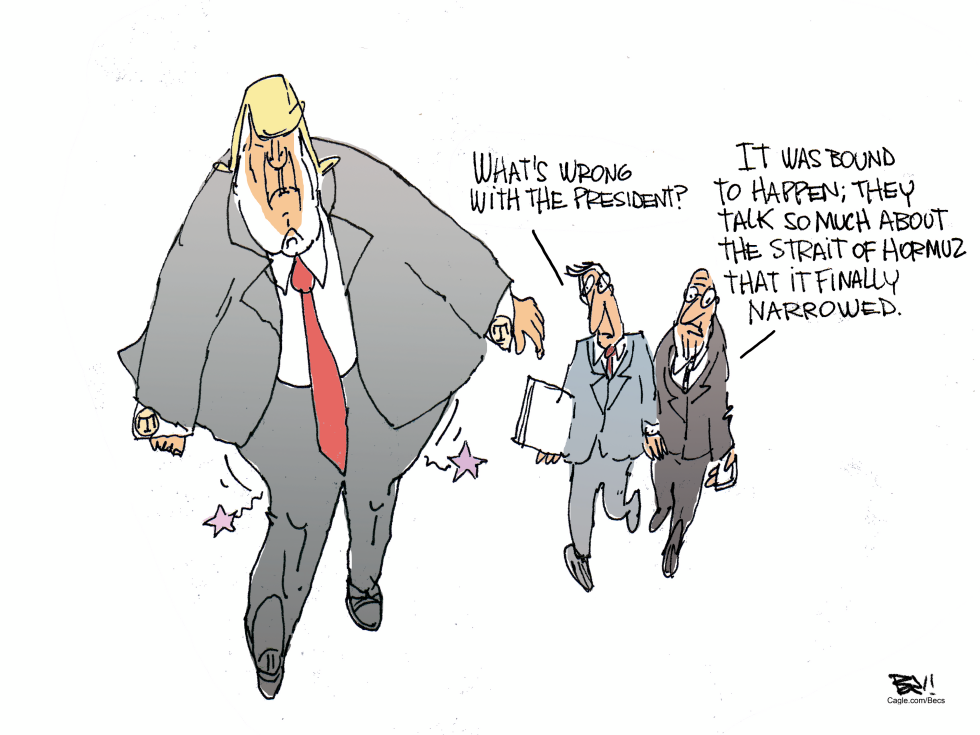
Becs captures the Donald Trump Administration's fixation on the Strait of Hormuz in a cartoon where the president appears stricken, with aides commenting on the inevitable 'narrowing' due to endless talk. This US War satire ties into oil dependencies, Iran tensions, and price per barrel fluctuations, showing a large Trump figure clutching his side amid a pun on geopolitical chokepoints. The image underscores how constant rhetoric about the strait leads to comedic physical distress, blending humor with commentary on foreign policy obsessions.
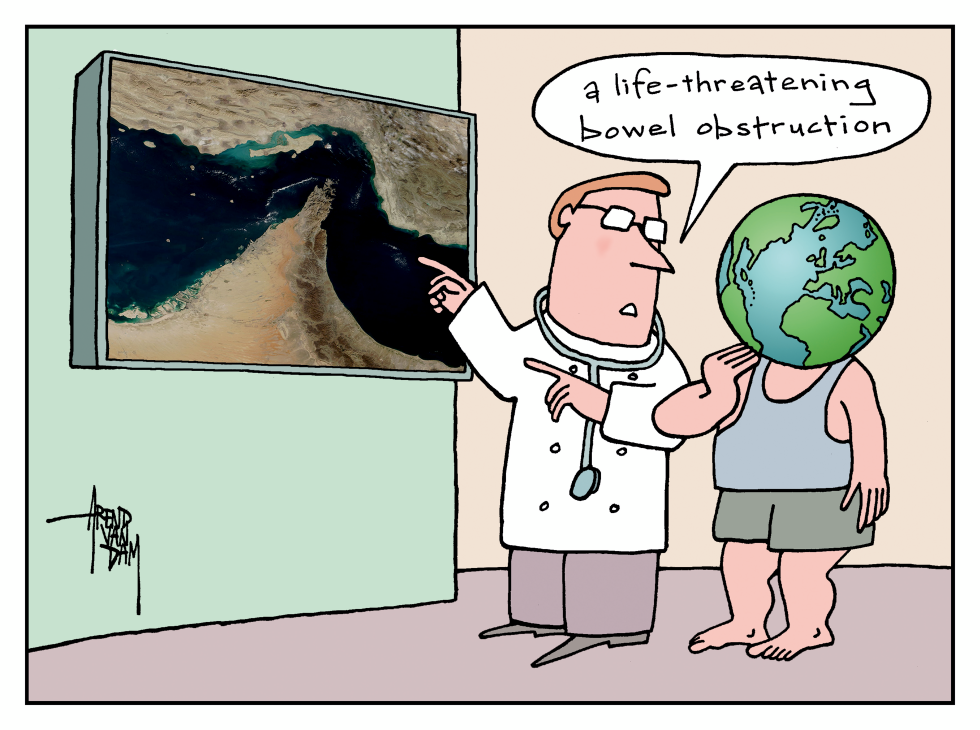
Arend van Dam\'s cartoon depicts a doctor diagnosing a child-like figure with a globe for a head, pointing to a screen showing the Strait of Hormuz as a life-threatening bowel obstruction. This visual metaphor ties into tags such as economy, world, oil, gas, obstruction, and war, illustrating how blockages in key trade routes threaten global stability. The barefoot patient in casual attire underscores vulnerability, while the doctor\'s serious demeanor adds dry humor to the geopolitical satire. Negotiations with ayatollahs and regime sanctions loom in the background, making the image a pointed commentary on how such conflicts create economic chokepoints. The overall composition blends medical analogy with international affairs for sharable impact.
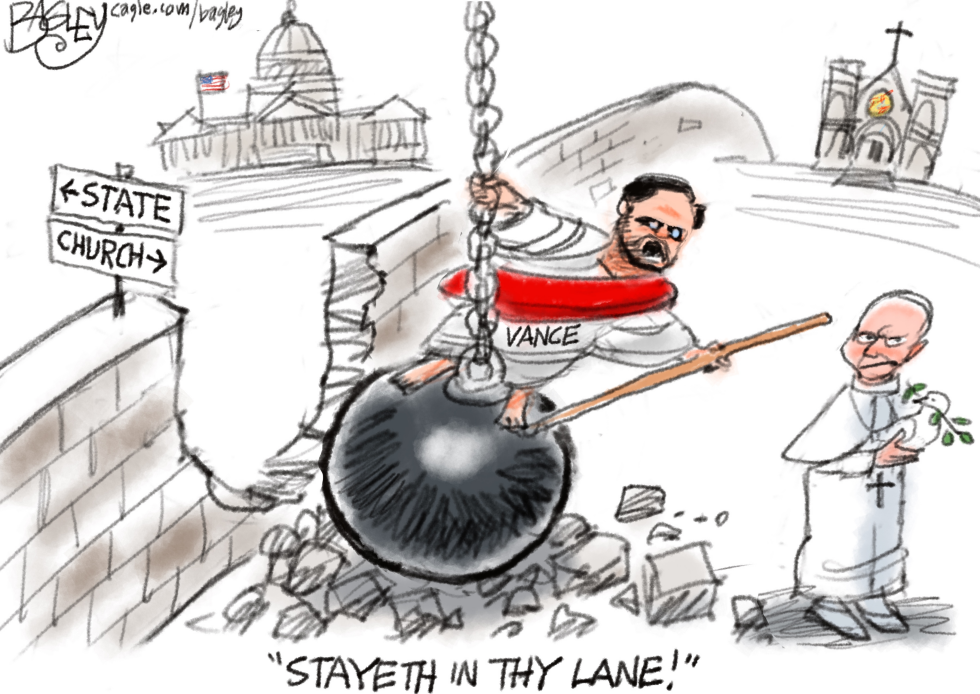
Pat Bagley's cartoon shows JD Vance dressed as Jesus, labeled 'VANCE,' swinging a massive wrecking ball to shatter a brick wall marked with signs pointing to 'STATE' and 'CHURCH.' He shouts 'STAYETH IN THY LANE!' at a figure resembling the Pope, who holds an olive branch and dove, symbols of peace. In the background, the U.S. Capitol flies an American flag, while a church with a cross represents the Vatican. Tags like war, peace, JD Vance, religion, Trump, and scripture underscore the satire on blurring lines between church and state, with Vance enforcing boundaries ironically through destruction. The image critiques political figures invoking religion amid Capitol politics.
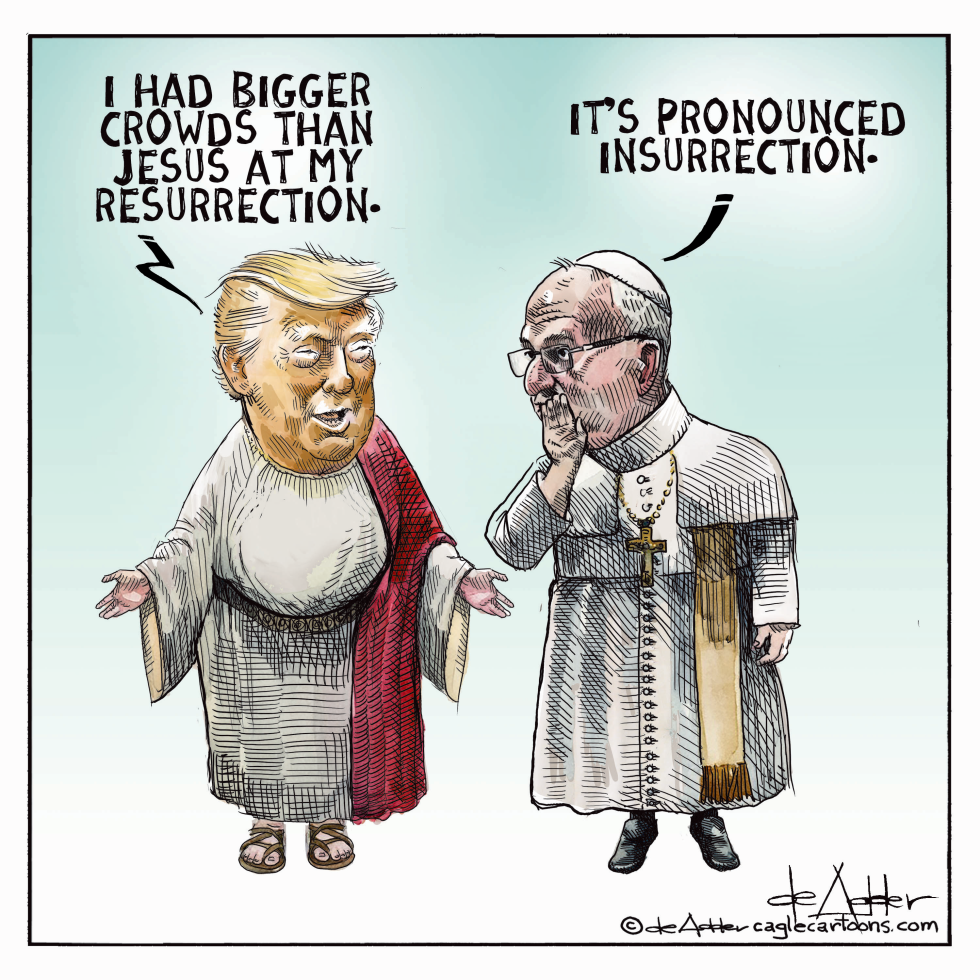
The cartoon depicts Donald Trump as Jesus Christ, complete with robe and sandals, claiming he had bigger crowds than Jesus at his resurrection. Standing beside him is the Pope, dressed in traditional Vatican attire with glasses and a cross, correcting the pronunciation to insurrection. Tags like Trump, Pope, Jesus, resurrection, and insurrection drive the humor, poking at Trump's known obsession with crowd sizes and linking it to the January 6 events. The artist, Michael de Adder, uses simple lines and a light background to focus on the figures and dialogue, creating a sharp satirical commentary on arrogance and political missteps. This piece fits well in editorial sections, blending religious imagery with current politics for a dry, pointed laugh.
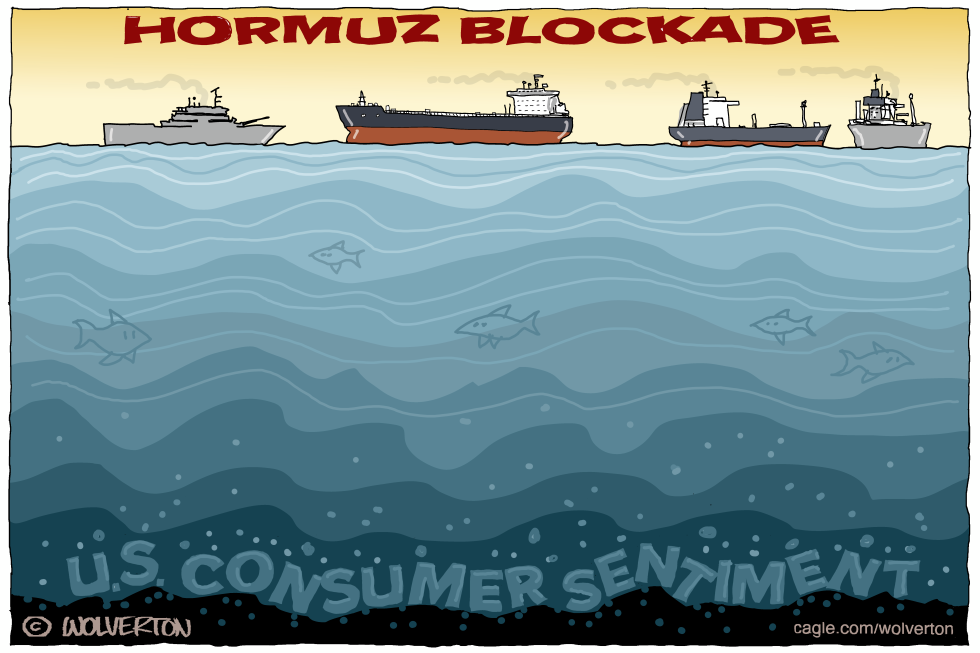
Monte Wolverton's cartoon captures the Hormuz Strait blockade with warships and tankers lined up on the water's surface, a clear nod to geopolitical strife in key oil passages. Below, the phrase U.S. consumer sentiment is etched into the ocean floor, surrounded by fish, driving home the idea of economic morale hitting rock bottom. This piece uses simple lines and color to highlight how international blockades can sink domestic confidence, tying into broader themes of global trade disruptions. The dry humor shines through in the visual pun, making it a standout in political satire circles. Tags like Hormuz Strait blockade political cartoon, US consumer sentiment sinking economy illustration, oil tanker ships naval blockade satire, Strait of Hormuz geopolitical tension comic, economic impact of Middle East conflict drawing, and consumer confidence underwater metaphor cartoon amplify its SEO reach.
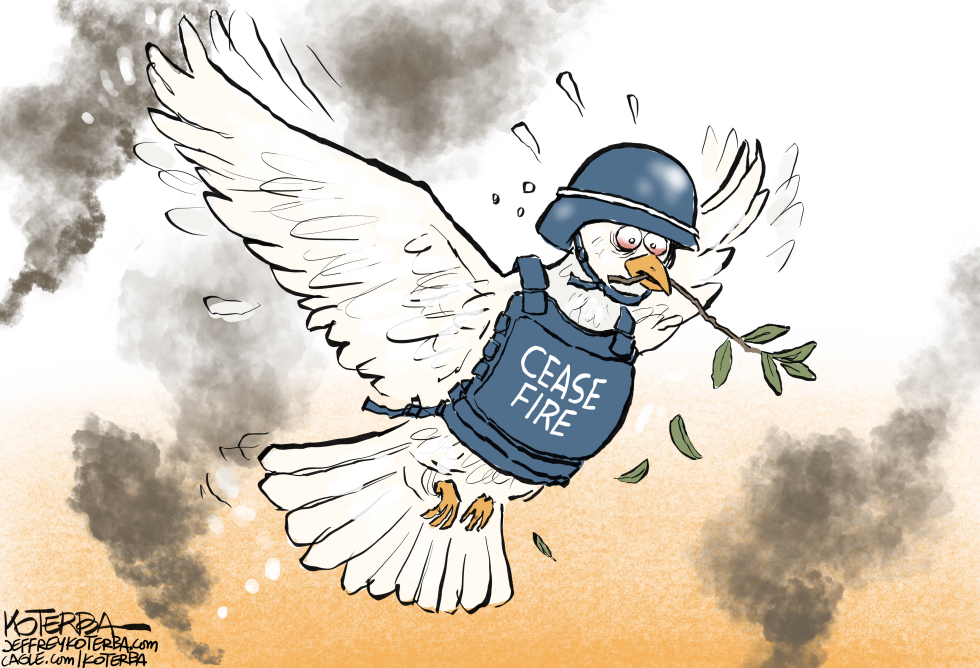
Jeff Koterba's cartoon shows a white dove, traditional symbol of peace, outfitted in a blue military helmet and a bulletproof vest marked 'CEASE FIRE.' The bird clutches an olive branch in its beak, eyes wide in surprise, as it navigates through billowing dark smoke clouds. This setup highlights the fragility of cease fire attempts in war zones, with the armored dove representing protected yet vulnerable peace initiatives. The orange-tinted background suggests a fiery landscape, emphasizing conflict's harsh reality. Tags like political cartoon, peace dove, cease fire vest, olive branch, war smoke, and satirical illustration capture the image's essence for SEO.
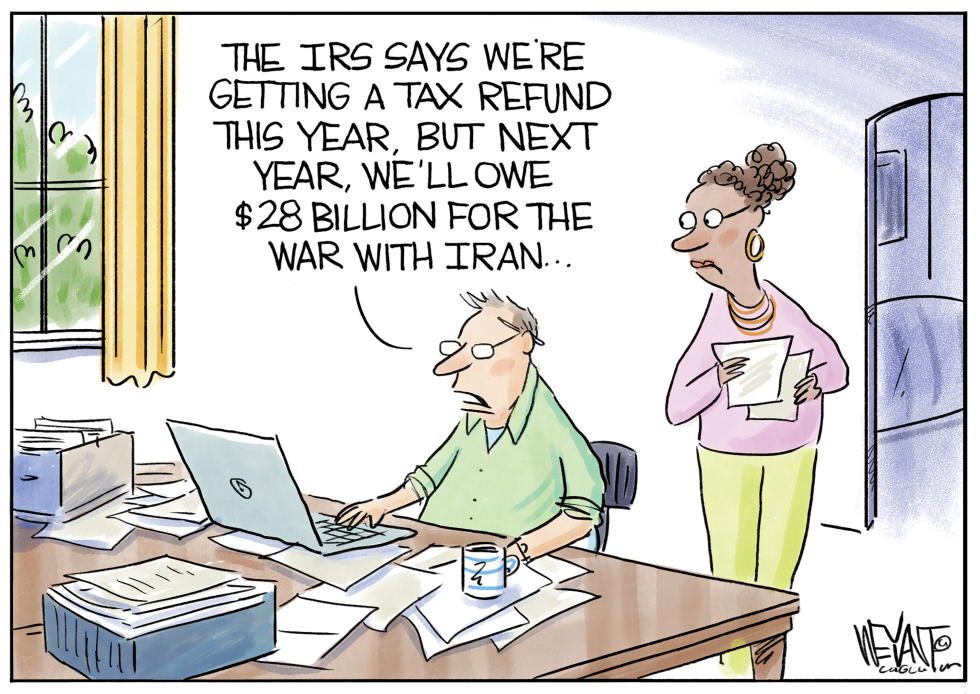
Dive into this biting political cartoon tax refund piece where a woman, holding papers, informs a laptop-working man about their IRS windfall this year, only to drop the bomb of owing $28 billion next for the war with Iran. The satirical cartoon Iran war vibe captures the absurdity of US taxes funding wars, with cluttered desks and exasperated expressions underscoring the humorous take on federal spending. It's a classic taxpayer burden Iran conflict jab, poking fun at government spending satire while illustrating the disconnect between personal finances and massive military expenses. Through cartoon about military expenses, it cleverly critiques fiscal policy in an office setting, making the war with Iran taxpayer joke both relatable and irreverently insightful for viewers pondering editorial cartoon fiscal policy.
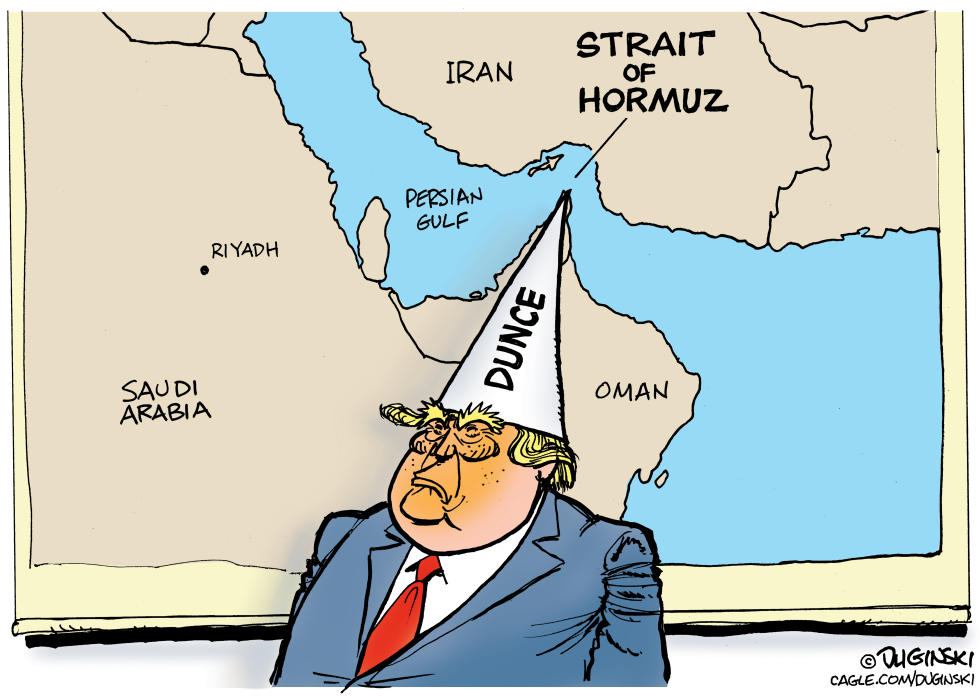
The cartoon depicts a simplified map of the Middle East, including labels for Iran, Saudi Arabia, Oman, Riyadh, and the Persian Gulf. The Strait of Hormuz is prominently marked, with a caricatured man in a suit and red tie wearing a dunce cap labeled \'DUNCE\' positioned over it. This setup uses the strait as a choke point for oil and energy, tying into themes of foreign policy, war, and ignorance. The image critiques handling of Middle East waterway issues, possibly linked to closure threats, tankers, and ceasefire efforts. Artist signature appears in the bottom right.
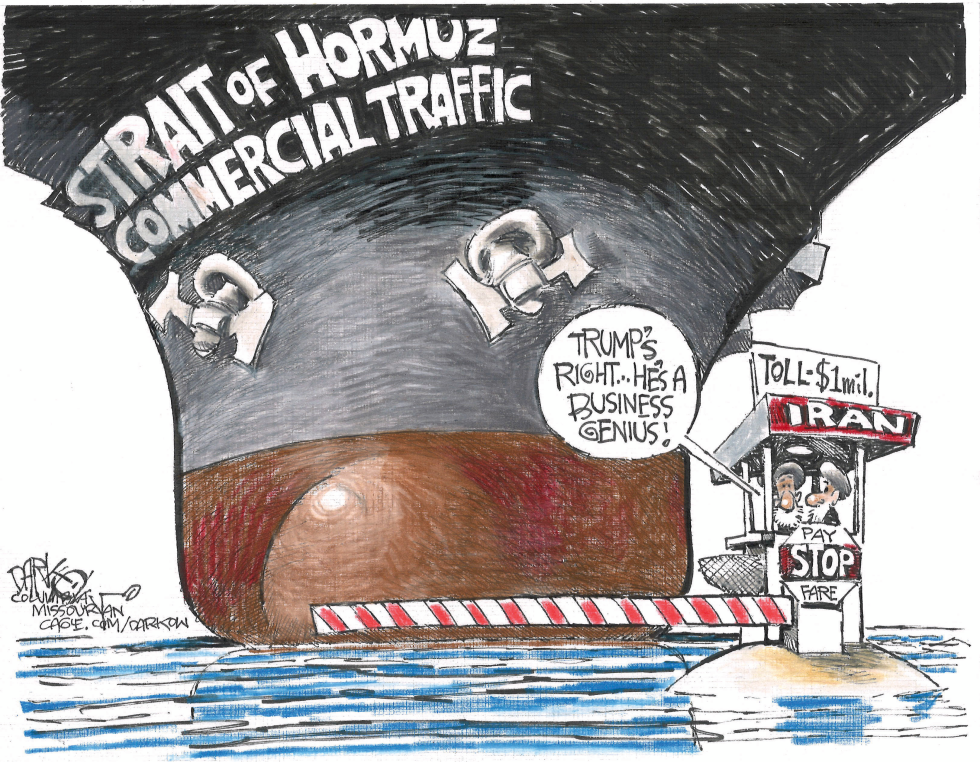
The cartoon shows a massive ship representing commercial traffic through the Strait of Hormuz approaching an Iran-operated toll booth charging one million dollars. Two figures in the booth exchange remarks crediting Trump with business acumen. The scene illustrates tensions over control of the vital shipping route between Iran and Gulf states.
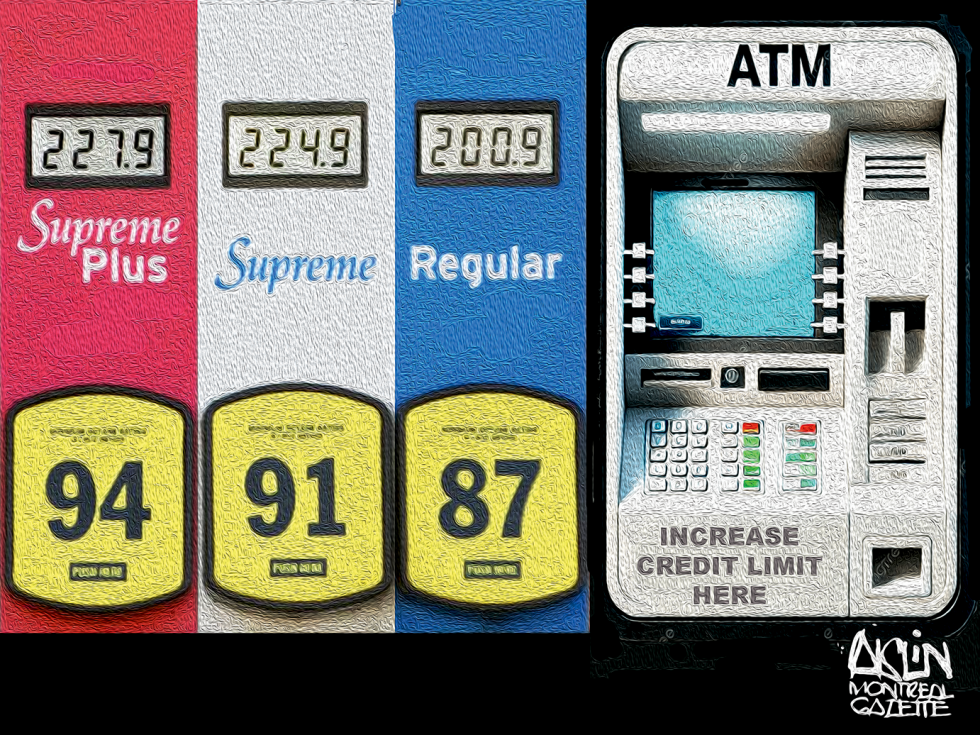
The cartoon shows a gas pump price board with supreme plus at 2.279 per gallon and 94 octane, supreme at 2.249 with 91 octane, and regular at 2.009 with 87 octane. Next to it sits an ATM labeled to increase credit limit here, poking at high gas prices and the economy's push toward more credit. Tags like gas, prices, cost, economy, credit, and pump underline the visual joke on affording fuel through debt. This setup captures the frustration with rising fuel costs without words, relying on the absurdity of blending a gas pump with credit services. Cartoonists often use such direct imagery to comment on everyday economic strains.
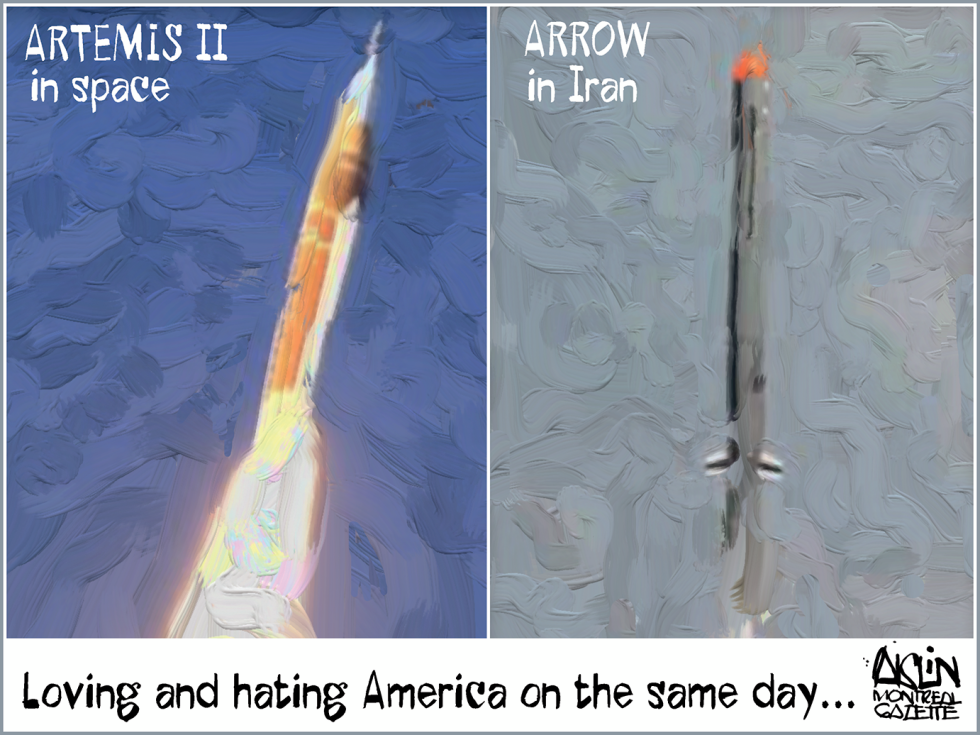
In this irreverent political cartoon, a vibrant Artemis II space launch rockets upward in a blue expanse on the left, symbolizing American innovation and triumph in US space exploration. Contrasting sharply on the right, a stark Arrow in Iran points downward with an orange glow against a gray sky, evoking geopolitical tension and Iranian weaponry. The caption 'Loving and hating America on the same day....' ties it together, offering a humorous take on the bipolar view of America in world news. With its simple yet effective composition, the artwork captures the absurdity of global perceptions, blending satire on international conflict with admiration for NASA's feats. This piece underscores the dichotomy in how the world engages with American power, from awe at space missions to ire over foreign policy frictions.
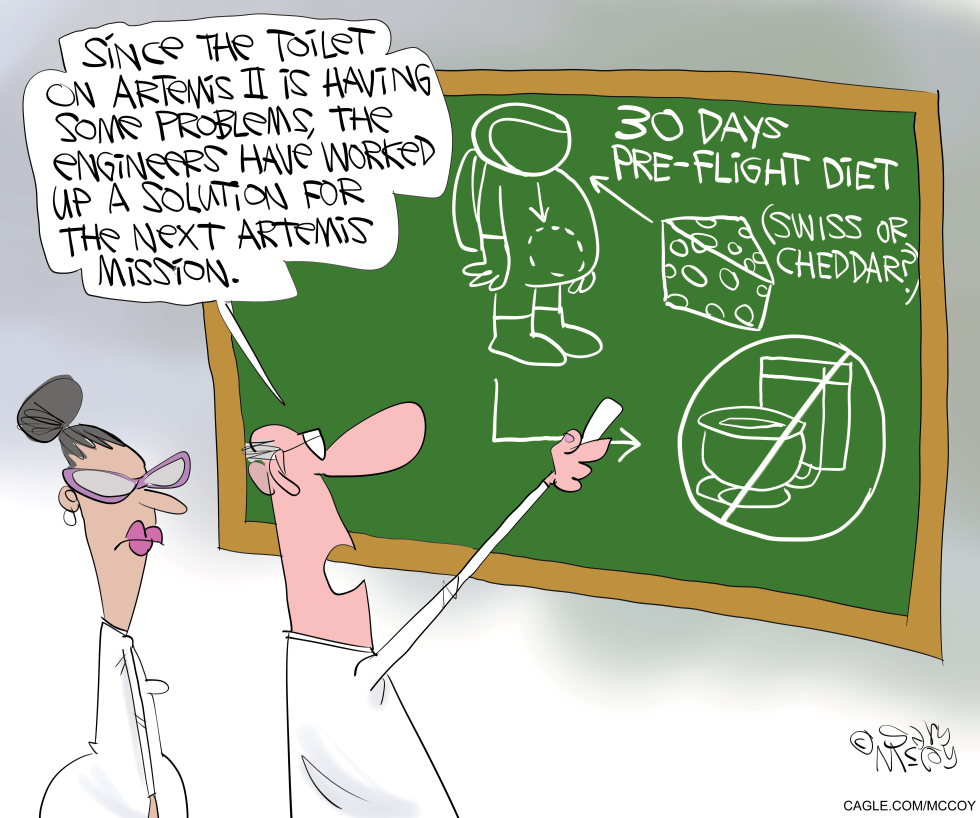
Gary McCoy\\\'s political cartoon depicts two figures in white coats, one pointing to a chalkboard with a speech bubble explaining a solution to Artemis II toilet problems via a 30-day pre-flight diet of Swiss or cheddar cheese. The board features a bloated astronaut sketch, a cheese cube, and a crossed-out toilet, poking fun at NASA engineering woes. This space mission satire uses dry humor to comment on technical glitches in the Artemis program, with tags like NASA Artemis II toilet problems, engineers solution Artemis mission, space mission pre-flight diet, Gary McCoy cartoon, cheesy diet fix, and humorous take on NASA solutions. The image stays light-hearted, focusing on visible elements without deeper speculation.
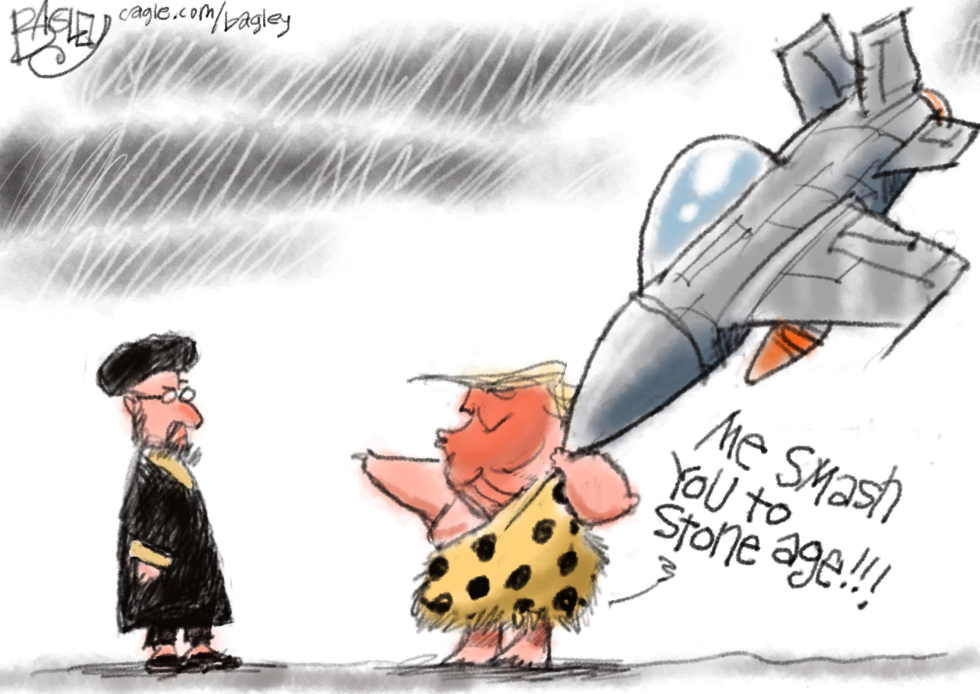
Pat Bagley's cartoon captures Trump as a caveman in a spotted tunic, gripping a fighter jet like a club, his face red with anger as he shouts 'Me Smash You to Stome age!!!' at a stern-faced man in black robes, beard, glasses, and hat under stormy skies. The scene underscores Trump threats, political satire, caveman caricature, fighter jet weapon, judge figure, and primitive aggression in a straightforward jab at regressive tactics. Editors see these kinds of drawings often, where exaggeration drives the point home without subtlety, making it shareable for those tracking US politics Trump style. The dry humor lies in the absurdity of modern weaponry in prehistoric hands, a classic cartoon trope that lands with insider familiarity.
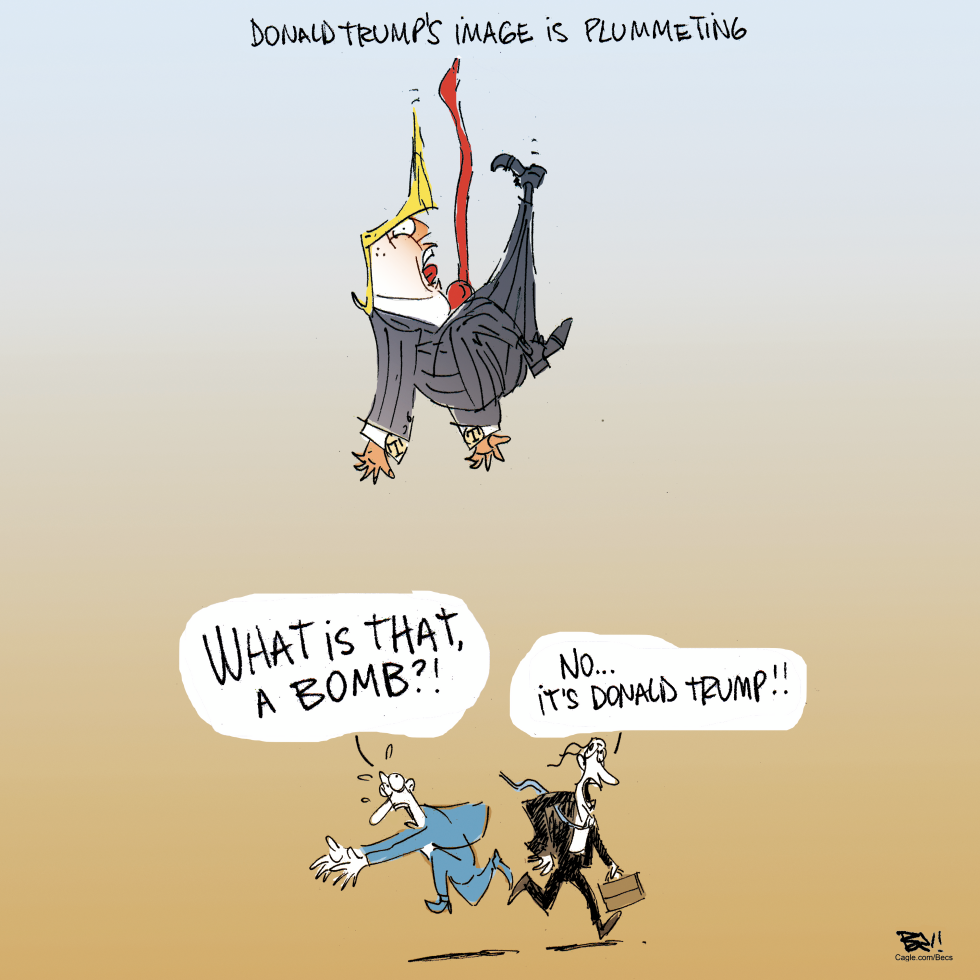
The cartoon depicts a figure with yellow hair and red tie, clearly caricaturing Donald Trump, diving headfirst from the sky like a falling bomb, mouth agape and limbs flailing. Below, two suited men run in panic, one asking if it's a bomb, the other identifying it as Trump. The title declares 'Donald Trumps Image is Plummeting,' playing on the pun of falling popularity. This piece skewers the Trump administration in the US for saying one thing then another, coming off as perverse and arrogant. It portrays him as thinking he's a king, the absolute tyrant of the world, with Europe and the world fed up. The dry humor lands through the visual metaphor, emphasizing global exasperation.