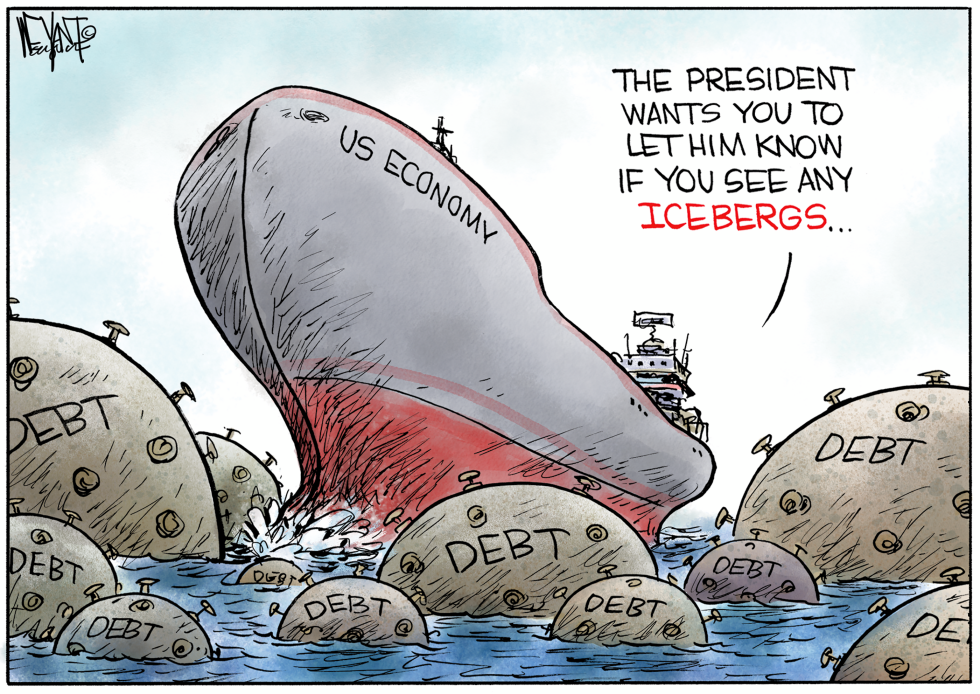
This political cartoon illustrates the US Economy as a massive ship labeled accordingly, dramatically sinking after colliding with numerous icebergs each marked 'DEBT.' A speech bubble from the ship warns to alert the president about icebergs, evoking the Titanic disaster in a clear metaphor for economic peril. Incorporating tags such as economy, debt, budget, inflation, prices, and costs, the image critiques fiscal irresponsibility. The artwork by Christopher Weyant uses simple lines and colors to emphasize the collision's impact, with water splashing and the ship's hull damaged. Such cartoons often highlight how mounting debt threatens stability, drawing parallels to historical maritime tragedies for satirical effect. The composition places the ship at an angle, surrounded by floating debt bergs, underscoring inevitable crisis if warnings go unheeded.
Arend van Dam's cartoon shows a gray battleship marked USA, complete with guns and missiles, driven by a figure in a suit at the wheel, as it goes over a waterfall between rocky cliffs under a blue sky. The image captures the essence of strategy failure in the Strait of Hormuz, tying into themes of Iran, ayatollahs, war, battleship mishaps, Middle East conflicts, oil, gas, energy, and economy. Such visuals often poke at misguided military moves, where the ship's plunge represents a dramatic downfall in strategic planning. The dry humor lies in the absurdity of a warship treating a strait like a river rapid, underscoring potential economic fallout from regional tensions. Cartoons like this thrive on clear, exaggerated metaphors that resonate with readers familiar with global news.
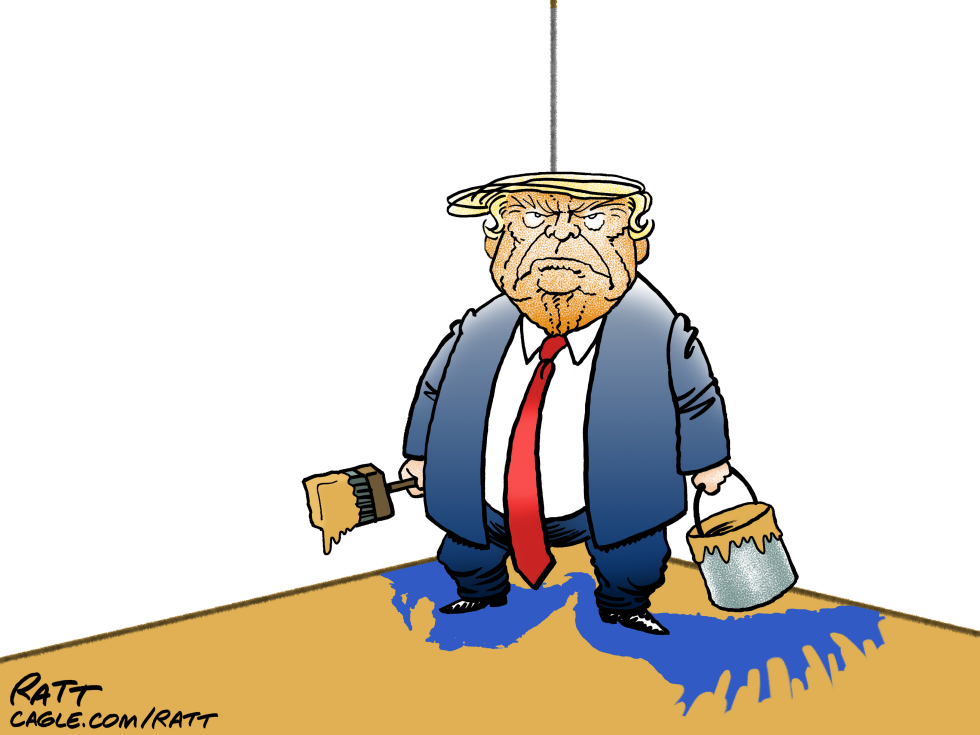
Donald Trump appears in a 2026 editorial image holding a paintbrush and bucket while standing on a blue painted area resembling the Strait of Hormuz. The scene responds to ongoing concerns over Iranian oil routes, potential conflict, and resulting effects on global oil and gas prices. The visual shows the figure applying paint that creates a path leading to restricted movement.
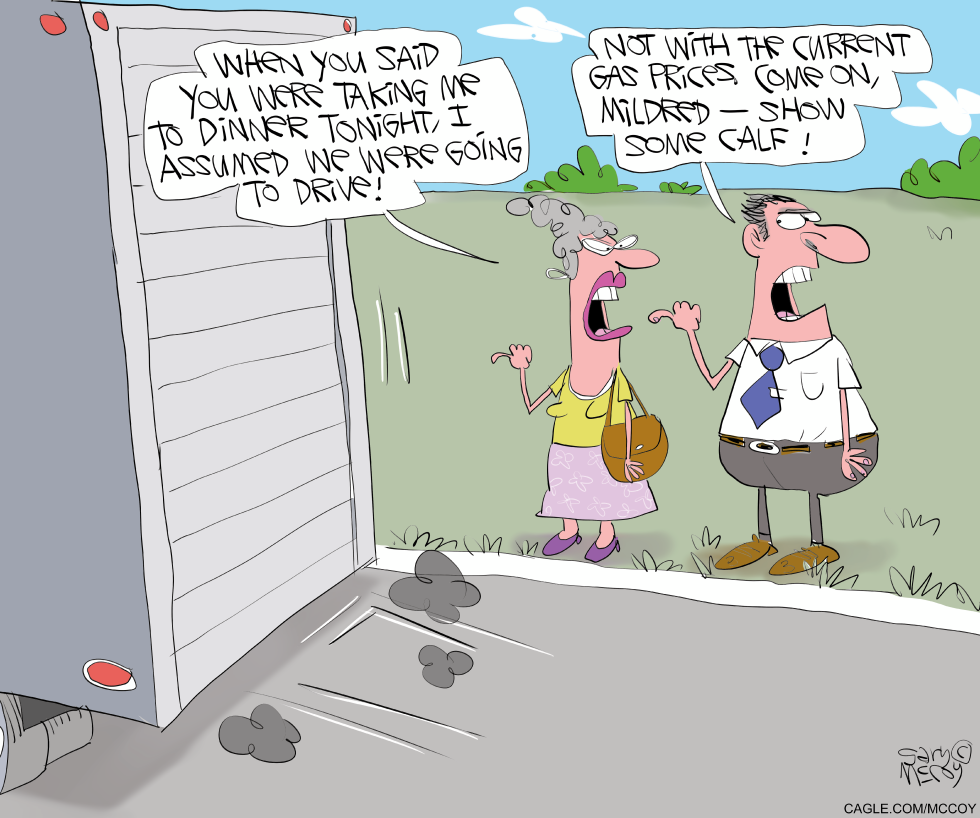
The cartoon depicts an elderly woman in a yellow top and purple skirt standing with a man in a white shirt and blue tie beside a large gray truck with its door open. Speech bubbles show the woman assuming a drive to dinner and the man citing current gas prices while suggesting she show some calf. The scene includes grass, sky, and tire marks on the ground.
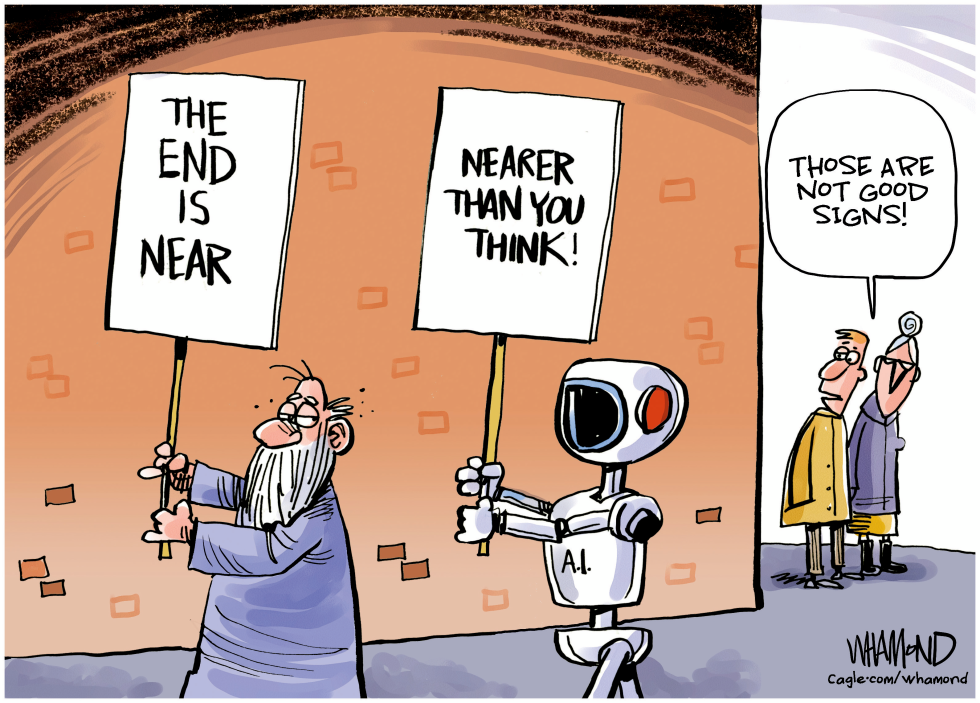
On April 29 2026 Dave Whamond depicts an elderly prophet and an A.I. robot both holding signs warning the end is near. The robot claims the end is nearer than the prophet thinks while two men react that the signs are not good. The image addresses ongoing public debate over artificial intelligence risks and workplace transformation.
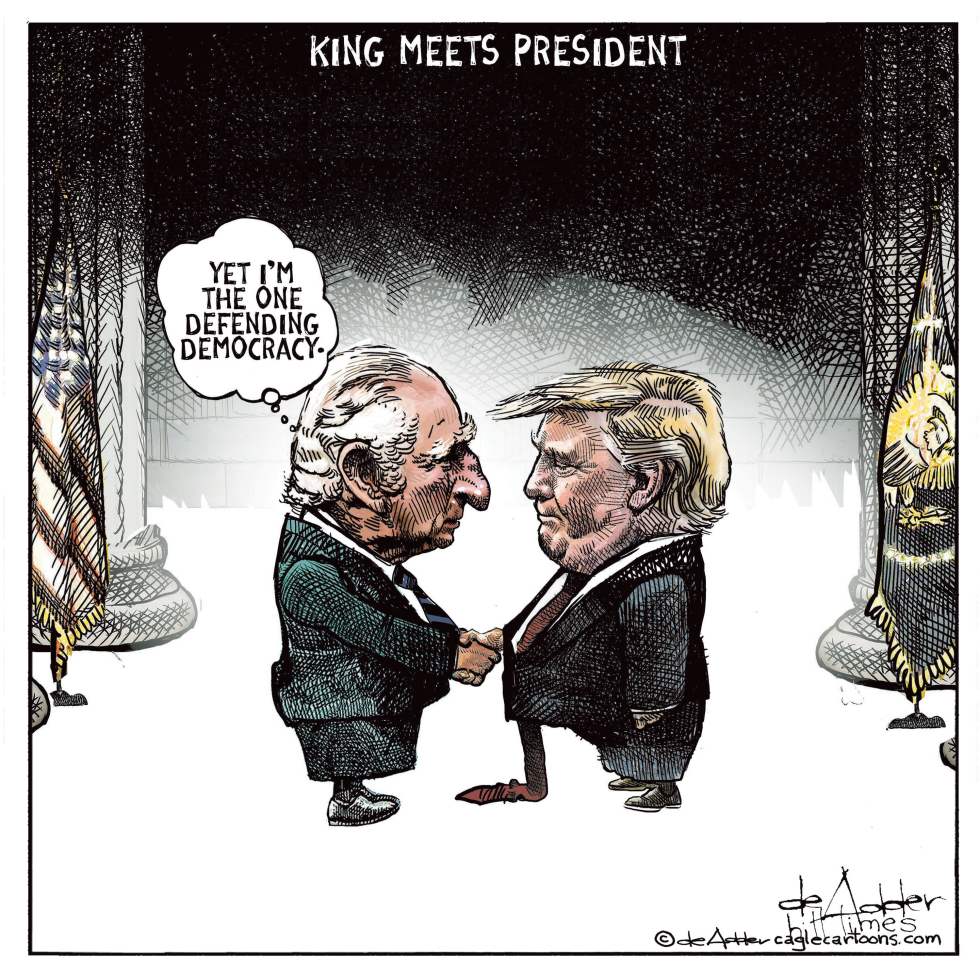
Michael de Adder's cartoon captures a handshake between King Charles and President Trump, set against American and implied British flags in a White House-like scene. The title 'KING MEETS PRESIDENT' tops the image, with Charles saying, 'Yet I'm the one defending democracy.' Tags like UK, United Kingdom, States, America, White House, Visit, State underscore the diplomatic theme. This satire touches on trade, tariffs, and economy without overreaching into unseen motives. The dry humor lies in the visual irony of two leaders in suits, one royal and one presidential, amid formal backdrops. Artistic style uses crosshatching for depth, keeping focus on the central exchange.
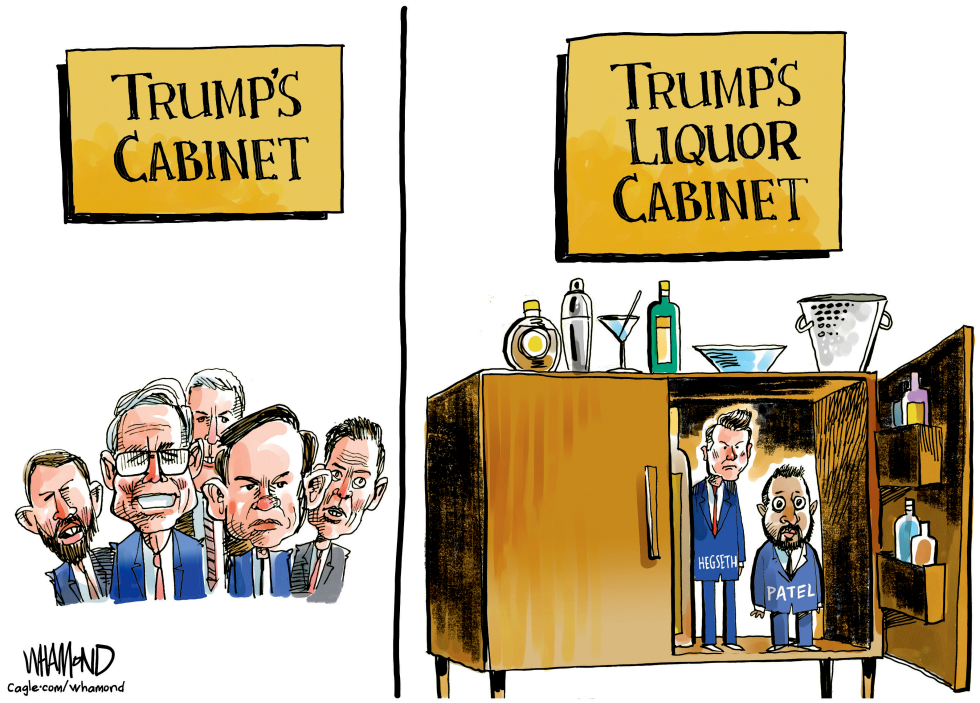
Dave Whamond's cartoon splits the scene between Trump's Cabinet of stern-faced men in suits and Trump's Liquor Cabinet, where caricatures labeled Hegseth and Patel emerge disheveled amid bottles and barware, poking at Trump's cabinet problems. The dry humor targets Kash Patel as FBI director nominee and Pete Hegseth for Secretary of Defense, amid drinking allegations and excessive drinking claims from The Atlantic. Unexplained absences and AWOL accusations add to the satire of unfit picks, with a defamation lawsuit looming. This piece captures the irony of Trump's best people turning into a partying liquor cabinet fiasco, all in a straightforward, insider jab at political absurdity.
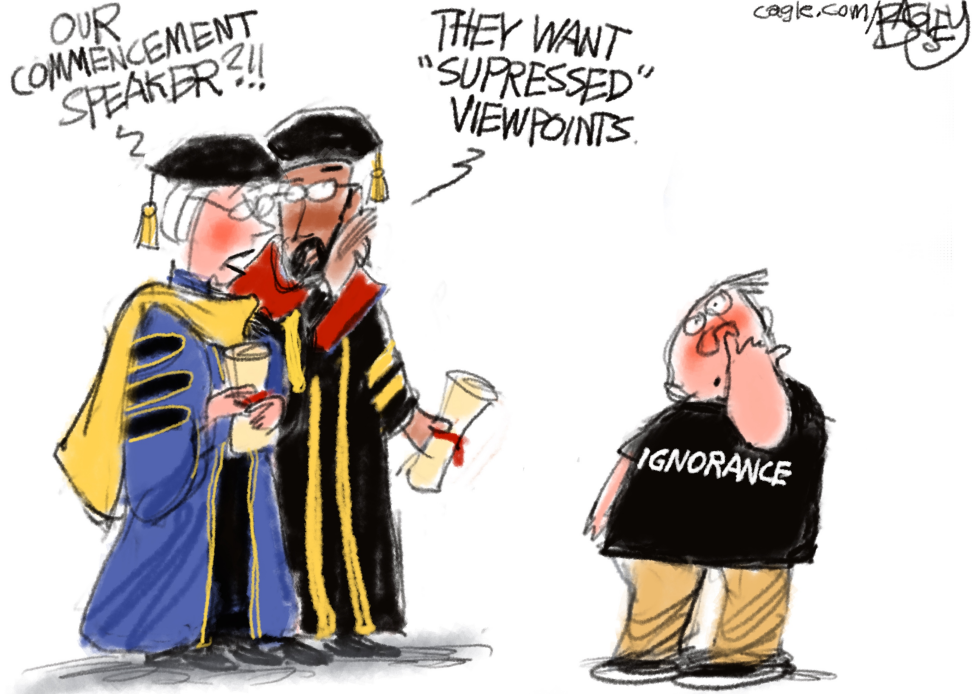
The image shows two academics in graduation gowns and caps standing close together. One holds a cup and the other a rolled diploma. Speech bubbles read our commencement speaker and they want suppressed viewpoints. A separate figure on the right wears a black shirt labeled ignorance and stands with hand near face. The drawing includes the cagle.com signature in the corner.
Monte Wolverton\'s cartoon depicts a doctor holding up an xray that reveals an intestine shaped like the Strait of Hormuz, complete with stars indicating blockages and inflammation. Trump peers over the top, his distinctive hair visible, as the doctor diagnoses intermittent blockages, polyps, and suggests consuming more fiber while cutting back on fast food. Tags like Iran War and blockade tie into the visual pun, turning a geopolitical chokepoint into a medical ailment. The piece uses dry humor to highlight discomfort in a straightforward way, with the xray\'s pinkish intestine contrasting against the black background. Artistic elements include the doctor\'s pointing finger and Trump\'s curious pose, emphasizing the satire without overcomplicating the scene.
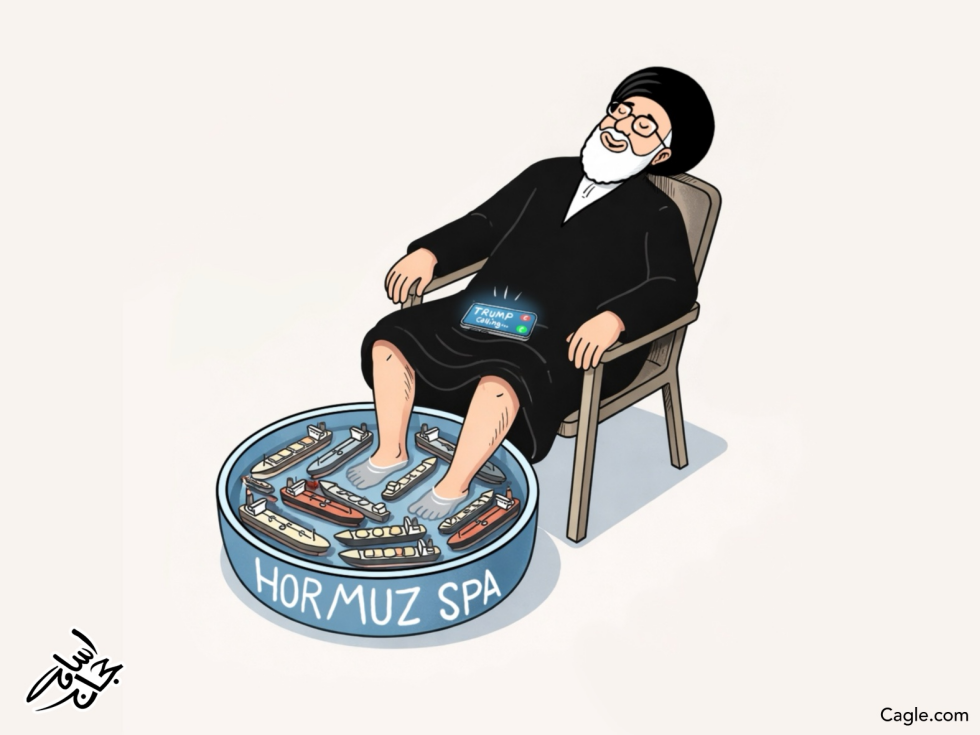
Osama Hajjaj draws an Iranian leader, resembling a cleric in black robes and turban, slouched in a chair with feet immersed in a blue basin labeled Hormuz Spa. Tiny ships float around his feet, evoking the Strait of Hormuz. A phone on his lap displays Trump with a green light, implying a call or alert. The scene captures dry satire on Iran-Trump relations, with the spa pun highlighting control over vital shipping lanes. Tags like Hormuz, Iran, Donald Trump, spa, and political cartoon underscore the humor in geopolitical friction.
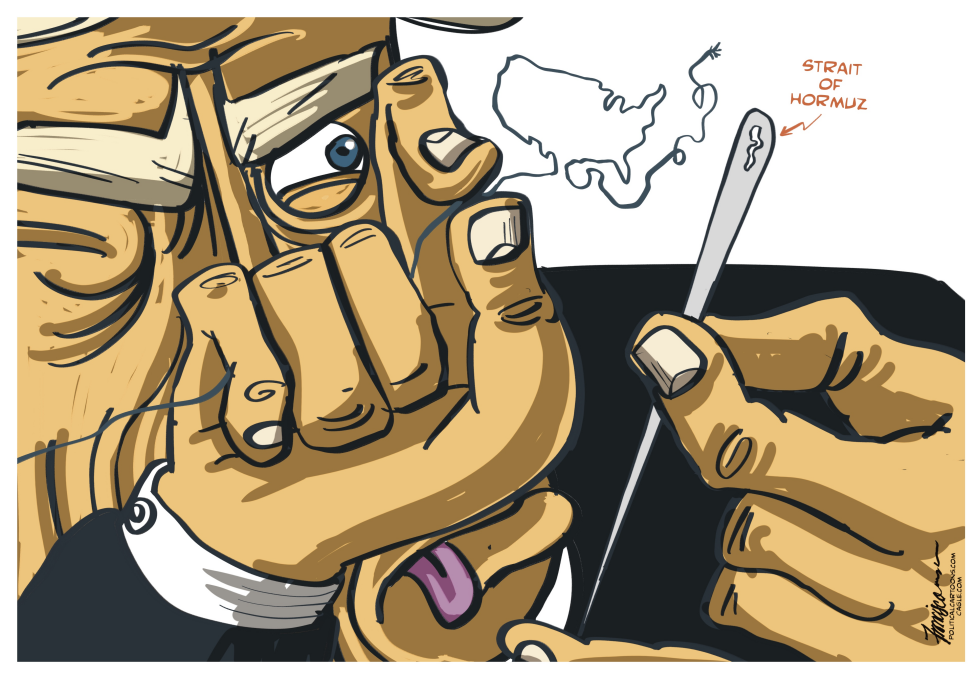
Manny Francisco\'s cartoon captures a close-up of a man with a bandage over one eye, tongue out in concentration, holding a needle labeled Strait of Hormuz. The thread resembles the USA map, with smoke trailing. Tags like Trump, president, USA, Strait of Hormuz, political satire underscore the image. It depicts careful maneuvering, as if sewing with precision. The dark background emphasizes the focused action. This piece from 2026 comments on delicate international affairs without overt symbolism beyond the visible elements. Artistic style is straightforward, with bold lines and minimal color.
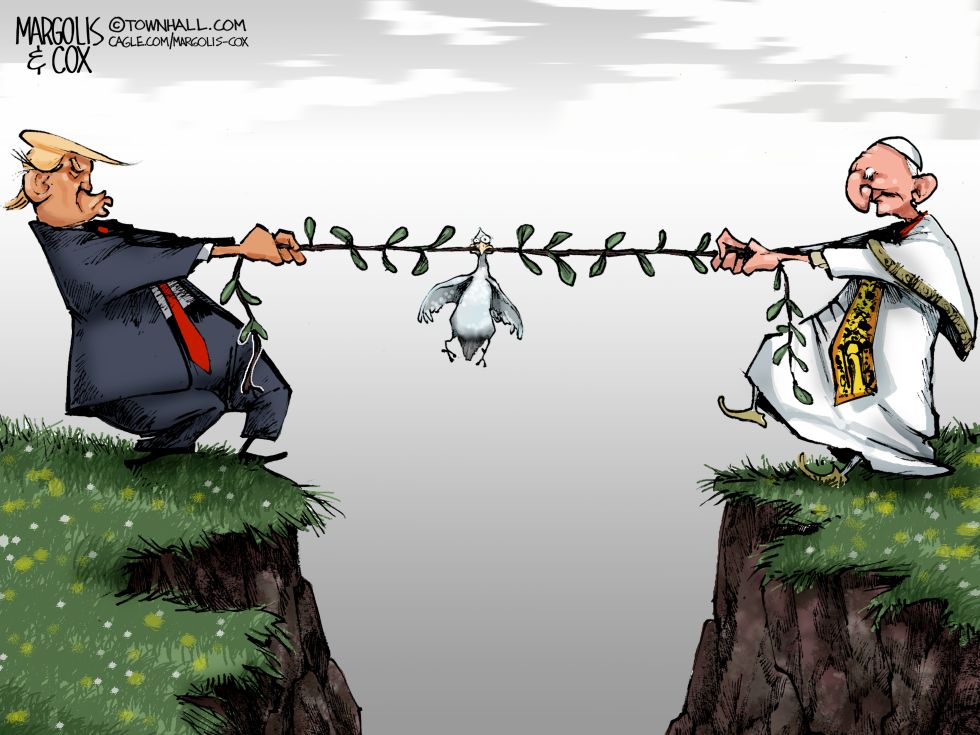
The cartoon shows a caricature of President Trump on one grassy cliff, gripping a vine with leaves that connects to a white dove in the center, while a figure resembling Pope Leo stands on the opposite cliff, also pulling the vine. They face each other across a deep chasm, with cloudy skies above. Tags like war, peace, dove, Iran, Middle East, and Church underscore the visual tension. The artists, Margolis & Cox, place their signature prominently. This setup captures a straightforward conflict over a peace symbol, without hidden layers. The dove hangs upside down, wings slightly spread, as the two figures strain. No emotions or backstories are added; it's just the visible pull between suited man and robed leader.
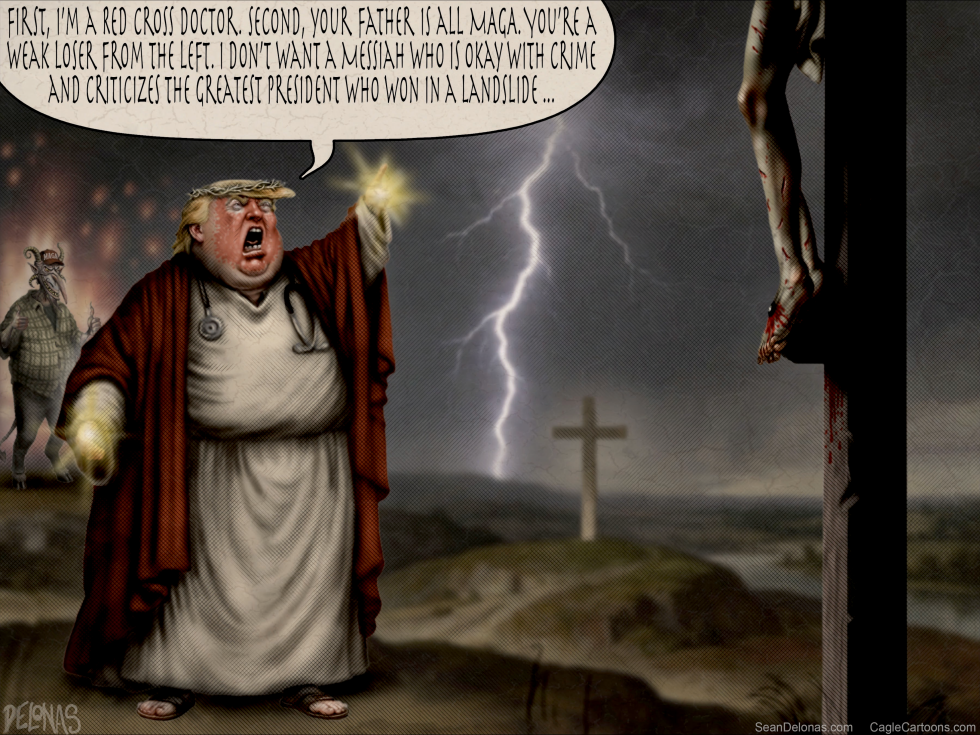
Delonas places Trump in a crucifixion scene, robed with stethoscope, rejecting the messiah as a weak leftist. Stormy skies and a demon add drama, blending politics and religion for dry satire. Tags like Trump, Jesus, Crucifixion highlight the bold commentary on leadership cults.