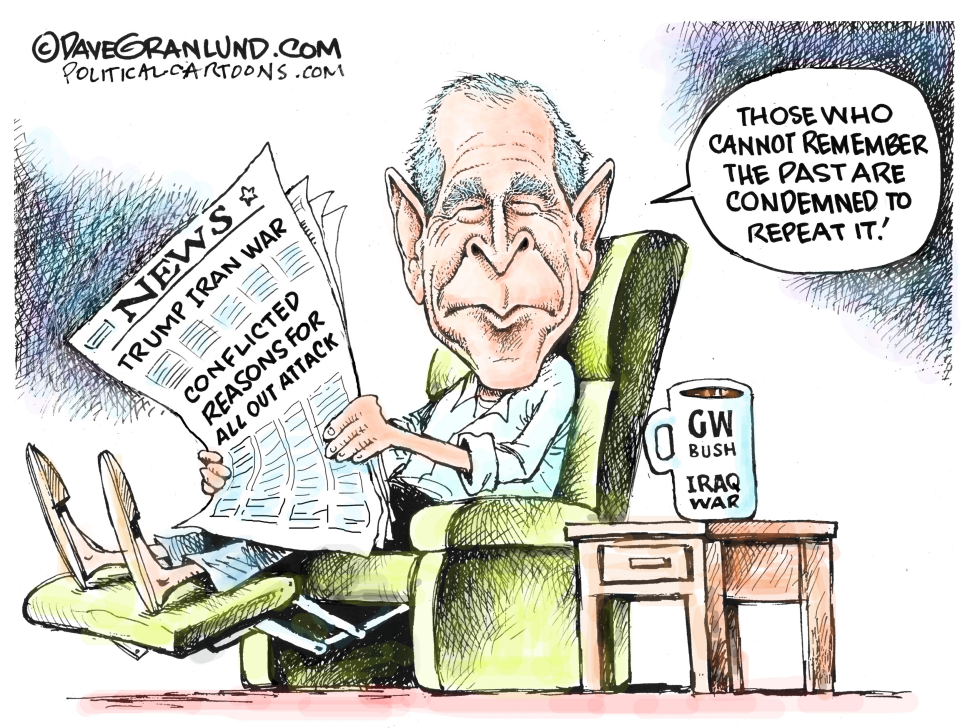
Dave Granlund's political cartoon cleverly lampoons the Trump Iran conflict by portraying a smug, elf-eared figure—possibly a nod to forgetful policymakers—lounging with a newspaper screaming 'Iran War' headlines, while clutching a mug emblazoned with 'GW Bush Iraq War.' The speech bubble twists George Santayana's famous quote on historical amnesia, warning that those who cannot remember the past are condemned to repeat it. This satirical jab underscores the eerie parallels between Bush's ill-fated Iraq invasion and Trump's bellicose posturing toward Iran, blending humor with sharp insight into geopolitical folly. Tags like Iraq War repetition and Trump Iran conflict amplify its relevance, making it a viral-ready critique of endless war cycles.
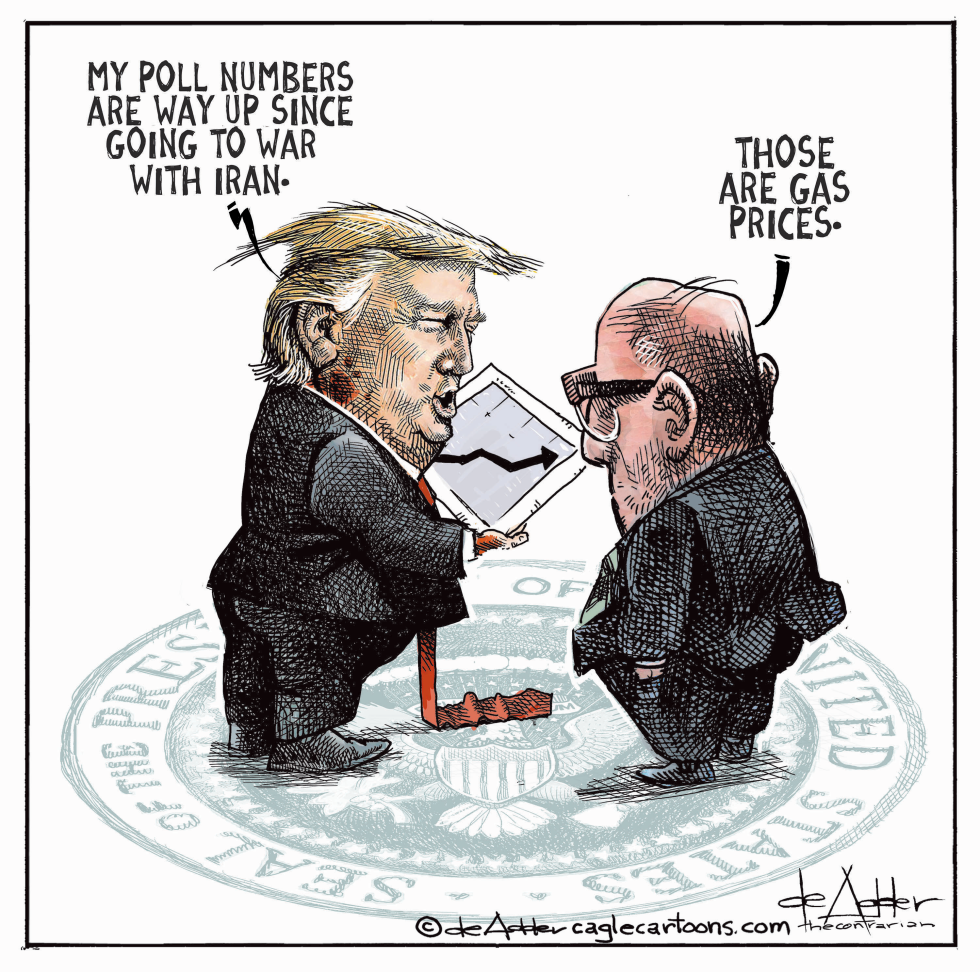
This sharp political cartoon by Michael de Adder captures Donald Trump triumphantly holding a chart of upward trends, claiming his poll numbers have skyrocketed since going to war with Iran. However, a bespectacled Dick Cheney corrects him, revealing those are actually gas prices soaring. The satire highlights the ironic consequences of Middle East conflict on the US economy, blending humor with commentary on presidential approval ratings tied to foreign policy blunders. Incorporating elements of US politics, oil prices, and war economy, the image stands on the presidential seal, emphasizing official folly. It's a witty jab at how leaders might misread economic fallout as personal gains, perfect for editorial discussions on satire and current events.
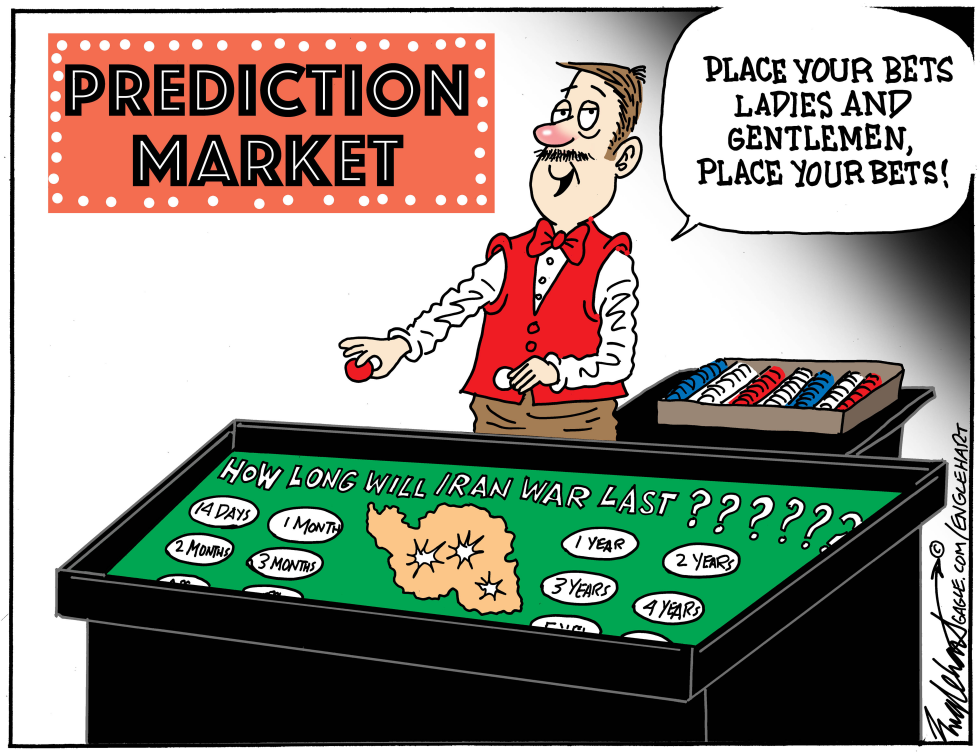
In a biting political cartoon, a smirking croupier oversees a prediction market table shaped like Iran, complete with explosion graphics, where punters can wager on war duration options ranging from 14 days to 5 years. This satirical take skewers the commodification of geopolitical betting, turning grave matters like Iran war into casino-style gambles. By blending elements of gambling on war with Middle East conflict, the artwork highlights the absurdity of prediction markets applied to real-world crises, offering humorous yet insightful commentary on how society speculates on political humor and potential catastrophes. The irreverent style underscores the folly of treating war length wager as just another market fluctuation.
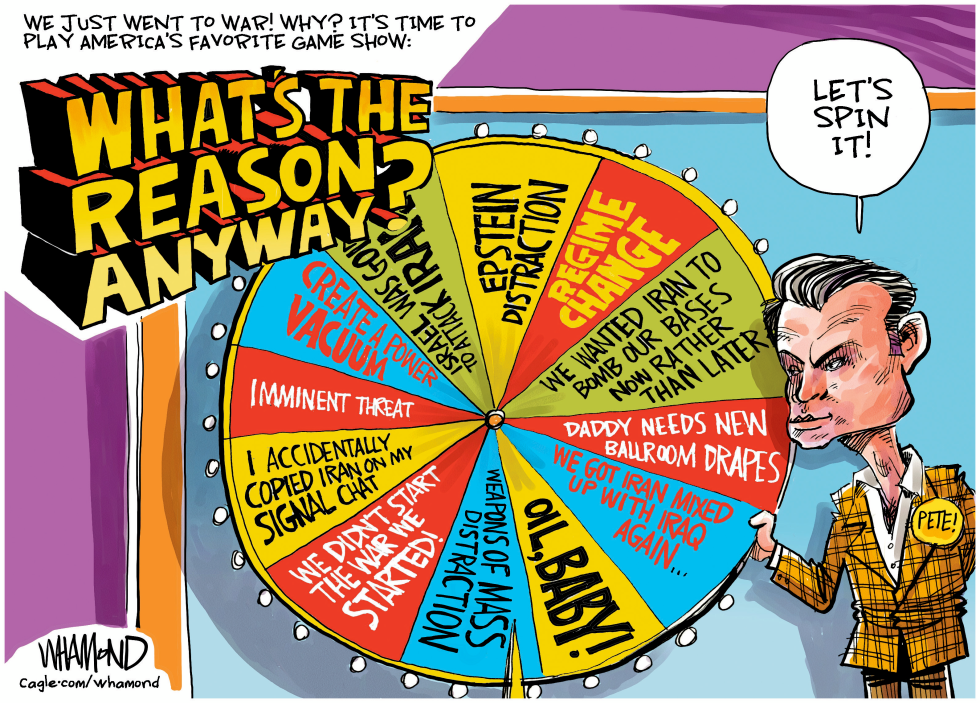
Dive into this biting political cartoon where America's war decisions are reduced to a game show parody wheel, featuring options like 'Imminent Threat,' 'Oil, Baby!,' and 'Regime Change.' The irreverent satire targets US foreign policy, highlighting how military interventions often spin on flimsy pretexts, from accidental escalations to resource grabs. With a host eagerly spinning the wheel, the artwork cleverly critiques the absurdity of war justifications, blending humor with insightful commentary on geopolitical cynicism. Tags like political cartoon, war justifications, and military intervention humor underscore its viral potential in today's polarized discourse.
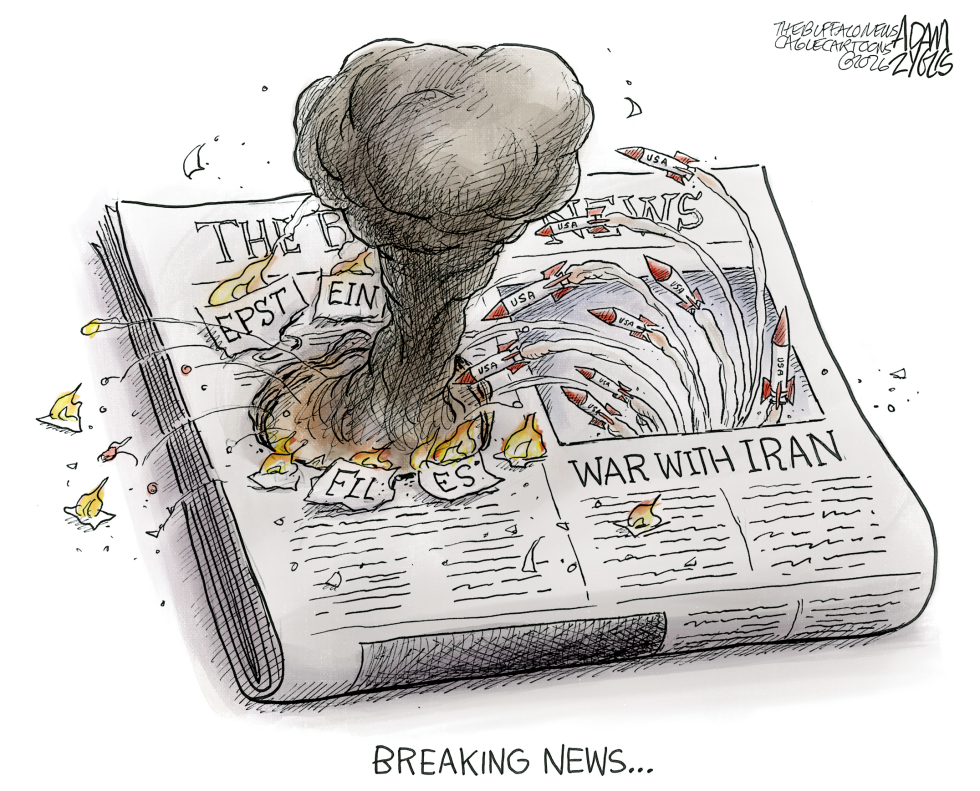
Dive into Adam Zyglis's political cartoon where breaking news morphs into a nuclear explosion, symbolizing media sensationalism around the Epstein files and war with Iran. USA missiles and Iran conflict visuals underscore geopolitical tension, while the exploding headlines serve as a sharp journalism critique. This satirical illustration captures the chaos of fake news explosion, reminding us how sensational stories can overshadow substance in today's fast-paced media landscape. With irreverent humor, it questions the ethics of turning tragedies into spectacles, blending satire with insightful commentary on news consumption.
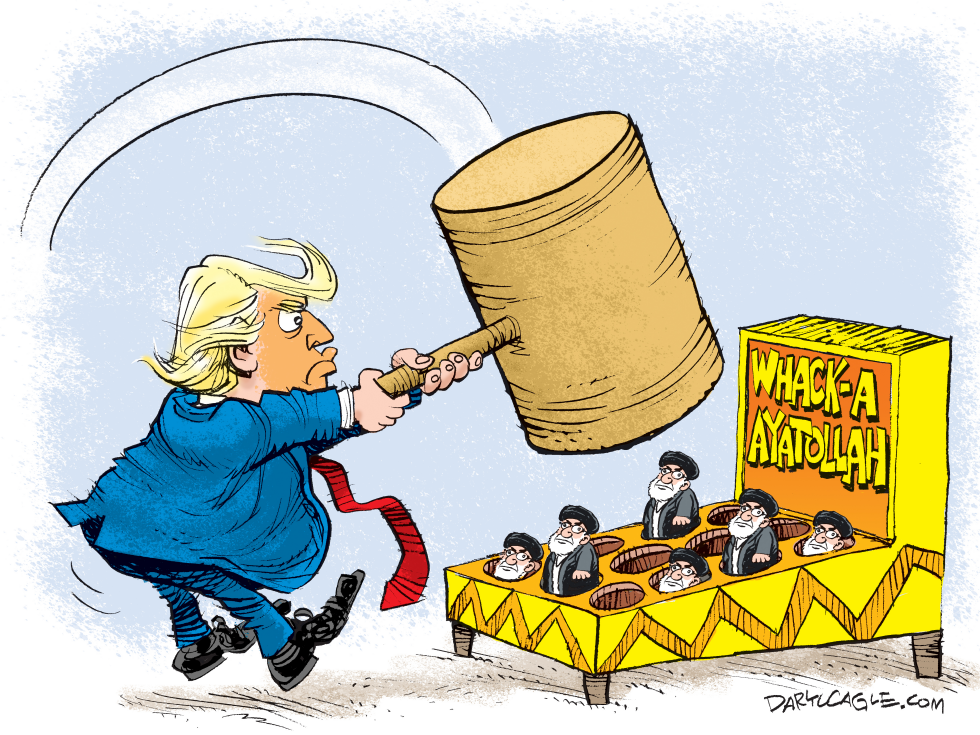
The cartoon shows Donald Trump in a blue suit swinging a massive wooden mallet at figures resembling Iranian Ayatollahs emerging from holes in a yellow arcade machine labeled Whack-A Ayatollah. The president appears mid-swing with motion lines indicating effort. The image comments on US policy toward Iran by framing the conflict as a repetitive carnival game where targets keep reappearing. Publication occurs during a period of heightened US-Iran tensions over nuclear issues and regional influence. The visual metaphor suggests difficulty in permanently resolving the challenge despite repeated attempts.
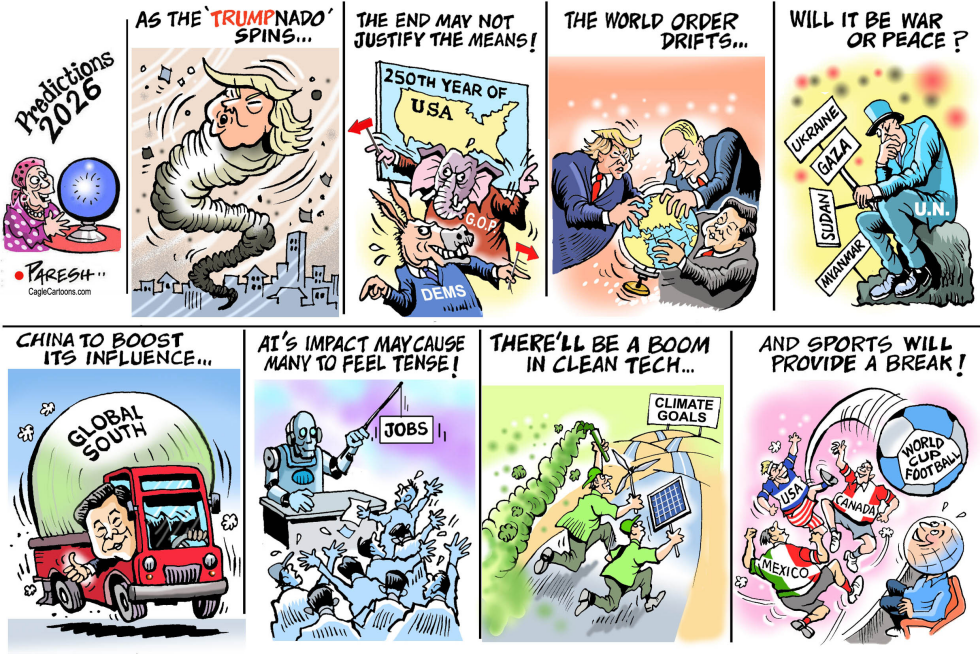
Paresh Nath's January 2026 predictions panel series opens with a fortune teller viewing a crystal ball. Subsequent sections show a Trump tornado, an elephant and donkey arguing over the US 250th anniversary, leaders tugging at a globe, a UN figure pondering conflict zones, China boosting influence in the global south, a robot waving a jobs sign amid chaos, workers chasing clean tech, and athletes from USA, Canada and Mexico scrambling for a World Cup football.
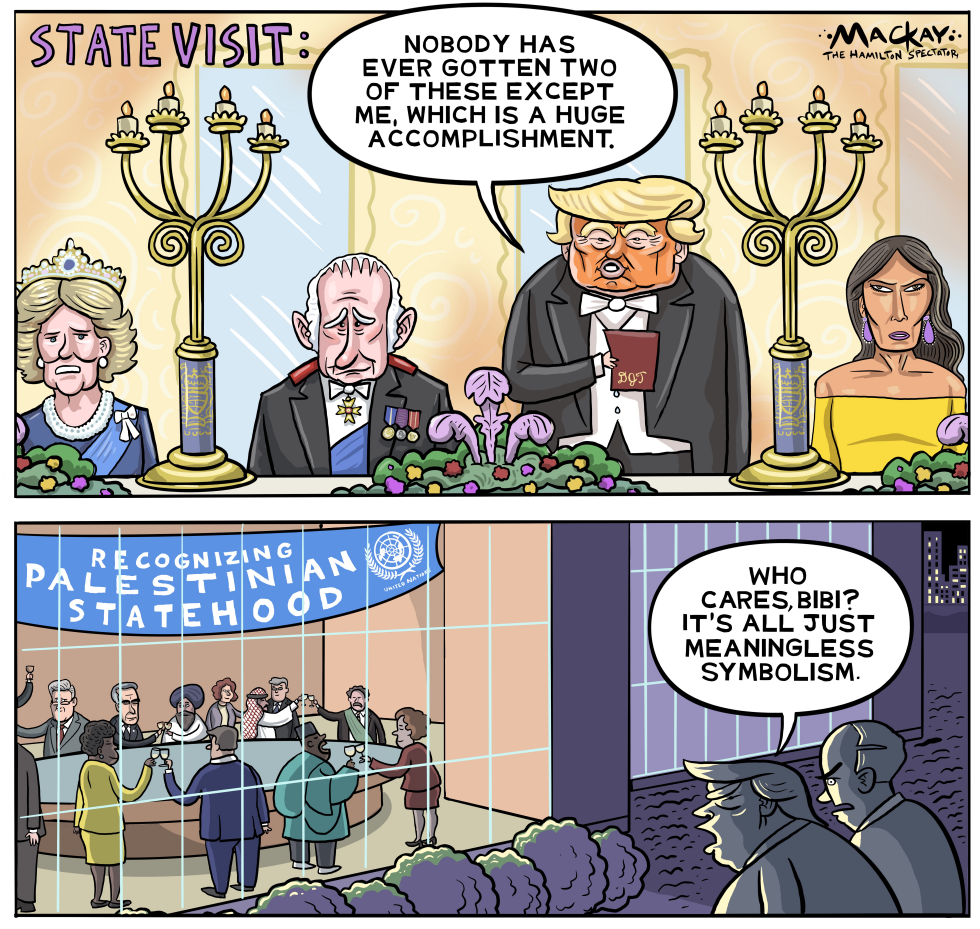
Graeme MacKay's cartoon captures a state visit dinner scene with figures at a table adorned with candelabras, where a caricature resembling Donald Trump boasts about unique accomplishments. The lower panel shifts to a United Nations setting with a banner reading 'Recognizing Palestinian Statehood,' showing delegates toasting, while outside, Trump and another figure, addressed as Bibi, dismiss the event as meaningless symbolism. Incorporating tags like Allies, Palestine, United Nations, Statehood, Recognition, and Peace, the artwork highlights contrasts in diplomatic perceptions. The composition uses split panels to juxtapose formal pomp with cynical realpolitik, emphasizing themes of symbolic gestures versus substantive policy in the Israel-Gaza conflict context.
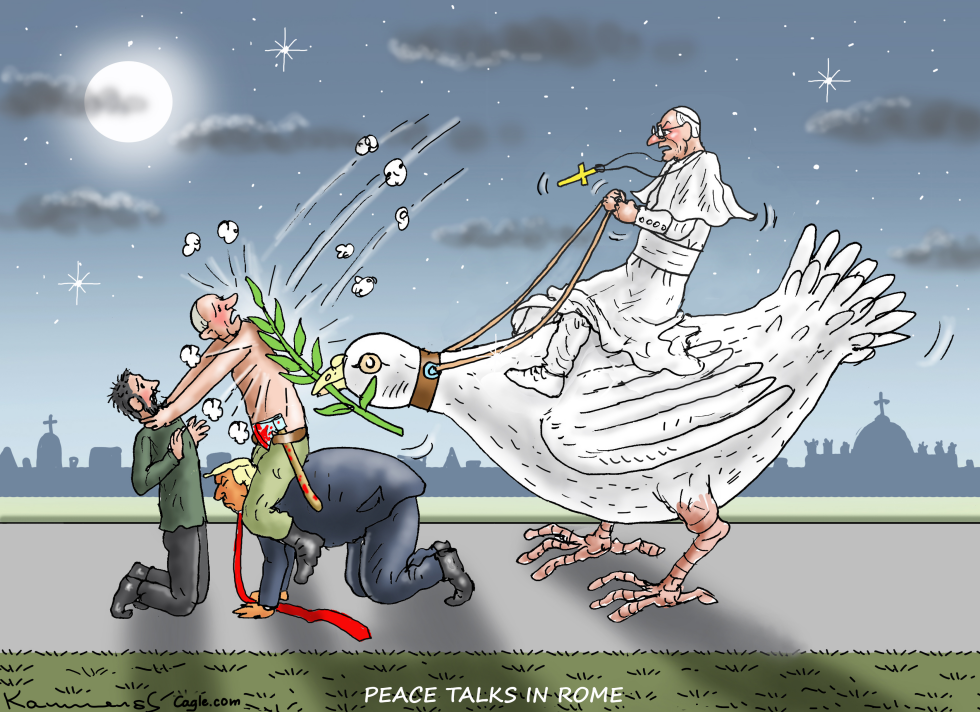
Marian Kamensky's cartoon titled 'Peace Talks in Rome' depicts the Pope astride a giant white dove, olive branch in its beak, as he whips it forward with a cross. Below, caricatures of Trump, Putin, and Zelensky kneel on the ground, engaged in a scuffle with punches and pulling. Set against a nighttime Roman skyline with domes and crosses, the scene captures tension in Ukraine Russia relations. Stars and moon add a surreal touch to this satirical commentary on international diplomacy involving key figures like the Pope and world leaders.
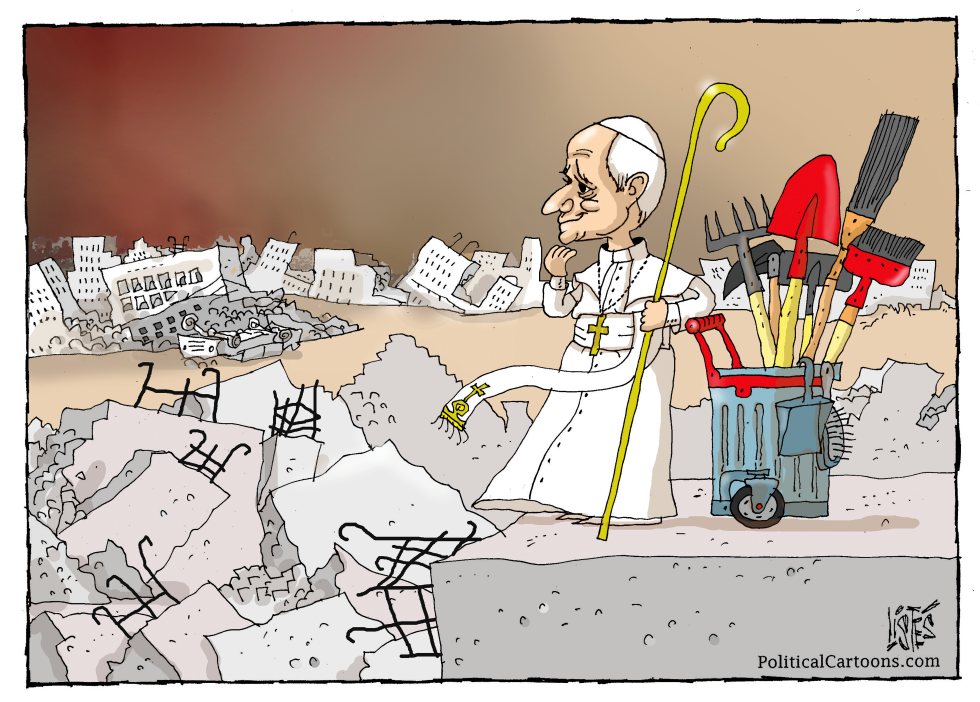
The cartoon depicts a figure resembling a pope, clad in traditional white attire with a cross, standing thoughtfully amid vast urban destruction. He grips a curved staff in one hand and pulls a wheeled bin filled with cleaning implements like a red shovel, black broom, rake, and brush. The background shows collapsed buildings under a reddish sky, suggesting widespread devastation. Tags like Pope Leo XIV, Vatican, economy, Europe, world, USA, new pope, and peace frame the image as commentary on leadership tackling global crises. The dry humor lies in the pontiff's mundane tools against apocalyptic ruins, highlighting the enormity of starting anew.