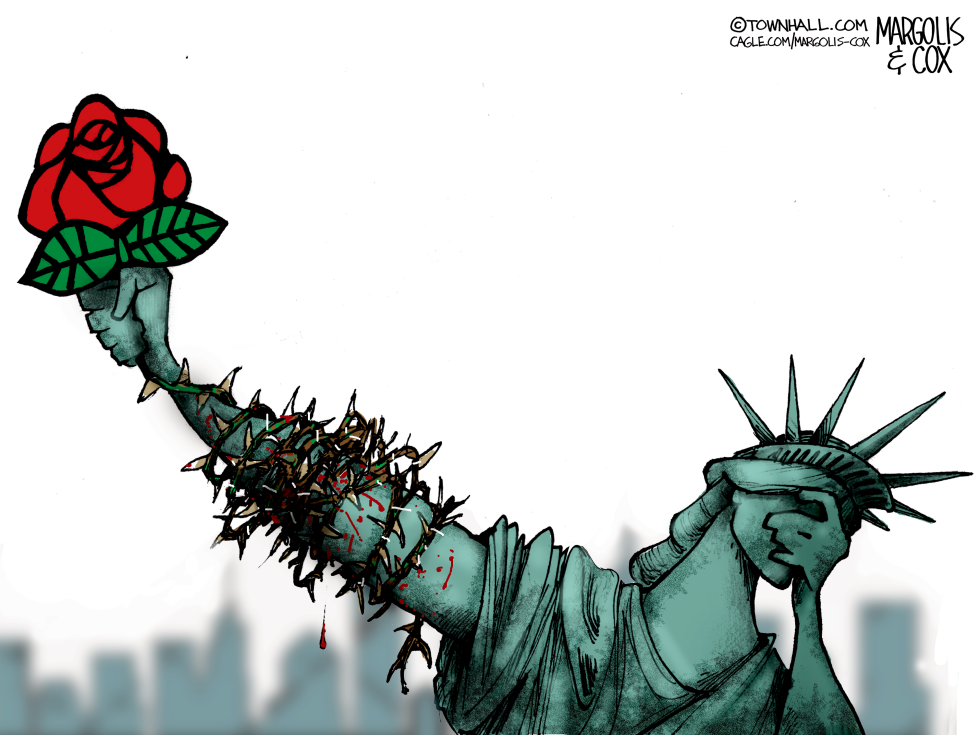
The image shows the Statue of Liberty with her raised arm entangled in barbed wire that draws blood, holding a large red rose in place of the traditional torch. Her other hand covers her face as the New York skyline fades behind her. The work responds to ongoing debates over socialist symbolism in American public imagery on the June 2026 date. The visual replaces the torch with the rose, a traditional emblem of socialism, while the barbed wire suggests entrapment or harm. Artist credit appears in the upper right corner.
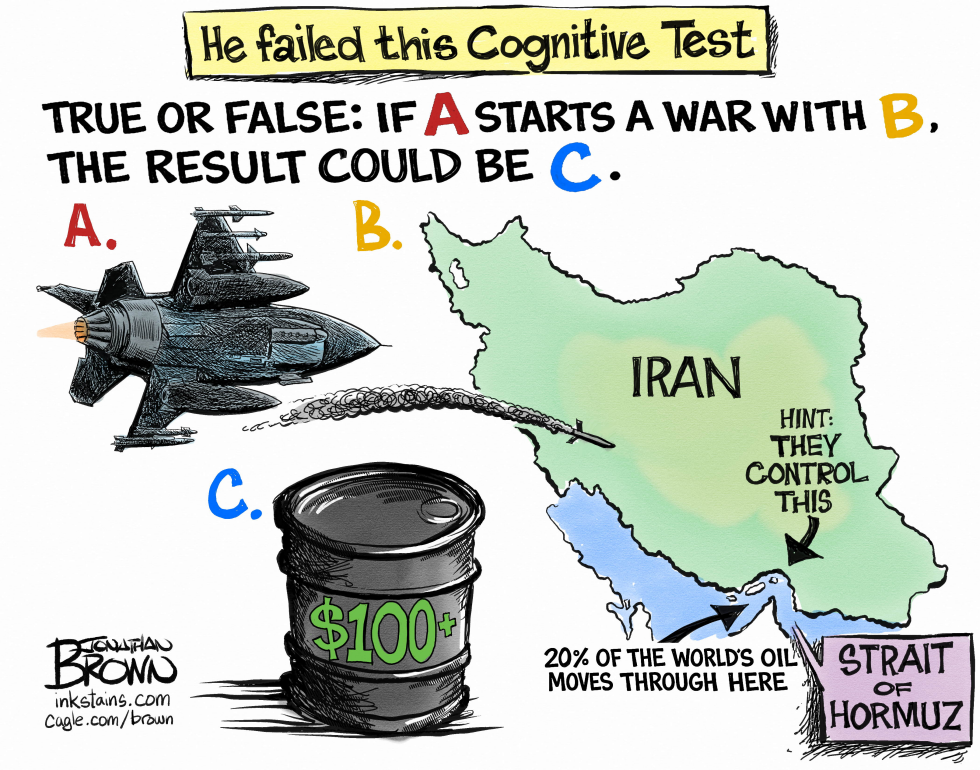
Jonathan Brown's cartoon presents a stark true-or-false cognitive test: if A (a fighter jet) starts a war with B (Iran), the result could be C (an oil barrel marked $100+). The map of Iran includes a hint pointing to the Strait of Hormuz, noting that 20% of the world's oil moves through there, underscoring control over this chokepoint. Tags such as cognitive test, war in Iran, oil prices, Strait of Hormuz, gas prices, and cost of war frame the satire. The artwork warns of economic fallout from conflict, with the jet trailing toward Iran and the oil barrel symbolizing surging costs. This piece captures geopolitical tensions in a simple, visual riddle.
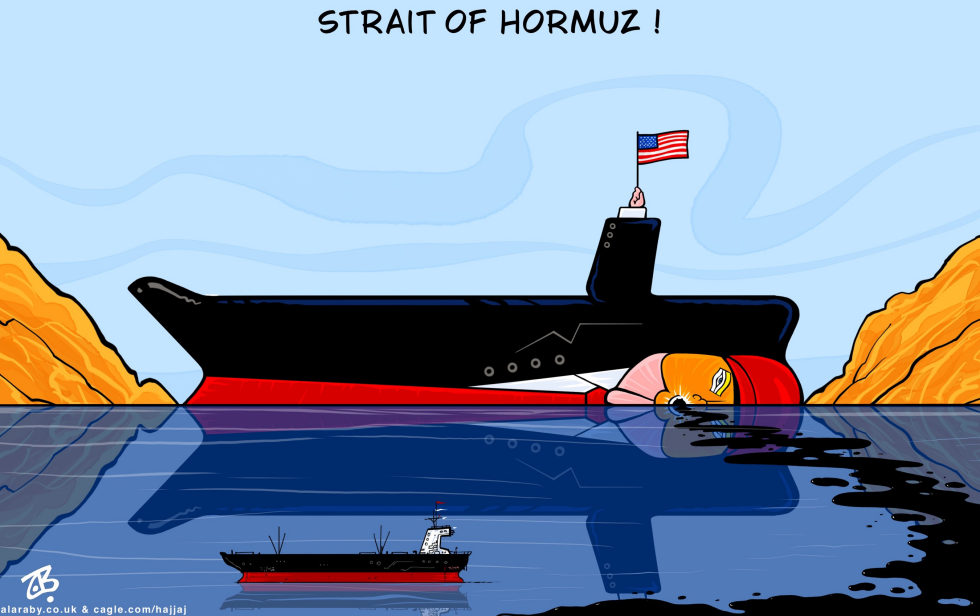
Emad Hajjaj's cartoon depicts a large black submarine with a red hull, stuck between orange landmasses in the Strait of Hormuz, its bow featuring an orange face with yellow hair and a red tie, clearly caricaturing Donald Trump. An American flag flies atop the vessel, while black oil spills into the blue water, reflecting the ship. Below, a smaller black tanker with a white figure onboard sails through the oily sea, tagged with Persian, Gulf, Sea, Tanker, Oil, War. The image satirizes US involvement in Middle East conflicts, particularly Iran war scenarios, without overreaching into hidden meanings. The composition is straightforward, with clear lines and bold colors emphasizing the blockage.
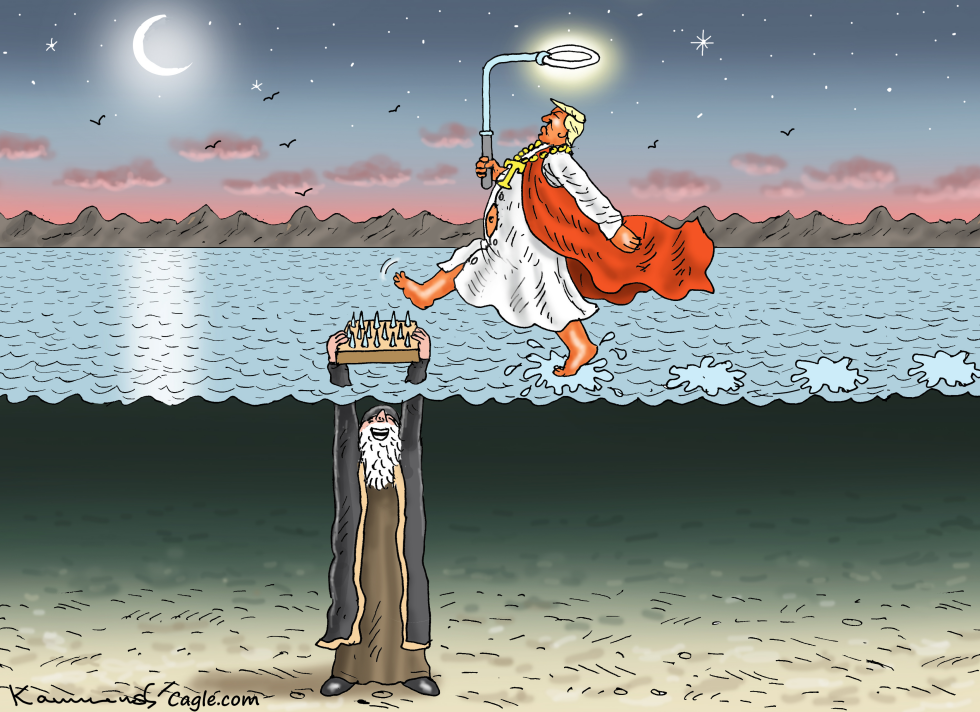
Marian Kamensky nails the absurdity with a Trump caricature striding across the Hormuz waves like some divine emperor, complete with a lamppost halo and a sword in hand. He's dangling a crown of thorns to a bearded prophet type popping up from the depths, all set against a starry night with mountains and a crescent moon. Tags like Iran, Hormuz, Trump, MAGA Terror, Oil War, Fascism scream the point without words. It's classic cartoon exaggeration, poking at ego-driven foreign policy blunders. The red cape flutters, the water splashes—pure visual punch. No subtlety here, just sharp commentary on power plays in troubled waters.
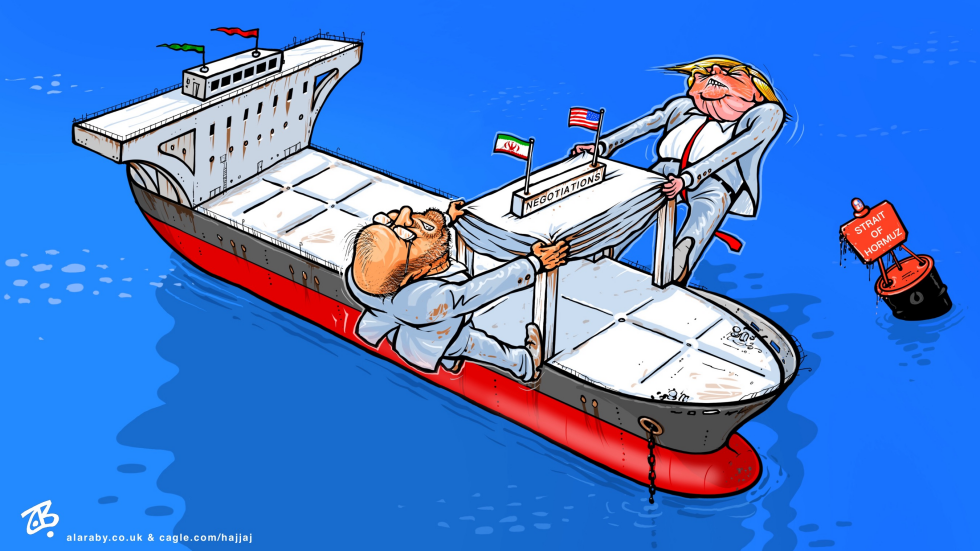
Emad Hajjaj\'s cartoon captures the tense Hormuz Strait negotiations between Trump and an Iranian figure on a massive tanker ship flying US and Iran flags. The scene shows them balancing a \'NEGOTIATIONS\' table on the tilting vessel, with an anchor chain and a leaking \'Strait of Hormuz\' buoy spilling oil. This Gulf war satire highlights the precarious talks amid potential sea block, where the ship appears damaged and unstable. Tags like ship, anchor, Gulf, war, tanker, talks underscore the maritime conflict theme. The dry humor lies in the literal sinking of diplomatic efforts.
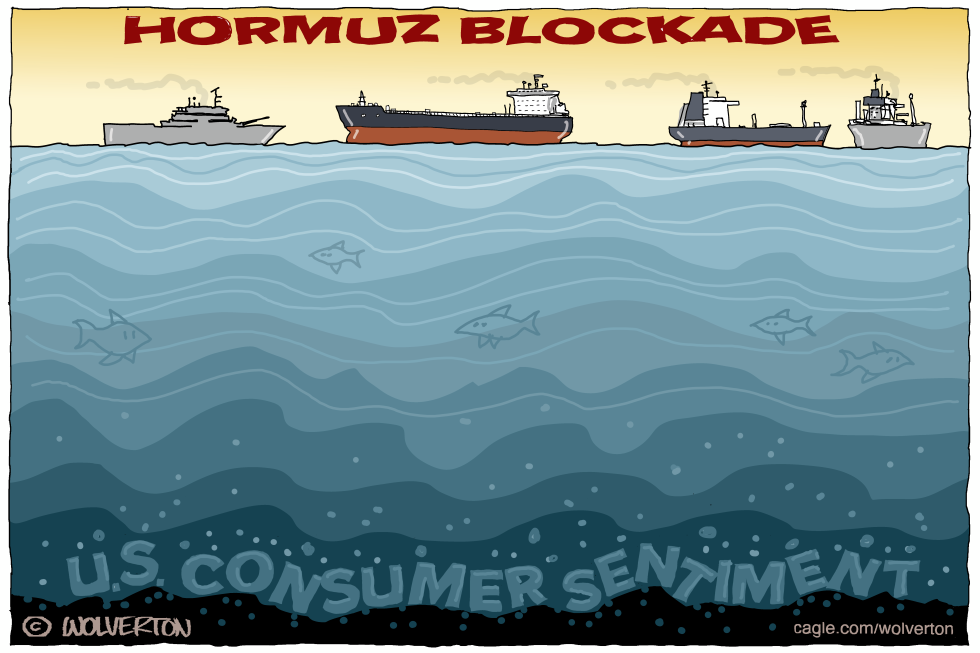
Monte Wolverton's cartoon captures the Hormuz Strait blockade with warships and tankers lined up on the water's surface, a clear nod to geopolitical strife in key oil passages. Below, the phrase U.S. consumer sentiment is etched into the ocean floor, surrounded by fish, driving home the idea of economic morale hitting rock bottom. This piece uses simple lines and color to highlight how international blockades can sink domestic confidence, tying into broader themes of global trade disruptions. The dry humor shines through in the visual pun, making it a standout in political satire circles. Tags like Hormuz Strait blockade political cartoon, US consumer sentiment sinking economy illustration, oil tanker ships naval blockade satire, Strait of Hormuz geopolitical tension comic, economic impact of Middle East conflict drawing, and consumer confidence underwater metaphor cartoon amplify its SEO reach.
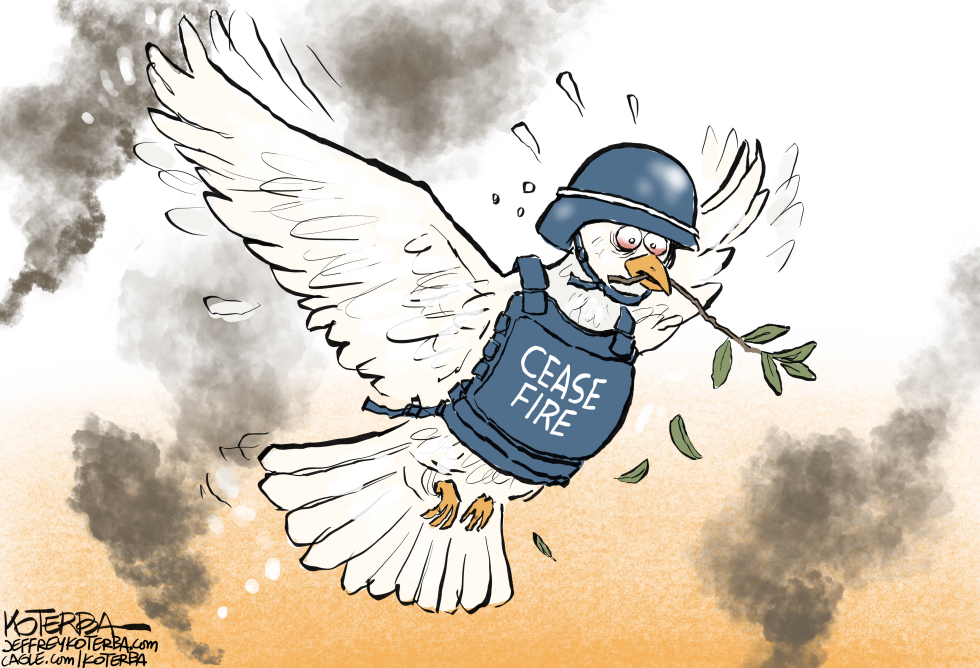
Jeff Koterba's cartoon shows a white dove, traditional symbol of peace, outfitted in a blue military helmet and a bulletproof vest marked 'CEASE FIRE.' The bird clutches an olive branch in its beak, eyes wide in surprise, as it navigates through billowing dark smoke clouds. This setup highlights the fragility of cease fire attempts in war zones, with the armored dove representing protected yet vulnerable peace initiatives. The orange-tinted background suggests a fiery landscape, emphasizing conflict's harsh reality. Tags like political cartoon, peace dove, cease fire vest, olive branch, war smoke, and satirical illustration capture the image's essence for SEO.
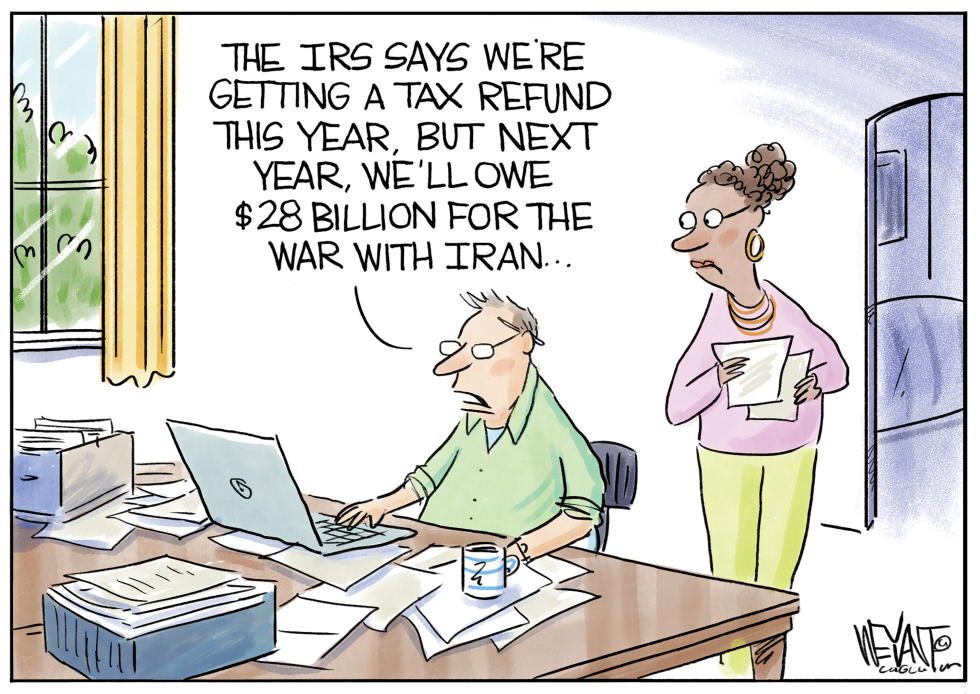
Dive into this biting political cartoon tax refund piece where a woman, holding papers, informs a laptop-working man about their IRS windfall this year, only to drop the bomb of owing $28 billion next for the war with Iran. The satirical cartoon Iran war vibe captures the absurdity of US taxes funding wars, with cluttered desks and exasperated expressions underscoring the humorous take on federal spending. It's a classic taxpayer burden Iran conflict jab, poking fun at government spending satire while illustrating the disconnect between personal finances and massive military expenses. Through cartoon about military expenses, it cleverly critiques fiscal policy in an office setting, making the war with Iran taxpayer joke both relatable and irreverently insightful for viewers pondering editorial cartoon fiscal policy.
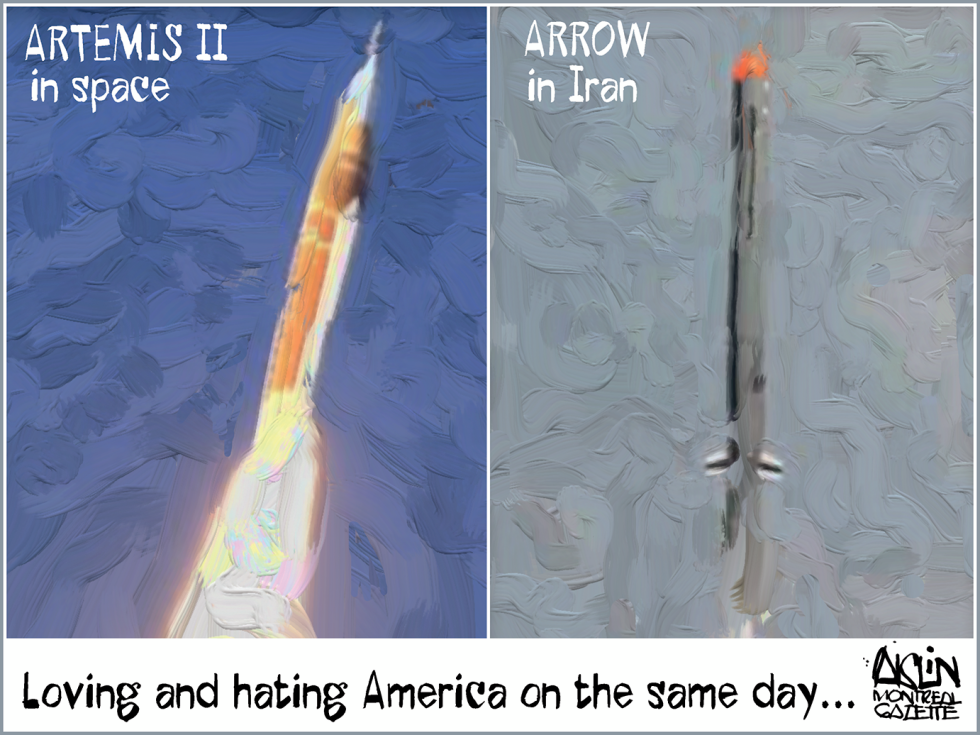
In this irreverent political cartoon, a vibrant Artemis II space launch rockets upward in a blue expanse on the left, symbolizing American innovation and triumph in US space exploration. Contrasting sharply on the right, a stark Arrow in Iran points downward with an orange glow against a gray sky, evoking geopolitical tension and Iranian weaponry. The caption 'Loving and hating America on the same day....' ties it together, offering a humorous take on the bipolar view of America in world news. With its simple yet effective composition, the artwork captures the absurdity of global perceptions, blending satire on international conflict with admiration for NASA's feats. This piece underscores the dichotomy in how the world engages with American power, from awe at space missions to ire over foreign policy frictions.
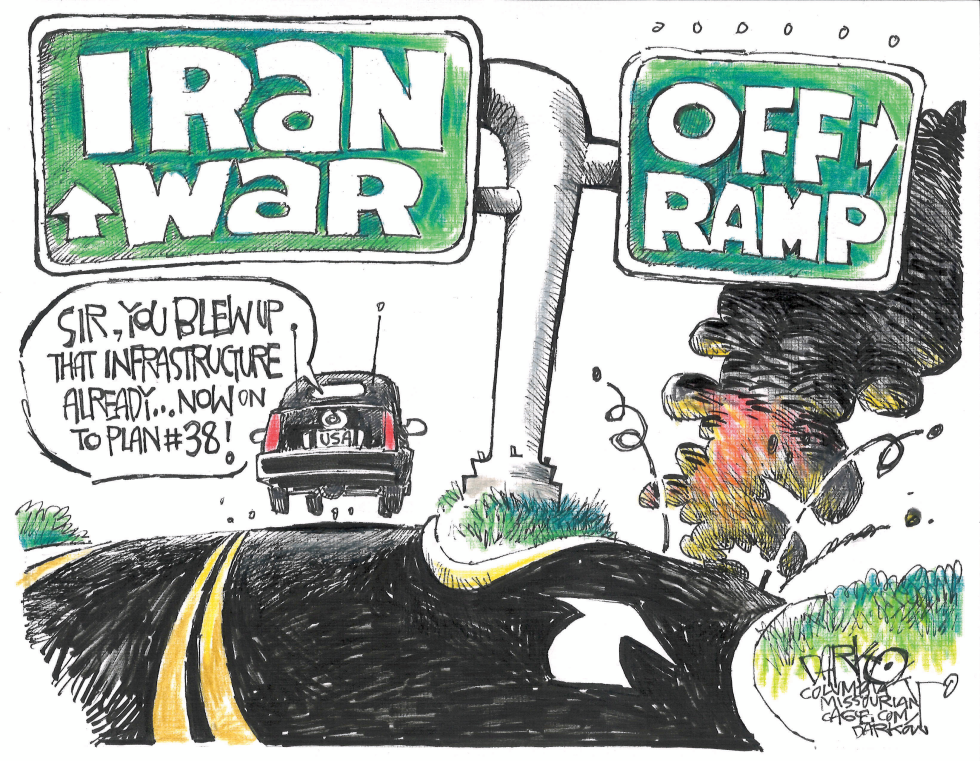
This daryl cagle political cartoon shows a highway split with signs for iran war upward and off ramp rightward, where a usa license plate car drives into an explosion. The car\'s speech bubble says, \'SIR, YOU BLEW UP THAT INFRASTRUCTURE ALREADY... NOW ON TO PLAN #38!\' highlighting satirical destruction. Amid grass and road lines, the image mocks usa iran conflict satire through off ramp infrastructure destruction cartoon, emphasizing failed exits in political cartoon usa foreign policy. The irreverent style captures highway to iran war illustration with humorous despair over repeated plans.
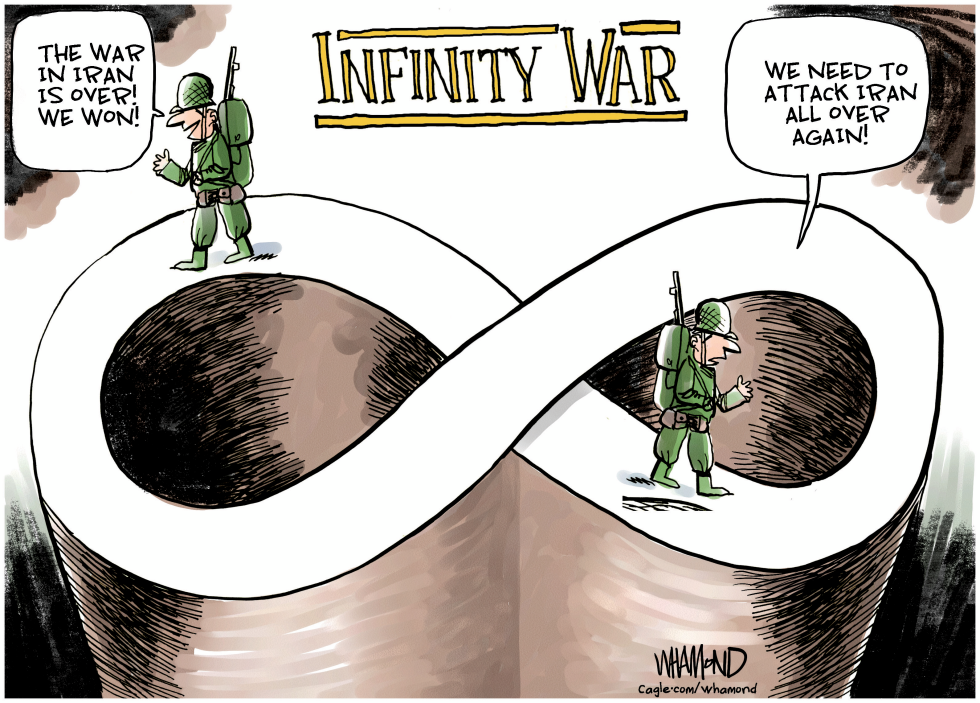
Dave Whamond's cartoon features two soldiers positioned on a large infinity symbol, one announcing victory in the Iran war while the other insists on attacking again, highlighting the perpetual nature of conflict. The title 'Infinity War' parodies endless warfare, with the loop representing cycles of victory and renewed aggression. Tags like iran war cartoon, infinity symbol war, endless conflict satire, military parody, perpetual war illustration, and satirical soldiers emphasize the dry humor in depicting how wars in regions like Iran seem to restart indefinitely, a common theme in political cartoons that resonates with ongoing global tensions.
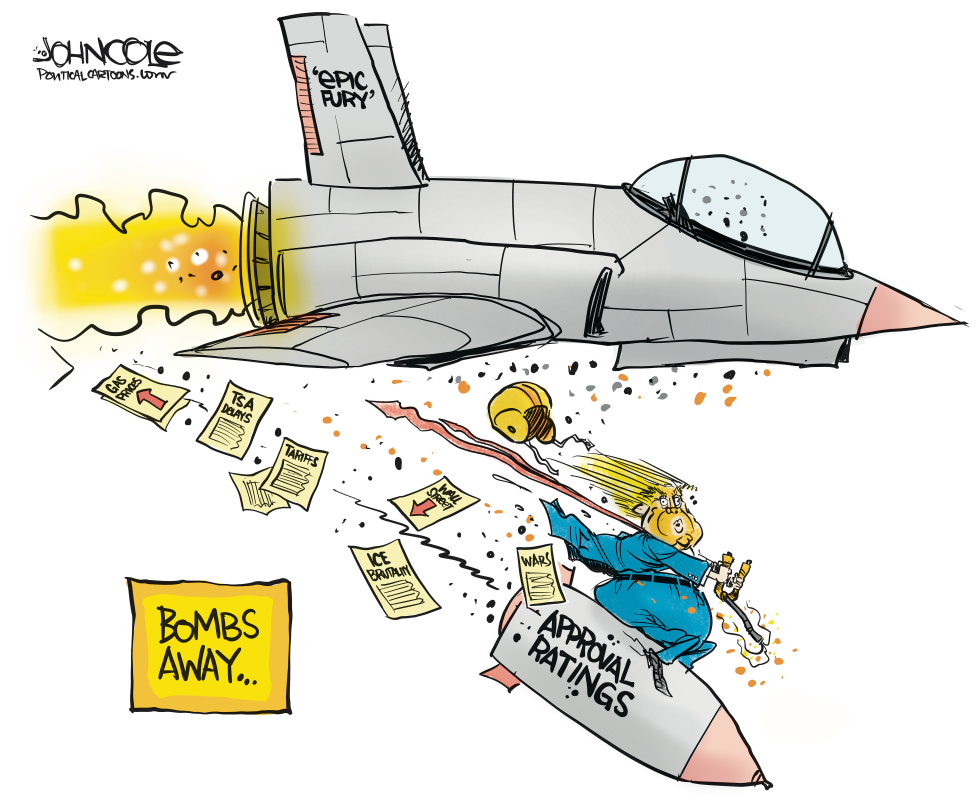
This political cartoon features a fighter jet labeled 'EPIC FURY' with flames bursting from its rear, dropping papers marked 'Gas Prices,' 'TSA Plays,' 'Tariffs,' 'ICE Brutality,' and 'War' like bombs away. A blonde figure in a blue outfit rides a white missile labeled 'APPROVAL RATINGS,' wielding a stick as if charging forward amid falling debris and sparks. The scene captures satirical chaos with 'Bombs Away..' sign floating nearby, emphasizing themes of political maneuvering through policy drops to boost approval ratings. John Cole's signature and PoliticalCartoons.com appear in the top left, adding to the irreverent commentary on epic fury in governance.
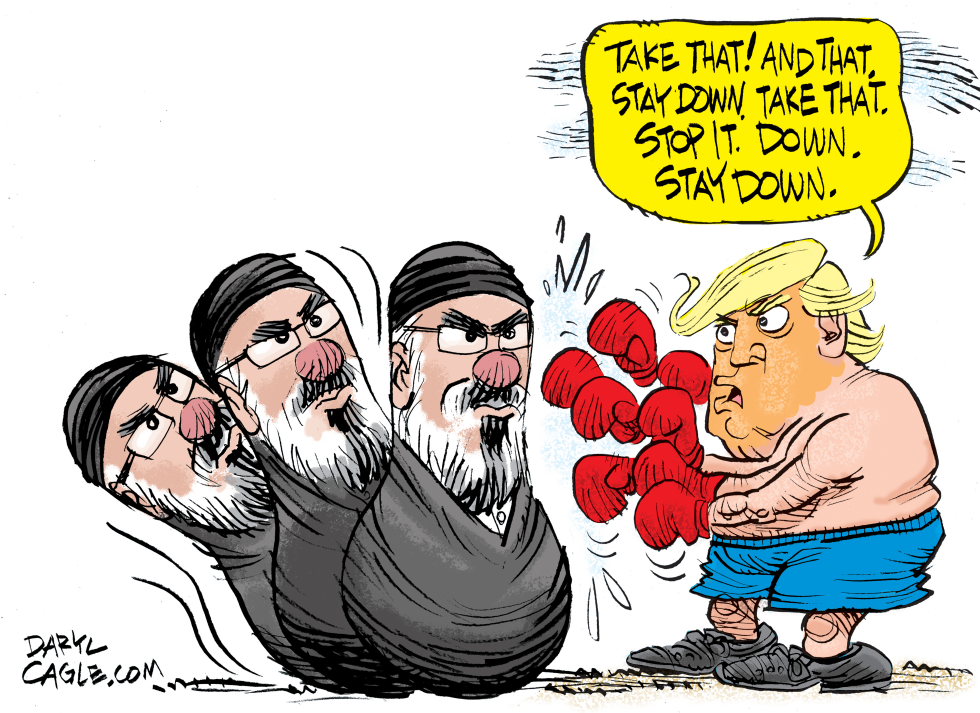
The cartoon shows Donald Trump, shirtless and wearing boxing gloves, repeatedly striking a large bop bag shaped like an Iranian cleric. Multiple faces of bearded men in turbans appear on the bag, which rebounds after each punch. A speech bubble captures Trump's frustrated commands for the figure to stay down. The image responds to reports of a new Iranian supreme leader and U.S. efforts against the regime in early 2026. It highlights the perceived futility of direct confrontations with Iran's leadership structure.
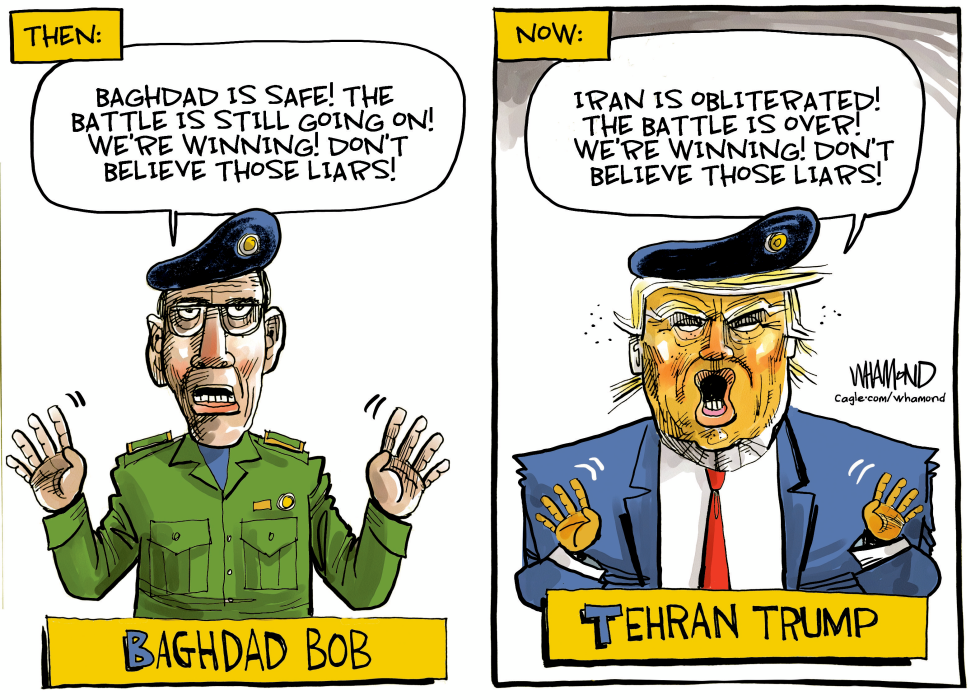
Dave Whamond's political cartoon splits into 'Then' and 'Now' panels, showing Baghdad Bob in military garb proclaiming Baghdad's safety and ongoing victory, dismissing liars. On the right, a Trump-like figure dubbed Tehran Trump, wearing a beret and suit, declares Iran obliterated and battle over, again urging disbelief in liars. The satire underscores parallels in propaganda and denialism, with tags like political satire, Trump caricature, Iraq War reference, Iran conflict, misinformation leaders, and historical parallel. This visual commentary critiques how figures twist realities in wartime narratives, blending dry humor with sharp observation on political exaggeration.
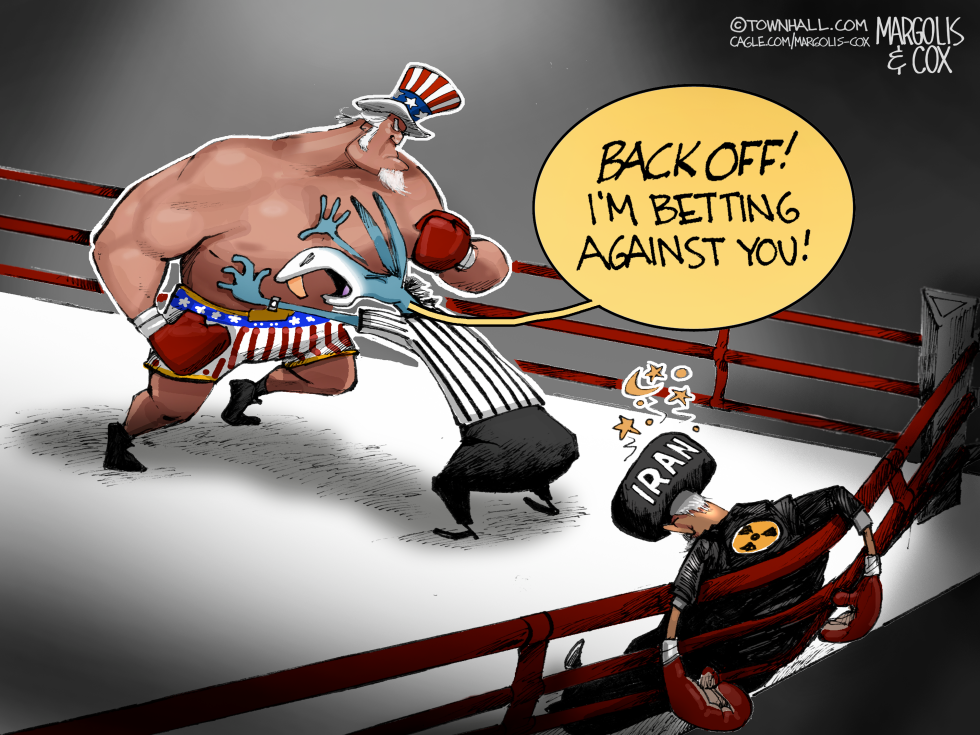
The cartoon depicts a boxing ring where Uncle Sam, wearing a top hat and patriotic shorts, advances aggressively, punching a referee in striped shirt who clutches a white dove. The referee's arm extends to halt the fight, but Uncle Sam shouts 'BACK OFF! I'M BETTING AGAINST YOU!' Meanwhile, the opponent, labeled 'Iran' with a nuclear symbol on his back, sprawls knocked out on the canvas. Stars indicate the impact. This setup uses boxing metaphor to satirize US foreign policy toward Iran, portraying America as betting against peace interventions, possibly represented by the dove-bearing referee. The artwork by Margolis & Cox captures tensions with dry humor, emphasizing unchecked aggression in international relations.