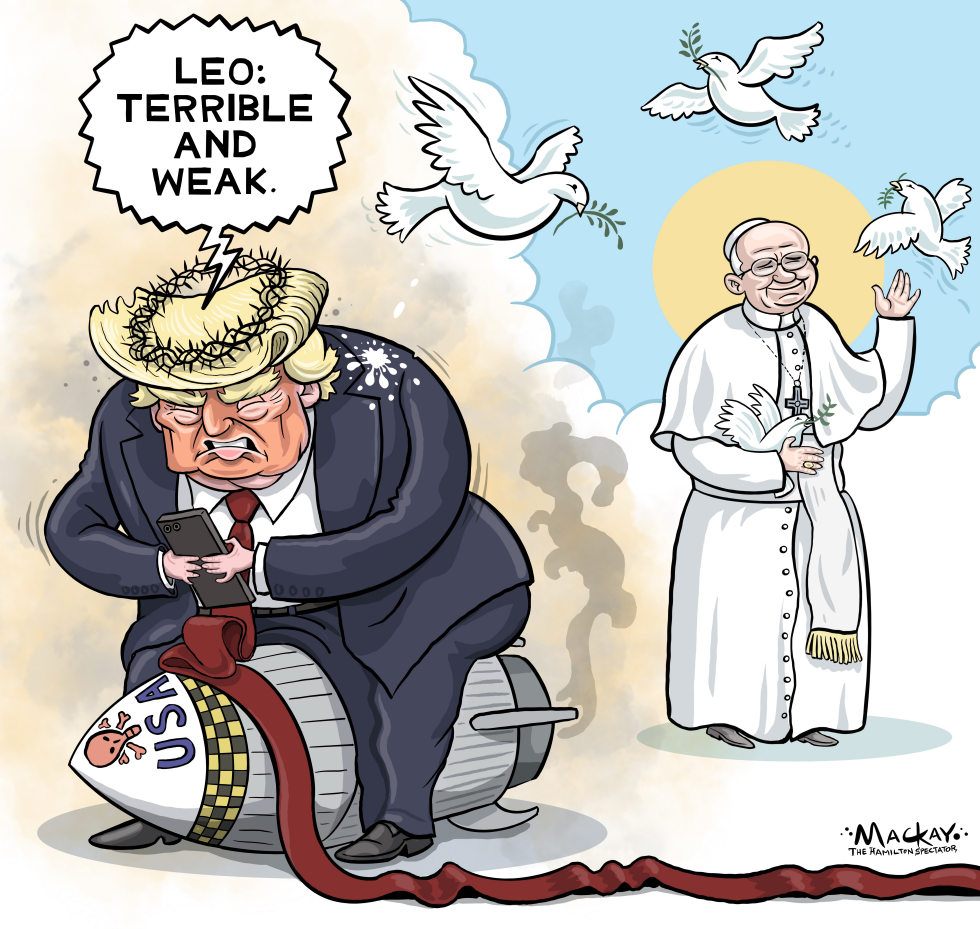
Graeme MacKay's political cartoon captures Trump, caricatured with crown of thorns hair, sitting on a bomb labeled USA with a skull symbol, holding a phone and declaring 'Leo: Terrible and Weak' in a speech bubble. Smoke rises from the missile, contrasting sharply with the Pope on the right, halo glowing, releasing white doves carrying olive branches. The scene unfolds against a cloudy sky, highlighting themes of war and peace. This satirical illustration pokes at political rhetoric, religious symbolism, and international tensions, blending humor with critique in a style that's both direct and pointed.
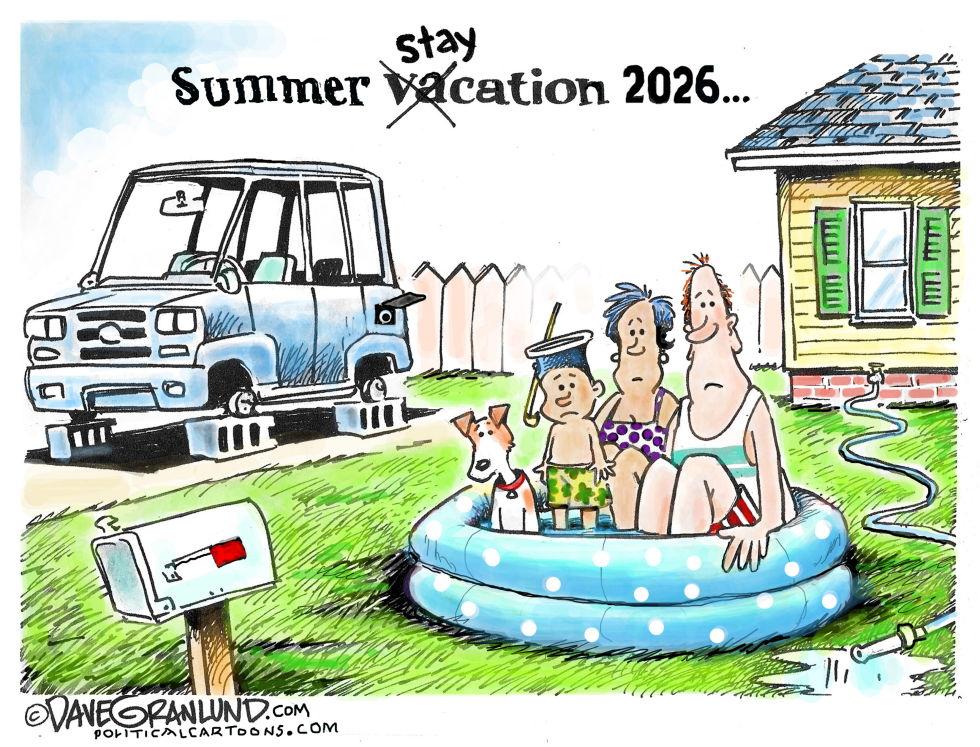
Dave Granlund's cartoon nails the frustration of high gasoline prices derailing summer road trips for families on limited budgets. Instead of hitting the highway in their autos, this crew opts for a stay home vacation, splashing in a backyard kiddie pool with the dog. The jacked-up minivan on blocks screams grounded plans, while the crossed-out 'Va' in vacation turns it into 'Staycation 2026.' It's a sharp poke at how fuel costs force folks to tighten belts, swapping grand adventures for hose-filled pools and mailbox views. Tags like gasoline prices, high cost, and stay home highlight the economic squeeze, making this a relatable jab at everyday belt-tightening.
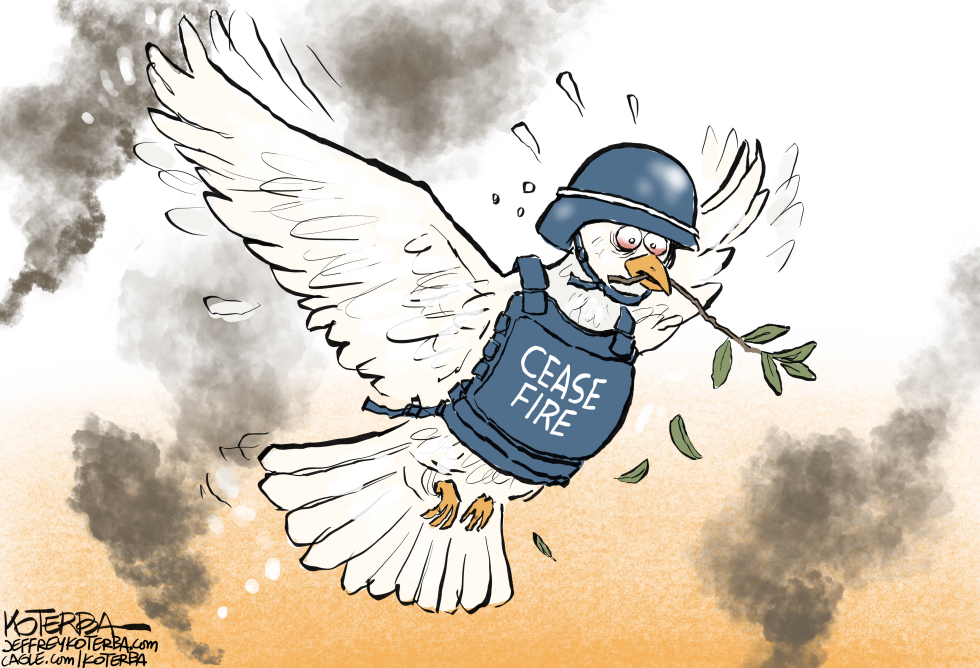
Jeff Koterba's cartoon shows a white dove, traditional symbol of peace, outfitted in a blue military helmet and a bulletproof vest marked 'CEASE FIRE.' The bird clutches an olive branch in its beak, eyes wide in surprise, as it navigates through billowing dark smoke clouds. This setup highlights the fragility of cease fire attempts in war zones, with the armored dove representing protected yet vulnerable peace initiatives. The orange-tinted background suggests a fiery landscape, emphasizing conflict's harsh reality. Tags like political cartoon, peace dove, cease fire vest, olive branch, war smoke, and satirical illustration capture the image's essence for SEO.
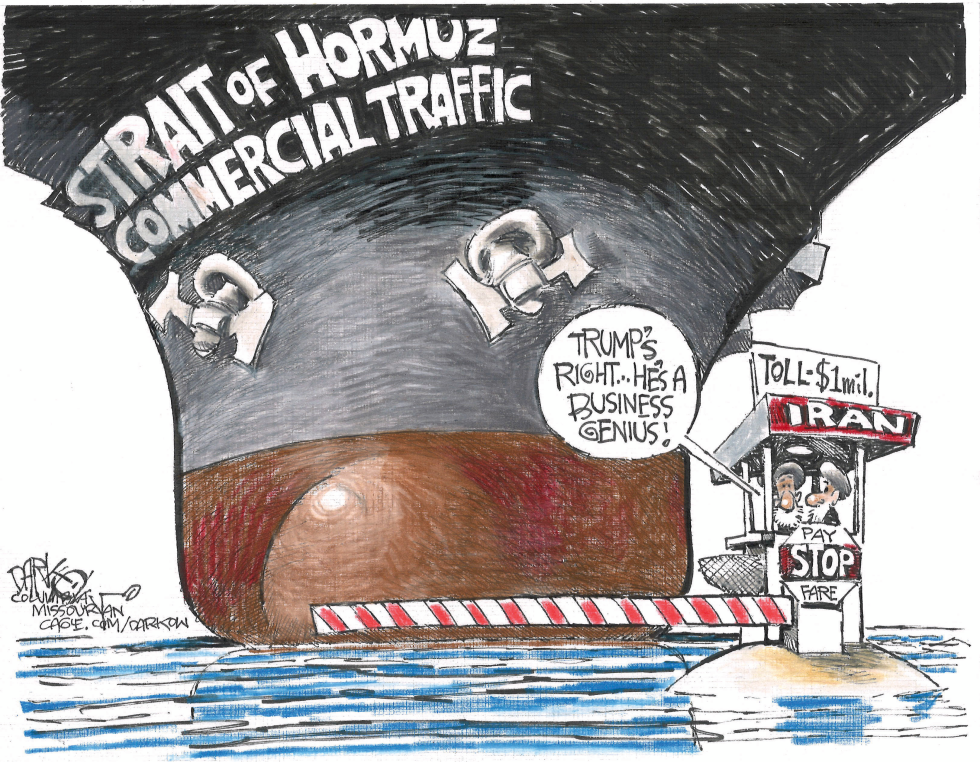
The cartoon shows a massive ship representing commercial traffic through the Strait of Hormuz approaching an Iran-operated toll booth charging one million dollars. Two figures in the booth exchange remarks crediting Trump with business acumen. The scene illustrates tensions over control of the vital shipping route between Iran and Gulf states.
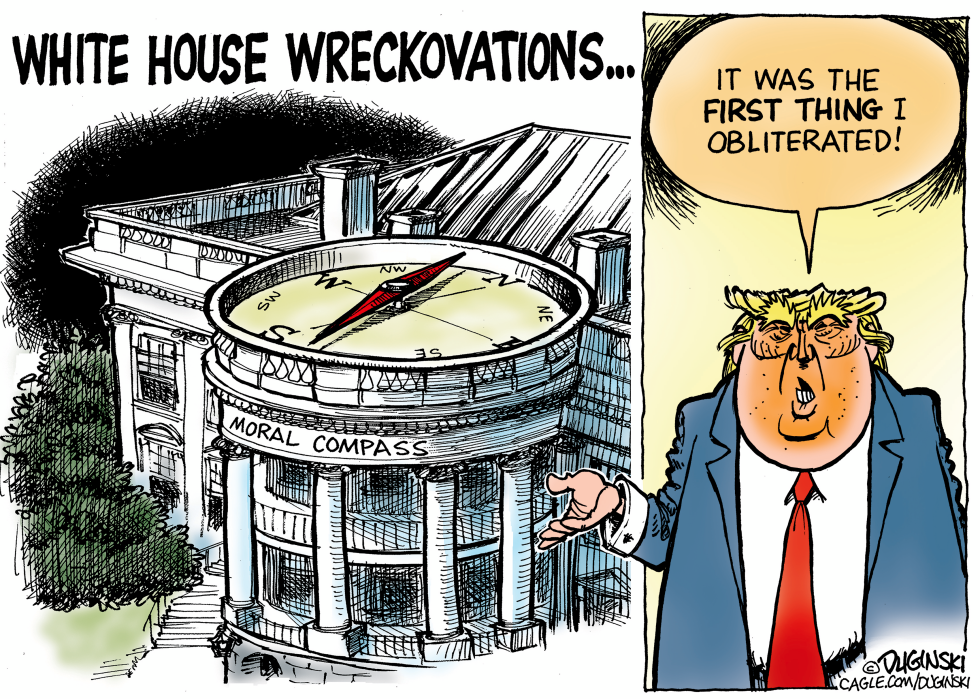
Paul Duginski's cartoon shows a caricatured Trump gesturing proudly while speaking about obliterating the moral compass, a large dome-like structure labeled 'Moral Compass' with directional arrows, placed on the White House roof. The title 'White House Wreckovations' plays on renovations, suggesting destructive changes. Tags including president, MAGA, White House, demolition, morality, ethics, obliteration, Republicans, and Iran war frame the image as a critique of ethical standards in politics. The scene captures a dark night setting with part of the building and trees visible, emphasizing the theme of moral destruction in Washington.
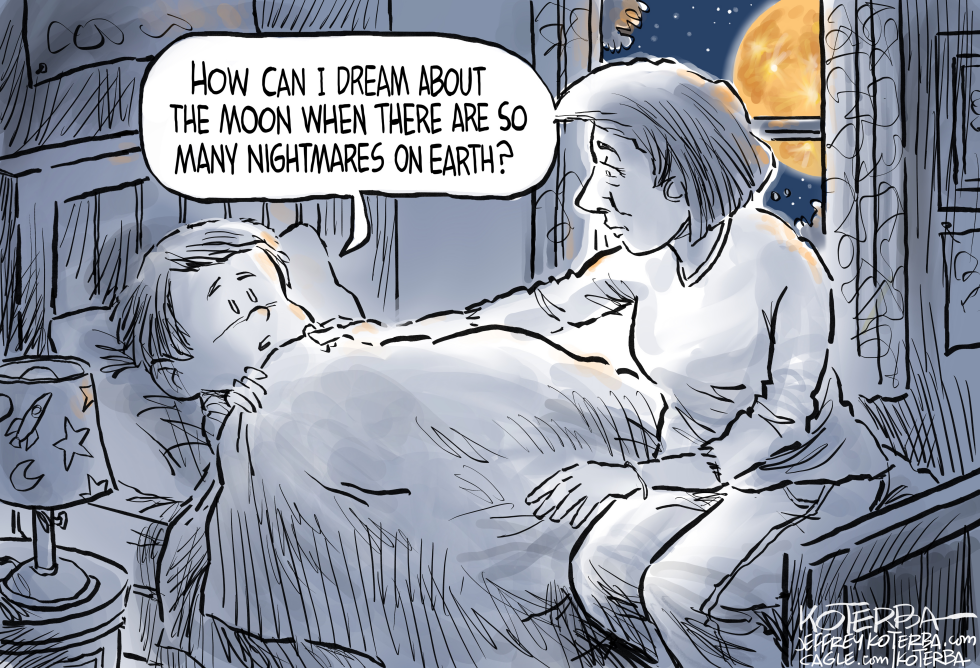
This poignant political cartoon depicts a child in bed, gazing toward a window framing a massive orange moon against a starry night sky, while confiding in a seated adult figure. The child's speech bubble reads: 'How Can I Dream About The Moon When There Are So Many Nightmares On Earth?' A bedside lamp with a star design illuminates the scene. Through this setup, the artwork satirizes how youth anxiety from global issues—like wars, climate woes, and social upheavals—stifles big dreams and aspirations. It's a clever commentary on how earthly nightmares eclipse celestial hopes, blending humor with insight into modern parenthood and childhood innocence lost. Tags: political cartoon, child nightmares, moon dreams, earth troubles, satirical illustration, youth anxiety, global chaos.
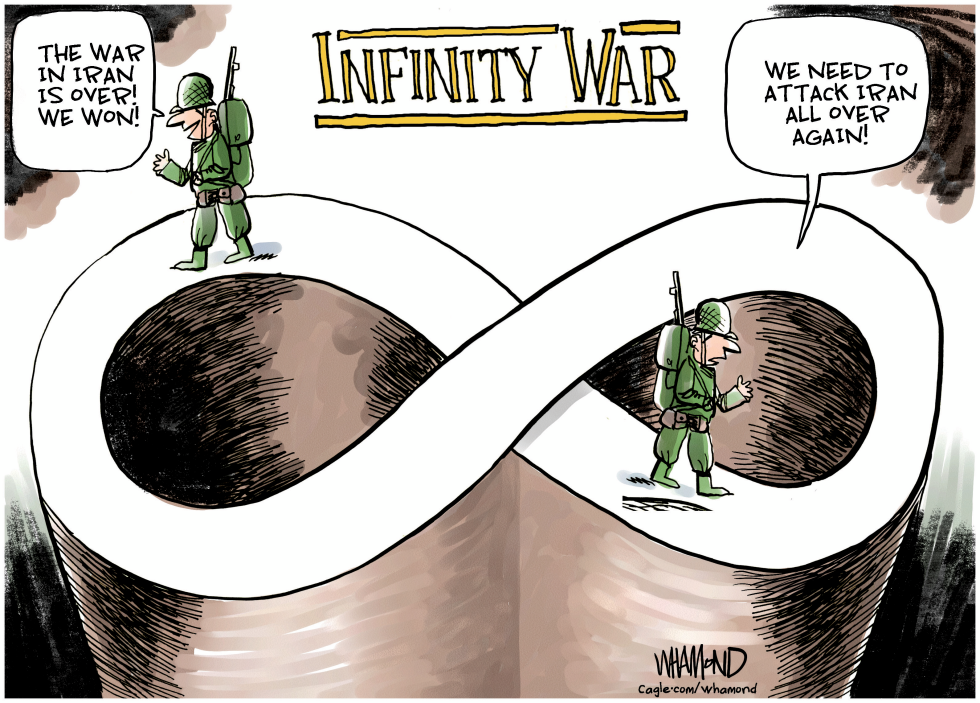
Dave Whamond's cartoon features two soldiers positioned on a large infinity symbol, one announcing victory in the Iran war while the other insists on attacking again, highlighting the perpetual nature of conflict. The title 'Infinity War' parodies endless warfare, with the loop representing cycles of victory and renewed aggression. Tags like iran war cartoon, infinity symbol war, endless conflict satire, military parody, perpetual war illustration, and satirical soldiers emphasize the dry humor in depicting how wars in regions like Iran seem to restart indefinitely, a common theme in political cartoons that resonates with ongoing global tensions.
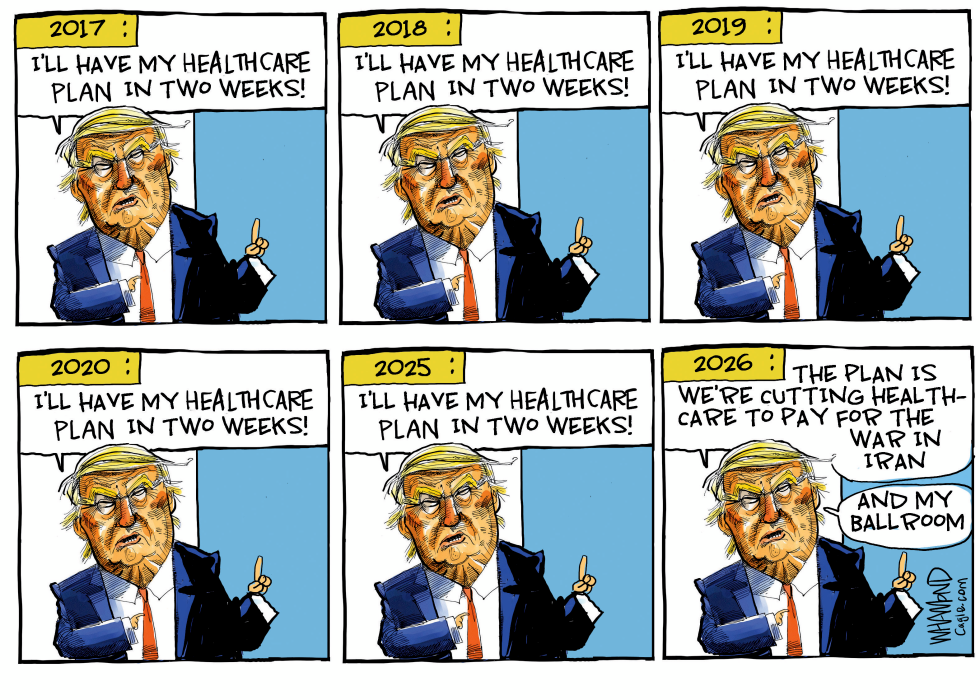
Dave Whamond's political cartoon depicts a recurring figure with distinctive blonde hair and suit, pointing emphatically while promising a healthcare plan 'in two weeks' from 2017 through 2025. The sequence builds to a 2026 punchline where the promise shifts to cutting healthcare to fund a war in Iran and a personal ballroom. This Trump healthcare plan political cartoon employs dry humor to critique endless delays and misplaced priorities. The US politics war funding criticism underscores how domestic needs like healthcare reform delay comic strip give way to military spending in this Republican healthcare policy parody. The endless two weeks promise meme captures the frustration with unfulfilled pledges in a sharp, sequential format.
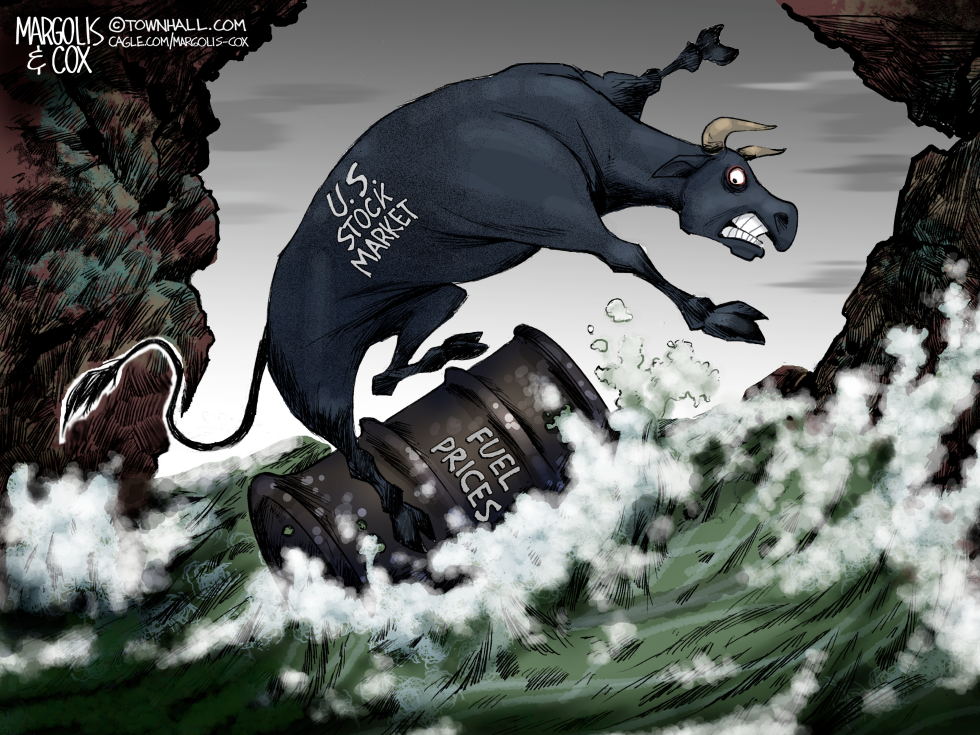
The cartoon shows a fierce black bull, emblazoned with 'U.S. Stock Market,' plummeting off jagged cliffs into a turbulent green sea where an oil barrel labeled 'Fuel Prices' tips over amid white foam. This visual packs a punch on how rising fuel prices can drag down the bull market, touching on economy, stocks, oil, prices, portfolio, and market tags. It's a classic setup: the bull charges ahead but hits the wall of energy costs, splashing into chaos. Editors see these often, where financial optimism meets harsh commodity realities, making it relatable for readers watching their investments swirl in the currents.
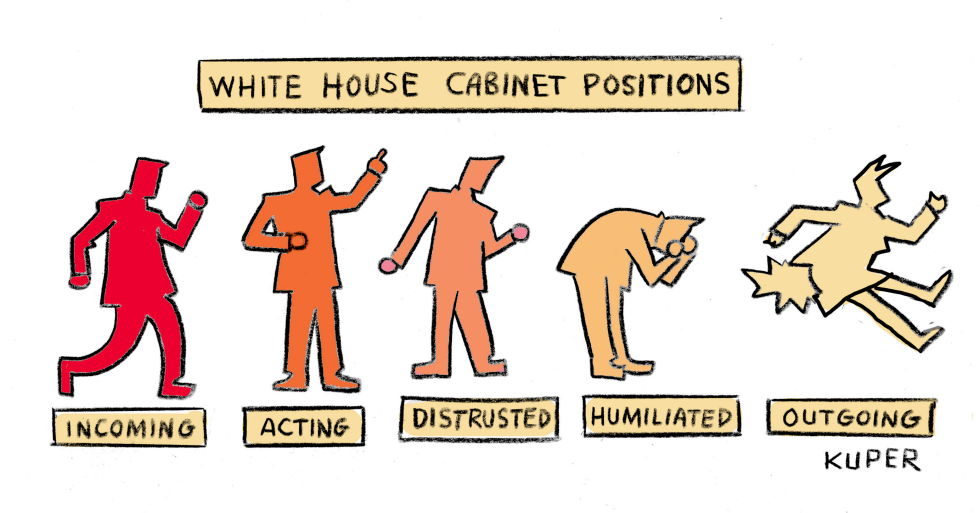
Peter Kuper nails the absurdity of Trump White House cabinet positions in this sharp cartoon. Five stylized figures march through stages: incoming in red, striding confidently; acting with a pointing gesture; distrusted standing still; humiliated bent over in shame; outgoing fleeing with a kick. Labels underscore the progression from promise to humiliation. Tags like cabinet turnover, political satire, administration instability, Trump firings, White House staff cycle, and executive distrust highlight the revolving door of appointments. It's a dry commentary on the chaos, where loyalty meets betrayal in quick succession. The simplicity amplifies the bite, making it perfect for syndication.
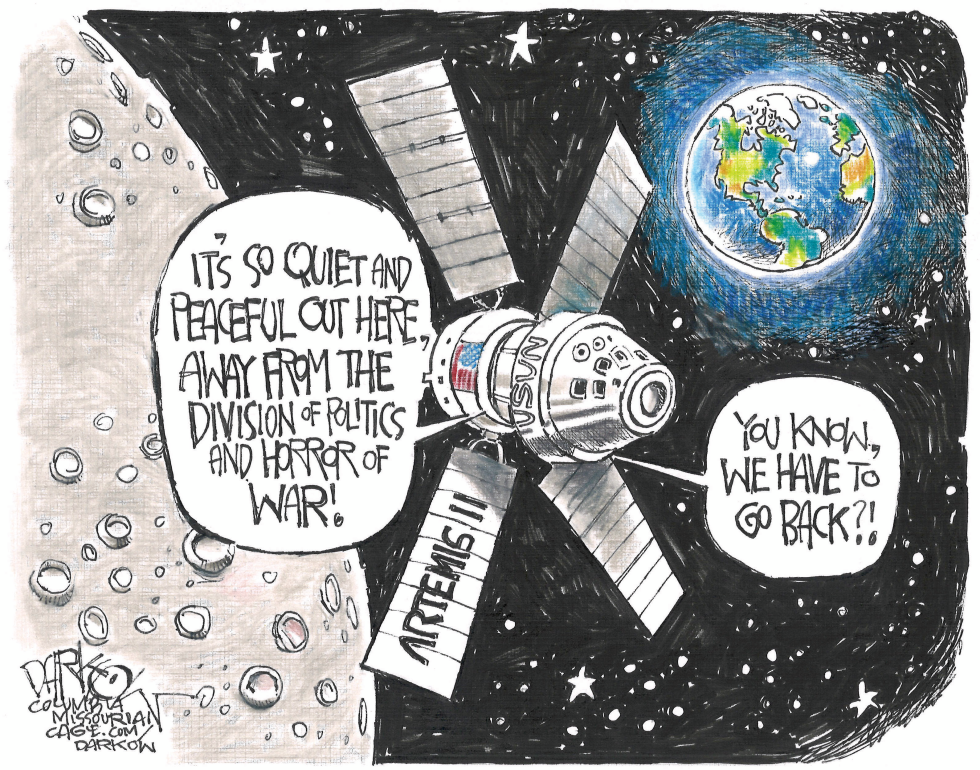
This Daryl Cagle political cartoon analysis features the Artemis II spacecraft floating in serene space, with Earth glowing in the background and the moon nearby. The left speech bubble extols the quiet peace away from division of politics and horror of war, while the right one resignedly notes the need to go back. It's a satirical cartoon on politics and war division, poking fun at how space exploration escaping earthly conflicts offers temporary respite. The NASA Artemis program humor illustration underscores the irony of advanced space missions contrasting with unresolved human divisions on Earth. Through this humorous take on returning to political division, the cartoon cleverly comments on the allure of peaceful space vs chaotic Earth without delving into specifics.
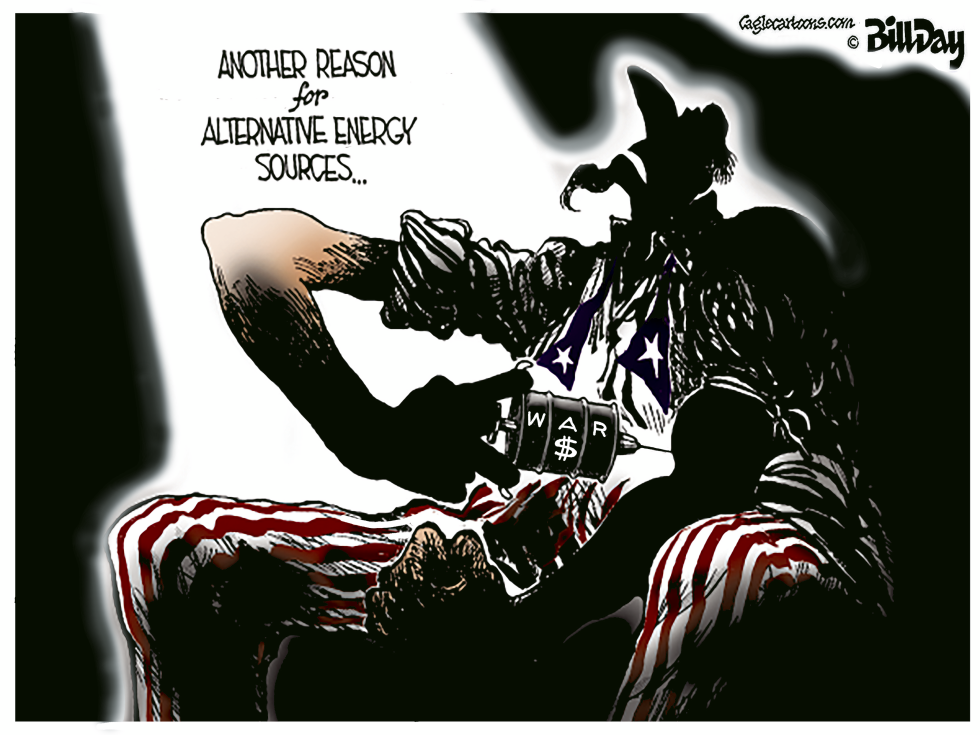
Bill Day's cartoon shows a figure in red-and-white stripes, resembling national colors, self-injecting a syringe marked 'WAR' and '$', with text pleading for alternative energy sources. The dark, shadowy style underscores the grim addiction to oil, tying into tags like war, oil prices, Gulf of Hormuz, global warming, climate change, and addiction. This visual metaphor pushes for wind energy and solar panels as escapes from the cycle of dependency that leads to conflict and environmental harm. The composition is stark, with the arm and syringe dominating, emphasizing the self-destructive habit amid calls for renewable shifts.
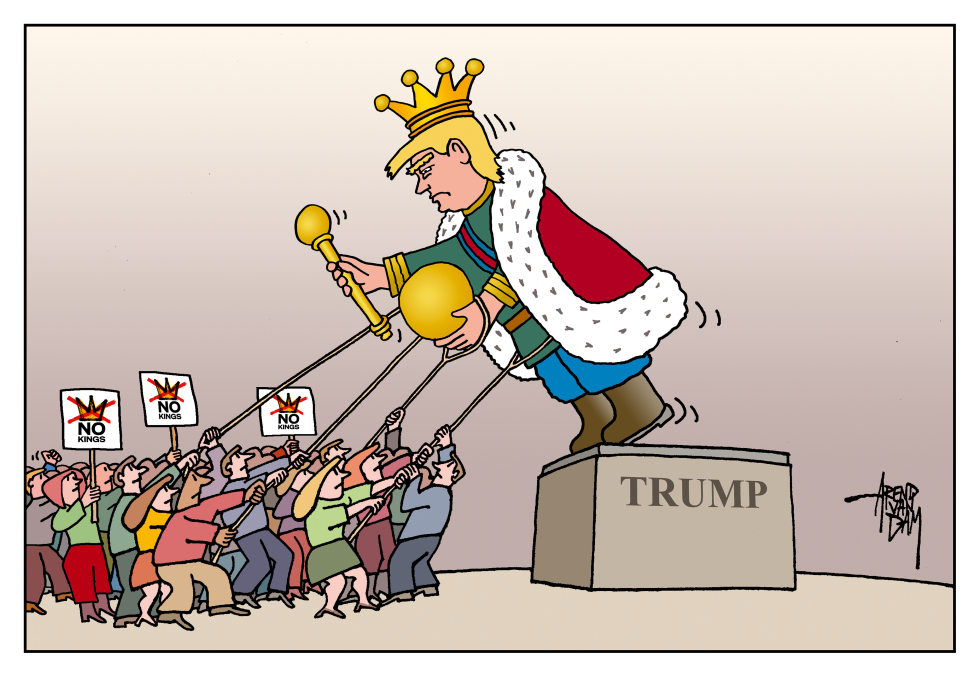
Arend van Dam's cartoon depicts a massive figure resembling Donald Trump, adorned with a crown and royal robe, perched atop a pedestal marked 'TRUMP.' A diverse group of protesters, holding signs reading 'NO KINGS,' 'NO,' and another 'NO,' tug on ropes attached to the figure's scepter, causing it to tilt as if being toppled in an act of resistance. The scene evokes themes of USA democracy clashing with autocracy, portraying a symbolic revolution against a would-be king or dictator. Protests and demonstrations fill the foreground, highlighting public outcry against unchecked power. Dated 2026, the artwork underscores ongoing concerns about authoritarian tendencies in politics.
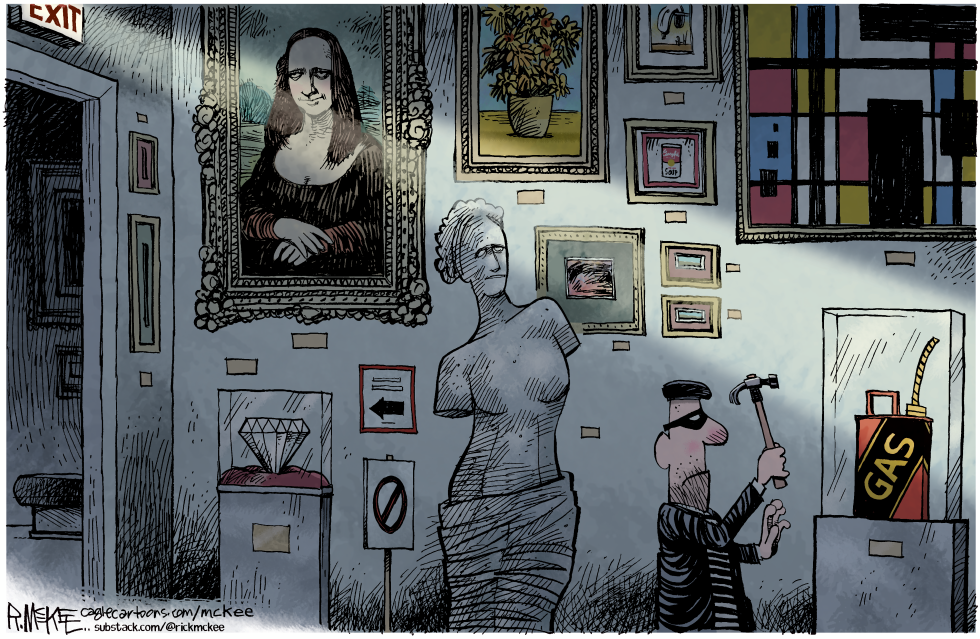
Rick McKee's cartoon depicts a dimly lit museum where a striped-shirted thief, masked and wielding a hammer, targets a display case with a red gas can marked 'GAS,' overlooking iconic pieces like the Mona Lisa portrait, Venus de Milo statue, a large diamond, Van Gogh-style sunflowers painting, abstract Mondrian-like art, and smaller framed works. An 'EXIT' sign glows above, and a 'no' symbol sign hangs nearby. The scene uses tags such as Trump, war, Iran, gas prices, oil, museum to comment on how escalating fuel costs make gasoline more valuable than cultural treasures, blending humor with commentary on energy crises.
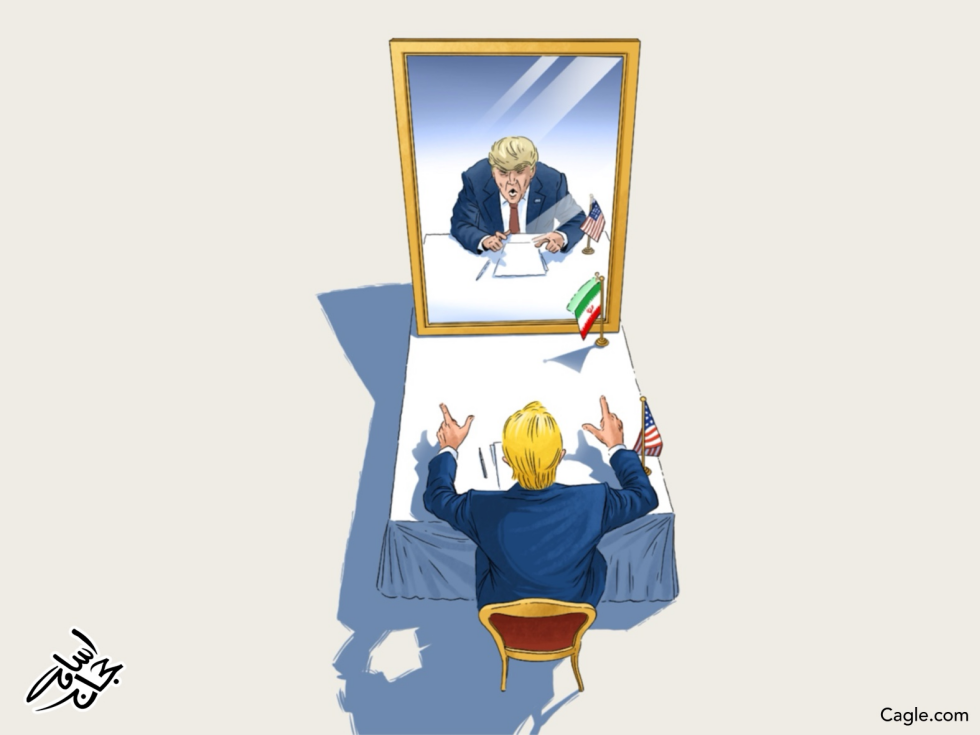
This humorous political cartoon depicts a figure with distinctive yellow hair and a blue suit seated at a table, pointing accusingly at a large mirror. In the reflection, an identical figure points back, but with an Iran flag instead of the US flag beside him. The setup cleverly satirizes self-negotiation or internal conflict in international relations, using mirror imagery for ironic effect. Elements like the pointing fingers, national flags, and desk setup emphasize bilateral tensions. As a satirical piece from Cagle.com, it offers insightful commentary on diplomatic absurdities, blending humor with political critique in a visually striking composition.