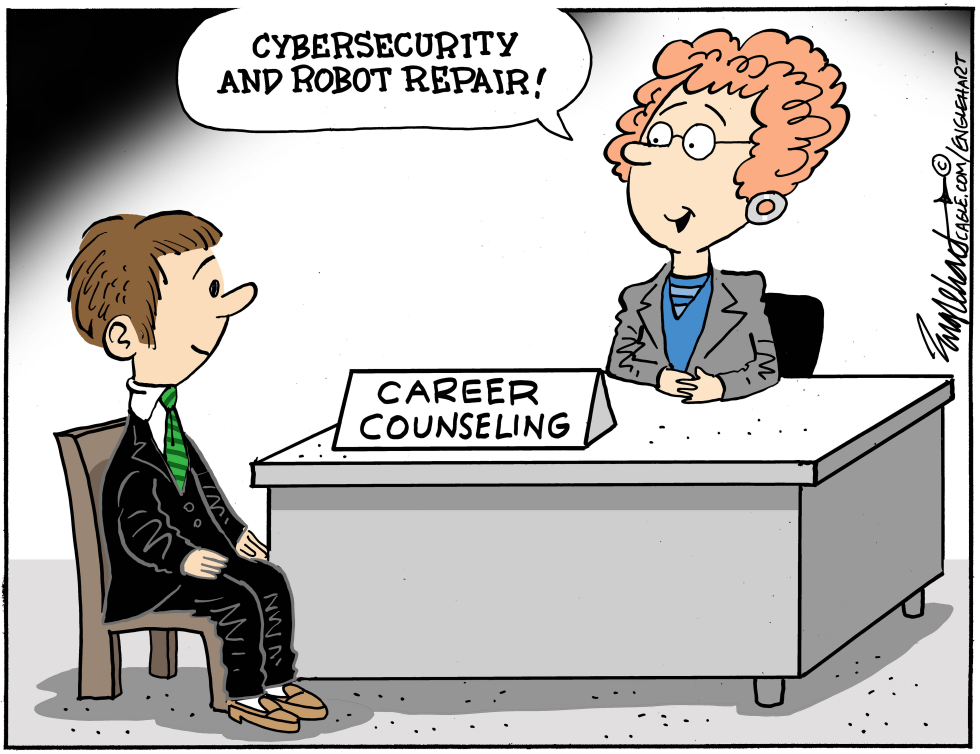
On June 8, 2026, Bob Englehart depicts a career counseling session where a professional recommends cybersecurity and robot repair to a young client. The scene reflects ongoing shifts in job markets driven by artificial intelligence and automation. The desk sign and speech bubble emphasize practical skills for future employment.
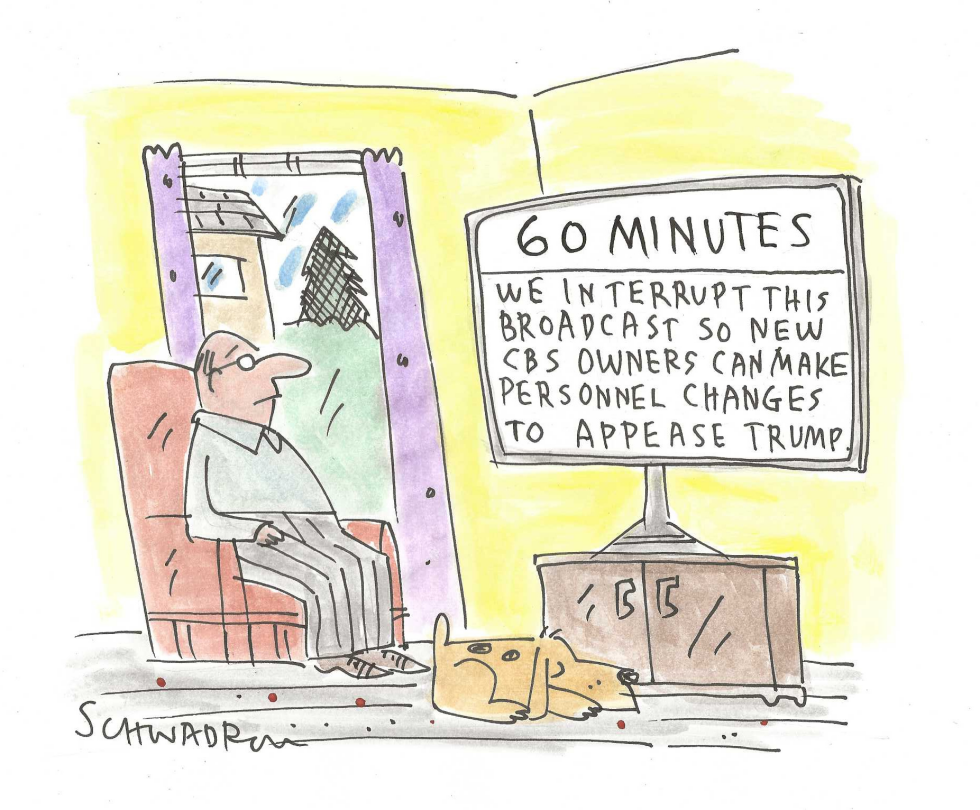
The cartoon depicts a viewer watching an on-screen announcement from 60 Minutes that interrupts the broadcast for personnel changes at CBS to appease Trump. The scene shows the television set displaying the message while the viewer remains seated and a dog lies on the floor. The date of June 2026 places the image in a period of ongoing discussion about media ownership and external political pressure on news outlets.
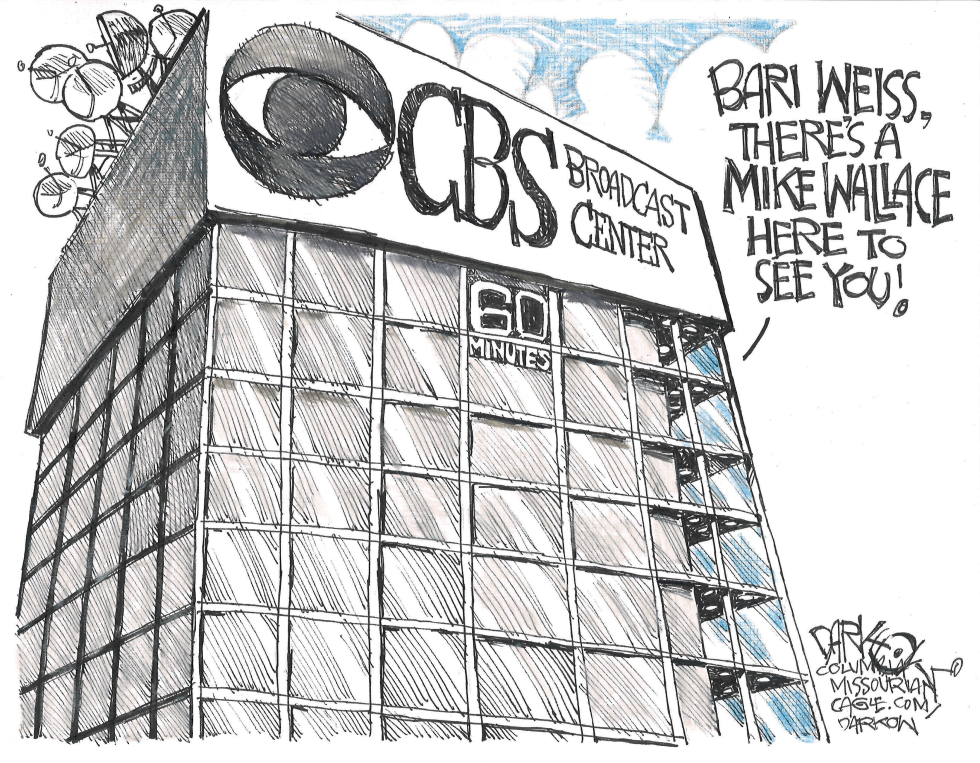
The drawing shows the CBS Broadcast Center in New York with its prominent eye logo and 60 Minutes signage. Large lettering on the right addresses Bari Weiss directly, stating a Mike Wallace figure has arrived to see her. The image appears amid reports of personnel changes and editorial disputes at CBS News in the spring of 2026.
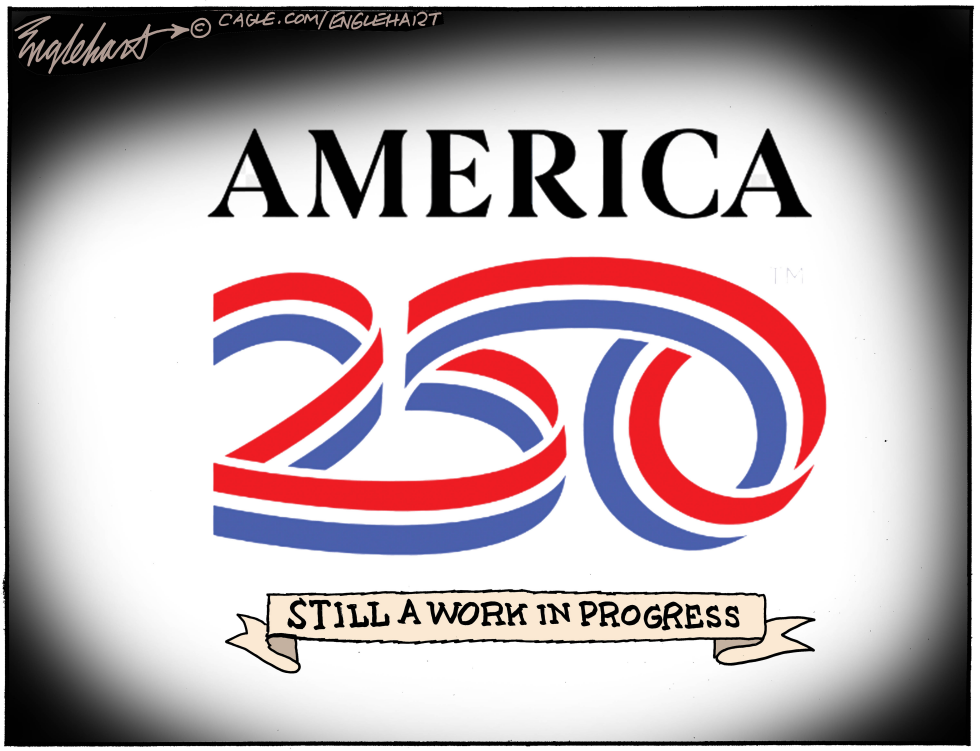
Bob Englehart's June 2026 cartoon marks America's 250th anniversary with a large stylized 250 in patriotic colors under the word AMERICA. A banner across the bottom reads STILL A WORK IN PROGRESS. The image ties directly to the upcoming semiquincentennial on July 4 2026 and offers a simple visual statement about the nation's continuing evolution.
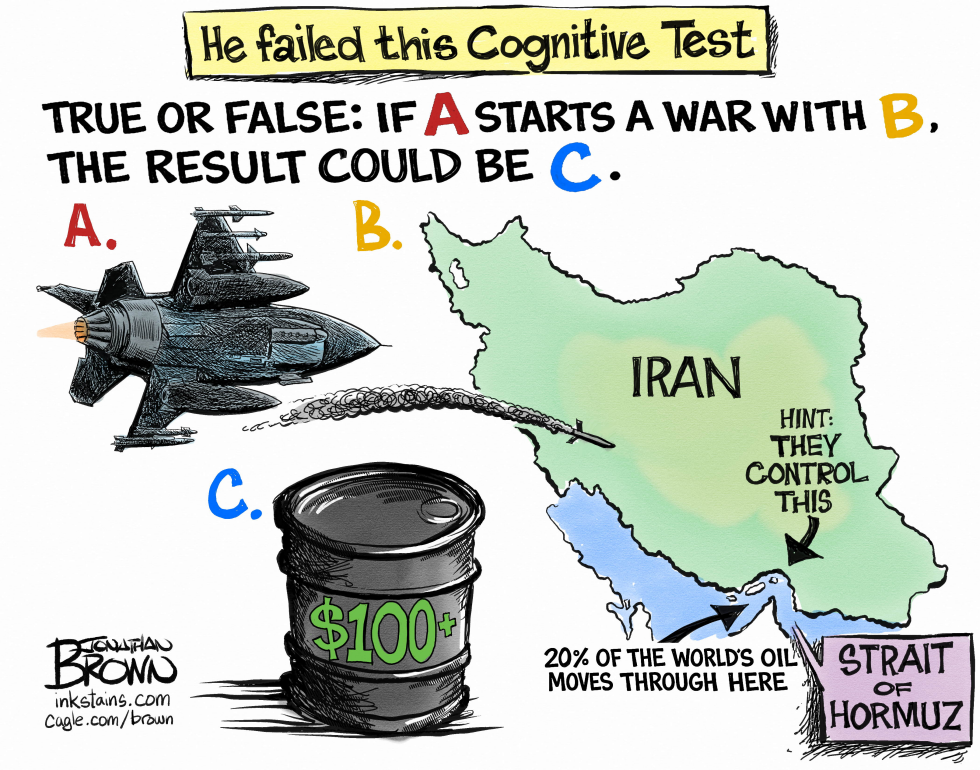
Jonathan Brown's cartoon presents a stark true-or-false cognitive test: if A (a fighter jet) starts a war with B (Iran), the result could be C (an oil barrel marked $100+). The map of Iran includes a hint pointing to the Strait of Hormuz, noting that 20% of the world's oil moves through there, underscoring control over this chokepoint. Tags such as cognitive test, war in Iran, oil prices, Strait of Hormuz, gas prices, and cost of war frame the satire. The artwork warns of economic fallout from conflict, with the jet trailing toward Iran and the oil barrel symbolizing surging costs. This piece captures geopolitical tensions in a simple, visual riddle.
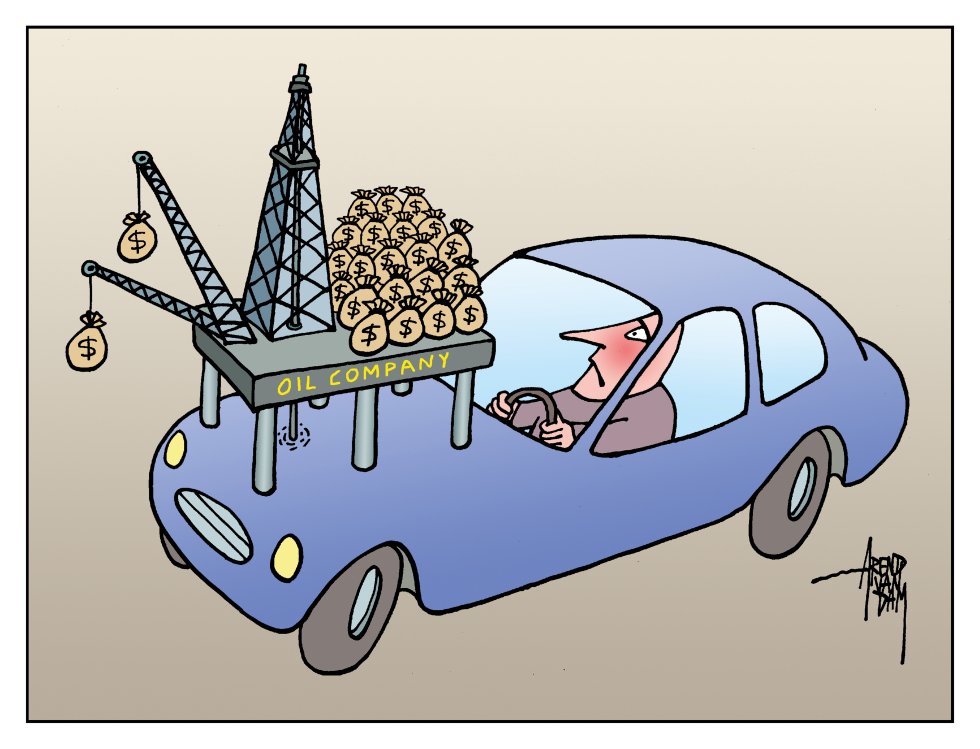
In this pointed political cartoon, an oil company platform sits atop a blue car, loaded with piles of dollar-sign money bags, while cranes dangle more profits. The frustrated motorist grips the wheel, face red with anger, illustrating how excessive profits from oil companies crush consumers at the pump. Tags like excessive profits, motorists, fuel, petrol, and refuel capture the essence, with Iran and Strait of Hormuz hinting at geopolitical tensions driving prices. This visual satire underscores the disparity between corporate windfalls and everyday drivers' pain, a timeless theme in energy politics.
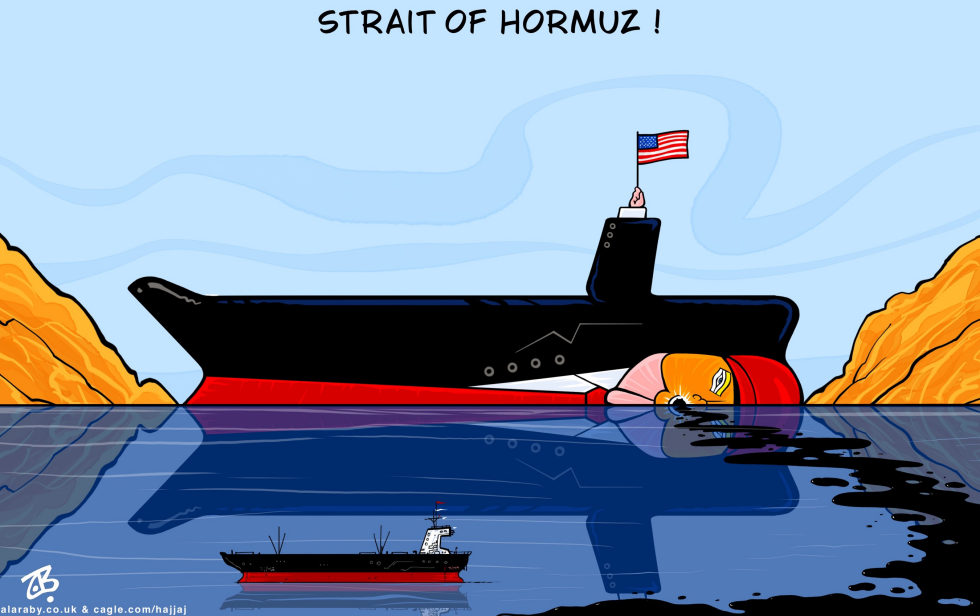
Emad Hajjaj's cartoon depicts a large black submarine with a red hull, stuck between orange landmasses in the Strait of Hormuz, its bow featuring an orange face with yellow hair and a red tie, clearly caricaturing Donald Trump. An American flag flies atop the vessel, while black oil spills into the blue water, reflecting the ship. Below, a smaller black tanker with a white figure onboard sails through the oily sea, tagged with Persian, Gulf, Sea, Tanker, Oil, War. The image satirizes US involvement in Middle East conflicts, particularly Iran war scenarios, without overreaching into hidden meanings. The composition is straightforward, with clear lines and bold colors emphasizing the blockage.
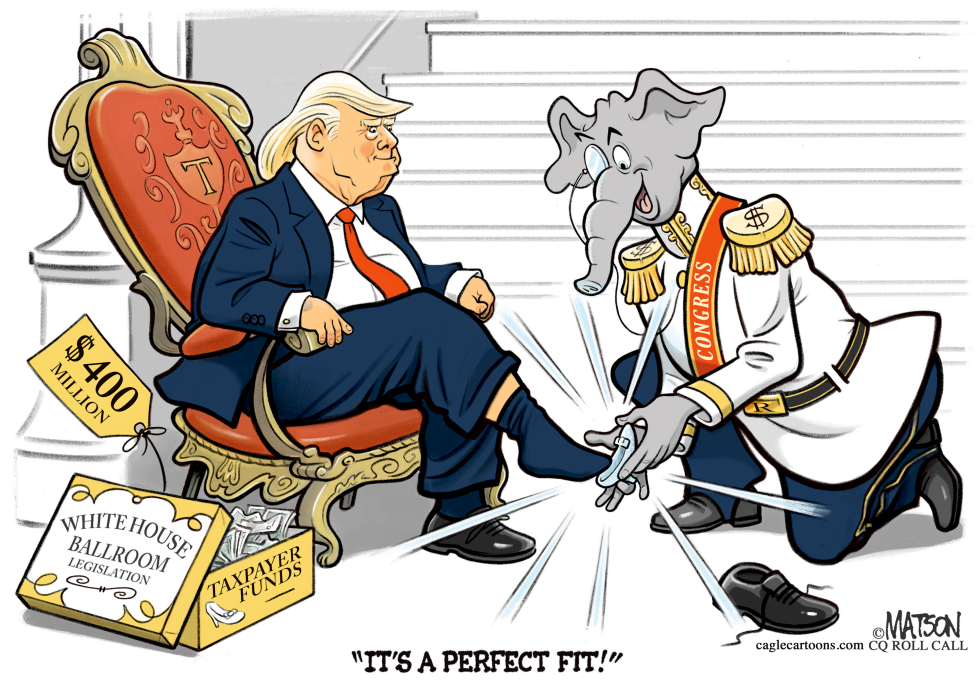
RJ Matson's cartoon depicts President Trump as Cinderella, lounging on a throne while a grinning Congress elephant, adorned with a sash and dollar-sign epaulets, slips a black shoe onto his foot, exclaiming 'It's a perfect fit!!' A box labeled 'White House Ballroom' overflows with 'Taxpayer Funds,' and a $400 million tag dangles nearby. This sharp satire targets Congressional Republicans' approval of hefty taxpayer funding for White House upgrades, echoing the fairy tale but with a political twist on government spending and Donald Trump's influence. The White House Correspondents Association Dinner at the Hilton Hotel lurks in the background tags, highlighting budget priorities amid fiscal debates.
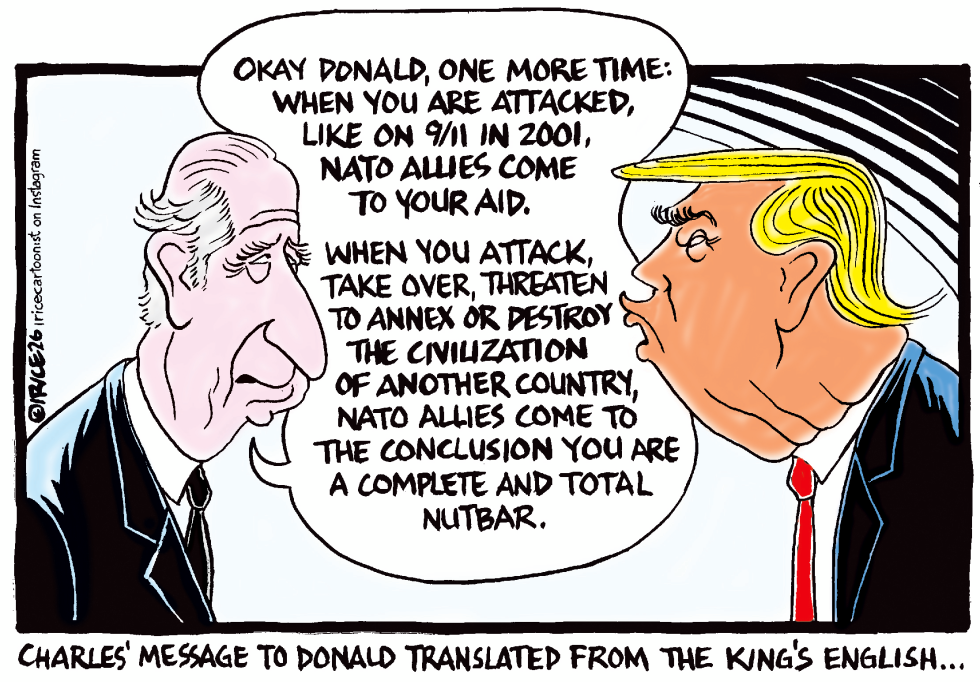
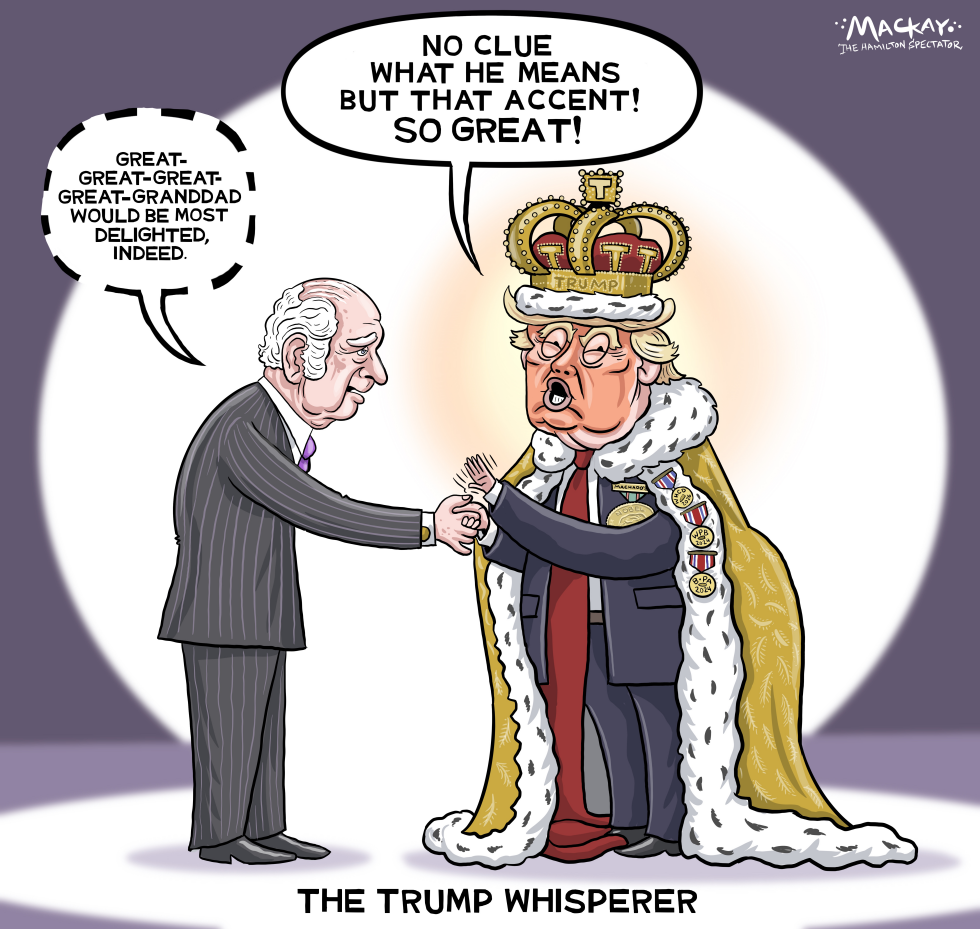
Graeme MacKay's cartoon depicts King Charles III leaning in to whisper a message from King George III to a regally dressed President Trump, who misinterprets it due to the accent. Tagged with USA, Canada, UK, the image explores monarchy, diplomacy, and alliance themes. Trump's crown labeled with his name adds symbolism of self-aggrandizement, while the 'Trump Whisperer' caption underscores the tension in this leadership encounter. Historical nods to tradition and stability contrast with modern visit dynamics, blending respect and satire in a visually striking composition.
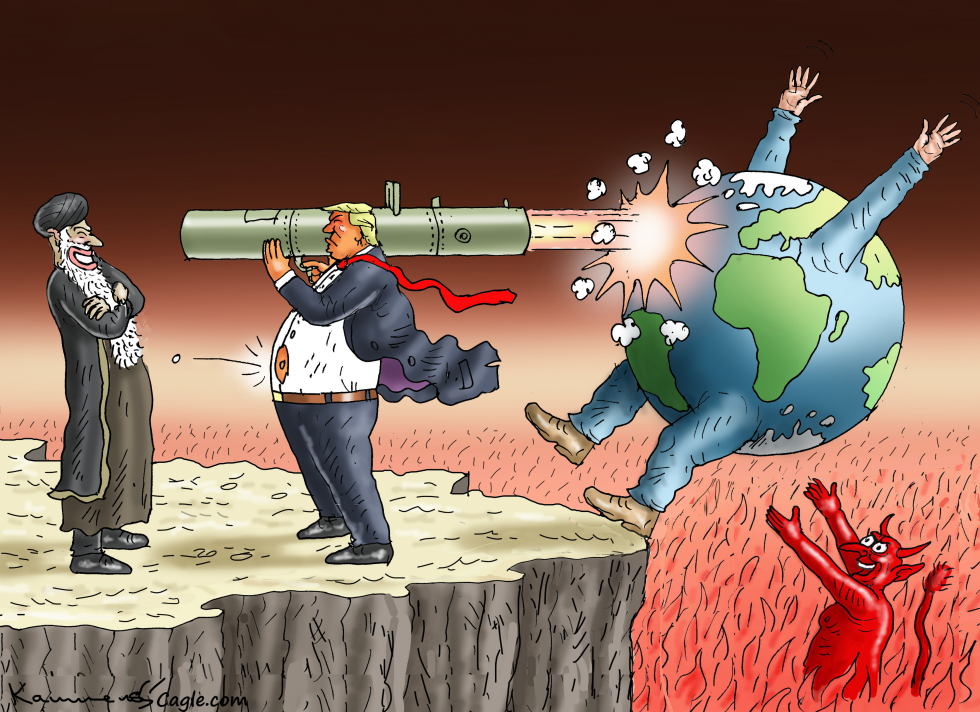
Marian Kamensky's cartoon shows a bearded figure in robes watching as a Trump caricature, with his signature hair and red tie, fires a massive rocket launcher. The blast hits a blue Earth globe with arms and legs, kicking it off a rocky cliff into a red, fiery abyss where a grinning devil waits with raised arms. The dark background emphasizes the dramatic fall. Incorporating tags such as Iran War, Trump, Hormuz, Fascism, Oil War, and MAGA Terror, the image captures a stark visual metaphor for escalating tensions and potential global catastrophe in a straightforward satirical style.
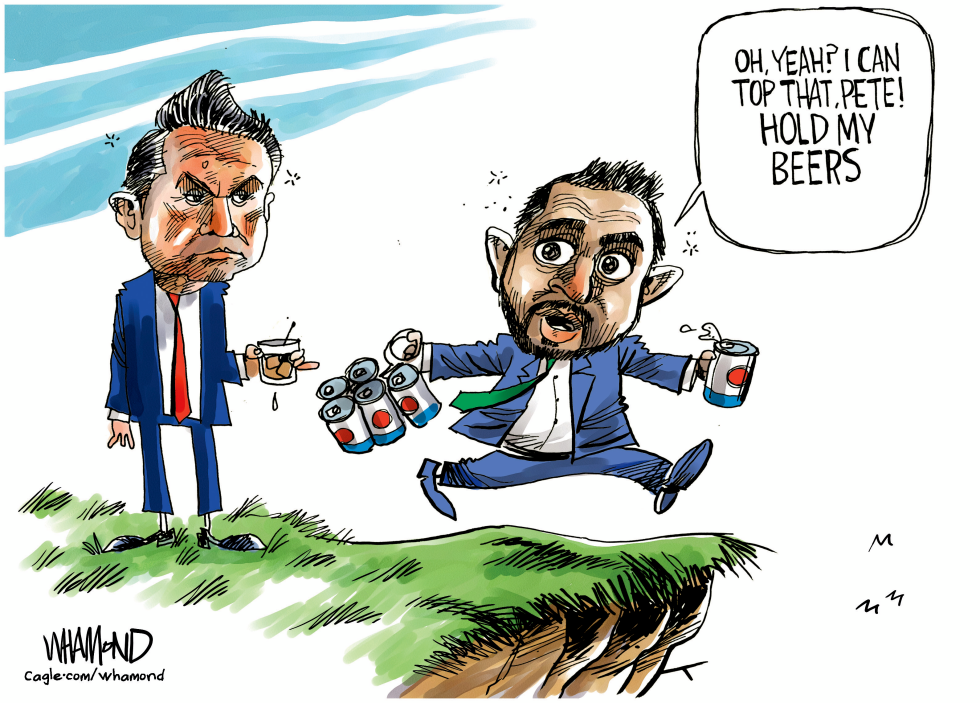
Dave Whamond's cartoon depicts Kash Patel energetically leaping from a grassy cliff, clutching a handful of beer cans and a drink, while yelling 'OH YEAH? I CAN TOP THAT PETE! HOLD MY BEERS' in a speech bubble. A stern-faced man in a suit stands nearby, holding a small drink. The scene plays on drinking allegations surrounding Patel's FBI director nomination, incorporating tags like The Atlantic article, reported alcohol use, drinks to excess, intoxication, unexplained absences, and Patel's 250M defamation lawsuit. The artwork uses caricature style to satirize political figures lashing out at press and Democrats demanding alcohol abuse tests, with Patel portrayed in a dynamic, over-the-top pose against a simple sky and grass background.
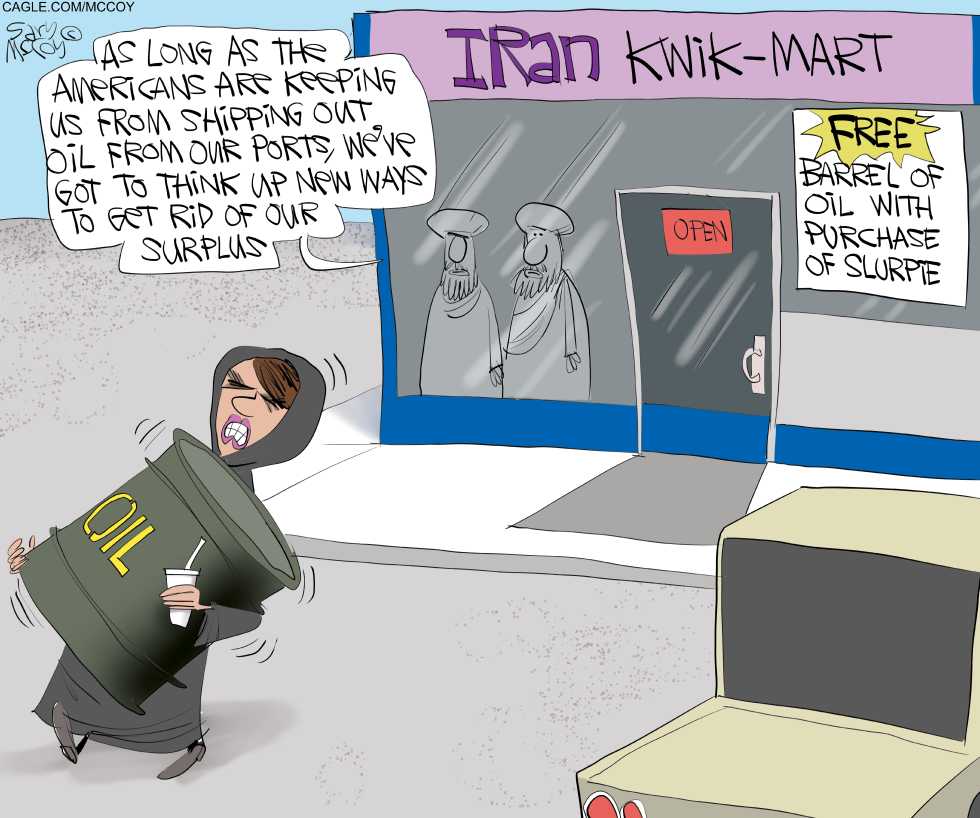
Gary McCoy's cartoon depicts two bearded Iranian clerics inside the Iran Kwik-Mart, promoting a free barrel of oil with Slurpee purchase to handle surplus crude. Outside, a hooded figure dumps an oil barrel into a car trunk, lamenting U.S. blockades on shipping ports. The image ties into Strait of Hormuz tensions, oil prices, Trump-era policies, Iran's Revolutionary Guard, and Middle East conflicts, highlighting ironic solutions to energy surplus amid international sanctions and naval standoffs. Commercial ships and tankers face barriers, forcing creative disposal methods in this dryly humorous take on global oil dynamics.
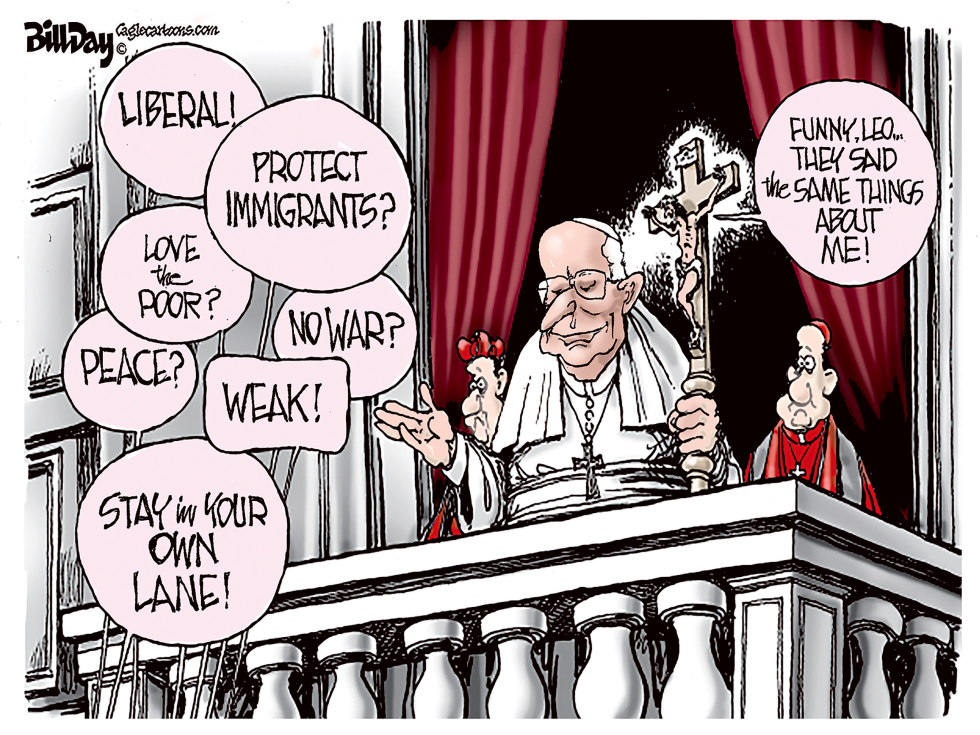
Bill Day's political cartoon shows a central pope figure on a balcony, holding a cross staff, surrounded by speech bubbles accusing liberal views like protect immigrants, love the poor, peace, no war, weak. A side figure remarks on funny Leo saying the same things about me, drawing a clear visual parallel. The composition uses red curtains and clerical attire for a Vatican setting, emphasizing satire on church politics. Tags include political cartoon pope francis, bill day cartoon, pope leo comparison, conservative backlash pope, anti-war pope, catholic church politics.
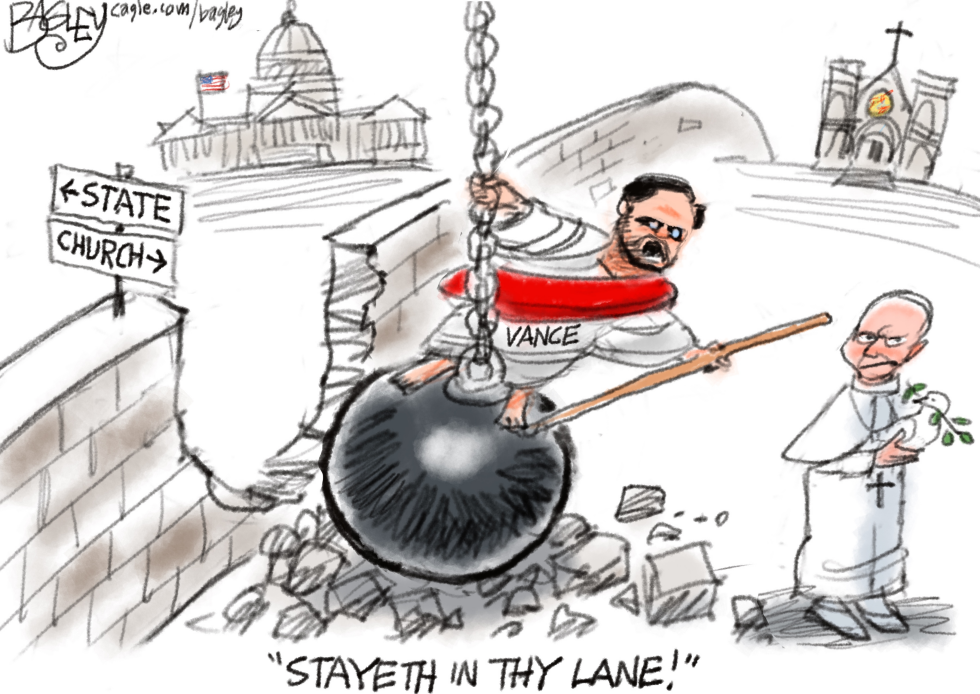
Pat Bagley's cartoon shows JD Vance dressed as Jesus, labeled 'VANCE,' swinging a massive wrecking ball to shatter a brick wall marked with signs pointing to 'STATE' and 'CHURCH.' He shouts 'STAYETH IN THY LANE!' at a figure resembling the Pope, who holds an olive branch and dove, symbols of peace. In the background, the U.S. Capitol flies an American flag, while a church with a cross represents the Vatican. Tags like war, peace, JD Vance, religion, Trump, and scripture underscore the satire on blurring lines between church and state, with Vance enforcing boundaries ironically through destruction. The image critiques political figures invoking religion amid Capitol politics.