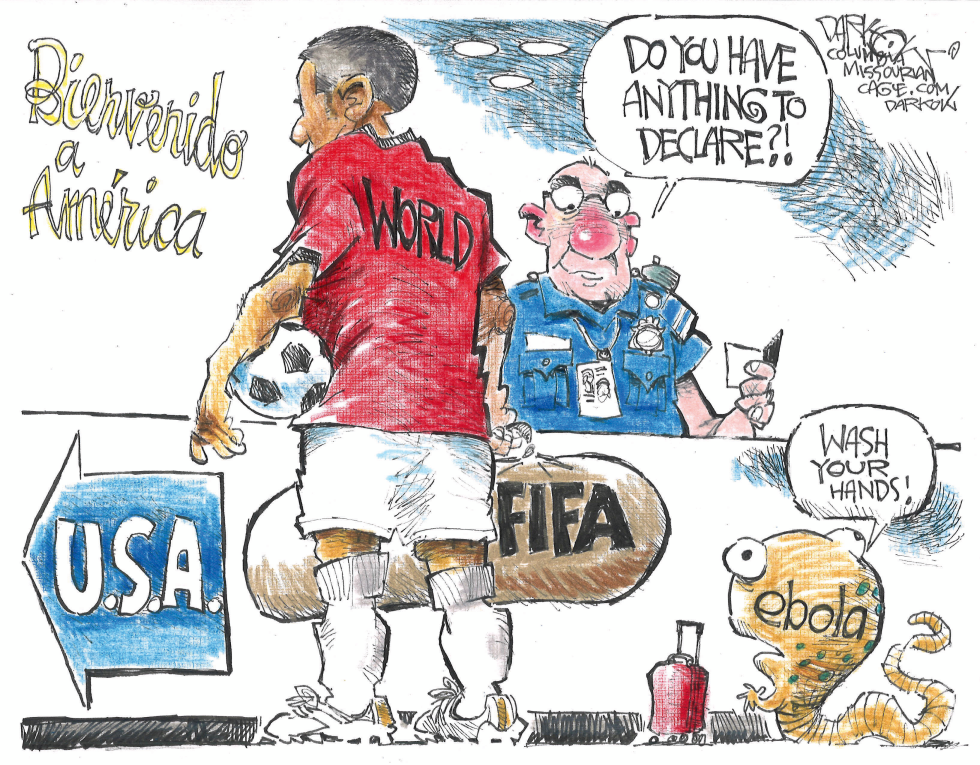
A cartoon depicts a World Cup soccer player in a red jersey arriving at a U.S. border checkpoint. A customs officer asks if he has anything to declare. An anthropomorphic Ebola virus character nearby urges hand washing. The FIFA logo appears on a barrier. Text welcomes visitors to America in Spanish. The scene highlights health screening during international sports travel.
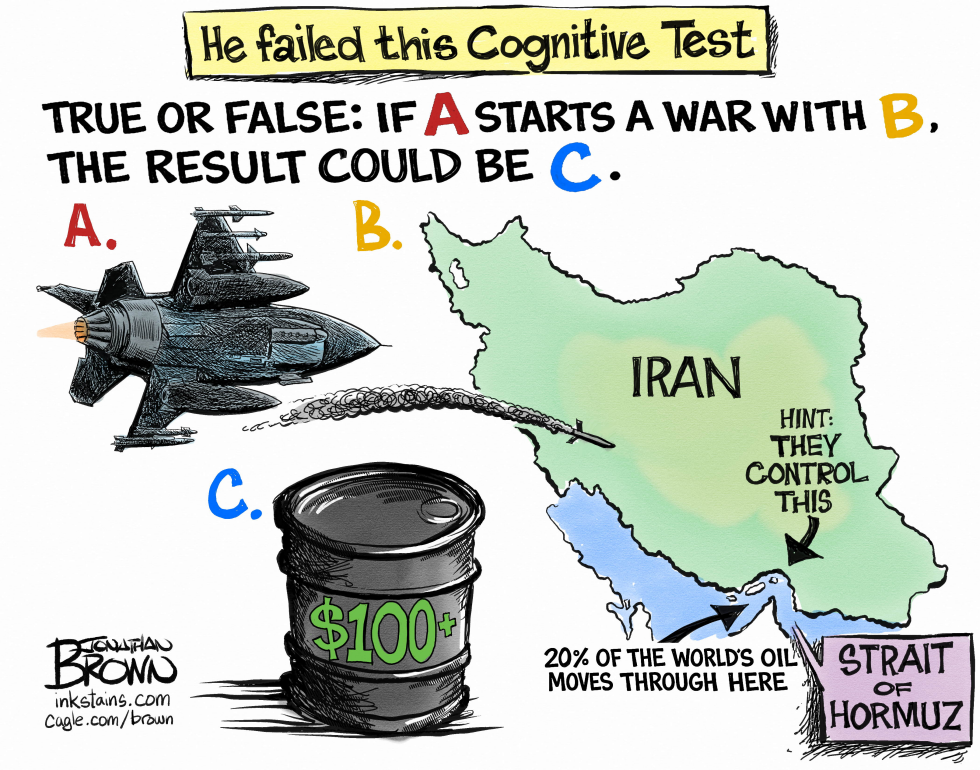
Jonathan Brown's cartoon presents a stark true-or-false cognitive test: if A (a fighter jet) starts a war with B (Iran), the result could be C (an oil barrel marked $100+). The map of Iran includes a hint pointing to the Strait of Hormuz, noting that 20% of the world's oil moves through there, underscoring control over this chokepoint. Tags such as cognitive test, war in Iran, oil prices, Strait of Hormuz, gas prices, and cost of war frame the satire. The artwork warns of economic fallout from conflict, with the jet trailing toward Iran and the oil barrel symbolizing surging costs. This piece captures geopolitical tensions in a simple, visual riddle.
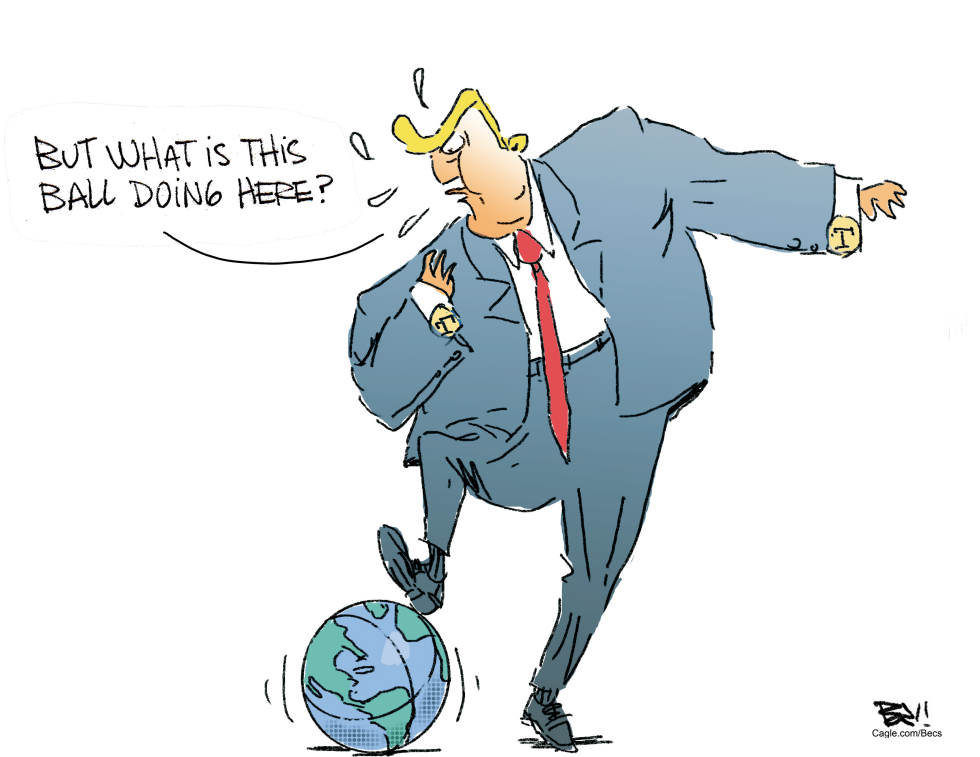
On May 10 2026 Donald Trump appears in a cartoon kicking a globe shaped like a soccer ball. The former president looks down in confusion at the ball near his foot. A speech bubble shows him asking what the ball is doing there. The image coincides with the upcoming 2026 World Cup tournament. The cartoon highlights Trump's apparent disconnect from the sporting event.
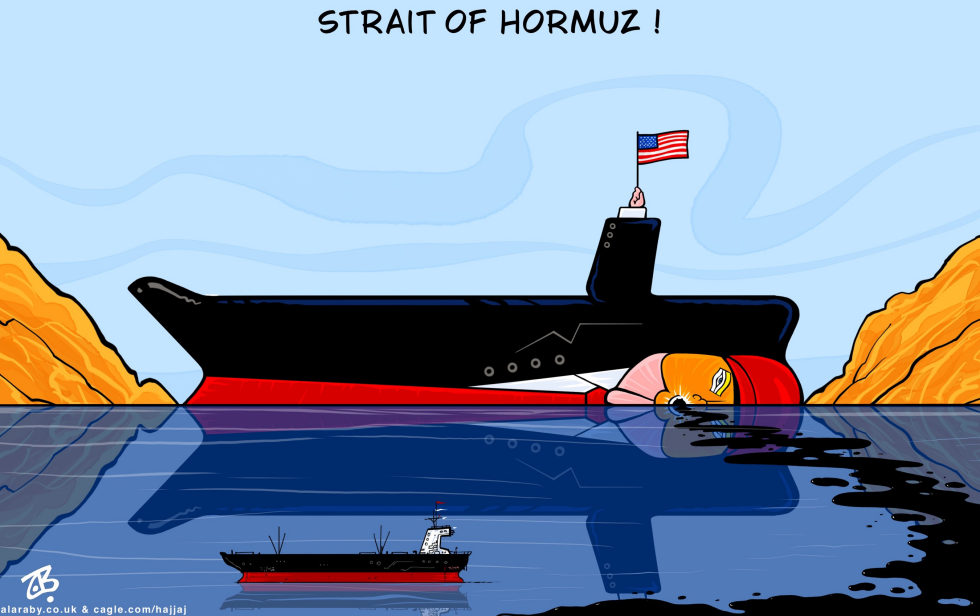
Emad Hajjaj's cartoon depicts a large black submarine with a red hull, stuck between orange landmasses in the Strait of Hormuz, its bow featuring an orange face with yellow hair and a red tie, clearly caricaturing Donald Trump. An American flag flies atop the vessel, while black oil spills into the blue water, reflecting the ship. Below, a smaller black tanker with a white figure onboard sails through the oily sea, tagged with Persian, Gulf, Sea, Tanker, Oil, War. The image satirizes US involvement in Middle East conflicts, particularly Iran war scenarios, without overreaching into hidden meanings. The composition is straightforward, with clear lines and bold colors emphasizing the blockage.
Arend van Dam's cartoon shows a gray battleship marked USA, complete with guns and missiles, driven by a figure in a suit at the wheel, as it goes over a waterfall between rocky cliffs under a blue sky. The image captures the essence of strategy failure in the Strait of Hormuz, tying into themes of Iran, ayatollahs, war, battleship mishaps, Middle East conflicts, oil, gas, energy, and economy. Such visuals often poke at misguided military moves, where the ship's plunge represents a dramatic downfall in strategic planning. The dry humor lies in the absurdity of a warship treating a strait like a river rapid, underscoring potential economic fallout from regional tensions. Cartoons like this thrive on clear, exaggerated metaphors that resonate with readers familiar with global news.
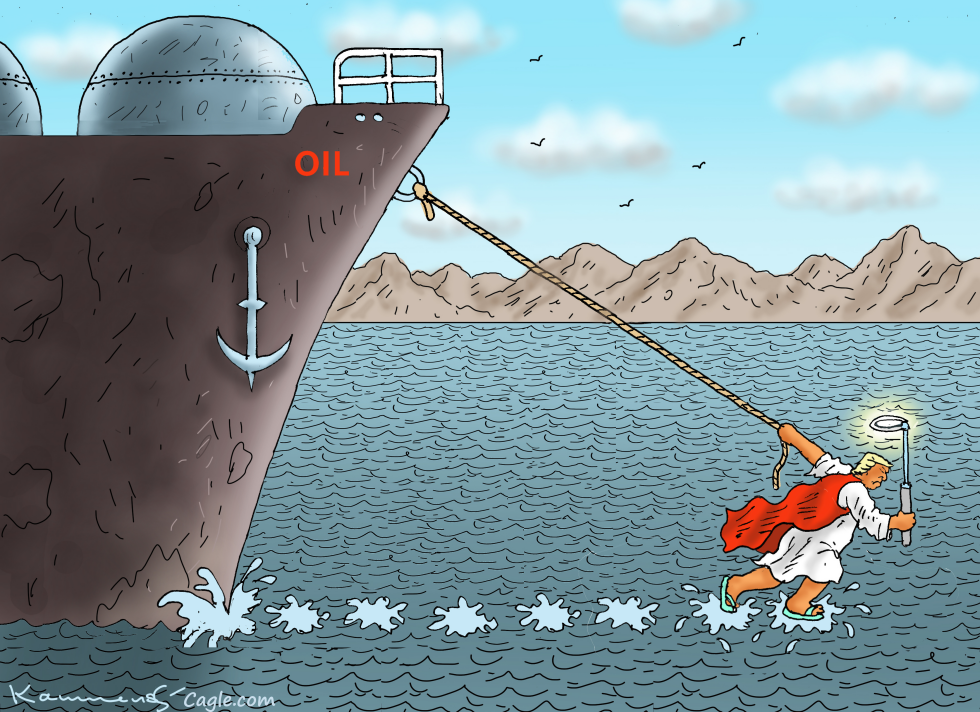
The image depicts a figure dressed in a white robe and red cape, complete with a glowing halo, running across the water while pulling a large oil tanker marked 'OIL' with a rope. He holds a golf club in one hand, splashing water with each step against a backdrop of mountains and a clear sky. This setup draws on tags like Trump, Hormuz, Iran, oil war, MAGA terror, and fascism to satirize political figures intervening in global oil crises. The cartoon's composition emphasizes the absurdity of a divine savior tackling economic and geopolitical issues, with birds flying overhead and distant peaks suggesting a Middle Eastern strait. Kamensky's style brings dry humor to the forefront, poking at notions of messianic leadership in turbulent times.
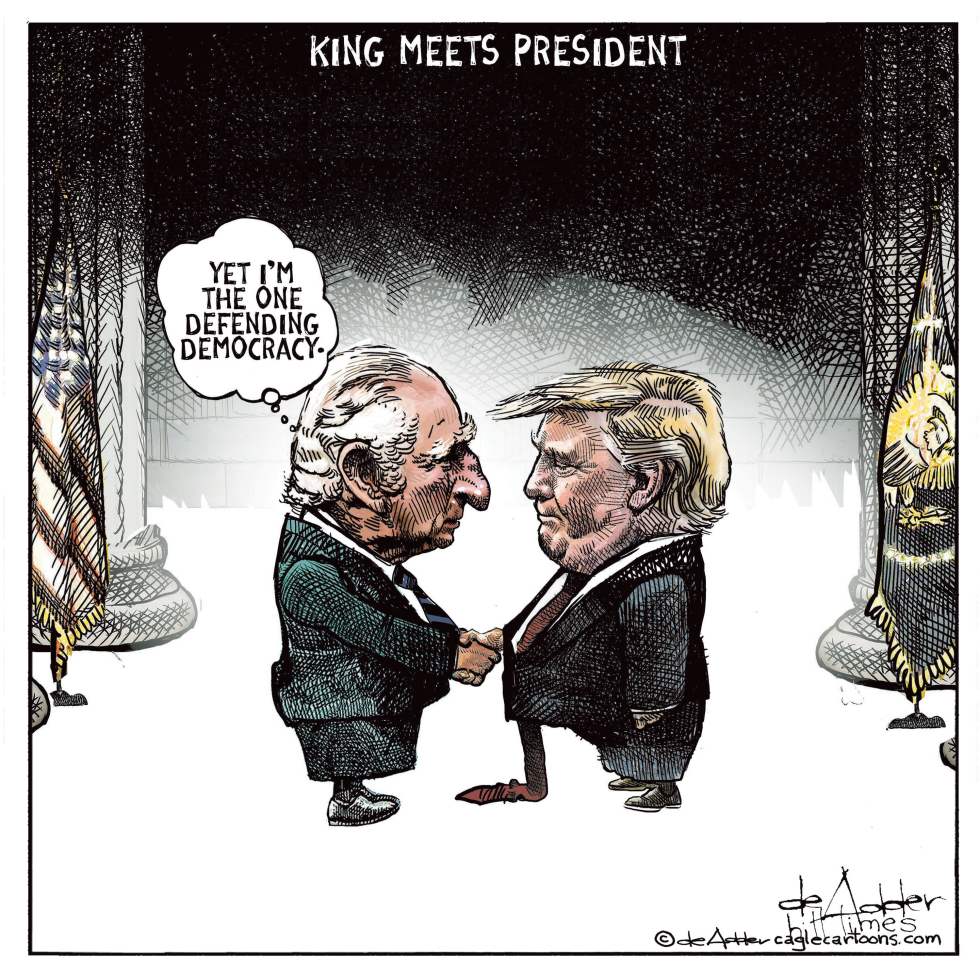
Michael de Adder's cartoon captures a handshake between King Charles and President Trump, set against American and implied British flags in a White House-like scene. The title 'KING MEETS PRESIDENT' tops the image, with Charles saying, 'Yet I'm the one defending democracy.' Tags like UK, United Kingdom, States, America, White House, Visit, State underscore the diplomatic theme. This satire touches on trade, tariffs, and economy without overreaching into unseen motives. The dry humor lies in the visual irony of two leaders in suits, one royal and one presidential, amid formal backdrops. Artistic style uses crosshatching for depth, keeping focus on the central exchange.
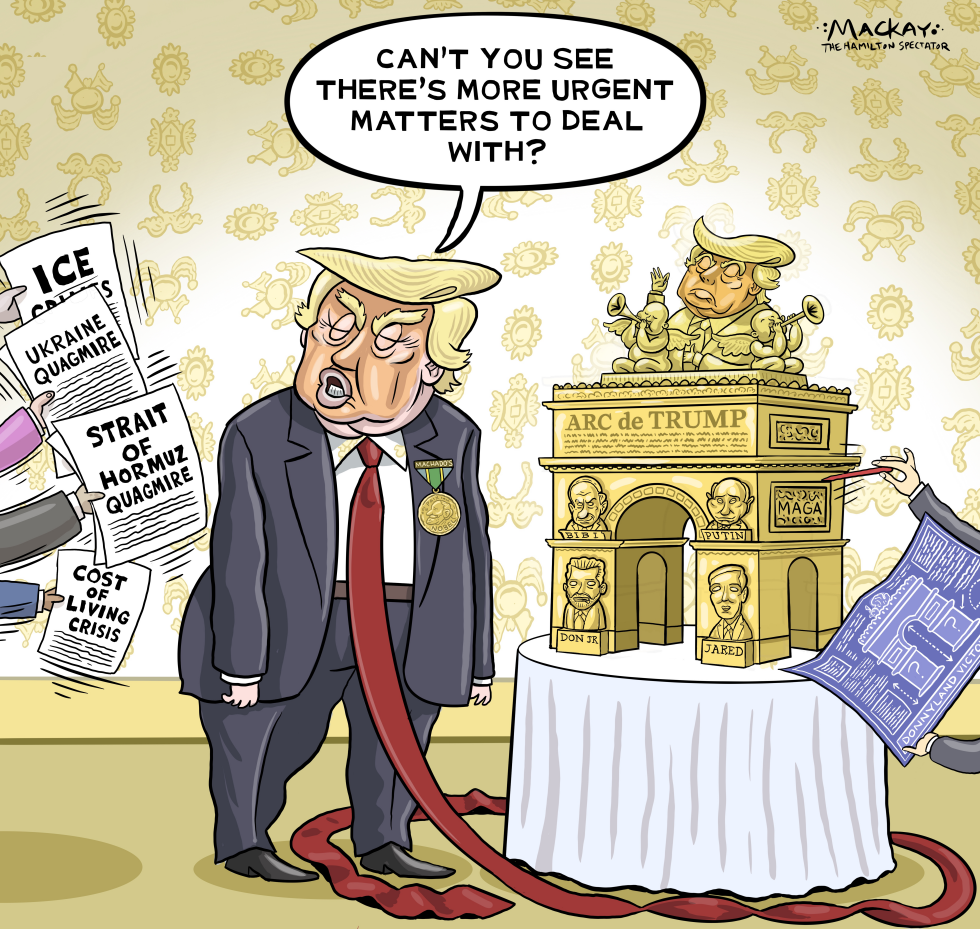
Graeme MacKay\'s cartoon depicts Donald Trump absorbed in unveiling a golden Arc de Trump, a parody of the Arc de Triomphe, topped with his own figure and cherubs, while ignoring flying papers labeled with crises like ICE crisis, Ukraine quagmire, Strait of Hormuz quagmire, and cost of living crisis. The monument includes busts of Don Jr, Ivanka, MAGA, and Jared, emphasizing Trump\'s priorities on vanity over urgent matters. A hand unveils blueprints for Donald J. Trump Arc de Victoire, highlighting the satire on legacy obsession amid global quagmires. The dry humor underscores how such self-focus distracts from real-world affordability and international issues, a common theme in editorial cartoons critiquing political figures.