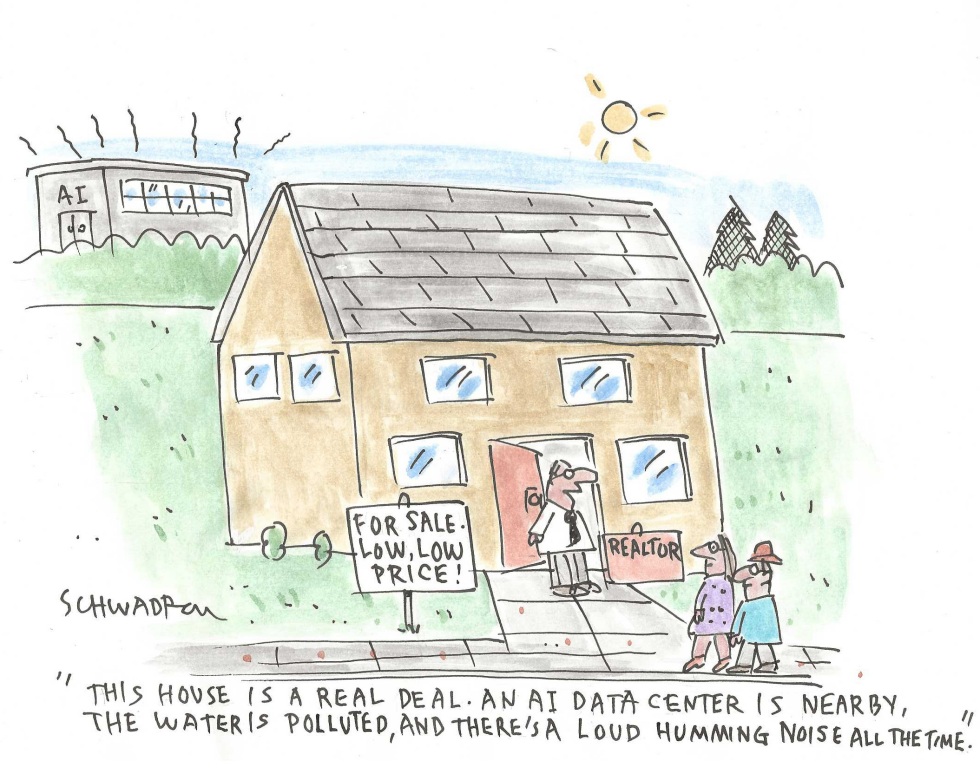
AI data centers are expanding rapidly across suburban areas, bringing jobs and infrastructure but also raising local concerns over noise, water use, and environmental effects. Home values near these facilities have begun to soften as buyers factor in constant humming and potential pollution. The cartoon highlights how real estate agents market such properties at steep discounts while openly disclosing the drawbacks to prospective buyers.
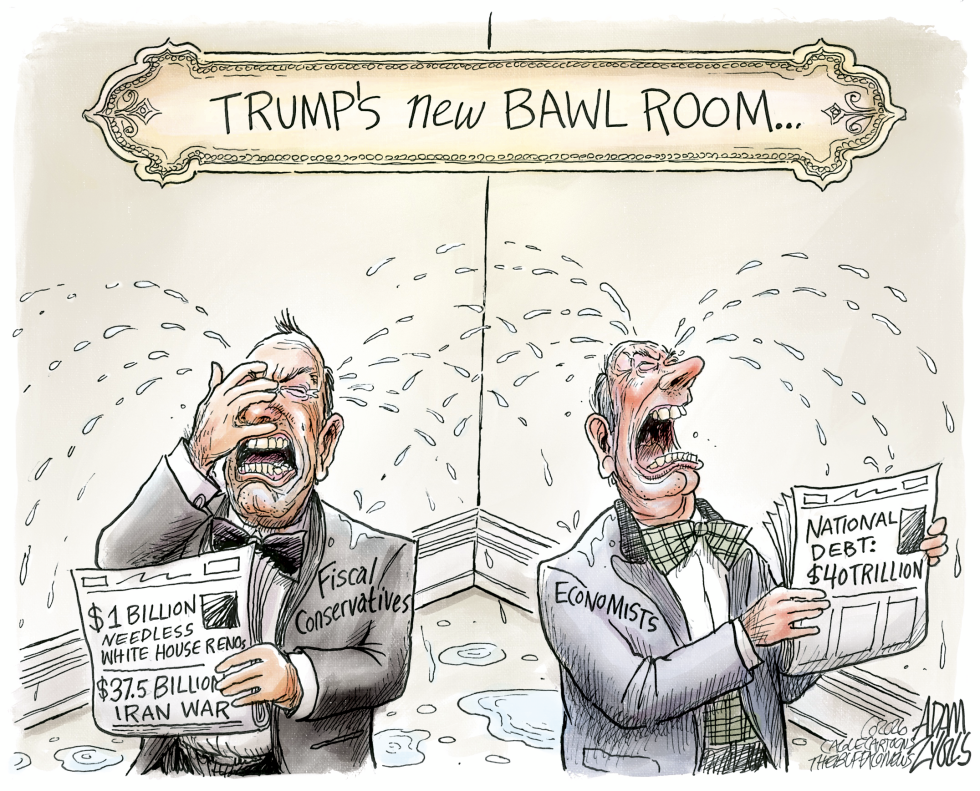
The cartoon depicts fiscal conservatives and economists weeping in a room labeled Trump's new bawl room. One holds documents citing a needless one billion dollar White House renovation and thirty seven point five billion dollar Iran war. The other displays a national debt of forty trillion dollars. The image highlights concerns over federal spending priorities.
The cartoon depicts a mother and son in a domestic setting where the son defends his use of vulgar language by citing the president's public example. The speech bubble from the son questions why he cannot use obscenities if the nation's leader does so without consequence. The scene includes household details such as a tablet in the mother's hands and mechanical parts on the wall. The argument highlights ongoing debates about language standards in public life and their influence on younger generations. The cartoon responds to recent discussions about presidential rhetoric and its broader societal effects.
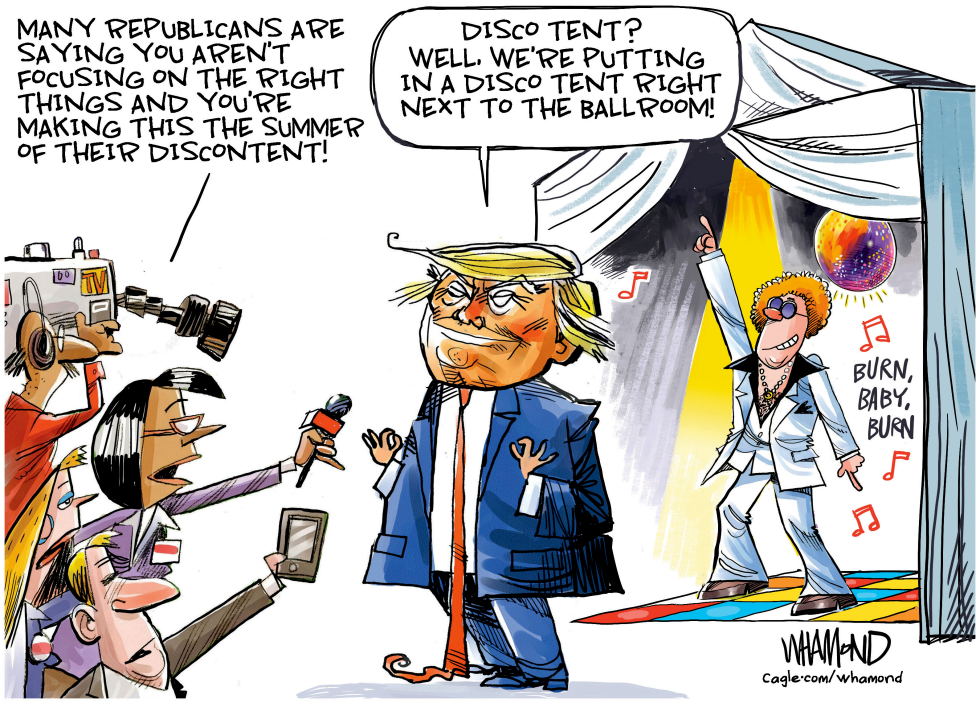
Republicans have publicly criticized Donald Trump for diverting focus from core issues during the summer of 2026, highlighting internal party friction over perceived misplaced priorities. The criticism centers on White House renovation choices that include adding a disco tent adjacent to the ballroom. Trump faces direct questions from the press about these decisions. The editorial position frames the episode as evidence of deepening discontent within the Republican ranks over the president's agenda.
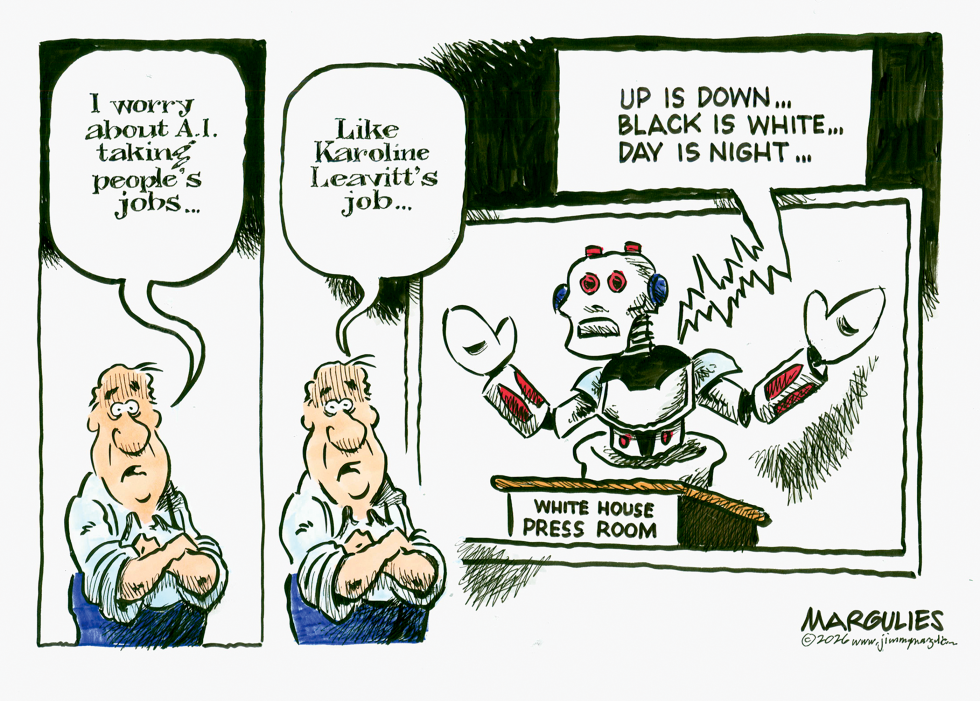
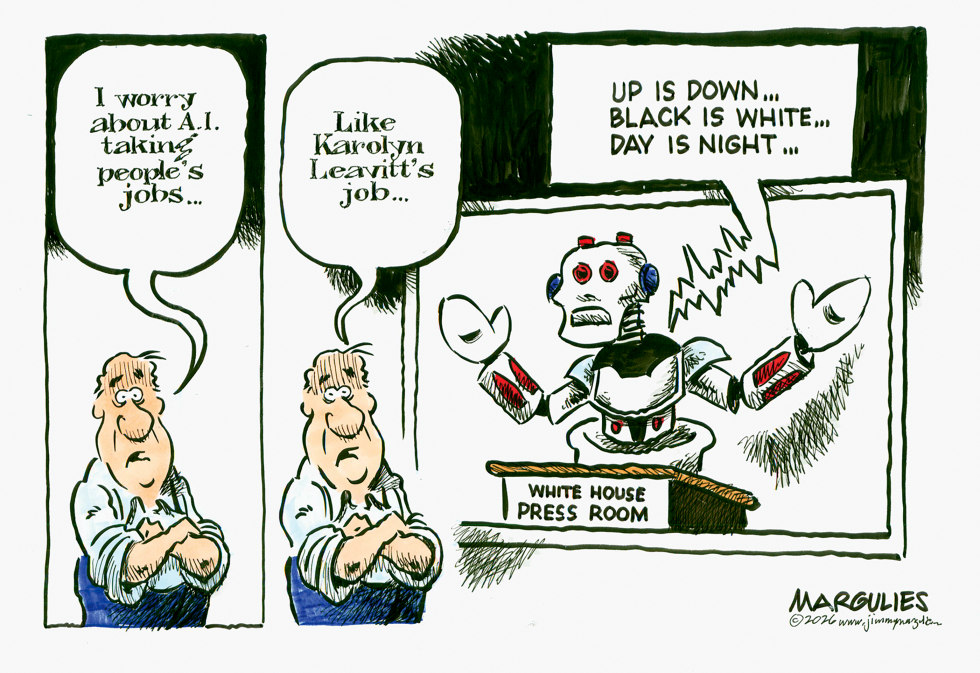
As artificial intelligence advances into government communications roles, concerns grow over job displacement for human staff including White House press secretary Karoline Leavitt. The piece responds to this development by depicting an AI robot assuming the podium and issuing contradictory statements. It takes the position that such automation risks eroding clarity and accountability in official messaging.
An AI robot has assumed duties as White House press secretary amid ongoing debates over automation displacing human roles in government communications. The development highlights tensions between technological efficiency and traditional staffing in high-profile federal positions. The piece portrays the shift as enabling scripted, contradictory messaging from the briefing room.
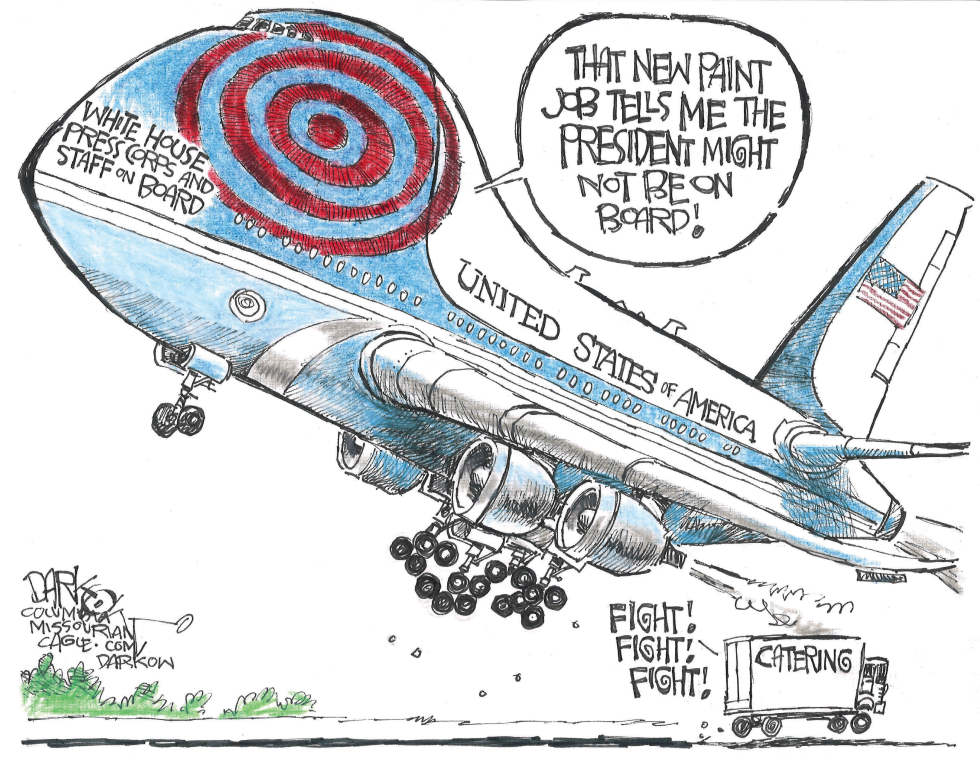
Air Force One appears with a large target painted on its upper fuselage while carrying White House press corps and staff. A nearby catering truck chants fight slogans as the plane descends. The image suggests the president may not be aboard the targeted aircraft. This visual plays on recent tensions surrounding presidential travel and security. The editorial stance highlights perceived risks or distancing from official duties.
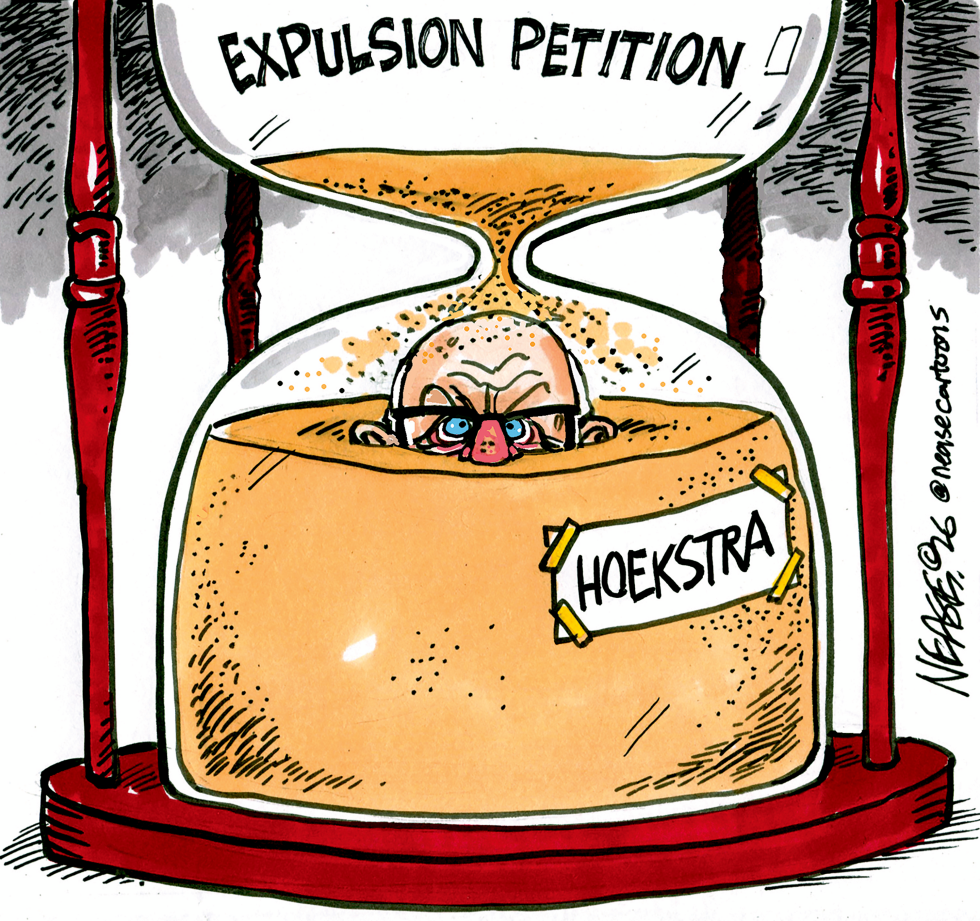
A petition to expel Representative Hoekstra from Congress has advanced, placing the lawmaker under direct procedural threat. The measure reflects internal House pressure over conduct and accountability standards. Colleagues must decide whether to advance the rare expulsion process or allow the matter to lapse. The development underscores ongoing tensions within the chamber about member discipline and institutional standards.
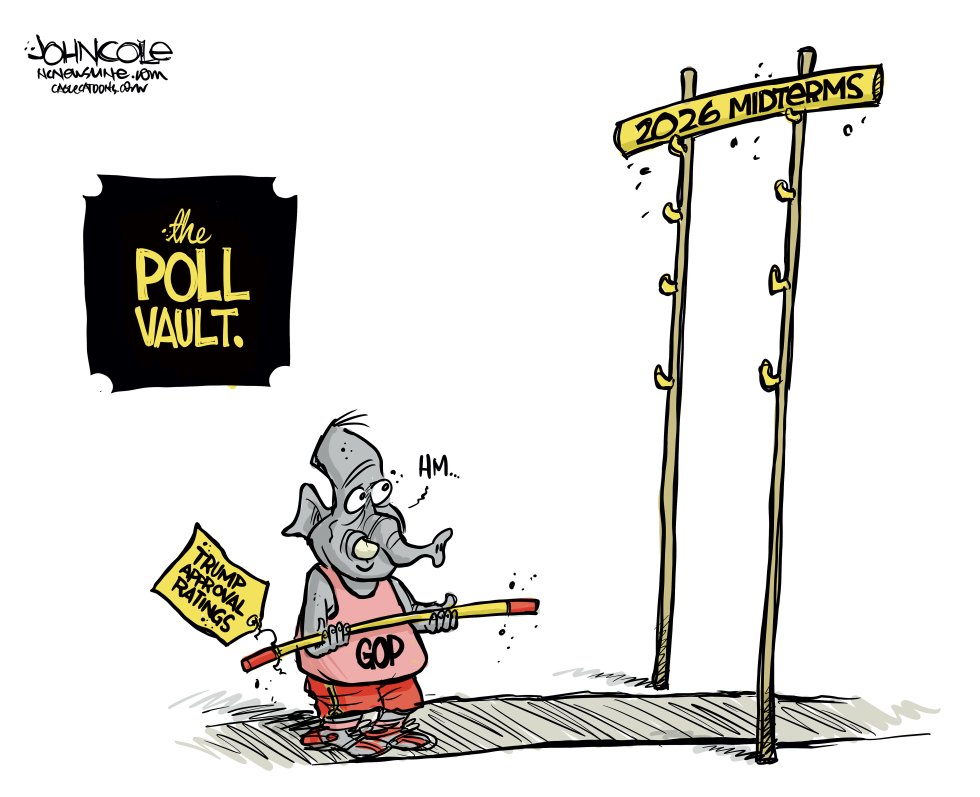
Republicans face the 2026 midterm elections with Donald Trump as a central figure whose approval ratings remain a key variable. Party strategists must decide how heavily to tie their candidates to the former president amid ongoing voter sentiment. The piece portrays the GOP as an athlete preparing to clear the midterm bar but questioning whether the available pole will suffice.
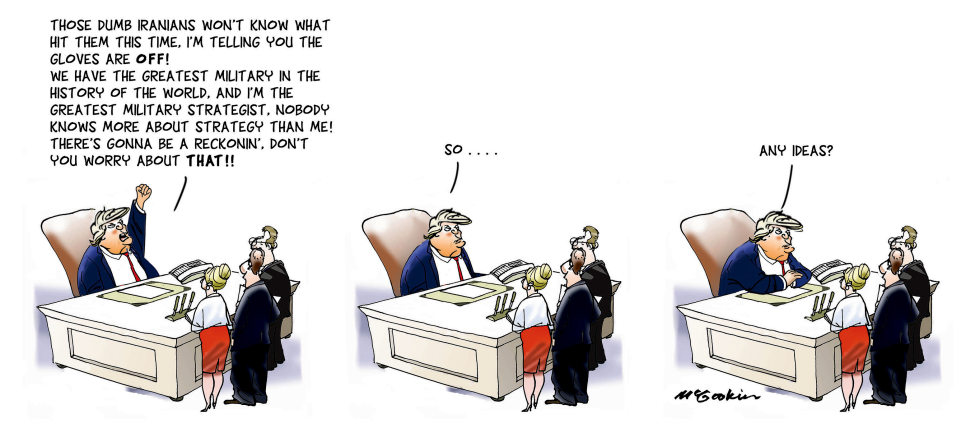
President Trump has directed his national security team to develop new military options regarding Iran. The move comes amid ongoing regional tensions and follows public statements emphasizing U.S. military superiority. The editorial takes the position that such demands reflect an impulsive approach to foreign policy that risks unnecessary escalation without clear strategic direction.
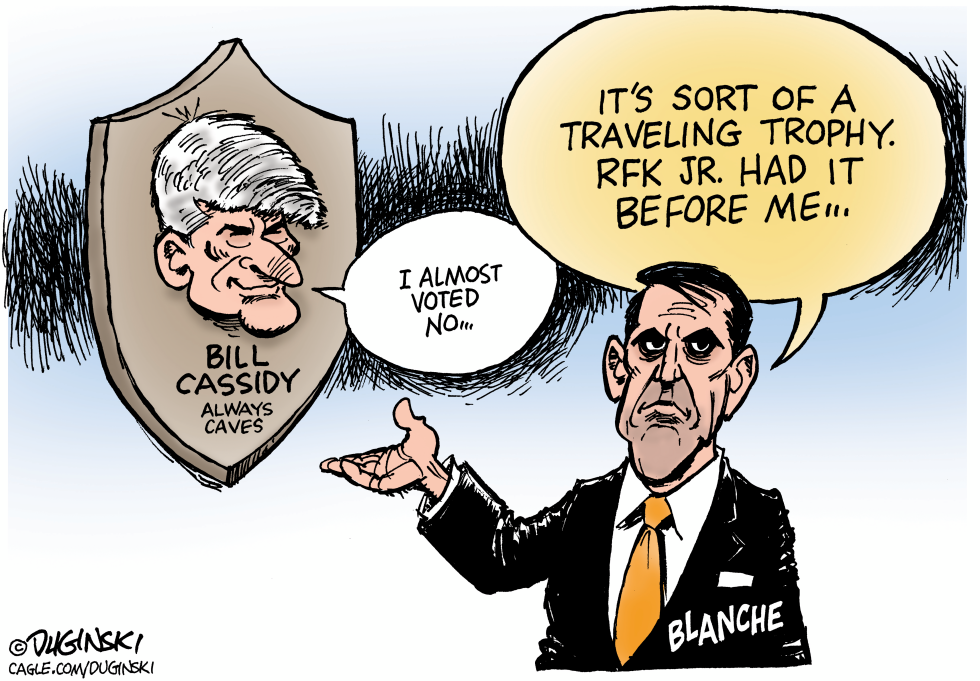
Todd Blanche, recently confirmed to a senior administration post, has mounted a shield bearing Sen. Bill Cassidy\'s likeness on his office wall. The Louisiana Republican, long viewed as a potential swing vote, backed the nomination despite earlier signals of hesitation. RFK Jr. reportedly displayed the same item during his own tenure. The arrangement underscores ongoing tensions within the GOP over loyalty tests and confirmation battles. The piece portrays Cassidy\'s support as another instance of yielding under pressure rather than a principled stand.
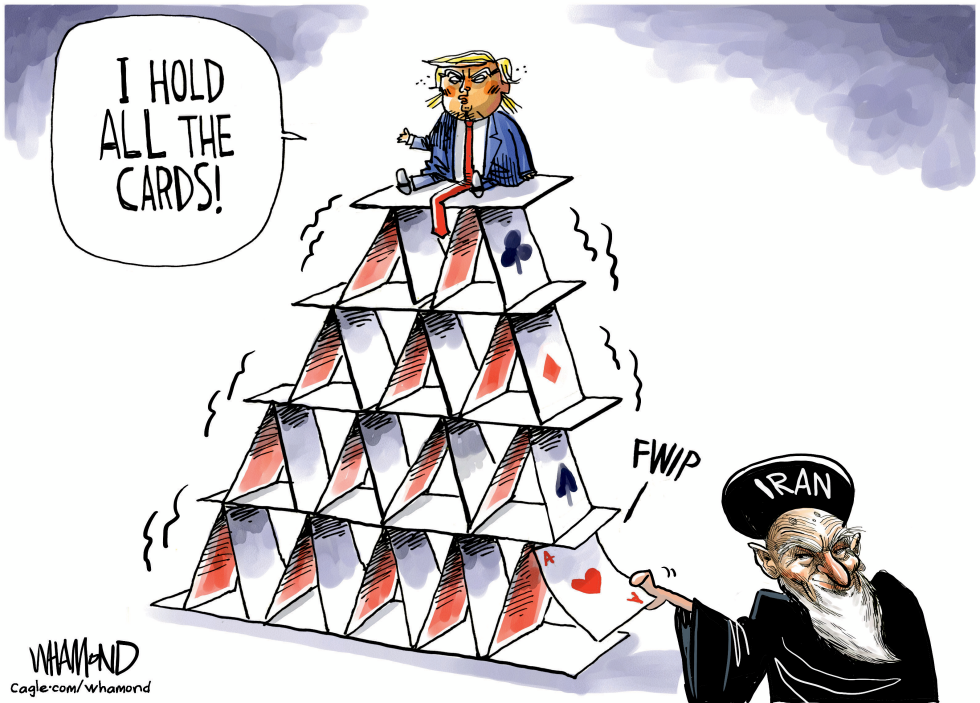
Donald Trump publicly asserted that the United States holds all leverage in dealings with Iran. The claim came amid ongoing tensions over nuclear issues and regional influence. Iran responded with actions that directly challenged that position. The editorial cartoon depicts the assertion as resting on an unstable foundation that Iran can readily disrupt. It frames the dynamic as one where bold statements outpace actual structural strength.
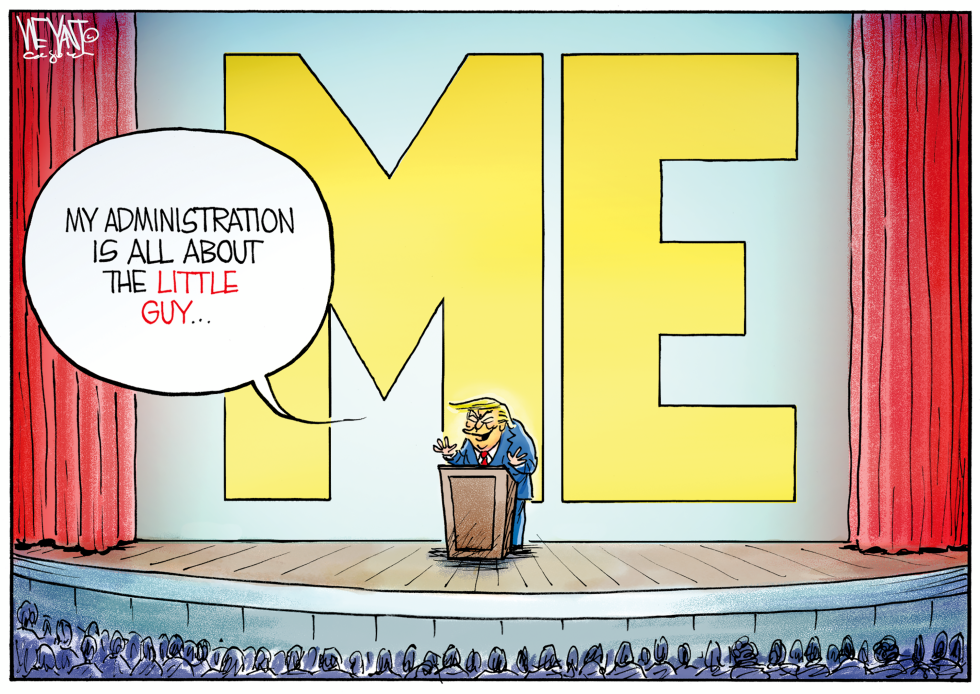
Donald Trump has repeatedly positioned his administration as champion of ordinary Americans during public addresses. The claim comes amid ongoing debates over policy priorities and personal branding in the White House. The piece portrays the rhetoric as centered on the speaker rather than the public.
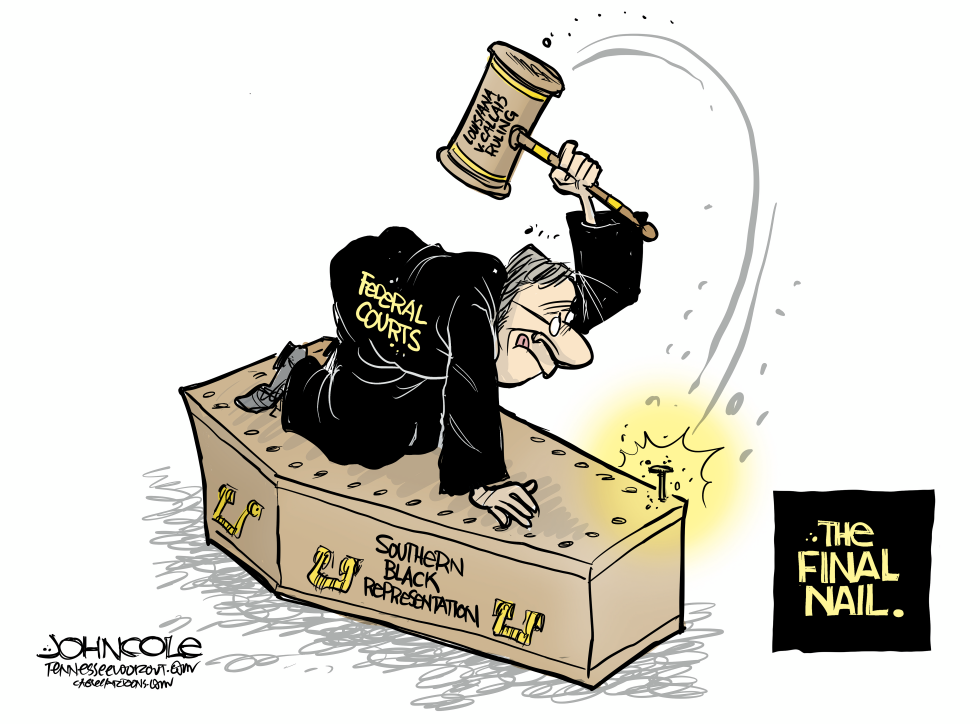
A federal court ruling on Louisiana redistricting has reduced black congressional representation across southern states. The decision follows ongoing litigation over district maps and voting access. It matters because it alters the number of majority-minority seats available in Congress. The piece argues the ruling delivers a decisive setback to those representation gains.