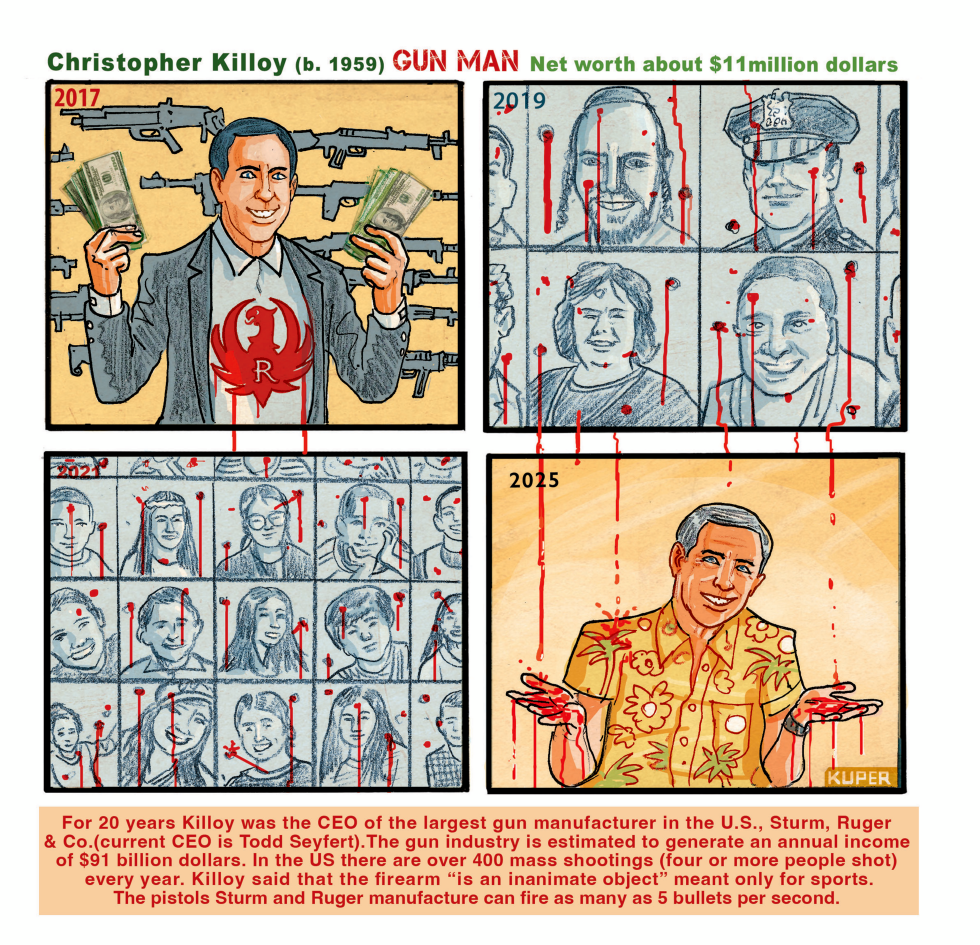
Christopher Killoy served as CEO of Sturm, Ruger & Co. from roughly 2005 to 2025, during which the company generated billions in revenue from firearms used in hundreds of U.S. mass shootings. The industry earns an estimated $91 billion annually, and more than 400 incidents occur each year. Killoy described guns as inanimate sporting objects. The cartoon criticizes the disconnect between corporate profits and the human cost shown in the accumulating portraits of victims.
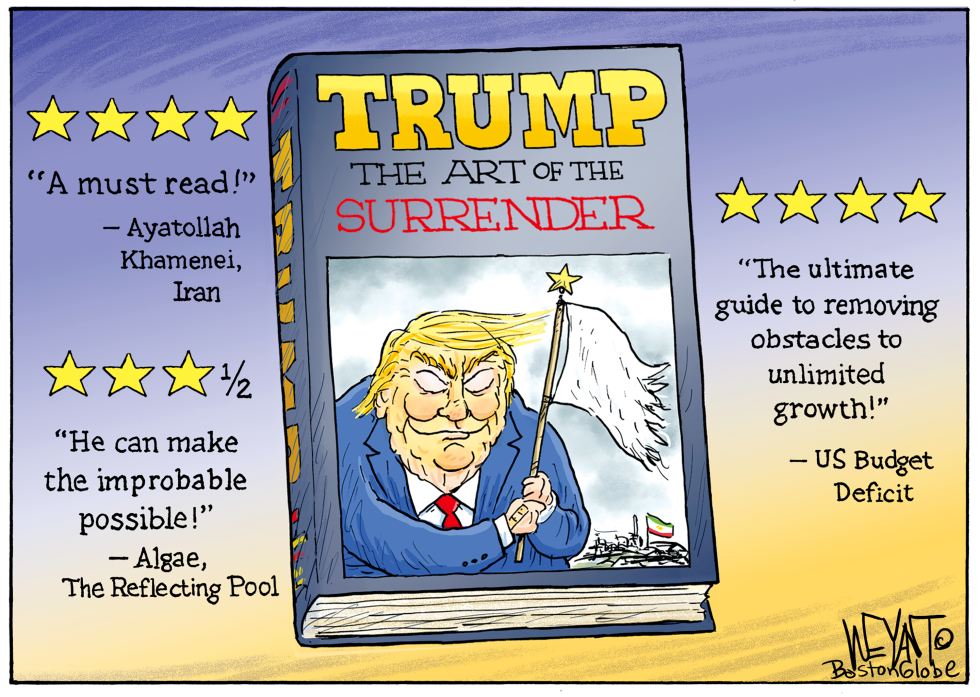
The June 28 2026 cartoon by Christopher Weyant shows a book titled Trump The Art of the Surrender. Donald Trump appears on the cover holding a white flag. Background includes an Iranian flag. Endorsements from Ayatollah Khamenei and the US Budget Deficit appear on either side with star ratings. The image responds to ongoing US Iran tensions and fiscal debates active in late June 2026.
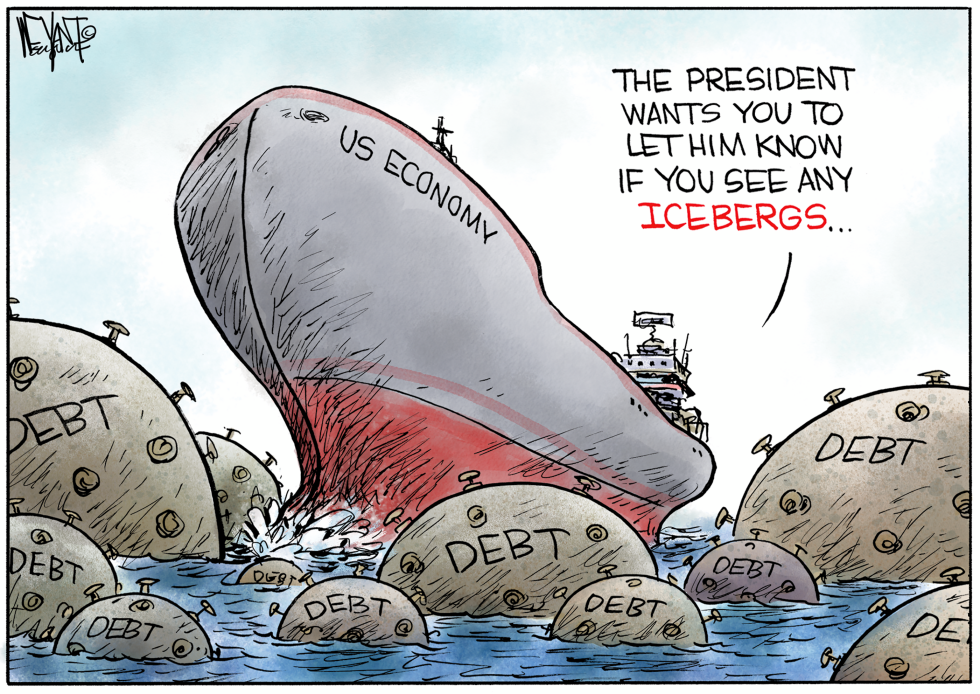
This political cartoon illustrates the US Economy as a massive ship labeled accordingly, dramatically sinking after colliding with numerous icebergs each marked 'DEBT.' A speech bubble from the ship warns to alert the president about icebergs, evoking the Titanic disaster in a clear metaphor for economic peril. Incorporating tags such as economy, debt, budget, inflation, prices, and costs, the image critiques fiscal irresponsibility. The artwork by Christopher Weyant uses simple lines and colors to emphasize the collision's impact, with water splashing and the ship's hull damaged. Such cartoons often highlight how mounting debt threatens stability, drawing parallels to historical maritime tragedies for satirical effect. The composition places the ship at an angle, surrounded by floating debt bergs, underscoring inevitable crisis if warnings go unheeded.
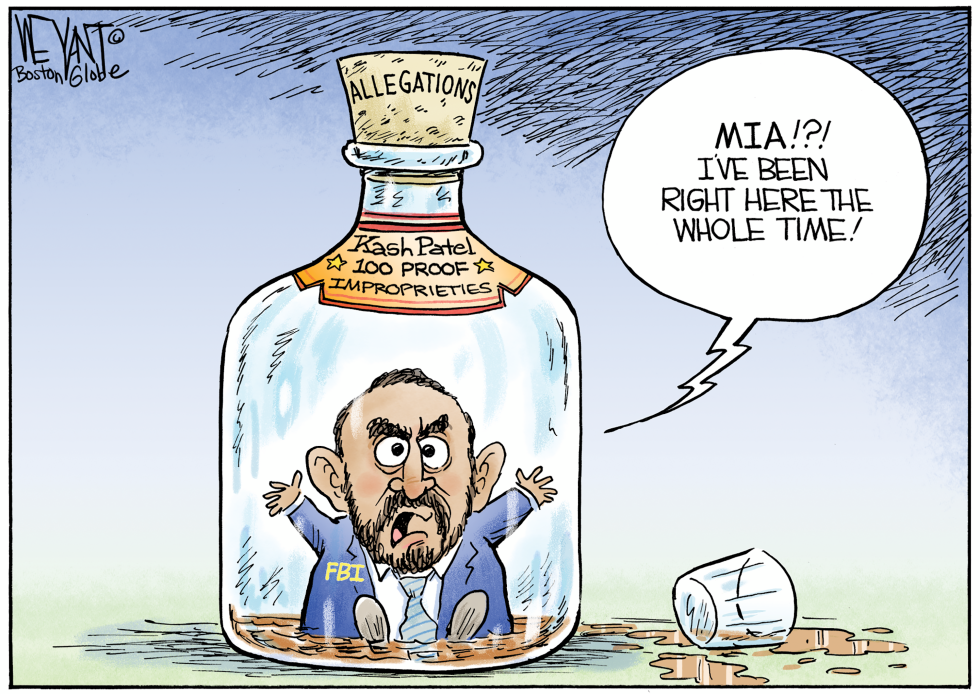
Christopher Weyant's cartoon captures Kash Patel trapped inside a large bottle labeled 'Kash Patel 100 Proof Improprieties,' with the cork marked 'Allegations.' The figure, dressed in a suit with 'FBI' on the sleeve, raises arms and shouts in a speech bubble: 'MIA!?! I've been right here the whole time!' A tipped-over glass spills liquid nearby. Tags like FBI, Kash Patel, alcoholic, allegations, bottle, and fail underscore the visual pun on being 'in the bottle,' tying into themes of inept leadership and ongoing controversies in domestic policy and criminal justice.
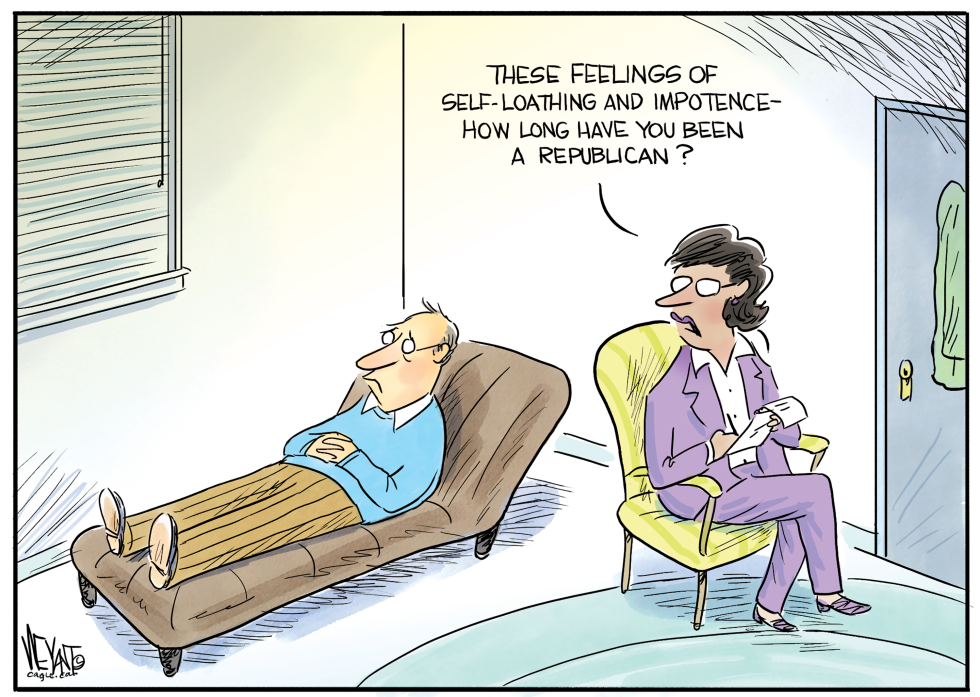
Christopher Weyant's political cartoon shows a therapy room with blinds, a door, and a coat hanger. A balding man in glasses, blue shirt, and brown pants reclines on a brown couch, arms crossed, looking distressed. A woman with dark hair, glasses, purple suit, sits on a yellow chair holding notes, speaking the punchline linking self-loathing and impotence to Republican tenure. The scene captures satirical commentary on political identity, with dry humor evident in the exaggerated expressions and simple setting. Tagged as republican party satire, therapy humor, political cartoon, self-loathing joke, impotence metaphor, and party affiliation critique, it highlights insider views on partisan struggles.
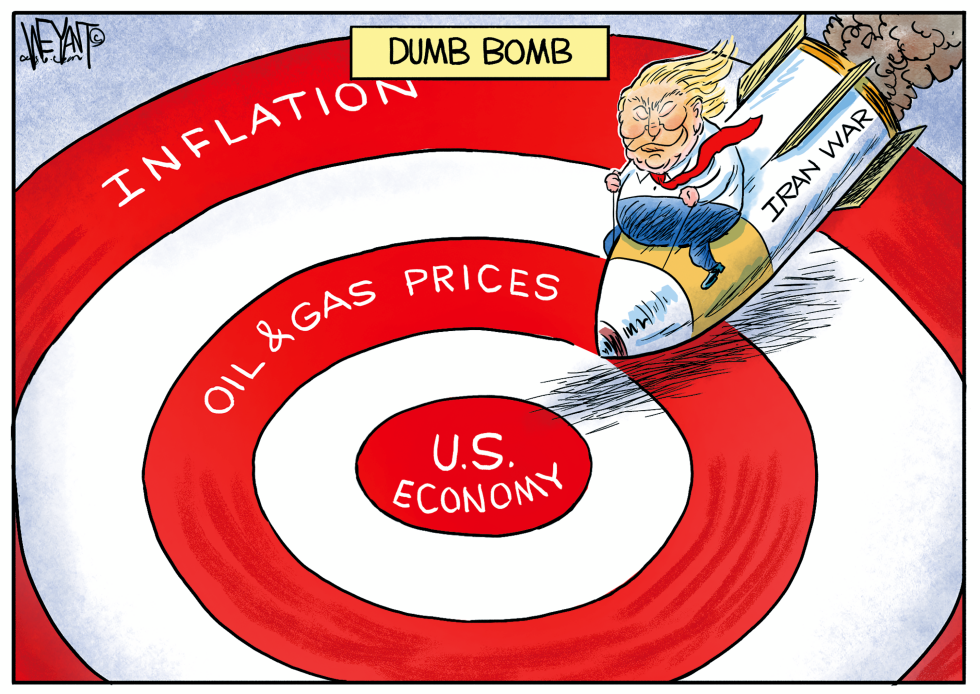
Christopher Weyant's cartoon shows a Donald Trump caricature astride a 'Dumb Bomb' labeled 'Iran War,' plummeting toward a red-and-white bullseye. The target's rings are inscribed with 'Inflation,' 'Oil & Gas Prices,' and at the center, 'U.S. Economy.' This setup highlights concerns over foreign policy decisions affecting domestic finances. The dry humor underscores the risks of impulsive actions in international affairs, with Trump's windswept hair and determined expression adding to the satirical edge. Tags like political cartoon, Trump Iran war, US economy satire, inflation oil prices, dumb bomb cartoon, and Christopher Weyant emphasize the image's relevance to current events.
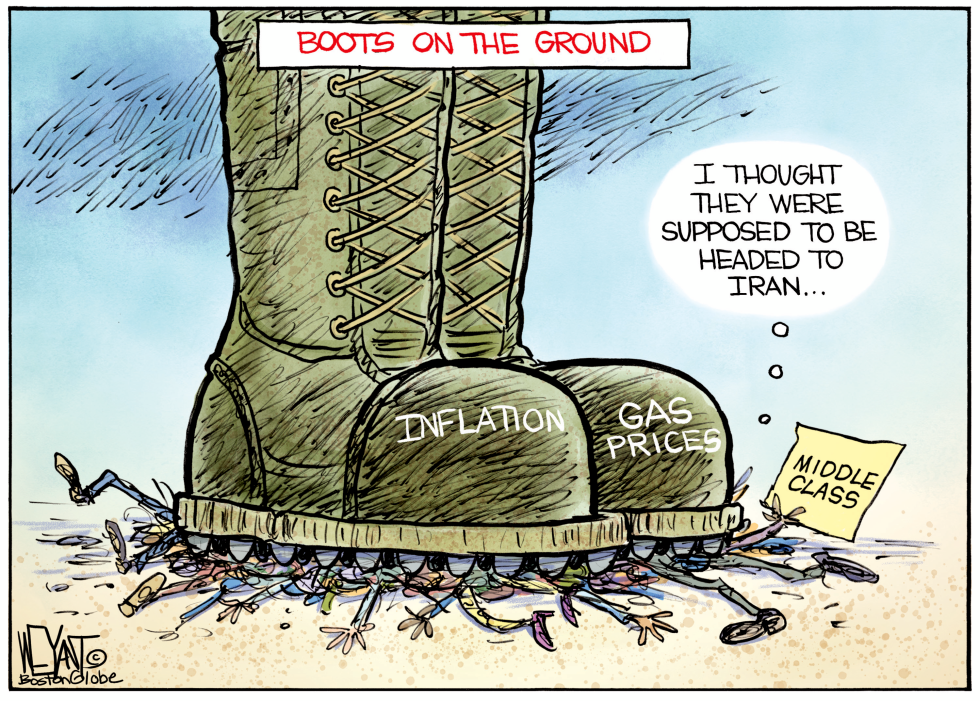
The cartoon shows a pair of massive military boots dominating the scene, one labeled 'Inflation' and the other 'Gas Prices,' as they crush small human figures on the ground, with a sign reading 'Middle Class' among them. A speech bubble from one of the crushed figures says, 'I thought they were supposed to be headed to Iran...' The title 'Boots on the Ground' sits at the top. This setup uses dry humor to highlight misplaced priorities in war, economy, inflation, gas prices, middle class, and Iran. The sandy ground and stormy sky add to the chaotic feel, tying into tags like Trump, negotiation, Strait of Hormuz, and domestic policy impacts.
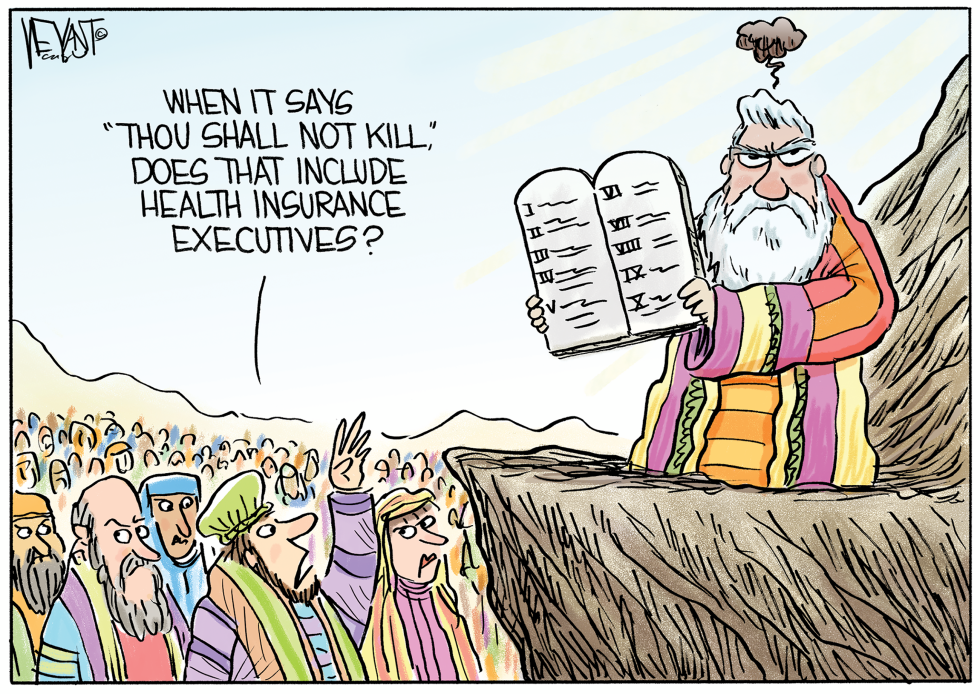
The cartoon shows Moses atop a rocky peak, stone tablets in hand, with Roman numerals visible on them. A crowd of robed figures gathers below, one raising a hand. The question in the speech bubble ties the ancient commandment to modern frustration with health insurance executives. This piece uses biblical imagery to critique the health care system, where denials and costs can feel life-threatening. The dry humor underscores public anger toward corporate figures in insurance, making a pointed satirical statement without overt violence.
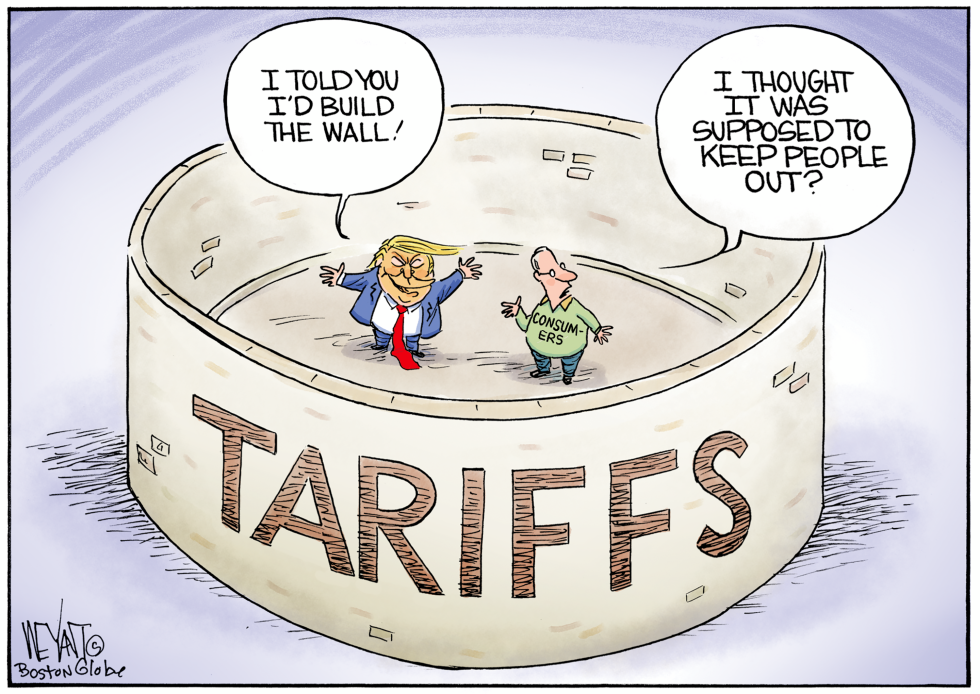
The cartoon shows Trump inside a circular wall labeled 'TARIFFS,' declaring he built the wall, with a figure marked 'CONSUMERS' puzzled that it's supposed to keep people out. Tags like trump, tariffs, threats, Mexico, Canada, China, trade, wall, prisoner, consumers underscore the irony. The image critiques how tariffs meant to protect against foreign threats from Mexico, Canada, and China end up trapping domestic consumers like prisoners. This visual metaphor draws on Trump's famous wall promise, flipping it to show trade policies harming those inside. The dry humor lies in the reversal, where the wall imprisons rather than excludes, commenting on economic fallout.