Subscribers Only Content
High resolution image downloads are available to subscribers only.
Not a subscriber? Try one of the following options:
OUR SERVICES VISIT CAGLE.COMFREE TRIAL
Get A Free 30 Day Trial.
No Obligation. No Automatic Rebilling. No Risk.
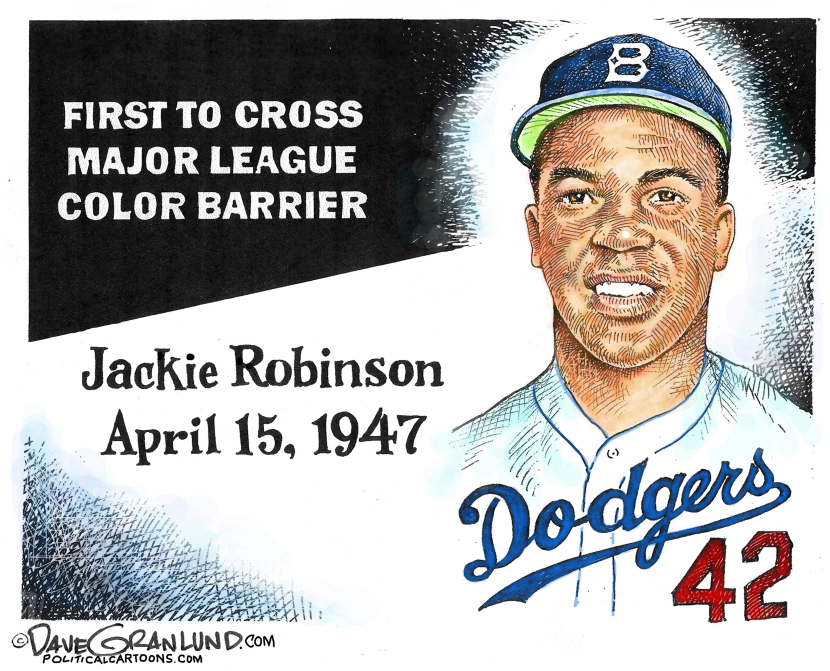
Every April 15 since 2004, Major League Baseball celebrates Jackie Robinson Day, in honor of the first Black player to appear in a big-league game
In a stupefying display of hypocrisy, baseball officials play the day up shamelessly, even as they have actively worked to displace black Americans from baseball.
The most obvious and most meaningful way to honor Robinson’s legacy is not to assign every player Jackie’s old number 42, the current practice and an insult to the great Dodger. A bench warming Taiwanese national has no business wearing No. 42.
“This is supposed to be an honor, and just a handful of guys wearing the number,” former Minnesota Twins outfielder Torii Hunter told USA Today. “Now you’ve got entire teams doing it. I think we’re killing the meaning. It should be special wearing Jackie’s number, not just because it looks cool.”
Hall of Fame pitcher C. C. Sabathia echoed Hunter’s sentiment. “It kind of waters it down. I could see the Dodgers since that was his team, but not everyone else.” Another Hall of Fame great, Ken Griffey, opined “I didn’t know so many guys planned to wear the number. I sure wasn’t expecting whole teams to wear it,”
While Commissioners Rob Manfred and his predecessor Bud Selig bemoaned the shortage of Black players on the diamond, the truth is they are omnipresent – Caribbean Blacks players, that is. According to a study by the Society for American Baseball Research, the percentage of African Americans grew steadily from Jackie Robinson’s debut in 1947 until the early 1970s, at which point it plateaued at around 16% to 19% for a quarter-century (1972-1996). Since then, the Black share of players has plummeted to less than half that amount, 6.7%. Using the same quarter century time period, Latino participation spiked from 0.7% to 27%.
It is an inarguable fact MLB has consciously displaced or blocked potential American players. All MLB teams have multi-million dollar Dominican Republic training facilities that cater to the prospects’ needs, not only on the field but also academically. Each year, 450 to 500 Caribbean-born players sign professional contracts and take advantage of training camp coaching, practice fields, gym, cafeteria and a dorm. Enrollment in a Dominican camp does not guarantee a ticket north, but it gets players a step closer than the U.S. inner city kid, who has nothing comparable where he can play baseball all day long. More importantly, MLB hasn’t shown the least interest in building similar stateside facilities to develop American kids.
Here’s a story that reflects how baseball’s process works today. At the end of the 2025 season, the Pittsburgh Pirates one-time MVP Andrew McCutchen, age 39, hoped to end his productive career with the Buccos. Instead, McCutchen, who is Black, was released and replaced by Dominican veteran Marcell Ozuna, 35, to a one-year, $12 million guaranteed contract.
Normally, a general manager would say he’s cutting a player to save payroll or to bring up someone younger. But in the McCutchen/Ozuna case, the GM dumped a fan favorite and paid $10 million extra to do it. Through April 15, Ozuna is hitting .118 while McCutchen, with limited game time, is hitting .222.
The point is McCutchen is the most popular Pirates player since Bill Mazeroski and possibly since Honus Wagner. He is beloved in the Black community, especially among youths. No one in Pittsburgh cares about a journeyman Dominican playing out his baseball string.
Chances are that despite that Jackie Robinson Day hoopla, few players could answer the most fundamental questions about Robinson’s personal or professional life. That’s a pity. All the teams travel to New York to play either the Yankees or the Mets. Show of hands, please. How many players have taken the time to visit the Jackie Robinson Museum in Manhattan?
Players have free time in the morning and early afternoon before the evening game when they could learn about the great Robinson’s life, a more meaningful experience than mindlessly putting on a No. 42 uniform.
–
Copyright 2026 Joe Guzzardi, distributed by Cagle Cartoons newspaper syndicate.
Joe Guzzardi is a Society for American Baseball Research and Internet Baseball Writers’ Association member. Contact him at [email protected].


