Subscribers Only Content
High resolution image downloads are available to subscribers only.
Not a subscriber? Try one of the following options:
OUR SERVICES VISIT CAGLE.COMFREE TRIAL
Get A Free 30 Day Trial.
No Obligation. No Automatic Rebilling. No Risk.
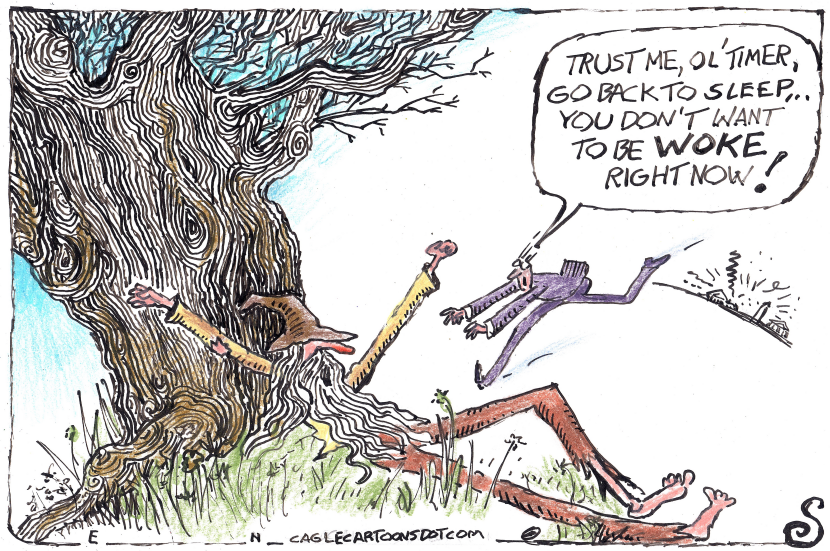
Alexandria Ocasio Cortez’s recent suggestion that “Woke 1 was crazyy” – echoing a remark made on social media by New York City Councilman Chi Ossé – has created a political frenzy leading up to the midterms.
The reaction is hardly surprising, given the fact one of the most recognizable left-wing politicians in the nation has publicly conceded on national television the left became too extreme over the past few years.
The 2020 protests criticizing police violence and the accompanying verbiage resulted in an untamed movement where many individuals, including themselves, embraced misguided positions. Now, having learned the error of their ways, Ocasio-Cortez and other Democrats are evolving into more politically refined individuals.
The genesis of the term woke has been debated. The common consensus is certain Black activists used it during the mid-20th century as a clarion call to stand defiantly in the fight against systemic and institutional racism. The term was frequently employed by supporters of the Black Lives Matter movement during the 2010s. Then at some point a segment of far-right conservatives in the early 2020s started using the word to ridicule what they perceived to be overly dramatic, substance-deficient gestures of racial and gender politics.
Soon to be former Florida Gov. Ron DeSantis introduced the Stop Woke Act (Stop Wrongs to Our Kids and Employees Act), which tried to prohibit schools and businesses from discussing critical race theory, sexism, and other oppressive vices. Then Kentucky Sen. Mitch McConnell declared corporations must stop listening to calls for equity, or they would fall prey to “a woke parallel government.” Right-wing commentator Ben Shapiro held live events to discuss “how wokeness is destroying America.” And a Santa Barbara Independent op-ed praised far-right podcaster Charlie Kirk for “going into the lion’s den of woke.”
There is no agreed-upon definition of woke. Many of the term’s detractors don’t even understand what the term means. This provides a perverse opportunity for such individuals to assign vague meanings to the word, rendering it void of any concrete definition. Thus, it became a useful term for politicians to distort and weaponize to attack any person, event, or movement they might dislike. They also consider the term and the movement associated with it as an unalterable threat to their political, social, and cultural advancement.
Some wish it was not simply a futile exercise in wordplay. The so-called woke movement addressed real political, cultural, and environmental issues while challenging the attitudes and trends of those it provoked.
The movement adroitly addressed deeply entrenched issues, such as the relationship between law enforcement and minority communities, more commonly known as police brutality. It also included the right of women to be free of and to pursue recourse for enduring sexual harassment or assault, giving rise to the #MeToo movement.
More importantly, wokeness was highly successful in reconstructing the endemic structures that developed and maintained such oppressive systems. The movement encouraged higher education institutions to expand and diversify their curriculum to incorporate a diverse and pluralistic group of perspectives, instead of embracing disproportionately Eurocentric curriculums that routinely marginalized the contributions of women and people of color. As an academic, I found this to be immensely psychologically cathartic. Although some actors in the movement may have been a little over the top in their antics, such efforts were noble and far from being “crazy.”
The gruesome murder of George Floyd in May 2020 by rogue police officer Derek Chauvin was viewed by much of the larger society as evidence of a major societal crisis that had to be addressed. That same year, the additional deaths of Breonna Taylor , Rayshard Brooks , and Michael Ramos further jolted the nation, and the names of the aforementioned individuals resulted in millions of Americans taking to the streets at the height of the COVID pandemic to condemn police brutality. The victims’ names became symbolic of racial justice both domestically and globally. Anyone who was supportive of such movements was agitating for progress and placed themselves on the correct, moral side of history.
Admittedly, some of the methods promoting supposed wokeness were dreadfully performative and misguided. Some individuals even scoured social media, attempting to monitor and dictate what others wrote or said, resulting in the loss of employment for certain individuals and the “cancelling” of others. That being said, a few bad apples do not make a movement.
Wokeness, as the genuine definition of the terms implies, is a noble concept. It is an astute, forward-looking philosophy that is diverse, inclusive, and frequently holistic in nature. There is no reason why anyone should feel the need to apologize for endorsing such beliefs.
Rather, what must be confronted and combated are the menacing and devious efforts of right-wing individuals and organizations, who all too often do everything in their power to distort the spirit of wokeness and dismiss its true message every opportunity they get.
–
Copyright 2026 Elwood Watson, distributed by Cagle Cartoons newspaper syndicate
Elwood Watson is a professor of history, Black studies, and gender and sexuality studies at East Tennessee State University. He is also an author and public speaker.


