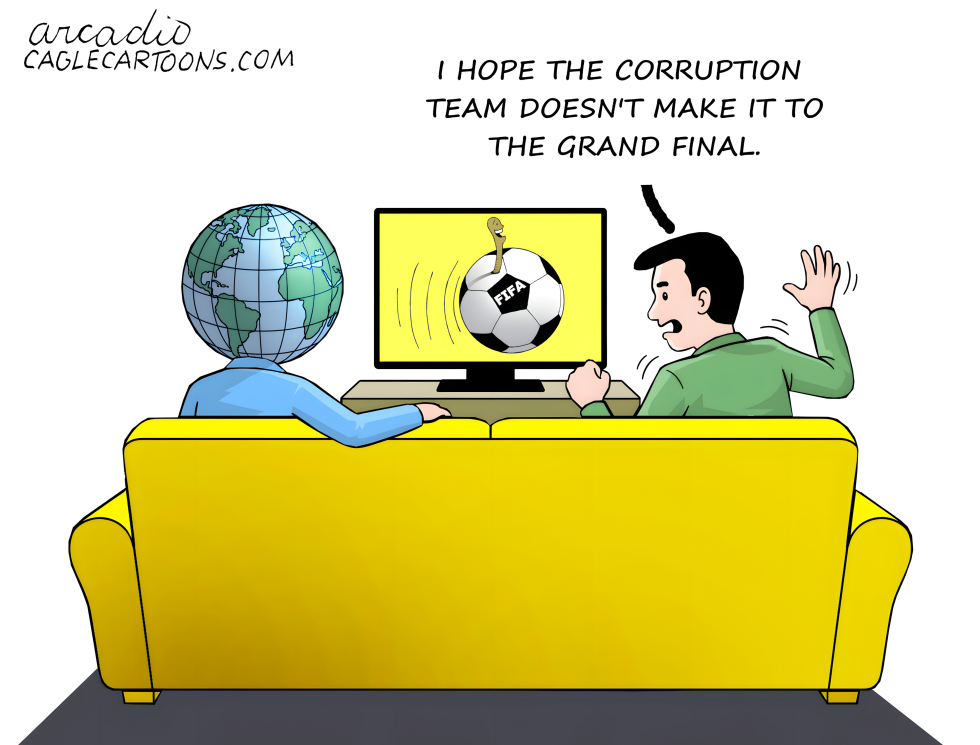
A man with a globe for a head sits beside a green-shirted viewer on a yellow couch, both staring at a television displaying a FIFA soccer ball with a worm emerging from it. The viewer raises a hand in alarm while a speech bubble expresses hope that the corruption team will not reach the grand final. The image, dated July 7, 2026, captures public anxiety over ongoing FIFA integrity issues tied to major soccer events.
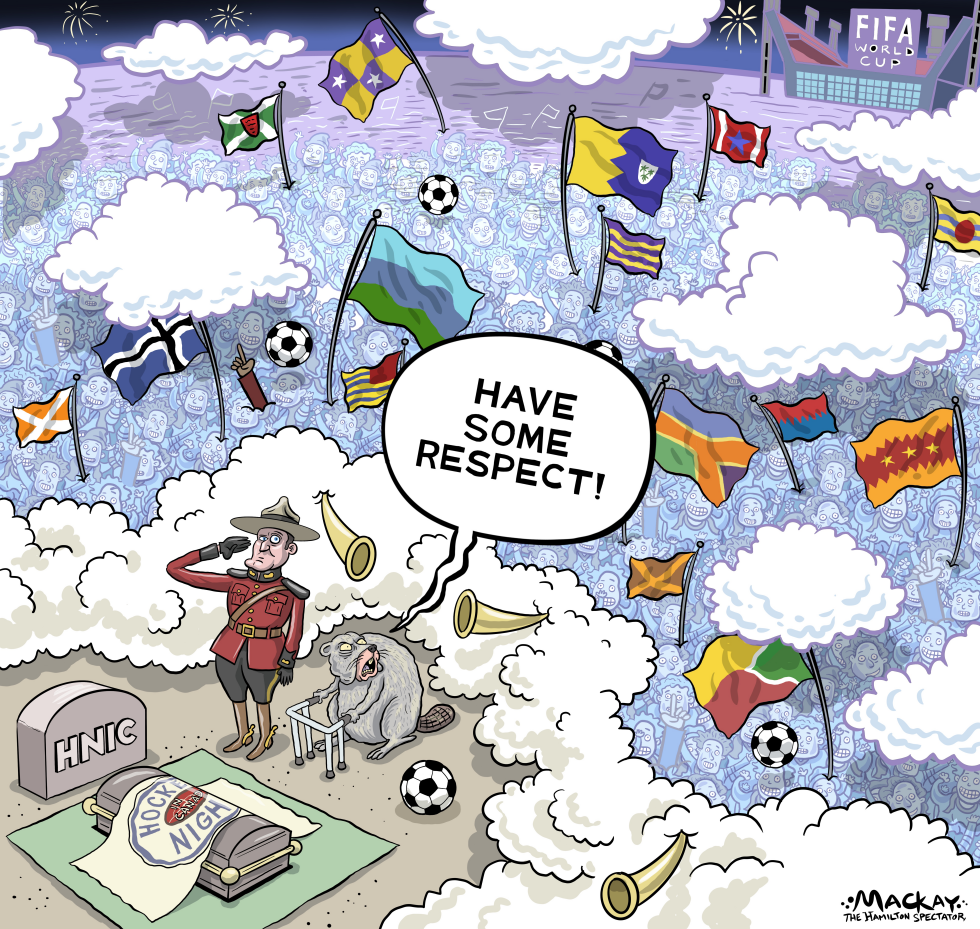
The image depicts the symbolic funeral of Hockey Night in Canada during the 2026 FIFA World Cup. A Mountie salutes while a beaver weeps beside the coffin labeled Hockey Night in Canada. A large crowd of soccer supporters fills the background waving flags from many nations and holding soccer balls. A speech bubble from the crowd reads Have Some Respect. The scene captures the shift from Canada's traditional winter sport broadcast ritual to the global summer soccer event.
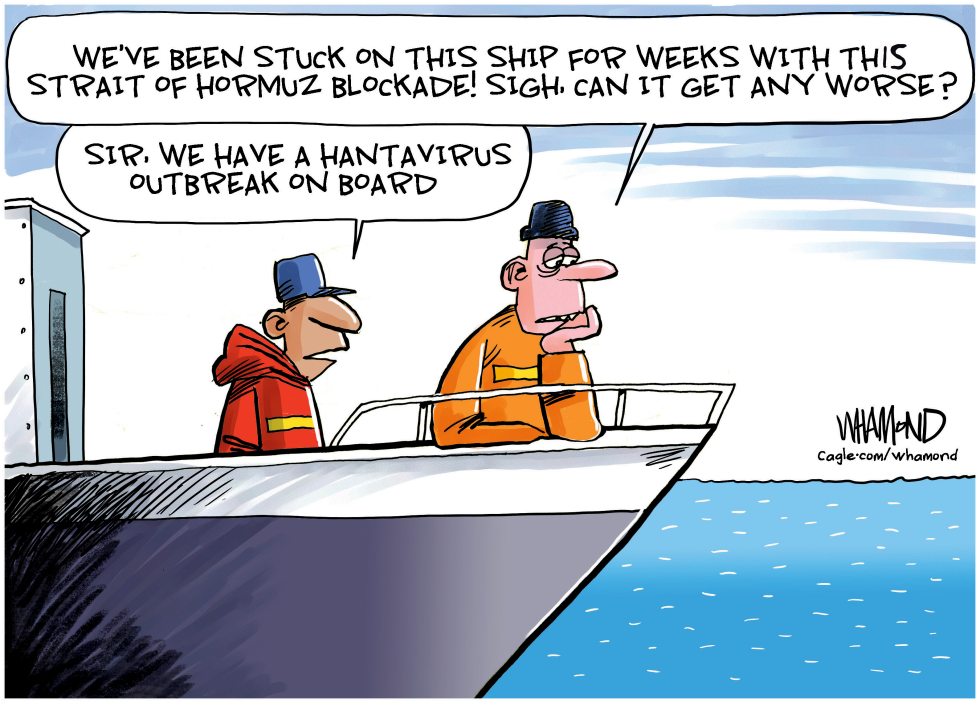
The cartoon depicts two sailors aboard a ship trapped in the Strait of Hormuz due to a naval blockade. One laments the weeks-long delay and wonders if conditions can worsen. The other reports a hantavirus outbreak on board. The image responds to ongoing tensions involving Iran and disruptions to global oil routes. As of the May 2026 publication date, the blockade has halted tanker traffic and strained energy markets. The added health crisis underscores the compounding risks for crews and supply chains. The visual ties geopolitical conflict directly to immediate human and economic consequences.
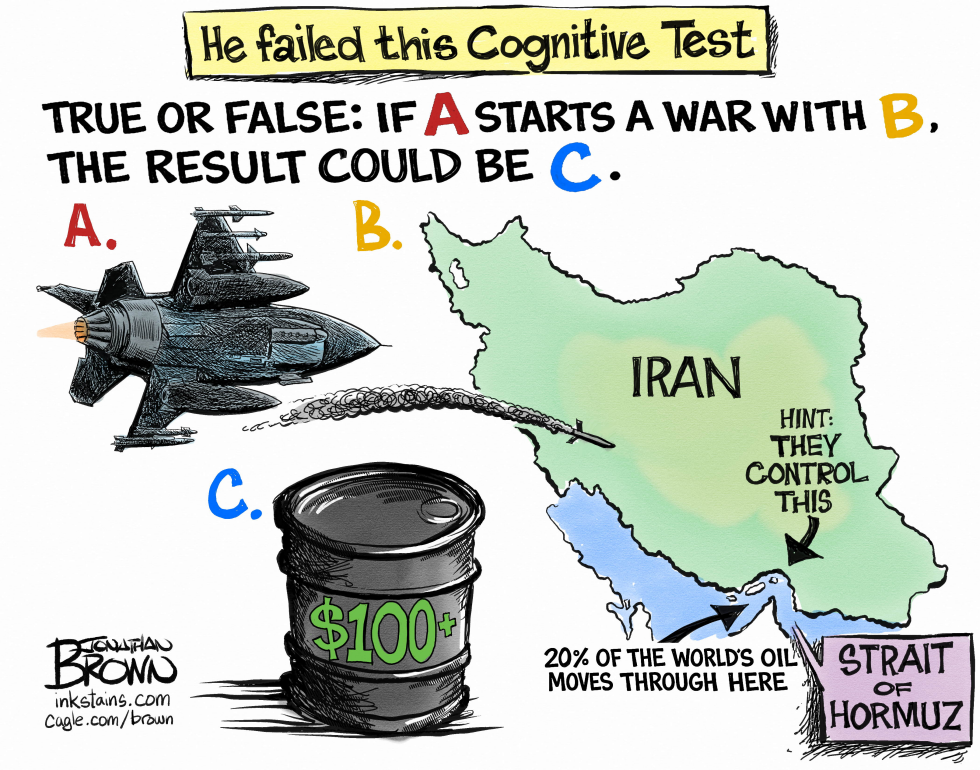
Jonathan Brown's cartoon presents a stark true-or-false cognitive test: if A (a fighter jet) starts a war with B (Iran), the result could be C (an oil barrel marked $100+). The map of Iran includes a hint pointing to the Strait of Hormuz, noting that 20% of the world's oil moves through there, underscoring control over this chokepoint. Tags such as cognitive test, war in Iran, oil prices, Strait of Hormuz, gas prices, and cost of war frame the satire. The artwork warns of economic fallout from conflict, with the jet trailing toward Iran and the oil barrel symbolizing surging costs. This piece captures geopolitical tensions in a simple, visual riddle.
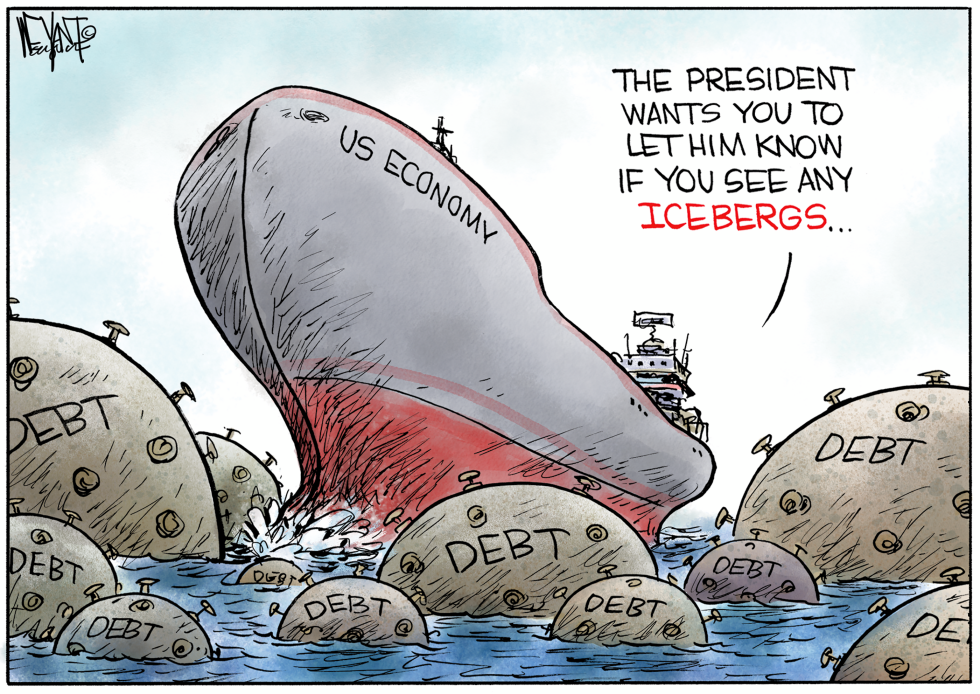
This political cartoon illustrates the US Economy as a massive ship labeled accordingly, dramatically sinking after colliding with numerous icebergs each marked 'DEBT.' A speech bubble from the ship warns to alert the president about icebergs, evoking the Titanic disaster in a clear metaphor for economic peril. Incorporating tags such as economy, debt, budget, inflation, prices, and costs, the image critiques fiscal irresponsibility. The artwork by Christopher Weyant uses simple lines and colors to emphasize the collision's impact, with water splashing and the ship's hull damaged. Such cartoons often highlight how mounting debt threatens stability, drawing parallels to historical maritime tragedies for satirical effect. The composition places the ship at an angle, surrounded by floating debt bergs, underscoring inevitable crisis if warnings go unheeded.
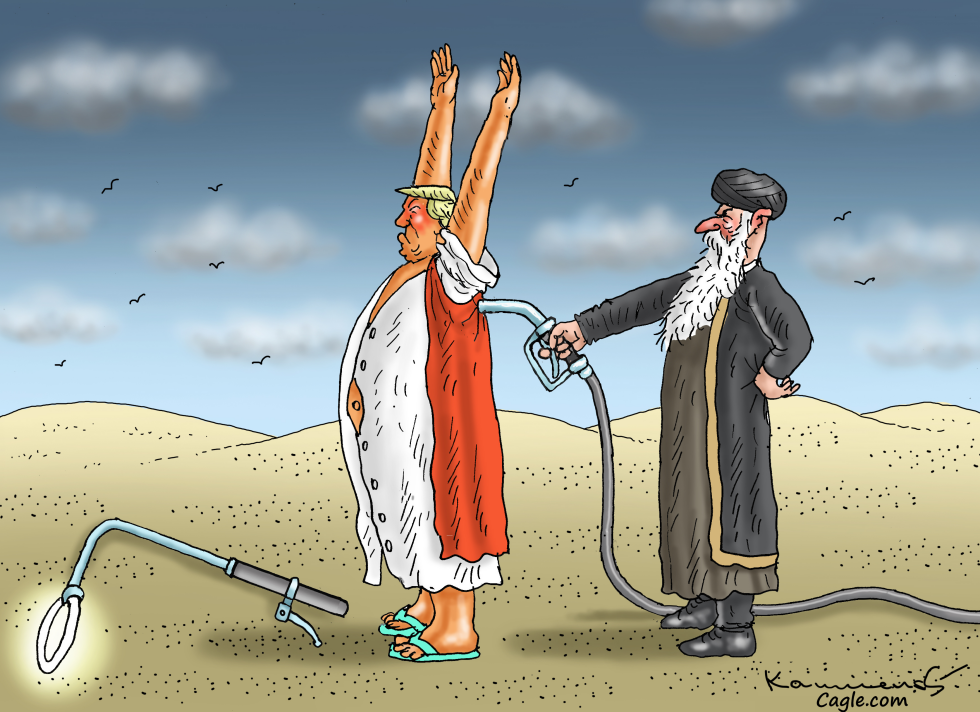
Marian Kamensky's cartoon captures a surreal scene in the desert where a figure resembling Trump, dressed in white and red robes with arms raised skyward, has a gas pump nozzle inserted into his side by a bearded man in dark robes and turban. The image plays on themes of Trump, Iran, Hormuz, fascism, MAGA terror, and oil war, blending religious imagery with modern geopolitical tensions. Birds fly in a cloudy sky over sandy dunes, emphasizing isolation and absurdity. The signature and Cagle.com mark confirm its syndication roots. This piece skewers the intersections of politics, religion, and resource dependency without words, relying on visual punch for impact. Such cartoons thrive in editorial pages for their sharp commentary on current events.
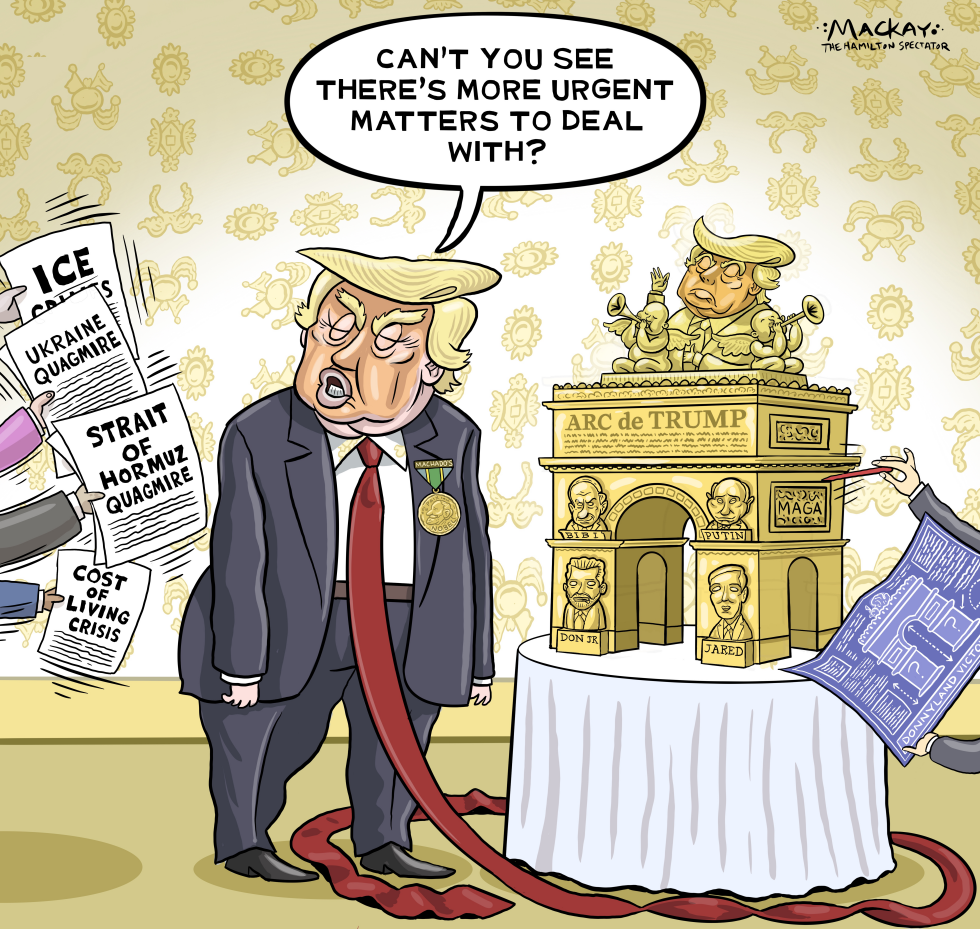
Graeme MacKay\'s cartoon depicts Donald Trump absorbed in unveiling a golden Arc de Trump, a parody of the Arc de Triomphe, topped with his own figure and cherubs, while ignoring flying papers labeled with crises like ICE crisis, Ukraine quagmire, Strait of Hormuz quagmire, and cost of living crisis. The monument includes busts of Don Jr, Ivanka, MAGA, and Jared, emphasizing Trump\'s priorities on vanity over urgent matters. A hand unveils blueprints for Donald J. Trump Arc de Victoire, highlighting the satire on legacy obsession amid global quagmires. The dry humor underscores how such self-focus distracts from real-world affordability and international issues, a common theme in editorial cartoons critiquing political figures.
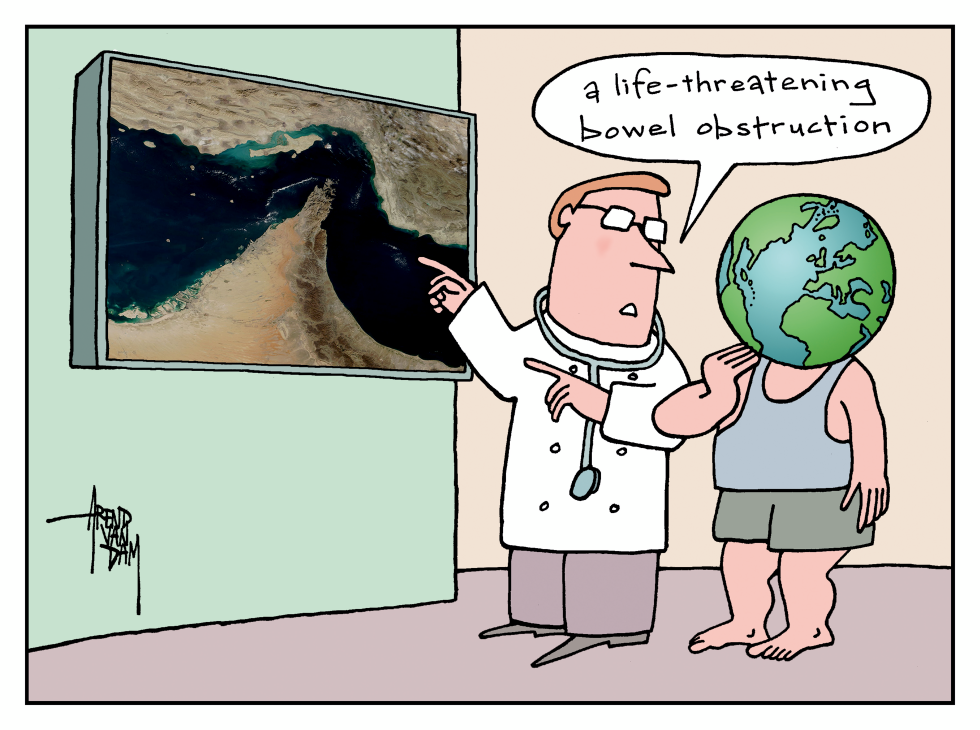
Arend van Dam\'s cartoon depicts a doctor diagnosing a child-like figure with a globe for a head, pointing to a screen showing the Strait of Hormuz as a life-threatening bowel obstruction. This visual metaphor ties into tags such as economy, world, oil, gas, obstruction, and war, illustrating how blockages in key trade routes threaten global stability. The barefoot patient in casual attire underscores vulnerability, while the doctor\'s serious demeanor adds dry humor to the geopolitical satire. Negotiations with ayatollahs and regime sanctions loom in the background, making the image a pointed commentary on how such conflicts create economic chokepoints. The overall composition blends medical analogy with international affairs for sharable impact.
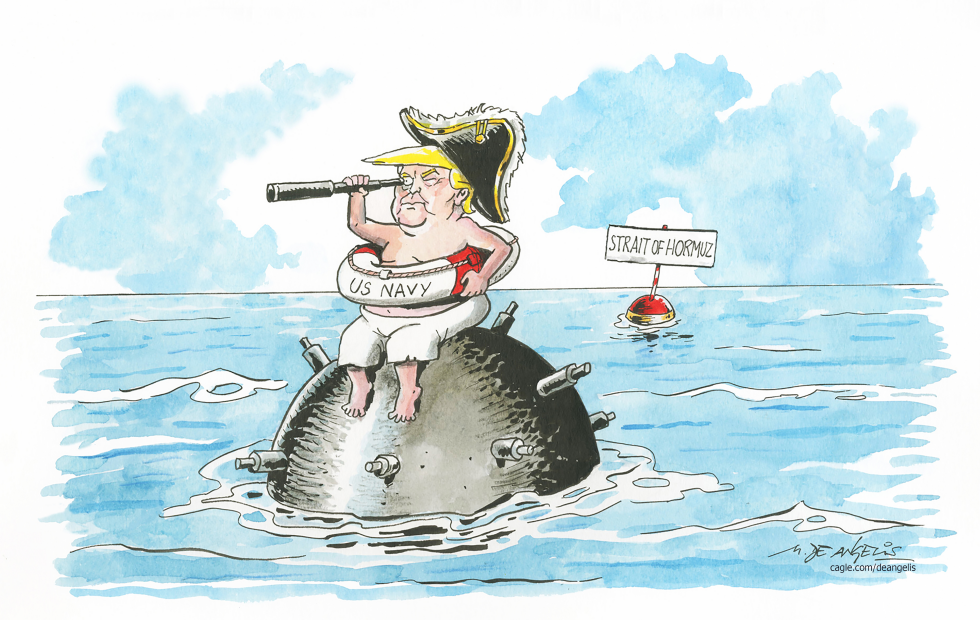
Marco De Angelis draws a caricature resembling Donald Trump, shirtless with a US NAVY life preserver, white shorts, and pirate hat, sitting on a large mine bobbing in blue waters. He holds a telescope to his eye, gazing out, while a small buoy nearby bears a Strait of Hormuz sign. The scene tags USA, IRAN, HORMUZ, NAVY, MINES, OIL, NEGOTIATIONS, FLEET, ALONE, ADMIRAL, MIDDLE EAST, WAR, capturing a sense of solitary watch in troubled seas. The dry humor underscores the absurdity of one man embodying an entire fleet, floating precariously on explosive hardware. Cartoons like this thrive on exaggeration, turning geopolitical standoffs into visual punchlines that newspapers love for their sharability.
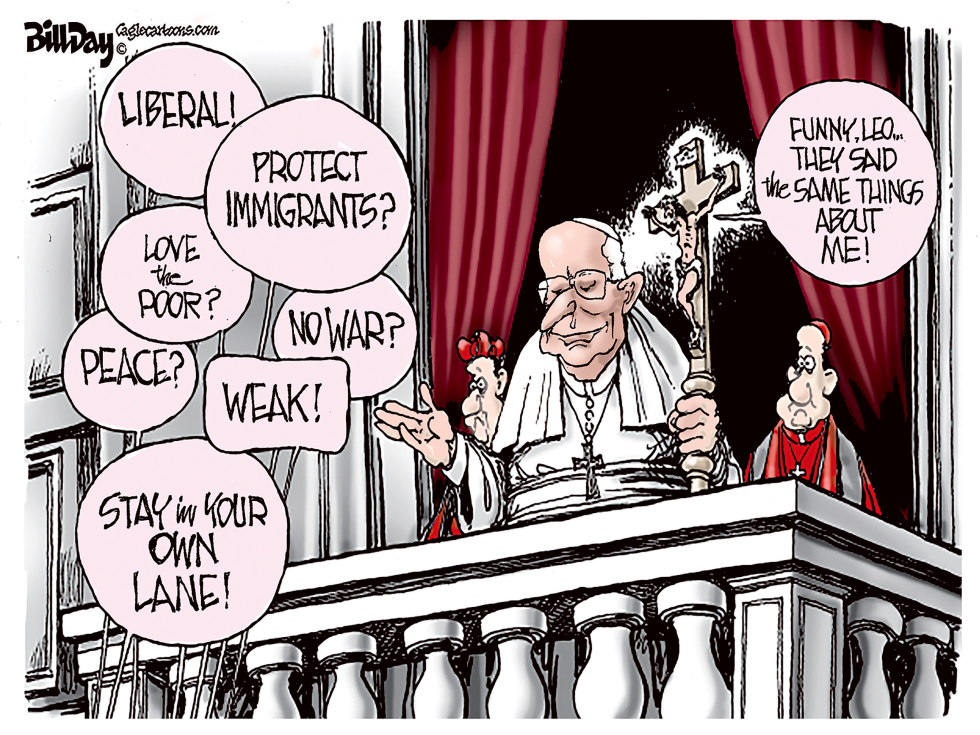
Bill Day's political cartoon shows a central pope figure on a balcony, holding a cross staff, surrounded by speech bubbles accusing liberal views like protect immigrants, love the poor, peace, no war, weak. A side figure remarks on funny Leo saying the same things about me, drawing a clear visual parallel. The composition uses red curtains and clerical attire for a Vatican setting, emphasizing satire on church politics. Tags include political cartoon pope francis, bill day cartoon, pope leo comparison, conservative backlash pope, anti-war pope, catholic church politics.
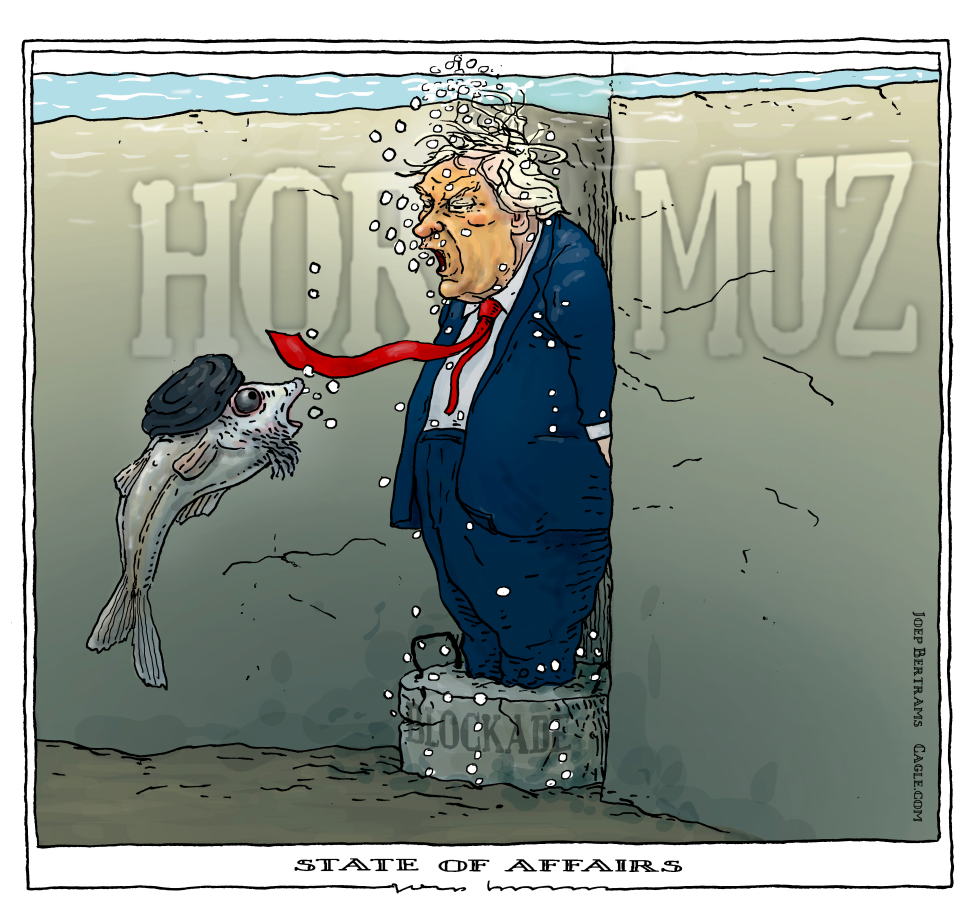
Joep Bertrams captures the Strait of Hormuz tensions with a caricature of Donald Trump sinking in concrete shoes marked blockade, bubbles rising from his open mouth as a fish in a black hat nibbles his red tie. The underwater setting features a cracked wall labeled Hormuz, emphasizing the sunk metaphor for diplomatic failures. Tags like Iran, concrete shoes, and fish highlight the satirical take on US-Iran relations, with the caption State of Affairs underscoring the dire situation. This cartoon from 2026 blends humor and commentary on potential blockades, showing Trump in a blue suit against a murky seabed.
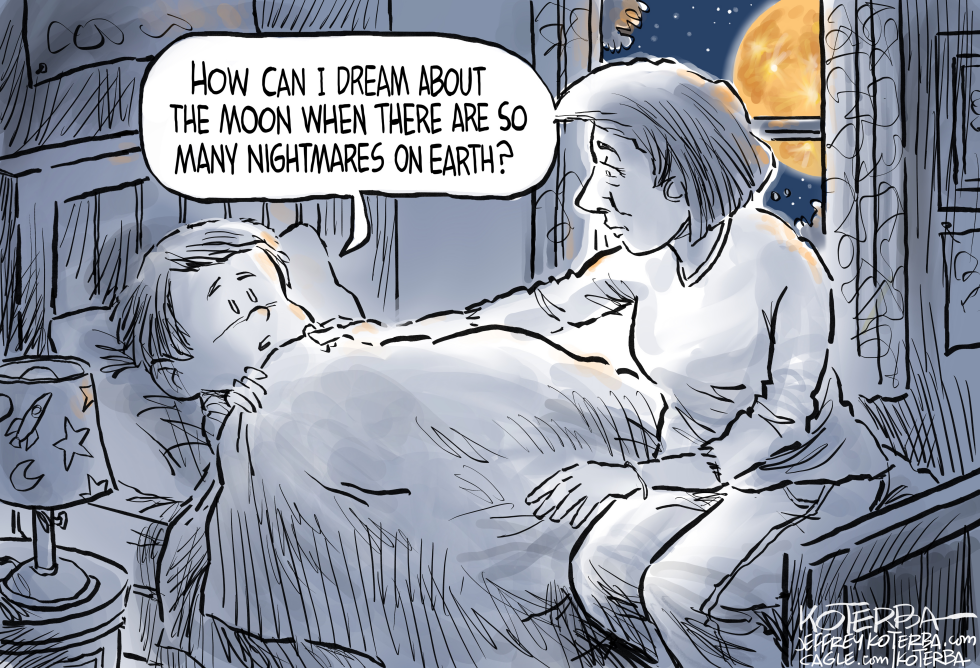
This poignant political cartoon depicts a child in bed, gazing toward a window framing a massive orange moon against a starry night sky, while confiding in a seated adult figure. The child's speech bubble reads: 'How Can I Dream About The Moon When There Are So Many Nightmares On Earth?' A bedside lamp with a star design illuminates the scene. Through this setup, the artwork satirizes how youth anxiety from global issues—like wars, climate woes, and social upheavals—stifles big dreams and aspirations. It's a clever commentary on how earthly nightmares eclipse celestial hopes, blending humor with insight into modern parenthood and childhood innocence lost. Tags: political cartoon, child nightmares, moon dreams, earth troubles, satirical illustration, youth anxiety, global chaos.
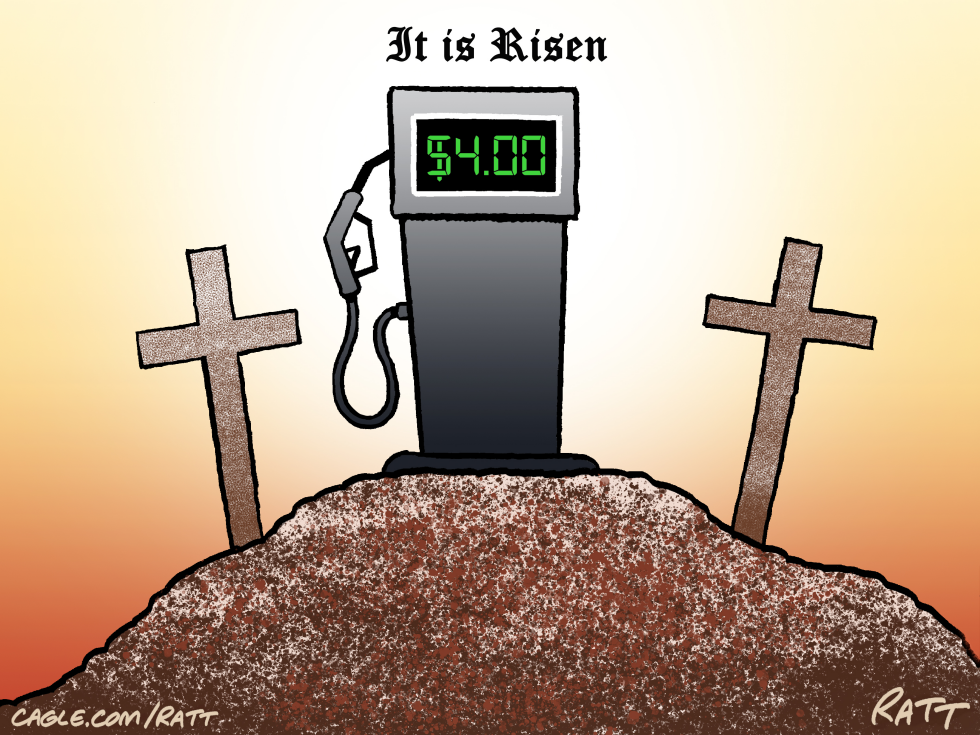
Ratt's cartoon captures Easter in America 2026 with a gas pump standing in for the central cross on a Calvary hill, showing $4.00 on its display and the text 'It is Risen' above, playing on rising gas prices. Tags like Easter, gas prices, oil, Iran war, and Strait of Hormuz suggest a future where geopolitical tensions drive fuel costs skyward. The artwork uses simple lines and a sunset background to evoke the biblical scene, but replaces resurrection with economic pain. This satire highlights how global events, including potential conflicts in the Strait of Hormuz, could lead to exorbitant oil prices by 2026. The dry humor underscores American dependence on foreign oil, making the cartoon timely and shareable amid ongoing energy debates.
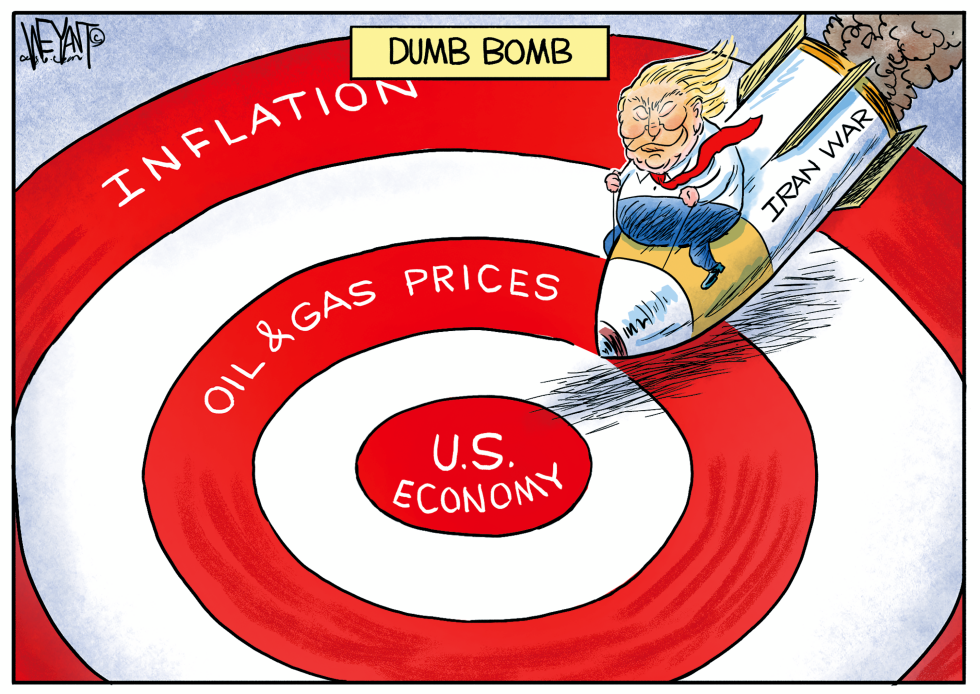
Christopher Weyant's cartoon shows a Donald Trump caricature astride a 'Dumb Bomb' labeled 'Iran War,' plummeting toward a red-and-white bullseye. The target's rings are inscribed with 'Inflation,' 'Oil & Gas Prices,' and at the center, 'U.S. Economy.' This setup highlights concerns over foreign policy decisions affecting domestic finances. The dry humor underscores the risks of impulsive actions in international affairs, with Trump's windswept hair and determined expression adding to the satirical edge. Tags like political cartoon, Trump Iran war, US economy satire, inflation oil prices, dumb bomb cartoon, and Christopher Weyant emphasize the image's relevance to current events.
John Darkow's cartoon captures the sting of high gas prices amid inflation and war, showing a yellow vehicle at a station with unleaded fuel marked at 3.95 9/10 per gallon, pay in advance. Speech bubbles reveal a conversation where one asks about not going anywhere for spring break, and the reply puns on being 'Spring Broke' due to gas costs. The image underscores travel disruptions, with tags like gas prices, inflation, spring break, travel, war, and economic satire emphasizing how rising fuel expenses halt vacation plans. This straightforward drawing uses dry humor to point out everyday economic frustrations without overcomplicating the scene.