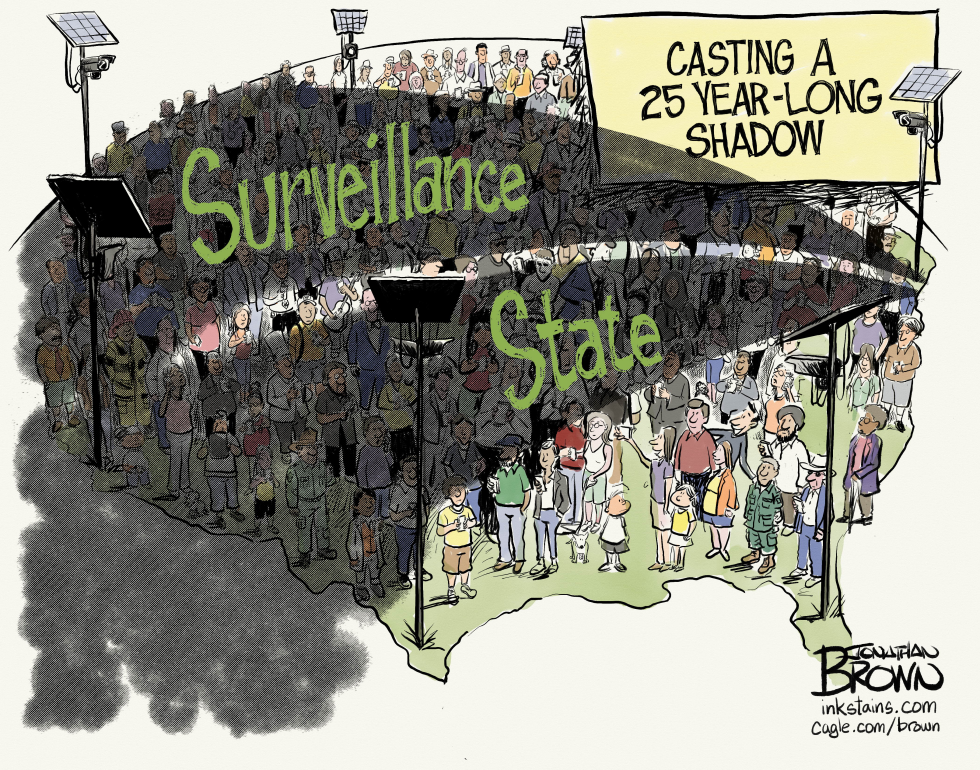
The cartoon depicts a dense crowd of Americans standing on a map of the United States, partially obscured by a large dark shadow cast by surveillance cameras mounted on poles. The words 'Surveillance State' appear prominently in green lettering across the scene, while a sign in the upper right reads 'CASTING A 25 YEAR-LONG SHADOW.' The image comments on the lasting effects of expanded government surveillance programs that began after the September 11 attacks, now spanning a quarter century. It illustrates how these measures continue to influence daily life and public spaces in 2026.
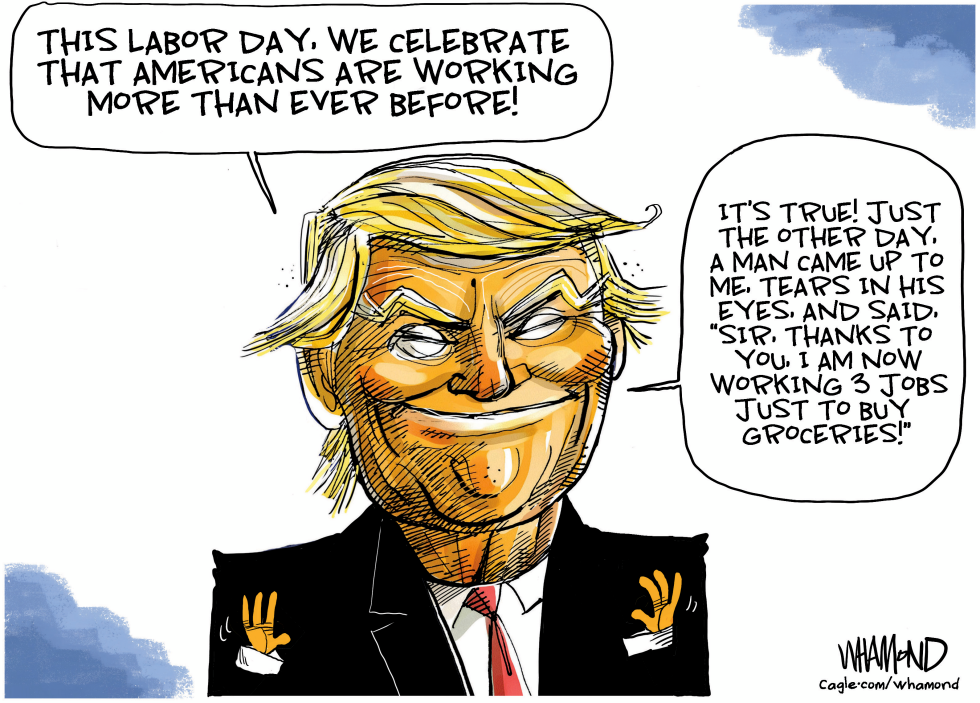
On Labor Day 2026, President Trump highlighted what he described as record employment levels in a public address. He pointed to Americans taking on more work as evidence of economic strength. The remarks come amid ongoing public concern over household costs and wage pressures. Critics argue the comments underscore the gap between official job numbers and the lived experience of workers needing multiple positions to cover basic expenses. The cartoon presents the remarks as tone-deaf to economic strain.
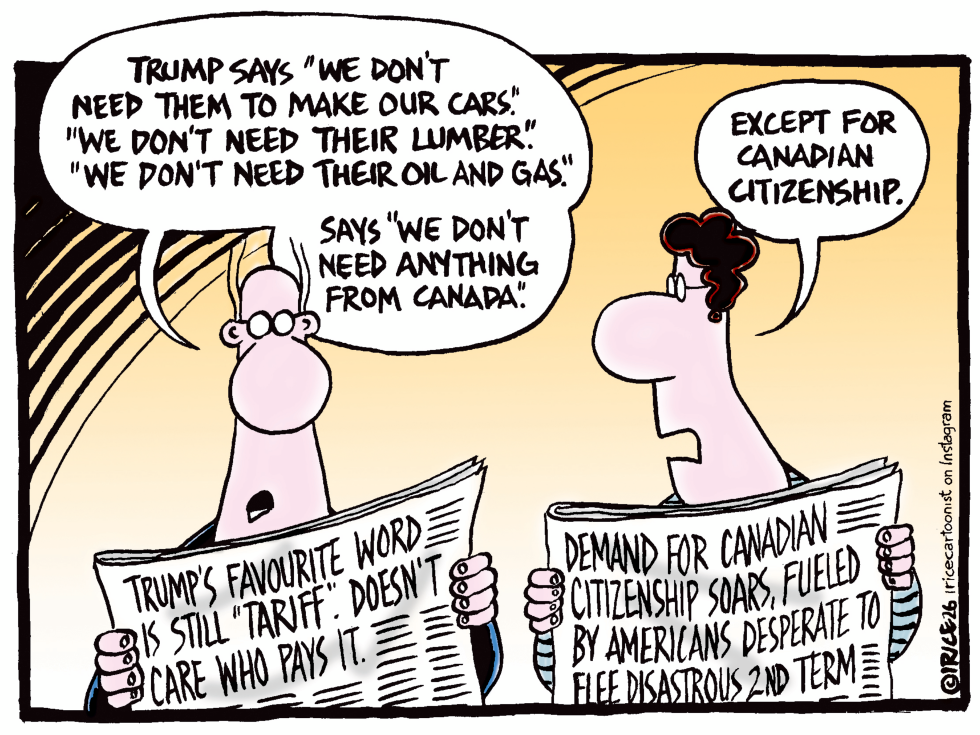
Trump's renewed tariffs on Canadian cars, lumber, oil and gas have triggered a sharp rise in applications for Canadian citizenship from Americans wary of his second term. The move underscores ongoing US-Canada trade friction and domestic policy backlash. The cartoon frames the policy as self-defeating, highlighting the irony of Canadians becoming the one Canadian product still in demand.
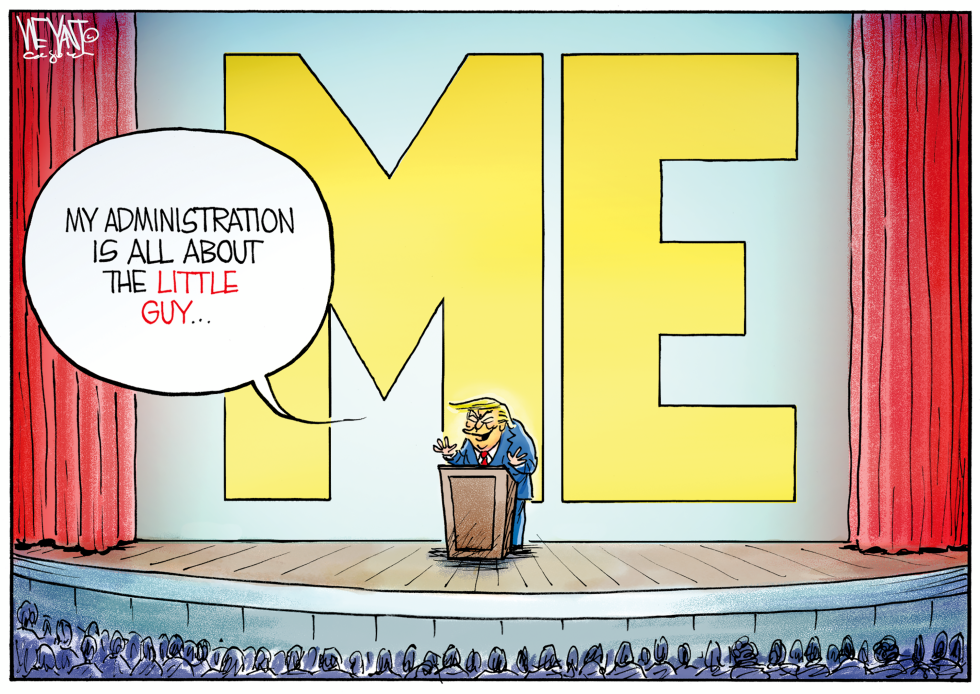
Donald Trump has repeatedly positioned his administration as champion of ordinary Americans during public addresses. The claim comes amid ongoing debates over policy priorities and personal branding in the White House. The piece portrays the rhetoric as centered on the speaker rather than the public.
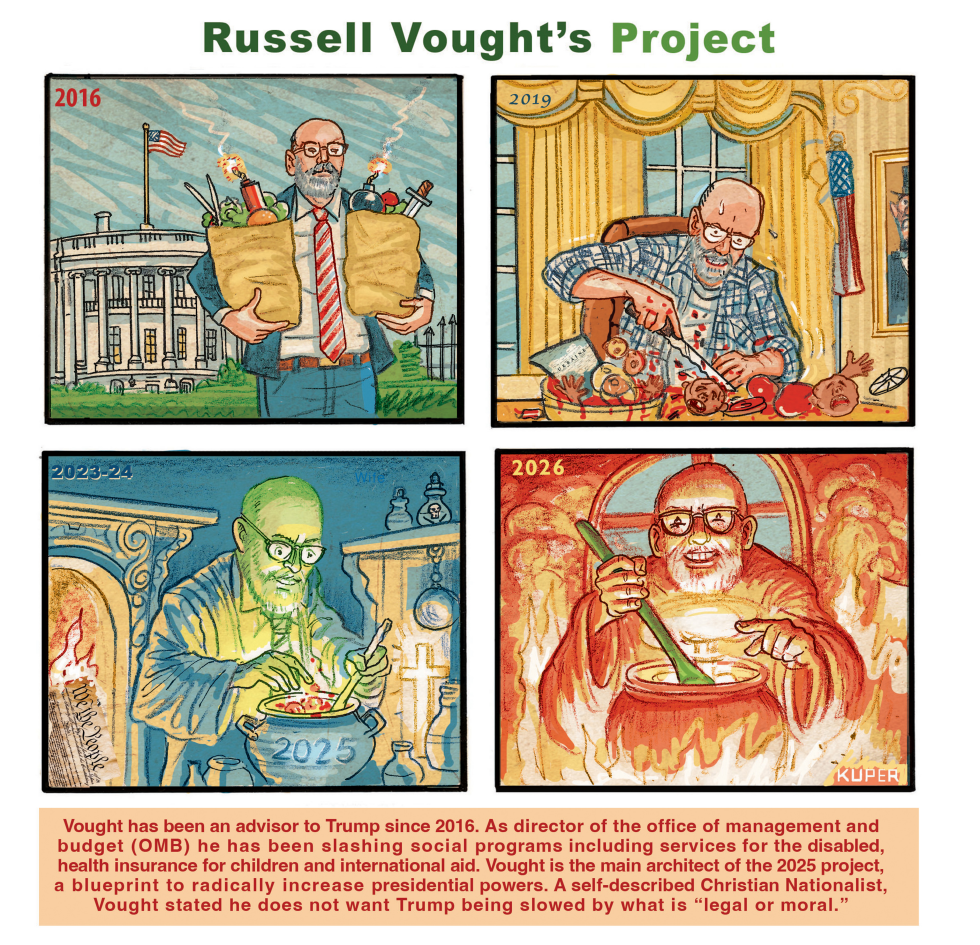
Russell Vought has served as a Trump advisor since 2016 and later directed the Office of Management and Budget, where he cut funding for disability services, children’s health insurance and foreign aid. He is the principal author of Project 2025, a plan to enlarge presidential authority. The cartoon presents his progression from 2016 through 2026 as a deliberate effort to remove legal or moral restraints on executive action.
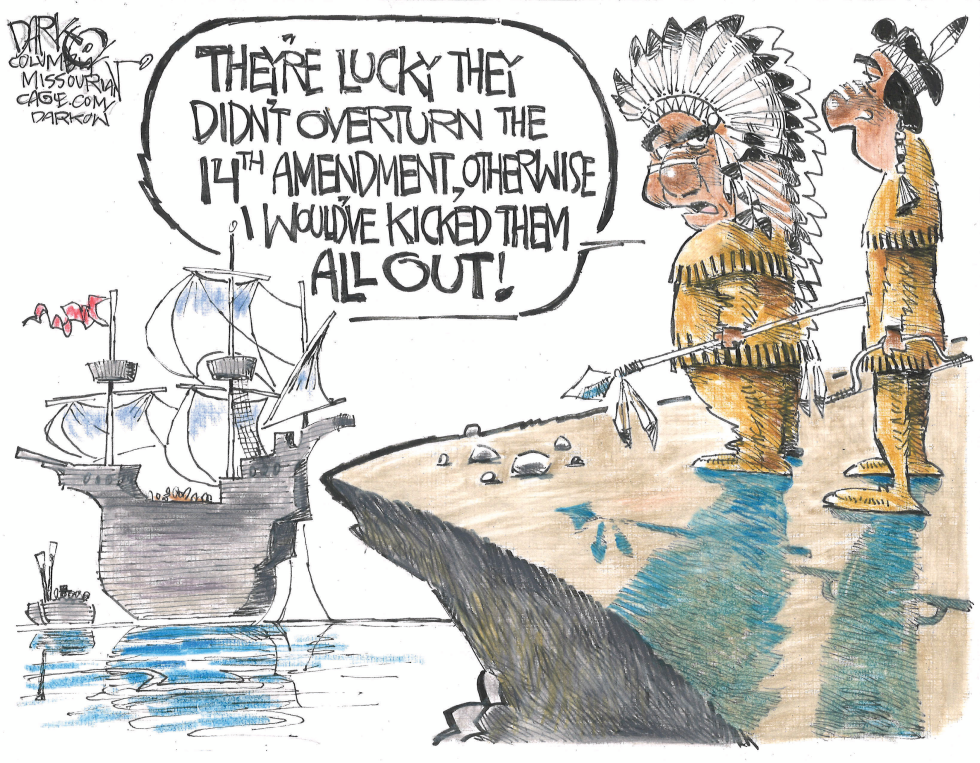
The cartoon depicts two Native Americans on a shoreline observing an approaching sailing ship. A speech bubble from one figure references the 14th Amendment and hypothetical removal of arrivals. The scene ties into ongoing discussions of birthright citizenship and the amendment's scope as of mid-2026.
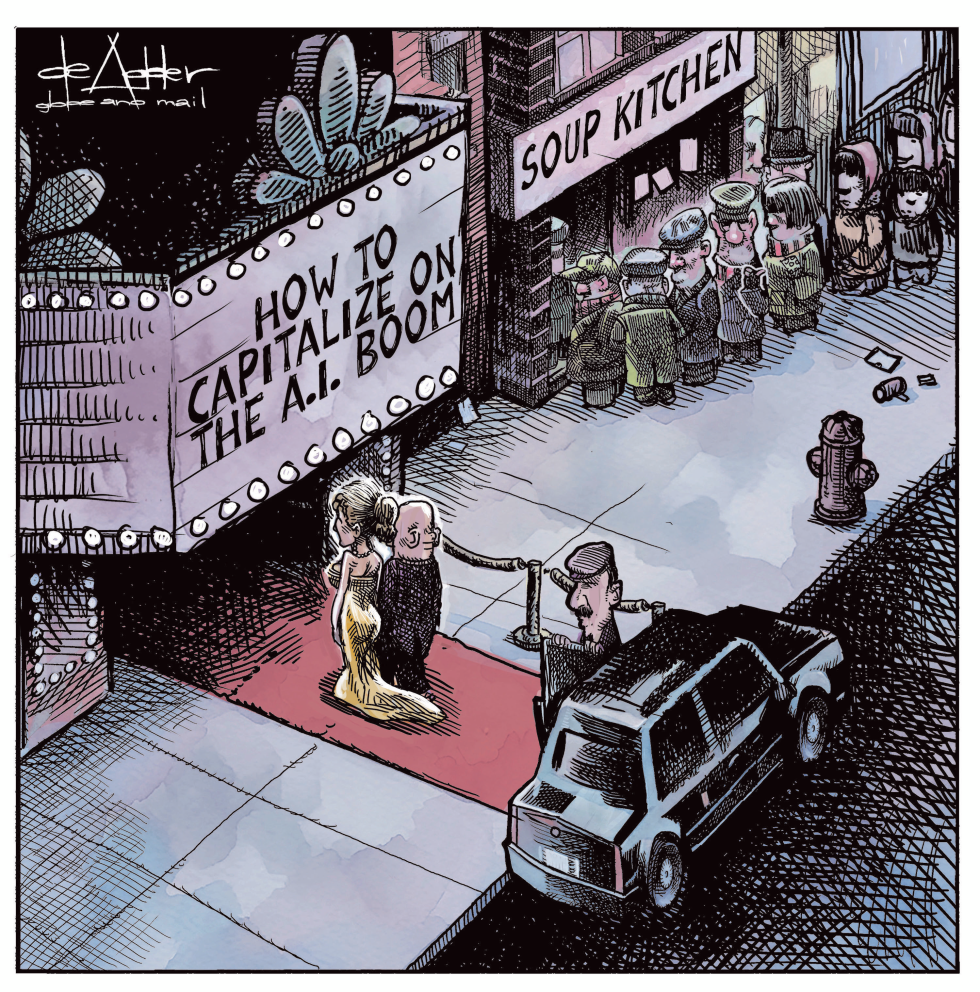
A political cartoon depicts a wealthy couple arriving at a theater hosting an event titled 'How to Capitalize on the A.I. Boom.' A red carpet and limousine service the entrance. Across the street a long line of people waits outside a soup kitchen. The image contrasts the gains from artificial intelligence for some with ongoing needs for others in 2026.
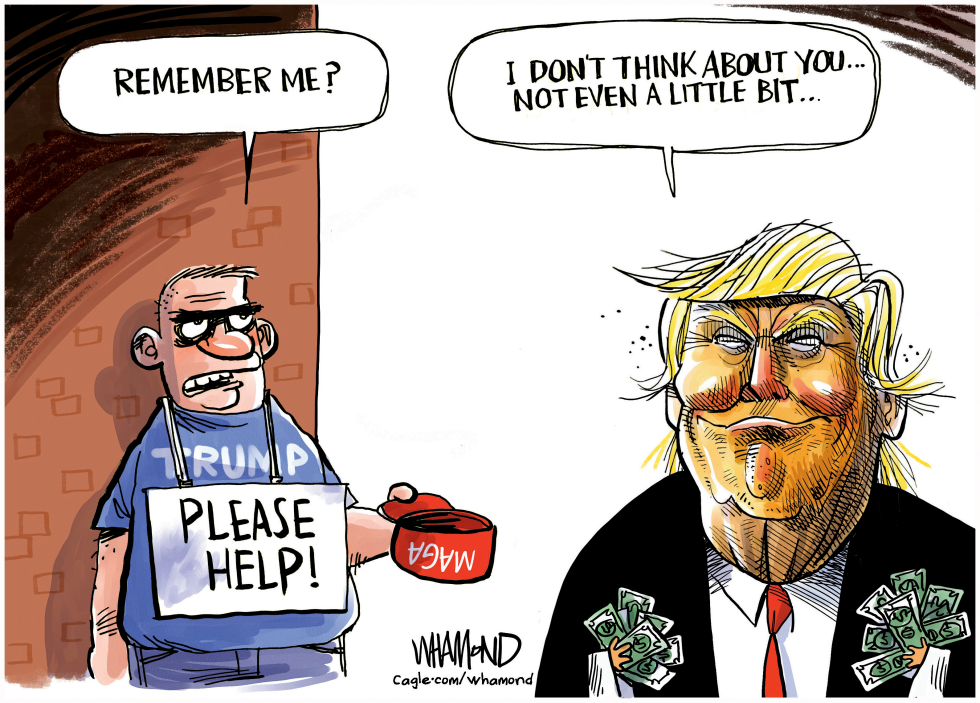
Visible in the cartoon are two figures facing each other. The left figure wears a blue shirt labeled trump, holds a white sign reading please help, and carries a red hat marked maga. The right figure has yellow hair, a black jacket with green bills protruding from pockets, and a red tie. Two speech bubbles display the phrases remember me and i dont think about you not even a little bit. The artist signature whamond and cagle.com/whamond appear at the bottom.