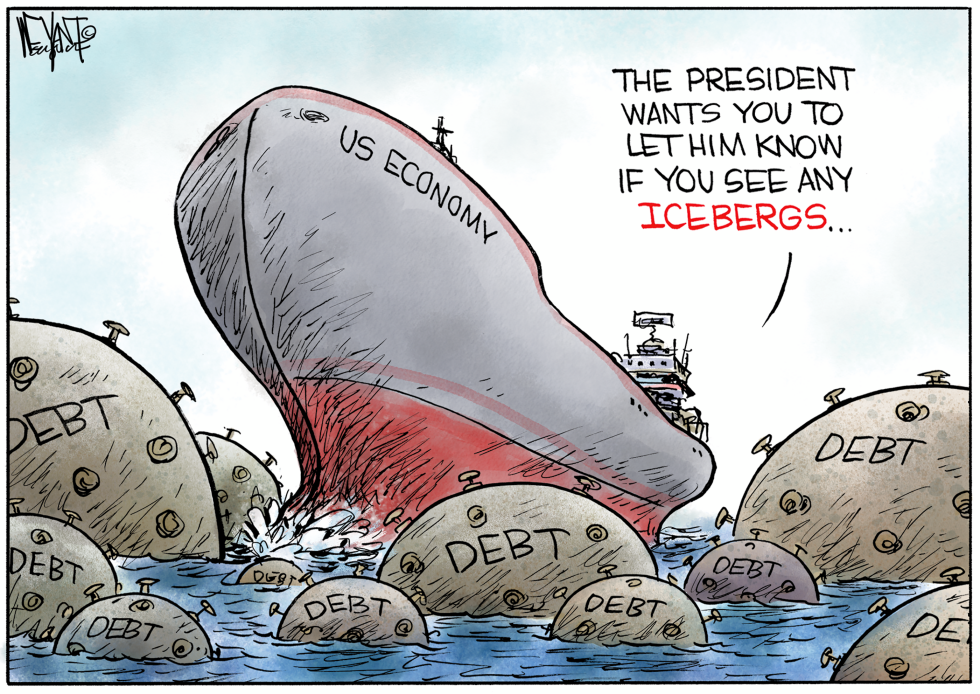
This political cartoon illustrates the US Economy as a massive ship labeled accordingly, dramatically sinking after colliding with numerous icebergs each marked 'DEBT.' A speech bubble from the ship warns to alert the president about icebergs, evoking the Titanic disaster in a clear metaphor for economic peril. Incorporating tags such as economy, debt, budget, inflation, prices, and costs, the image critiques fiscal irresponsibility. The artwork by Christopher Weyant uses simple lines and colors to emphasize the collision's impact, with water splashing and the ship's hull damaged. Such cartoons often highlight how mounting debt threatens stability, drawing parallels to historical maritime tragedies for satirical effect. The composition places the ship at an angle, surrounded by floating debt bergs, underscoring inevitable crisis if warnings go unheeded.
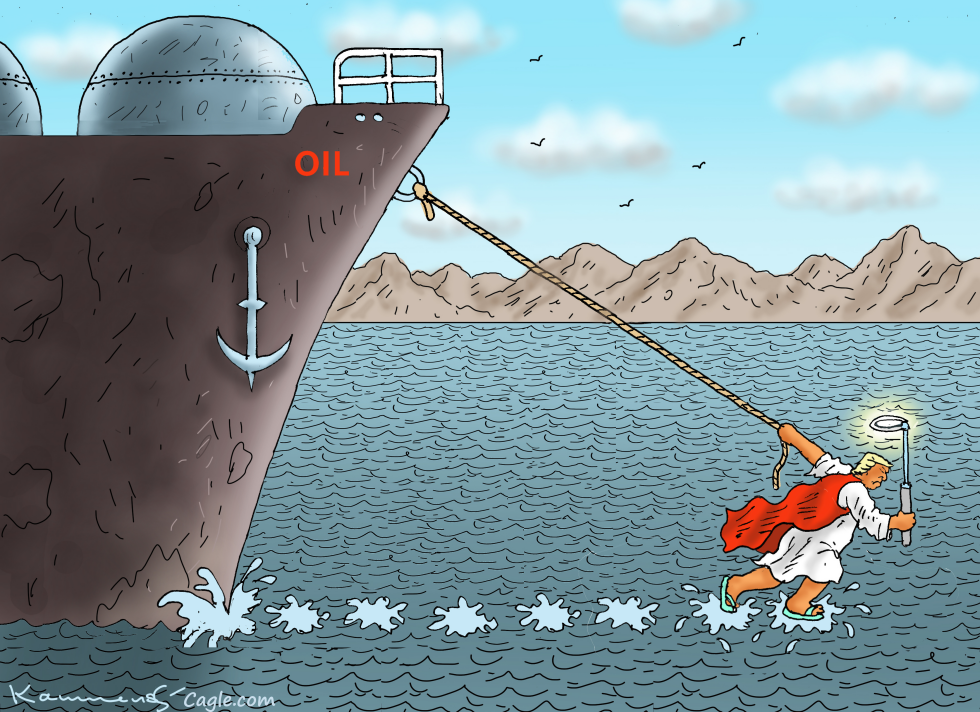
The image depicts a figure dressed in a white robe and red cape, complete with a glowing halo, running across the water while pulling a large oil tanker marked 'OIL' with a rope. He holds a golf club in one hand, splashing water with each step against a backdrop of mountains and a clear sky. This setup draws on tags like Trump, Hormuz, Iran, oil war, MAGA terror, and fascism to satirize political figures intervening in global oil crises. The cartoon's composition emphasizes the absurdity of a divine savior tackling economic and geopolitical issues, with birds flying overhead and distant peaks suggesting a Middle Eastern strait. Kamensky's style brings dry humor to the forefront, poking at notions of messianic leadership in turbulent times.
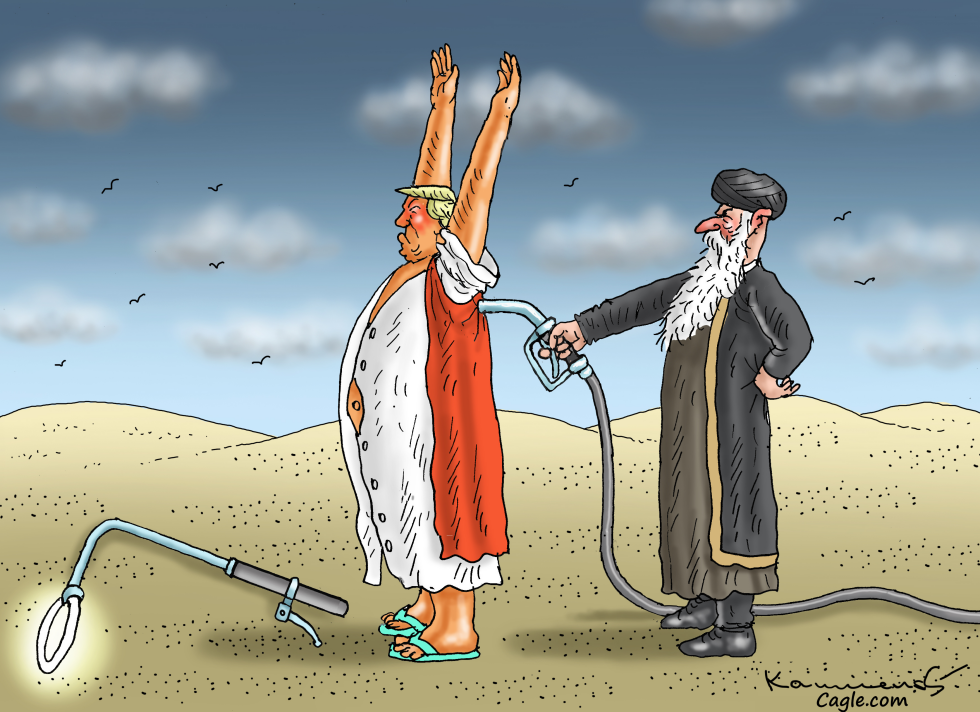
Marian Kamensky's cartoon captures a surreal scene in the desert where a figure resembling Trump, dressed in white and red robes with arms raised skyward, has a gas pump nozzle inserted into his side by a bearded man in dark robes and turban. The image plays on themes of Trump, Iran, Hormuz, fascism, MAGA terror, and oil war, blending religious imagery with modern geopolitical tensions. Birds fly in a cloudy sky over sandy dunes, emphasizing isolation and absurdity. The signature and Cagle.com mark confirm its syndication roots. This piece skewers the intersections of politics, religion, and resource dependency without words, relying on visual punch for impact. Such cartoons thrive in editorial pages for their sharp commentary on current events.
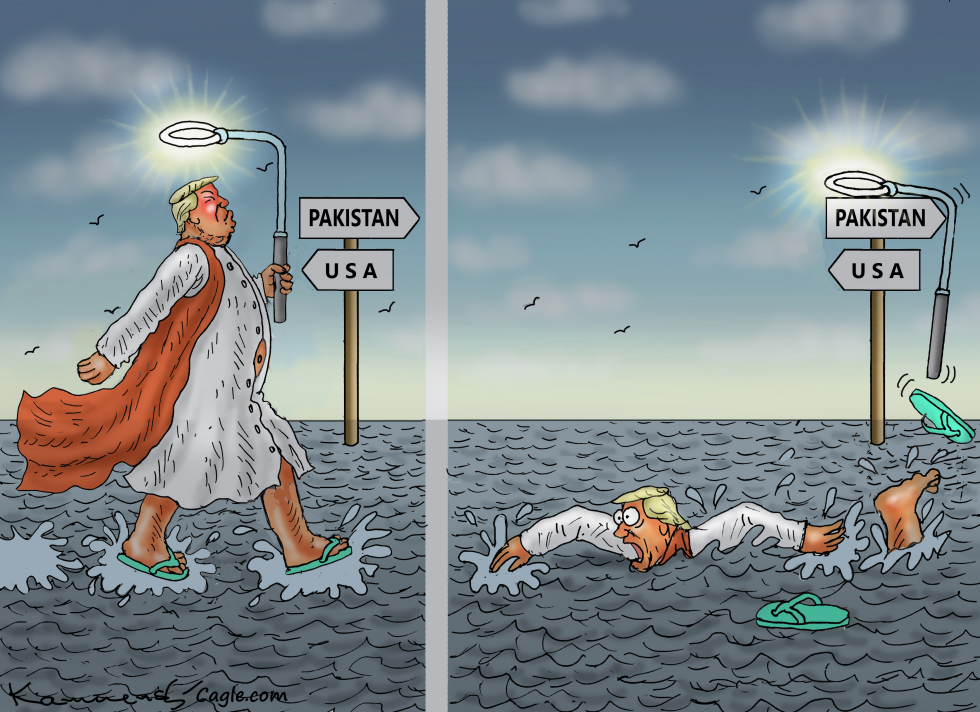
Marian Kamensky\'s cartoon captures Trump with a halo, striding across the sea in robes and flip-flops toward signs pointing to Pakistan and USA, evoking peace talks amid Hormuz strife. The satire turns sharp as Trump, embodying fascism and MAGA terror, plunges into the waves, desperately swimming while his flip-flop floats away and the signpost topples. This two-panel setup underscores the hubris of political figures tackling international relations, blending humor with critique of overreaching ambitions in U.S.-Pakistan dynamics. The artwork\'s clean lines and exaggerated expressions amplify the dry wit, making it a pointed commentary on failed diplomacy and self-proclaimed savior complexes in global politics.
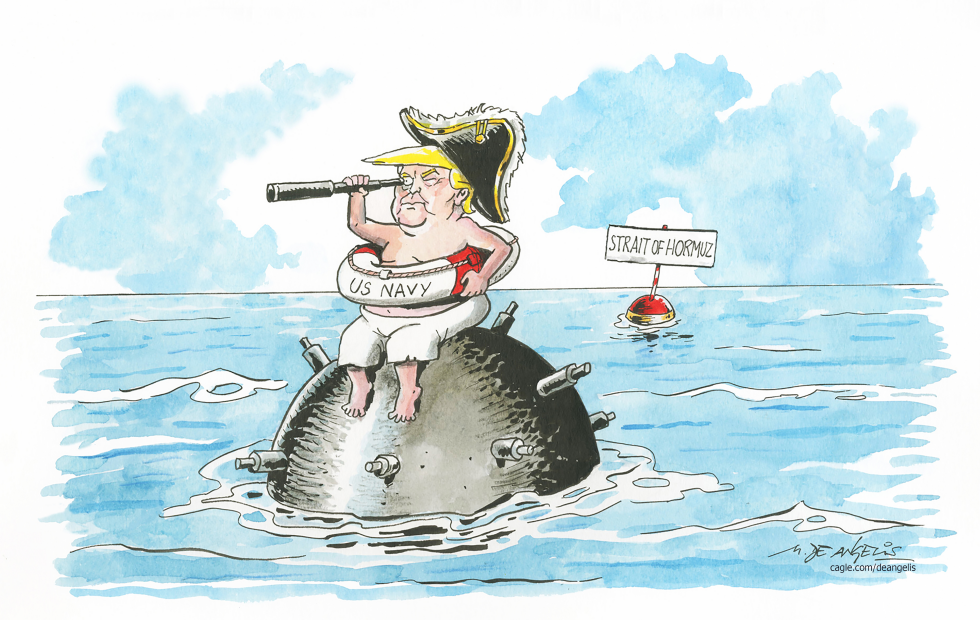
Marco De Angelis draws a caricature resembling Donald Trump, shirtless with a US NAVY life preserver, white shorts, and pirate hat, sitting on a large mine bobbing in blue waters. He holds a telescope to his eye, gazing out, while a small buoy nearby bears a Strait of Hormuz sign. The scene tags USA, IRAN, HORMUZ, NAVY, MINES, OIL, NEGOTIATIONS, FLEET, ALONE, ADMIRAL, MIDDLE EAST, WAR, capturing a sense of solitary watch in troubled seas. The dry humor underscores the absurdity of one man embodying an entire fleet, floating precariously on explosive hardware. Cartoons like this thrive on exaggeration, turning geopolitical standoffs into visual punchlines that newspapers love for their sharability.
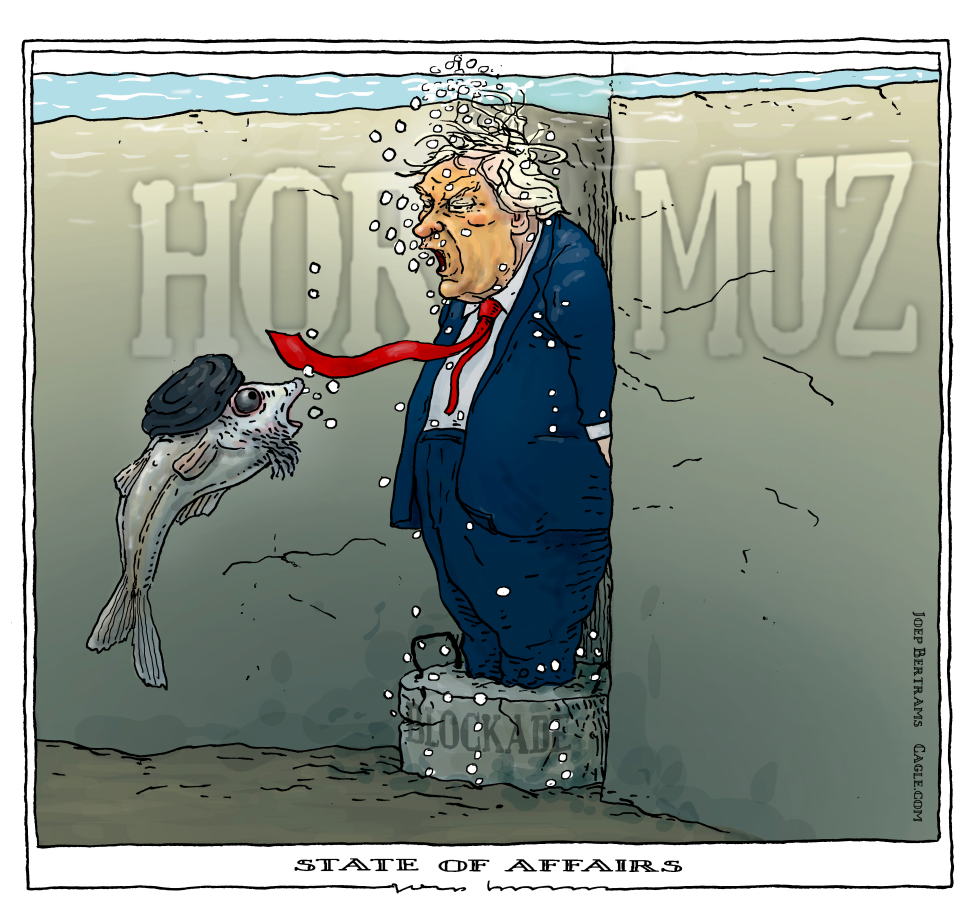
Joep Bertrams captures the Strait of Hormuz tensions with a caricature of Donald Trump sinking in concrete shoes marked blockade, bubbles rising from his open mouth as a fish in a black hat nibbles his red tie. The underwater setting features a cracked wall labeled Hormuz, emphasizing the sunk metaphor for diplomatic failures. Tags like Iran, concrete shoes, and fish highlight the satirical take on US-Iran relations, with the caption State of Affairs underscoring the dire situation. This cartoon from 2026 blends humor and commentary on potential blockades, showing Trump in a blue suit against a murky seabed.
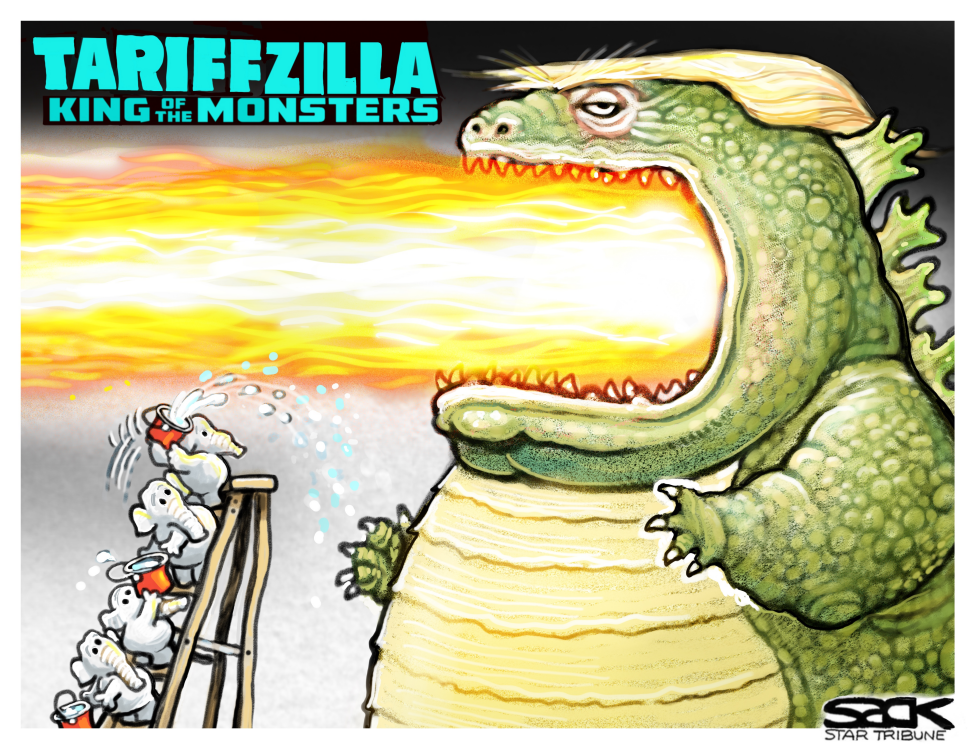
Steve Sack's 2019 cartoon portrays Trump as Tariffzilla, a Godzilla-inspired beast with the president's distinctive hair, unleashing destructive fire. Below, a chain of small white elephants, symbols of the Republican party, ascend a ladder to splash water from buckets onto the monster's foot, suggesting futile efforts against overwhelming tariff policies. The title 'Tariffzilla King of the Monsters' ties into trade war themes with Mexico over immigration and migrants. This sharp satire captures the chaos of Trump's tariff threats, blending monster movie tropes with political commentary on border issues. The image underscores how such policies loom large, dwarfing party attempts to mitigate damage.
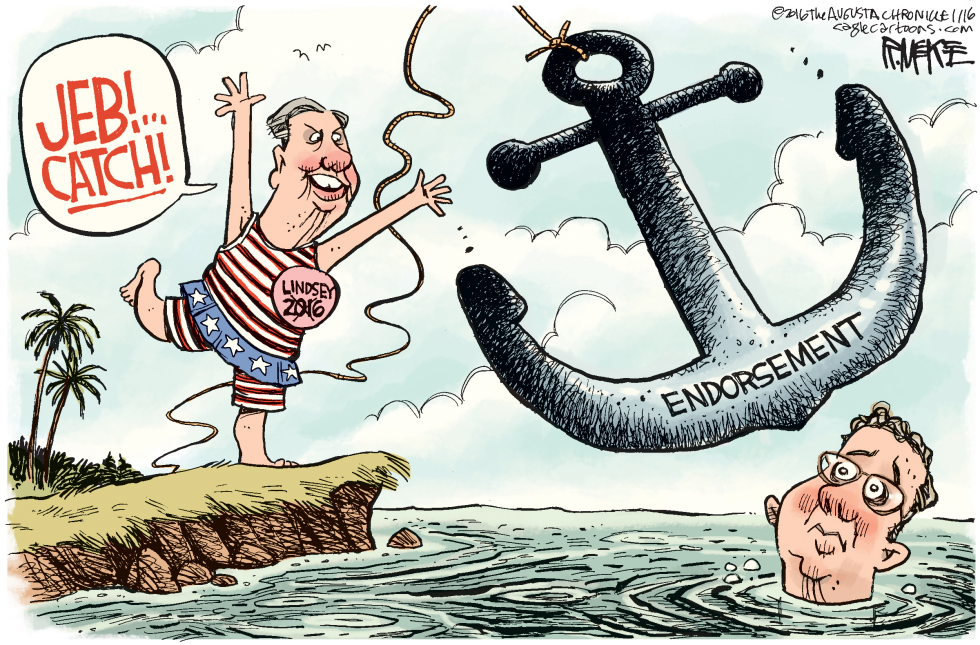
On January 15 2016 Lindsey Graham stands on a cliff edge in a stars and stripes swimsuit and hurls a large anchor marked endorsement toward Jeb Bush who treads water below. The scene responds to Graham's recent public backing of Bush in the Republican presidential primary. Graham had served as a senator from South Carolina and Bush had been governor of Florida. Their alliance formed as other candidates competed for the nomination. The image captures the weight of that support at a key moment in the campaign cycle.
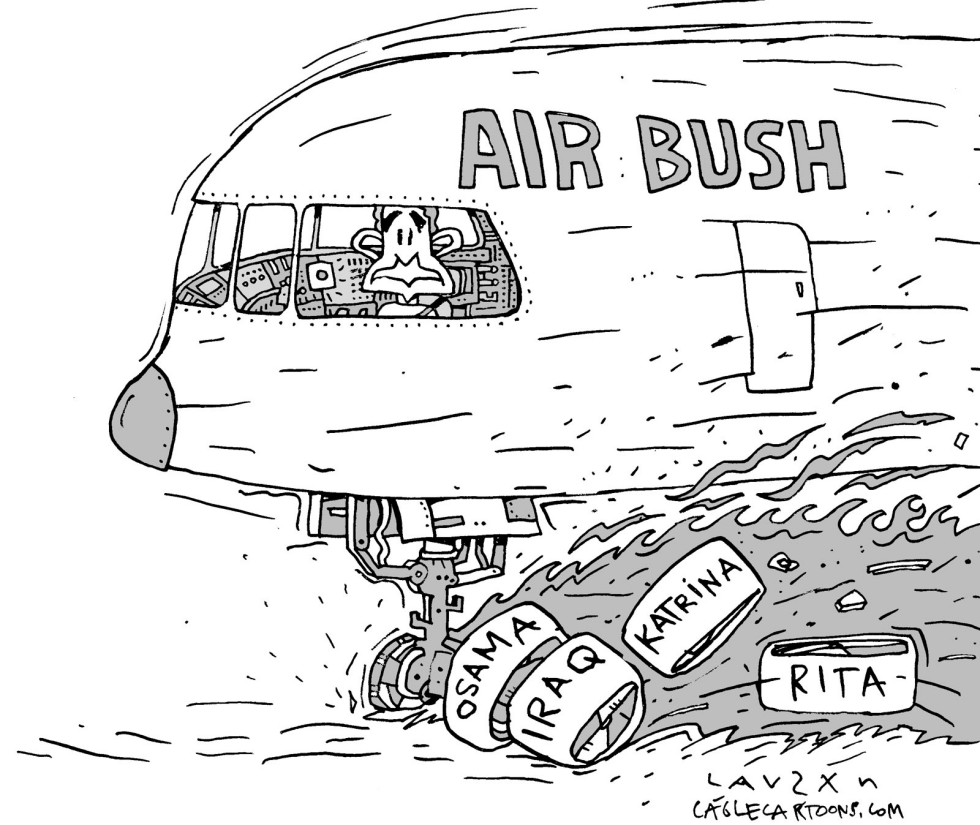
The cartoon shows Air Bush plane landing on barrels labeled Osama, Iraq, Katrina, Rita amid waves, satirizing Bush's crises in Iraq War, Osama pursuit, and hurricanes. Dry humor highlights the bumpy presidential ride without overinterpreting.