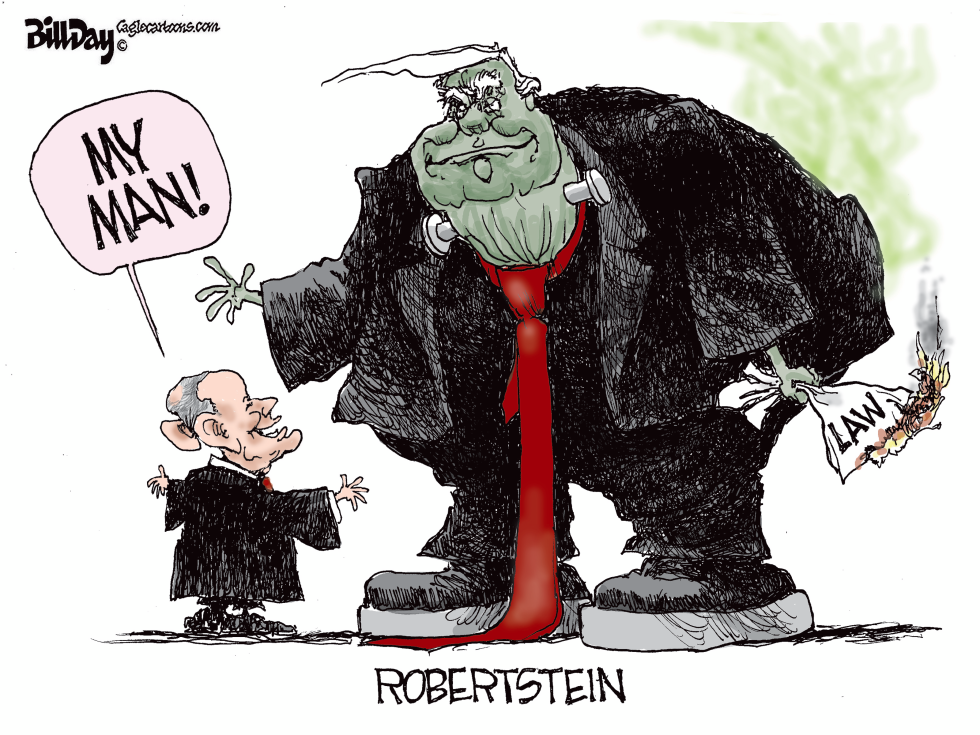
A judge nicknamed Robertstein appears as a stitched-together monster clutching a burning copy of the law while a smaller political figure hails him as 'my man.' The image responds to ongoing concerns over judicial appointments that produce ideologically driven rulings. Critics argue such selections prioritize loyalty over legal restraint, weakening institutional guardrails. The cartoon takes the position that these appointments create uncontrollable forces that damage the rule of law.
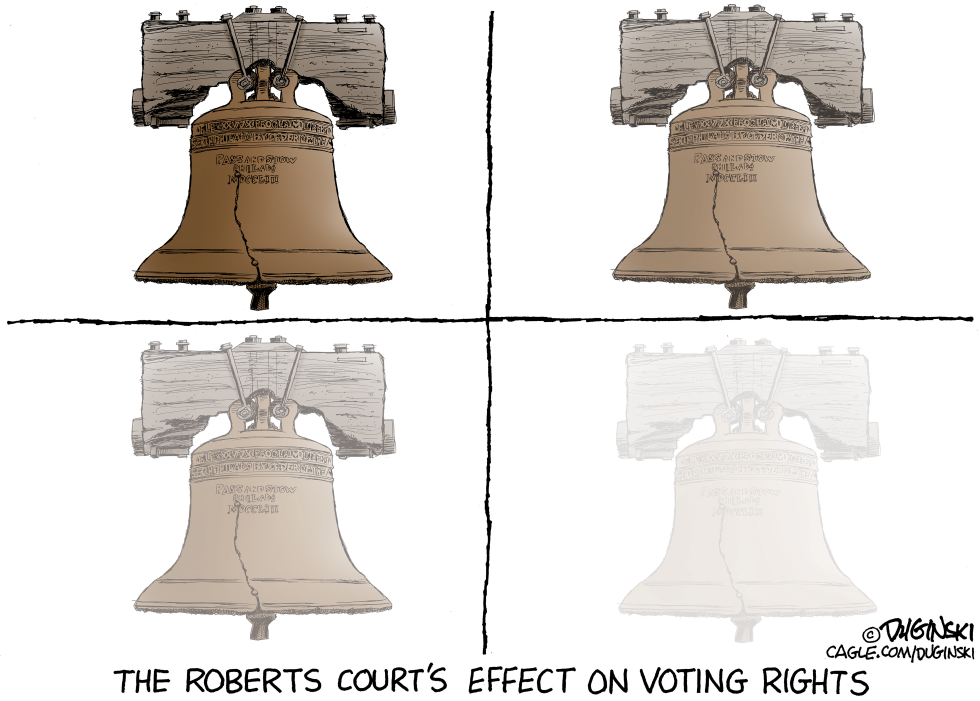
The Supreme Court under Chief Justice John Roberts has issued a series of decisions that have curtailed key provisions of the Voting Rights Act, most notably in Shelby County v. Holder and subsequent cases limiting federal oversight of state election laws. These rulings have shifted power to states, enabling new voting restrictions in multiple jurisdictions. The editorial cartoon frames this judicial trend as a deliberate fading of the Liberty Bell, a symbol of American liberty, to argue that the court's actions are systematically undermining voting access and protections established decades earlier.
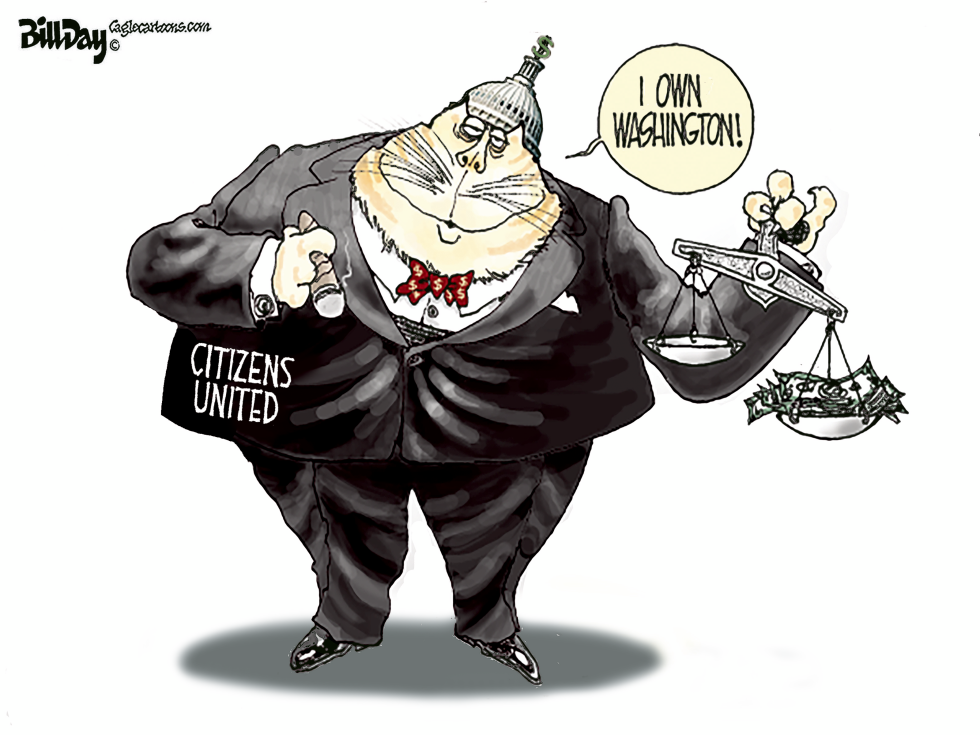
The 2010 Citizens United Supreme Court ruling opened the door to unlimited independent expenditures by corporations and unions in elections. Critics argue the decision amplified the voice of wealthy donors and special interests over average voters. The cartoon responds to the ongoing effects of that precedent by depicting a powerful corporate figure claiming control of the capital. It highlights how the ruling has reshaped campaign finance and public trust in government institutions.
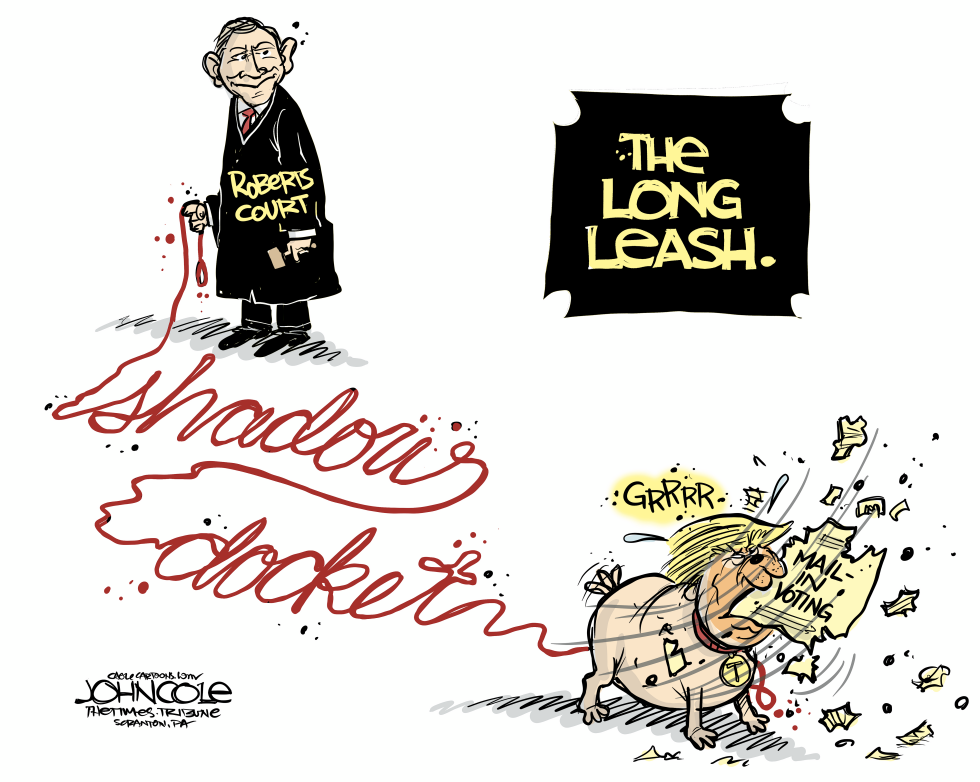
The Supreme Court under Chief Justice John Roberts issued orders limiting former President Donald Trump's administration from advancing certain mail-in voting restrictions through the shadow docket. The rulings underscore the Court's role in checking executive actions on election procedures ahead of future contests. The cartoon portrays the Roberts Court maintaining firm oversight while depicting resistance from Trump-aligned efforts.
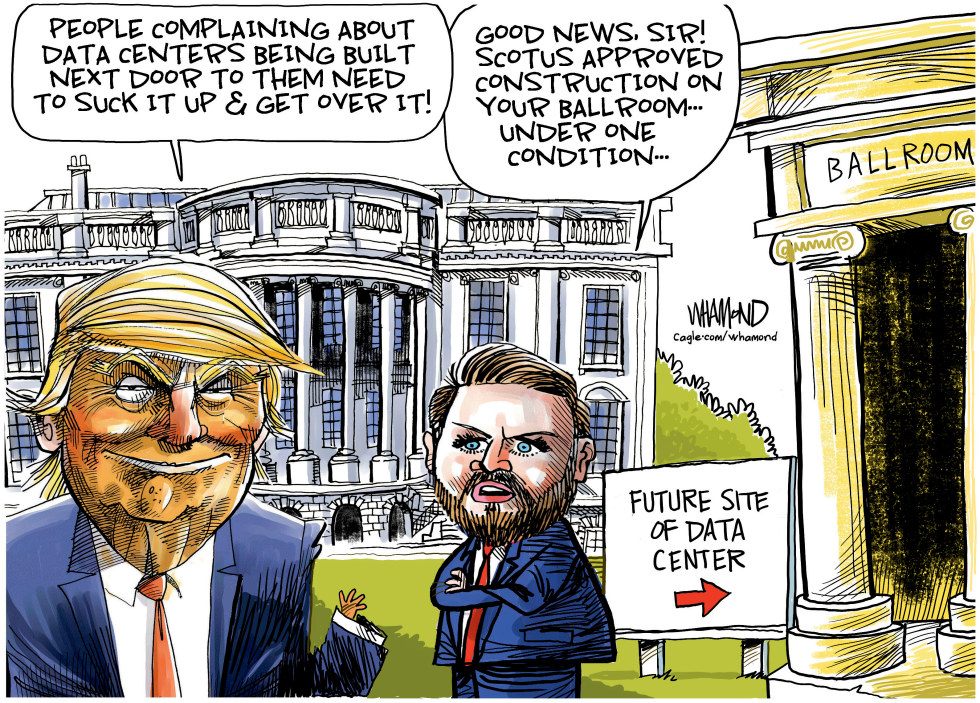
On September 2, 2026, reports emerged that the Trump administration secured Supreme Court approval for a new White House ballroom with the condition that the site also host a data center. The decision comes as communities nationwide protest data center construction near homes. The cartoon depicts Trump dismissing resident complaints while an aide delivers the conditional news. It highlights tensions between executive ambitions and local opposition to large-scale tech infrastructure. The piece argues that such projects prioritize political vanity over community concerns.
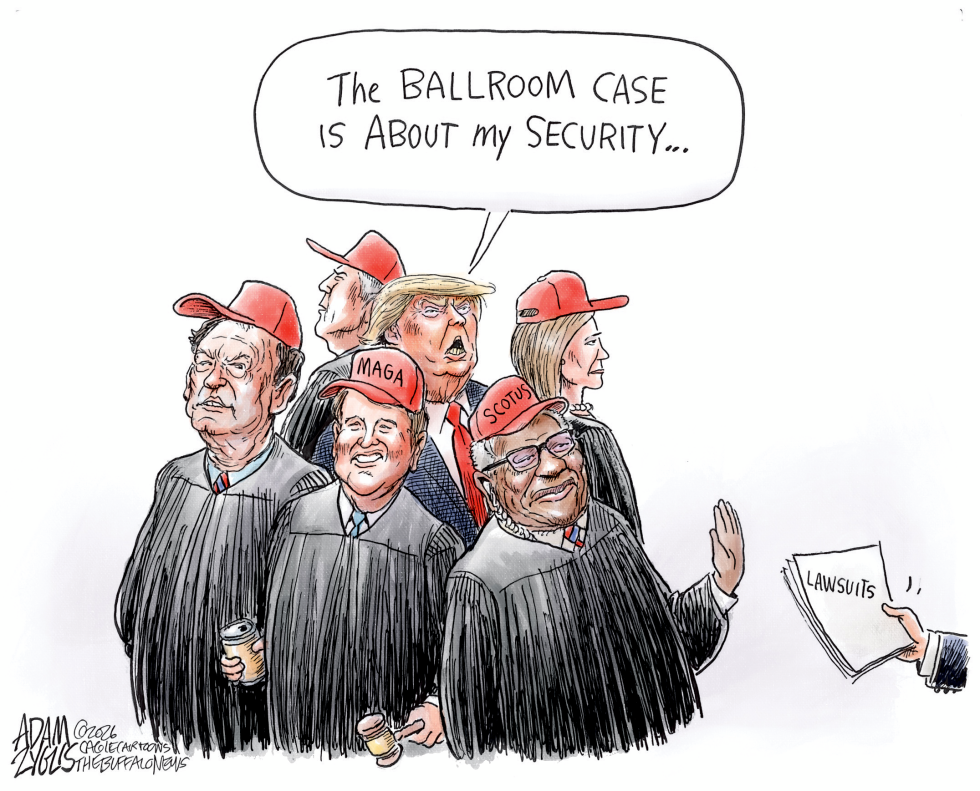
A political cartoon published September 2, 2026, shows Supreme Court justices in judicial robes and red MAGA caps gathered around Donald Trump. One justice declares in a speech bubble that the ballroom case is about my security. A hand extends papers labeled lawsuits from the side. The image comments on recent litigation involving Trump and claims of judicial security concerns tied to the case.
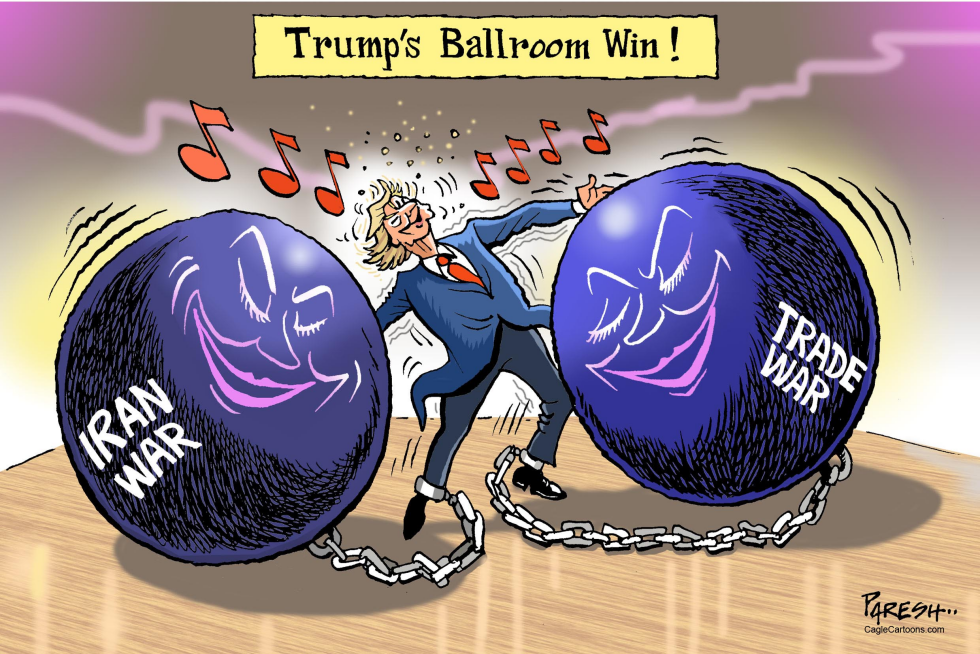
A political cartoon published September 1, 2026, portrays Donald Trump dancing energetically in a ballroom while his ankles are chained to two large balls labeled Iran War and Trade War. The image suggests the president is weighed down by simultaneous foreign policy and economic conflicts. Music notes and a banner reading Trump's Ballroom Win add ironic flair to the scene. The cartoon responds to ongoing tensions involving U.S. relations with Iran and persistent trade disputes. It visually argues that these issues continue to constrain administration actions despite any claimed victories.
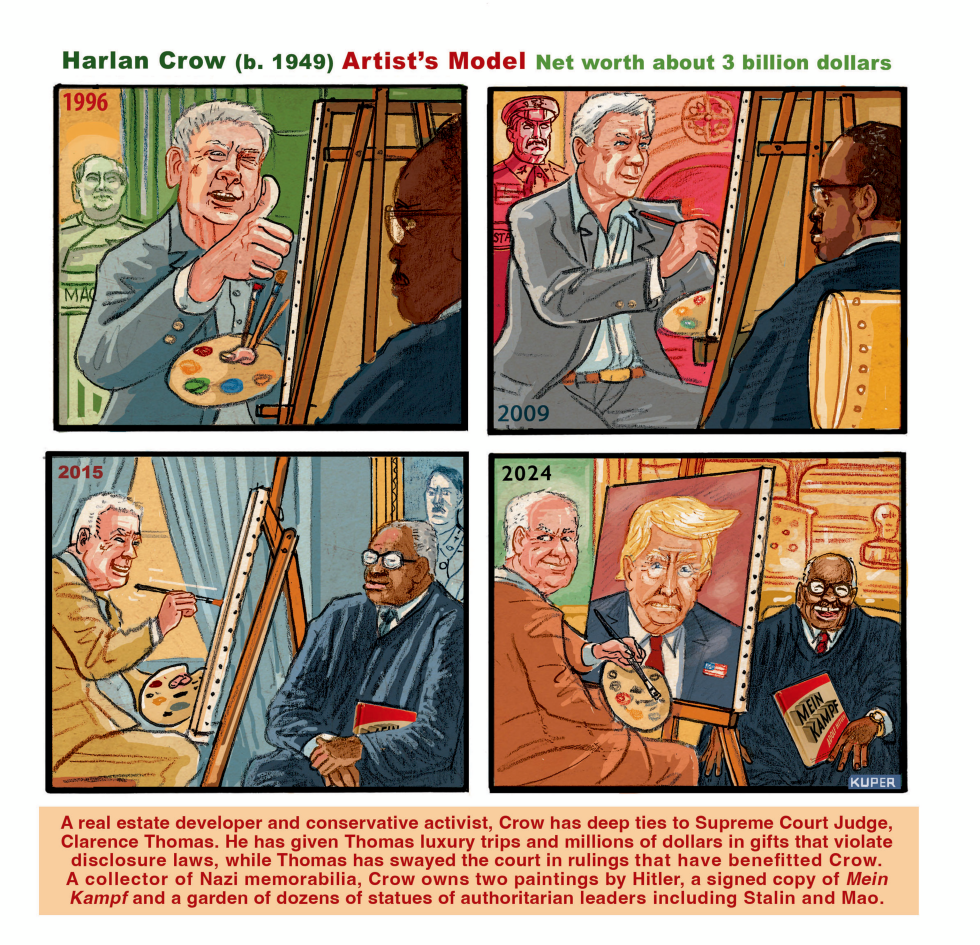
Real estate developer Harlan Crow has provided Supreme Court Justice Clarence Thomas with luxury trips and millions in undisclosed gifts that violate ethics rules. Thomas has participated in rulings benefiting Crow. Crow also collects Nazi memorabilia including Hitler paintings and a signed copy of Mein Kampf. The cartoon extends the pattern to a 2024 portrait of Donald Trump. It criticizes the intersection of wealthy donor influence and judicial decisions.
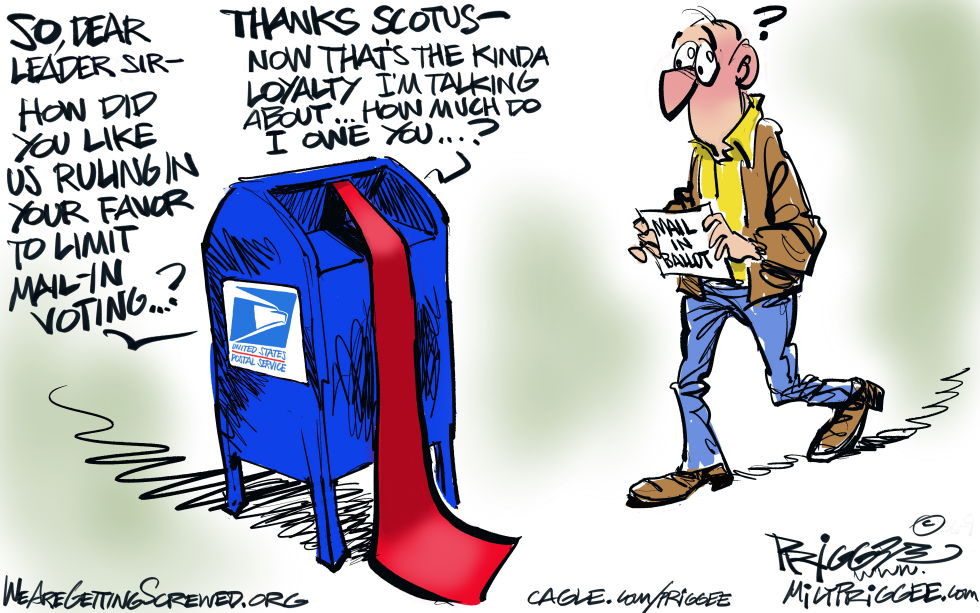
The cartoon shows a voter holding a mail-in ballot and questioning a USPS mailbox about a Supreme Court ruling that limited mail-in voting in favor of a political leader. The mailbox responds with thanks for the loyalty and an offer to pay. The image highlights concerns over judicial influence on elections and voter access as of the 2026 publication date.
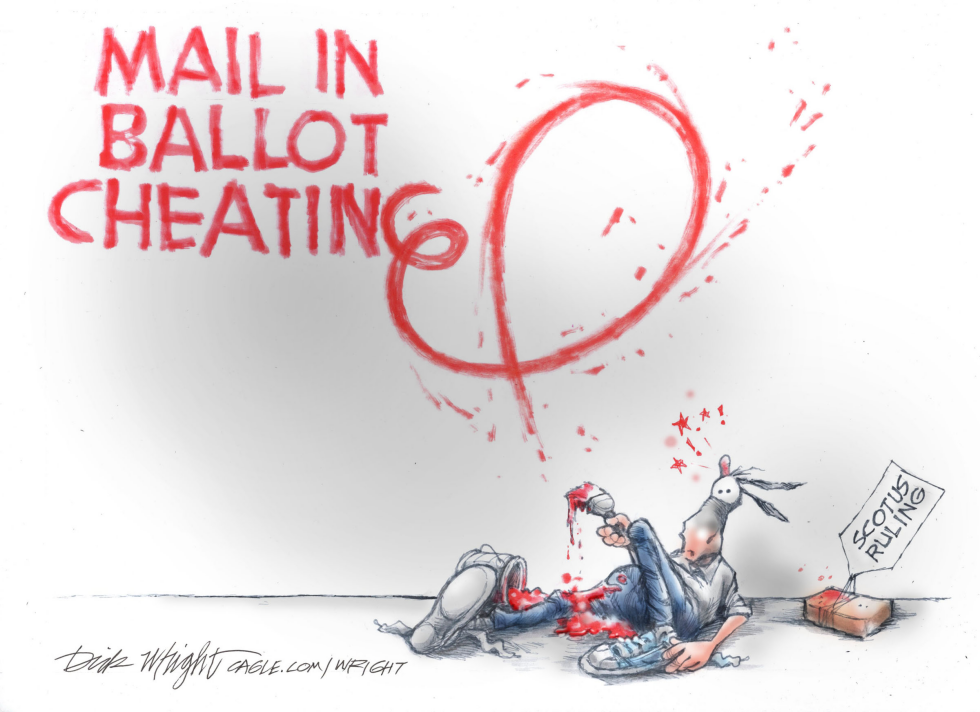
The image depicts the Democratic Party symbol as a donkey lying wounded on the ground with red liquid visible near its body. A large red prohibition symbol covers the words mail in ballot cheating at the top. A sign reading SCOTUS ruling stands nearby next to a box. The composition responds to a Supreme Court decision limiting certain mail-in ballot procedures. The visual argument centers on claims of reduced opportunities for improper voting practices. Publication occurred on August 25 2026. The work uses the party emblem to illustrate the effect of the ruling on one political side. No specific prior case details appear in the image itself.
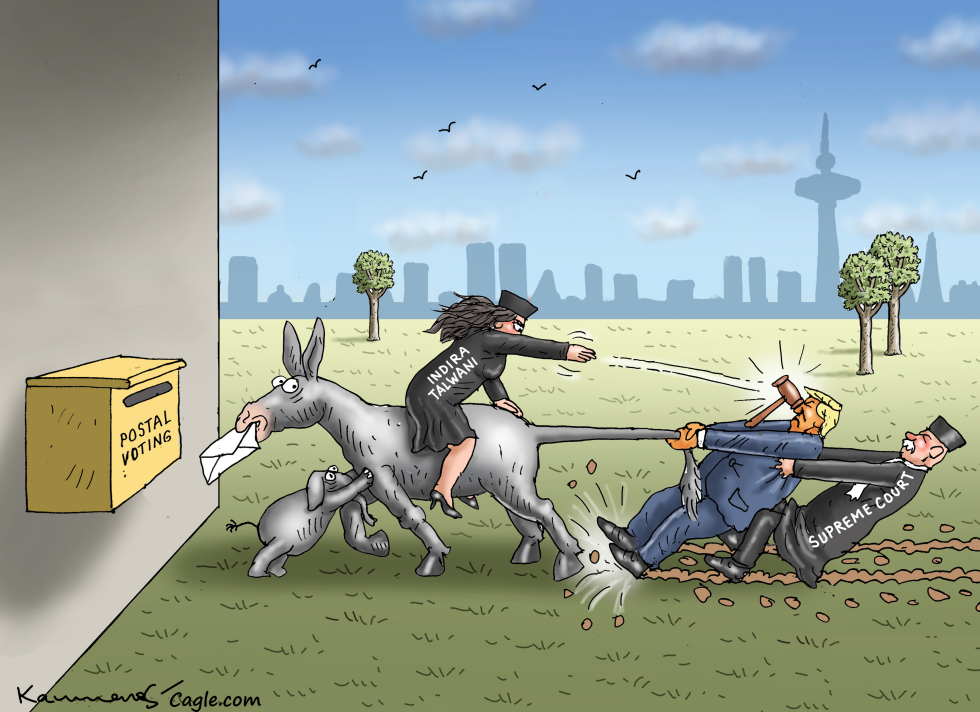
A political cartoon shows federal Judge Indira Talwani riding a Democratic donkey labeled with postal voting while dragging two Supreme Court justices across a field near the Space Needle. The image responds to ongoing disputes over postal voting rules and federal court involvement in election procedures. Talwani, a U.S. District Judge, has issued rulings affecting voting access in recent cases. The cartoon uses the donkey as a party symbol and a yellow ballot box to illustrate the conflict between lower court decisions and the Supreme Court. The visual argument centers on judicial power in election law matters active in 2026.
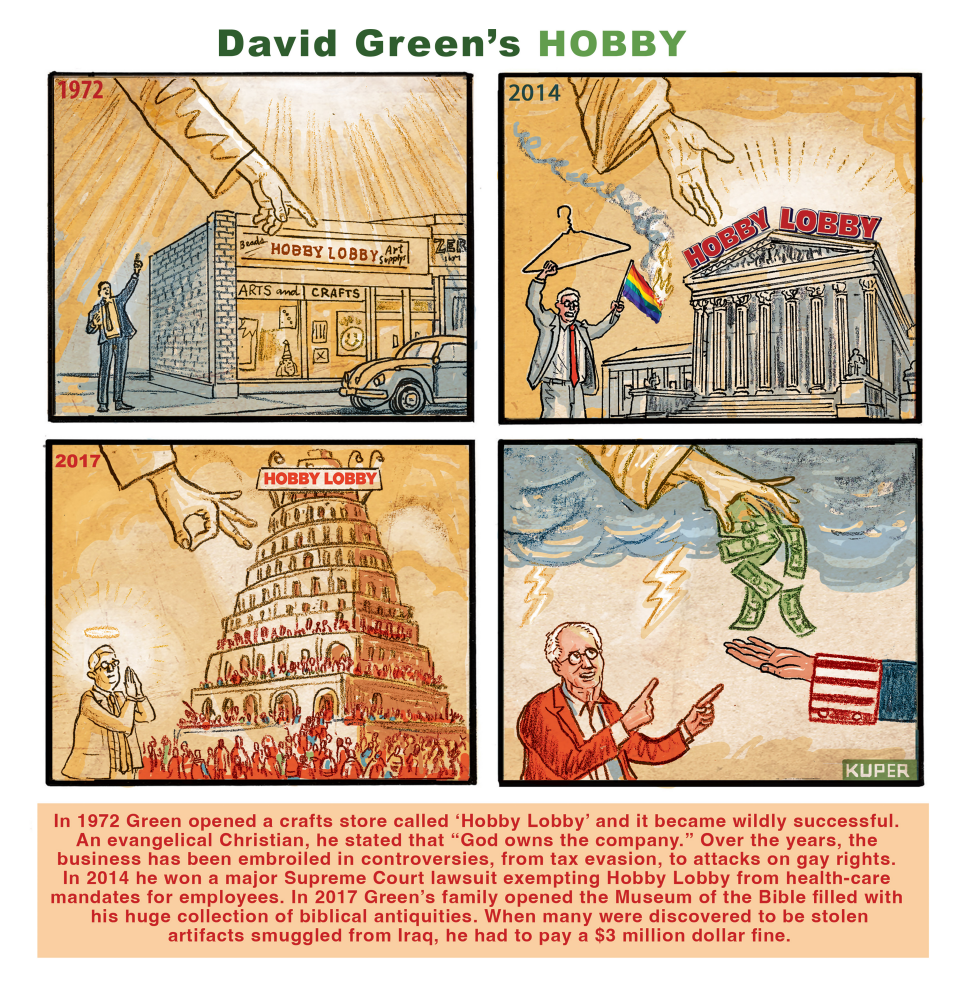
David Green opened Hobby Lobby in 1972 and built it into a major chain while declaring God owns the company. The business faced repeated controversies including a 2014 Supreme Court case on health care mandates and a 2017 Bible Museum scandal involving smuggled Iraqi artifacts that resulted in a $3 million fine. The piece presents these events as a pattern of legal and ethical issues tied to the company's evangelical leadership.
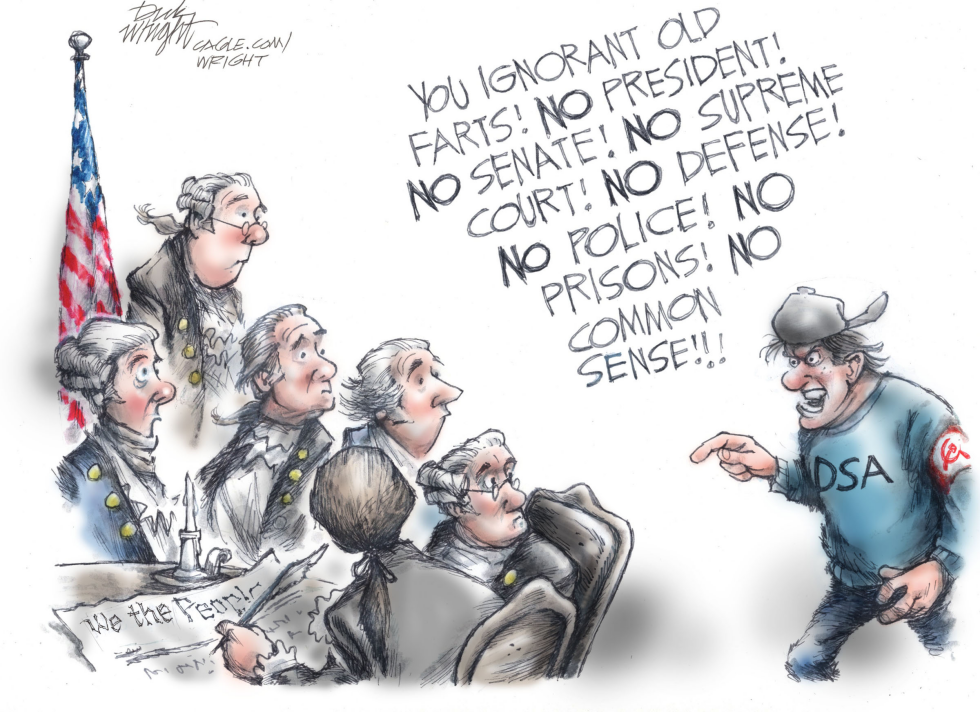
A DSA activist publicly rejects the presidency, Senate, Supreme Court, defense forces, police and prisons while addressing figures associated with the Constitution's creation. The exchange highlights ongoing tensions between socialist activists and defenders of established American governmental structures. The position frames these institutions as unnecessary and lacking basic logic.
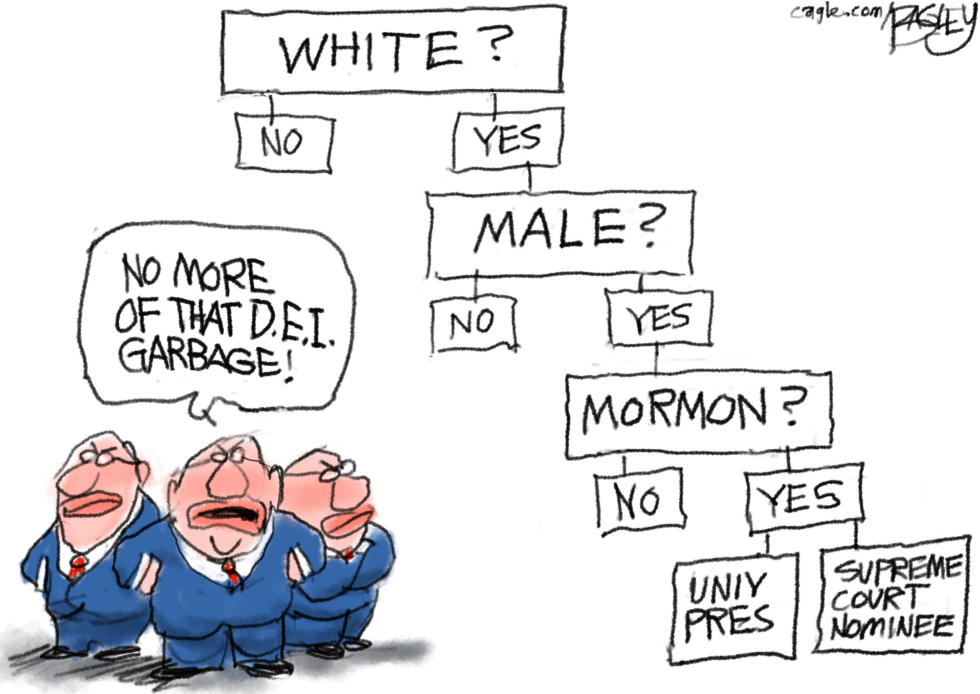
A flowchart circulating in political circles outlines a narrow path to Supreme Court nomination that begins with questions about race, gender and religion. The diagram routes only white male Mormons to the top position while directing others toward university presidencies. Three figures in the image voice opposition to diversity initiatives. The piece responds to ongoing debates over judicial selection standards and identity considerations in appointments. It takes the position that such rigid criteria undermine broader merit-based processes.