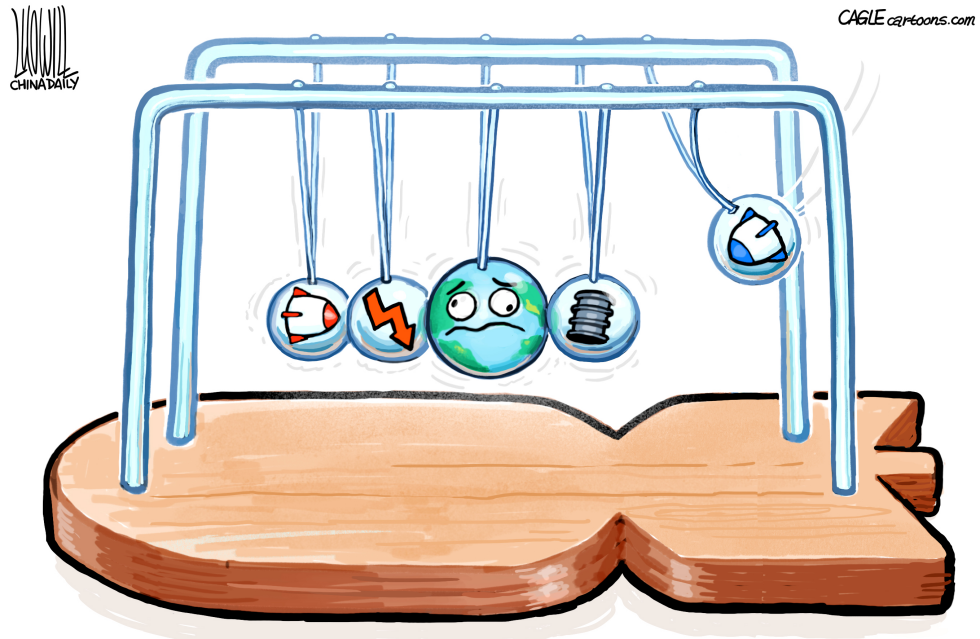
A Newton's cradle setup features spheres marked with a missile, lightning bolt, sad-faced Earth, stacked bombs, and a helmeted orb. The device rests on a wooden base resembling a map fragment. The image highlights ongoing global tensions tied to military actions and energy resources as of mid-2026.
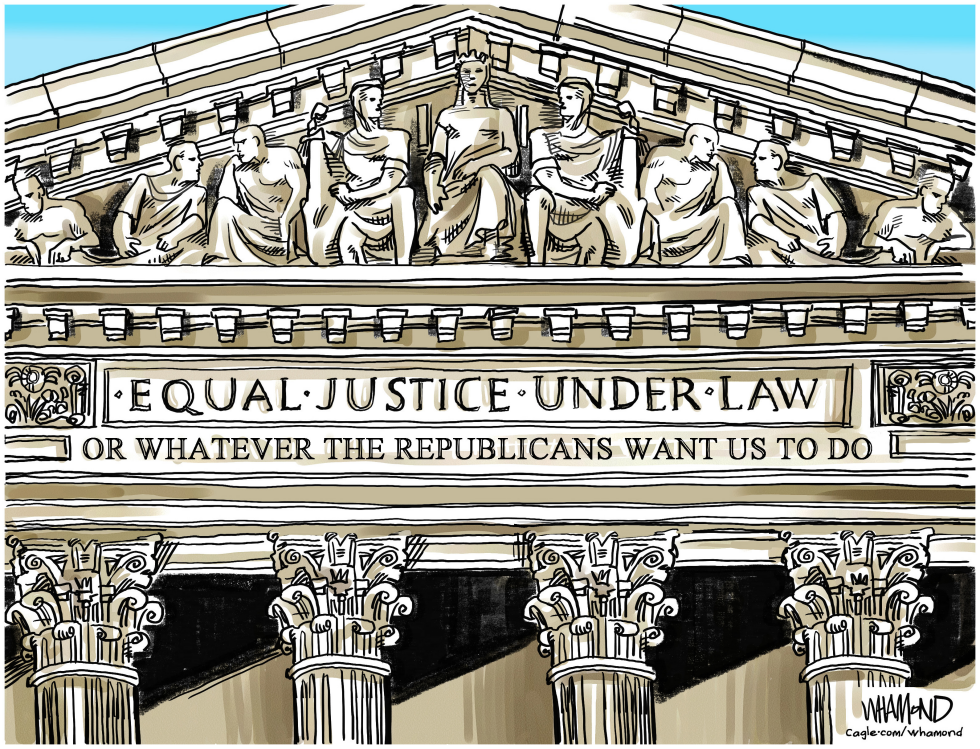
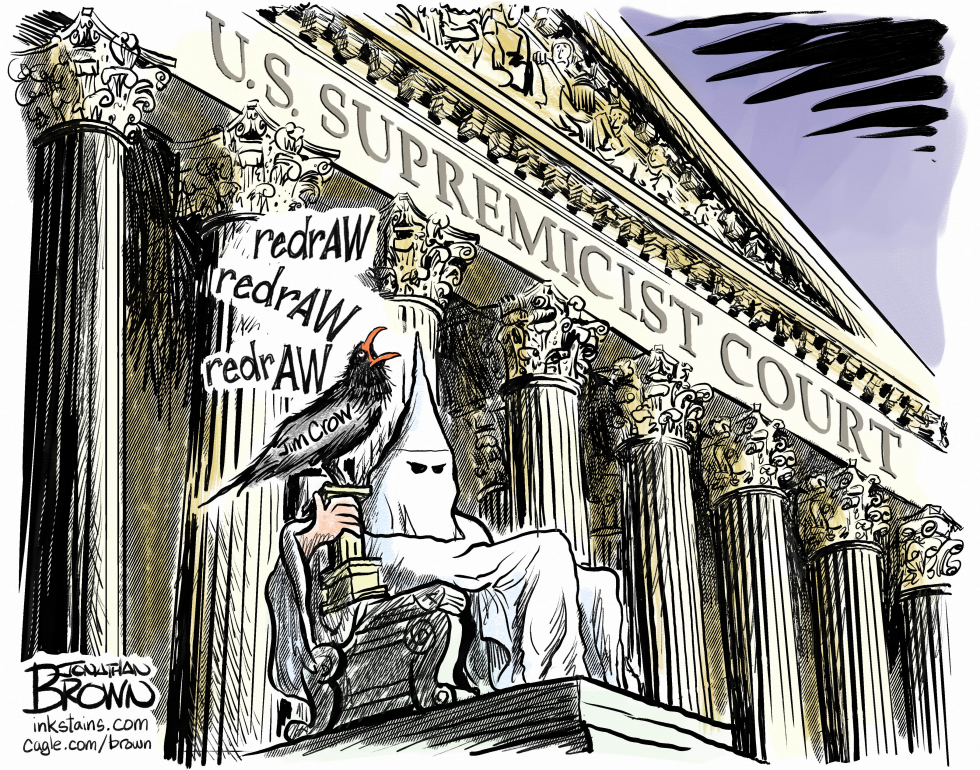
The cartoon depicts the U.S. Supreme Court building with its famous frieze inscription altered from Equal Justice Under Law to Or Whatever the Republicans Want Us to Do. This visual responds to recent rulings including the Alabama voting map decision that permitted GOP-drawn districts accused of diluting Black voter power. The image critiques the court's use of the shadow docket and perceived ideological alignment with Republican priorities on voting rights and gerrymandering.
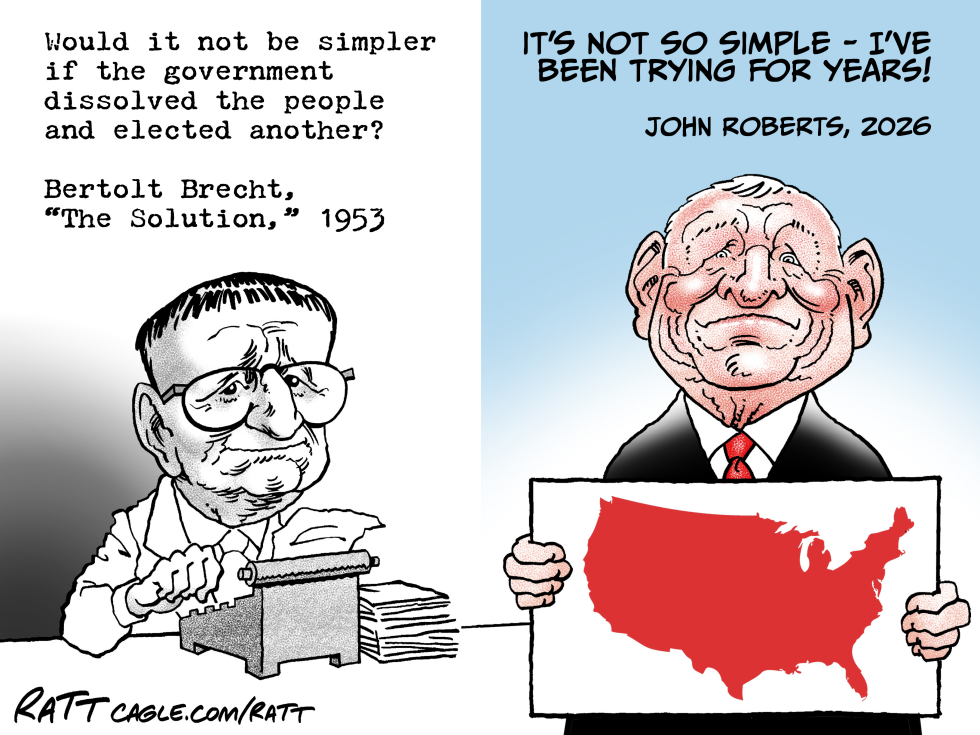
The May 2026 cartoon pairs a 1953 Bertolt Brecht quote with Chief Justice John Roberts holding a solid red United States map. It references ongoing disputes over the Voting Rights Act, gerrymandering, and the Louisiana v. Callais case ahead of the midterms.
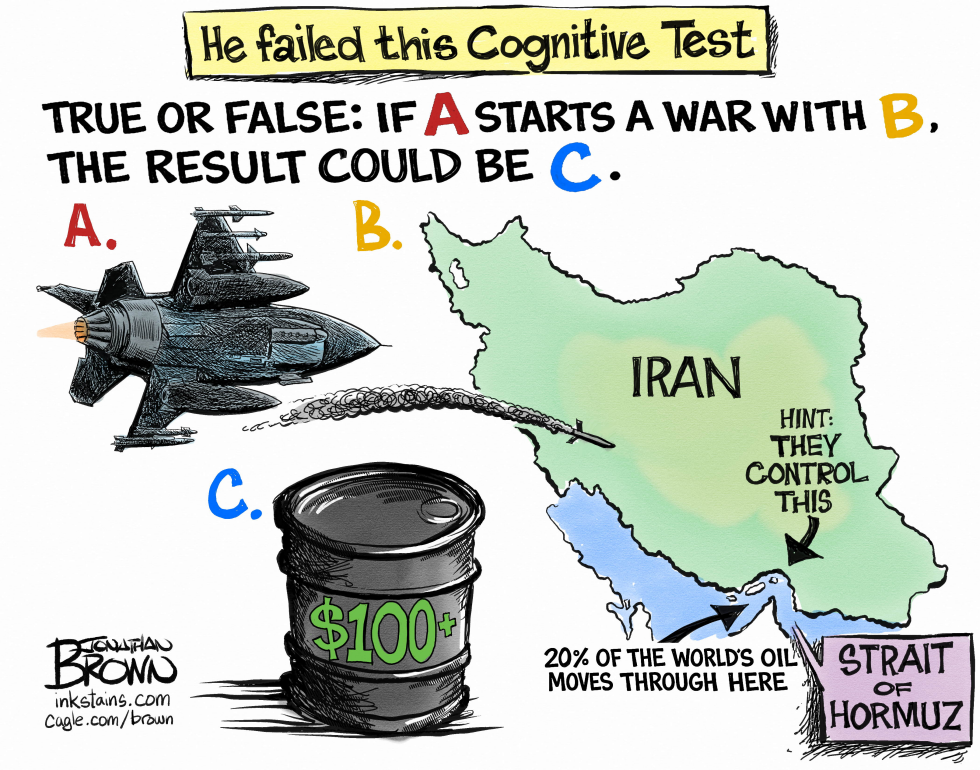
Jonathan Brown's cartoon presents a stark true-or-false cognitive test: if A (a fighter jet) starts a war with B (Iran), the result could be C (an oil barrel marked $100+). The map of Iran includes a hint pointing to the Strait of Hormuz, noting that 20% of the world's oil moves through there, underscoring control over this chokepoint. Tags such as cognitive test, war in Iran, oil prices, Strait of Hormuz, gas prices, and cost of war frame the satire. The artwork warns of economic fallout from conflict, with the jet trailing toward Iran and the oil barrel symbolizing surging costs. This piece captures geopolitical tensions in a simple, visual riddle.
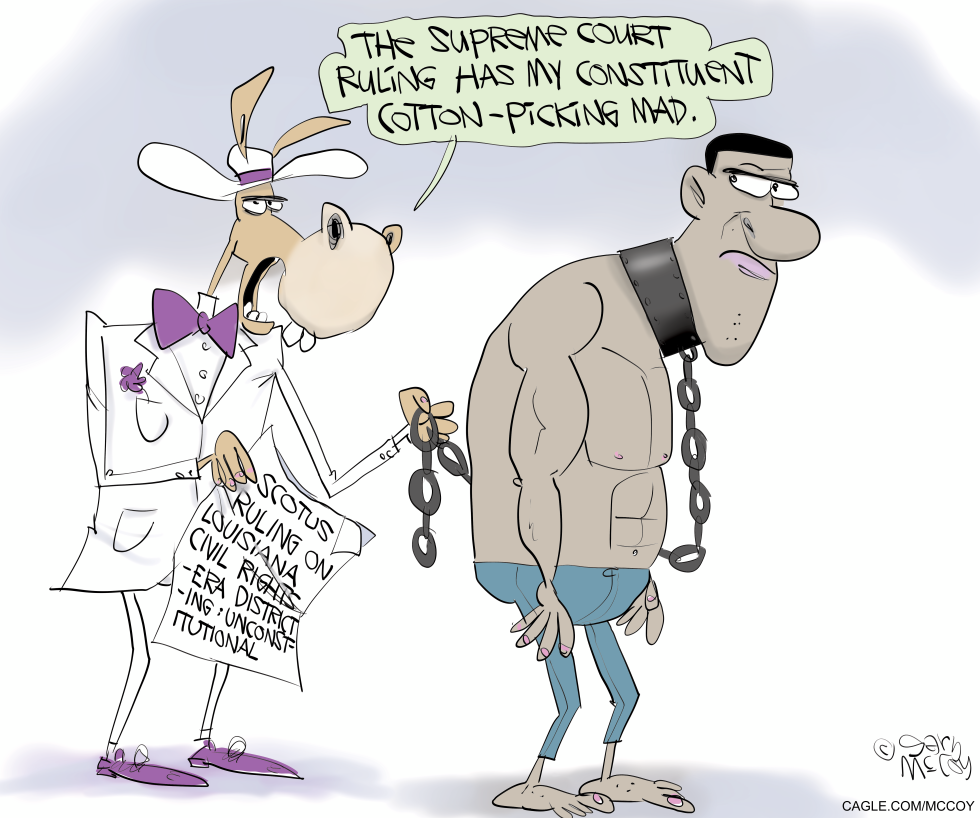
The Supreme Court ruled on Louisiana's congressional map involving civil rights era districts. The image shows a Democrat figure holding a chain attached to a second figure who comments on the decision affecting constituents.
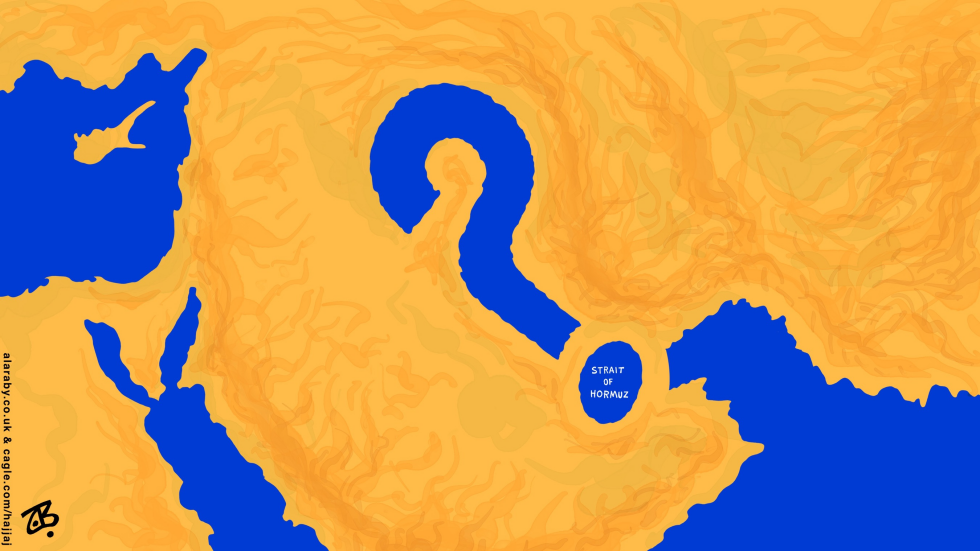
Monte Wolverton\'s cartoon depicts a doctor holding up an xray that reveals an intestine shaped like the Strait of Hormuz, complete with stars indicating blockages and inflammation. Trump peers over the top, his distinctive hair visible, as the doctor diagnoses intermittent blockages, polyps, and suggests consuming more fiber while cutting back on fast food. Tags like Iran War and blockade tie into the visual pun, turning a geopolitical chokepoint into a medical ailment. The piece uses dry humor to highlight discomfort in a straightforward way, with the xray\'s pinkish intestine contrasting against the black background. Artistic elements include the doctor\'s pointing finger and Trump\'s curious pose, emphasizing the satire without overcomplicating the scene.
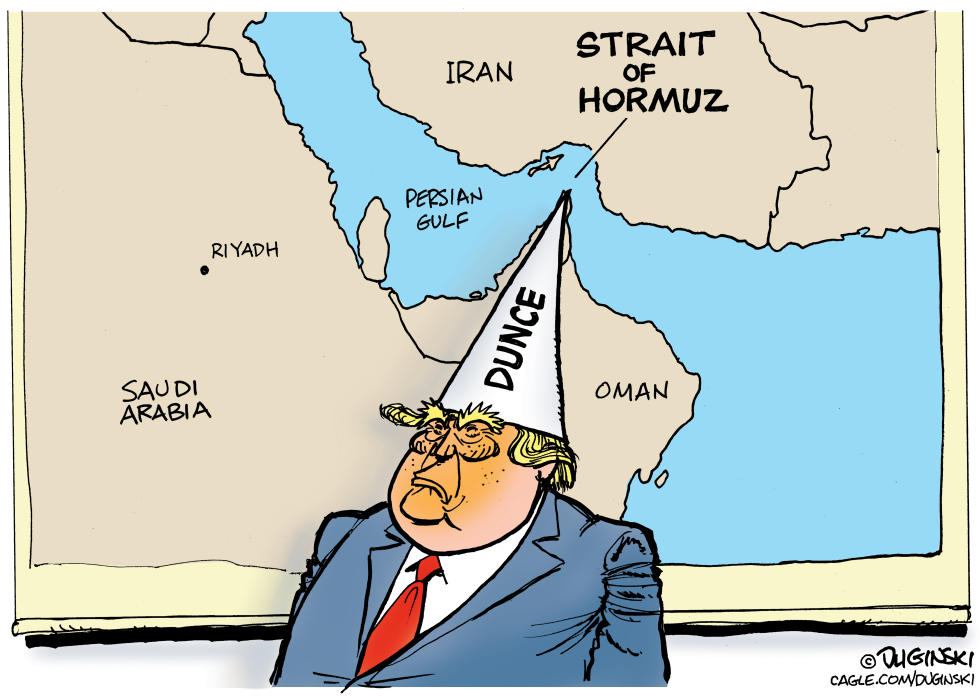
The cartoon depicts a simplified map of the Middle East, including labels for Iran, Saudi Arabia, Oman, Riyadh, and the Persian Gulf. The Strait of Hormuz is prominently marked, with a caricatured man in a suit and red tie wearing a dunce cap labeled \'DUNCE\' positioned over it. This setup uses the strait as a choke point for oil and energy, tying into themes of foreign policy, war, and ignorance. The image critiques handling of Middle East waterway issues, possibly linked to closure threats, tankers, and ceasefire efforts. Artist signature appears in the bottom right.
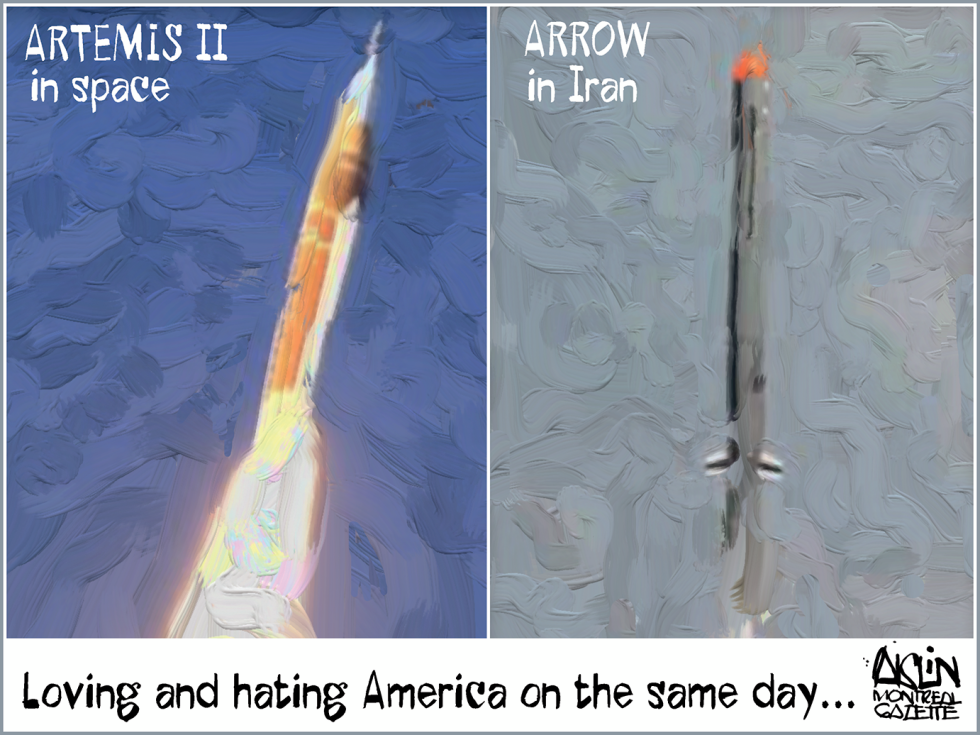
In this irreverent political cartoon, a vibrant Artemis II space launch rockets upward in a blue expanse on the left, symbolizing American innovation and triumph in US space exploration. Contrasting sharply on the right, a stark Arrow in Iran points downward with an orange glow against a gray sky, evoking geopolitical tension and Iranian weaponry. The caption 'Loving and hating America on the same day....' ties it together, offering a humorous take on the bipolar view of America in world news. With its simple yet effective composition, the artwork captures the absurdity of global perceptions, blending satire on international conflict with admiration for NASA's feats. This piece underscores the dichotomy in how the world engages with American power, from awe at space missions to ire over foreign policy frictions.