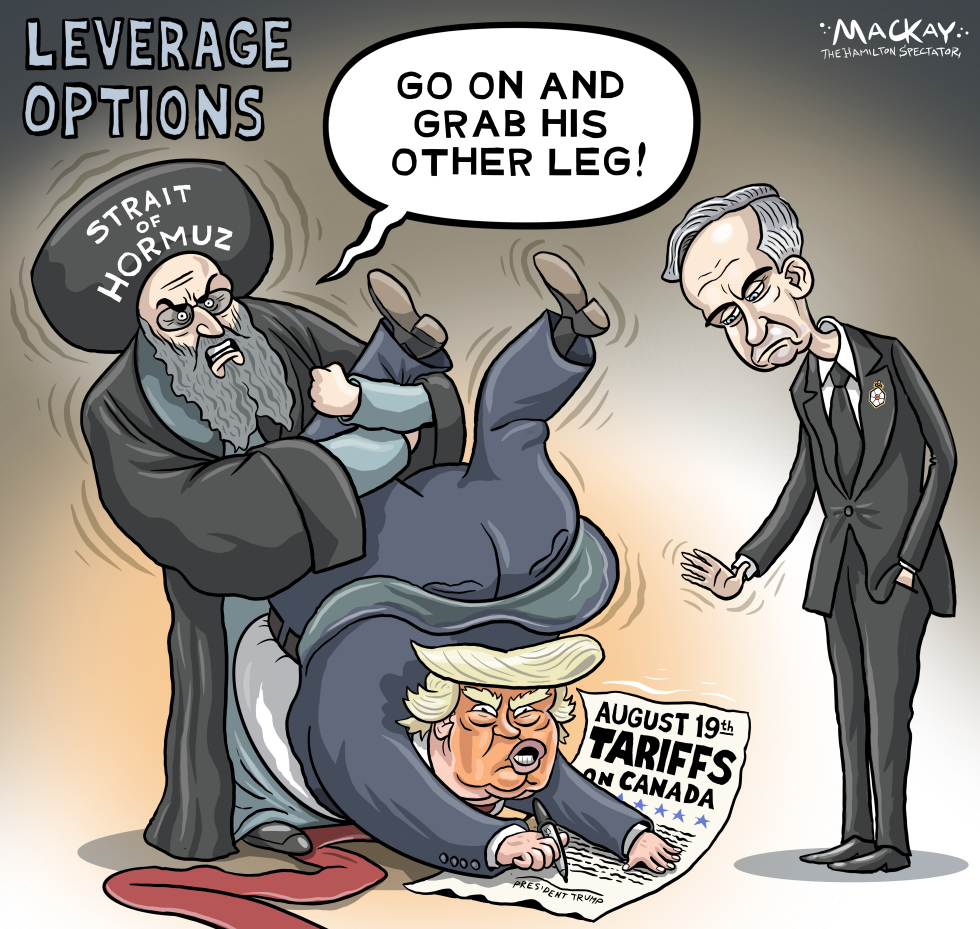
On August 12 2026 President Trump prepares to impose tariffs on Canada amid tensions involving the Strait of Hormuz. The move draws immediate pushback from Iran-linked actors seeking leverage. The piece argues that tariff policy invites risky entanglements that weaken U.S. position.
Taylor Jones draws a sharp contrast in this cartoon, with a pope-like figure in white robes and glasses, hands clasped, delivering the Sermon on the Mount line from Matthew 5:9 about blessed peacemakers being children of God. Beside him stands a blonde-haired man in a suit, halo above, mouth open in response, twisting John 3:16 to claim the Strait of Hormuz as a divine gift, or soon to be, labeled Don 3:16. The piece nods to Catholic Church teachings against a backdrop of Persian Gulf tensions, war in Iran, and oil exports disruptions. It's a dry poke at how leaders bend scripture for geopolitical gains, like controlling the Strait of Hormuz to spike crude prices. Vatican serenity meets brash claims, all in watercolor style on purple background.
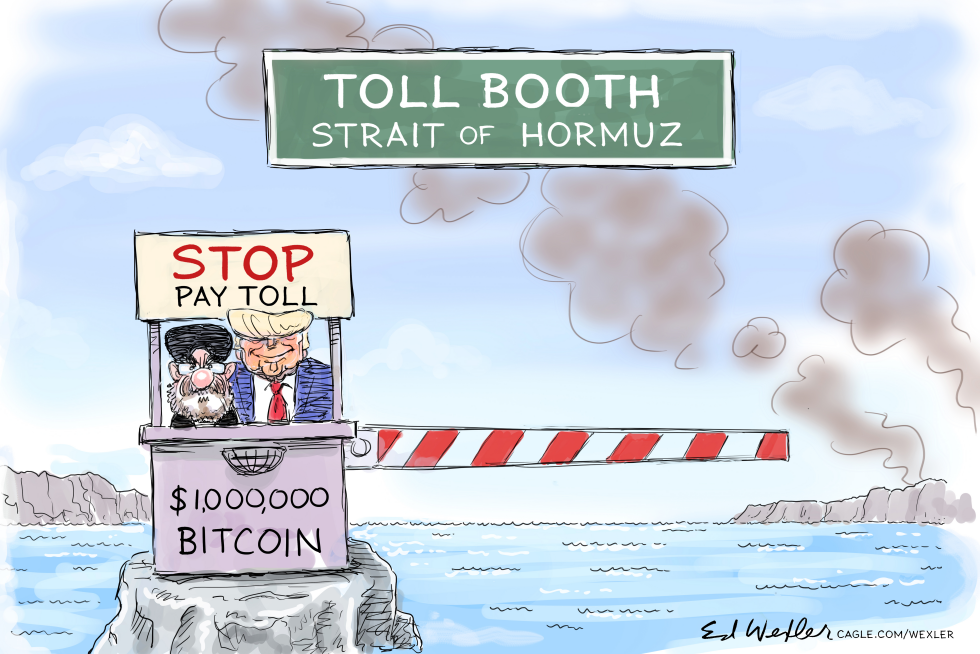
Ed Wexler\\\'s cartoon captures a toll booth in the Strait of Hormuz, where figures resembling Trump and the Ayatollah enforce a $1,000,000 Bitcoin toll. Smoke rises from what look like mines in the water, blending tags like Iran, Strait of Hormuz, tolls, Bitcoin, Trump, Ayatollah, and crypto into a sharp commentary. The barrier arm blocks passage, emphasizing control over this vital shipping lane. It\\\'s a straightforward jab at geopolitical tensions, with the toll sign demanding payment to proceed. No hidden layers here, just clear visuals tying economic pressures to digital currency in a contested area. The dry humor shines through in the absurdity of a Bitcoin booth amid potential explosions.
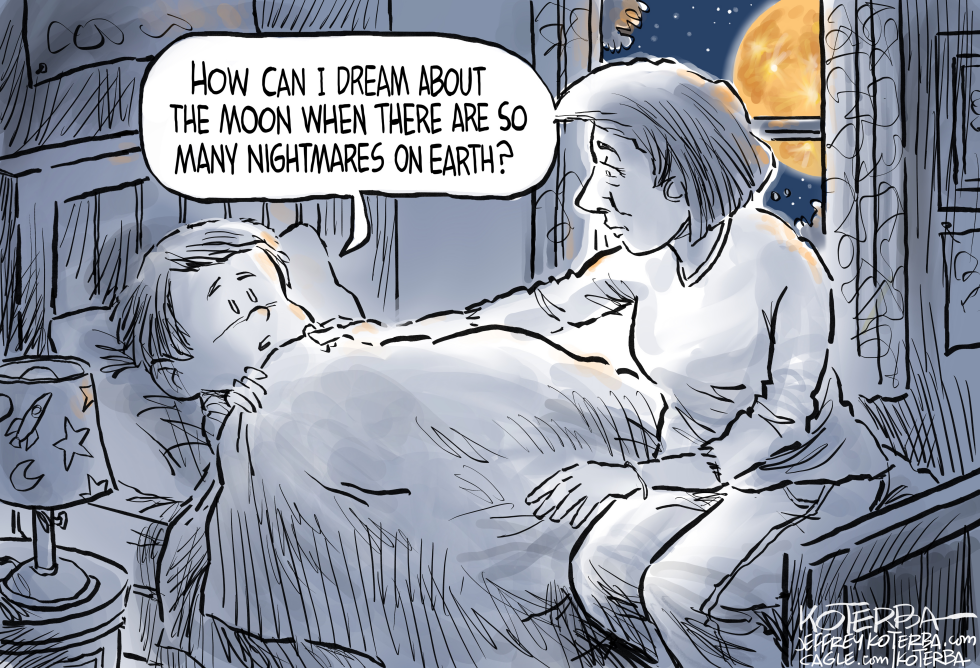
This poignant political cartoon depicts a child in bed, gazing toward a window framing a massive orange moon against a starry night sky, while confiding in a seated adult figure. The child's speech bubble reads: 'How Can I Dream About The Moon When There Are So Many Nightmares On Earth?' A bedside lamp with a star design illuminates the scene. Through this setup, the artwork satirizes how youth anxiety from global issues—like wars, climate woes, and social upheavals—stifles big dreams and aspirations. It's a clever commentary on how earthly nightmares eclipse celestial hopes, blending humor with insight into modern parenthood and childhood innocence lost. Tags: political cartoon, child nightmares, moon dreams, earth troubles, satirical illustration, youth anxiety, global chaos.
This satirical political cartoon depicts a bizarre lunar scene where a green alien is climbing a gushing oil derrick, tethered by rope to a spacesuit-wearing figure holding a 'TACO' sign. The backdrop includes a cratered moon surface, a starry sky, and a blue planet, with the white rocket labeled 'ARTEMIS 2 MAGA OIL MOON' emitting green smoke. A ladder leans against the rocket's open door, and a black barrel sits nearby. The imagery humorously critiques ambitious lunar exploits, blending space exploration with oil drilling fantasies in a visually striking composition that highlights the absurdity of extraterrestrial resource grabs.
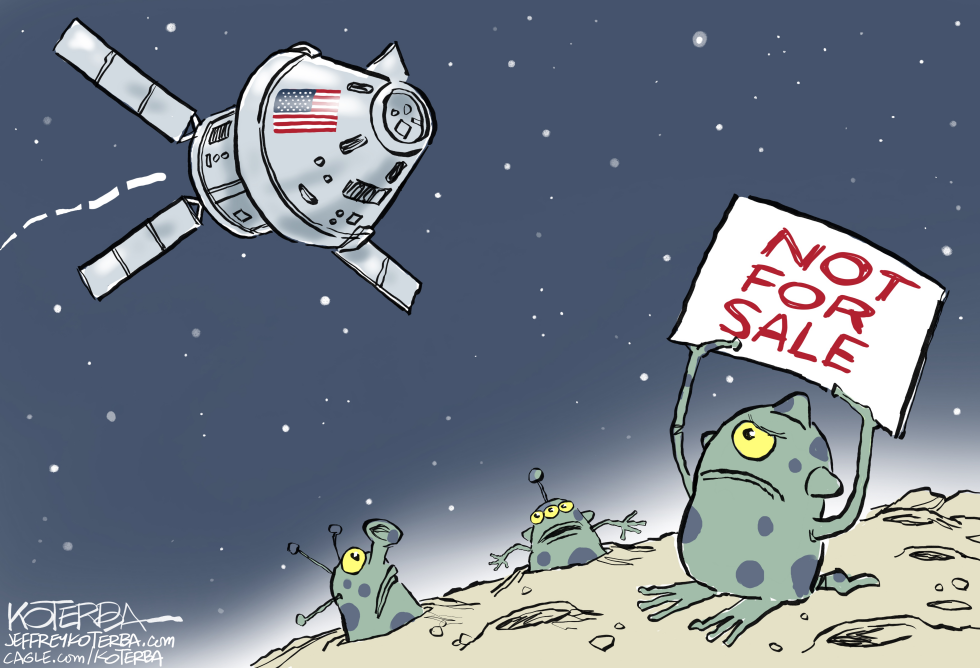
This political cartoon depicts green aliens on a sandy, moon-like surface, with one holding a \'NOT FOR SALE\' sign in red letters, facing a flying spacecraft adorned with an American flag and solar panels. The starry night sky background enhances the space exploration satire, while the trail behind the ship suggests approach. Incorporating elements like cartoon monsters, property rights protest, and US imperialism humor, the image offers an irreverent take on cosmic real estate. The artist\'s signature in the bottom left adds authenticity to this insightful editorial illustration, poking fun at human ambitions in outer space.
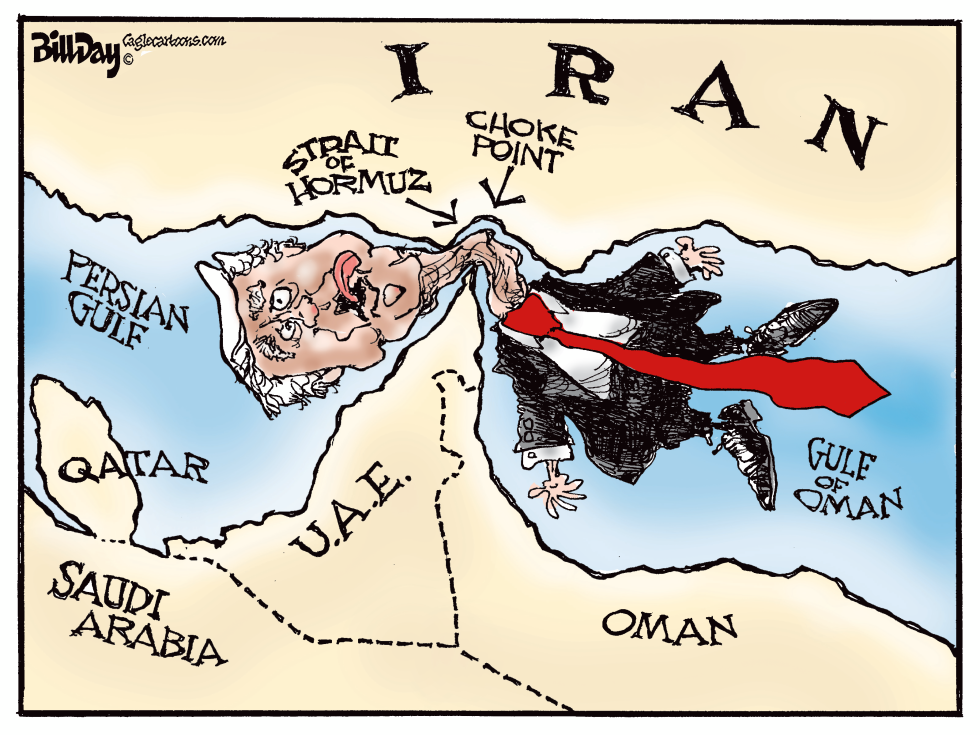
Dive into this Bill Day creation where the map of Iran morphs into a menacing hand at the Strait of Hormuz choke point, gripping a flailing figure in a suit and red tie, symbolizing tension in the Persian Gulf. Surrounding nations like Saudi Arabia, UAE, Qatar, Oman, and the Gulf of Oman frame the scene, highlighting the strategic choke point. This political cartoon Iran Strait of Hormuz captures the essence of Middle East satire, with Iran's form literally choking the strait, a nod to real-world frictions without delving into unshown depths. The irreverent style pokes fun at power plays, making the geopolitical humor both insightful and shareable in editorial circles.
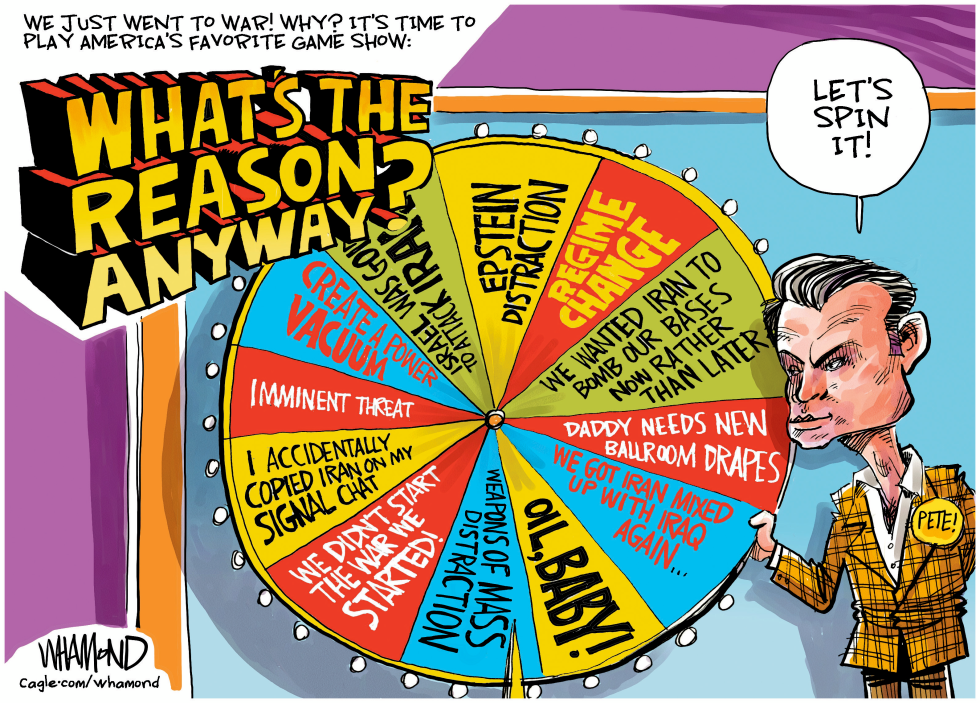
Dive into this biting political cartoon where America's war decisions are reduced to a game show parody wheel, featuring options like 'Imminent Threat,' 'Oil, Baby!,' and 'Regime Change.' The irreverent satire targets US foreign policy, highlighting how military interventions often spin on flimsy pretexts, from accidental escalations to resource grabs. With a host eagerly spinning the wheel, the artwork cleverly critiques the absurdity of war justifications, blending humor with insightful commentary on geopolitical cynicism. Tags like political cartoon, war justifications, and military intervention humor underscore its viral potential in today's polarized discourse.
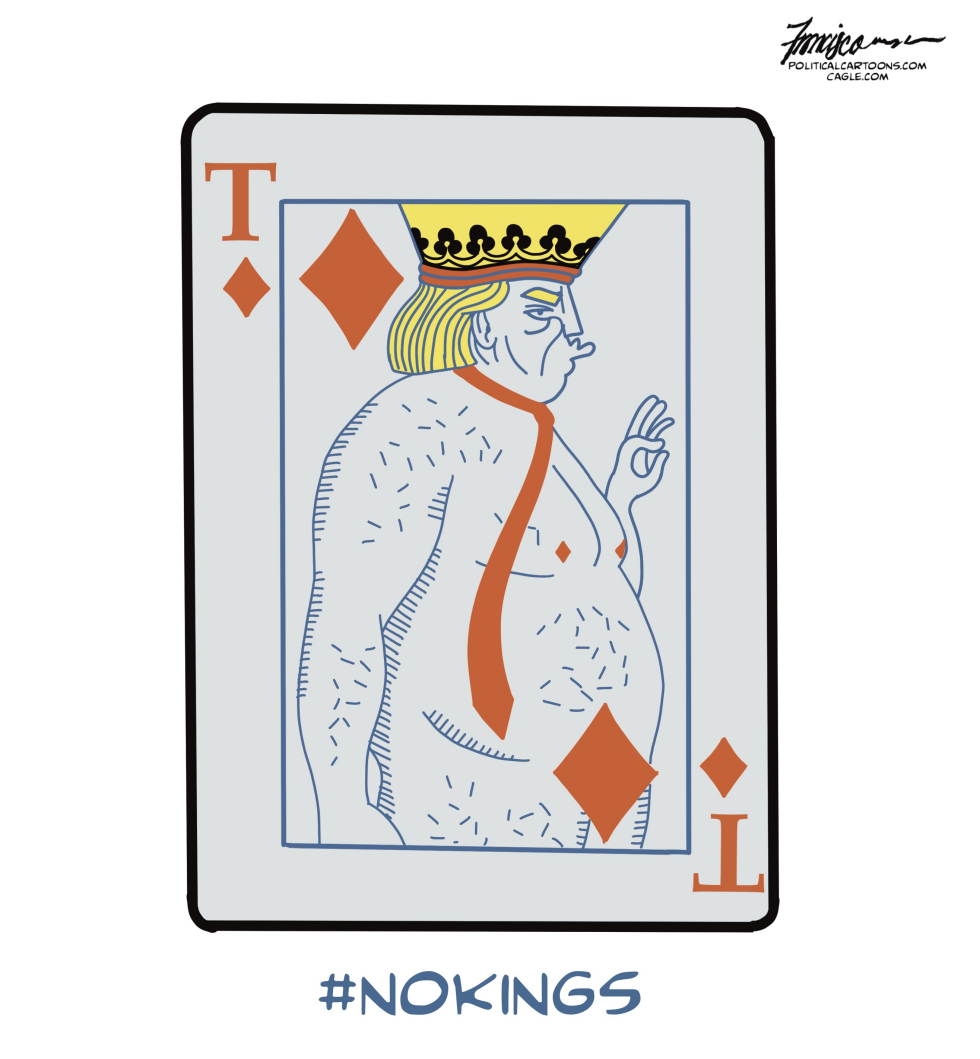
Manny Francisco's cartoon depicts a playing card with 'T' and diamond symbols, featuring a caricature of Trump as a naked, crowned king making an OK gesture, complete with a red tie and body hair details. The bottom label #NoKings ties into themes of rejecting monarchy. Tags such as trump, king, card, crown, nudity, and satire highlight the image's commentary on power. This straightforward illustration uses simple lines and bold colors to deliver its message. Newspapers often run such cartoons for their timely humor, though the nudity might limit some placements. Overall, it captures a dry take on political figures aspiring to unchecked rule.
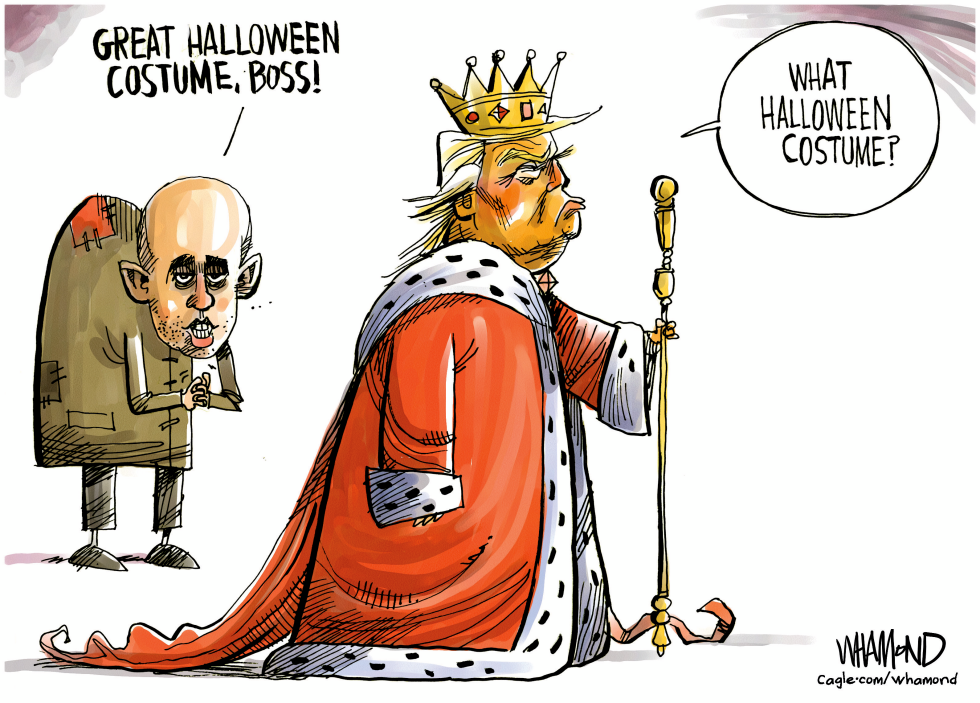
Dave Whamond's cartoon titled 'The Man who would be king' captures a caricatured Donald Trump donned in regal themes, complete with crown and red robe, wielding a scepter. A subservient, bald figure with pointy ears bows and praises the 'Great Halloween Costume, Boss!' while Trump retorts 'What Halloween Costume?' The image tags highlight themes of No Kings, Trump wants kinglike powers, and concerns over constitution and democracy. It satirizes ideas of president transitioning government into a monarchy, with elements of shutdown, taking control, and totalitarian state. The humor lies in Trump playing dress up yet denying it's a costume, symbolizing real aspirations for kinglike authority.
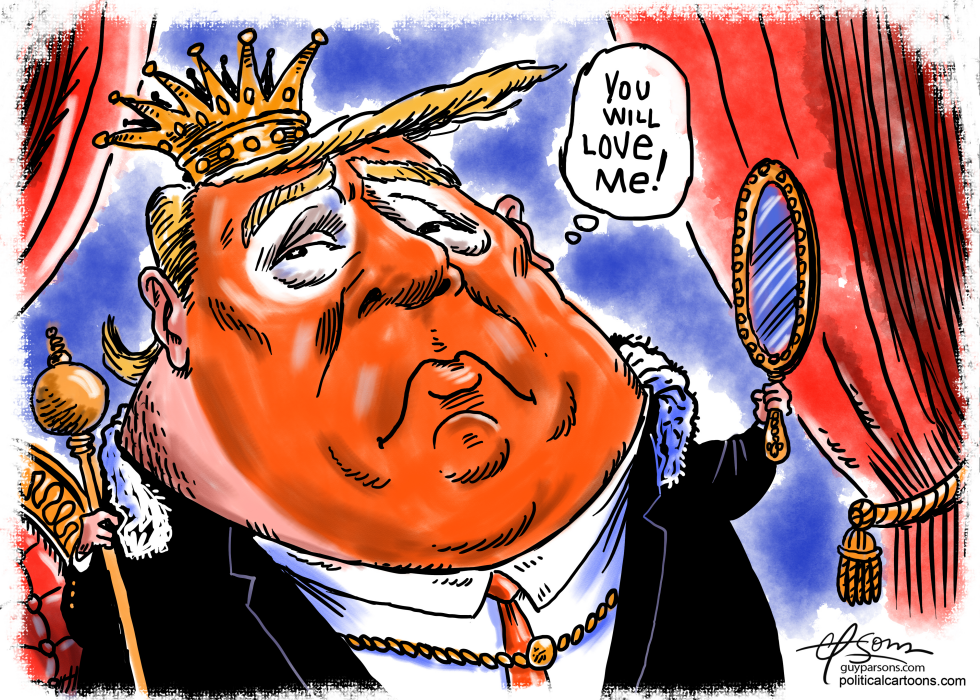
Guy Parsons draws a bloated, orange-faced figure resembling Donald Trump, decked out in a golden crown and royal robe, clutching a scepter in one hand and a hand mirror in the other. The speech bubble proclaims 'You will LOVE ME!' against a backdrop of red curtains, tying into tags like USA, America, Army, 250th anniversary, Trump birthday, and no kings. This setup pokes at delusions of monarchy in a nation founded on rejecting kings, with the mirror emphasizing self-adoration. The cartoon's timing, around Trump's birthday and the upcoming 250th anniversary of American independence, underscores the irony of a leader aspiring to unchecked power. Parsons' style keeps it bold and colorful, making the satire pop without subtlety.