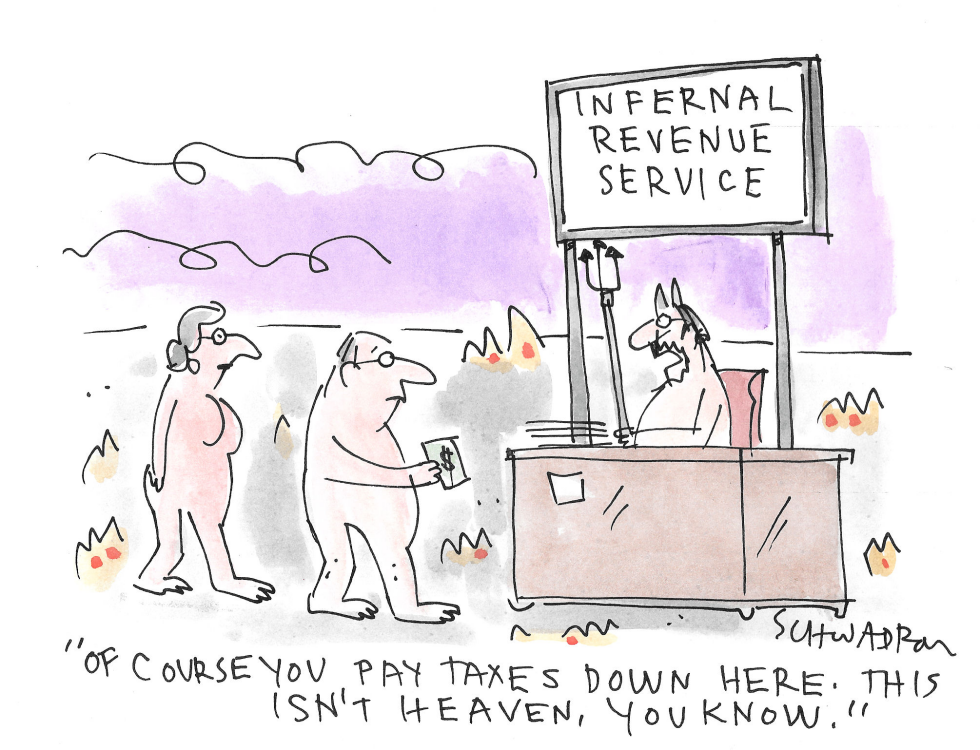
The long-standing adage that only death and taxes are certain receives fresh treatment in a cartoon depicting an IRS outpost operating in hell. No specific policy change or ruling prompted the piece, which instead plays on the enduring public frustration with tax collection as an inescapable force. The editorial stance pokes at bureaucratic persistence, suggesting the tax man follows citizens beyond the grave with the same relentless efficiency seen in life.
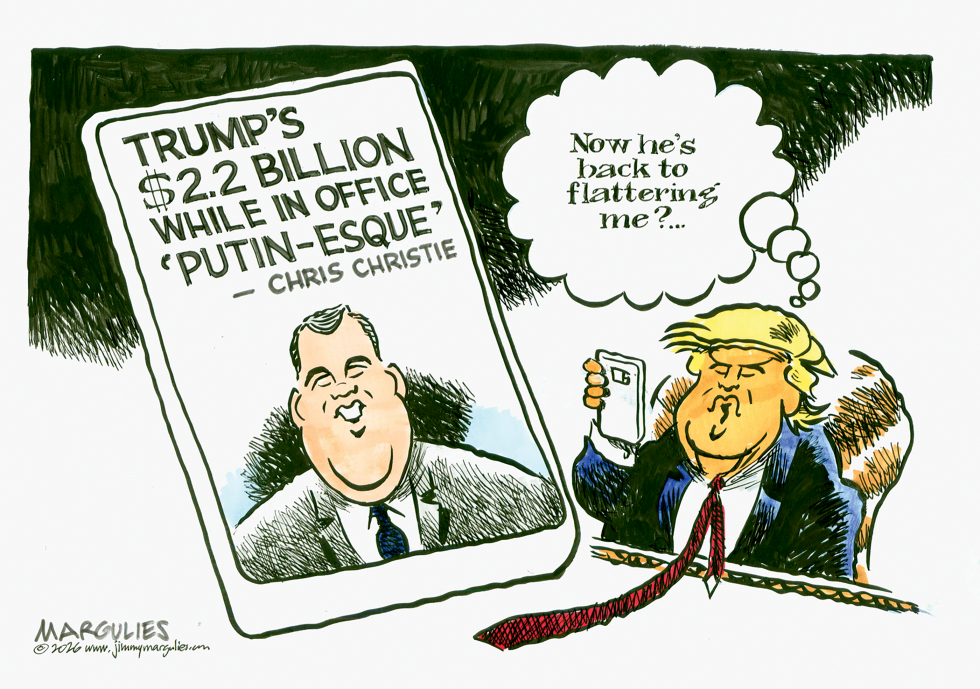
On July 6, 2026, a cartoon depicts Donald Trump examining a phone displaying Chris Christie’s quote labeling his $2.2 billion earnings while in office as Putin-esque. Trump’s thought bubble reveals he interprets the remark as flattery rather than criticism, highlighting an ongoing dynamic between the two figures amid foreign policy references to Russia.
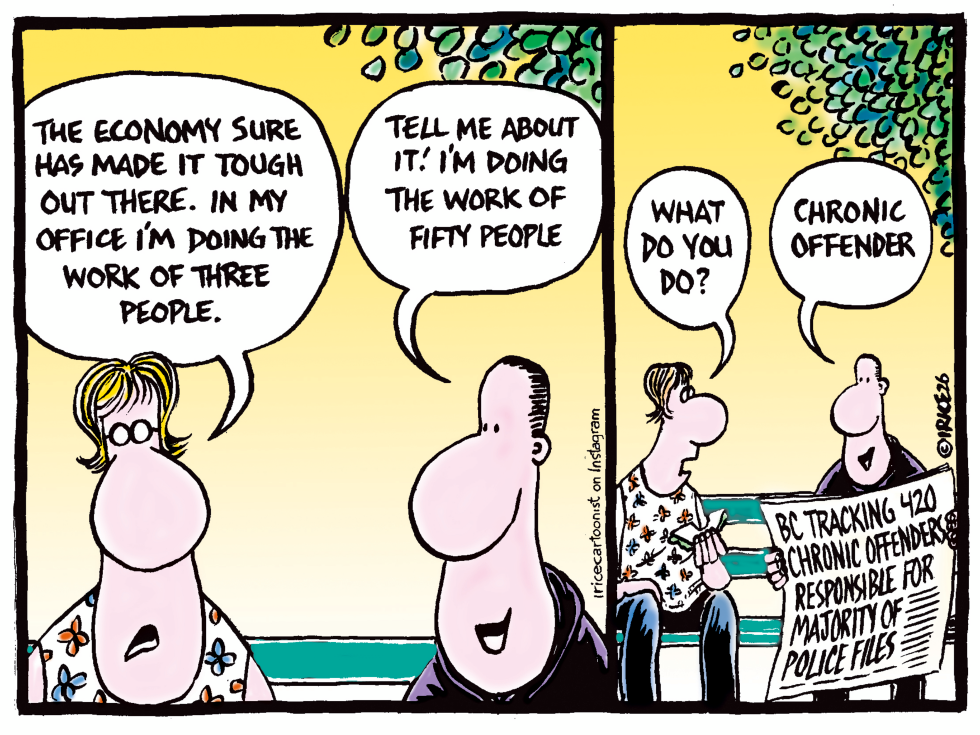
In a two-panel scene dated July 5 2026, office workers discuss heavy workloads caused by economic conditions, with one claiming to handle the work of three people and another fifty. The exchange shifts when a man on a bench identifies himself as a chronic offender, while a nearby newspaper headline reports British Columbia tracking 420 such individuals responsible for the majority of police files.
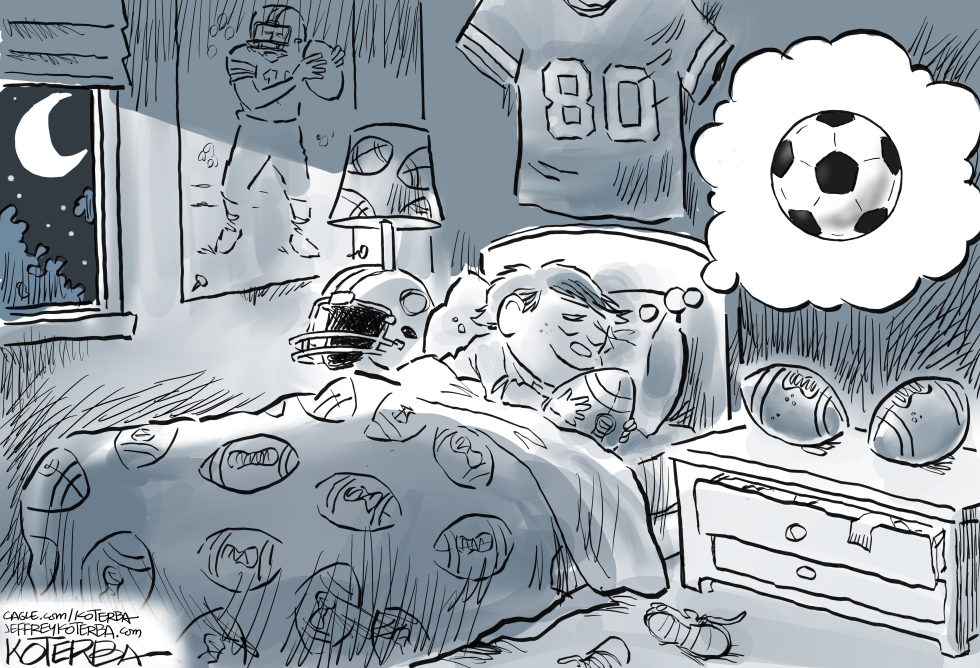
The cartoon depicts a young boy asleep in a bedroom decorated with American football posters, jerseys, helmets, and balls. A large thought bubble above his head contains a soccer ball, indicating his dream. The image, dated June 24, 2026, captures a simple contrast between the boy's surroundings and his subconscious preference without referencing any specific news event or public figure.
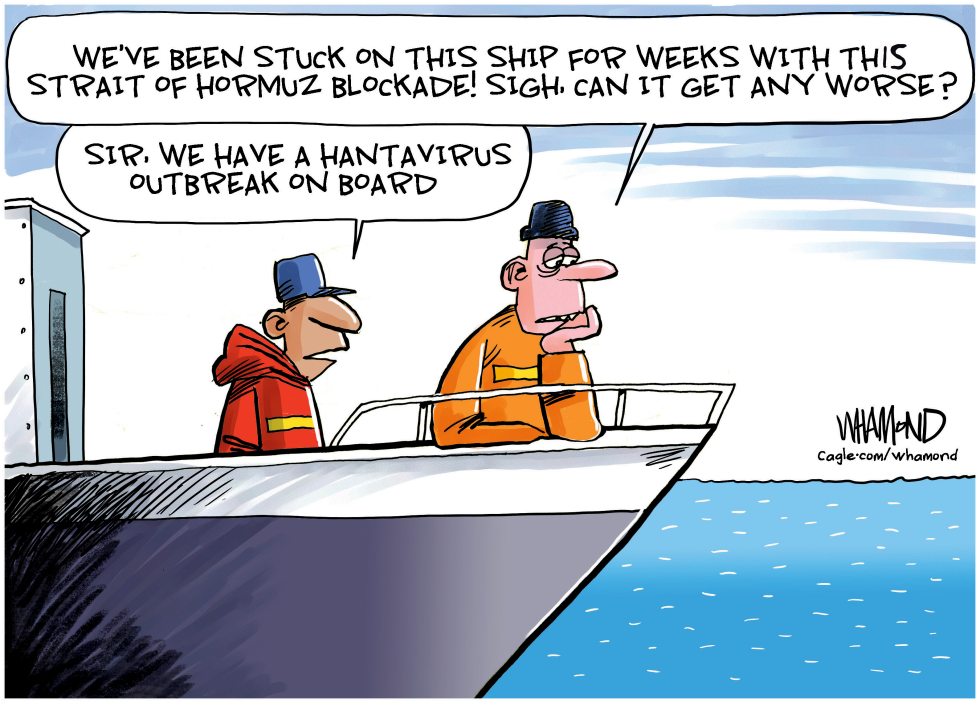
The cartoon depicts two sailors aboard a ship trapped in the Strait of Hormuz due to a naval blockade. One laments the weeks-long delay and wonders if conditions can worsen. The other reports a hantavirus outbreak on board. The image responds to ongoing tensions involving Iran and disruptions to global oil routes. As of the May 2026 publication date, the blockade has halted tanker traffic and strained energy markets. The added health crisis underscores the compounding risks for crews and supply chains. The visual ties geopolitical conflict directly to immediate human and economic consequences.
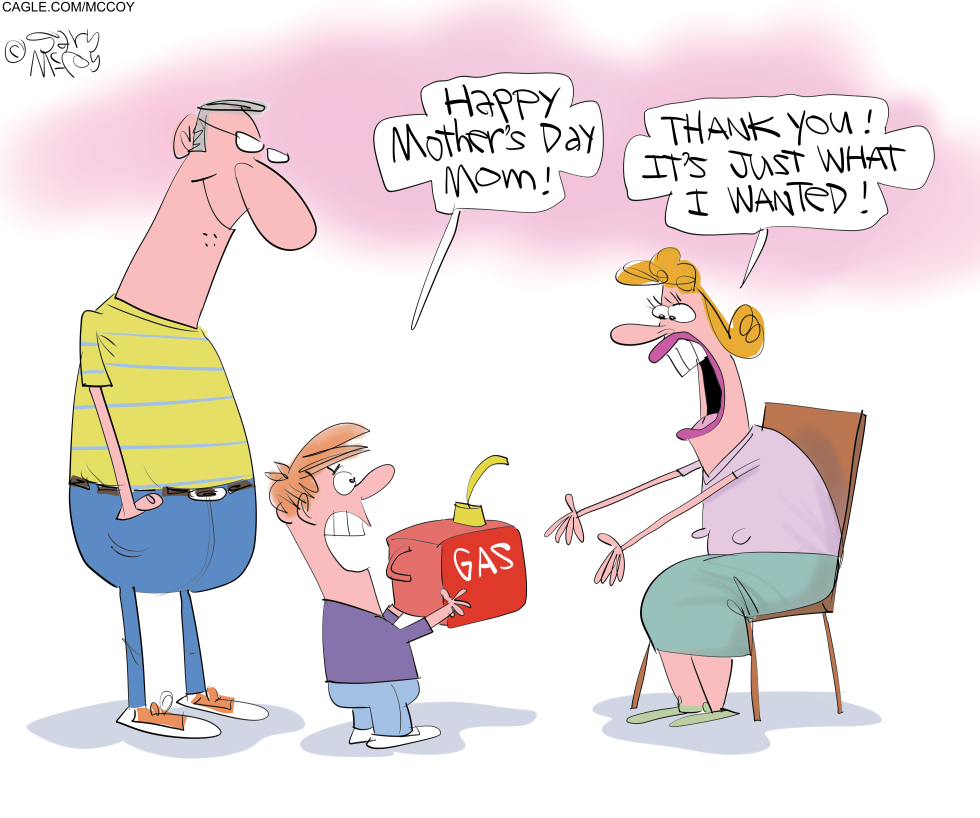
Gary McCoy's cartoon captures a family moment where a young son hands his mother a lit bomb marked GAS, exclaiming Happy Mother's Day, while she thanks him enthusiastically. The image ties into tags like Mom, mother, Mothers Day, gas, oil, petro, prices, economy, inflation. It highlights the burden of rising energy costs on families, with the explosive gift symbolizing volatile fuel markets. Amid references to Iran, strait of hormuz, Trump, the satire underscores how global tensions affect everyday life, blending holiday cheer with economic reality in a straightforward, exaggerated style typical of political cartoons.
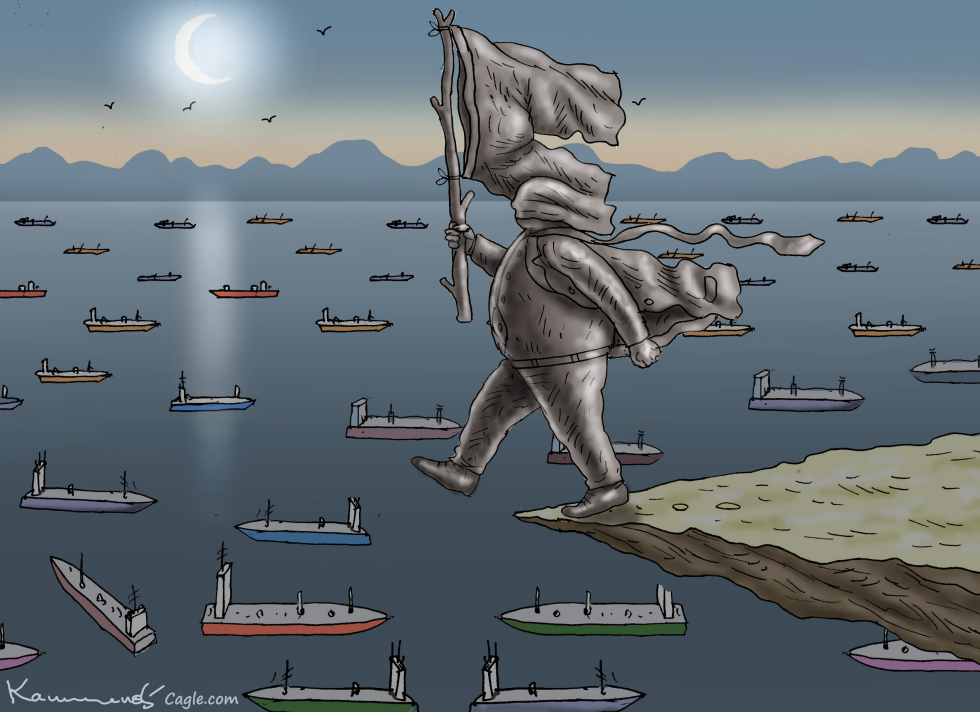
The cartoon shows a large, gray, statue-like figure with a hooded cloak, gripping a flag on a pole, as it steps forward off a cliff's edge. Below stretches a dark sea filled with many small ships of various colors, scattered across the water. In the background, mountains rise against a sky with a crescent moon and flying birds. The image, tagged with Banksy, Trumo, Hormuz, fascism, patriotism, and Maga terror, captures a moment of precarious advance. Artist Marian Kamensky signs it at the bottom left, linking to Cagle.com. This setup highlights a bold, unyielding march into potential downfall amid a busy maritime scene.
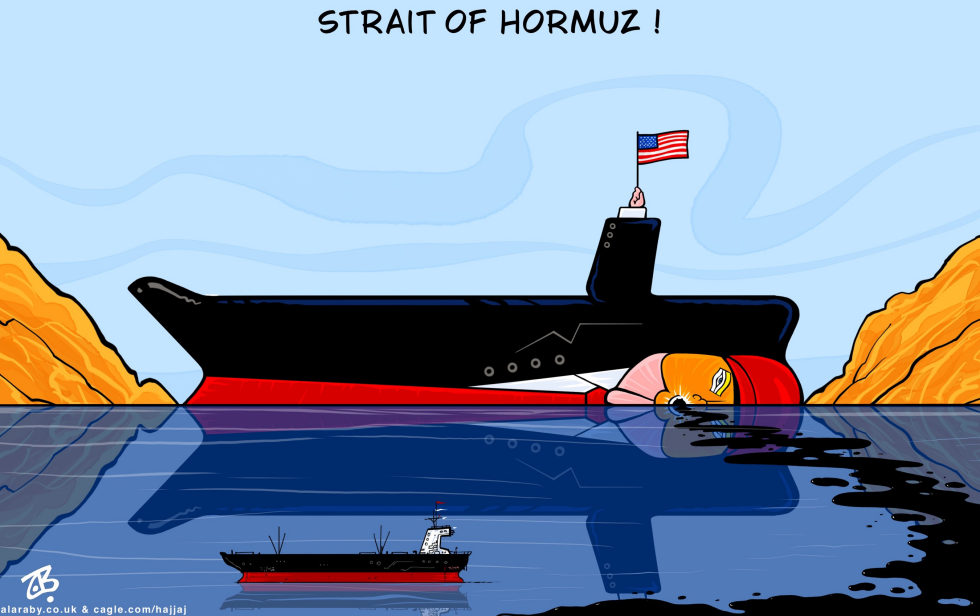
Emad Hajjaj's cartoon depicts a large black submarine with a red hull, stuck between orange landmasses in the Strait of Hormuz, its bow featuring an orange face with yellow hair and a red tie, clearly caricaturing Donald Trump. An American flag flies atop the vessel, while black oil spills into the blue water, reflecting the ship. Below, a smaller black tanker with a white figure onboard sails through the oily sea, tagged with Persian, Gulf, Sea, Tanker, Oil, War. The image satirizes US involvement in Middle East conflicts, particularly Iran war scenarios, without overreaching into hidden meanings. The composition is straightforward, with clear lines and bold colors emphasizing the blockage.
Arend van Dam's cartoon shows a gray battleship marked USA, complete with guns and missiles, driven by a figure in a suit at the wheel, as it goes over a waterfall between rocky cliffs under a blue sky. The image captures the essence of strategy failure in the Strait of Hormuz, tying into themes of Iran, ayatollahs, war, battleship mishaps, Middle East conflicts, oil, gas, energy, and economy. Such visuals often poke at misguided military moves, where the ship's plunge represents a dramatic downfall in strategic planning. The dry humor lies in the absurdity of a warship treating a strait like a river rapid, underscoring potential economic fallout from regional tensions. Cartoons like this thrive on clear, exaggerated metaphors that resonate with readers familiar with global news.
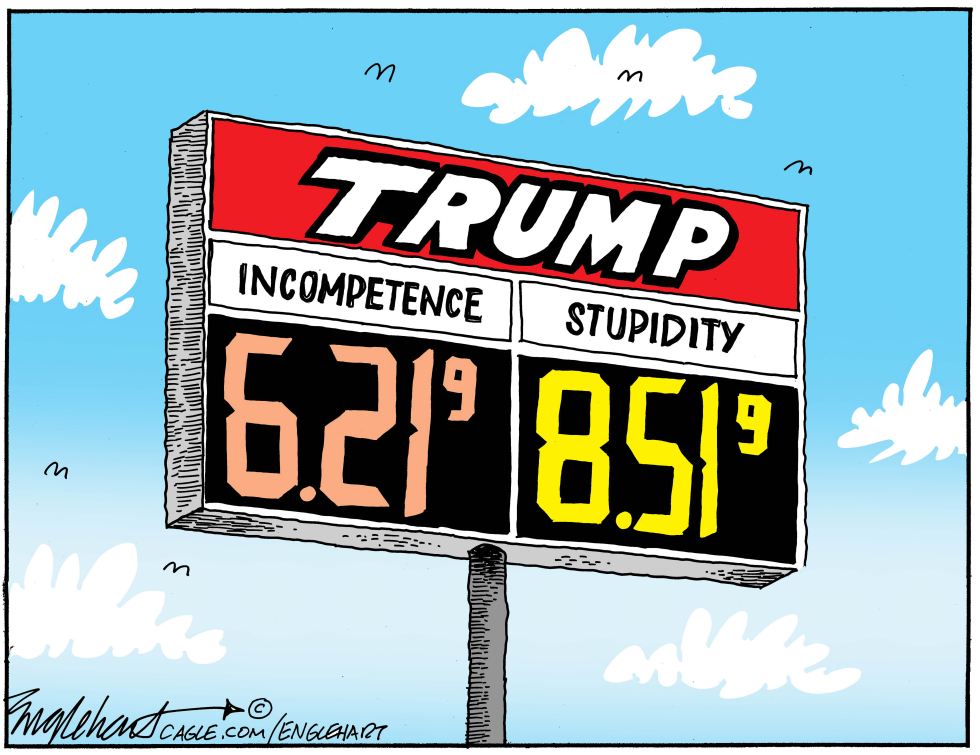
Bob Englehart's cartoon features a gas station sign with Trump at the top, showing prices for incompetence at 6.21⁹ and stupidity at 8.51⁹ against a blue sky with clouds. The tags Trump, Iran War, gas prices, gasoline, and gallon frame the visual pun. Such cartoons often tie political figures to everyday economic pains like fuel costs. The dry humor lands on how leadership flaws inflate prices, making it relatable for readers hit by pump shocks. With no characters, just the sign, it keeps the message direct. Tags like incompetence and stupidity drive the satire home, poking at perceived policy missteps without overcomplicating the scene.
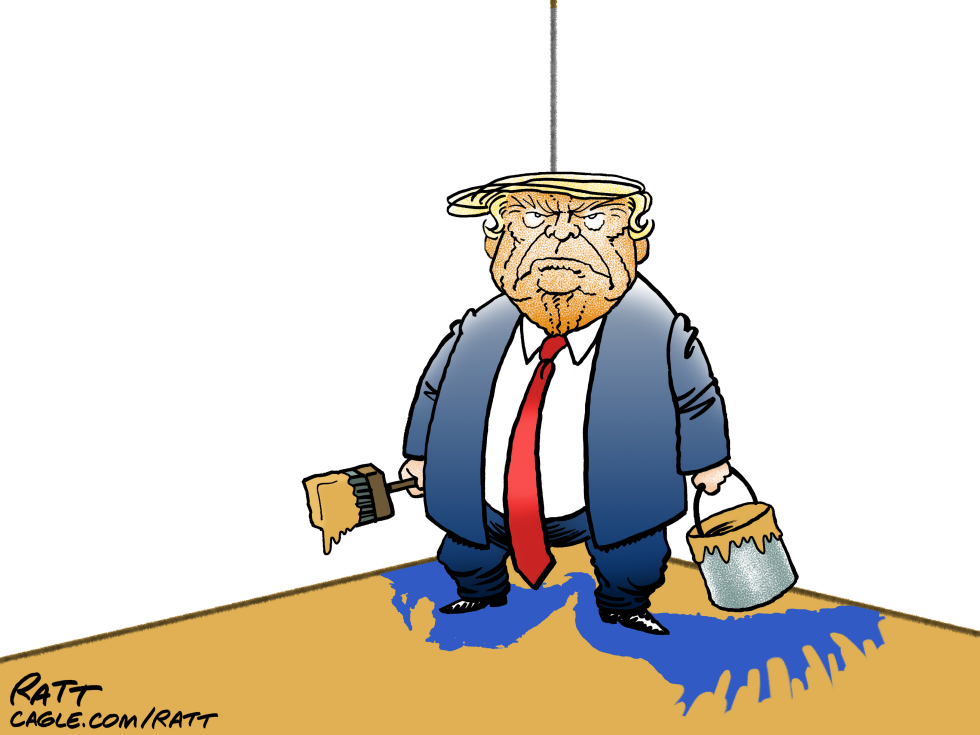
Donald Trump appears in a 2026 editorial image holding a paintbrush and bucket while standing on a blue painted area resembling the Strait of Hormuz. The scene responds to ongoing concerns over Iranian oil routes, potential conflict, and resulting effects on global oil and gas prices. The visual shows the figure applying paint that creates a path leading to restricted movement.
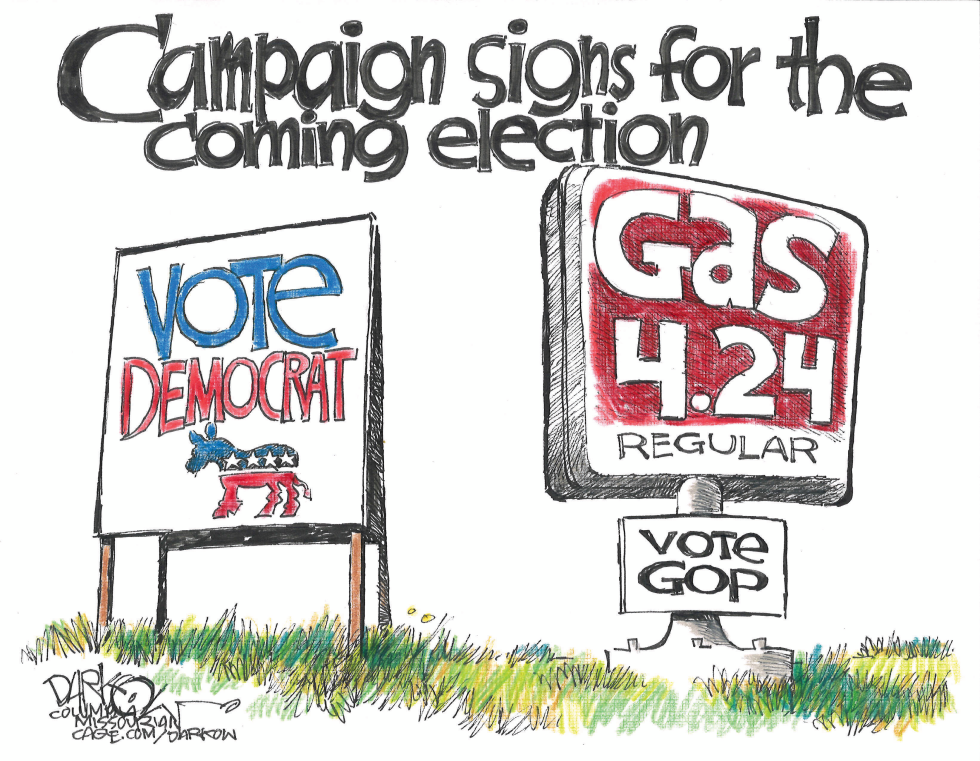
John Darkow's cartoon shows campaign signs for the coming election, with a straightforward Vote Democrat board featuring a blue donkey symbol, contrasted by a gas station-style sign advertising GAS 4.24 REGULAR and a small Vote GOP placard below. The image ties into 2026 midterms themes, highlighting gas prices, affordability, inflation, Strait of Hormuz tensions, cost of living pressures, and party strategies. The dry humor points to how economic issues like fuel costs become central in political advertising, with the GOP sign mimicking a bargain price to appeal to voters frustrated by rising expenses. This setup captures the insider view of how cartoons simplify complex voter concerns into visual punches.
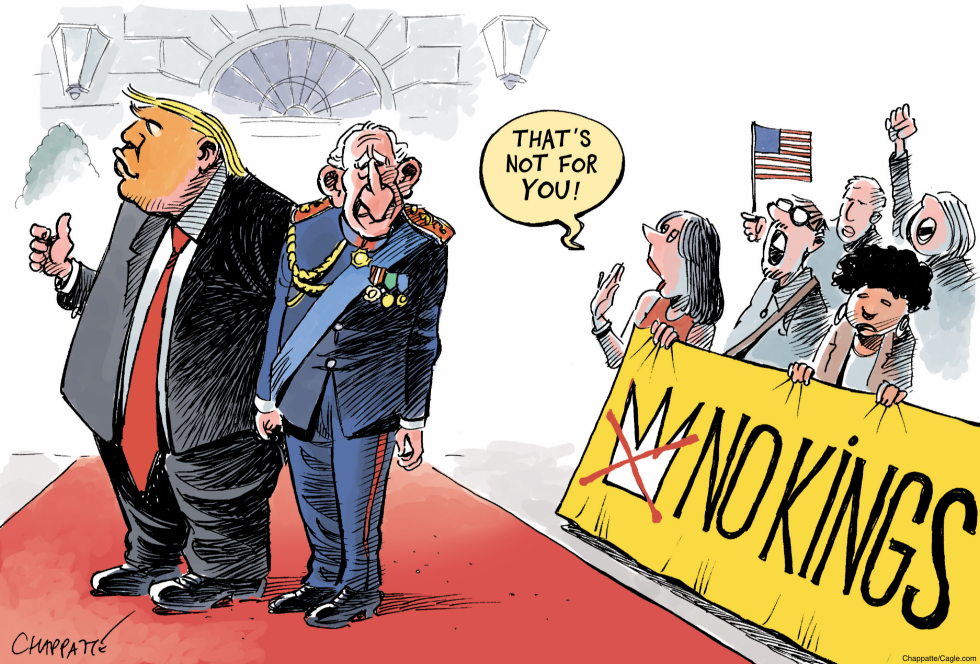
Patrick Chappatte's cartoon captures a fictional royal visit in Washington DC, where Trump, with his signature hair and suit, walks arm-in-arm with King Charles in full regalia. A group of protesters, waving a USA flag, holds a yellow sign featuring a crossed-out crown and 'NO KINGS,' while one shouts 'That's Not For You!' The scene tags USA, Great Britain, Trump, King Charles, monarchy, Democrats, demonstrations, United Kingdom, blending humor on transatlantic relations and anti-monarchy sentiments in a clearly visible setup on a red carpet against a grand building backdrop. The dry satire highlights visible contrasts without deeper inference.
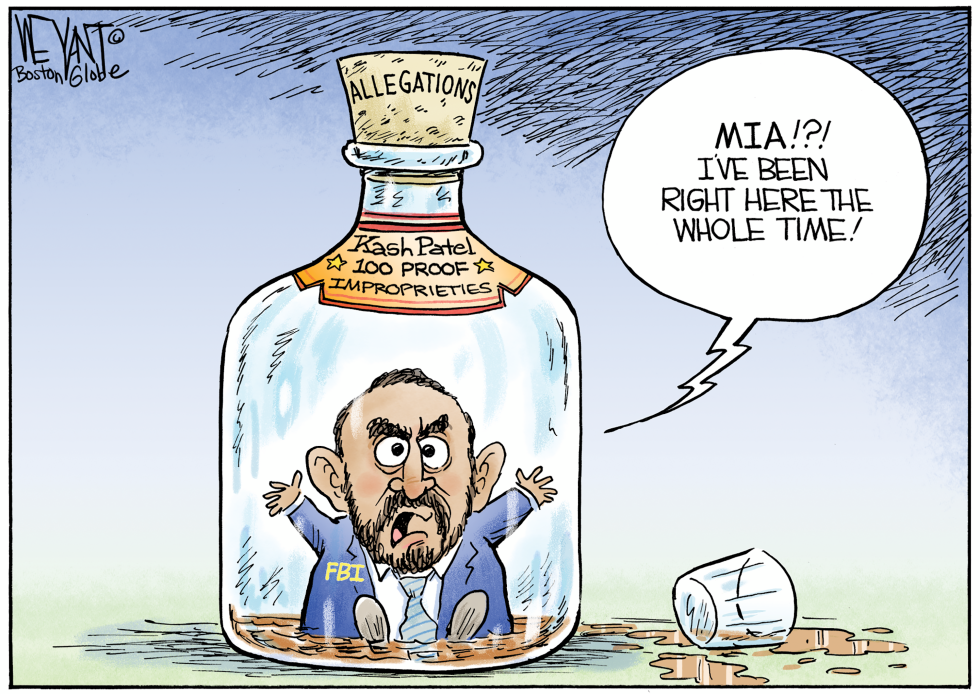
Christopher Weyant's cartoon captures Kash Patel trapped inside a large bottle labeled 'Kash Patel 100 Proof Improprieties,' with the cork marked 'Allegations.' The figure, dressed in a suit with 'FBI' on the sleeve, raises arms and shouts in a speech bubble: 'MIA!?! I've been right here the whole time!' A tipped-over glass spills liquid nearby. Tags like FBI, Kash Patel, alcoholic, allegations, bottle, and fail underscore the visual pun on being 'in the bottle,' tying into themes of inept leadership and ongoing controversies in domestic policy and criminal justice.
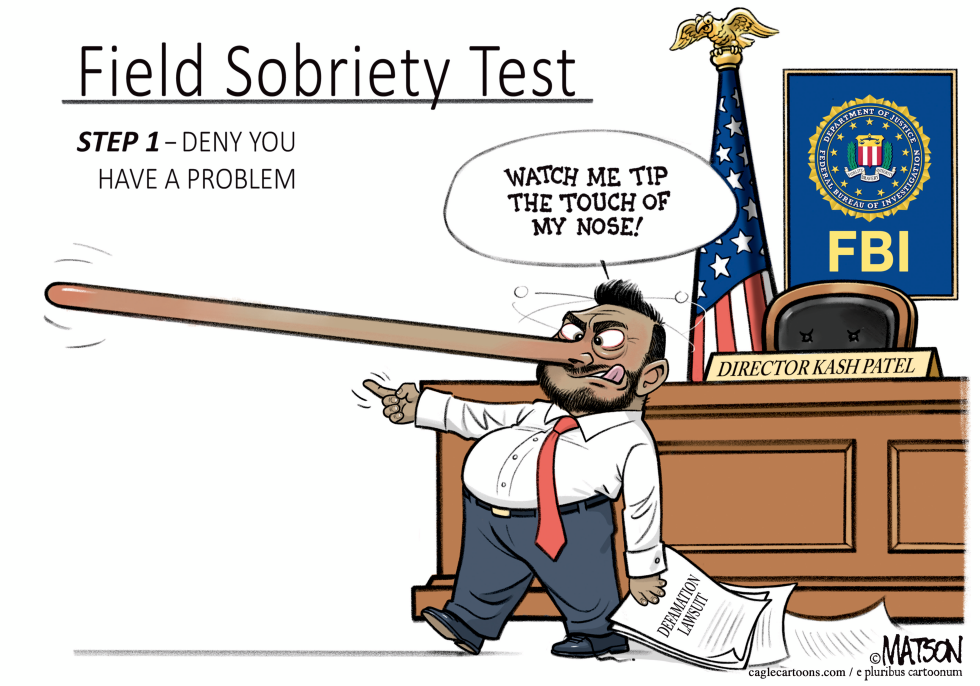
R.J. Matson's cartoon depicts Director Kash Patel behind an FBI desk, his nose elongated like Pinocchio's, as he mangles a sobriety test phrase: 'Watch me tip the touch of my nose!' The setup labels it Step 1: Deny you have a problem, with a defamation lawsuit paper slipping away. American and FBI flags frame the scene, tying into tags like Federal Bureau of Investigation, Kash Patel, field sobriety test, intoxication, drinking problem, and criminal justice. This visual pokes at perceptions of denial in leadership, blending humor with commentary on domestic policy without overreaching into unseen motives.