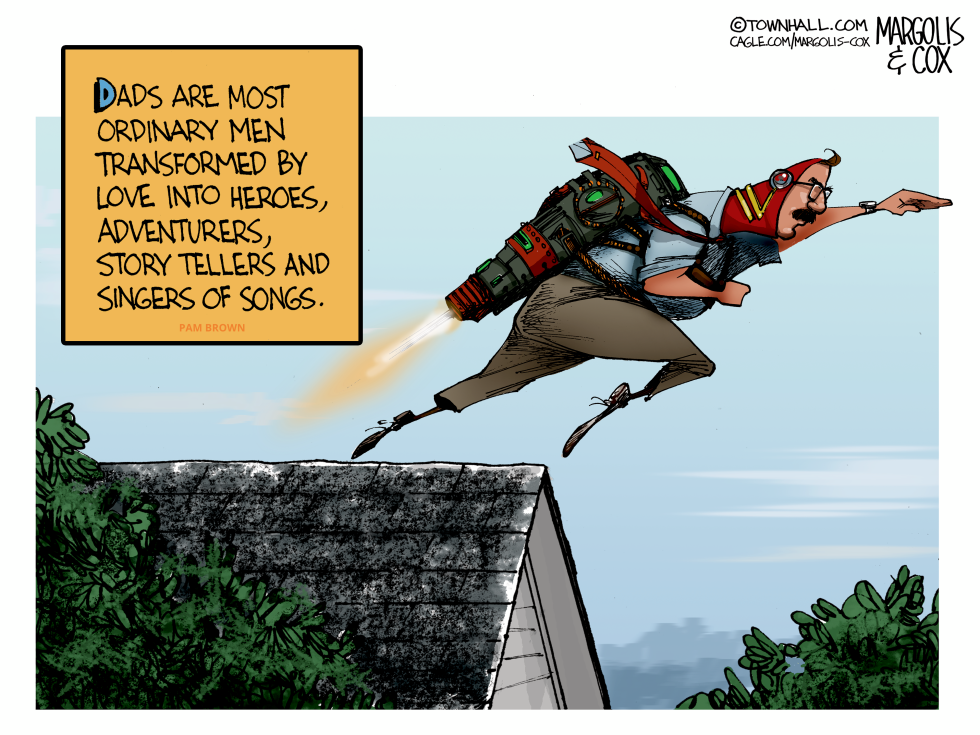
A father equipped with a detailed jetpack leaps from a rooftop into open sky on Father's Day. The image pairs the action with a prominent quote from Pam Brown celebrating how love transforms ordinary men into heroes, adventurers, storytellers and singers of songs. The illustration appears on Townhall and carries the Margolis & Cox credit line.
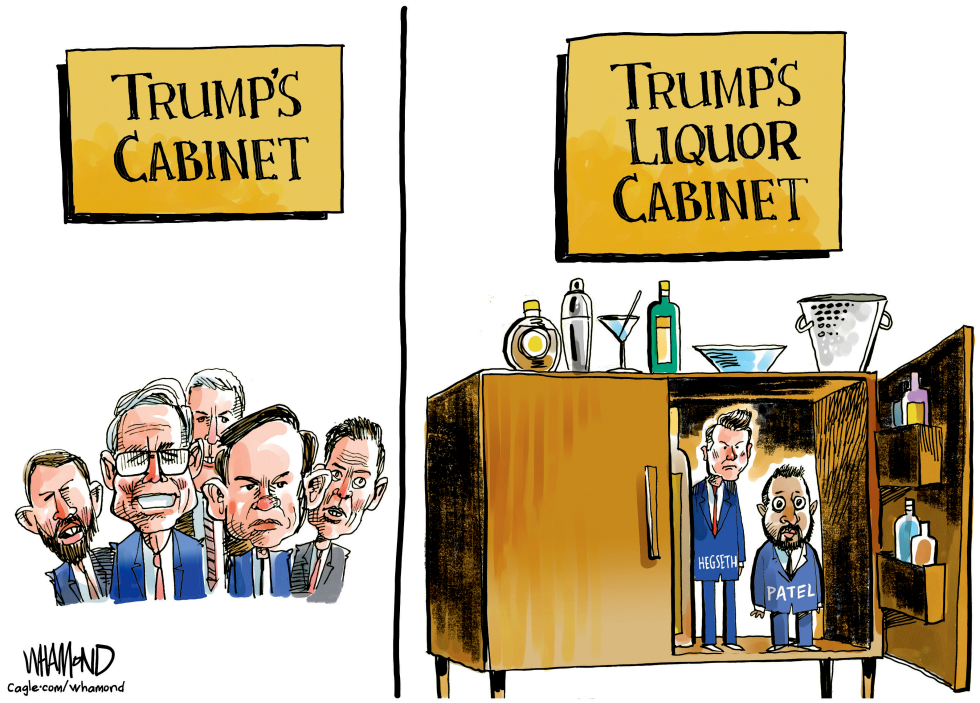
Dave Whamond's cartoon splits the scene between Trump's Cabinet of stern-faced men in suits and Trump's Liquor Cabinet, where caricatures labeled Hegseth and Patel emerge disheveled amid bottles and barware, poking at Trump's cabinet problems. The dry humor targets Kash Patel as FBI director nominee and Pete Hegseth for Secretary of Defense, amid drinking allegations and excessive drinking claims from The Atlantic. Unexplained absences and AWOL accusations add to the satire of unfit picks, with a defamation lawsuit looming. This piece captures the irony of Trump's best people turning into a partying liquor cabinet fiasco, all in a straightforward, insider jab at political absurdity.
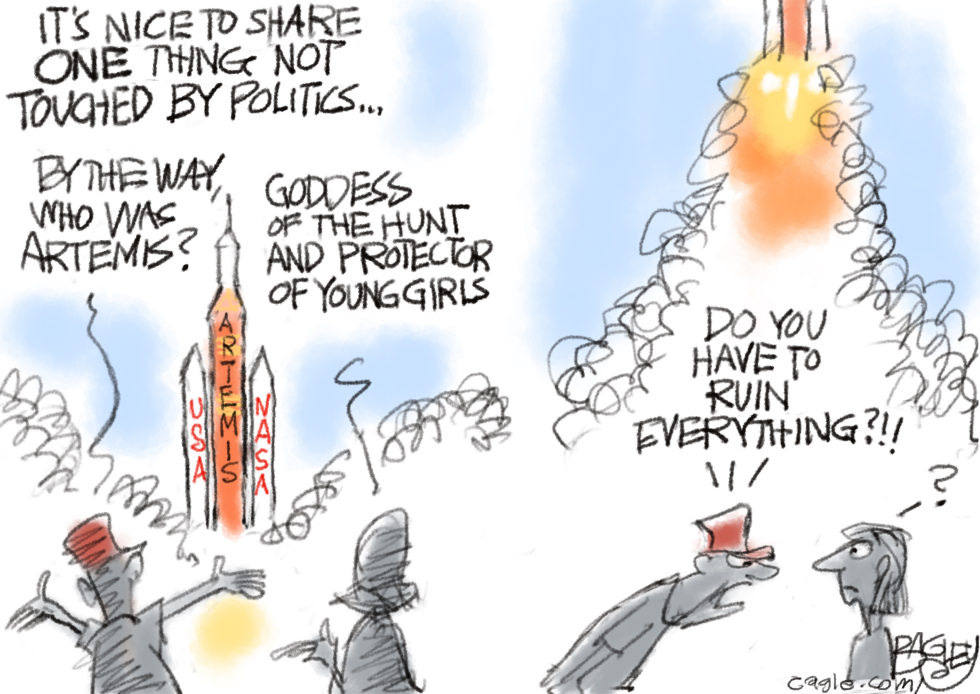
This political cartoon features a launching rocket labeled Artemis, SLS, NASA, and USA, with overlaid text praising one thing untouched by politics before asking about the goddess Artemis, described as goddess of the hunt and protector of young girls. A figure exclaims frustration at ruining everything, satirizing how even space missions get dragged into cultural debates. The irreverent sketch uses humorous figures with red hats to poke at over-politicization in science, blending mythology with modern rocketry in a witty critique. Tags like Artemis rocket launch political cartoon, NASA SLS Artemis mission satire, and politics invading science editorial cartoon underscore the cartoon's sharp insight into societal divisions spilling into apolitical realms like space exploration politicized cartoon.
John Darkow's cartoon captures the sting of high gas prices amid inflation and war, showing a yellow vehicle at a station with unleaded fuel marked at 3.95 9/10 per gallon, pay in advance. Speech bubbles reveal a conversation where one asks about not going anywhere for spring break, and the reply puns on being 'Spring Broke' due to gas costs. The image underscores travel disruptions, with tags like gas prices, inflation, spring break, travel, war, and economic satire emphasizing how rising fuel expenses halt vacation plans. This straightforward drawing uses dry humor to point out everyday economic frustrations without overcomplicating the scene.
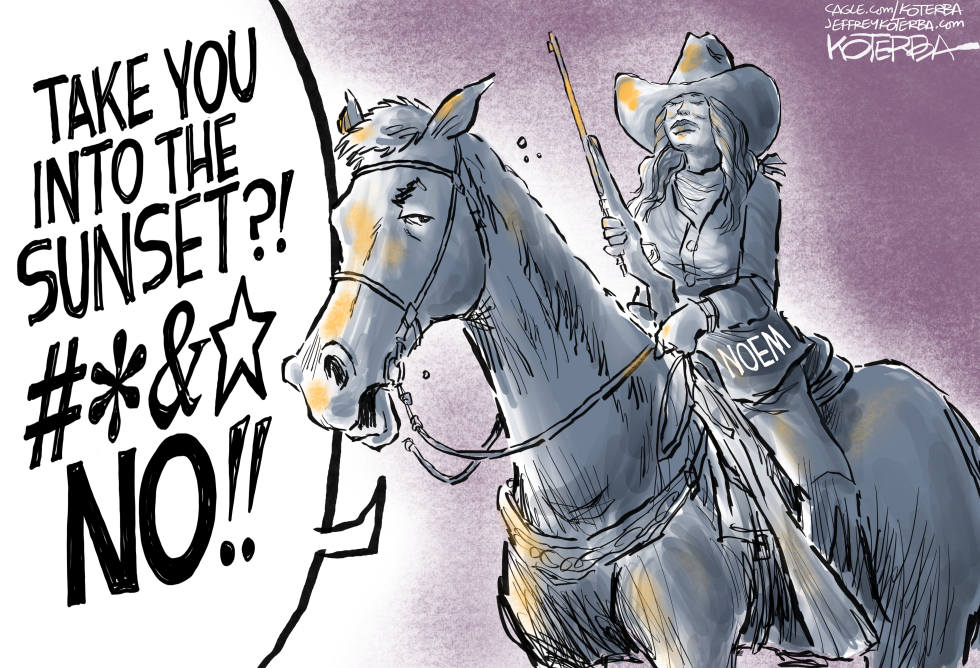
This Jeff Koterba political cartoon skewers Kristi Noem, the South Dakota governor embroiled in GOP scandal over her infamous dog-killing anecdote. Depicted as a cowgirl on a horse labeled 'NOEM,' the steed profanely refuses to 'take you into the sunset,' symbolizing the abrupt halt to her rising star in conservative politics, particularly her dashed hopes as a Trump VP pick. The humorous rejection underscores the backlash from animal cruelty revelations, blending satire with sharp commentary on Republican controversy and election humor. Viral potential lies in its irreverent take on political downfall, making it a shareable gem in American politics discourse.
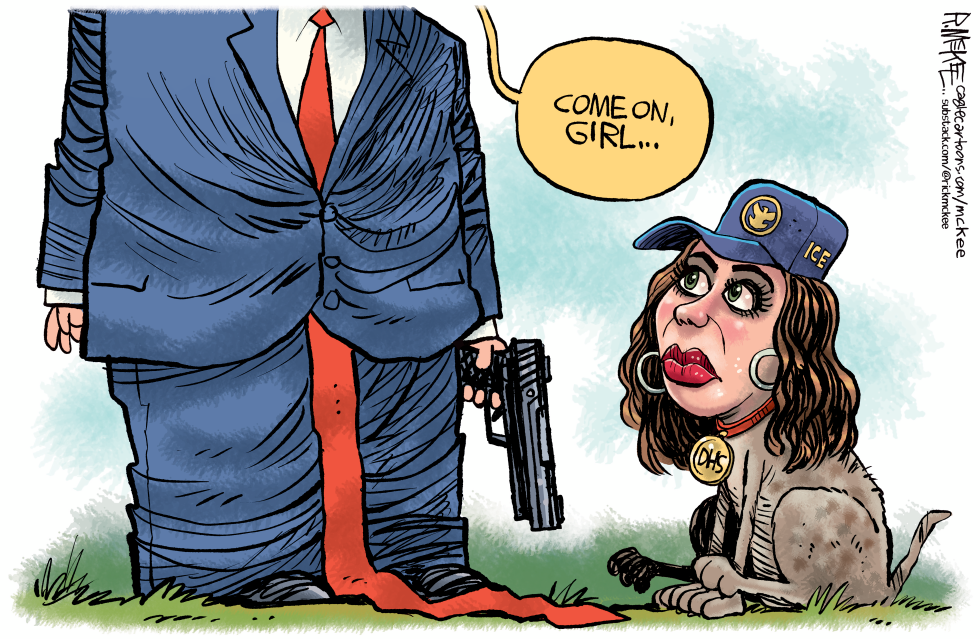
This political cartoon features Donald Trump coaxing a dog-like figure with Alexandria Ocasio-Cortez's face, donned in an ICE cap and DHS tag, gripping a gun on a leash— a sharp satire on immigration enforcement and border control. The image lampoons the Trump administration's hardline stance on deportation and US politics, using caricature to underscore the dehumanizing aspects of border patrol. With elements of political humor, it critiques how figures like AOC are portrayed in opposition, blending viral meme potential with editorial cartoon flair. The scene evokes questions about power dynamics in immigration policy, making it a timely piece for discussions on satire and governance.
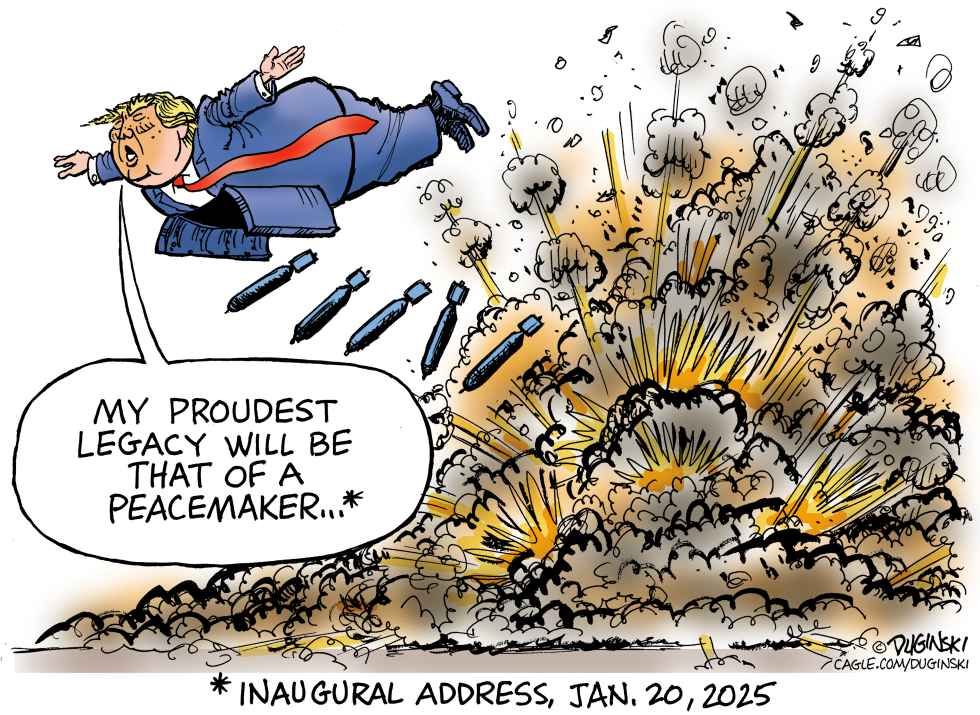
Duginski holds Trump accountable for his campaign promise to end wars within 24 hours of taking office. The Los Angeles Times illustrator catalogs the ongoing conflicts that remain unresolved. The broken promise imagery reflects sustained journalistic skepticism of Trump's foreign policy boasts.
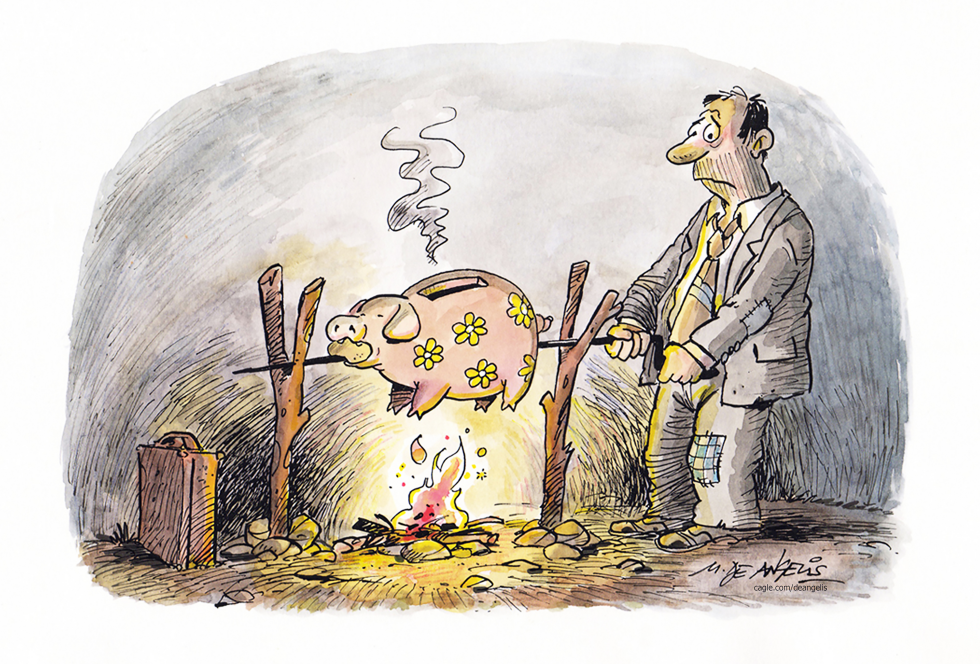
A suited man stands beside a campfire and rotates a pink piggy bank on a wooden spit. The bank features yellow flower decals and rests above glowing embers. A brown briefcase sits on the ground to the left of the scene. The composition centers on the act of turning the bank over heat in an outdoor setting.
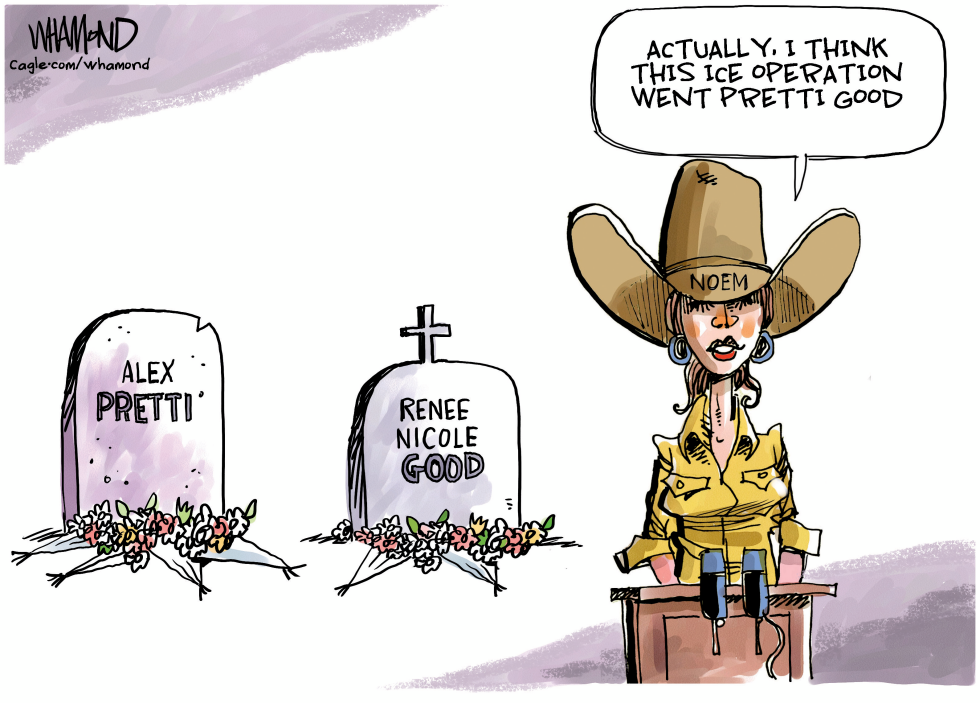
This political cartoon by Whamond features South Dakota Governor Kristi Noem, a prominent Republican and potential Trump ally, wearing a cowboy hat labeled 'NOEM' and speaking at a podium. She declares, 'Actually, I think this ICE operation went pretty good,' while standing beside two gravestones inscribed with 'Alex Pretti' and 'Renee Nicole Good,' adorned with flowers. The image satirizes immigration enforcement, border policy, and the human cost of deportation, highlighting perceived political callousness toward migrant deaths. Through humor and irony, it critiques how politicians like Noem might downplay tragedies in ICE operations, making it a sharp editorial cartoon on current Republican stances.
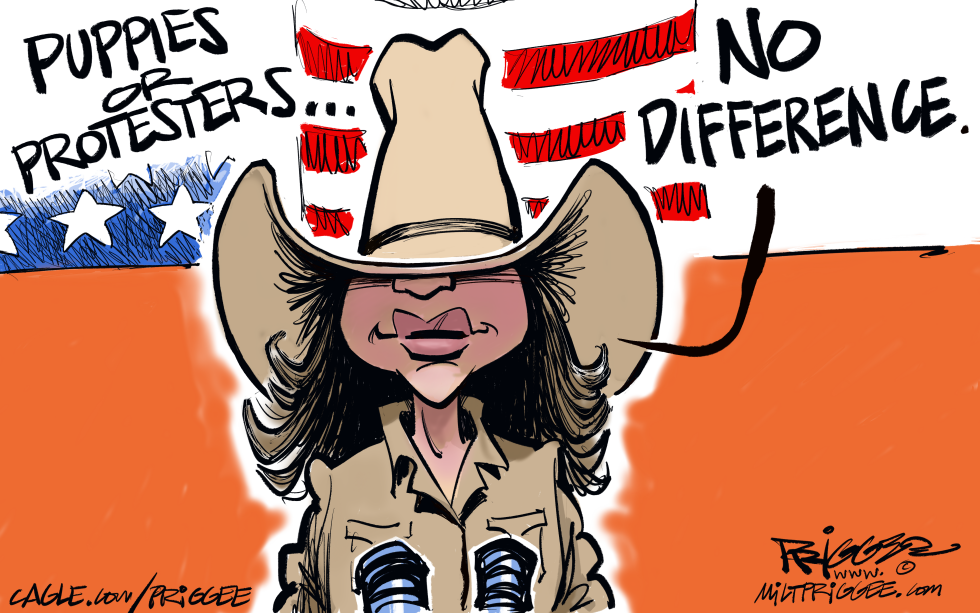
Dive into this irreverent political cartoon where a smirking, cowboy-hatted caricature, reminiscent of South Dakota's Kristi Noem, drawls that there's 'no difference' between puppies and protesters. With an American flag-adorned hat and a backdrop of scribbled disdain, the image skewers the GOP criticism surrounding Noem's infamous puppy shooting controversy. It's a sharp jab at conservative politics, blending animal cruelty debate with protest rights in a way that's both humorous and insightful. The satire underscores how some rancher lifestyle defenders might blur lines between disciplining unruly pets and quelling freedom of speech advocates. Created by Milt Priggee, this viral cartoon captures public outrage and media scandal, potentially eyeing Noem's Trump VP pick ambitions. Overall, it's a witty commentary on the absurdities of political figures who shoot from the hip—literally.
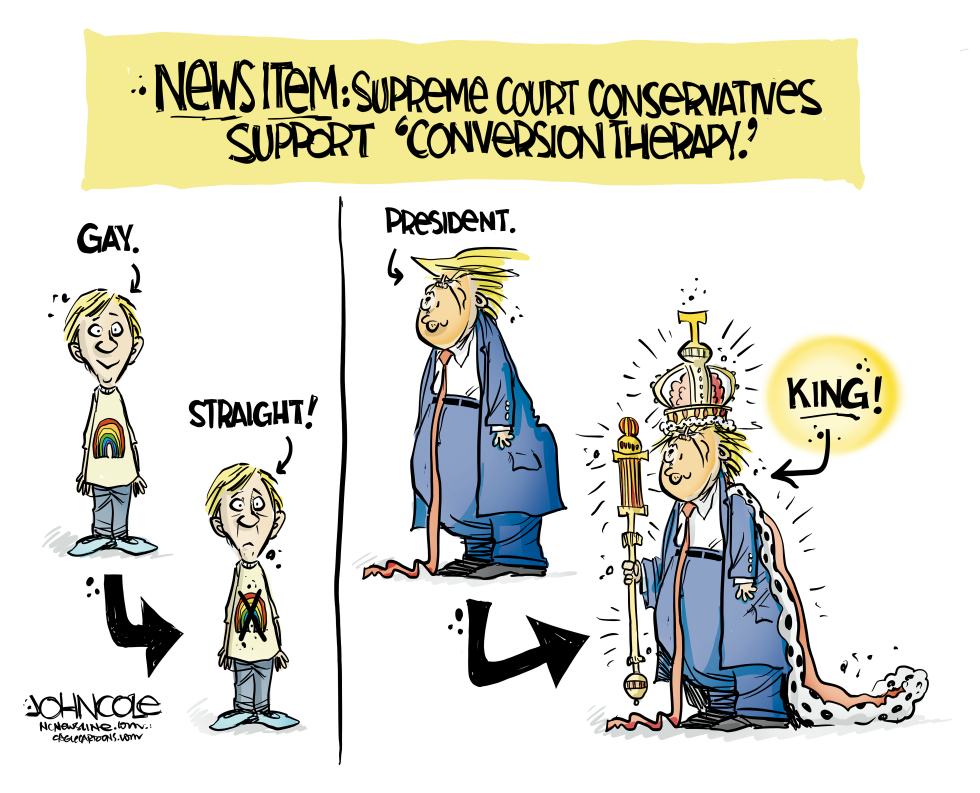
On October 14 2025 John Cole's cartoon depicts Supreme Court conservatives endorsing conversion therapy. The left panel shows a boy labeled gay transformed into straight. The right panel shows a president figure transformed into a robed and crowned king. The visual equates the therapy with an unconstitutional expansion of presidential power. The piece criticizes the court's conservative majority for enabling such shifts.
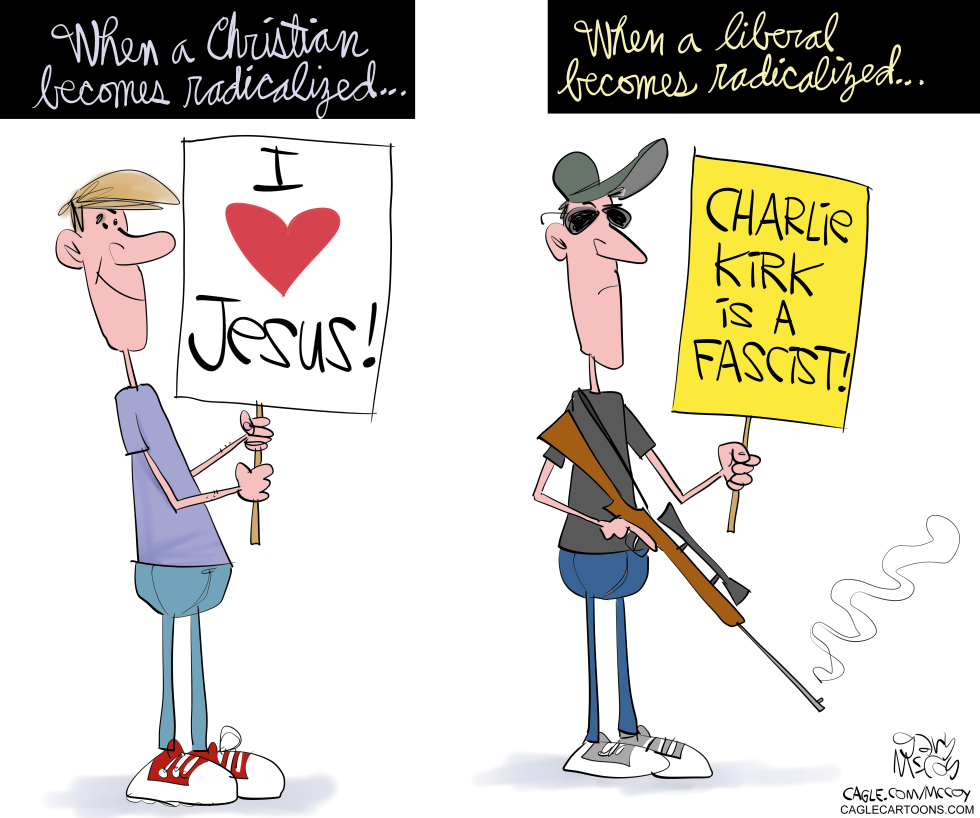
Gary McCoy's cartoon from 2025 divides the frame into two scenarios on radicalization. On the left, a figure in a cap holds a sign declaring 'I ♥ Jesus!' under the label 'When a Christian becomes radicalized...'. The right side shows a sunglasses-wearing man with a rifle emitting smoke, gripping a yellow sign that reads 'CHARLIE KIRK IS A FASCIST!' labeled 'When a liberal becomes radicalized.'. Tags like MAGA, Jesus, radicalized, Christian, liberal, Charlie Kirk, gun control, mental health, religion, Donald Trump, social media, and science frame the visual commentary. The piece highlights perceived disparities in how extremism manifests across ideological lines, with the Christian side shown as affectionate and the liberal as potentially violent.
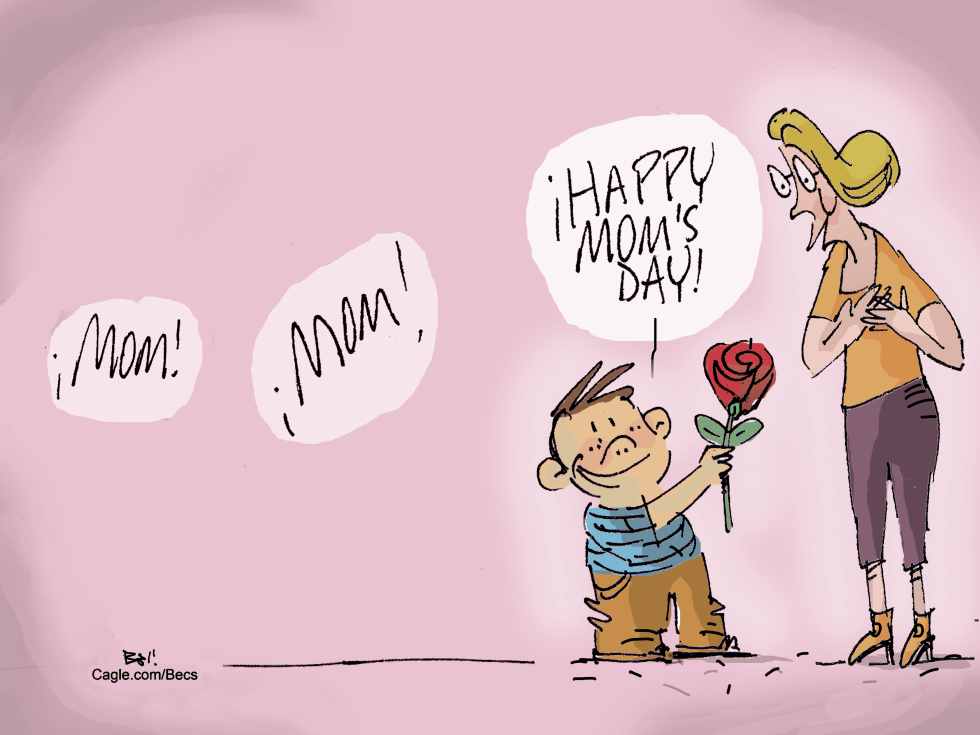
Cartoons like this mother's day illustration capture everyday humor with a tech twist. Here, a young boy extends a single red rose to a blonde woman in glasses, her hand to her chest in surprise. Speech bubbles blend Apple's 'i' prefix into classic greetings: 'iMom!', 'Mom!', and 'iHAPPY MOM'S DAY!'. It's a light satire on how digital branding seeps into personal moments. The pink backdrop keeps it warm and approachable, signed by Becs via Cagle.com. Such pieces remind us how tech parody fits into holiday cartoons, poking fun at modern family dynamics without overcomplicating the scene.
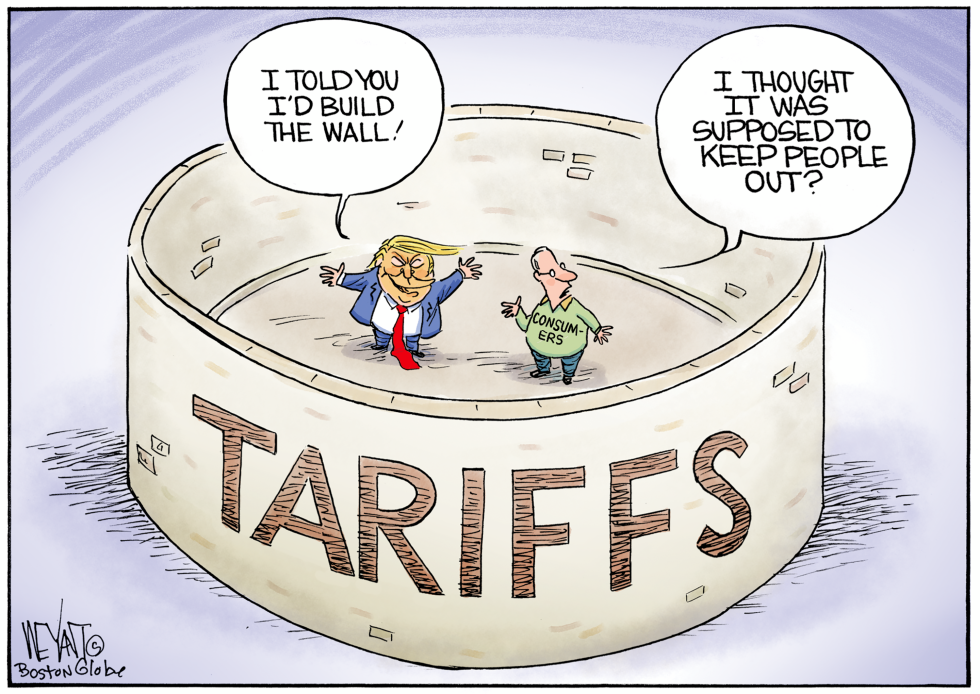
The cartoon shows Trump inside a circular wall labeled 'TARIFFS,' declaring he built the wall, with a figure marked 'CONSUMERS' puzzled that it's supposed to keep people out. Tags like trump, tariffs, threats, Mexico, Canada, China, trade, wall, prisoner, consumers underscore the irony. The image critiques how tariffs meant to protect against foreign threats from Mexico, Canada, and China end up trapping domestic consumers like prisoners. This visual metaphor draws on Trump's famous wall promise, flipping it to show trade policies harming those inside. The dry humor lies in the reversal, where the wall imprisons rather than excludes, commenting on economic fallout.