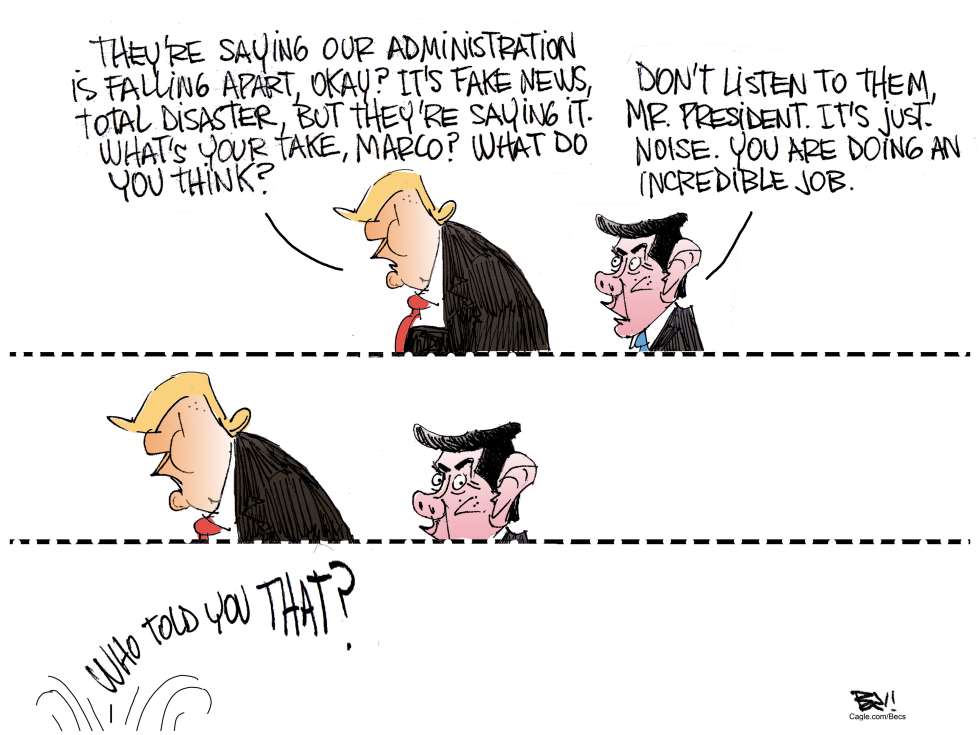
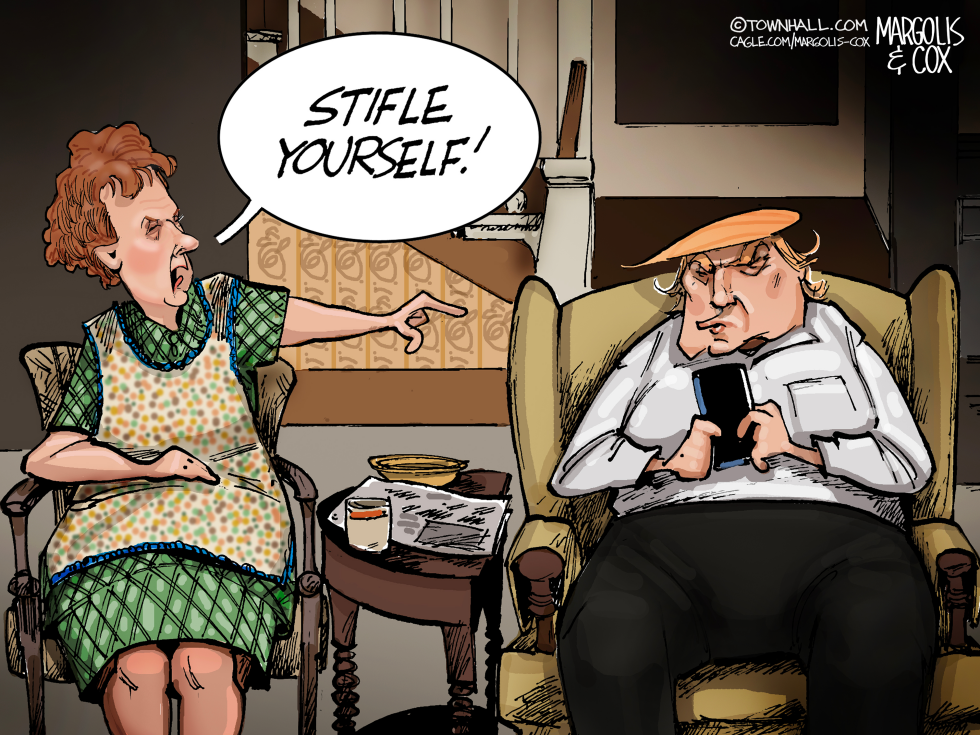
President Trump asked Senator Marco Rubio for his assessment of reports that the administration is in disarray, labeling them fake news. Rubio dismissed the reports as noise and praised Trump's performance. Trump responded by questioning who had told Rubio that assessment. The exchange highlights tensions over loyalty and information flow inside the administration. The cartoon portrays Rubio's positive reply as triggering suspicion rather than reassurance.
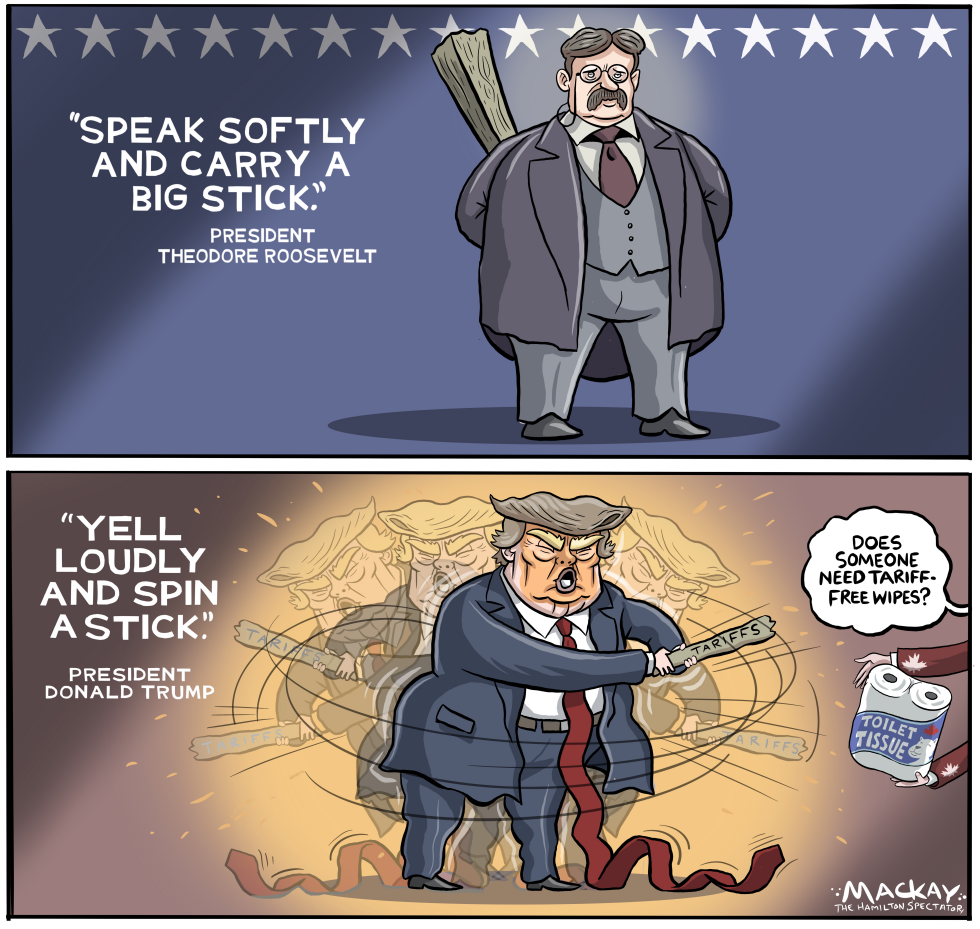
The cartoon by Graeme MacKay contrasts Theodore Roosevelt's famous speak softly and carry a big stick approach with Donald Trump's version of yelling loudly and spinning a stick covered in tariffs. In the lower panel Trump appears dizzy from the motion as a Canadian hand offers toilet tissue labeled tariff-free wipes. The image comments on recent US tariff actions and their impact on Canadian trade relations as of the September 2026 publication date.
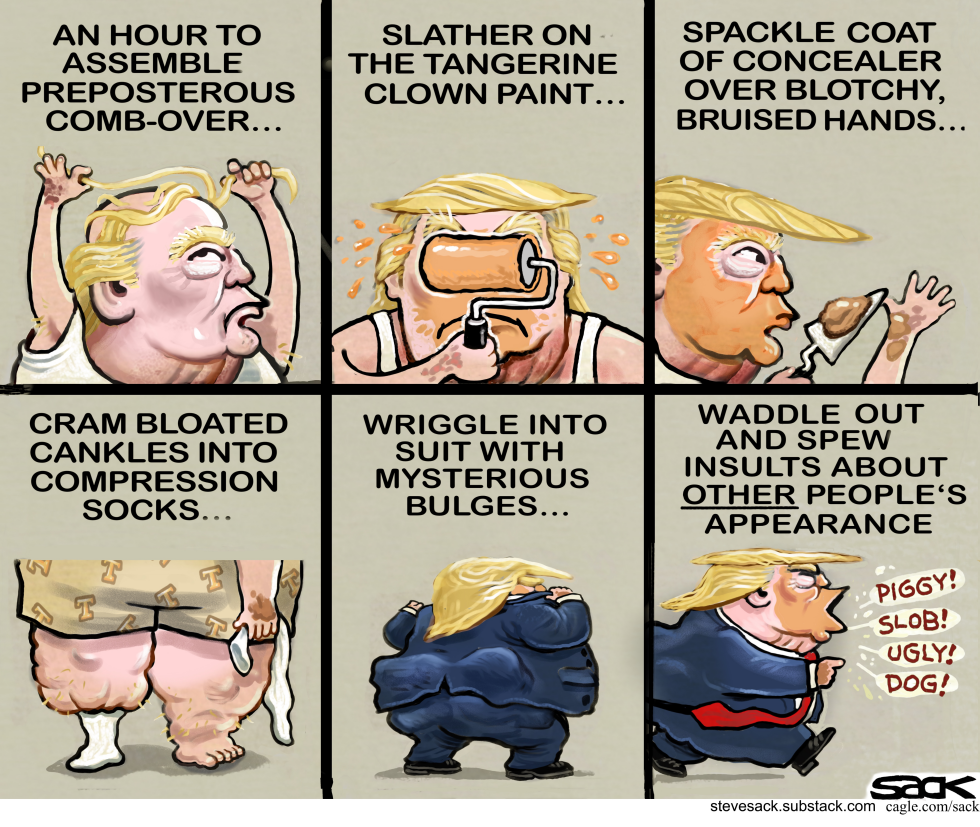
Donald Trump maintains a detailed personal grooming regimen that includes assembling a comb-over, applying tangerine-toned makeup, concealing skin issues, using compression socks, and adjusting his suit. This preparation precedes his public remarks criticizing the appearances of others. The piece presents the contrast as evidence of inconsistent standards in political discourse.
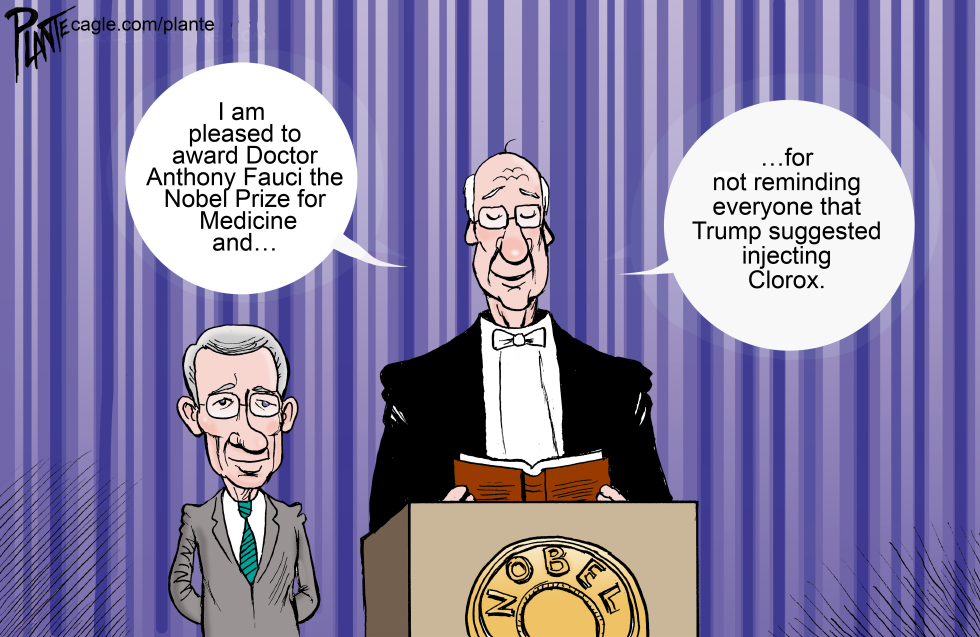
A Nobel Prize presentation for Dr. Anthony Fauci highlights his public health role during the COVID-19 period. The ceremony focuses on his contributions to medicine while avoiding reference to earlier statements from former President Trump about potential treatments. The moment underscores ongoing public debate over pandemic messaging and leadership accountability. The editorial position frames the award as recognition tied to selective memory rather than solely scientific achievement.
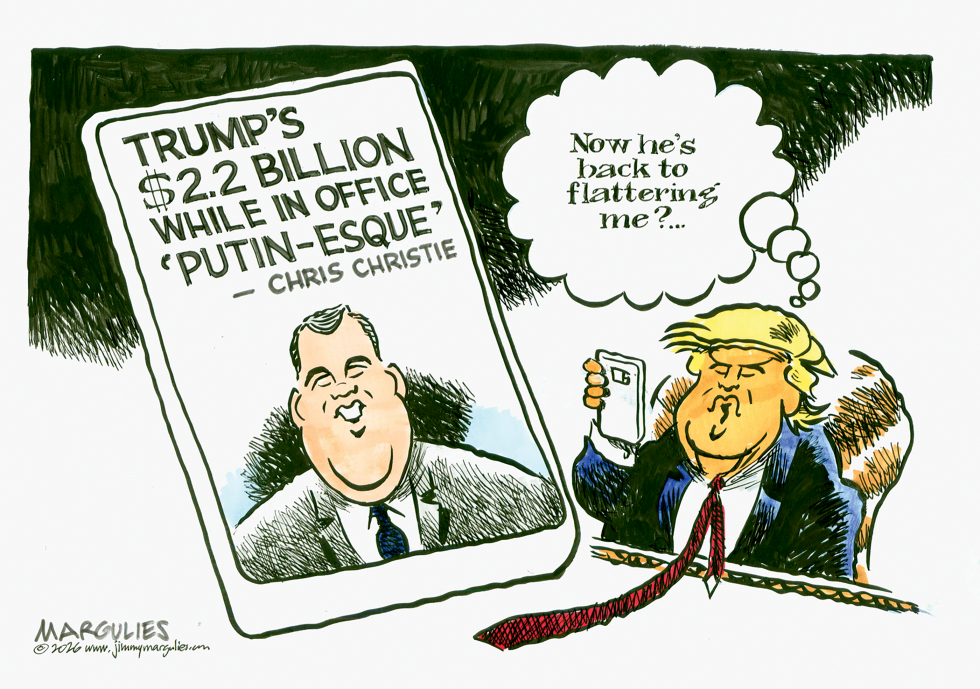
On July 6, 2026, a cartoon depicts Donald Trump examining a phone displaying Chris Christie’s quote labeling his $2.2 billion earnings while in office as Putin-esque. Trump’s thought bubble reveals he interprets the remark as flattery rather than criticism, highlighting an ongoing dynamic between the two figures amid foreign policy references to Russia.
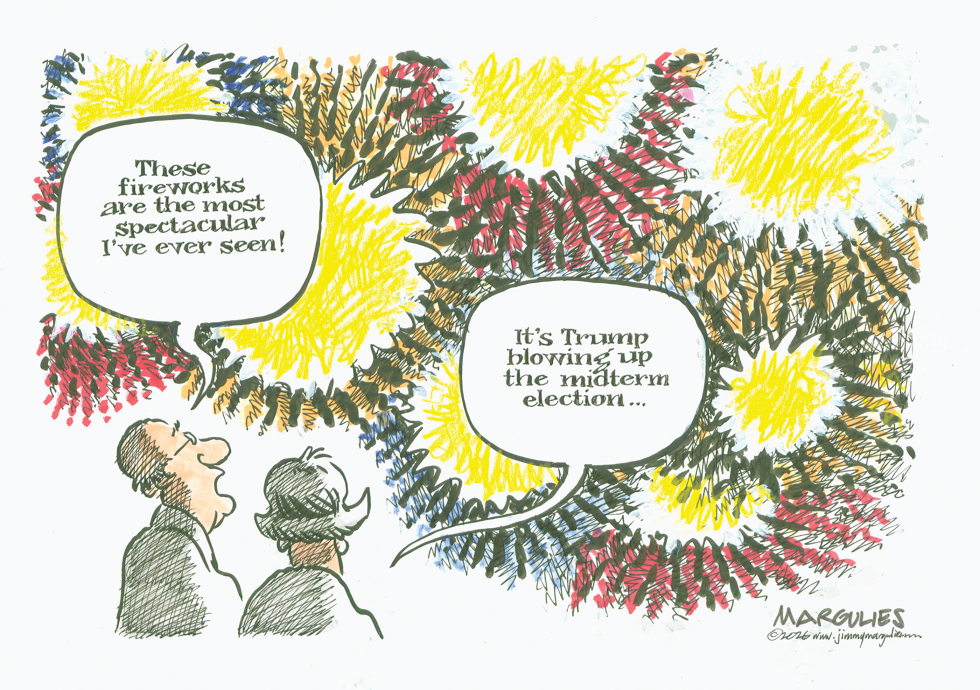
On June 29 2026 two figures stand in the foreground watching a burst of red yellow and blue fireworks fill the sky. One speech bubble praises the spectacular display while the second attributes the chaos to Trump blowing up the midterm election. The scene captures public attention on the upcoming November contests and the former president's continued influence on the political landscape.
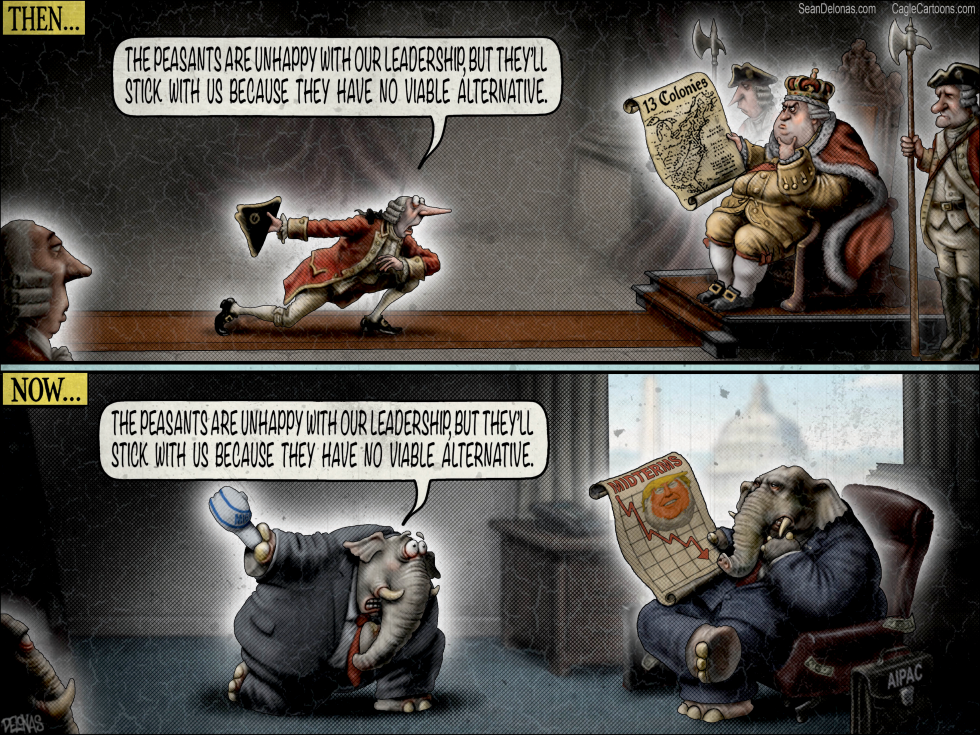
A two-panel cartoon contrasts King George III assuring aides that unhappy colonists have no viable alternative with a modern Republican elephant repeating the identical line while holding a plunging midterms chart marked with Donald Trump's face. The lower scene includes the U.S. Capitol dome and an AIPAC briefcase. The June 28 2026 date places the image weeks before the 2026 midterm elections.
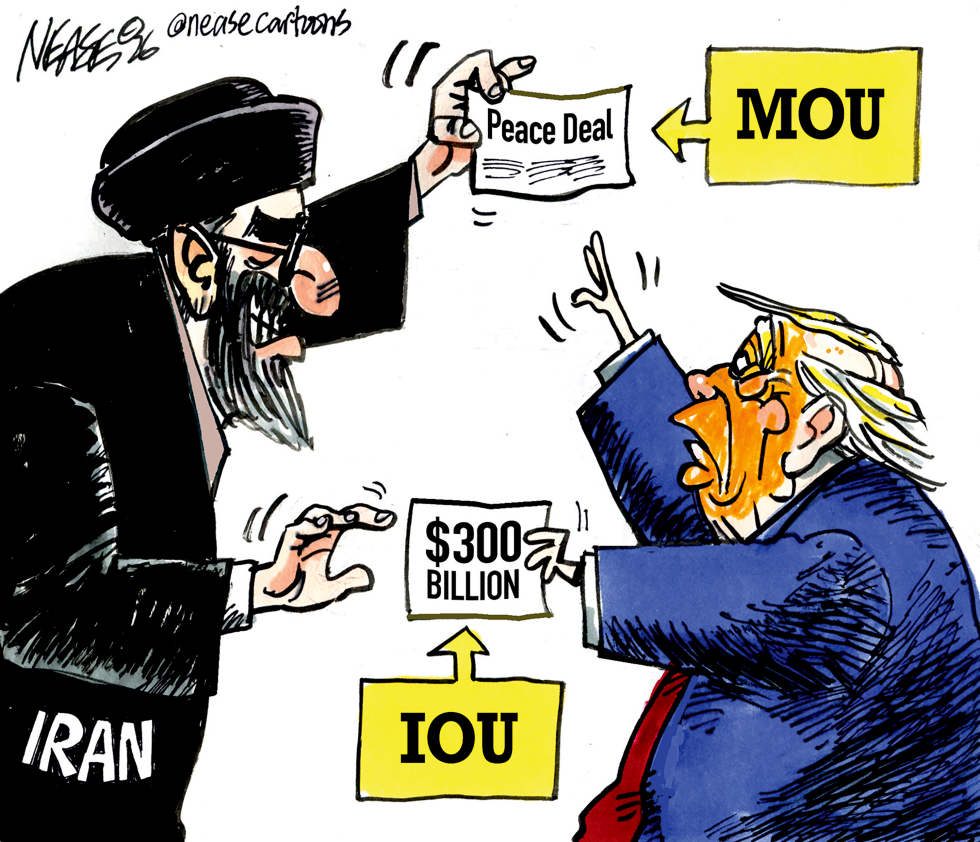
Nease, a Canadian cartoonist, examines the hidden costs of the peace agreements being brokered by Trump across multiple conflict zones. The cartoon suggests that peace achieved through coercion and abandonment of allies carries enormous human costs. The accounting metaphor frames diplomacy as a transactional exercise with losers.
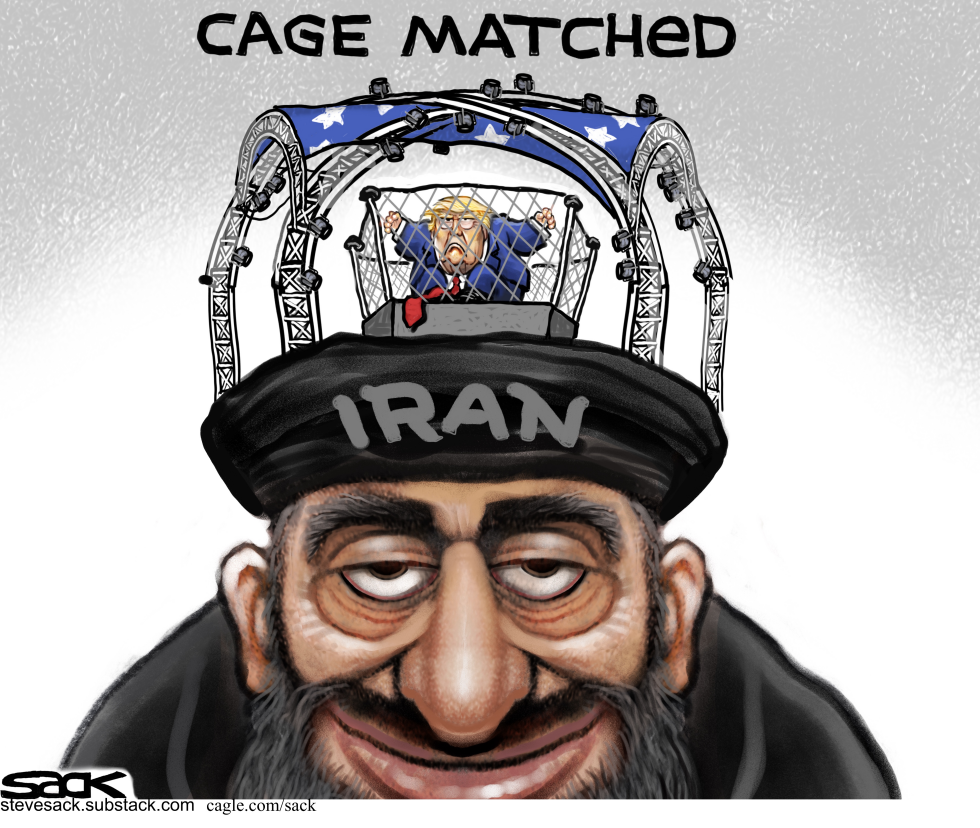
Steve Sack's cartoon depicts Ayatollah Khamenei wearing a black hat labeled Iran with a UFC-style cage on top containing Donald Trump. Trump grips the bars with an agitated expression. The image responds to ongoing US Iran tensions in 2026. Khamenei appears calm and slightly smiling beneath the structure. The visual uses the cage match metaphor to illustrate diplomatic entrapment.
The image depicts the FIFA World Cup trophy transformed with Donald Trump's face as its centerpiece. Gianni Infantino, the FIFA president, holds the base firmly. Several soccer players stand nearby, including figures resembling Kylian Mbappé and others in national kits. The scene references the upcoming 2026 World Cup hosted in part by the United States. Trump's prominent placement on the trophy underscores his outsized role in public discussions around the event.
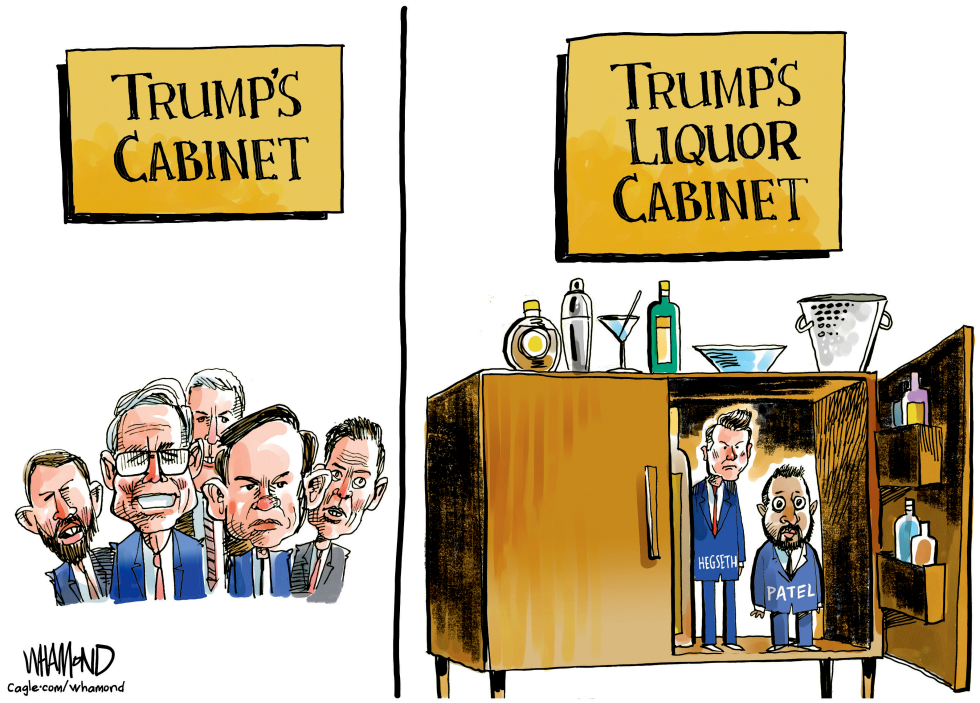
Dave Whamond's cartoon splits the scene between Trump's Cabinet of stern-faced men in suits and Trump's Liquor Cabinet, where caricatures labeled Hegseth and Patel emerge disheveled amid bottles and barware, poking at Trump's cabinet problems. The dry humor targets Kash Patel as FBI director nominee and Pete Hegseth for Secretary of Defense, amid drinking allegations and excessive drinking claims from The Atlantic. Unexplained absences and AWOL accusations add to the satire of unfit picks, with a defamation lawsuit looming. This piece captures the irony of Trump's best people turning into a partying liquor cabinet fiasco, all in a straightforward, insider jab at political absurdity.
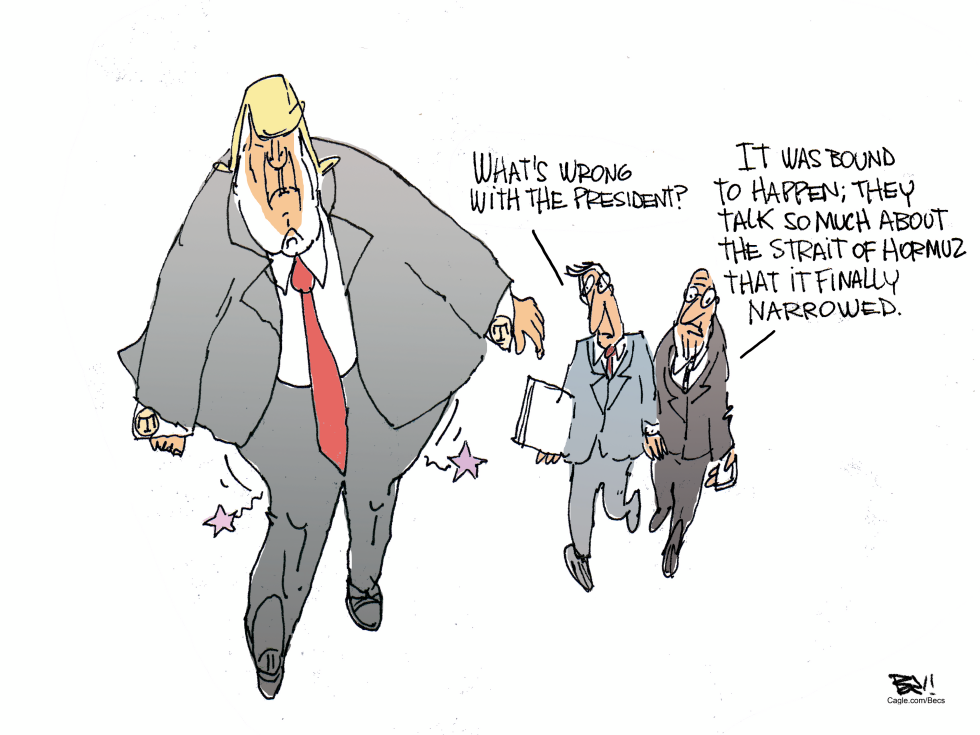
Becs captures the Donald Trump Administration's fixation on the Strait of Hormuz in a cartoon where the president appears stricken, with aides commenting on the inevitable 'narrowing' due to endless talk. This US War satire ties into oil dependencies, Iran tensions, and price per barrel fluctuations, showing a large Trump figure clutching his side amid a pun on geopolitical chokepoints. The image underscores how constant rhetoric about the strait leads to comedic physical distress, blending humor with commentary on foreign policy obsessions.
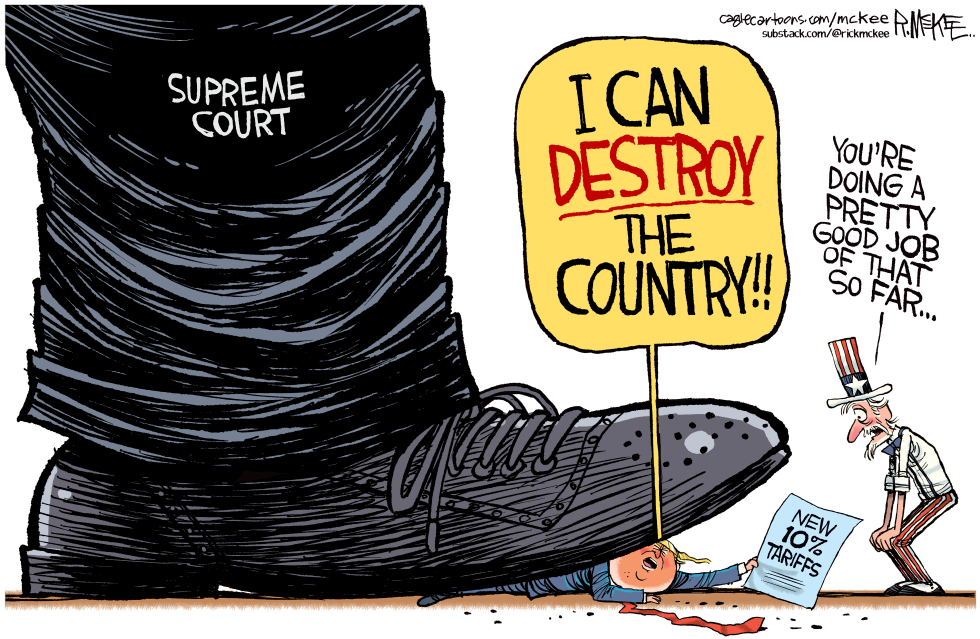
The Supreme Court issued a ruling against new tariffs proposed by former President Trump. The decision halts the 10 percent tariffs shown in the image. Uncle Sam notes the ongoing economic effects.