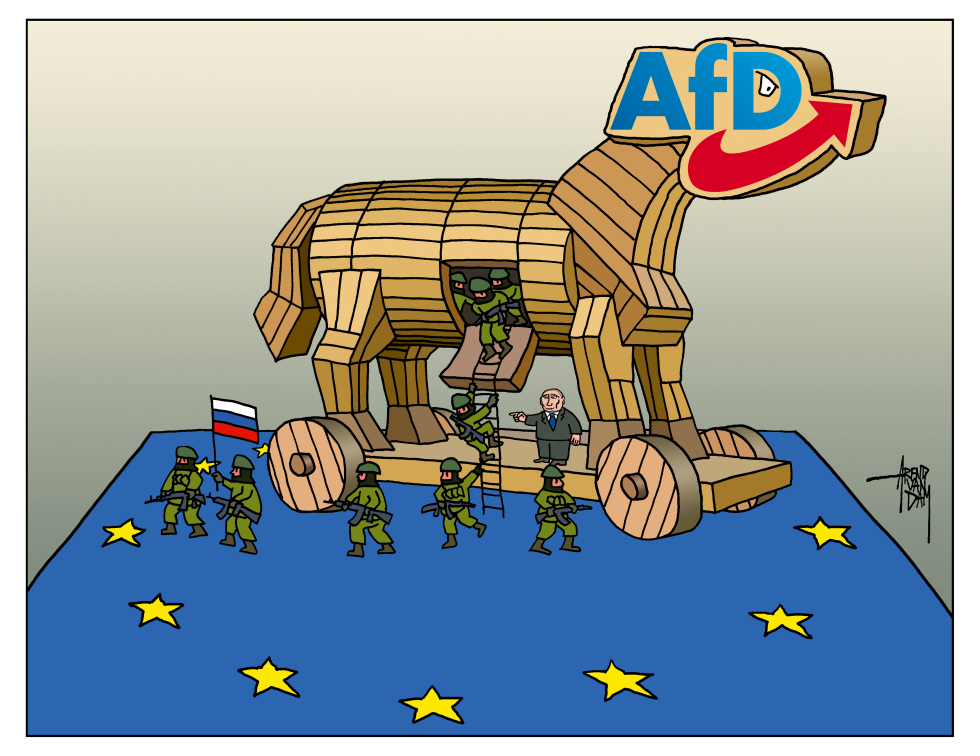
The AfD party in Germany faces accusations of serving as a conduit for Russian influence operations targeting the EU. Vladimir Putin benefits from the far-right group's rising profile ahead of elections, using it to sow division and weaken European unity. The cartoon portrays this dynamic as a classic Trojan horse tactic, with Russian troops emerging from the AfD structure on EU soil. Critics argue the party's policies align too closely with Kremlin interests, undermining NATO and EU cohesion at a critical time. The editorial stance warns that ignoring these ties risks strategic vulnerability for Europe.
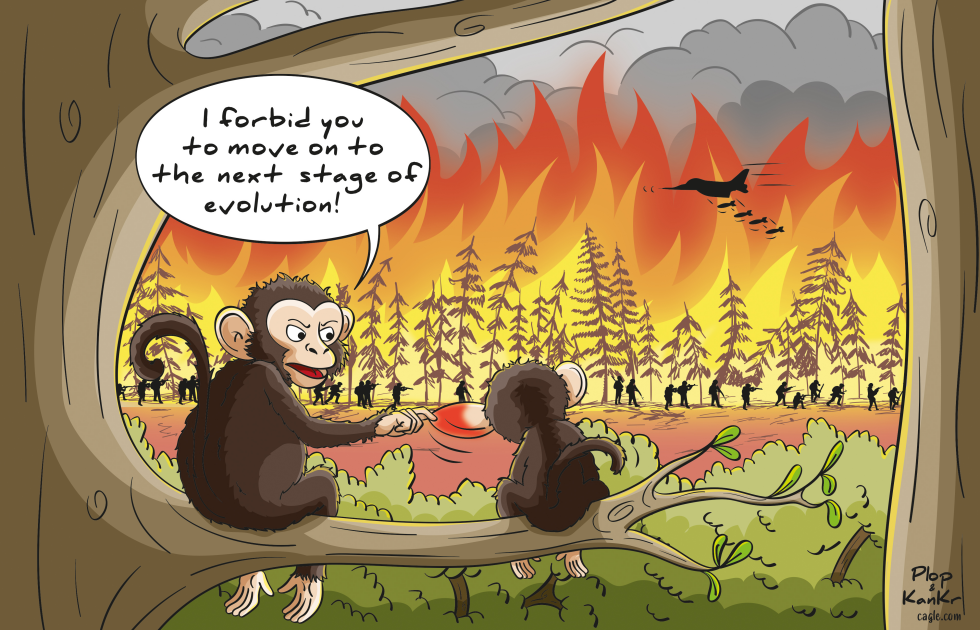
The cartoon published on September 7, 2026, shows two monkeys on a tree branch overlooking a forest fire. One monkey holds a red object and declares it forbids the next stage of evolution. In the background, soldiers stand in formation and a fighter jet flies overhead. The image responds to ongoing themes of war disrupting societal and human development. It uses the monkeys to represent humanity stalled by violence and destruction rather than advancing.
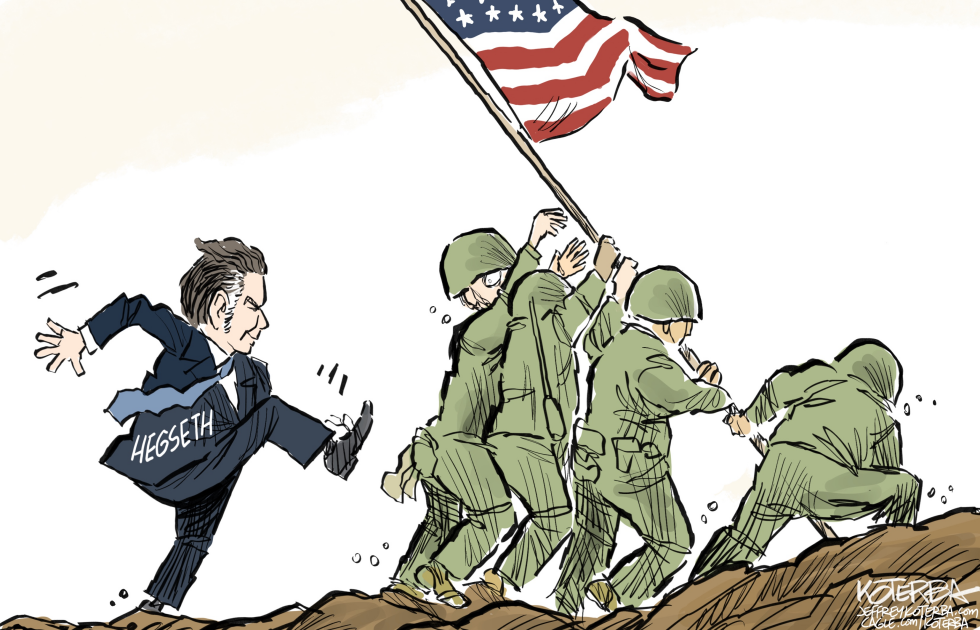
Pete Hegseth's conduct as a defense figure has drawn scrutiny for its effects on military readiness. Reports and commentary point to internal friction and lowered morale within the armed forces. The cartoon frames these developments as direct interference that leaves troops struggling to maintain core functions. Critics argue the pattern reflects broader leadership shortcomings at a time when force preparedness faces external pressures. The piece takes the position that Hegseth's approach actively harms the institution rather than strengthening it.
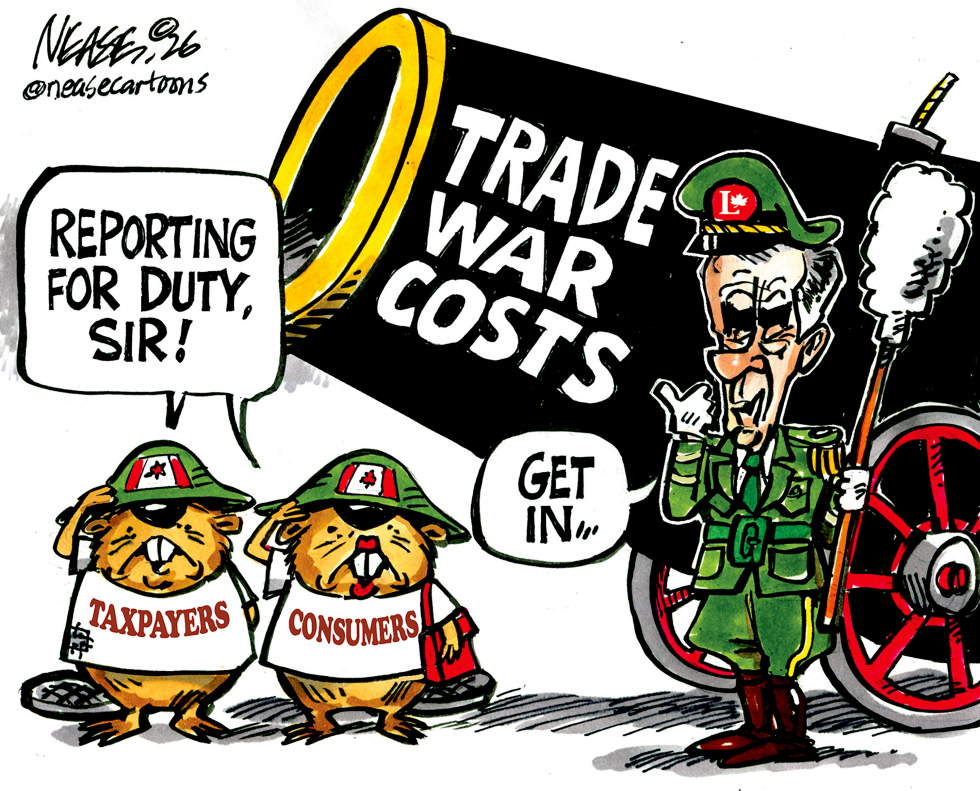
Canadian taxpayers and consumers face rising costs from an ongoing trade dispute. The situation places direct financial pressure on households through higher prices and economic measures. The editorial takes the position that ordinary citizens bear the burden while leadership directs the effort.
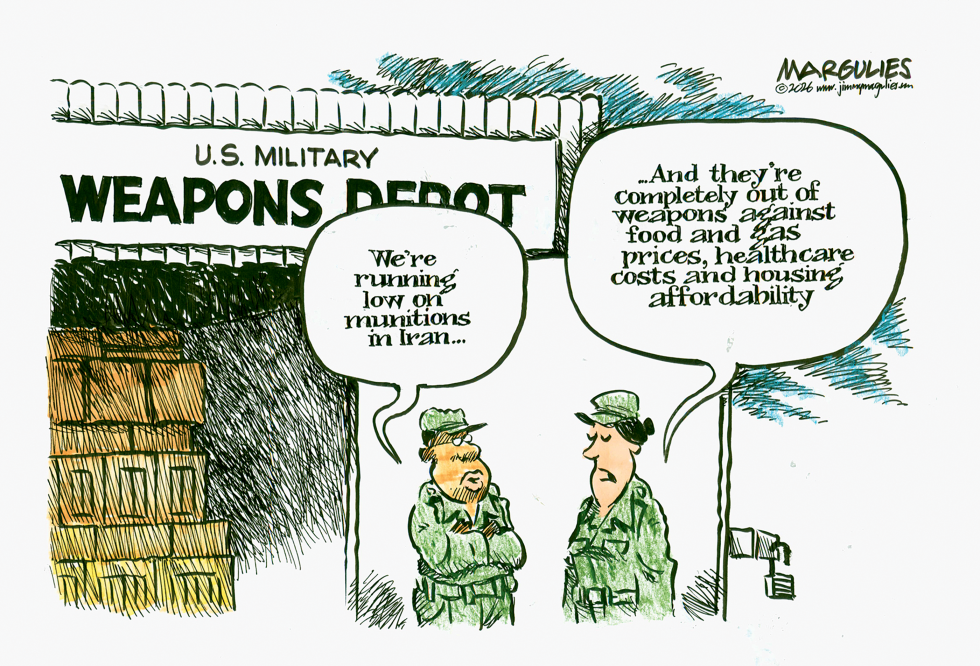
The cartoon depicts two U.S. soldiers outside a weapons depot labeled U.S. Military Weapons Depot. One soldier states the facility is running low on munitions in Iran. The second replies that domestic fronts are out of weapons against food and gas prices, healthcare costs and housing affordability. The image responds to ongoing debates over U.S. military aid commitments abroad and competing budget pressures at home as of the August 2026 publication date. It uses the depot setting and dialogue to contrast foreign military demands with economic challenges facing American households.
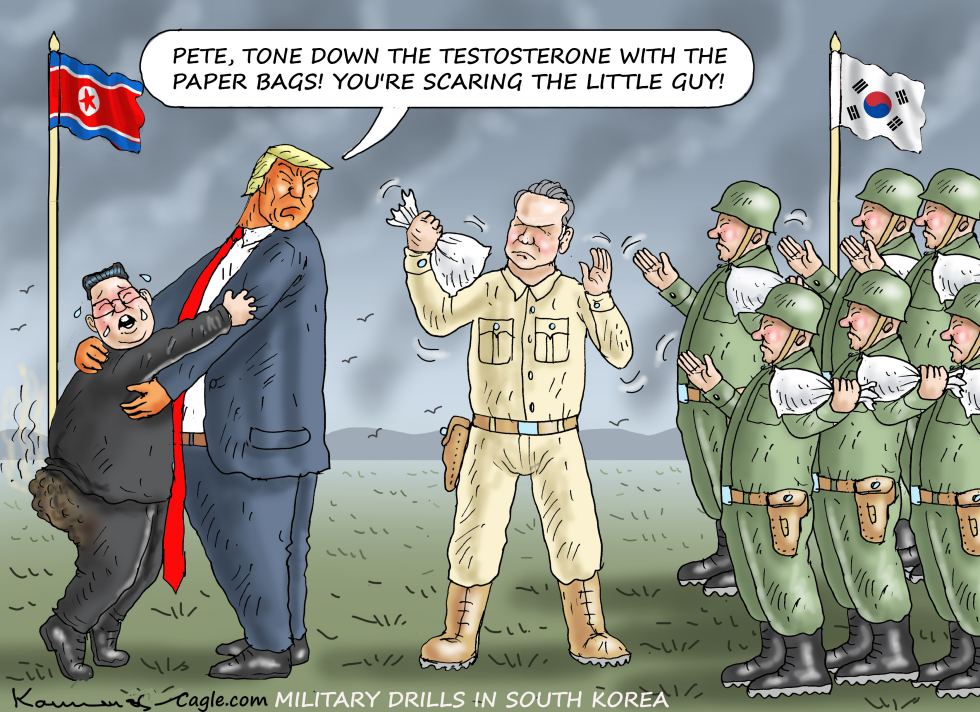
US and South Korean forces conducted joint military drills in mid-August 2026, prompting sharp North Korean protests over perceived threats. Donald Trump appeared at the scene restraining Kim Jong-un while a uniformed figure urged restraint with paper bags to calm the North Korean leader. The image frames the drills as overly provocative and mocks the testosterone-driven posturing on all sides.
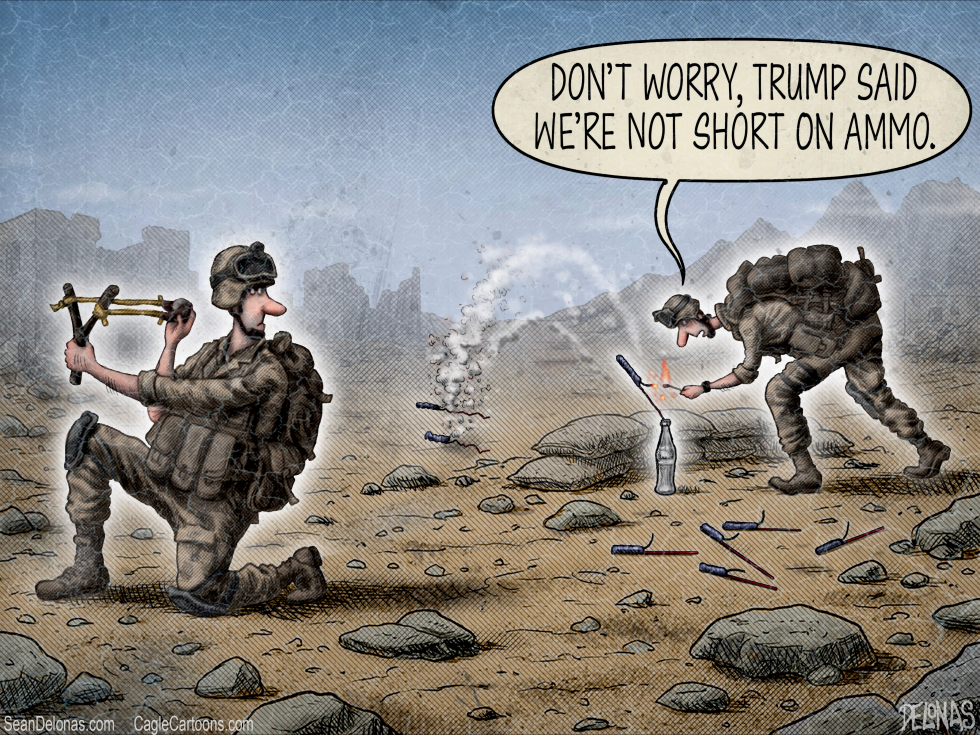
U.S. forces in a desert conflict zone report ammunition shortages forcing improvised weapons. The situation highlights strains on military logistics during ongoing operations. The piece critiques assurances from leadership that supplies remain adequate.
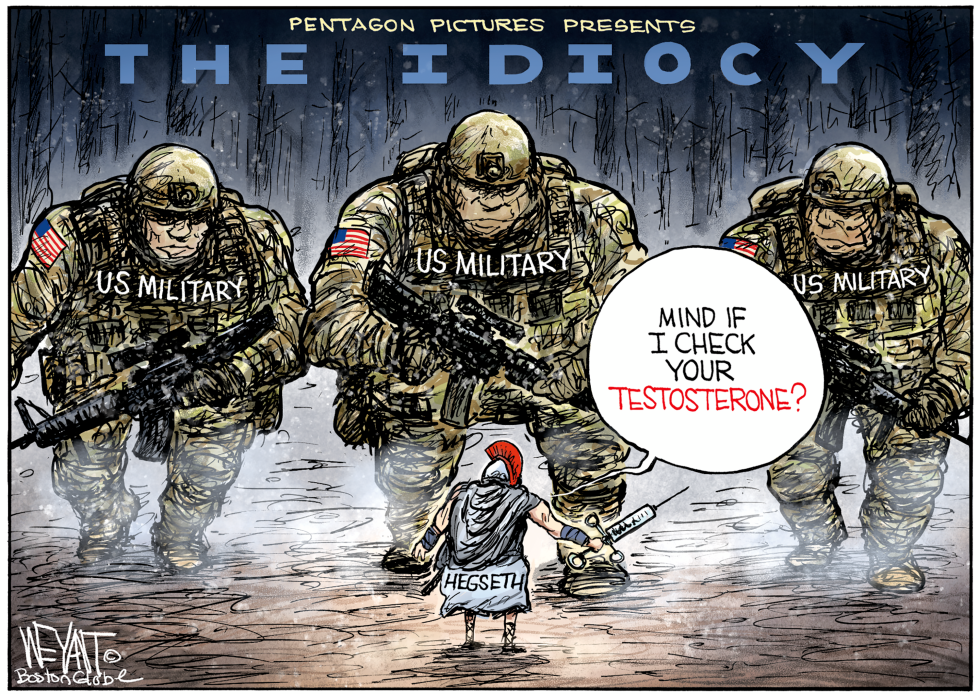
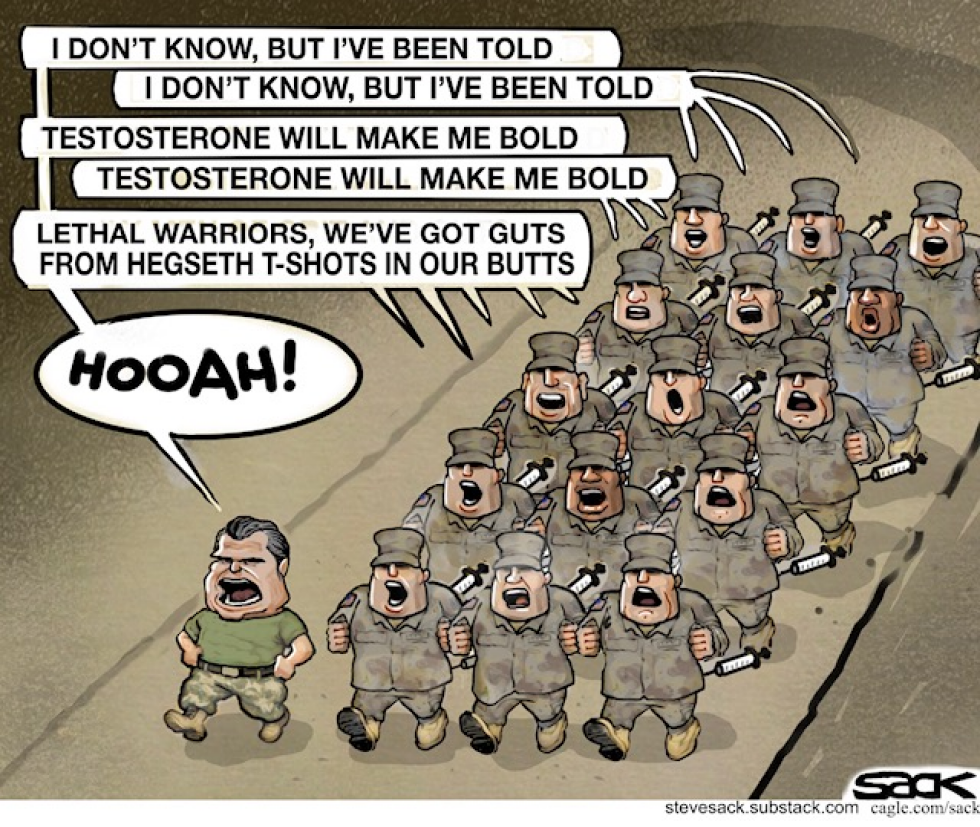
Defense Secretary Pete Hegseth has directed new scrutiny of testosterone levels across US military units. The move comes as the Pentagon reviews physical readiness standards for combat roles. Critics argue the focus distracts from broader readiness issues while supporters say it enforces accountability. The editorial takes the position that such micromanagement undermines troop morale and operational effectiveness.
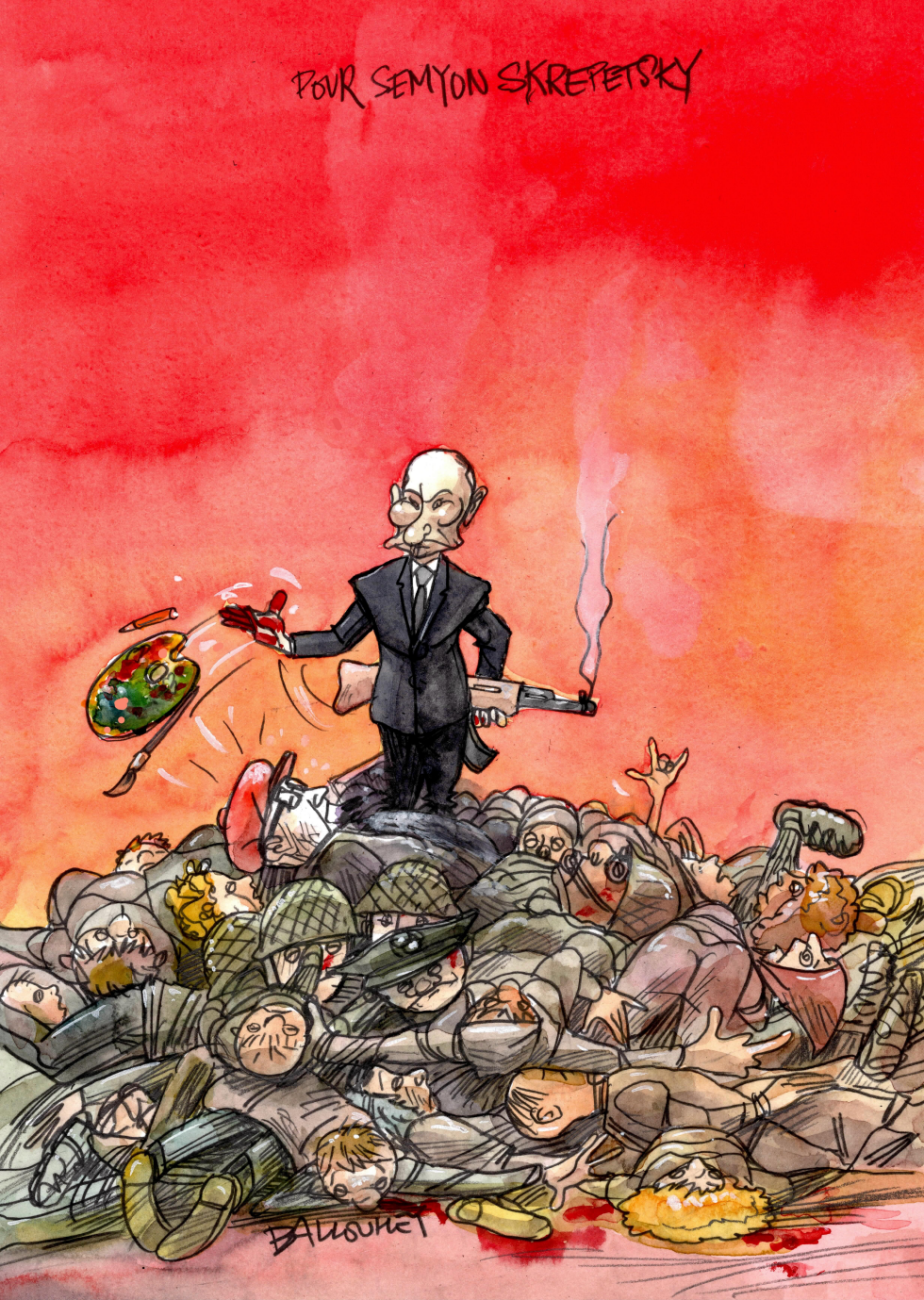
The illustration shows Semyon Skrepetsky standing on a heap of dead soldiers. He grips a rifle in one hand and a painter's palette in the other. Smoke rises from the weapon. The red-orange background suggests conflict. Text above reads 'POUR SEMYON SKREPETSKY'. The scene responds to ongoing military developments involving Russian forces as of the August 2026 publication date. The composition places the central figure above the casualties to emphasize the human cost of the fighting.
Defense Secretary Pete Hegseth's push for testosterone supplementation in the ranks drew fresh attention when troops adopted a new marching cadence crediting the shots for battlefield edge. The policy aims to sharpen combat performance amid recruitment shortfalls and readiness concerns. The cartoon frames the initiative as an over-the-top fix that reduces warrior ethos to chemical enhancement.
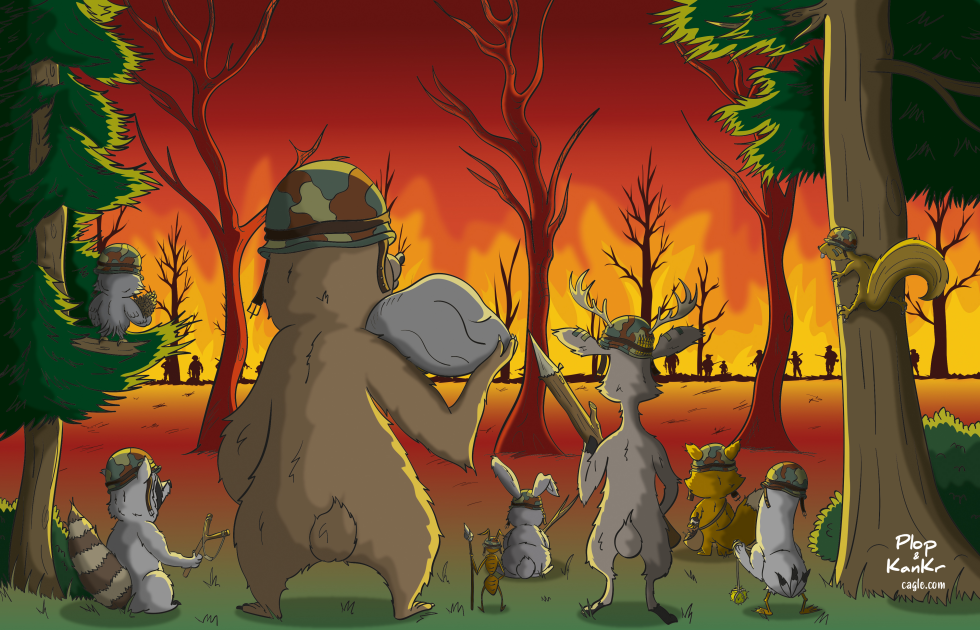
Anthropomorphic animals wearing military helmets occupy a forest where flames rise from the ground and trees. A large bear holds a rock while a deer grips a spear. Smaller figures include raccoons with bows and a squirrel on a trunk. Silhouettes appear in the background against an orange and red sky. The scene shows animals positioned throughout the burning area with weapons visible.
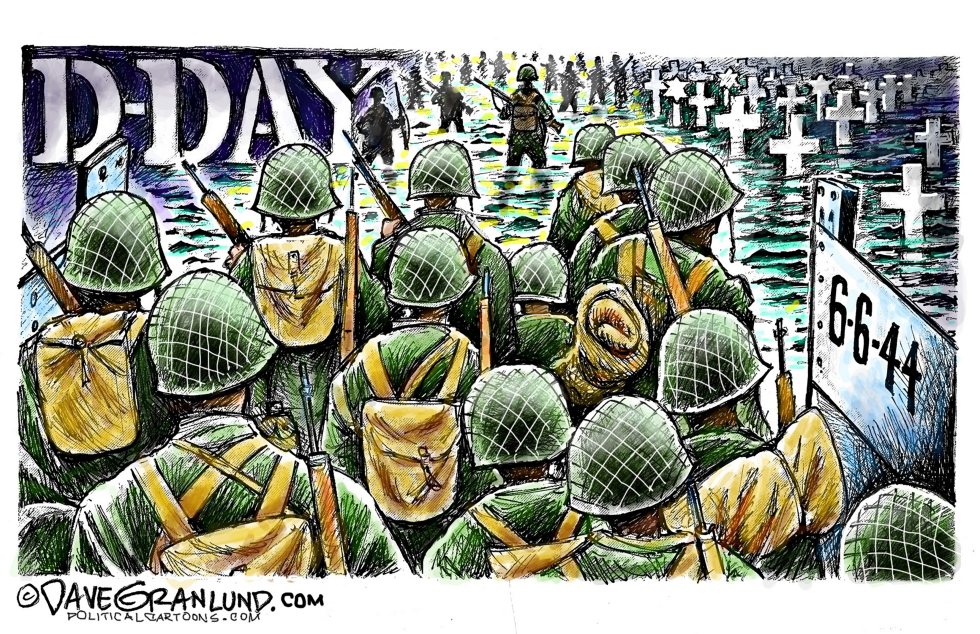
The image marks the June 6 1944 D-Day landings. Soldiers in green helmets and packs move through shallow water. Rows of white crosses stand in the surf behind them. A sign displays 6-6-44 on the right. The scene recalls the Allied invasion of Normandy during World War II.
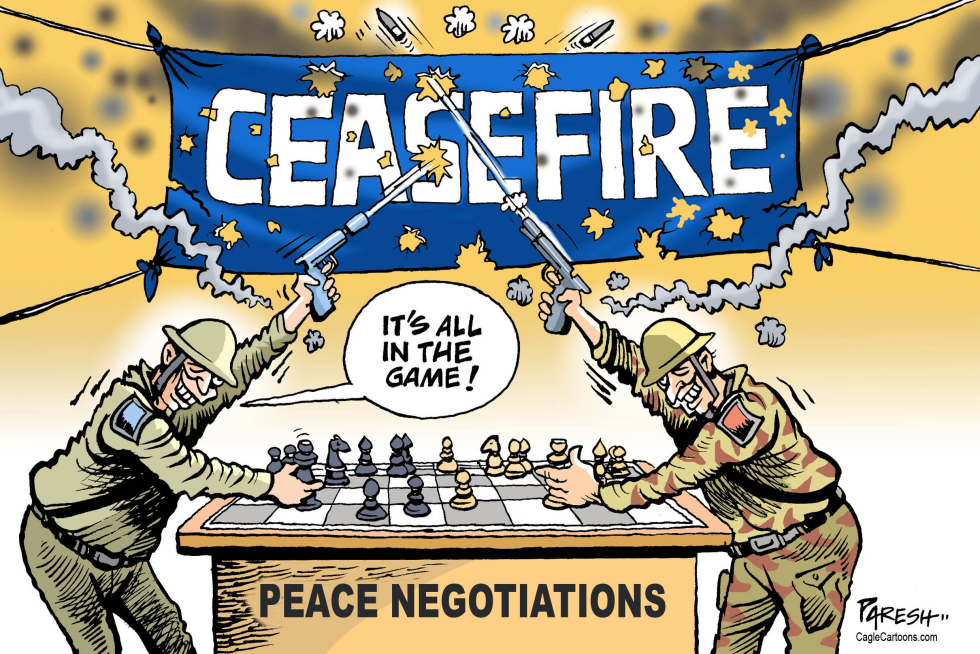
The cartoon depicts two soldiers in different uniforms aiming pistols at each other across a chessboard marked peace negotiations. A large blue banner reading ceasefire hangs above with multiple bullet holes and tears. One soldier declares it is all in the game. The scene illustrates the tension in ongoing Middle East ceasefire efforts involving multiple parties.