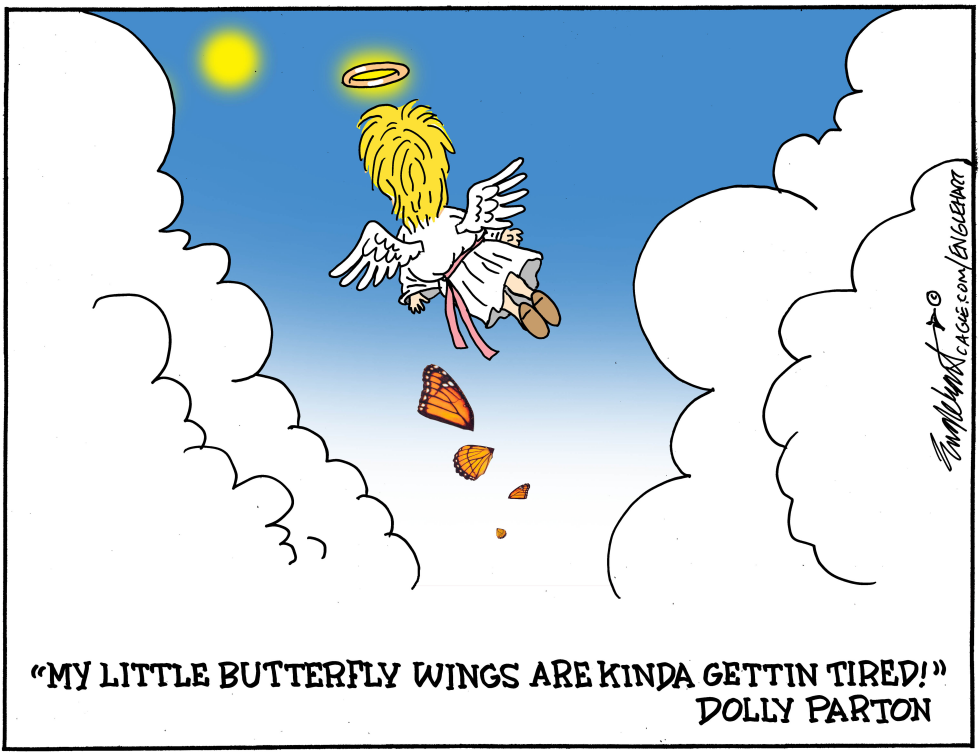
Dolly Parton receives an obituary-style tribute in 2026. The image shows her as an angel whose butterfly wings are falling away. The piece offers a gentle farewell to the country music icon.
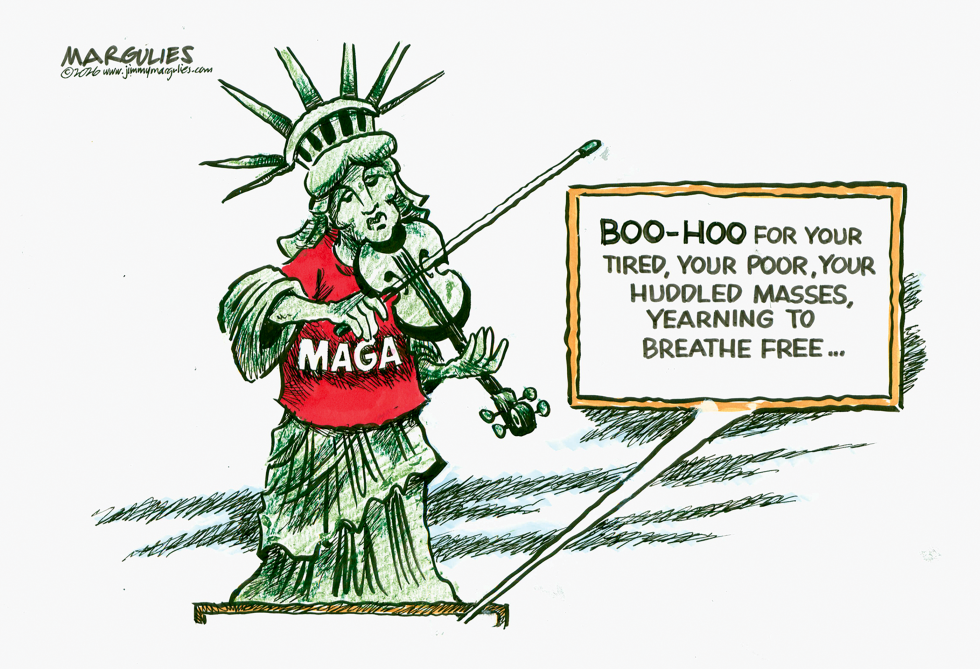
The image shows the Statue of Liberty wearing a red MAGA shirt and playing a violin while pointing to a sign that alters the famous immigration inscription to read boo-hoo for the tired and poor.
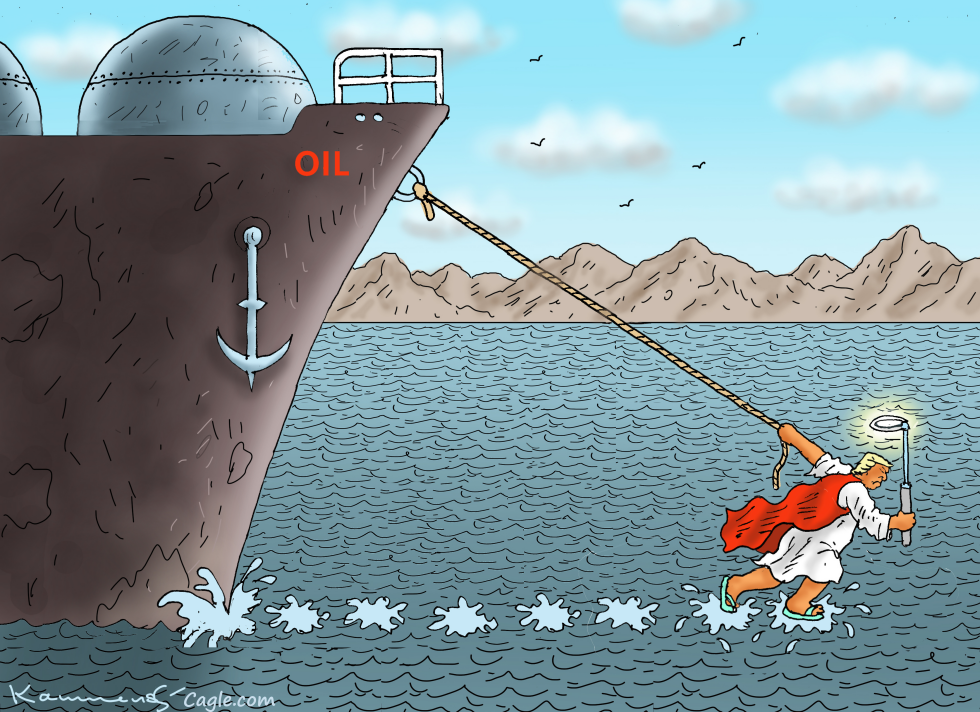
The image depicts a figure dressed in a white robe and red cape, complete with a glowing halo, running across the water while pulling a large oil tanker marked 'OIL' with a rope. He holds a golf club in one hand, splashing water with each step against a backdrop of mountains and a clear sky. This setup draws on tags like Trump, Hormuz, Iran, oil war, MAGA terror, and fascism to satirize political figures intervening in global oil crises. The cartoon's composition emphasizes the absurdity of a divine savior tackling economic and geopolitical issues, with birds flying overhead and distant peaks suggesting a Middle Eastern strait. Kamensky's style brings dry humor to the forefront, poking at notions of messianic leadership in turbulent times.
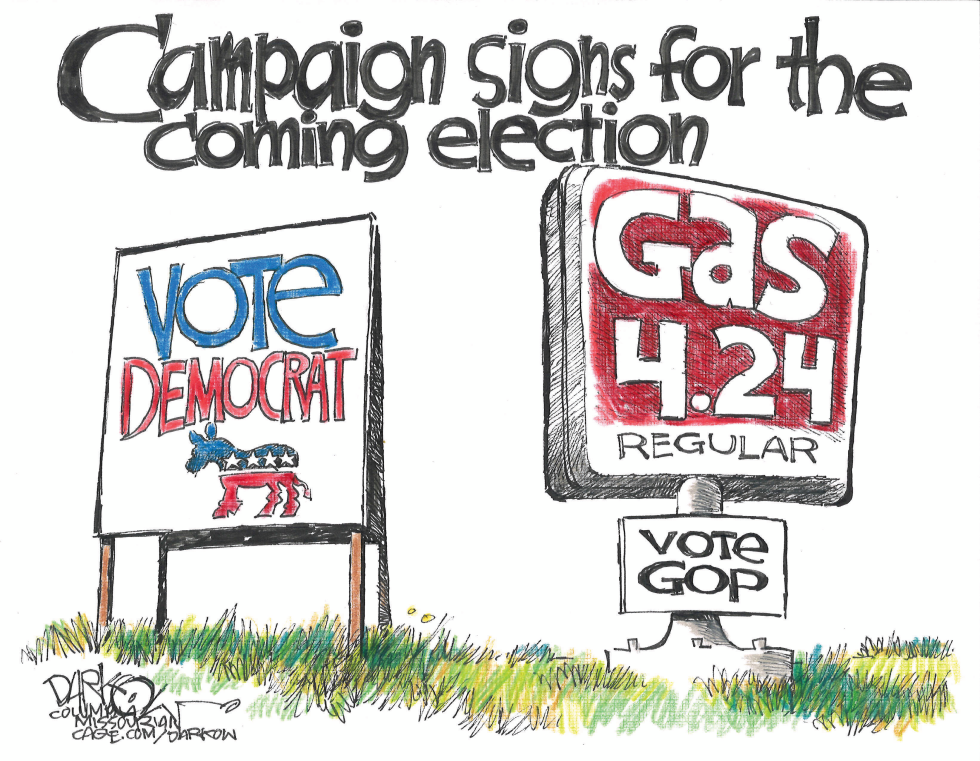
John Darkow's cartoon shows campaign signs for the coming election, with a straightforward Vote Democrat board featuring a blue donkey symbol, contrasted by a gas station-style sign advertising GAS 4.24 REGULAR and a small Vote GOP placard below. The image ties into 2026 midterms themes, highlighting gas prices, affordability, inflation, Strait of Hormuz tensions, cost of living pressures, and party strategies. The dry humor points to how economic issues like fuel costs become central in political advertising, with the GOP sign mimicking a bargain price to appeal to voters frustrated by rising expenses. This setup captures the insider view of how cartoons simplify complex voter concerns into visual punches.
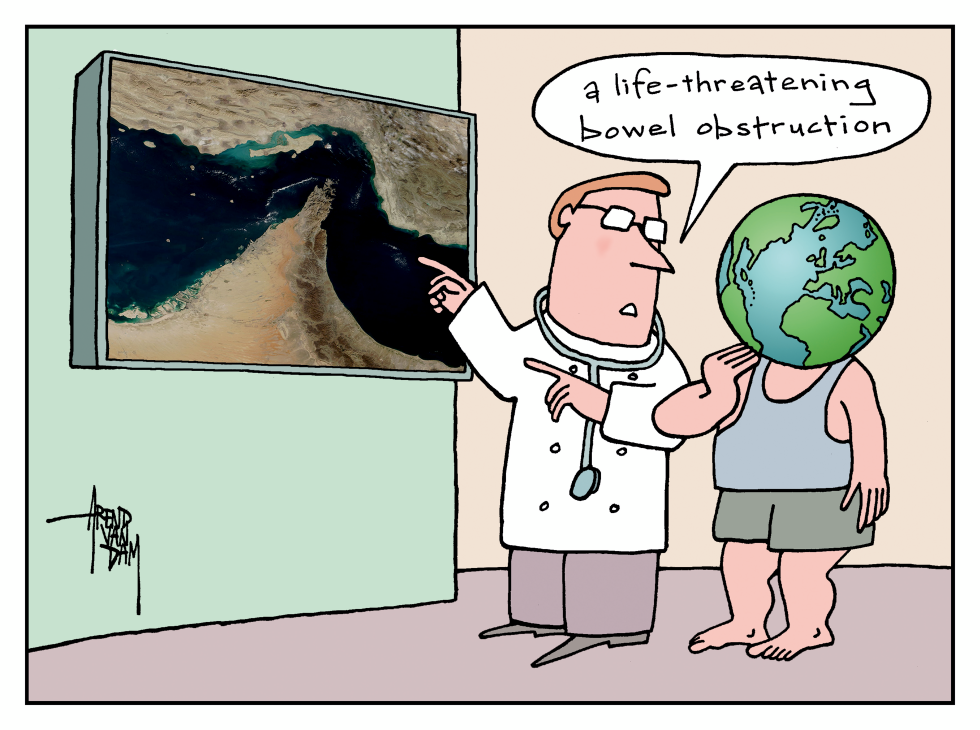
Arend van Dam\'s cartoon depicts a doctor diagnosing a child-like figure with a globe for a head, pointing to a screen showing the Strait of Hormuz as a life-threatening bowel obstruction. This visual metaphor ties into tags such as economy, world, oil, gas, obstruction, and war, illustrating how blockages in key trade routes threaten global stability. The barefoot patient in casual attire underscores vulnerability, while the doctor\'s serious demeanor adds dry humor to the geopolitical satire. Negotiations with ayatollahs and regime sanctions loom in the background, making the image a pointed commentary on how such conflicts create economic chokepoints. The overall composition blends medical analogy with international affairs for sharable impact.
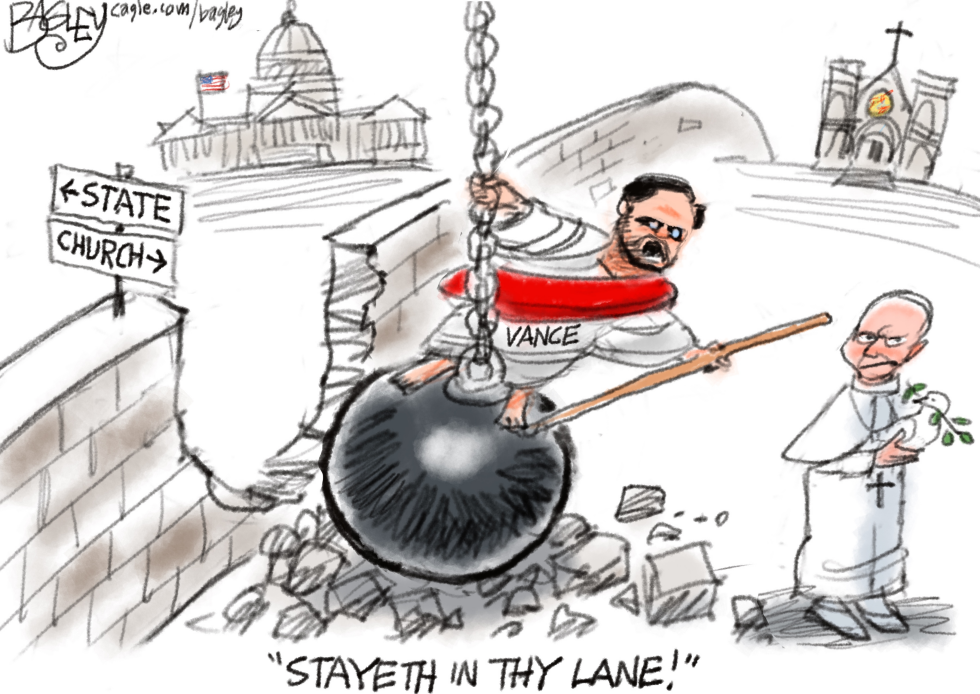
Pat Bagley's cartoon shows JD Vance dressed as Jesus, labeled 'VANCE,' swinging a massive wrecking ball to shatter a brick wall marked with signs pointing to 'STATE' and 'CHURCH.' He shouts 'STAYETH IN THY LANE!' at a figure resembling the Pope, who holds an olive branch and dove, symbols of peace. In the background, the U.S. Capitol flies an American flag, while a church with a cross represents the Vatican. Tags like war, peace, JD Vance, religion, Trump, and scripture underscore the satire on blurring lines between church and state, with Vance enforcing boundaries ironically through destruction. The image critiques political figures invoking religion amid Capitol politics.
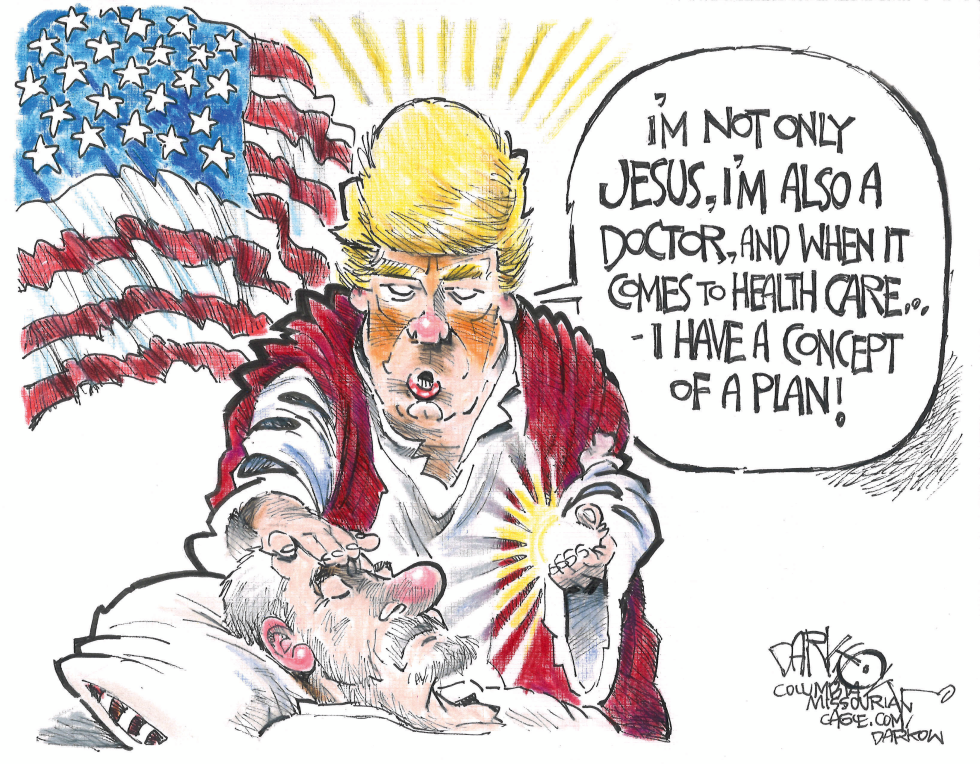
John Darkow's cartoon shows a blonde-haired figure resembling Donald Trump, clad in a red cape and white garment, extending a glowing hand toward an elderly man lying in bed. An American flag waves in the background with radiant beams from above. The speech bubble declares the figure as both Jesus and a doctor, boasting a concept of a health care plan. This setup highlights satirical elements in political imagery. Tags like donald trump political cartoon, trump health care plan satire, jesus doctor parody cartoon, american flag political humor, trump messiah complex illustration, and health care policy cartoon fit the visible components.
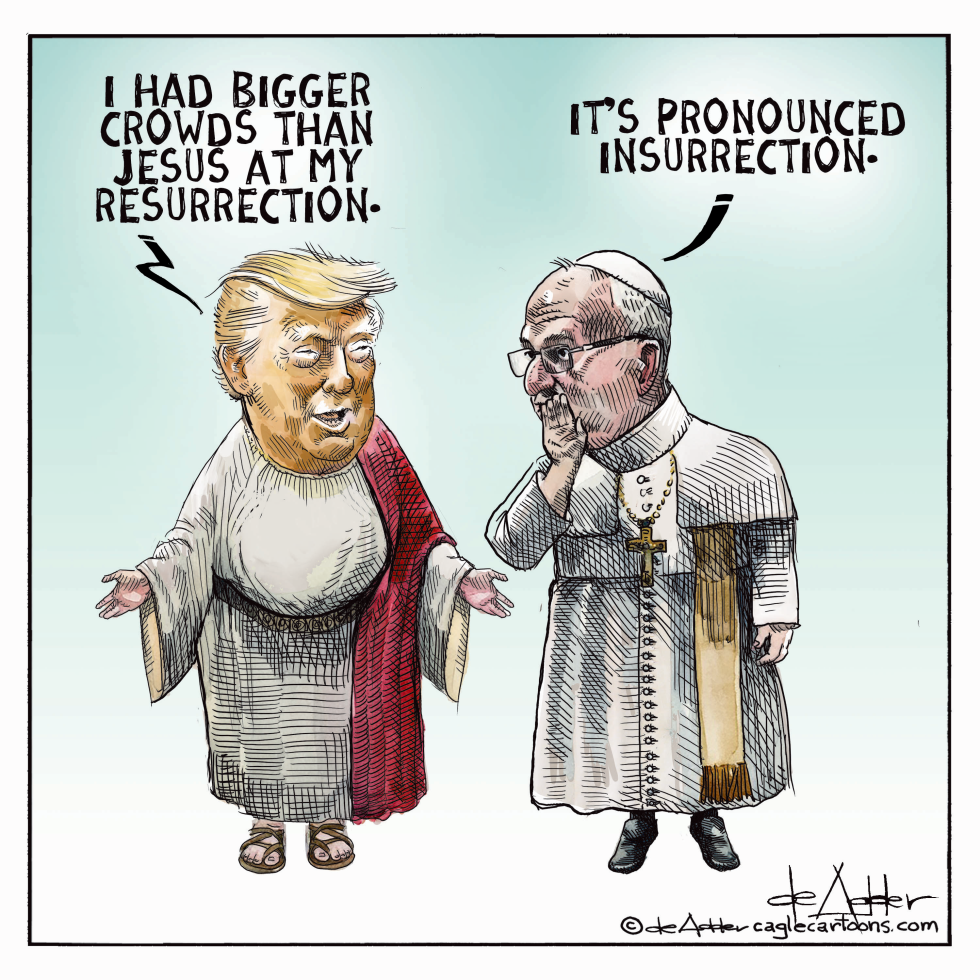
The cartoon depicts Donald Trump as Jesus Christ, complete with robe and sandals, claiming he had bigger crowds than Jesus at his resurrection. Standing beside him is the Pope, dressed in traditional Vatican attire with glasses and a cross, correcting the pronunciation to insurrection. Tags like Trump, Pope, Jesus, resurrection, and insurrection drive the humor, poking at Trump's known obsession with crowd sizes and linking it to the January 6 events. The artist, Michael de Adder, uses simple lines and a light background to focus on the figures and dialogue, creating a sharp satirical commentary on arrogance and political missteps. This piece fits well in editorial sections, blending religious imagery with current politics for a dry, pointed laugh.
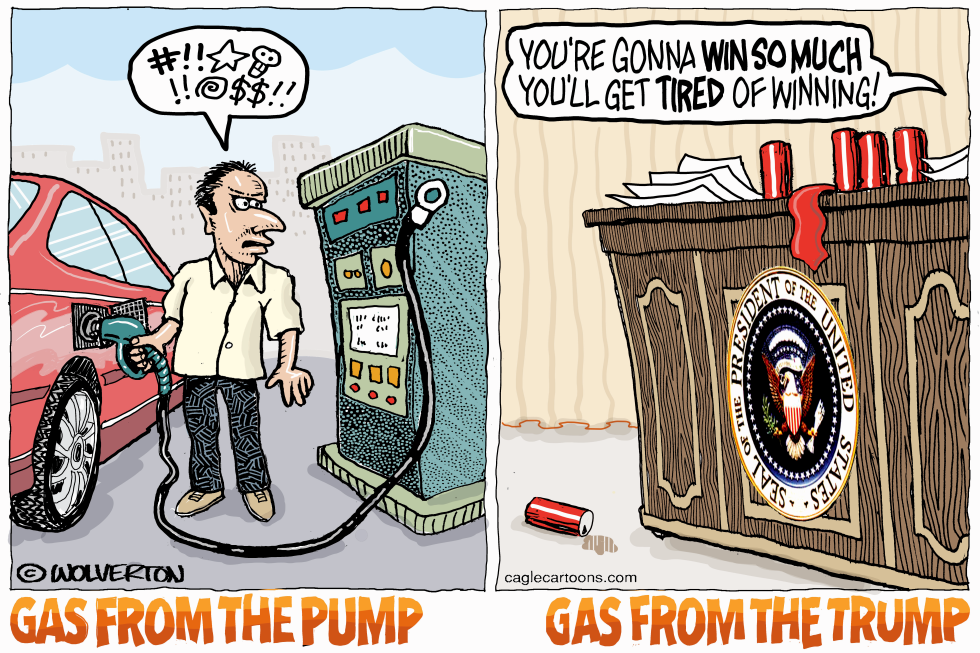
The cartoon splits into two panels: one shows a man at a car at gas pump, angrily reacting with symbols to high gasoline prices labeled as gas from the pump. The other depicts the Resolute Desk with the presidential seal, scattered papers, and coke cans, a speech bubble proclaiming 'You're gonna win so much! You'll get tired of winning!' tagged as gas from Trump. Tags like petrol, tired of winning, and Oval Office highlight the pun on 'gas' as fuel versus bluster. This setup comments on economic pains versus political rhetoric, using elements like the car at gas pump and coke cans for visual punch. The dry humor ties into ongoing debates on gasoline prices and leadership promises.
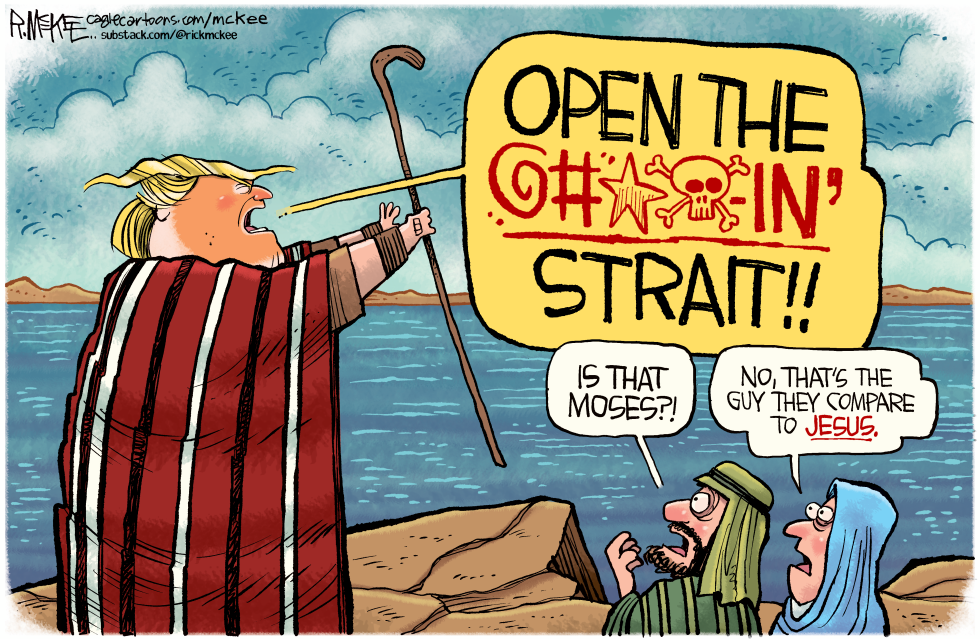
Rick McKee's cartoon depicts a blond-haired man resembling Donald Trump, dressed in red robes, holding a staff and yelling 'OPEN THE C@#*in' STRAIT!!' at a body of water, evoking the Moses parting the Red Sea scene. In the foreground, two ancient-dressed figures converse: one asks if it's Moges, the other clarifies it's the guy compared to Jesus. The image ties into tags like Trump, Easter, Iran, Israel, war, Strait of Hormuz, blending biblical imagery with modern political satire on Trump's self-comparisons and international tensions. The censored profanity adds a layer of obscenity to the parody, set against a desert landscape with clouds.
John Darkow's cartoon captures the Artemis II crew gazing through their spacecraft window at the far side of the moon, where craters frame an unexpected sight: the Midvale School for the Gifted from Gary Larson's The Far Side, complete with a striped-shirted figure fumbling at a 'pull' door on stairs. Tagged with artemis ii, moon flyby, far side, gary larson, nasa, space, and science, the image blends real space exploration with absurd humor. One crew member exclaims excitement, labeled with Artemis II Crew and NASA markings. This satire highlights the blend of high-stakes missions and pop culture whimsy, poking fun at what astronauts might hope to find beyond the visible lunar surface. The dry wit underscores how science fiction tropes collide with actual programs like Artemis II.
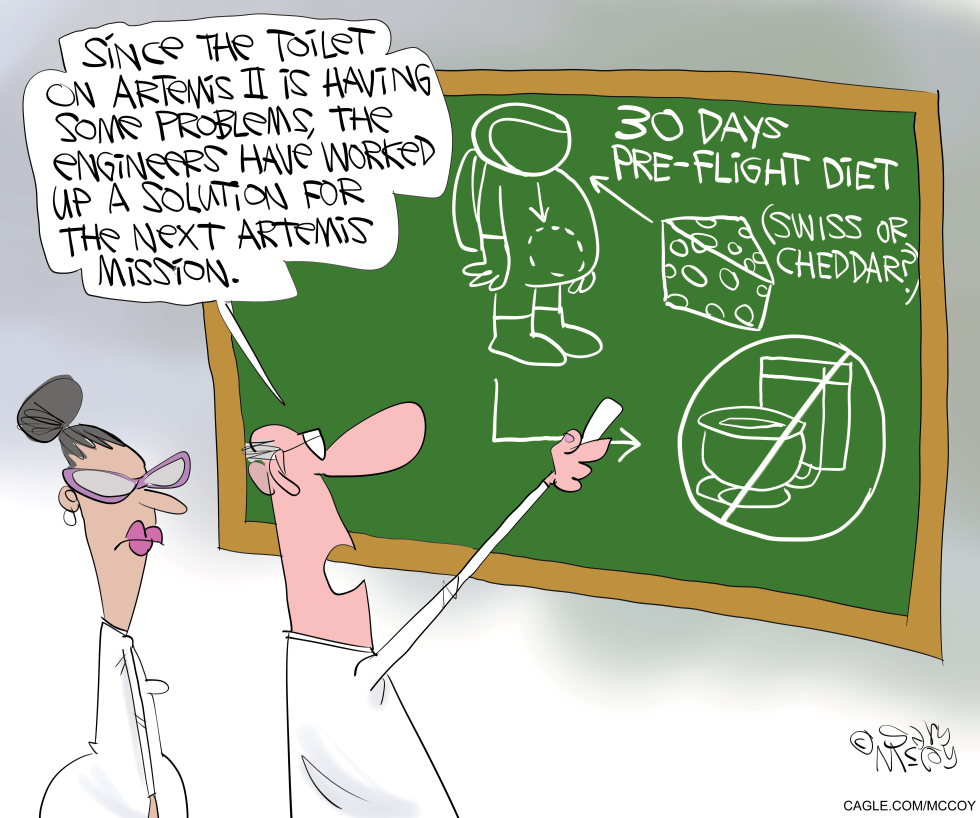
Gary McCoy\\\'s political cartoon depicts two figures in white coats, one pointing to a chalkboard with a speech bubble explaining a solution to Artemis II toilet problems via a 30-day pre-flight diet of Swiss or cheddar cheese. The board features a bloated astronaut sketch, a cheese cube, and a crossed-out toilet, poking fun at NASA engineering woes. This space mission satire uses dry humor to comment on technical glitches in the Artemis program, with tags like NASA Artemis II toilet problems, engineers solution Artemis mission, space mission pre-flight diet, Gary McCoy cartoon, cheesy diet fix, and humorous take on NASA solutions. The image stays light-hearted, focusing on visible elements without deeper speculation.
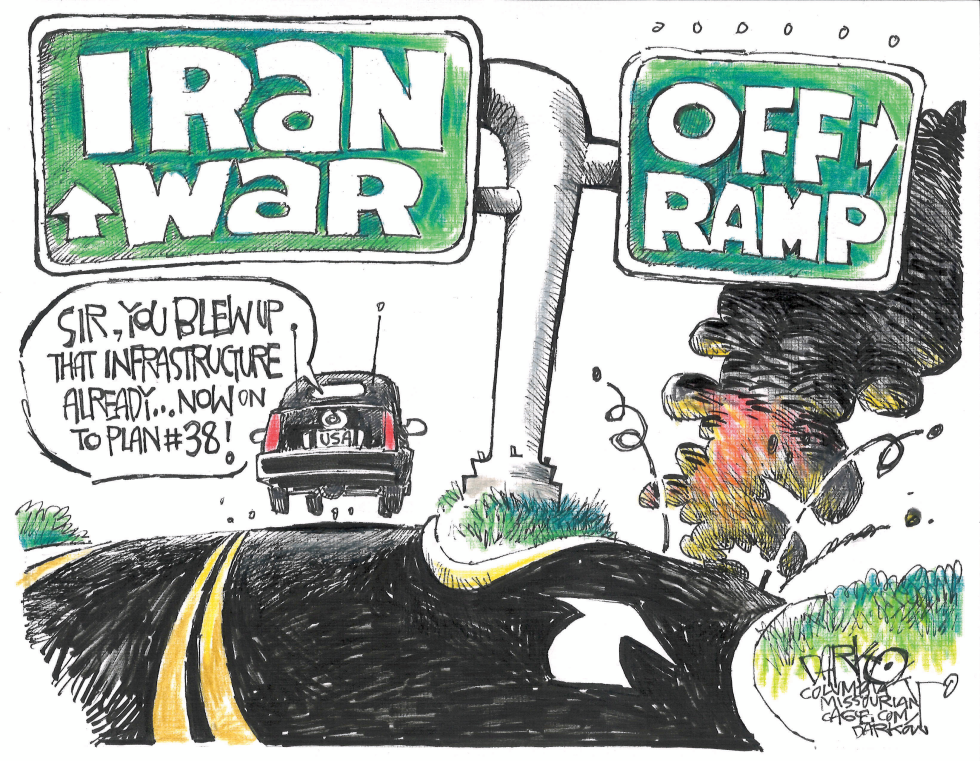
This daryl cagle political cartoon shows a highway split with signs for iran war upward and off ramp rightward, where a usa license plate car drives into an explosion. The car\'s speech bubble says, \'SIR, YOU BLEW UP THAT INFRASTRUCTURE ALREADY... NOW ON TO PLAN #38!\' highlighting satirical destruction. Amid grass and road lines, the image mocks usa iran conflict satire through off ramp infrastructure destruction cartoon, emphasizing failed exits in political cartoon usa foreign policy. The irreverent style captures highway to iran war illustration with humorous despair over repeated plans.
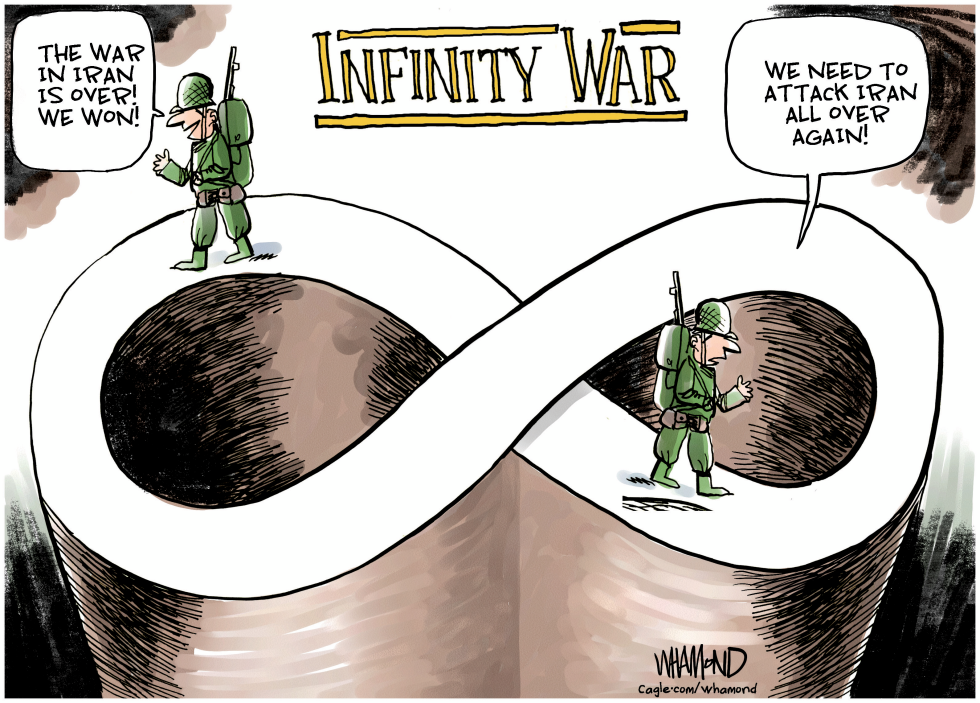
Dave Whamond's cartoon features two soldiers positioned on a large infinity symbol, one announcing victory in the Iran war while the other insists on attacking again, highlighting the perpetual nature of conflict. The title 'Infinity War' parodies endless warfare, with the loop representing cycles of victory and renewed aggression. Tags like iran war cartoon, infinity symbol war, endless conflict satire, military parody, perpetual war illustration, and satirical soldiers emphasize the dry humor in depicting how wars in regions like Iran seem to restart indefinitely, a common theme in political cartoons that resonates with ongoing global tensions.