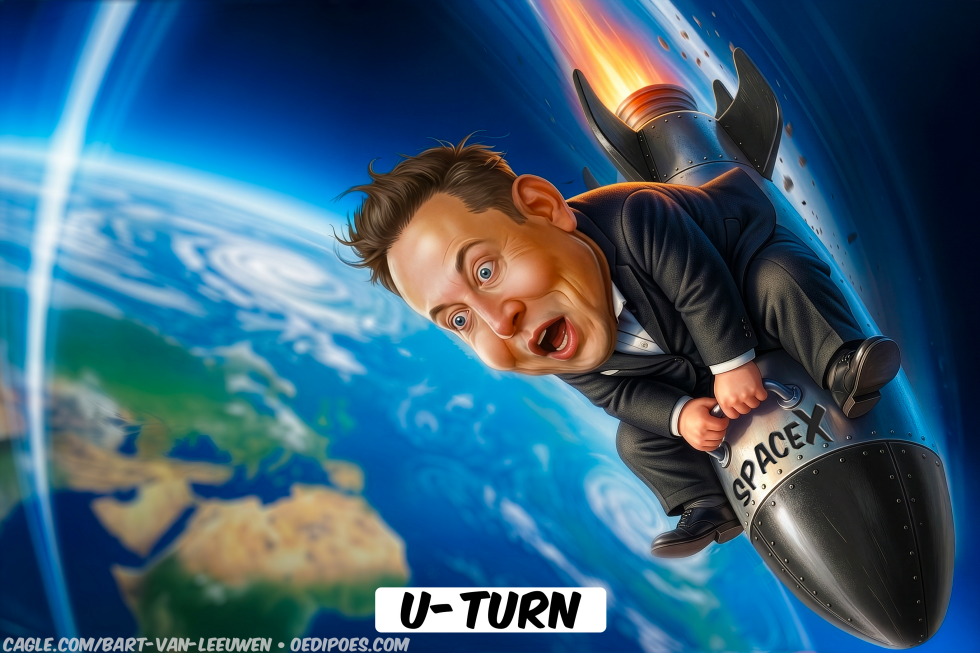
The image shows Elon Musk clinging to a SpaceX rocket that is executing a sharp U-turn back toward Earth. The rocket trails fire as it curves from space toward the planet's surface. Musk appears wide-eyed and open-mouthed in alarm. The scene is set against a backdrop of blue atmosphere and visible continents. Text labels identify the maneuver as a U-turn.
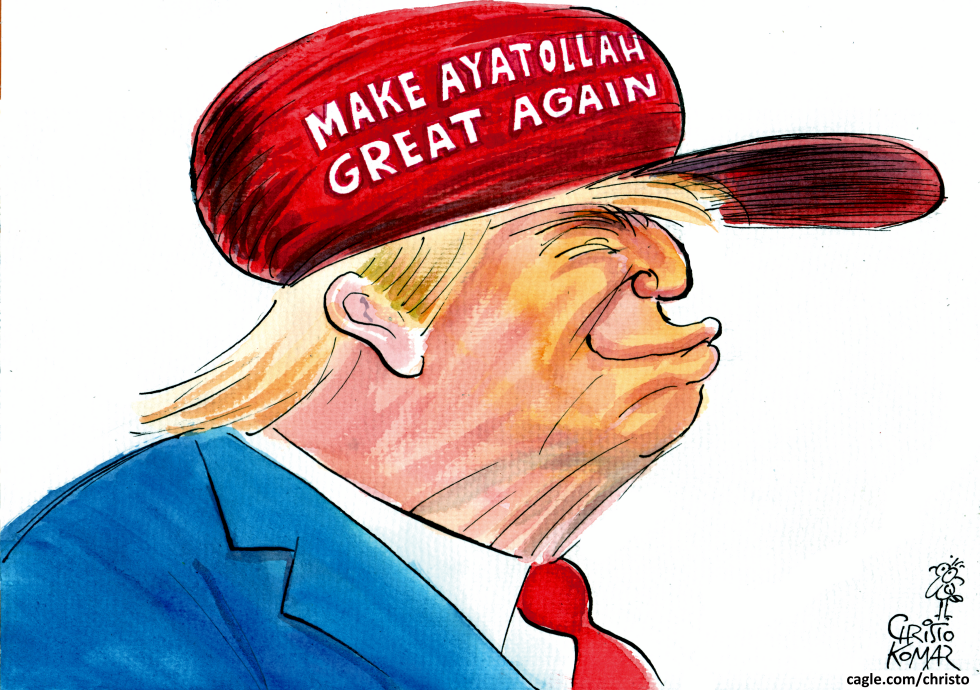
The drawing depicts Donald Trump in profile wearing a blue suit, white shirt and red tie. A red baseball cap sits on his head with the slogan Make Ayatollah Great Again printed in white letters. The image is signed by Christo Komarnitski and carries a cagle.com credit.
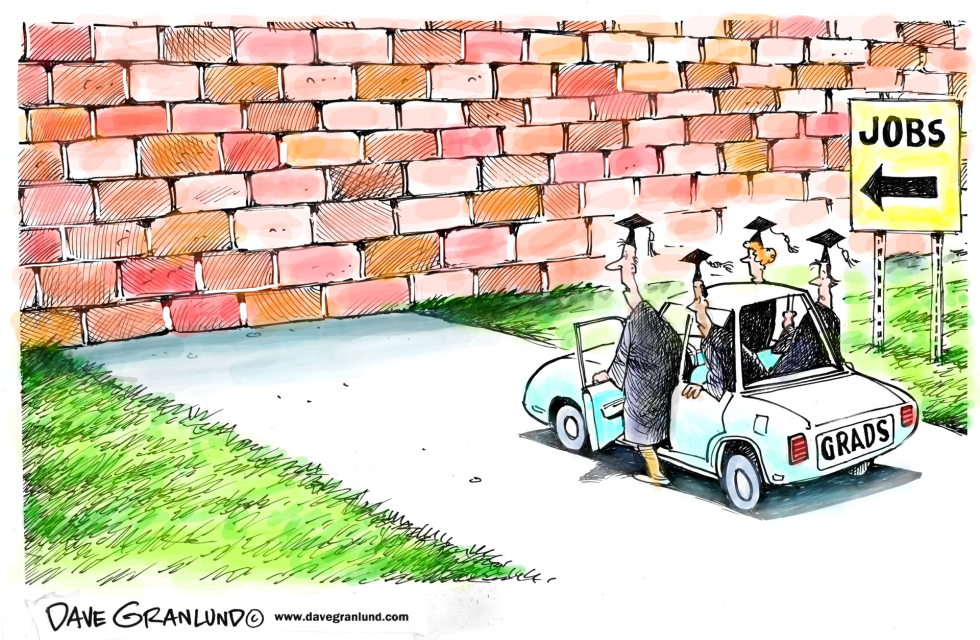
A group of graduates in a car labeled GRADS heads toward a yellow JOBS sign but faces a tall brick wall blocking the way. The image highlights difficulties recent diploma holders encounter when seeking employment in a constrained market.
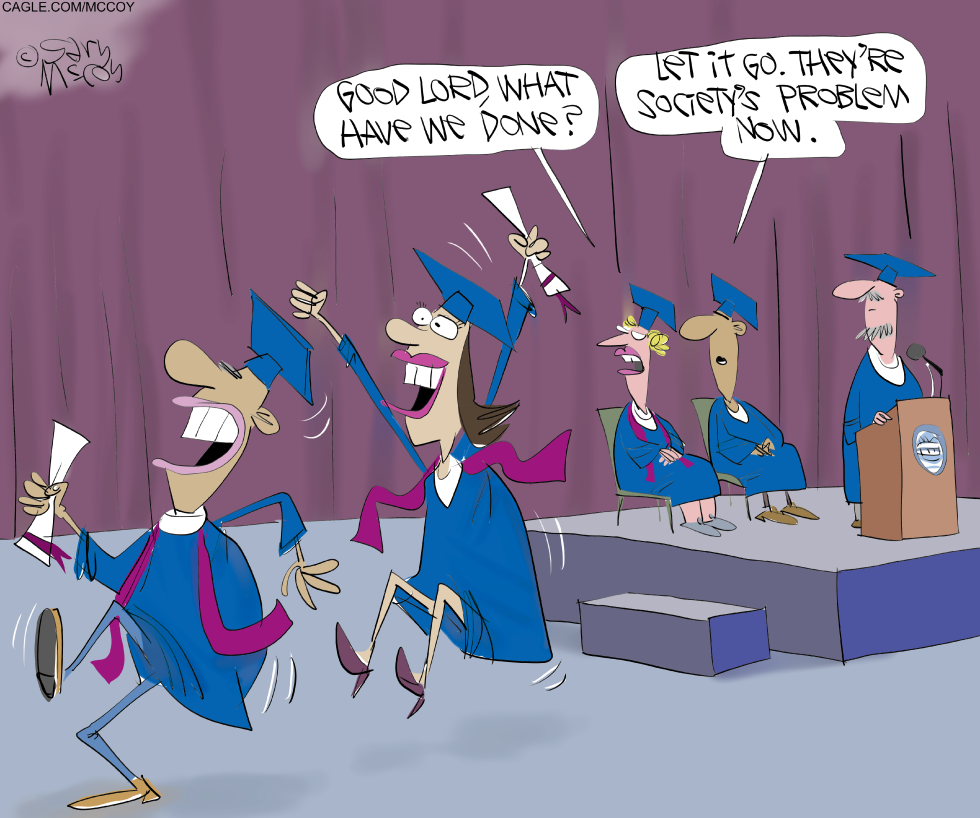
The cartoon shows two graduates in blue caps and gowns dancing energetically on a stage during what appears to be a graduation ceremony. One waves a diploma overhead while the other kicks a leg high. Three seated graduates in the background display open-mouthed expressions. A man at a podium with a microphone stands to the right. Speech bubbles contain the lines Good Lord what have we done and Let it go. They are society's problem now. The background is a plain purple curtain and gray stage floor.
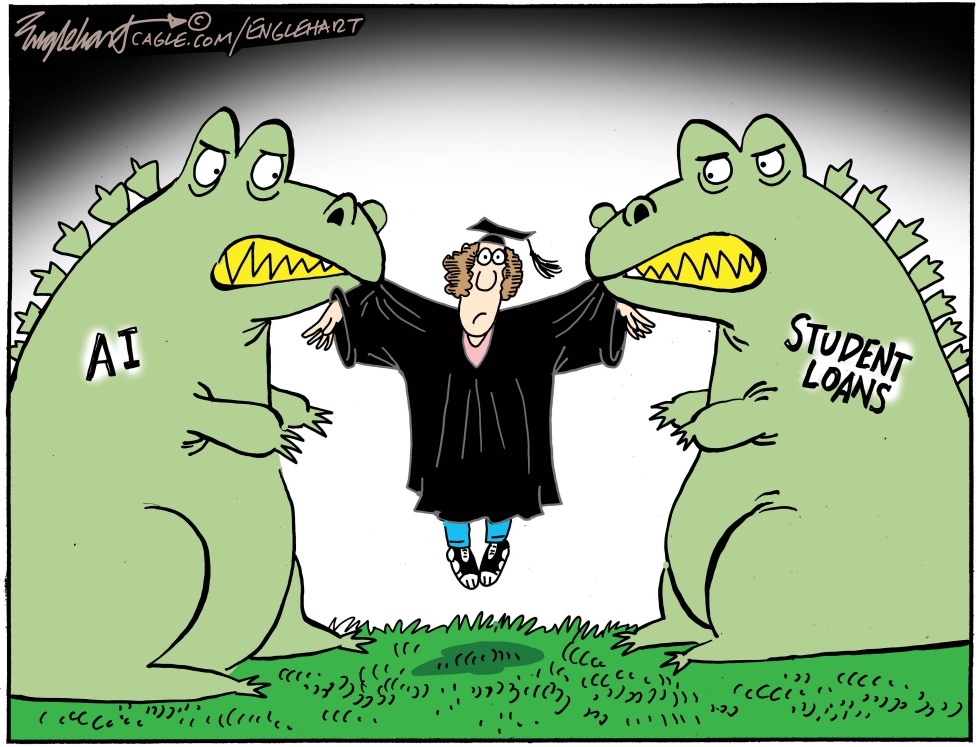
The cartoon shows a 2026 graduate caught between an AI alligator on the left and a student loans alligator on the right. Both creatures stand on green grass with open jaws. The graduate wears a black gown, blue socks and a mortarboard. Text labels identify each alligator clearly. The scene is simple with no additional figures or objects visible.
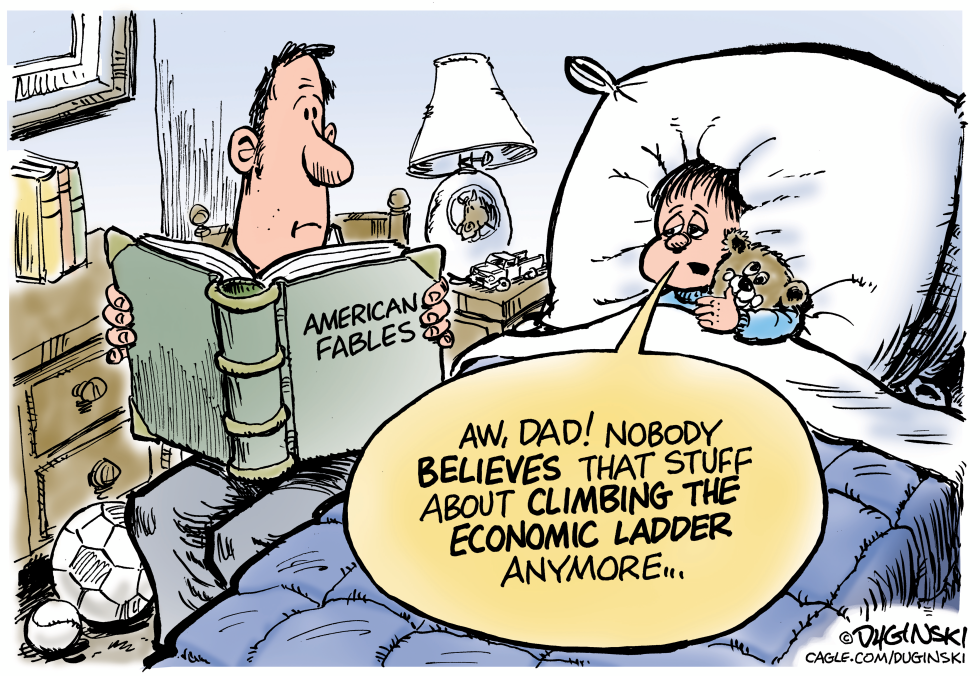
The image shows a father holding an open book titled American Fables beside a child tucked in bed with a teddy bear. The boy speaks from a large speech bubble rejecting the notion of climbing the economic ladder. A soccer ball rests on the floor near stacked books and a nightstand with a lamp and toy train. Tags include American Dream, climbing the economic ladder, upward mobility, cost of living, affordability, and inflation. The scene stays limited to these visible elements without added context.
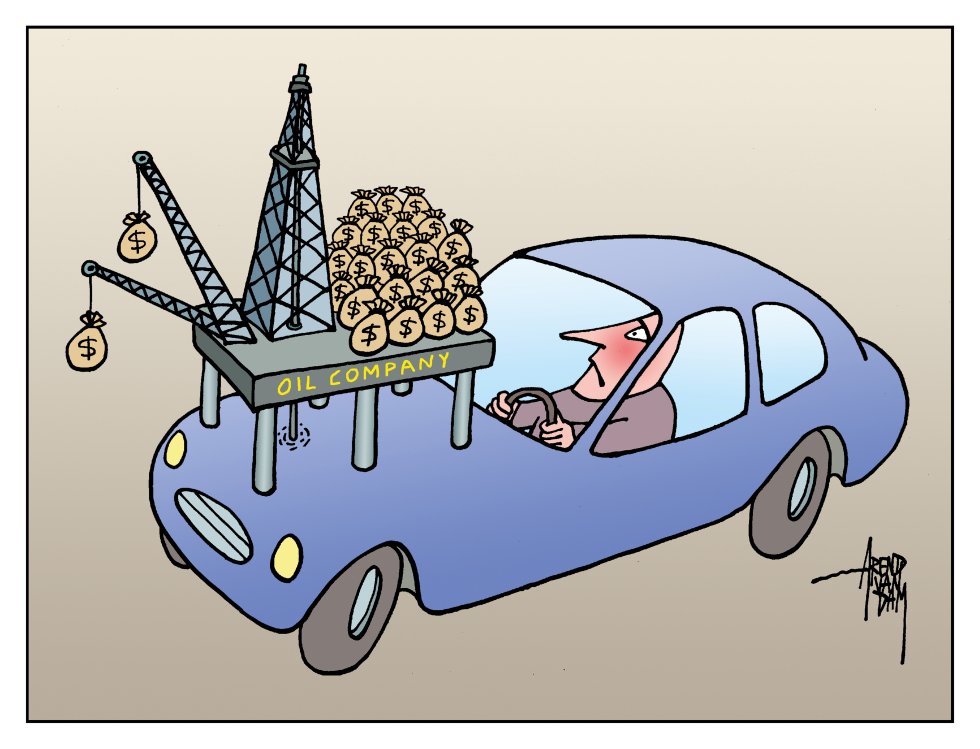
In this pointed political cartoon, an oil company platform sits atop a blue car, loaded with piles of dollar-sign money bags, while cranes dangle more profits. The frustrated motorist grips the wheel, face red with anger, illustrating how excessive profits from oil companies crush consumers at the pump. Tags like excessive profits, motorists, fuel, petrol, and refuel capture the essence, with Iran and Strait of Hormuz hinting at geopolitical tensions driving prices. This visual satire underscores the disparity between corporate windfalls and everyday drivers' pain, a timeless theme in energy politics.
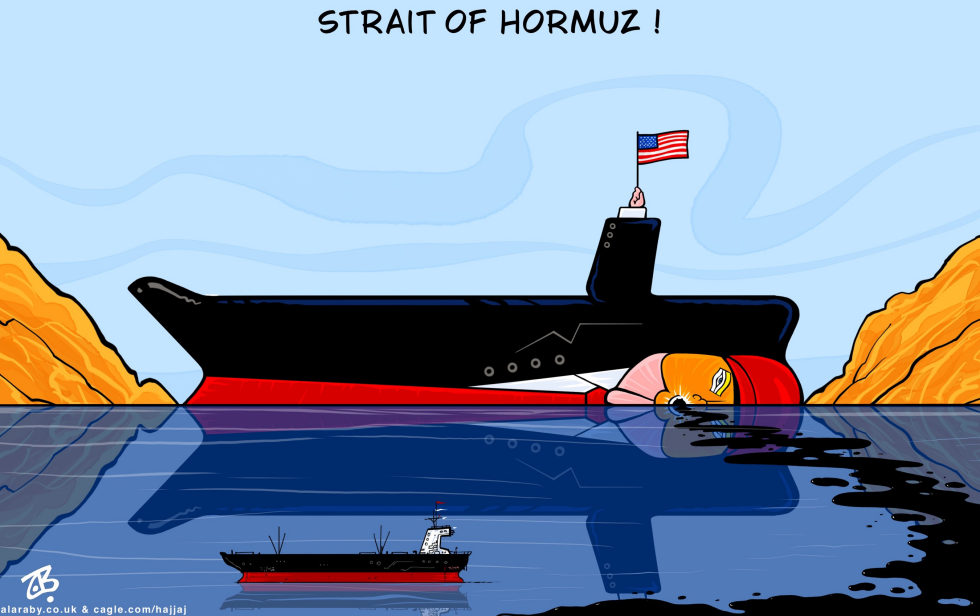
Emad Hajjaj's cartoon depicts a large black submarine with a red hull, stuck between orange landmasses in the Strait of Hormuz, its bow featuring an orange face with yellow hair and a red tie, clearly caricaturing Donald Trump. An American flag flies atop the vessel, while black oil spills into the blue water, reflecting the ship. Below, a smaller black tanker with a white figure onboard sails through the oily sea, tagged with Persian, Gulf, Sea, Tanker, Oil, War. The image satirizes US involvement in Middle East conflicts, particularly Iran war scenarios, without overreaching into hidden meanings. The composition is straightforward, with clear lines and bold colors emphasizing the blockage.
Arend van Dam's cartoon shows a gray battleship marked USA, complete with guns and missiles, driven by a figure in a suit at the wheel, as it goes over a waterfall between rocky cliffs under a blue sky. The image captures the essence of strategy failure in the Strait of Hormuz, tying into themes of Iran, ayatollahs, war, battleship mishaps, Middle East conflicts, oil, gas, energy, and economy. Such visuals often poke at misguided military moves, where the ship's plunge represents a dramatic downfall in strategic planning. The dry humor lies in the absurdity of a warship treating a strait like a river rapid, underscoring potential economic fallout from regional tensions. Cartoons like this thrive on clear, exaggerated metaphors that resonate with readers familiar with global news.
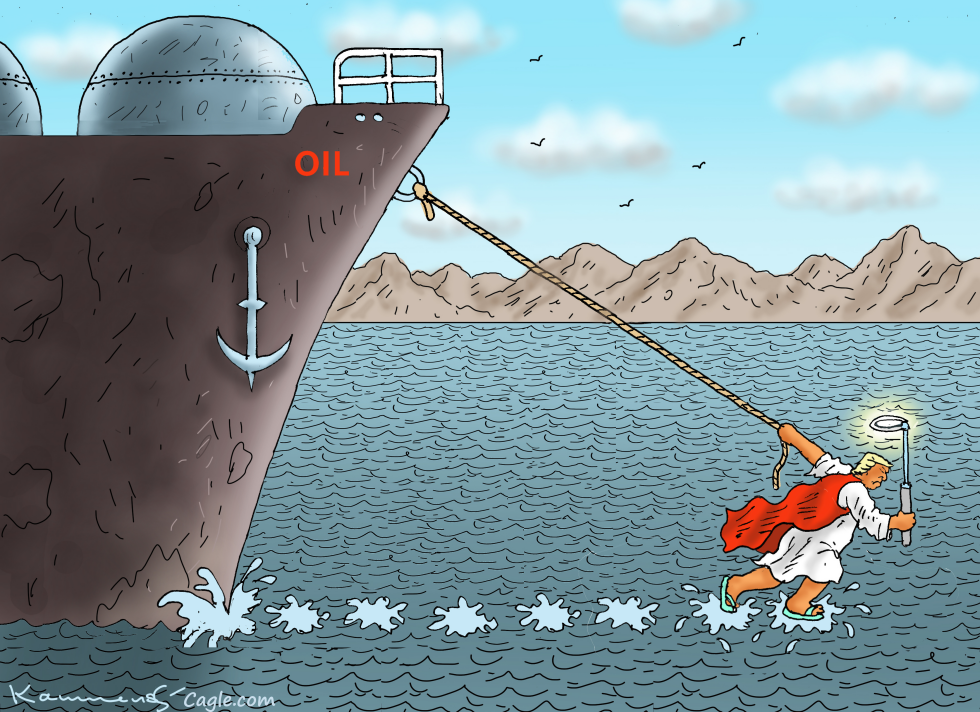
The image depicts a figure dressed in a white robe and red cape, complete with a glowing halo, running across the water while pulling a large oil tanker marked 'OIL' with a rope. He holds a golf club in one hand, splashing water with each step against a backdrop of mountains and a clear sky. This setup draws on tags like Trump, Hormuz, Iran, oil war, MAGA terror, and fascism to satirize political figures intervening in global oil crises. The cartoon's composition emphasizes the absurdity of a divine savior tackling economic and geopolitical issues, with birds flying overhead and distant peaks suggesting a Middle Eastern strait. Kamensky's style brings dry humor to the forefront, poking at notions of messianic leadership in turbulent times.
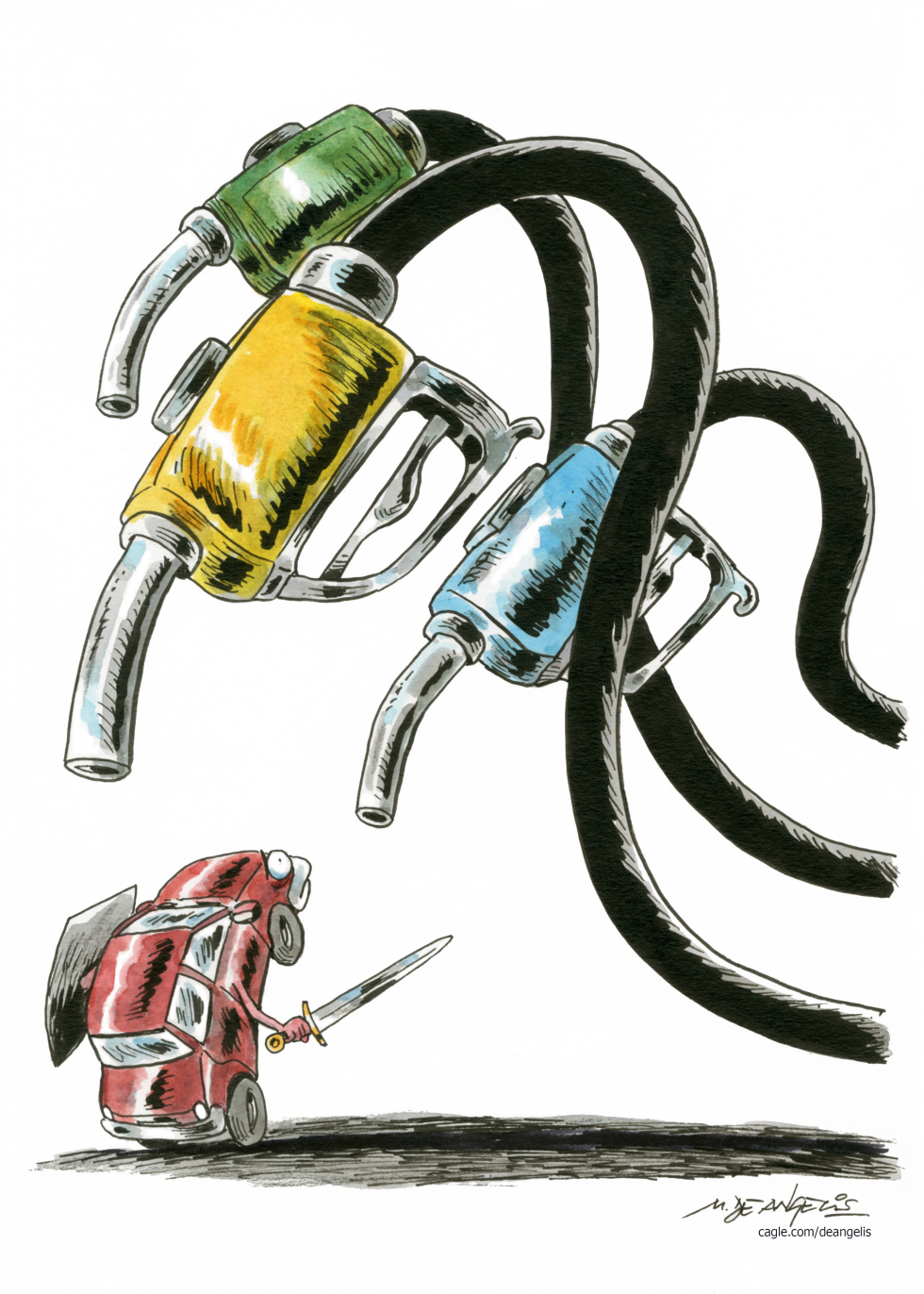
Marco De Angelis draws a clever twist on the ancient HYDRA myth, where a plucky red CAR, sword in hand, squares off against a beastly creature formed by three FUEL pump nozzles—green, yellow, and blue—attached to writhing black hoses. The scene plays on the endless battles drivers face with soaring OIL PRICES and FUEL costs, tying into broader ECONOMY woes. Tags like TRANSPORTATION, TRADE, WAR, CRISIS, IRAN, USA, and HORMUZ hint at real-world tensions in the Strait of Hormuz, where geopolitical strife disrupts global OIL supplies. It's a sharp commentary on how these issues regenerate like hydra heads, making every victory temporary in the fight against economic pressures.
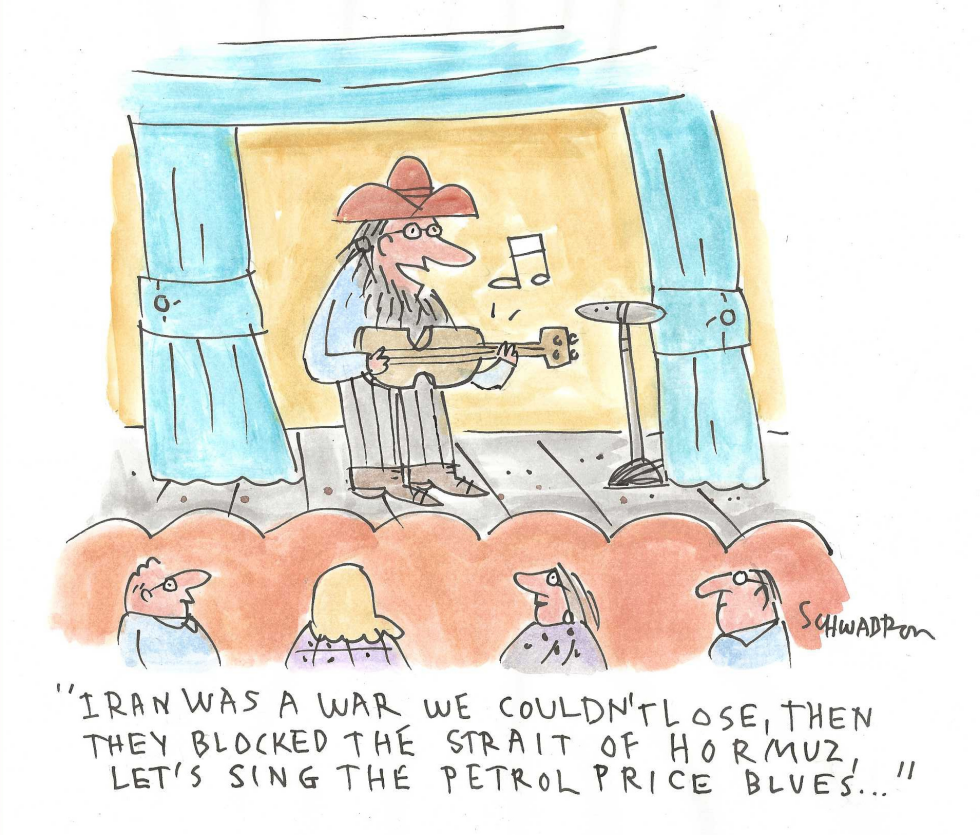
The cartoon depicts a guitarist on a stage with blue curtains and yellow backdrop singing about an unwinnable war with Iran followed by a blockade of the Strait of Hormuz that leads to higher petrol prices. Four audience members sit in the foreground. The scene uses simple lines and watercolor tones to show the performer with a music note floating nearby and a microphone stand to the side.
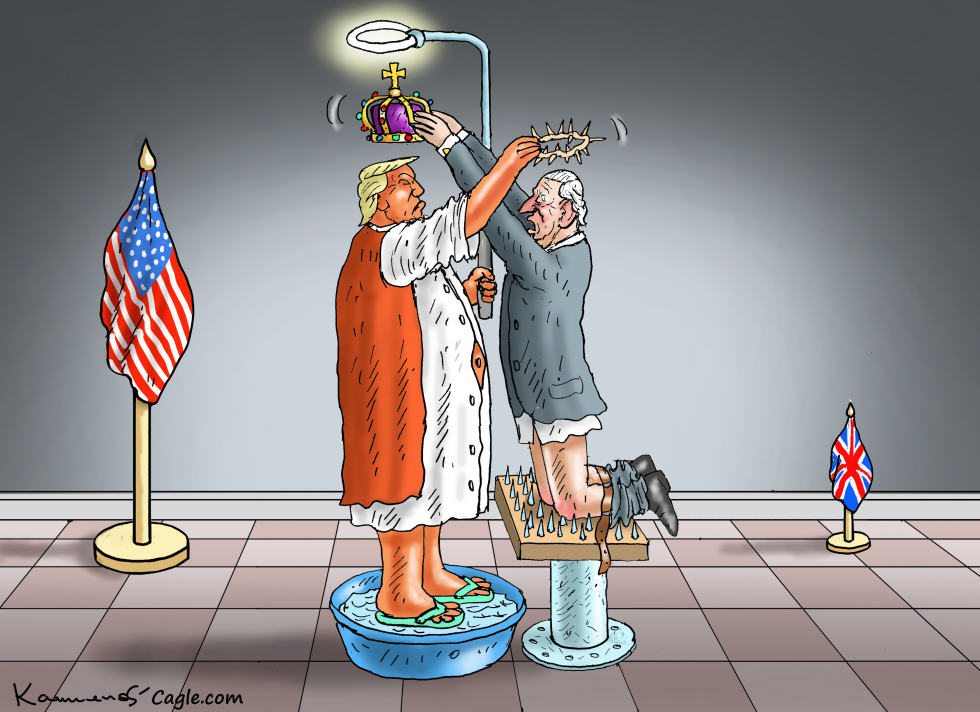
Marian Kamensky's cartoon depicts Trump holding a jeweled crown over King Charles's head while King Charles extends a crown of thorns, set against US and UK flags. The image, tagged Trump, King Charles, MAGA terror, Doctor Jesus, fascism, shows King Charles in a suit with pants down, standing in a basin on a spiked stool. This setup underscores themes of painful power exchanges, with Trump in a robe-like garment. The dark background and illuminated halo add to the satirical edge, commenting on political alliances and suffering in leadership.
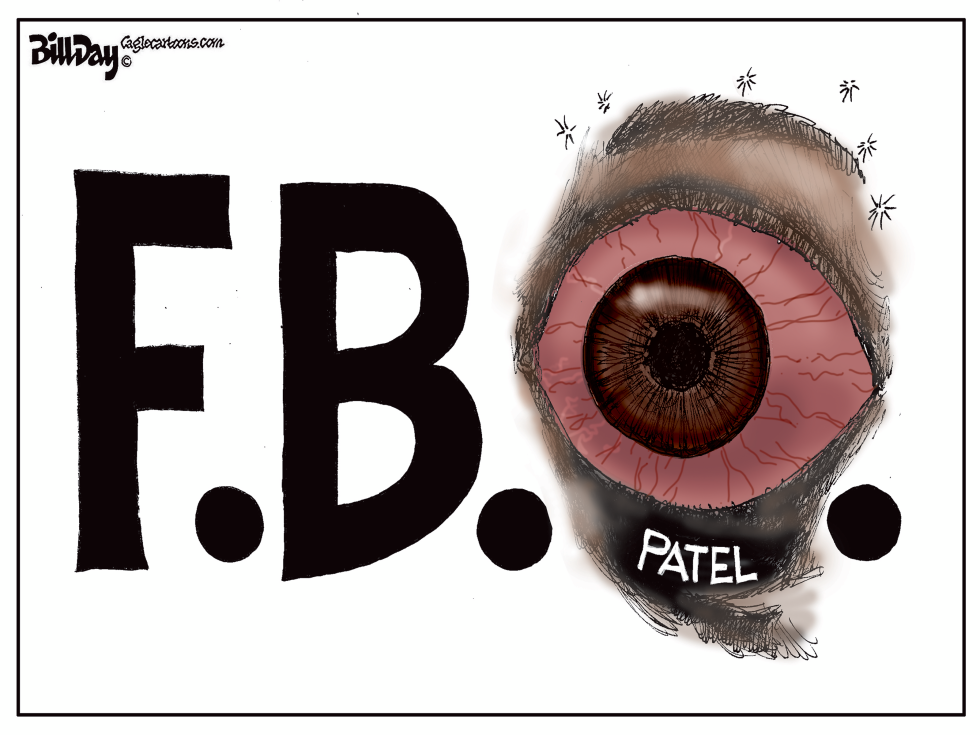
Bill Day's cartoon features the letters F.B.I. with a veiny, bloodshot eye replacing the 'I', and the word Patel scrawled beneath it, evoking themes of booze and drinking. Stars sparkle above the eye, adding to the sense of disorientation or absence. This piece, tagged with Patel, FBI, booze, drinking, absent, and drunk, offers a straightforward jab at a figure's rumored state. In the world of political cartoons, such direct visuals cut through the noise, reminding editors that simplicity often packs the biggest punch. Day's style here is classic, with rough lines emphasizing the eye's intoxicated look, making it shareable for those following nomination sagas.
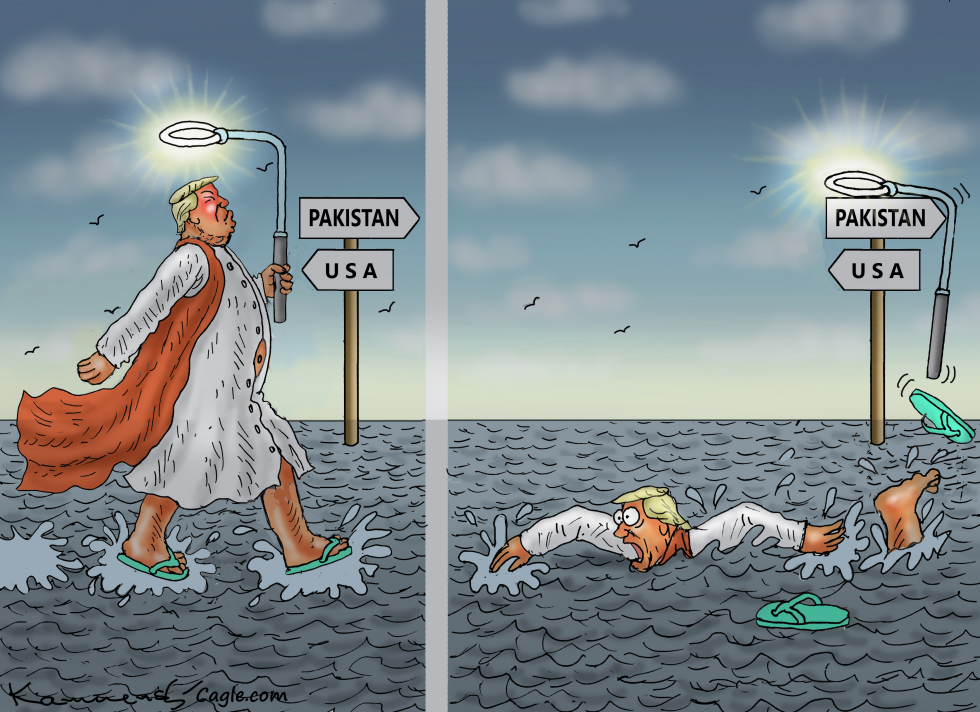
Marian Kamensky\'s cartoon captures Trump with a halo, striding across the sea in robes and flip-flops toward signs pointing to Pakistan and USA, evoking peace talks amid Hormuz strife. The satire turns sharp as Trump, embodying fascism and MAGA terror, plunges into the waves, desperately swimming while his flip-flop floats away and the signpost topples. This two-panel setup underscores the hubris of political figures tackling international relations, blending humor with critique of overreaching ambitions in U.S.-Pakistan dynamics. The artwork\'s clean lines and exaggerated expressions amplify the dry wit, making it a pointed commentary on failed diplomacy and self-proclaimed savior complexes in global politics.