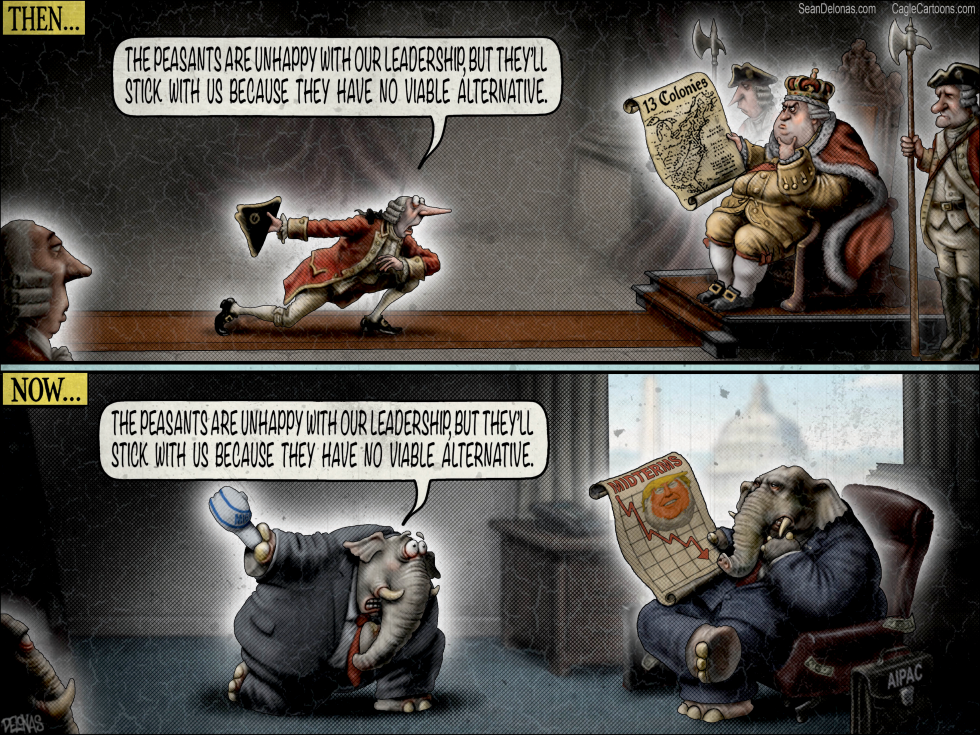
A two-panel cartoon contrasts King George III assuring aides that unhappy colonists have no viable alternative with a modern Republican elephant repeating the identical line while holding a plunging midterms chart marked with Donald Trump's face. The lower scene includes the U.S. Capitol dome and an AIPAC briefcase. The June 28 2026 date places the image weeks before the 2026 midterm elections.
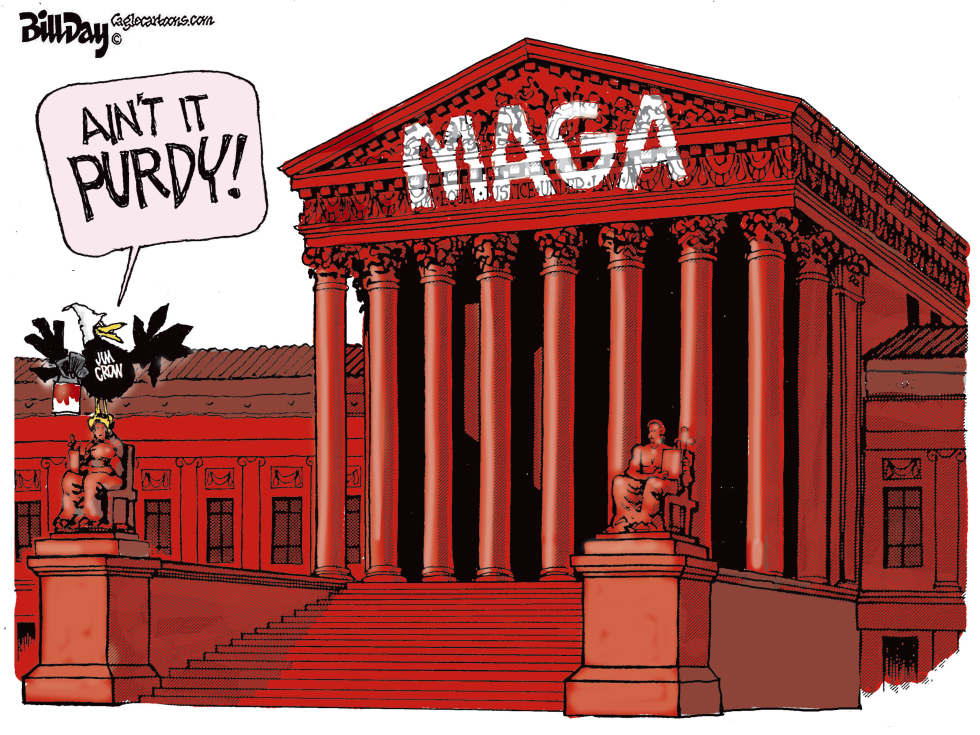
The May 2026 cartoon by Bill Day depicts the U.S. Supreme Court building painted red with MAGA letters dominating the pediment. A figure labeled Jim Crow appears on the left beside a crowned seated person. A speech bubble from the bird reads AIN'T IT PURDY! The frieze text EQUAL JUSTICE UNDER LAW remains partially visible beneath the new lettering. The image ties recent redistricting and voting rights debates to historical racial restrictions.
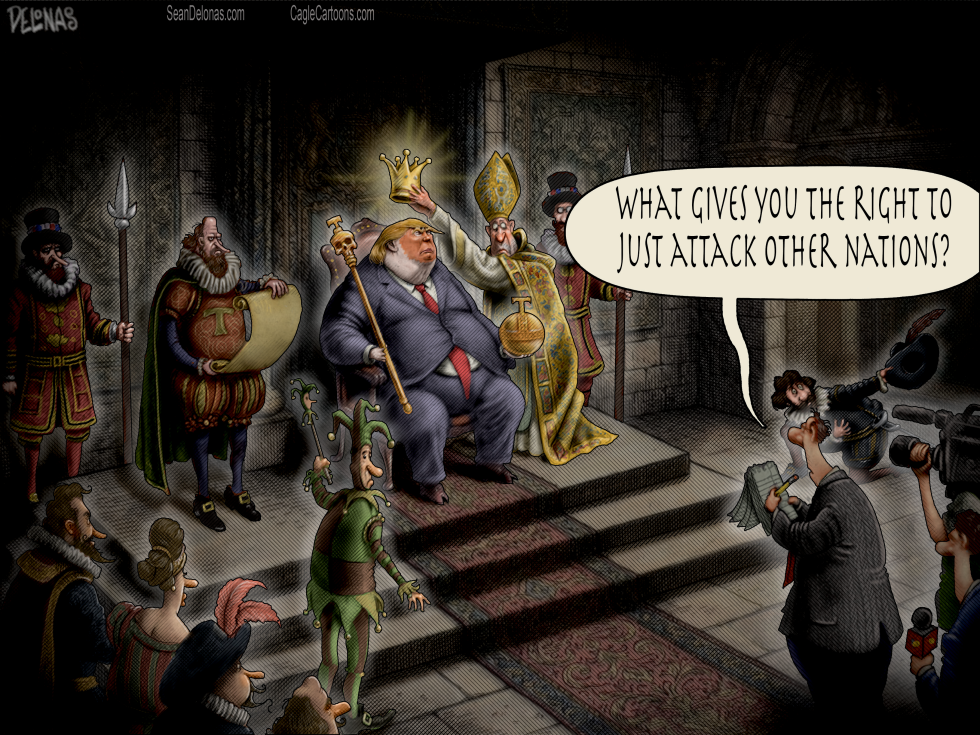
Sean Delonas captures Donald Trump as a rotund king lounging on a throne in a dimly lit castle hall, complete with a bishop crowning him with a glowing crown and a scepter in hand. Surrounded by medieval figures like guards, a jester, and courtiers, Trump faces a modern reporter wielding a microphone and notes, demanding to know what gives him the right to just attack other nations. The cartoon blends historical pomp with contemporary critique, tagging into Trump, wars, Iran, Venezuela, press, king, media, counterterrorism, military, policy, and president themes. The dry humor underscores the absurdity of unchecked power, with the artist's signature style emphasizing exaggerated features and satirical edge.
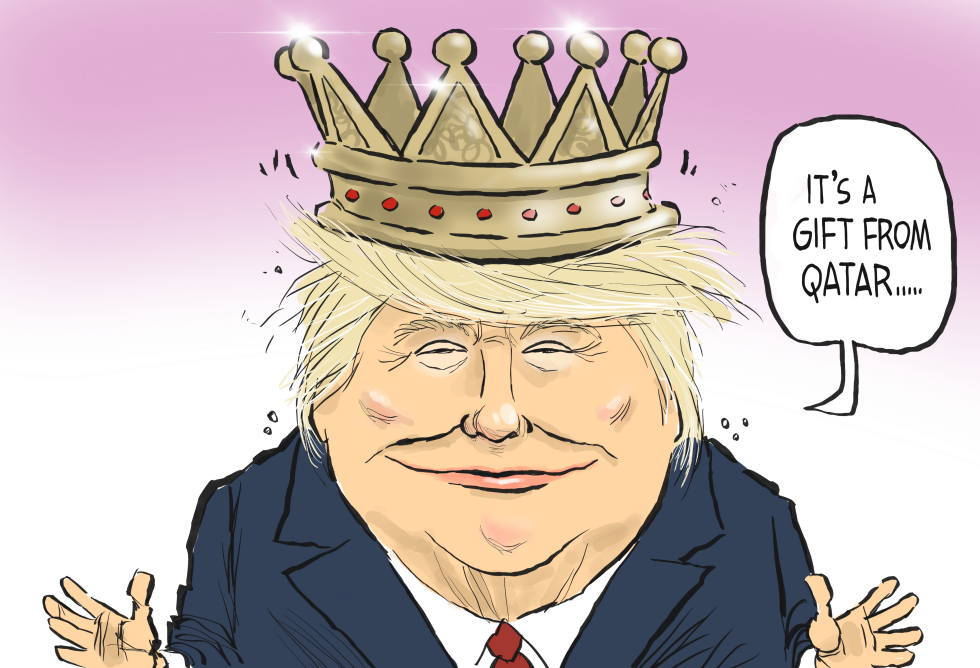
Jeff Koterba's cartoon captures Trump in a suit, topped with a golden crown that sparkles against a pink background, his hands outstretched as he speaks in a bubble: 'It's a gift from Qatar...!!' The tags like Qatar, Trump, crown, king, gift, ethics point to satire on political perks. Cartoons like this thrive on exaggeration, here turning Trump into a kingly figure accepting foreign gifts without a blink. It's straightforward humor, poking at ethics without overcomplicating the visuals. Readers see the crown as a clear symbol of assumed royalty, tied to tags on free gifts and potential scandals. Such pieces remind us how cartoons cut through the noise with simple, sharp imagery.