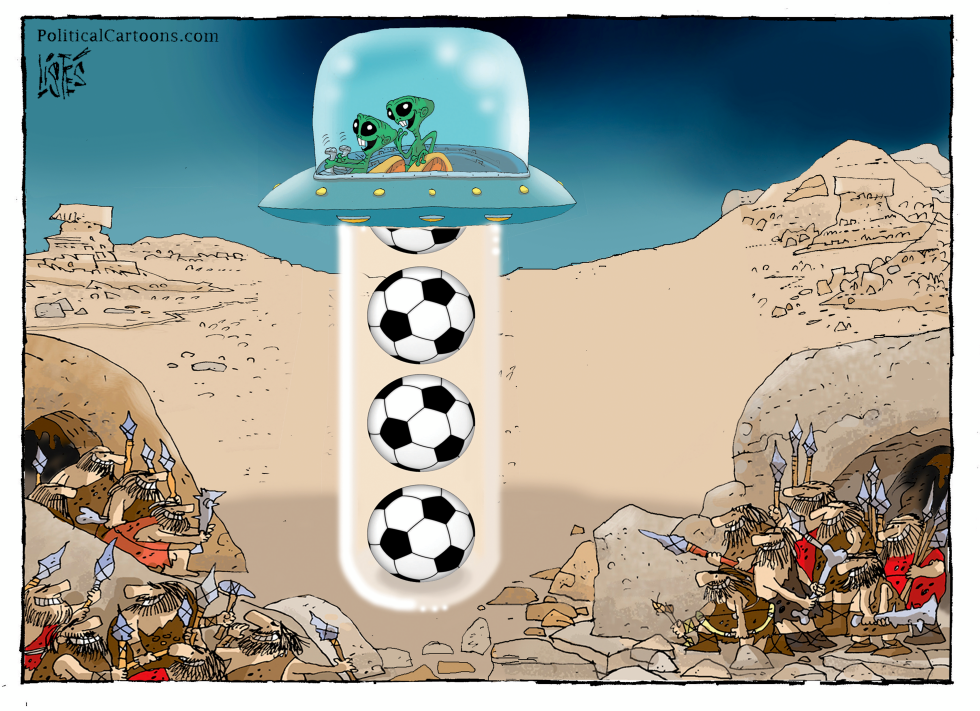
The cartoon depicts a UFO hovering over a desert landscape dotted with ruins. Two green aliens inside release a trail of soccer balls toward a group of cavemen armed with spears and clubs. The cavemen react with surprise and aggression as the balls descend. The scene plays on the idea of soccer's mysterious origins ahead of the 2026 World Cup hosted by the United States, Mexico, and Canada.
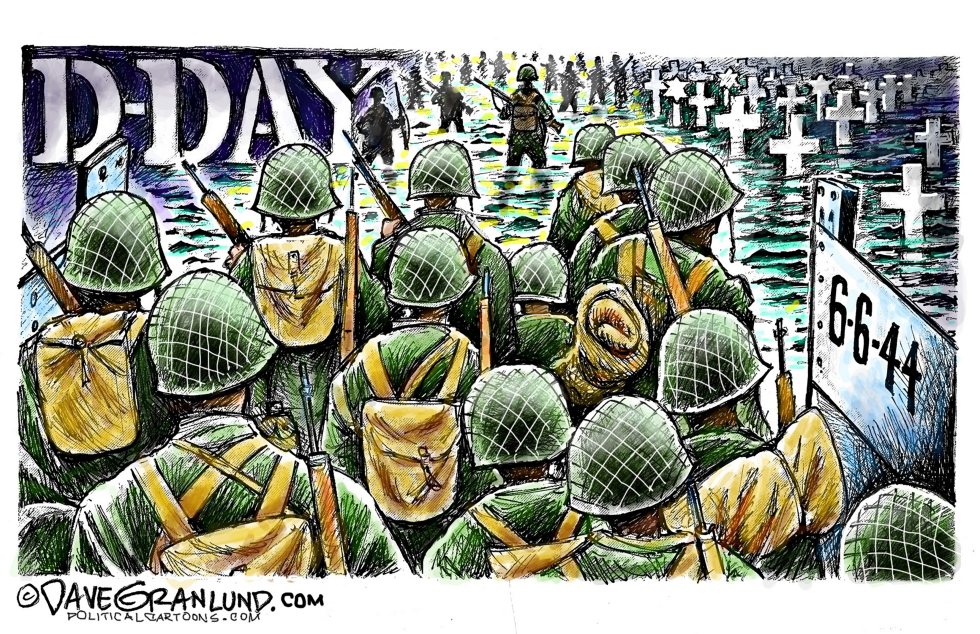
The image marks the June 6 1944 D-Day landings. Soldiers in green helmets and packs move through shallow water. Rows of white crosses stand in the surf behind them. A sign displays 6-6-44 on the right. The scene recalls the Allied invasion of Normandy during World War II.
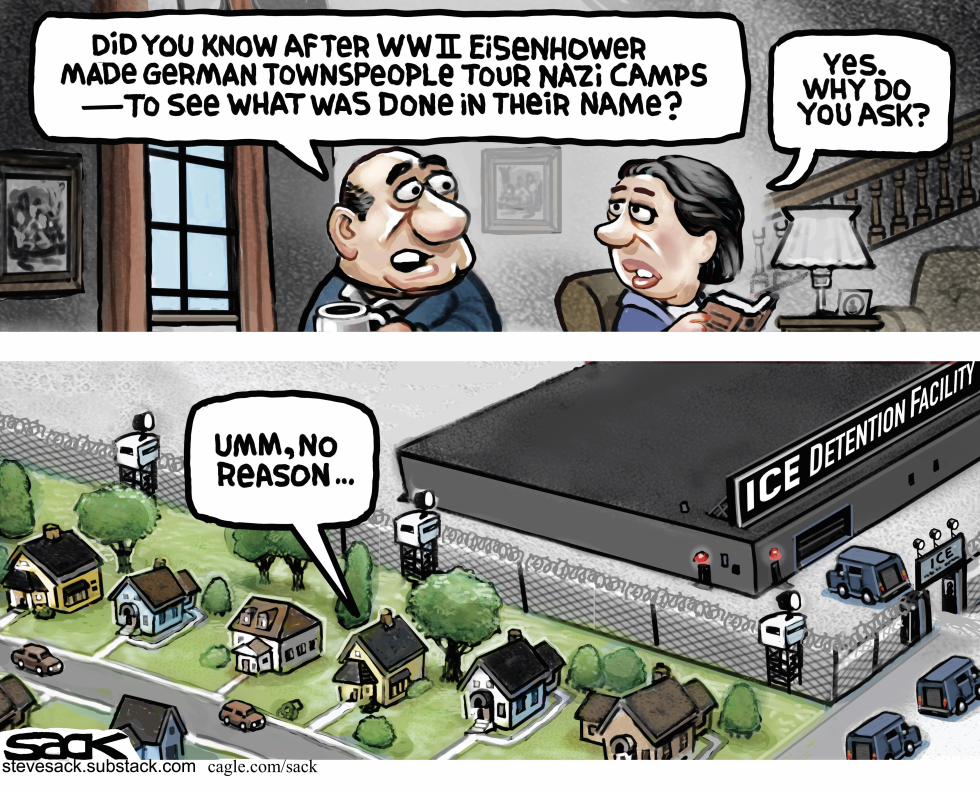
A two-panel cartoon contrasts a living room discussion of Eisenhower's order for German civilians to tour Nazi camps after World War II with a suburban scene featuring a large ICE detention facility adjacent to homes. One resident deflects when asked why the historical example was raised. The image highlights proximity of such facilities to neighborhoods and reluctance to acknowledge operations conducted in the community's name.
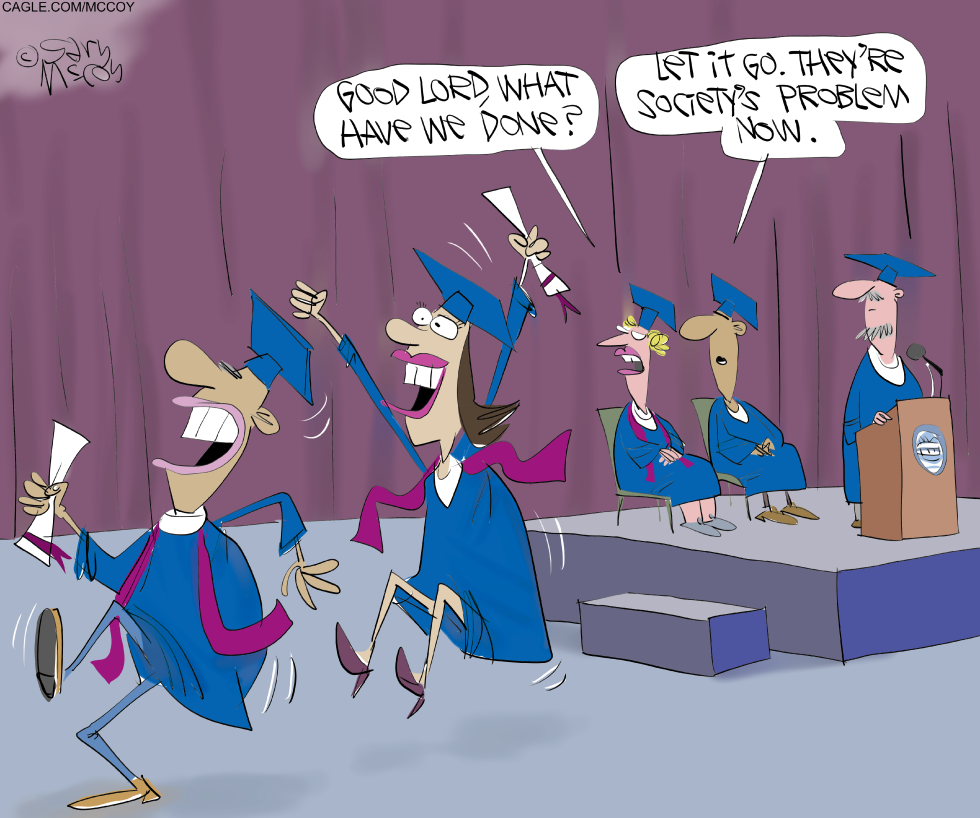
The cartoon shows two graduates in blue caps and gowns dancing energetically on a stage during what appears to be a graduation ceremony. One waves a diploma overhead while the other kicks a leg high. Three seated graduates in the background display open-mouthed expressions. A man at a podium with a microphone stands to the right. Speech bubbles contain the lines Good Lord what have we done and Let it go. They are society's problem now. The background is a plain purple curtain and gray stage floor.
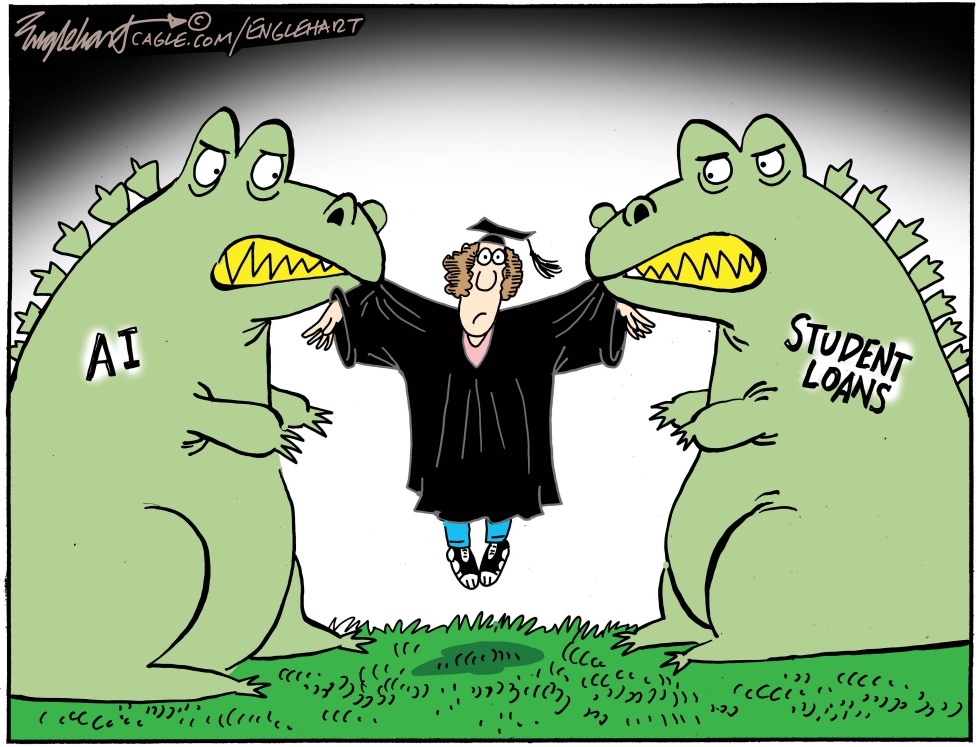
The cartoon shows a 2026 graduate caught between an AI alligator on the left and a student loans alligator on the right. Both creatures stand on green grass with open jaws. The graduate wears a black gown, blue socks and a mortarboard. Text labels identify each alligator clearly. The scene is simple with no additional figures or objects visible.
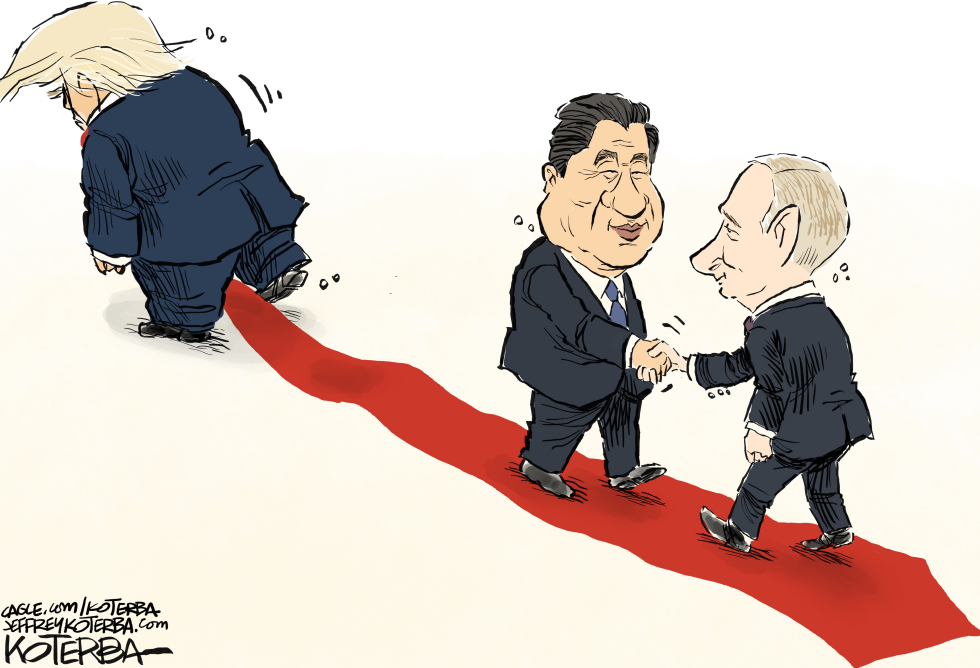
The image presents a simple cartoon scene with three figures in dark suits positioned along a red carpet. One figure with blonde hair is shown walking away toward the left edge. The remaining two figures face each other and clasp hands while standing on the carpet that stretches diagonally across the frame. Small motion lines and dots add basic movement details around the figures. The background remains plain and white with a signature block in the lower left corner.
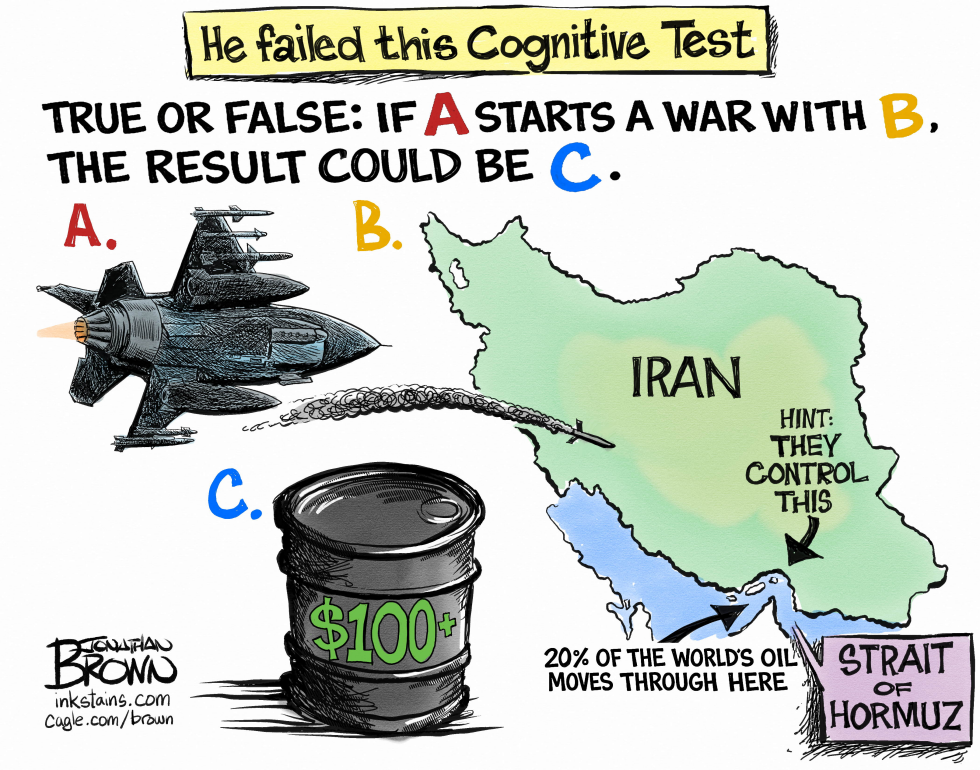
Jonathan Brown's cartoon presents a stark true-or-false cognitive test: if A (a fighter jet) starts a war with B (Iran), the result could be C (an oil barrel marked $100+). The map of Iran includes a hint pointing to the Strait of Hormuz, noting that 20% of the world's oil moves through there, underscoring control over this chokepoint. Tags such as cognitive test, war in Iran, oil prices, Strait of Hormuz, gas prices, and cost of war frame the satire. The artwork warns of economic fallout from conflict, with the jet trailing toward Iran and the oil barrel symbolizing surging costs. This piece captures geopolitical tensions in a simple, visual riddle.
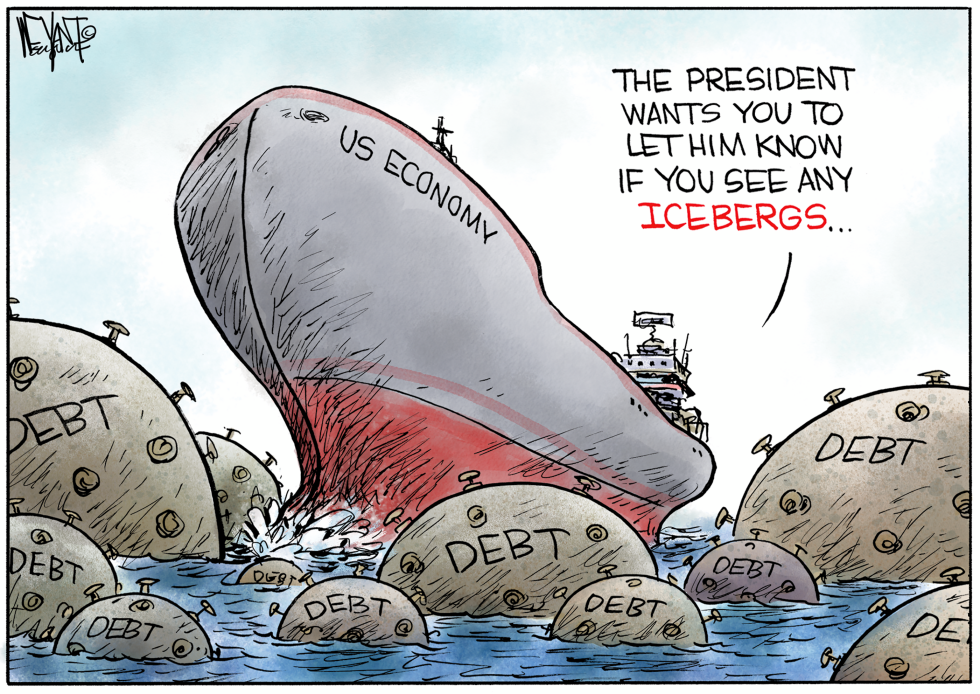
This political cartoon illustrates the US Economy as a massive ship labeled accordingly, dramatically sinking after colliding with numerous icebergs each marked 'DEBT.' A speech bubble from the ship warns to alert the president about icebergs, evoking the Titanic disaster in a clear metaphor for economic peril. Incorporating tags such as economy, debt, budget, inflation, prices, and costs, the image critiques fiscal irresponsibility. The artwork by Christopher Weyant uses simple lines and colors to emphasize the collision's impact, with water splashing and the ship's hull damaged. Such cartoons often highlight how mounting debt threatens stability, drawing parallels to historical maritime tragedies for satirical effect. The composition places the ship at an angle, surrounded by floating debt bergs, underscoring inevitable crisis if warnings go unheeded.
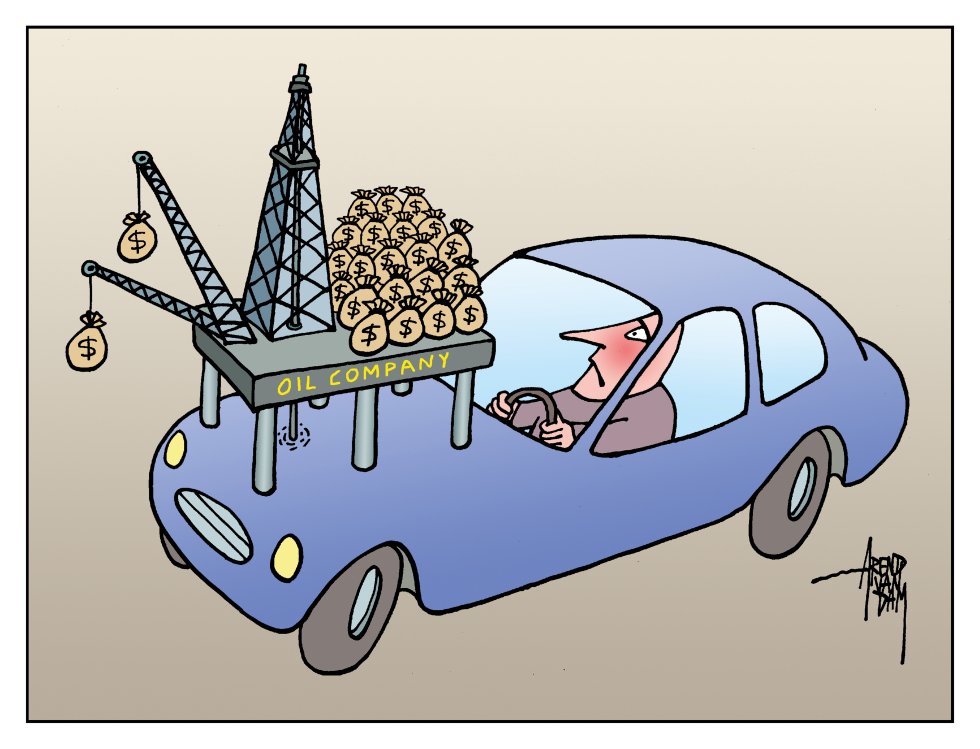
In this pointed political cartoon, an oil company platform sits atop a blue car, loaded with piles of dollar-sign money bags, while cranes dangle more profits. The frustrated motorist grips the wheel, face red with anger, illustrating how excessive profits from oil companies crush consumers at the pump. Tags like excessive profits, motorists, fuel, petrol, and refuel capture the essence, with Iran and Strait of Hormuz hinting at geopolitical tensions driving prices. This visual satire underscores the disparity between corporate windfalls and everyday drivers' pain, a timeless theme in energy politics.
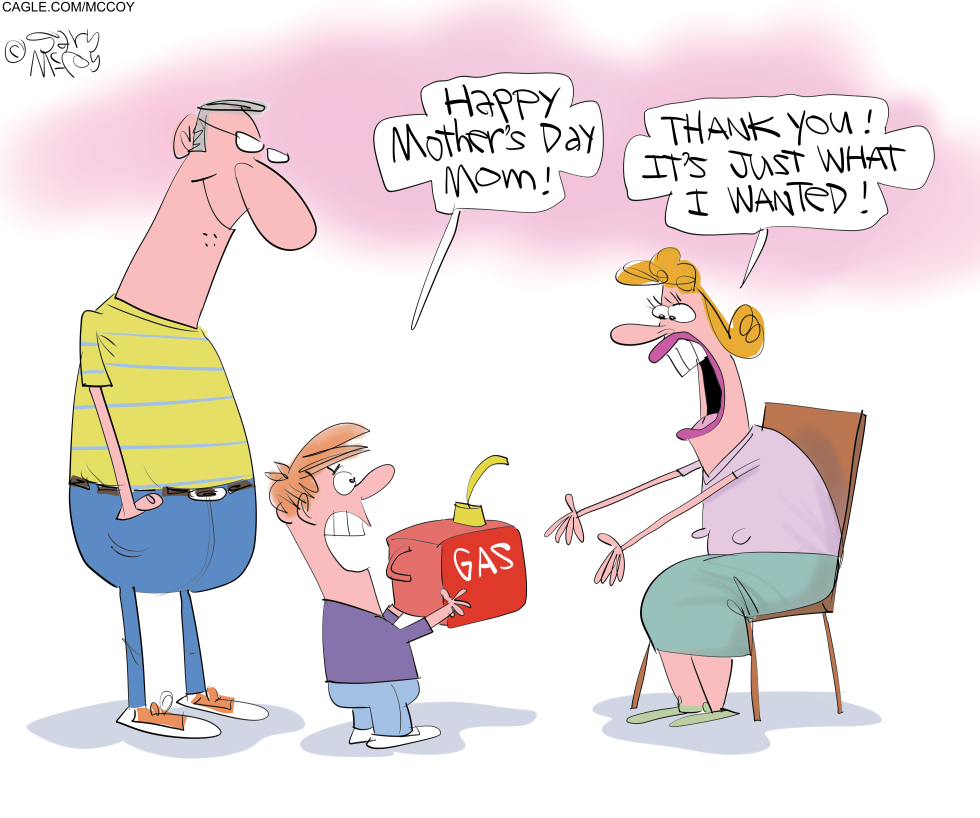
Gary McCoy's cartoon captures a family moment where a young son hands his mother a lit bomb marked GAS, exclaiming Happy Mother's Day, while she thanks him enthusiastically. The image ties into tags like Mom, mother, Mothers Day, gas, oil, petro, prices, economy, inflation. It highlights the burden of rising energy costs on families, with the explosive gift symbolizing volatile fuel markets. Amid references to Iran, strait of hormuz, Trump, the satire underscores how global tensions affect everyday life, blending holiday cheer with economic reality in a straightforward, exaggerated style typical of political cartoons.
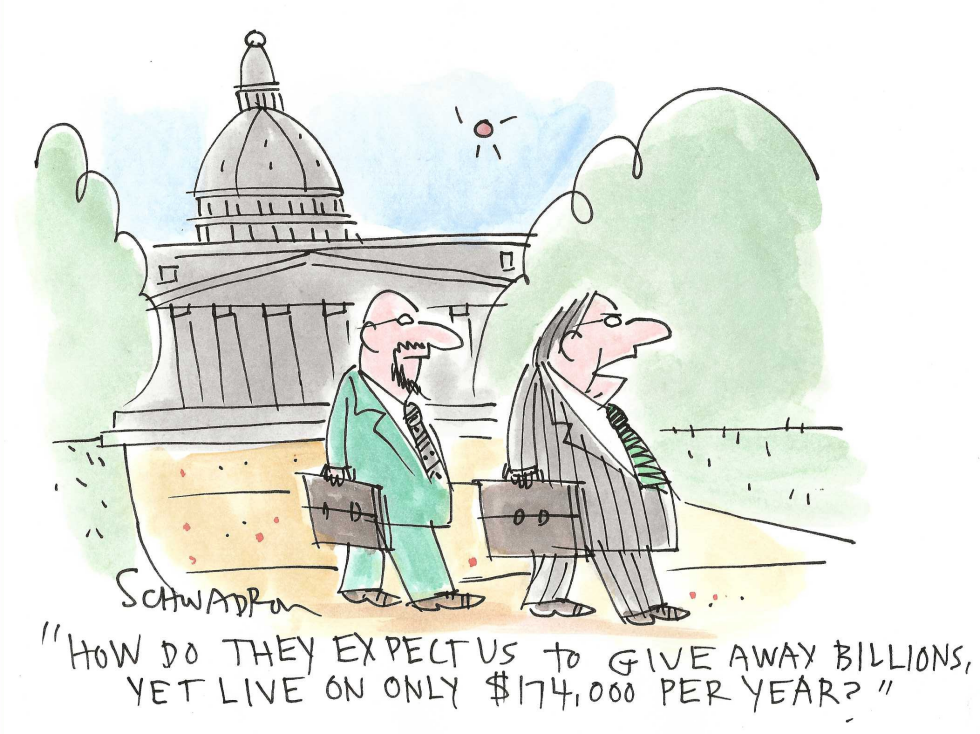
The cartoon shows two men in business attire carrying briefcases in front of a large domed building resembling Congress. One wears green, the other gray stripes. They hold cases labeled with dollar signs. The caption questions giving away billions on a $174,000 salary. Visible elements include green bushes, a path, and a small sun. Tags reference Congress, give away, billions, wars, tariffs, inflation, cost of living, and money. The scene focuses on the figures and their dialogue about expenditures.
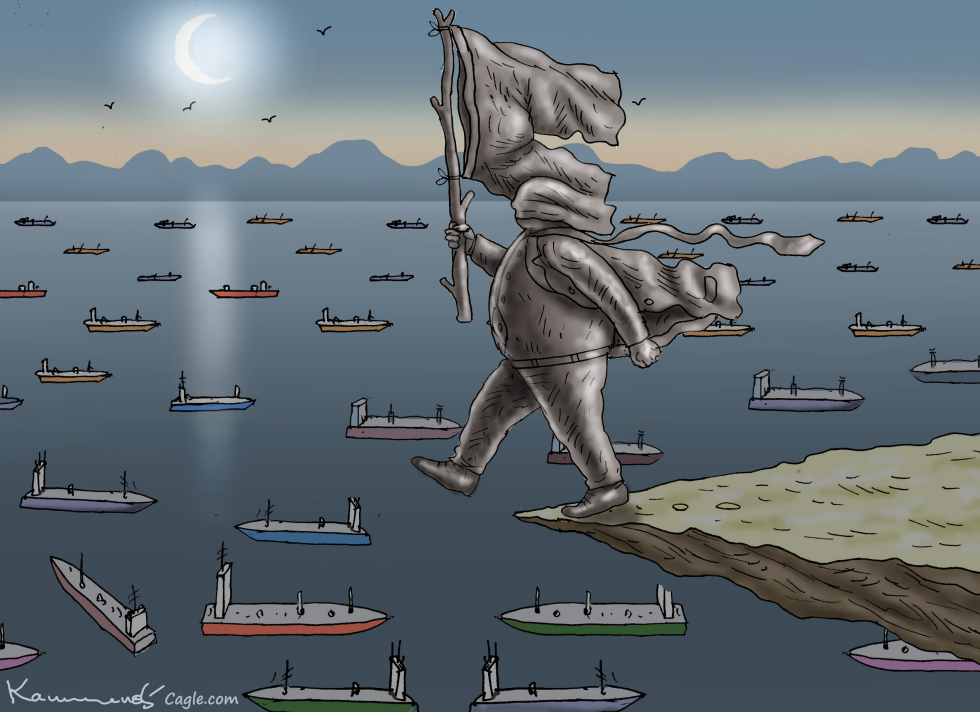
The cartoon shows a large, gray, statue-like figure with a hooded cloak, gripping a flag on a pole, as it steps forward off a cliff's edge. Below stretches a dark sea filled with many small ships of various colors, scattered across the water. In the background, mountains rise against a sky with a crescent moon and flying birds. The image, tagged with Banksy, Trumo, Hormuz, fascism, patriotism, and Maga terror, captures a moment of precarious advance. Artist Marian Kamensky signs it at the bottom left, linking to Cagle.com. This setup highlights a bold, unyielding march into potential downfall amid a busy maritime scene.
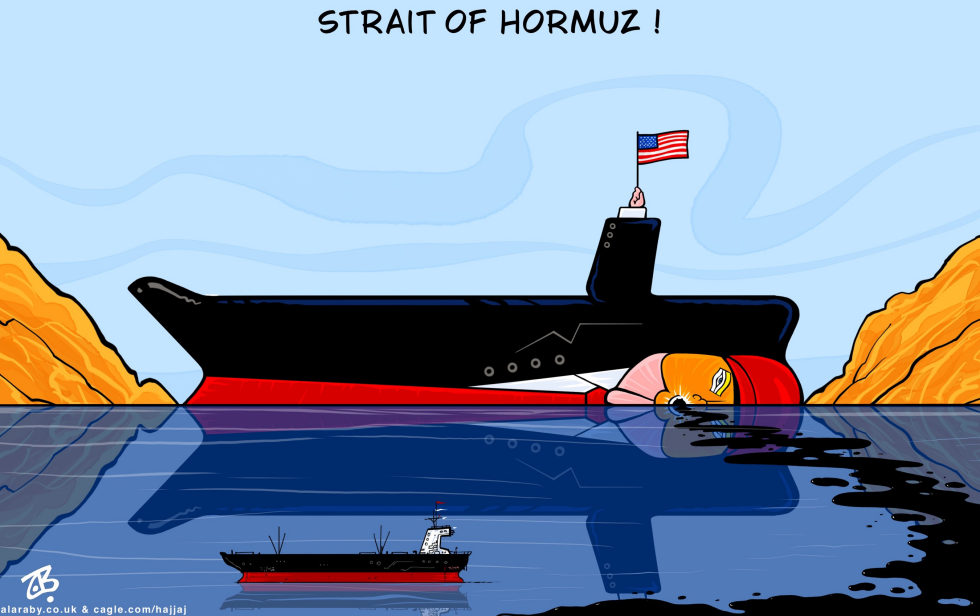
Emad Hajjaj's cartoon depicts a large black submarine with a red hull, stuck between orange landmasses in the Strait of Hormuz, its bow featuring an orange face with yellow hair and a red tie, clearly caricaturing Donald Trump. An American flag flies atop the vessel, while black oil spills into the blue water, reflecting the ship. Below, a smaller black tanker with a white figure onboard sails through the oily sea, tagged with Persian, Gulf, Sea, Tanker, Oil, War. The image satirizes US involvement in Middle East conflicts, particularly Iran war scenarios, without overreaching into hidden meanings. The composition is straightforward, with clear lines and bold colors emphasizing the blockage.
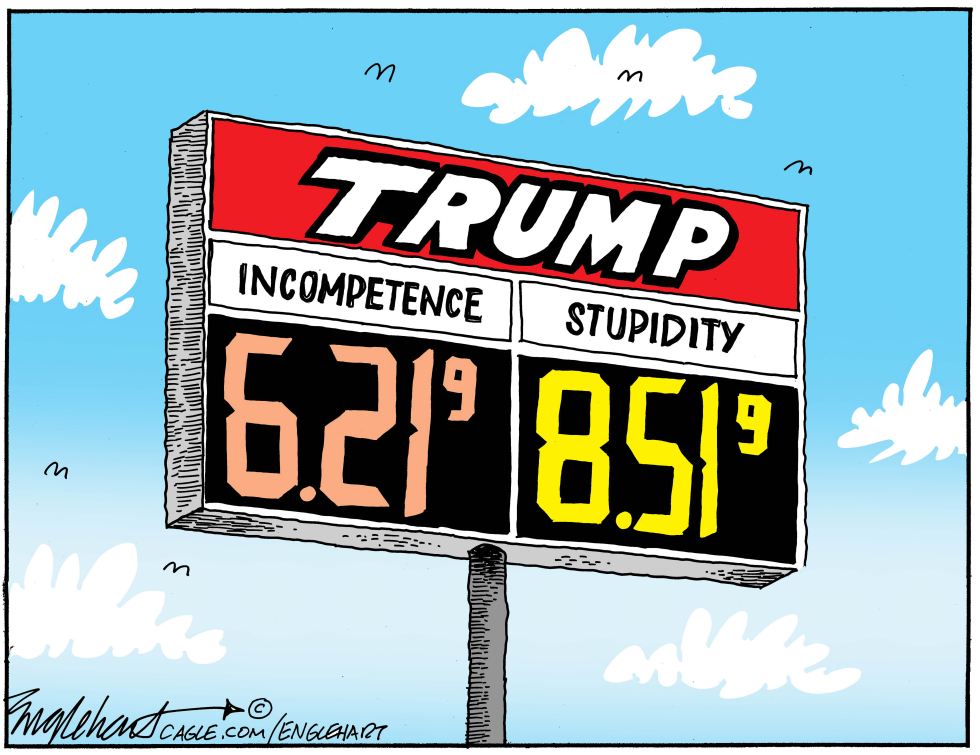
Bob Englehart's cartoon features a gas station sign with Trump at the top, showing prices for incompetence at 6.21⁹ and stupidity at 8.51⁹ against a blue sky with clouds. The tags Trump, Iran War, gas prices, gasoline, and gallon frame the visual pun. Such cartoons often tie political figures to everyday economic pains like fuel costs. The dry humor lands on how leadership flaws inflate prices, making it relatable for readers hit by pump shocks. With no characters, just the sign, it keeps the message direct. Tags like incompetence and stupidity drive the satire home, poking at perceived policy missteps without overcomplicating the scene.
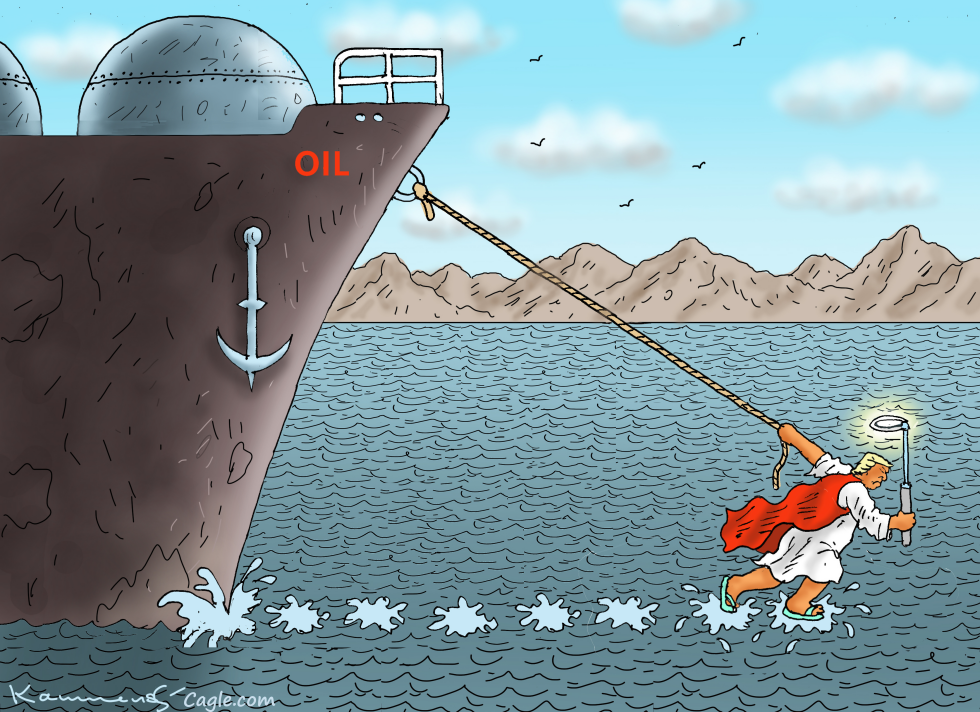
The image depicts a figure dressed in a white robe and red cape, complete with a glowing halo, running across the water while pulling a large oil tanker marked 'OIL' with a rope. He holds a golf club in one hand, splashing water with each step against a backdrop of mountains and a clear sky. This setup draws on tags like Trump, Hormuz, Iran, oil war, MAGA terror, and fascism to satirize political figures intervening in global oil crises. The cartoon's composition emphasizes the absurdity of a divine savior tackling economic and geopolitical issues, with birds flying overhead and distant peaks suggesting a Middle Eastern strait. Kamensky's style brings dry humor to the forefront, poking at notions of messianic leadership in turbulent times.