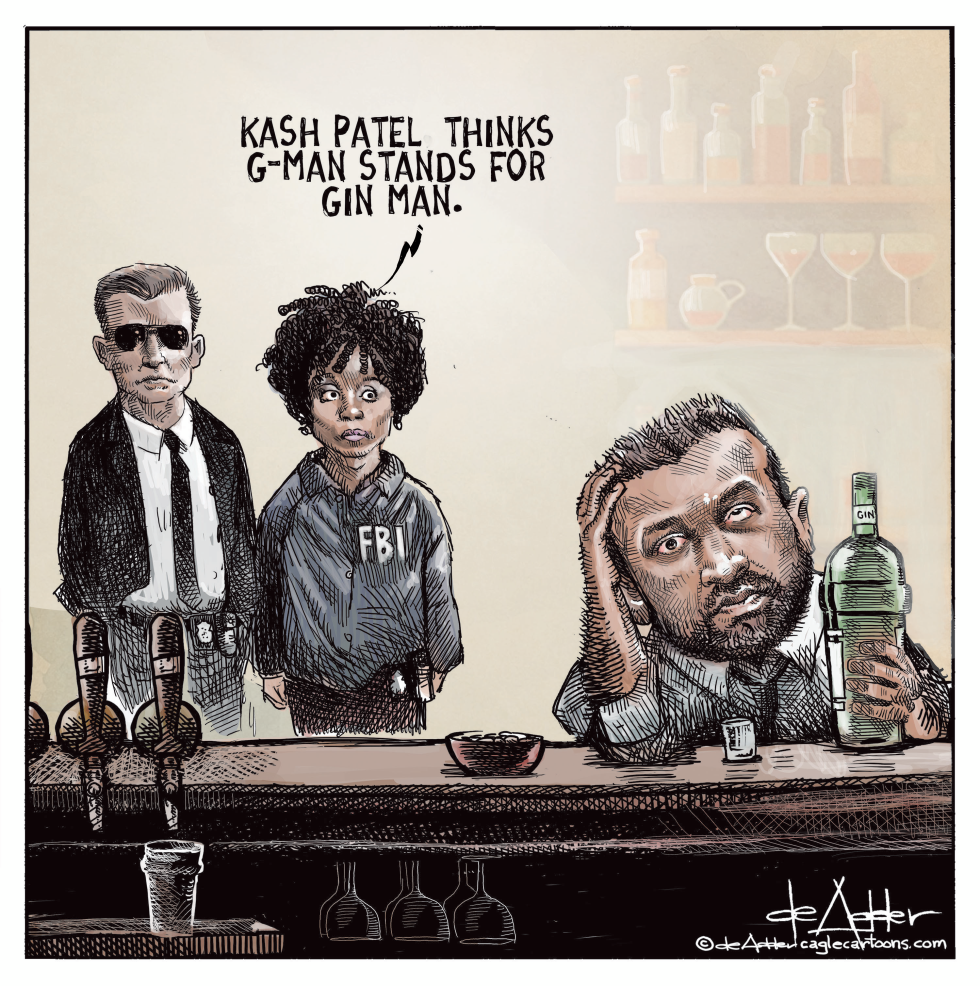
Michael de Adder's cartoon depicts a bearded man at a bar, hand on forehead, holding a green gin bottle, looking inebriated. Two figures stand behind: one in a suit with sunglasses, another in an FBI jacket. The text reads 'Kash Patel thinks G-man stands for gin man.' Bottles line the shelf, beer taps and glasses on the counter. Tags like Kash Patel, FBI, gin, drinking, alcohol, drunk underscore the visual pun on FBI agents as 'G-men' versus a 'gin man' in a bar setting. The scene captures a straightforward satirical jab without deeper layers visible.
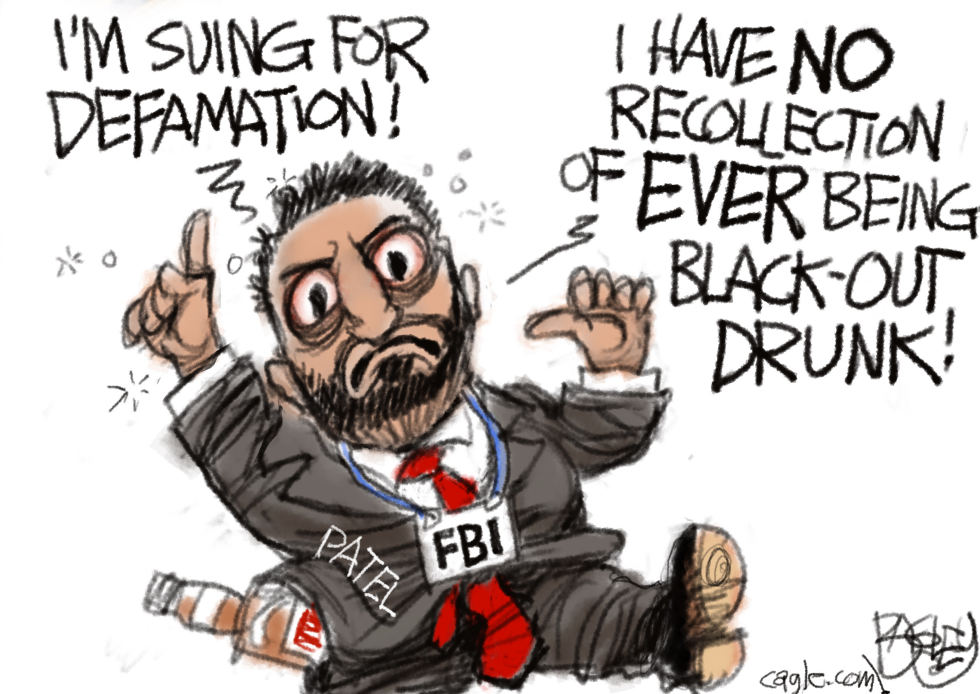
Pat Bagley's cartoon captures a caricatured Kash Patel, sprawled with a liquor bottle, his suit disheveled and FBI badge prominent. He gestures wildly, proclaiming a defamation lawsuit while insisting on no recollection of ever being blackout drunk. The image ties into themes of DUI, corruption, fraud, drinking, drunkenness, alcohol, national security, and terrorism, highlighting irony in a political figure's denial. Such satire underscores the absurdity in public denials, especially for someone eyed for a high-security role. The dry humor pokes at reliability amid scandal tags like Trump, GOP, and MAGA.
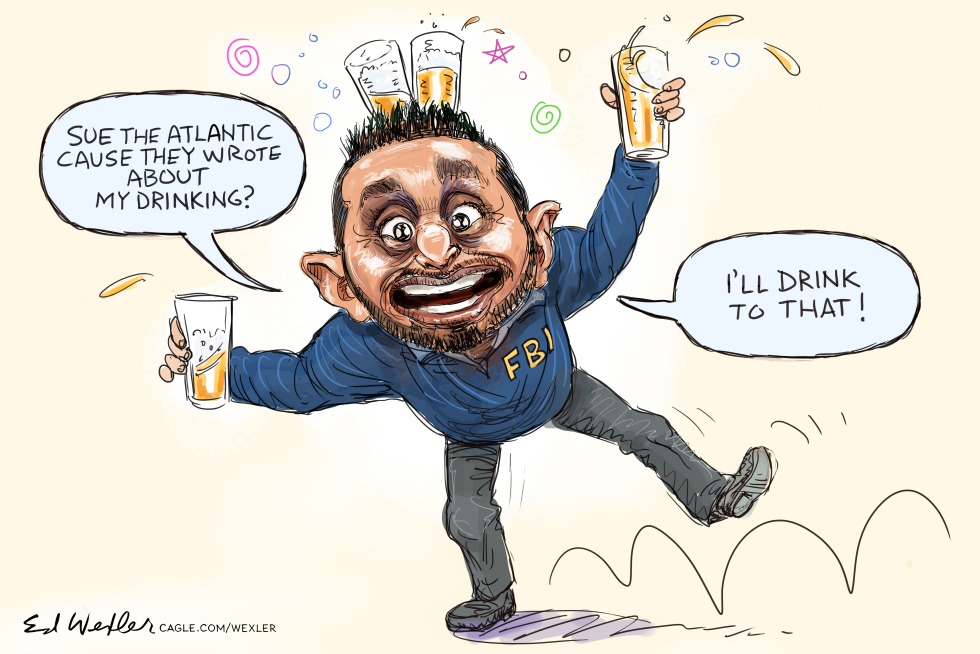
Ed Wexler's cartoon captures a man clearly modeled after a public figure, dressed in an FBI sweatshirt, balancing beers on his head and in his hands, with tags like kash, patel, the atlantic, drinking, alcohol, beer, obvious intoxication, and absences. The figure, showing signs of inebriation with wide eyes and a goofy grin, holds a glass in each hand while more pints teeter atop his spiky hair, foam spilling everywhere. Speech bubbles reveal his slurred plan to sue the Atlantic for writing about his drinking, followed by the punchline 'I'll drink to that!' Bubbles and stars float around, emphasizing the dizzy, drunken state. The signature at the bottom credits the artist and site, grounding the satire in visible elements of alcohol-fueled absurdity.
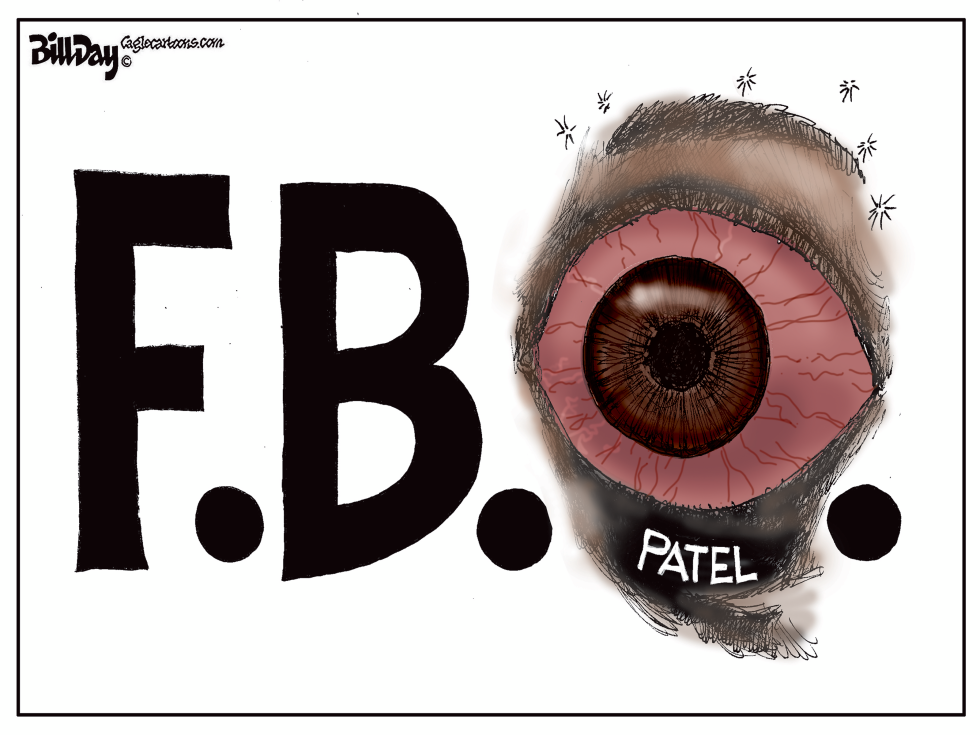
Bill Day's cartoon features the letters F.B.I. with a veiny, bloodshot eye replacing the 'I', and the word Patel scrawled beneath it, evoking themes of booze and drinking. Stars sparkle above the eye, adding to the sense of disorientation or absence. This piece, tagged with Patel, FBI, booze, drinking, absent, and drunk, offers a straightforward jab at a figure's rumored state. In the world of political cartoons, such direct visuals cut through the noise, reminding editors that simplicity often packs the biggest punch. Day's style here is classic, with rough lines emphasizing the eye's intoxicated look, making it shareable for those following nomination sagas.
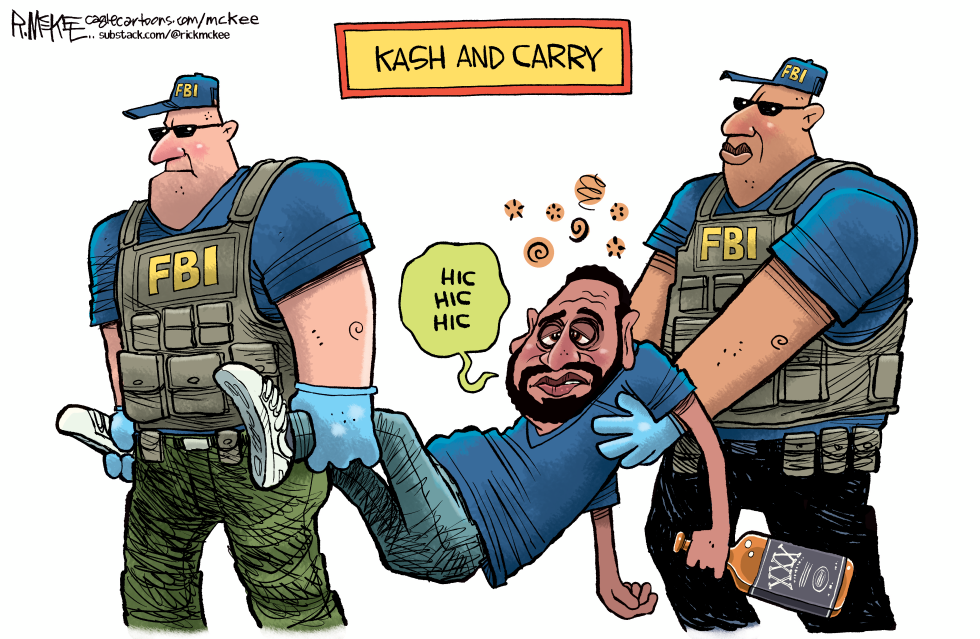
Rick McKee's cartoon shows two stern FBI agents in vests and caps, carrying a limp, bearded man who's clearly intoxicated, complete with hiccups and swirling symbols overhead, clutching a bottle marked XXX. The sign above reads 'Kash and Carry,' a clear pun tying into Kash Patel, the figure depicted. This piece tags into FBI, Federal Bureau of Investigation, drunk, alcohol, agents, criminal justice, and domestic policy, poking at the idea of leadership in a haze. The dry humor lands on the absurdity of carrying someone unfit, visually straightforward without hidden layers. Newspapers love this kind of sharp, unambiguous satire that comments on current events without overcomplicating the message.
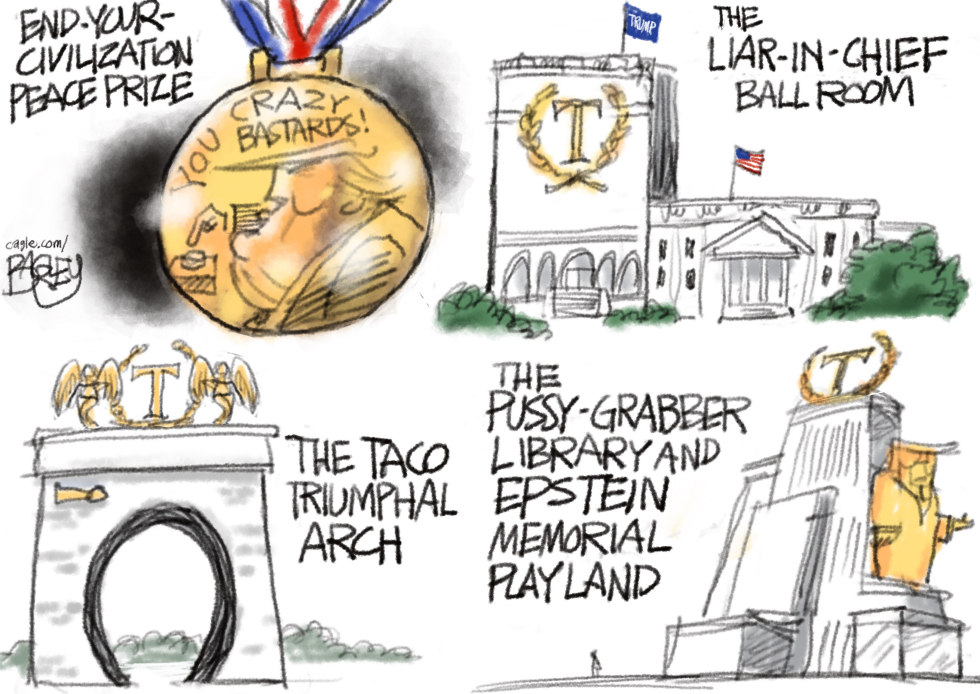
Pat Bagley's political cartoon titled Trump Legacy presents a series of imagined monuments that highlight controversial aspects through labels like End-Your-Civilization Peace Prize on a medal showing a figure with Trump's hairstyle, the Liar-in-Chief Ballroom resembling a grand building with Trump flag, the Taco Triumphal Arch as a stone structure with winged T, and the Pussy-Grabber Library and Epstein Memorial Playland as a classical edifice with a statue. These elements, tagged with arch, MAGA, triumphal, ballroom, peace prize, library, Epstein, use dry humor to comment on themes of liar, Republicans, fascism without adding unseen context. The composition clusters these items in a sketch style, emphasizing bold text and simple lines for impact.
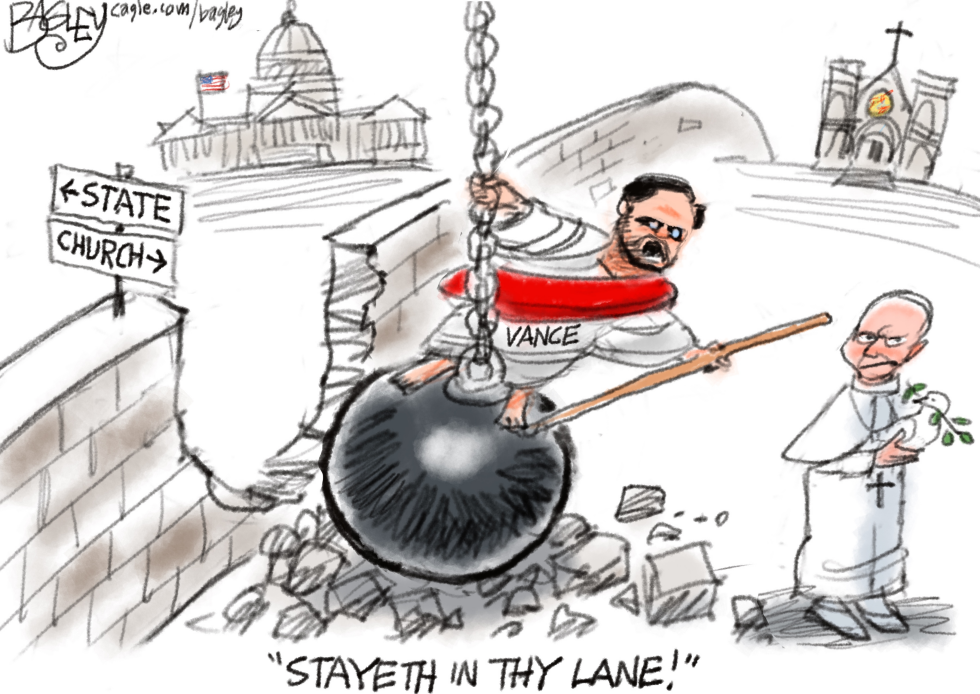
Pat Bagley's cartoon shows JD Vance dressed as Jesus, labeled 'VANCE,' swinging a massive wrecking ball to shatter a brick wall marked with signs pointing to 'STATE' and 'CHURCH.' He shouts 'STAYETH IN THY LANE!' at a figure resembling the Pope, who holds an olive branch and dove, symbols of peace. In the background, the U.S. Capitol flies an American flag, while a church with a cross represents the Vatican. Tags like war, peace, JD Vance, religion, Trump, and scripture underscore the satire on blurring lines between church and state, with Vance enforcing boundaries ironically through destruction. The image critiques political figures invoking religion amid Capitol politics.
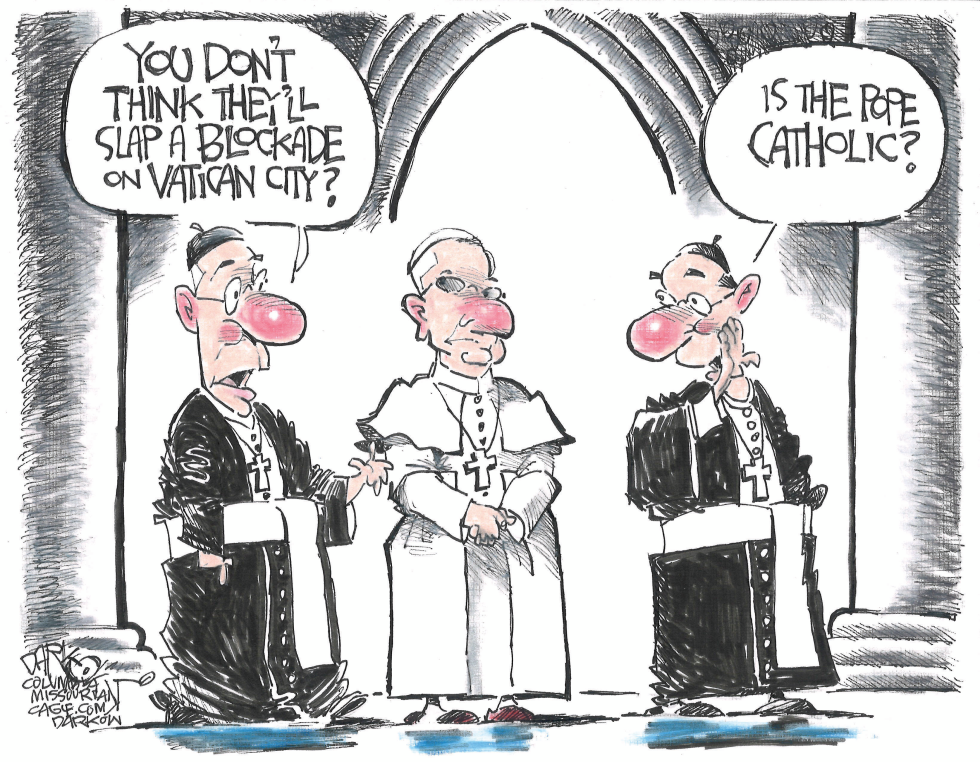
John Darkow's cartoon captures three Catholic clergy in traditional attire, with the central Pope figure amid a discussion on a Vatican blockade. The left figure worries about sanctions slapping Vatican City, while the right delivers the classic 'Is the Pope Catholic?' line, a rhetorical jab at obvious truths. This piece uses dry humor to spotlight tensions around religious institutions facing isolation, blending blockade fears with papal identity. The archway background grounds it in Vatican aesthetics, emphasizing the blockade theme without overreaching into unseen politics.
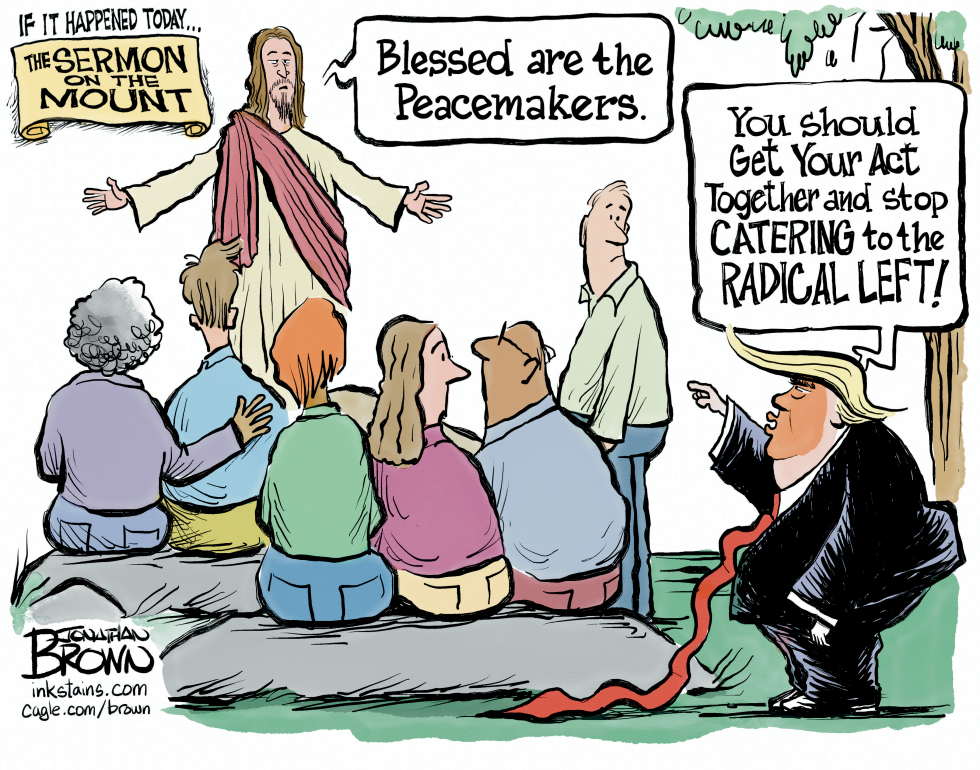
The cartoon depicts Jesus delivering the Sermon on the Mount, arms outstretched, proclaiming 'Blessed are the Peacemakers.' A banner reads 'If It Happened Today... The Sermon on the Mount.' A crowd sits on the ground, listening. A figure resembling Donald Trump, with distinctive hair and suit, points at Jesus and shouts, 'You Should Get Your Act Together and stop CATERING to the RADICAL LEFT!' The scene includes simple background elements like grass and a tree. Tags like war, peace, peacemakers, Jesus, and politics highlight the blend of biblical imagery with modern political commentary. This setup creates a direct contrast between messages of peace and partisan rhetoric.
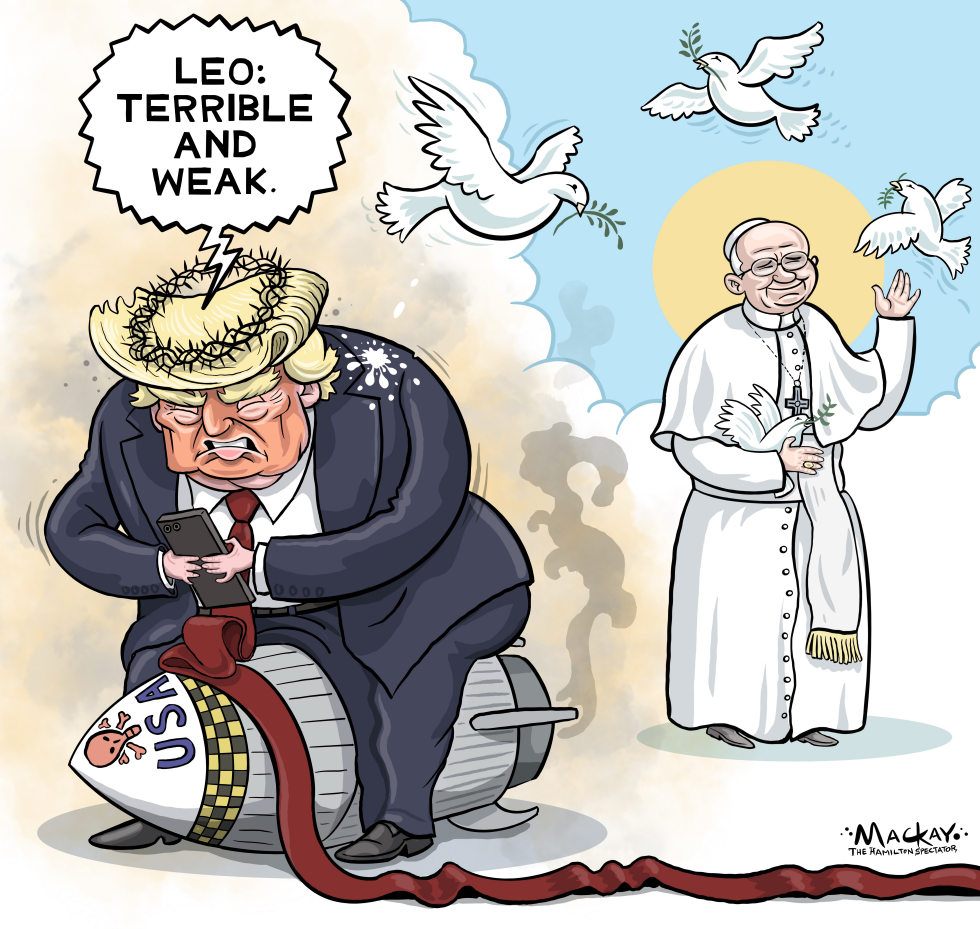
Graeme MacKay's political cartoon captures Trump, caricatured with crown of thorns hair, sitting on a bomb labeled USA with a skull symbol, holding a phone and declaring 'Leo: Terrible and Weak' in a speech bubble. Smoke rises from the missile, contrasting sharply with the Pope on the right, halo glowing, releasing white doves carrying olive branches. The scene unfolds against a cloudy sky, highlighting themes of war and peace. This satirical illustration pokes at political rhetoric, religious symbolism, and international tensions, blending humor with critique in a style that's both direct and pointed.
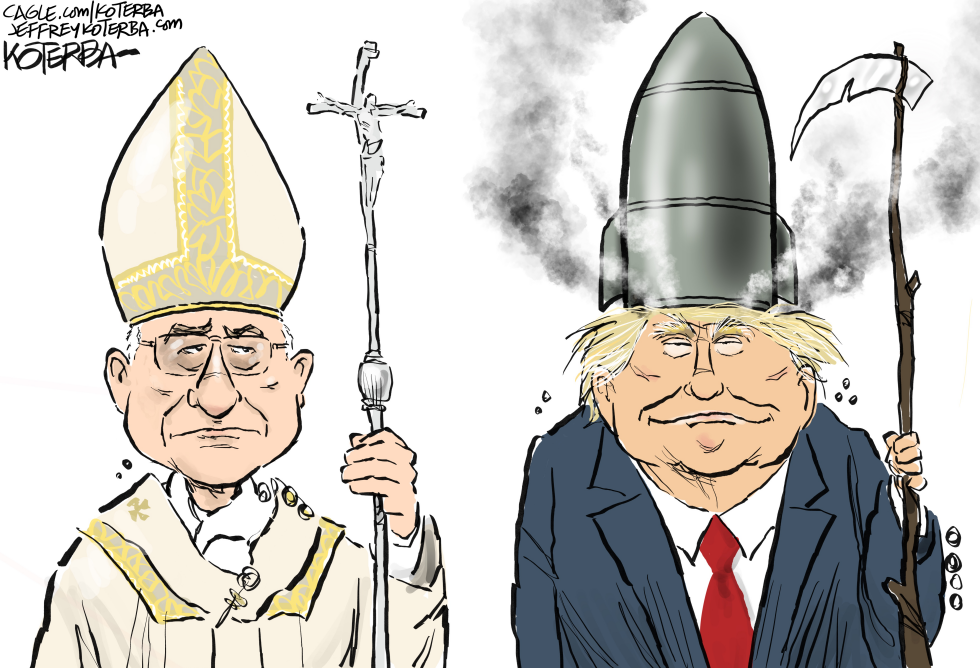
Jeff Koterba's cartoon captures Pope Leo in traditional mitre and Catholic robes, gripping a staff topped with a crucifix and cross featuring Jesus, set against a backdrop of war themes. On the right, a caricature of the president sports a bomb-shaped hat emitting smoke, paired with a grim reaper scythe, evoking missile imagery and Vatican contrasts. The piece blends humor with commentary on leadership, where religious symbols meet destructive elements. Tags such as war, bomb, missile, Catholic, crucifix, and Vatican underscore the satirical edge, pointing to tensions between spiritual authority and political power plays. This 2026-dated work maintains Koterba's style, direct and unflinching, poking at the absurdities of global figures.
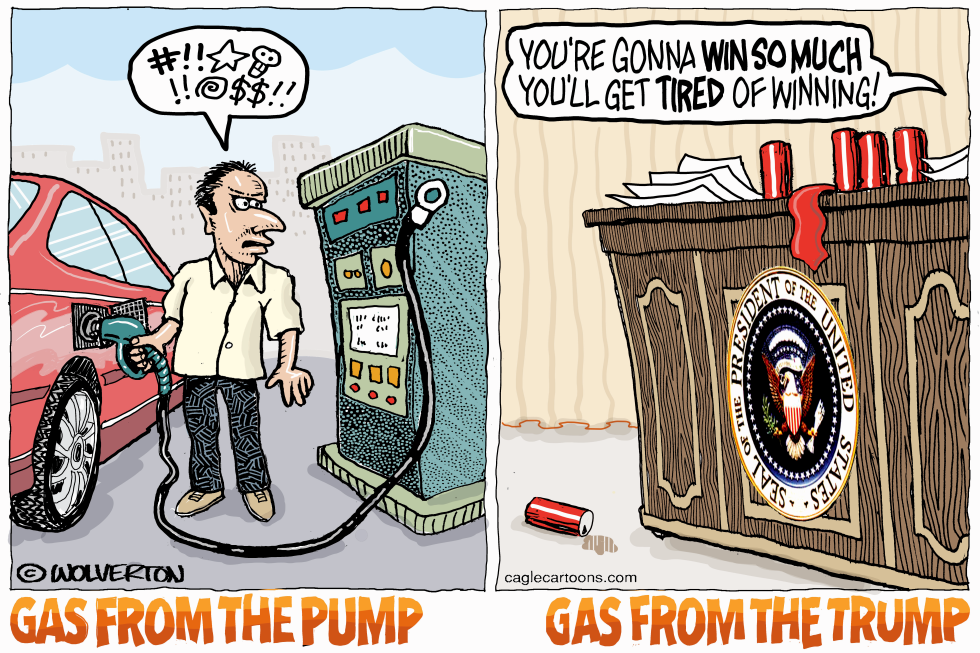
The cartoon splits into two panels: one shows a man at a car at gas pump, angrily reacting with symbols to high gasoline prices labeled as gas from the pump. The other depicts the Resolute Desk with the presidential seal, scattered papers, and coke cans, a speech bubble proclaiming 'You're gonna win so much! You'll get tired of winning!' tagged as gas from Trump. Tags like petrol, tired of winning, and Oval Office highlight the pun on 'gas' as fuel versus bluster. This setup comments on economic pains versus political rhetoric, using elements like the car at gas pump and coke cans for visual punch. The dry humor ties into ongoing debates on gasoline prices and leadership promises.
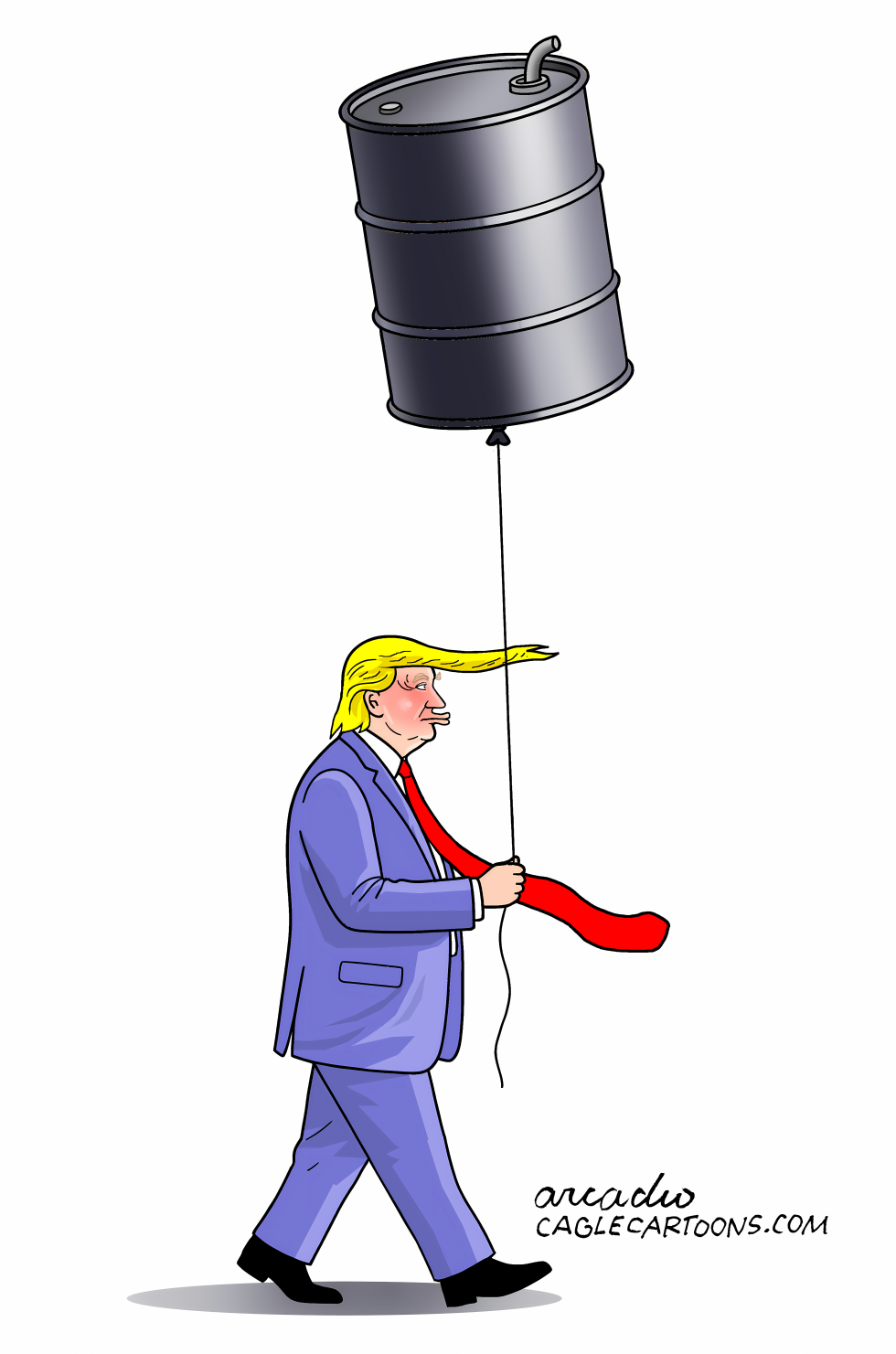
Arcadio Esquivel's cartoon captures Trump striding forward, his red tie extending upward to hold a massive oil barrel aloft like a helium balloon, with his yellow hair streaming behind. The simplicity highlights themes of Trump, oil prices, inflation, Hormuz, energy, and midterm elections. Such visuals often comment on economic pressures without words, relying on exaggerated features for recognition. Cartoonists like Esquivel use minimalism to drive points home, here linking a political figure to rising costs in a direct, unambiguous way. The white background keeps focus on the central elements, making the satire pop for viewers.
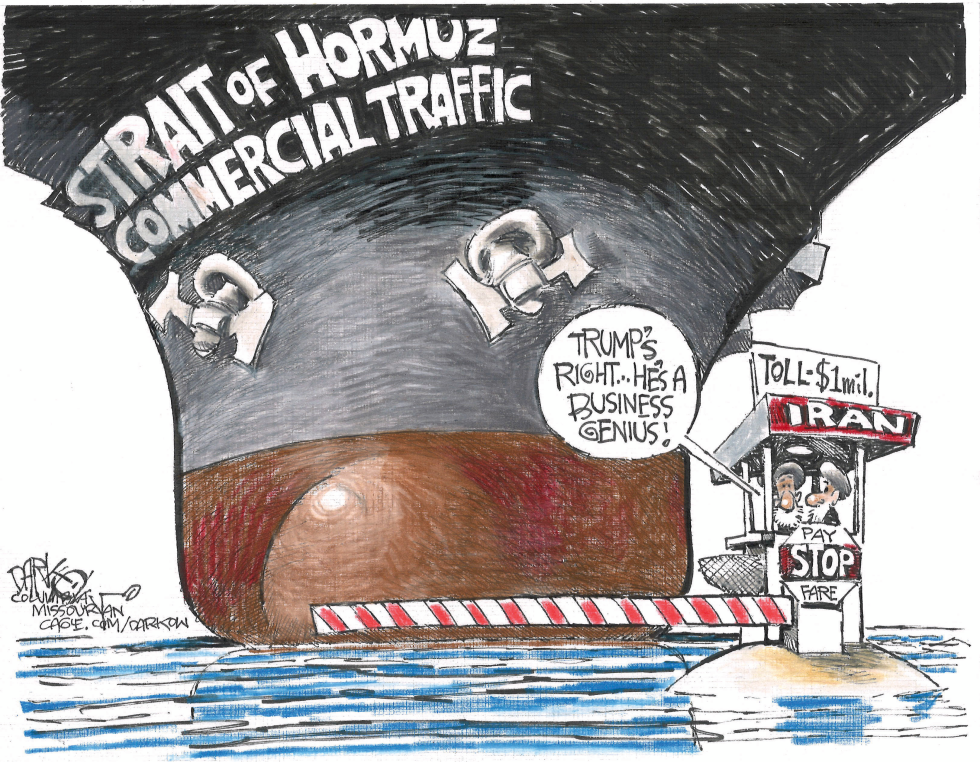
The cartoon shows a massive ship representing commercial traffic through the Strait of Hormuz approaching an Iran-operated toll booth charging one million dollars. Two figures in the booth exchange remarks crediting Trump with business acumen. The scene illustrates tensions over control of the vital shipping route between Iran and Gulf states.
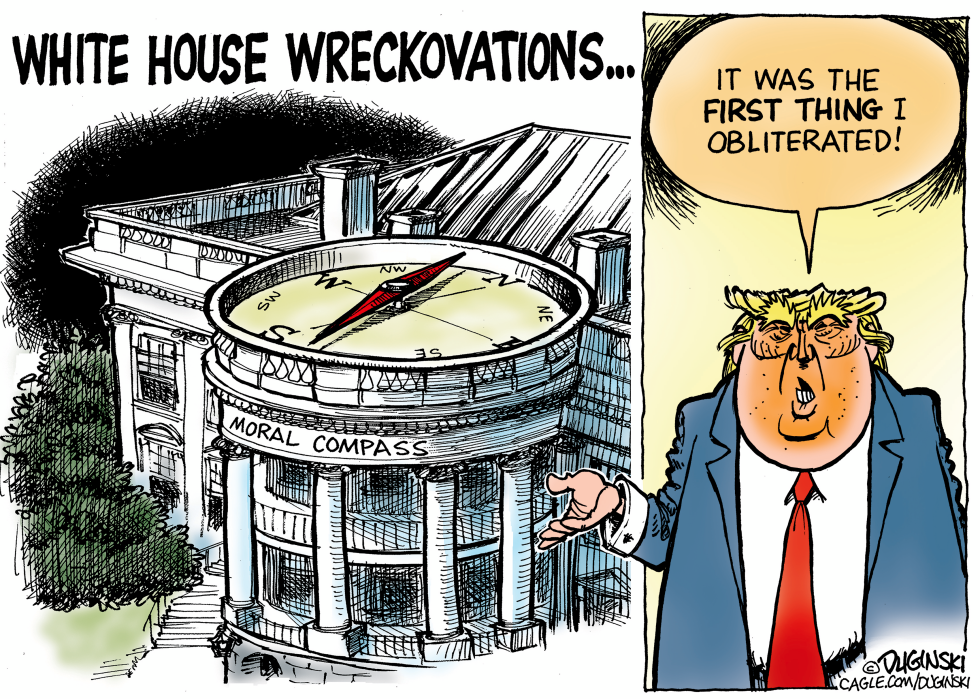
Paul Duginski's cartoon shows a caricatured Trump gesturing proudly while speaking about obliterating the moral compass, a large dome-like structure labeled 'Moral Compass' with directional arrows, placed on the White House roof. The title 'White House Wreckovations' plays on renovations, suggesting destructive changes. Tags including president, MAGA, White House, demolition, morality, ethics, obliteration, Republicans, and Iran war frame the image as a critique of ethical standards in politics. The scene captures a dark night setting with part of the building and trees visible, emphasizing the theme of moral destruction in Washington.