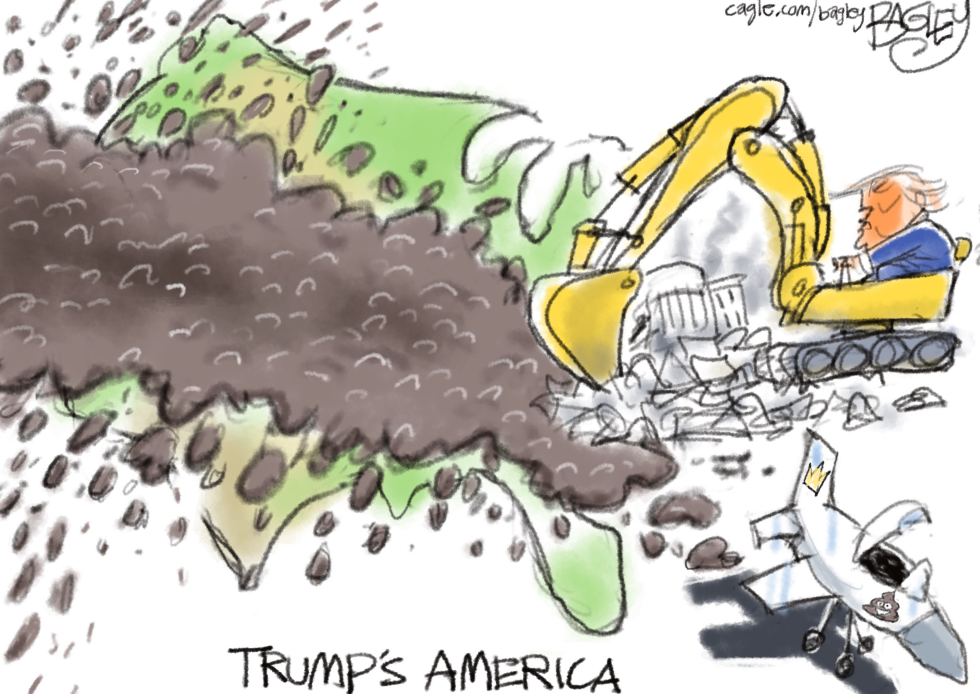
On October 21 2025 Donald Trump appears at the controls of a yellow excavator that is tearing down the White House. Debris scatters across the foreground while a large brown cloud expands from the left. A small jet marked with a crown sits on the ground near the wreckage. The scene is labeled Trump’s America at the bottom.
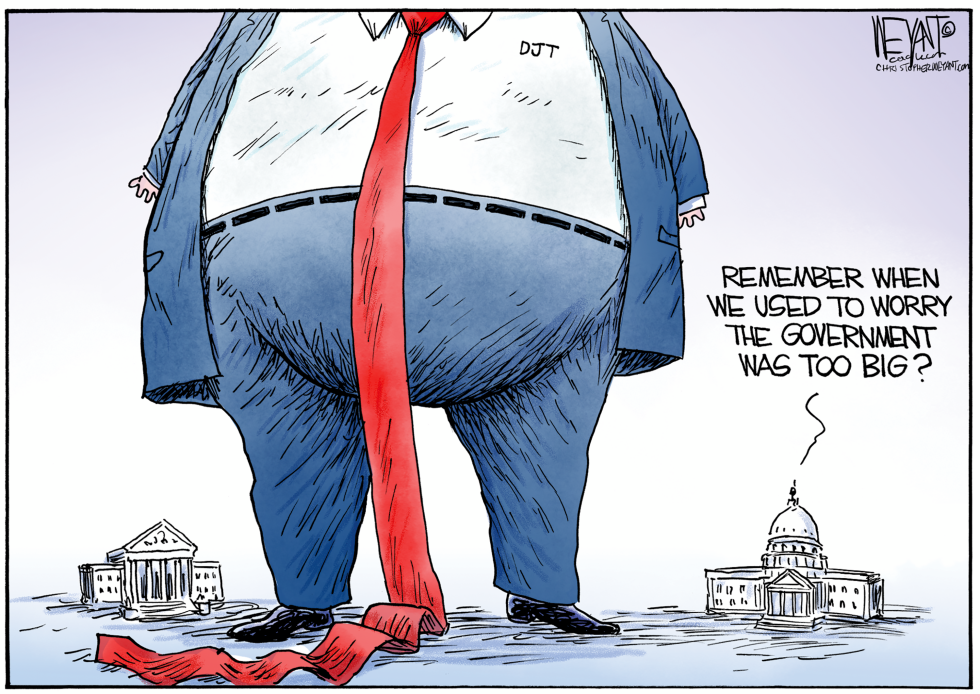
A cartoon published October 20, 2025, depicts a massive figure marked DJT standing over miniature representations of the Supreme Court and Capitol building. The figure's red tie lies on the ground near the structures. Text on the right recalls earlier concerns about an oversized government. The image highlights the contrast between the dominant central figure and the diminished institutions below.
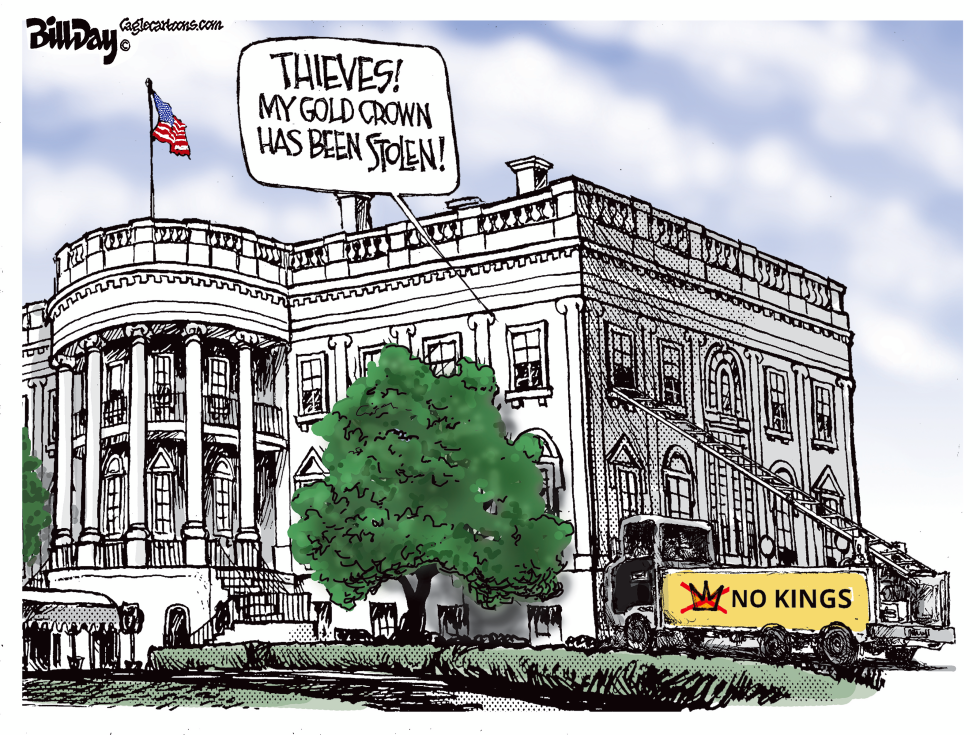
The White House appears in an image with a speech bubble declaring a gold crown stolen. A truck displaying a crossed-out crown and the words NO KINGS sits nearby with a ladder against the building. An American flag flies from the roof. The scene references a recent claim of theft involving royal symbols at the executive mansion.
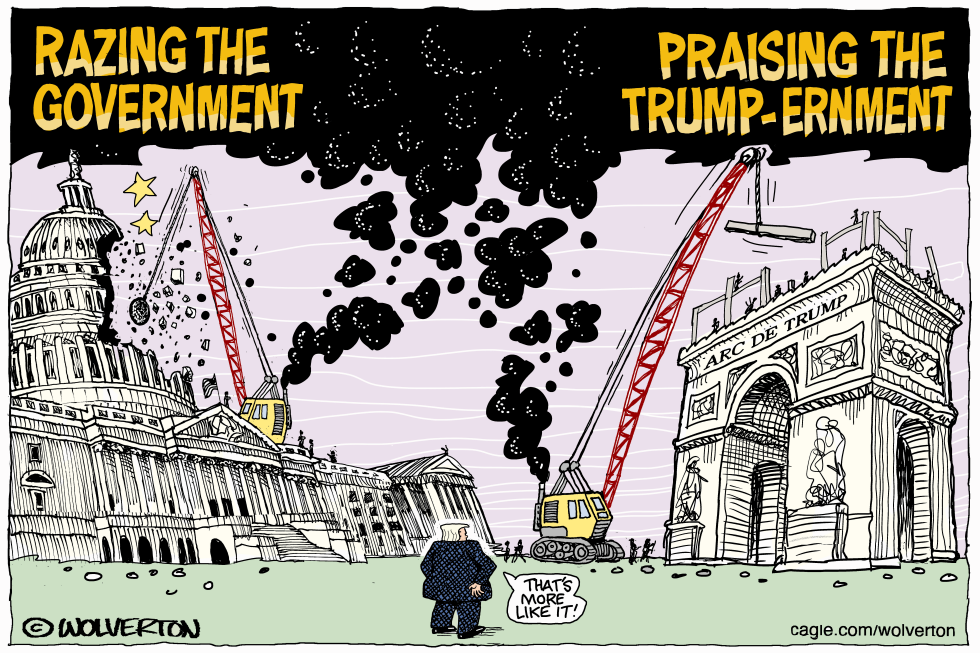
On October 18, 2025, a Monte Wolverton cartoon depicts President Donald Trump observing the demolition of the U.S. Capitol Building on the left and the construction of an Arc de Trump monument on the right. A wrecking ball and crane damage the Capitol while another crane assembles the arch. Black smoke fills the center. Trump, in the foreground, says 'THAT'S MORE LIKE IT!' The split headline reads 'RAZING THE GOVERNMENT' and 'PRAISING THE TRUMP-ERNMENT.' The image comments on federal workforce reductions and infrastructure priorities during the second Trump term.
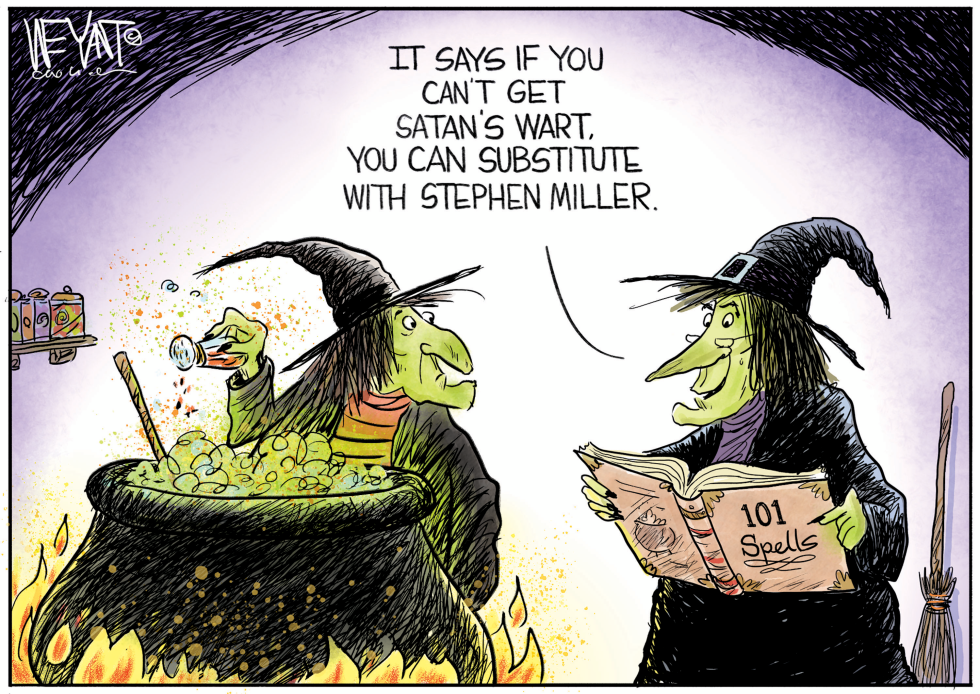
A cartoon depicts two witches preparing a potion in a cauldron. One adds a bottle labeled Satan's Wart and suggests substituting with Stephen Miller per the spell book instructions.
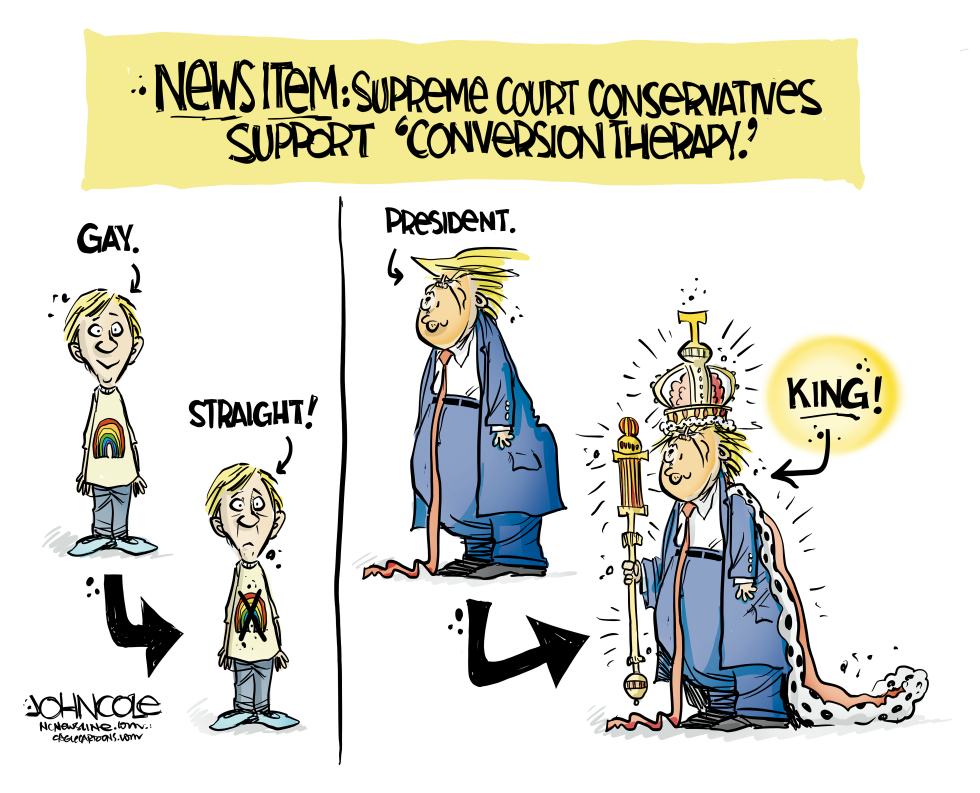
On October 14 2025 John Cole's cartoon depicts Supreme Court conservatives endorsing conversion therapy. The left panel shows a boy labeled gay transformed into straight. The right panel shows a president figure transformed into a robed and crowned king. The visual equates the therapy with an unconstitutional expansion of presidential power. The piece criticizes the court's conservative majority for enabling such shifts.
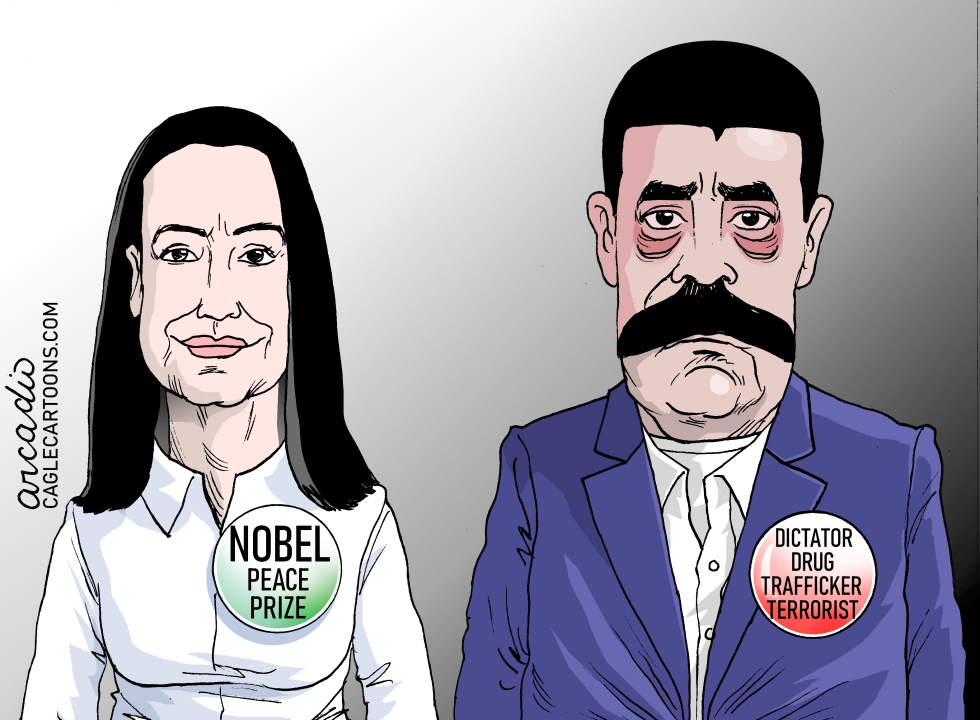
Arcadio Esquivel's cartoon contrasts a woman with a 'NOBEL PEACE PRIZE' badge against a man labeled 'Dictator Drug Trafficker Terrorist,' using tags like María Corina Machado, Maduro, and Venezuela to highlight political divides in a simple, label-driven satire.
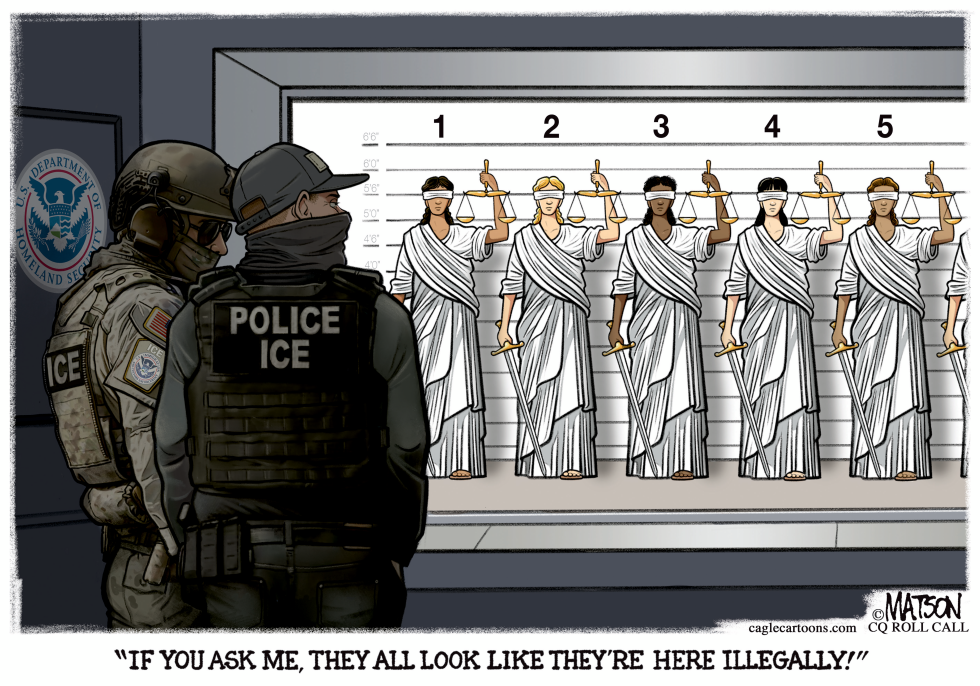
ICE agents stand in a station viewing a lineup of five robed figures resembling justice symbols. Each figure holds scales and a sword while blindfolded. Skin tones differ across the group. A caption at the bottom states that they all appear to be present illegally. The scene includes a homeland security emblem on a nearby door and tactical gear on the agents.
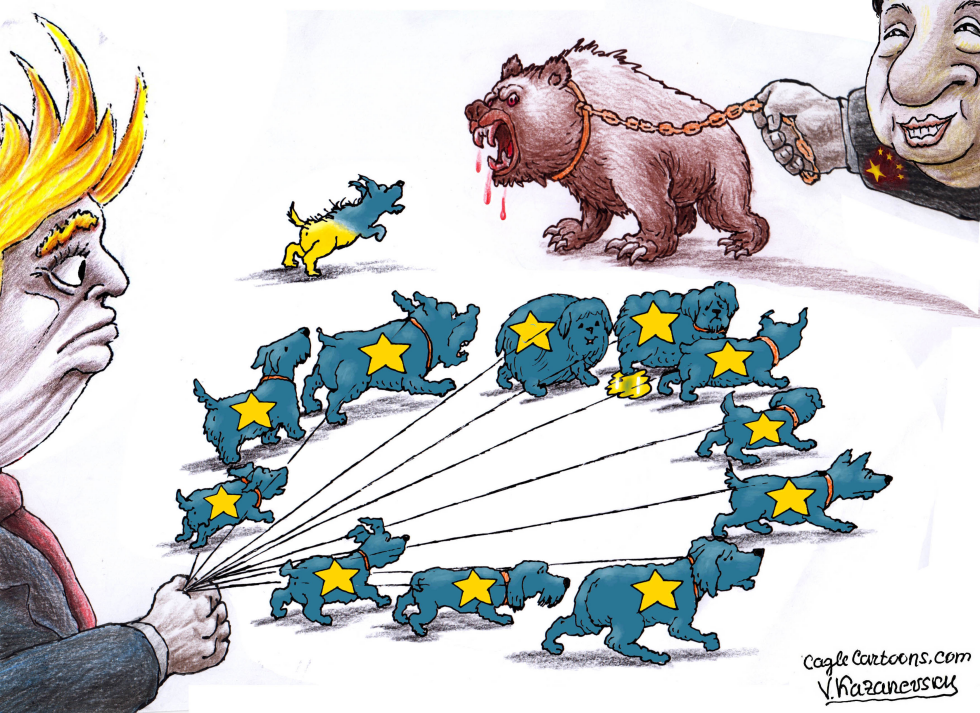
The drawing shows a yellow-haired figure on the left gripping multiple leashes attached to blue dogs marked with yellow stars. A brown bear with an open mouth and red drips stands chained on the right, held by a hand bearing Chinese stars. One small blue and yellow dog runs away in the background while other dogs form lines under the leashes.
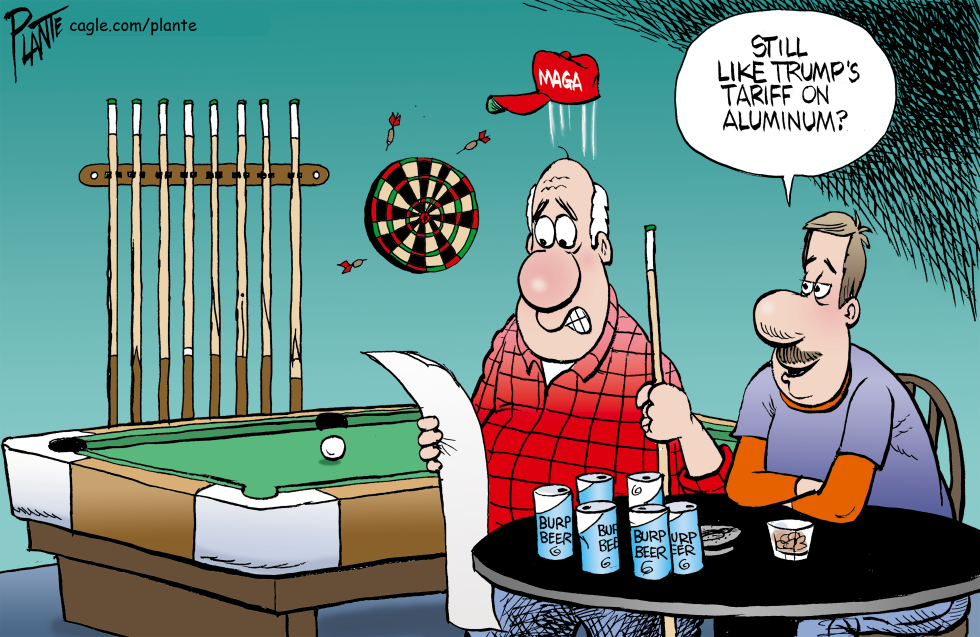
Two men discuss Trump's aluminum tariff at a pool table surrounded by Burp Beer cans and a dripping MAGA cap. The scene highlights rising costs from trade duties on aluminum and steel affecting everyday items like beer. Publication occurs during renewed focus on tariffs targeting Canada and Mexico.
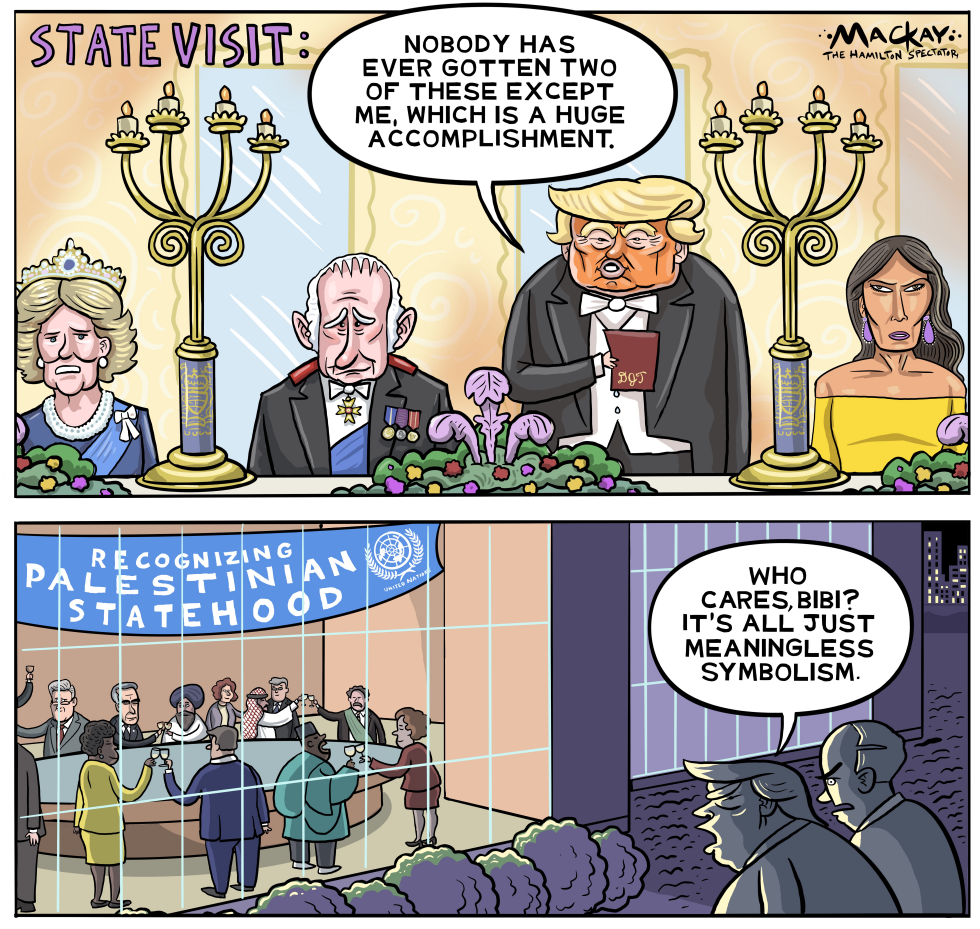
Graeme MacKay's cartoon captures a state visit dinner scene with figures at a table adorned with candelabras, where a caricature resembling Donald Trump boasts about unique accomplishments. The lower panel shifts to a United Nations setting with a banner reading 'Recognizing Palestinian Statehood,' showing delegates toasting, while outside, Trump and another figure, addressed as Bibi, dismiss the event as meaningless symbolism. Incorporating tags like Allies, Palestine, United Nations, Statehood, Recognition, and Peace, the artwork highlights contrasts in diplomatic perceptions. The composition uses split panels to juxtapose formal pomp with cynical realpolitik, emphasizing themes of symbolic gestures versus substantive policy in the Israel-Gaza conflict context.