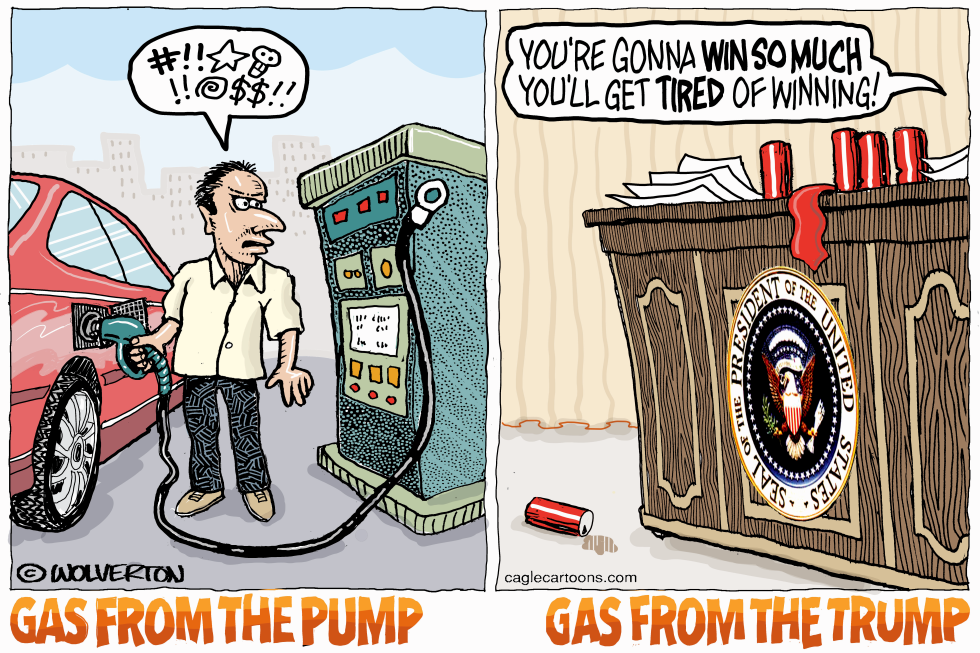
The cartoon splits into two panels: one shows a man at a car at gas pump, angrily reacting with symbols to high gasoline prices labeled as gas from the pump. The other depicts the Resolute Desk with the presidential seal, scattered papers, and coke cans, a speech bubble proclaiming 'You're gonna win so much! You'll get tired of winning!' tagged as gas from Trump. Tags like petrol, tired of winning, and Oval Office highlight the pun on 'gas' as fuel versus bluster. This setup comments on economic pains versus political rhetoric, using elements like the car at gas pump and coke cans for visual punch. The dry humor ties into ongoing debates on gasoline prices and leadership promises.
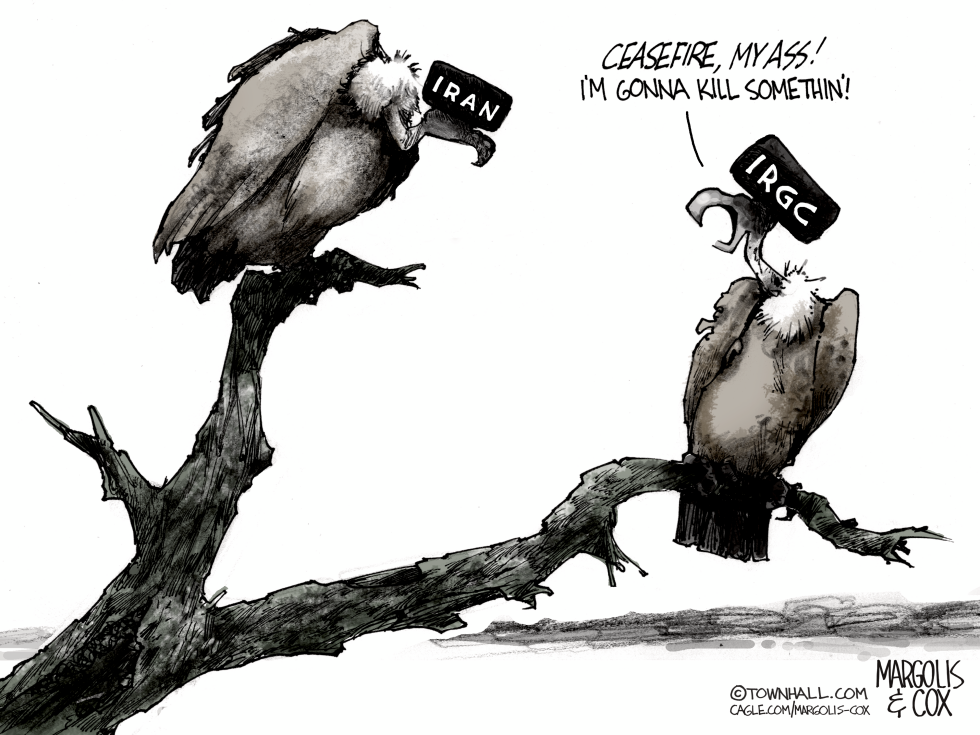
The image shows two vultures on a dead tree branch. The larger one carries an Iran sign. The smaller one carries an IRGC sign and declares rejection of any ceasefire. The scene responds to recent Iran negotiations over the Strait of Hormuz and related Middle East conflict developments in early 2026.
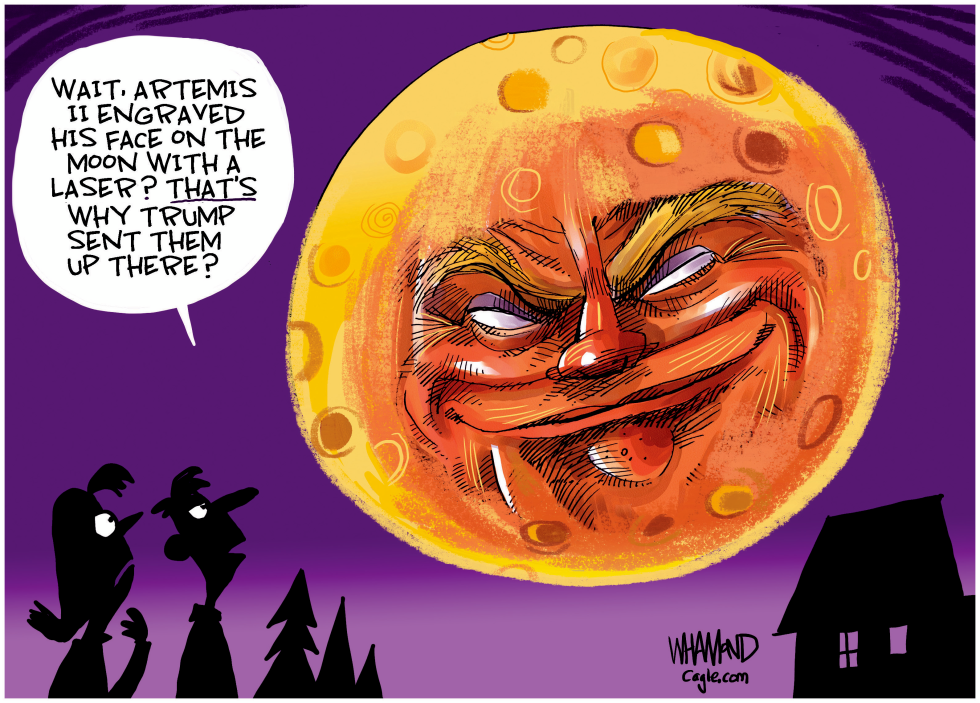
Dive into this political cartoon Trump moon masterpiece where the full moon sports a grinning caricature of Trump's face, complete with signature hair and smirk, against a purple sky. Silhouette figures below, one pointing, react via speech bubble questioning if Artemis mission satire involved laser engraving his likeness. Trees and a house add earthly contrast to the lunar oddity. This Trump face engraved on moon gag pokes fun at ego-driven space ambitions, blending humorous political satire with artistic flair. The Donald Trump space program parody captures timely irreverence, making it a sharable gem for satire lovers.
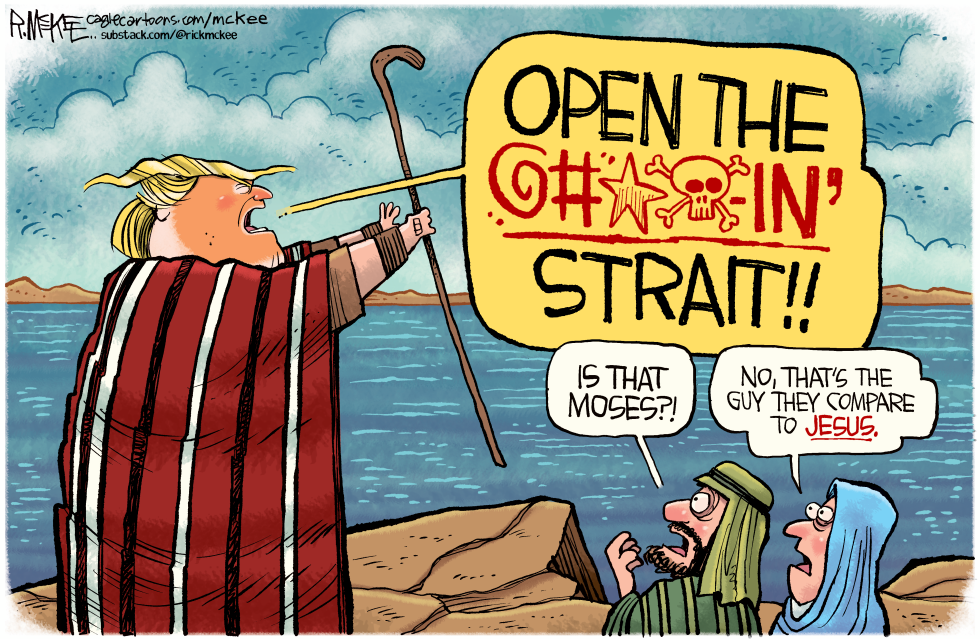
Rick McKee's cartoon depicts a blond-haired man resembling Donald Trump, dressed in red robes, holding a staff and yelling 'OPEN THE C@#*in' STRAIT!!' at a body of water, evoking the Moses parting the Red Sea scene. In the foreground, two ancient-dressed figures converse: one asks if it's Moges, the other clarifies it's the guy compared to Jesus. The image ties into tags like Trump, Easter, Iran, Israel, war, Strait of Hormuz, blending biblical imagery with modern political satire on Trump's self-comparisons and international tensions. The censored profanity adds a layer of obscenity to the parody, set against a desert landscape with clouds.
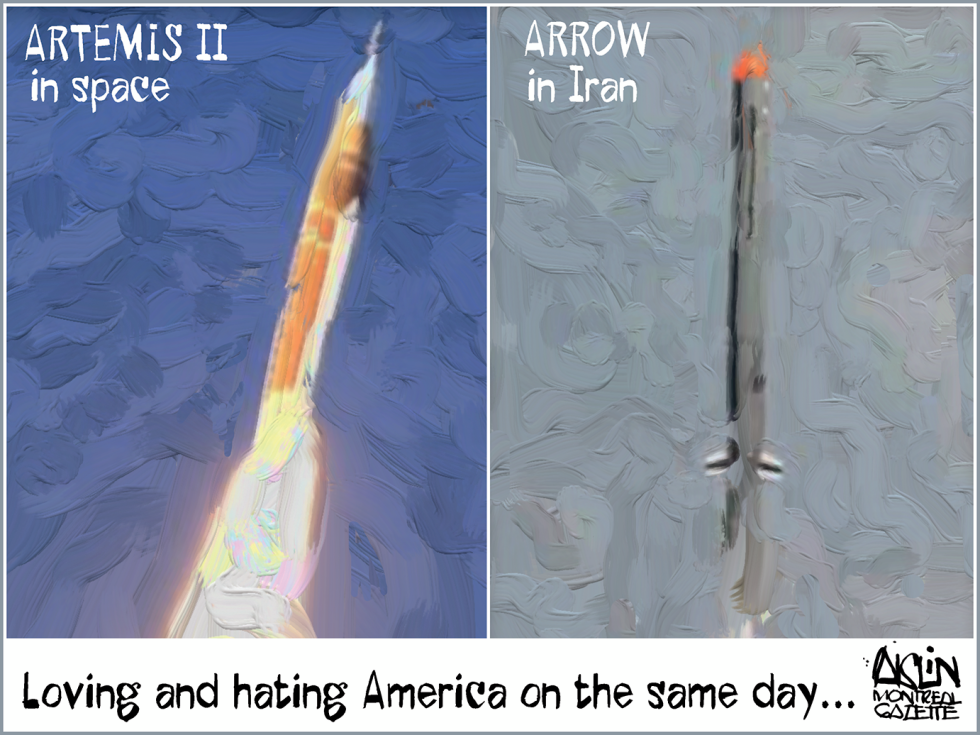
In this irreverent political cartoon, a vibrant Artemis II space launch rockets upward in a blue expanse on the left, symbolizing American innovation and triumph in US space exploration. Contrasting sharply on the right, a stark Arrow in Iran points downward with an orange glow against a gray sky, evoking geopolitical tension and Iranian weaponry. The caption 'Loving and hating America on the same day....' ties it together, offering a humorous take on the bipolar view of America in world news. With its simple yet effective composition, the artwork captures the absurdity of global perceptions, blending satire on international conflict with admiration for NASA's feats. This piece underscores the dichotomy in how the world engages with American power, from awe at space missions to ire over foreign policy frictions.
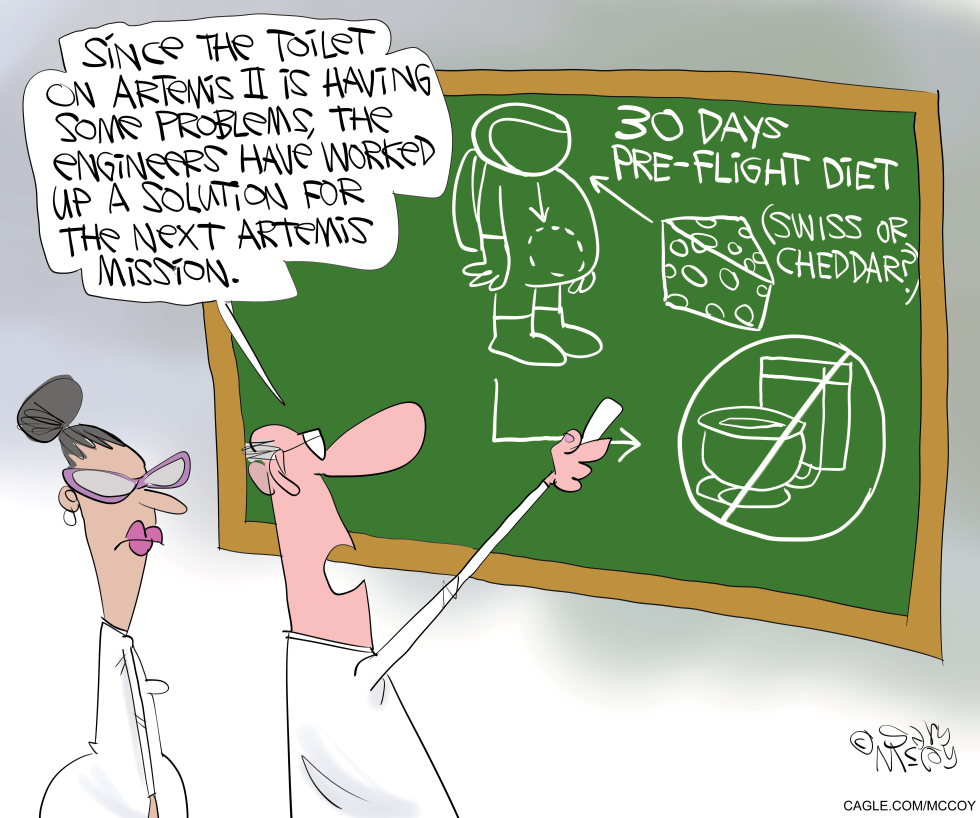
Gary McCoy\\\'s political cartoon depicts two figures in white coats, one pointing to a chalkboard with a speech bubble explaining a solution to Artemis II toilet problems via a 30-day pre-flight diet of Swiss or cheddar cheese. The board features a bloated astronaut sketch, a cheese cube, and a crossed-out toilet, poking fun at NASA engineering woes. This space mission satire uses dry humor to comment on technical glitches in the Artemis program, with tags like NASA Artemis II toilet problems, engineers solution Artemis mission, space mission pre-flight diet, Gary McCoy cartoon, cheesy diet fix, and humorous take on NASA solutions. The image stays light-hearted, focusing on visible elements without deeper speculation.
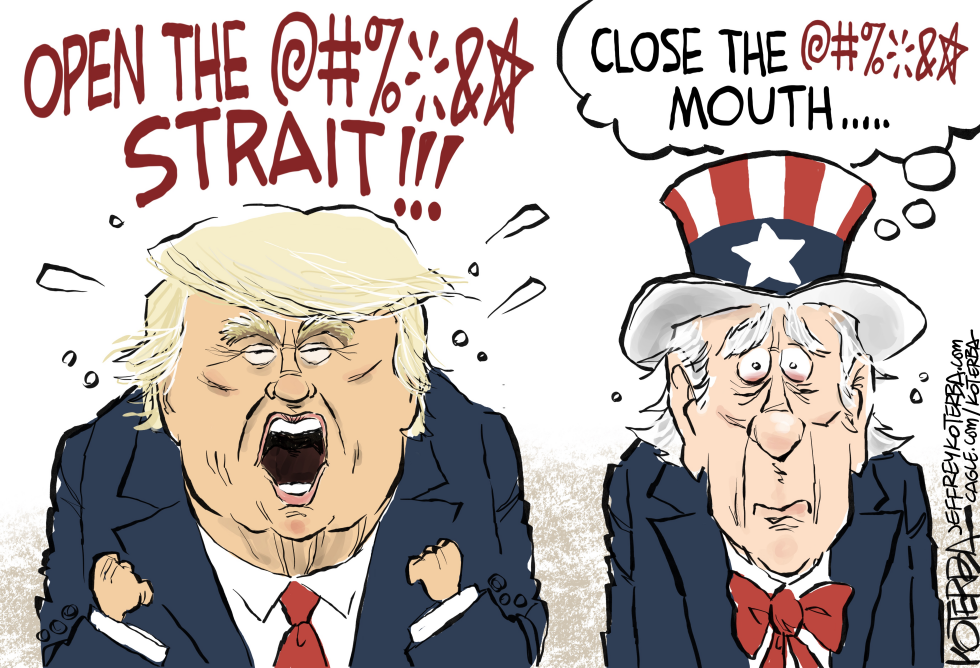
Donald Trump appears on the left side shouting for the Strait of Hormuz to open amid censored profanity. On the right Uncle Sam in stars and stripes hat replies via thought bubble to close the mouth. The April 2026 image contrasts the two figures in dark suits with contrasting expressions and gestures.
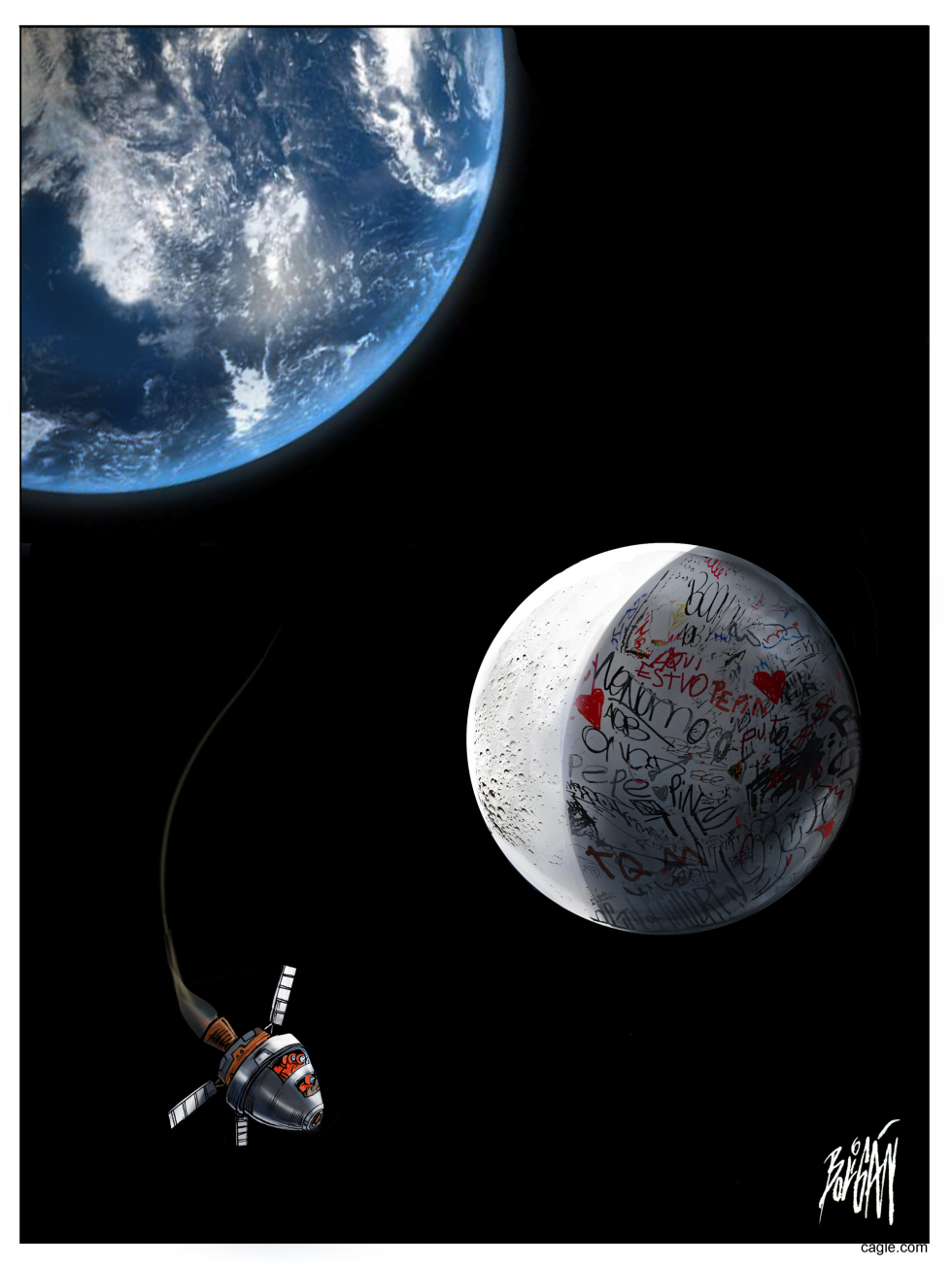
The image shows a spacecraft approaching the moon, whose near side displays extensive graffiti including words like bully and amor alongside hearts and scribbles. Earth is visible in the upper left against black space. The scene references ongoing lunar missions such as Artemis and Orion under NASA. The date of April 3 2026 places the work amid continued space exploration efforts. The visual highlights the contrast between pristine celestial bodies and terrestrial markings.
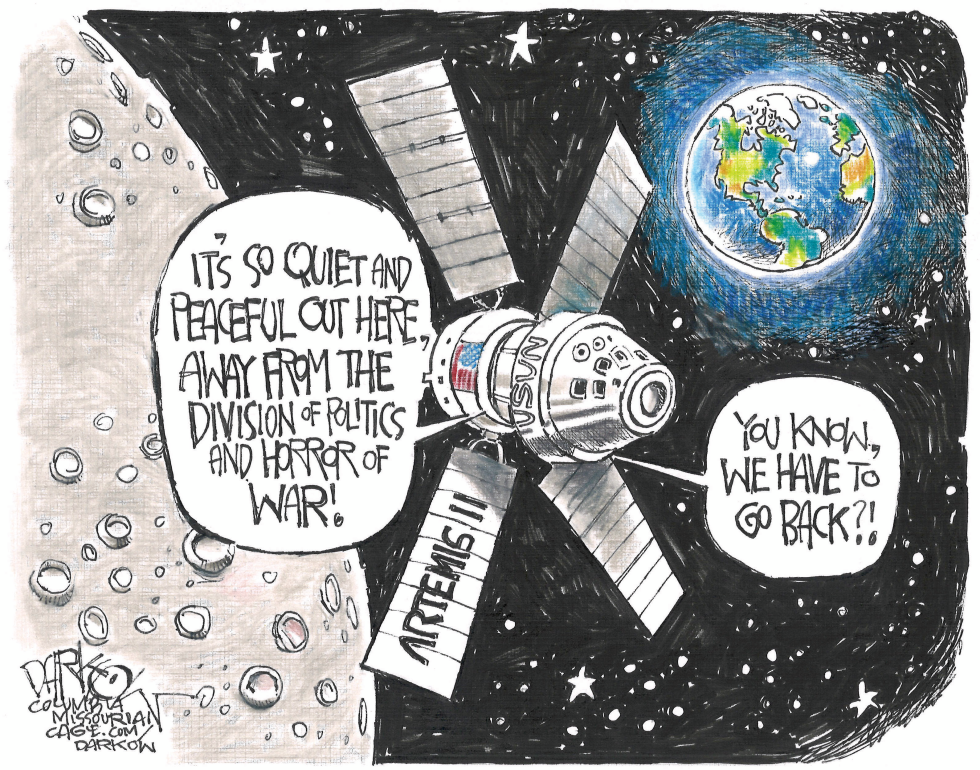
This Daryl Cagle political cartoon analysis features the Artemis II spacecraft floating in serene space, with Earth glowing in the background and the moon nearby. The left speech bubble extols the quiet peace away from division of politics and horror of war, while the right one resignedly notes the need to go back. It's a satirical cartoon on politics and war division, poking fun at how space exploration escaping earthly conflicts offers temporary respite. The NASA Artemis program humor illustration underscores the irony of advanced space missions contrasting with unresolved human divisions on Earth. Through this humorous take on returning to political division, the cartoon cleverly comments on the allure of peaceful space vs chaotic Earth without delving into specifics.
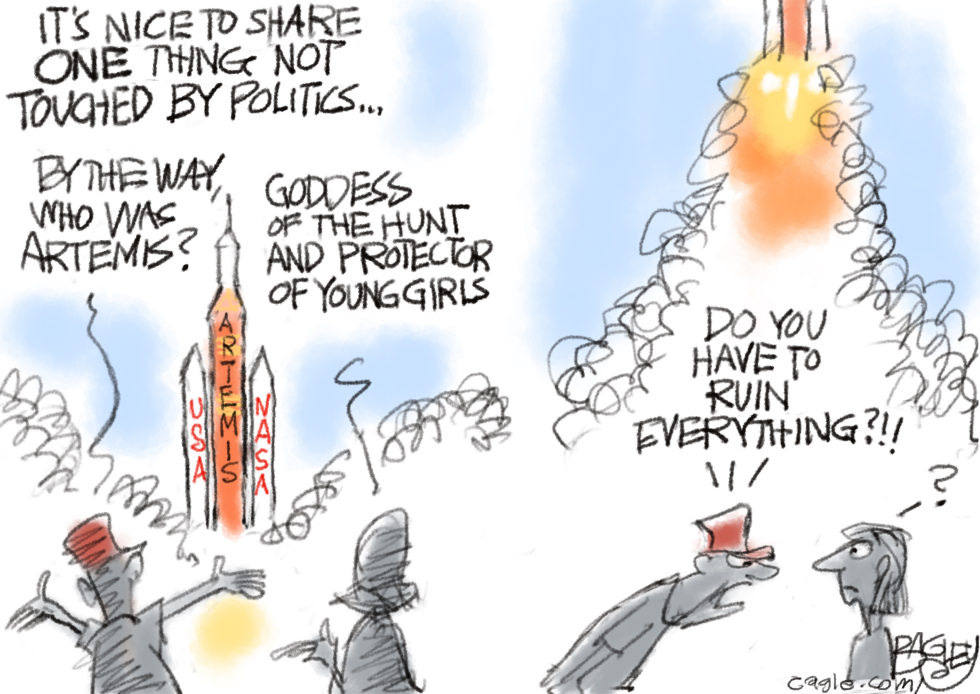
This political cartoon features a launching rocket labeled Artemis, SLS, NASA, and USA, with overlaid text praising one thing untouched by politics before asking about the goddess Artemis, described as goddess of the hunt and protector of young girls. A figure exclaims frustration at ruining everything, satirizing how even space missions get dragged into cultural debates. The irreverent sketch uses humorous figures with red hats to poke at over-politicization in science, blending mythology with modern rocketry in a witty critique. Tags like Artemis rocket launch political cartoon, NASA SLS Artemis mission satire, and politics invading science editorial cartoon underscore the cartoon's sharp insight into societal divisions spilling into apolitical realms like space exploration politicized cartoon.
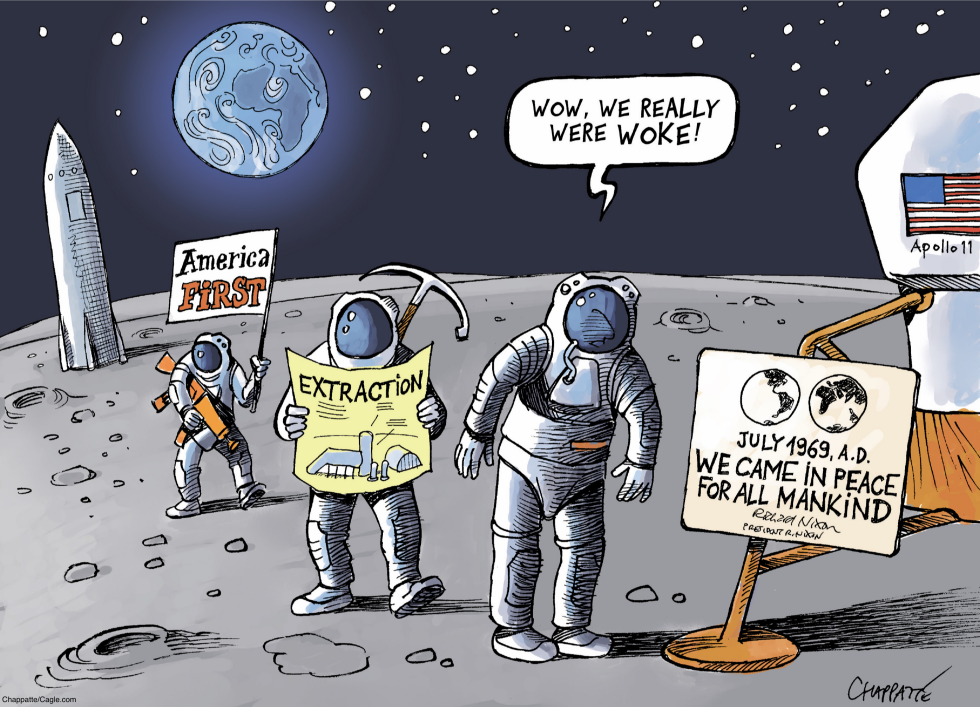
The cartoon shows three astronauts on the moon\\\\\\\'s surface, with Earth visible in the background. One holds a sign reading America First while carrying a weapon, another grips a document titled Extraction with a mining diagram, and the third wields a pickaxe next to a plaque stating We came in peace for all mankind from July 1969 A.D. near the Apollo 11 lander flagged with the US stars and stripes. A speech bubble declares Wow, we really were woke! The scene captures space race satire, lunar exploration humor, political cartoon commentary on shifting priorities from global peace to nationalistic resource grabs, all in Patrick Chappatte\\\\\\\'s style.
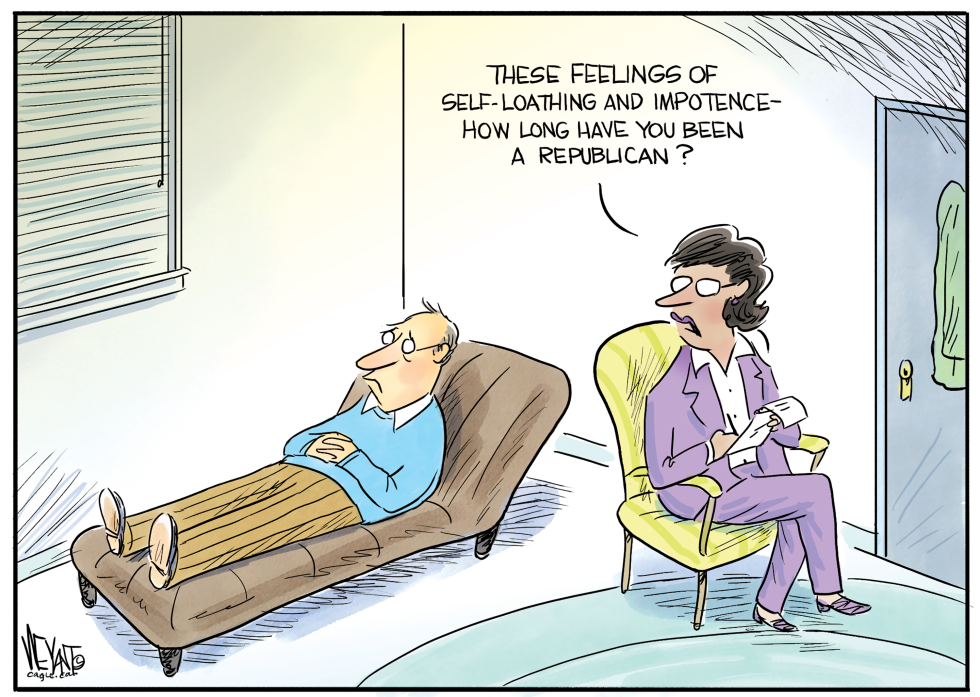
Christopher Weyant's political cartoon shows a therapy room with blinds, a door, and a coat hanger. A balding man in glasses, blue shirt, and brown pants reclines on a brown couch, arms crossed, looking distressed. A woman with dark hair, glasses, purple suit, sits on a yellow chair holding notes, speaking the punchline linking self-loathing and impotence to Republican tenure. The scene captures satirical commentary on political identity, with dry humor evident in the exaggerated expressions and simple setting. Tagged as republican party satire, therapy humor, political cartoon, self-loathing joke, impotence metaphor, and party affiliation critique, it highlights insider views on partisan struggles.
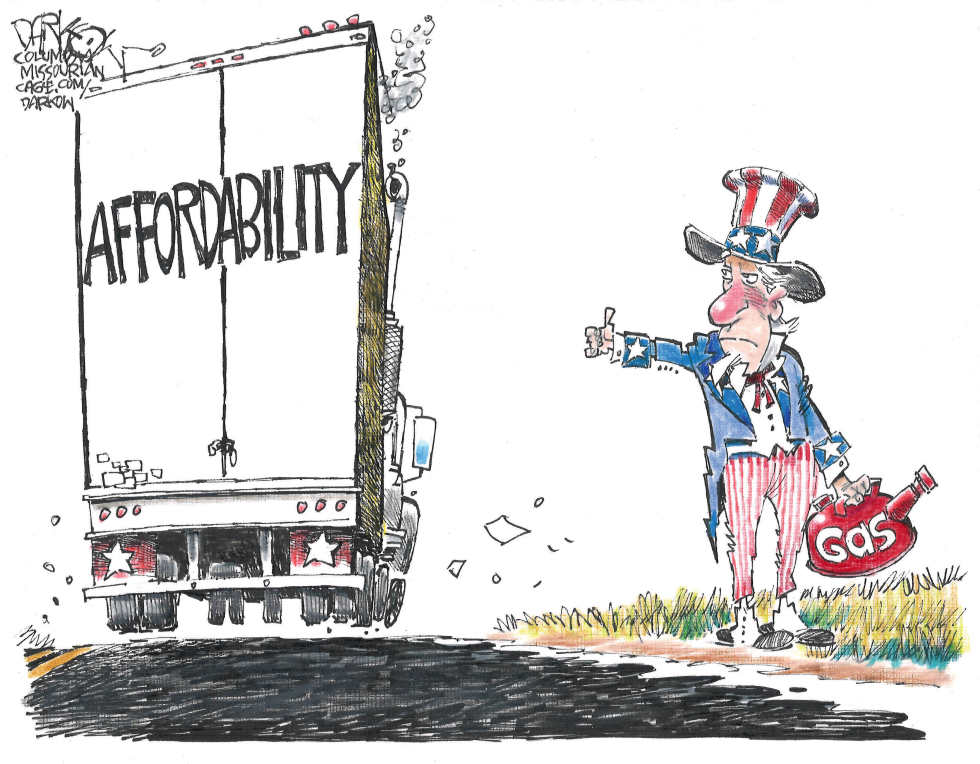
In this John Darkow cartoon, Uncle Sam stands on a roadside, thumb extended in a hitchhiking gesture, clutching a red gas can labeled 'Gas,' while a massive truck labeled 'AFFORDABILITY' barrels away, leaving exhaust and debris in its wake. The image captures the essence of the affordability crisis, with Uncle Sam personifying American struggles amid rising gas prices. Tags like affordability, gas prices, Iran war, Uncle Sam, and tariffs underscore the economic satire. The grassy roadside and spilled liquid add to the scene of abandonment. This visual commentary highlights how tariffs and potential conflicts like an Iran war could exacerbate fuel costs, leaving everyday affordability out of reach. The cartoon's composition emphasizes isolation, with Uncle Sam's frustrated expression plainly visible against the departing vehicle.