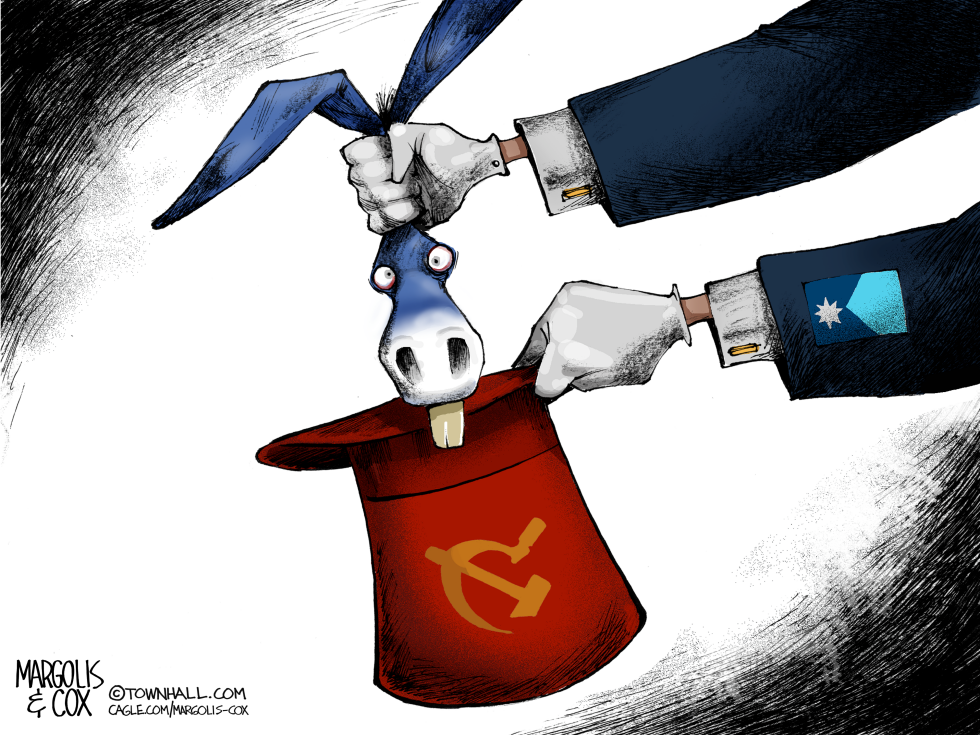
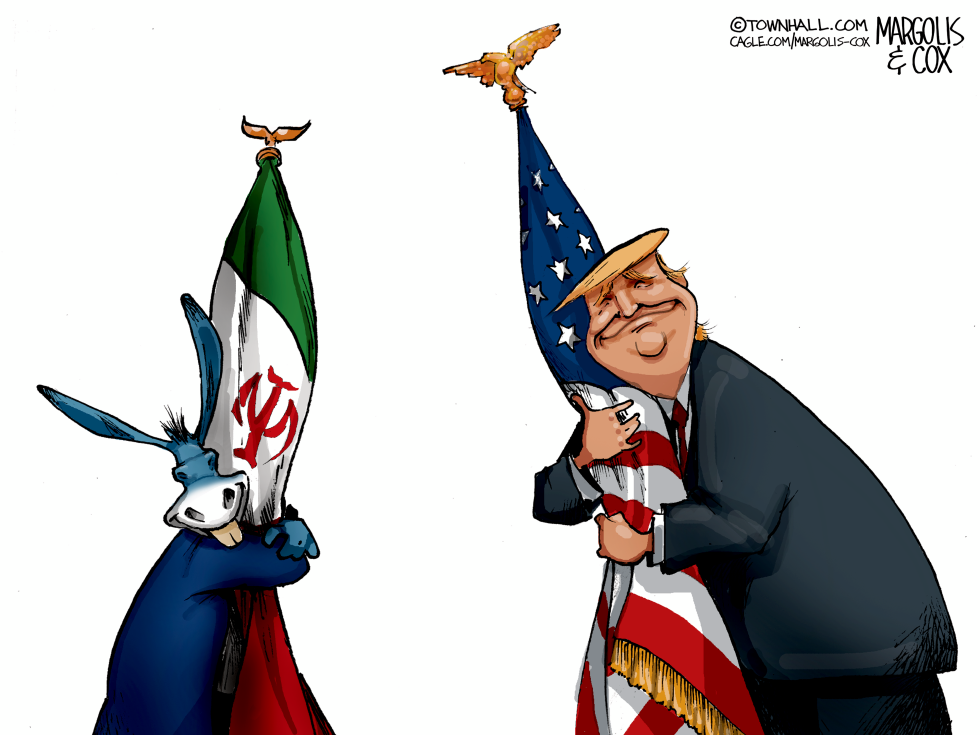
Accusations that Democratic policies carry communist undertones have persisted in partisan debate for years. The image frames the party as emerging directly from a communist emblem through a conjurer's reveal. This visual argument underscores ongoing conservative critiques that Democratic governance veers toward authoritarian economic controls rather than traditional American principles.
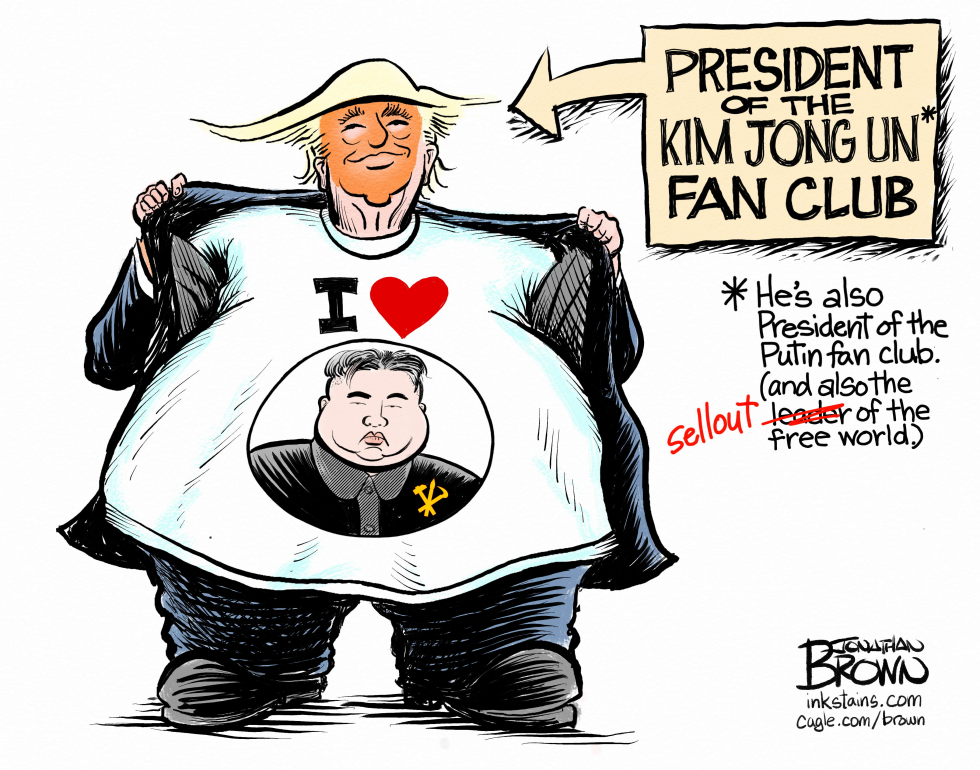
The image shows Donald Trump pulling open his jacket to reveal a white shirt bearing a portrait of Kim Jong Un inside a heart. An arrow points to a sign declaring him president of the Kim Jong Un fan club. Additional text notes his role in a Putin fan club and crosses out the word sellout next to a reference to leadership of the free world. The composition centers on the shirt reveal and the sign in the upper right.
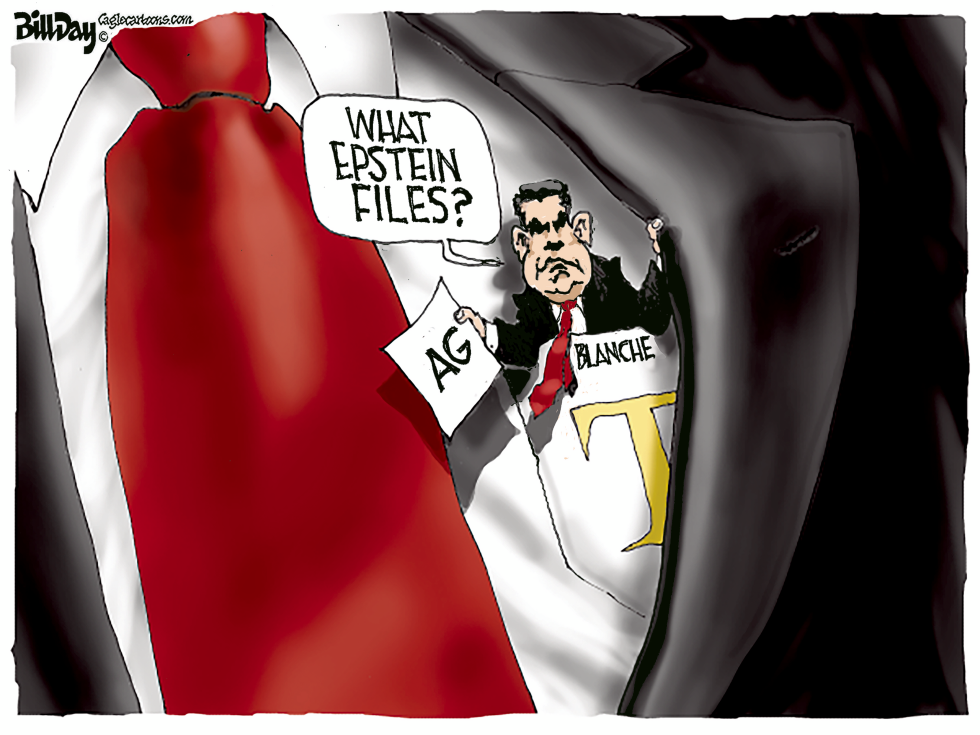
Todd Blanche, serving as attorney general in the Trump-aligned administration, has raised questions about the handling of Jeffrey Epstein-related files. The inquiry comes as legal and political scrutiny intensifies over past associations and document access. The piece portrays the questioning as occurring in close proximity to Trump symbols and influence.
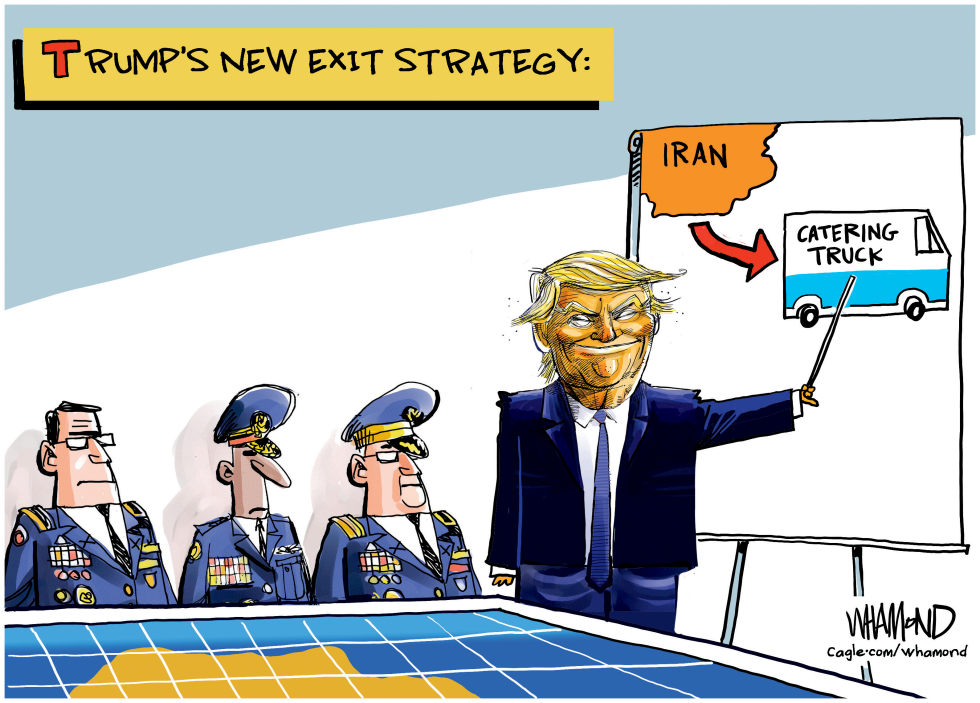
The cartoon depicts Donald Trump addressing three military officers while pointing to a whiteboard labeled Iran with a catering truck illustration. The yellow banner reads Trump's New Exit Strategy. The image uses the catering truck as a visual device for an Iran withdrawal plan. It responds to ongoing discussions about U.S. foreign policy toward Iran in 2026. The composition places Trump in a briefing role with officers seated at a table marked by a grid pattern.
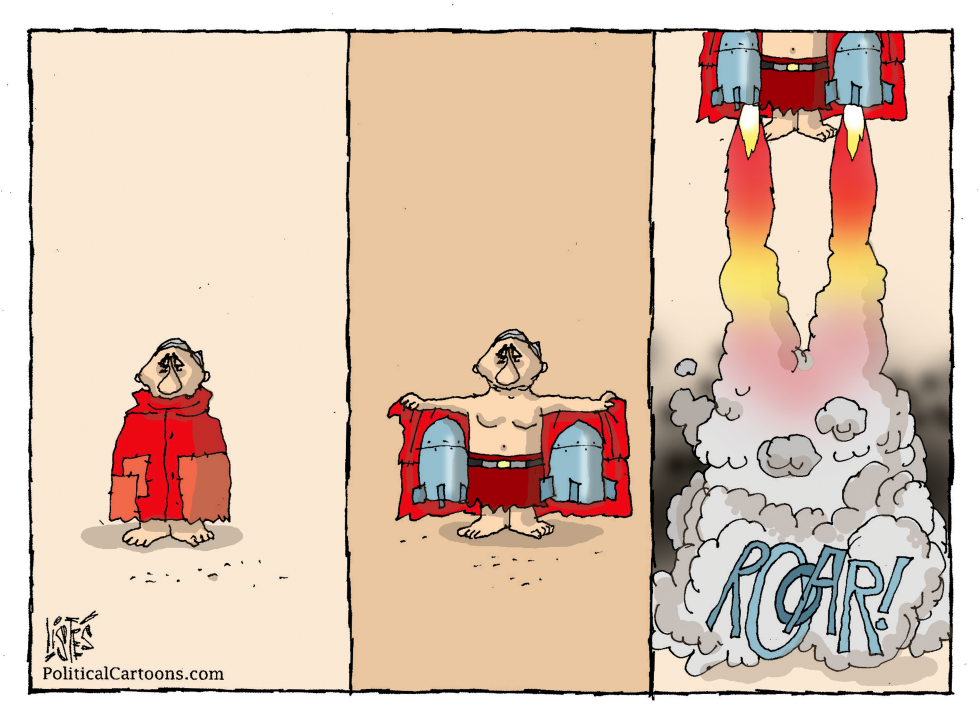
Vladimir Putin demonstrates a new personal rocket system as Russia continues military modernization efforts. The development underscores ongoing emphasis on advanced weaponry in national defense strategy. The piece portrays the move as an extension of Russia's assertive posture in global affairs.
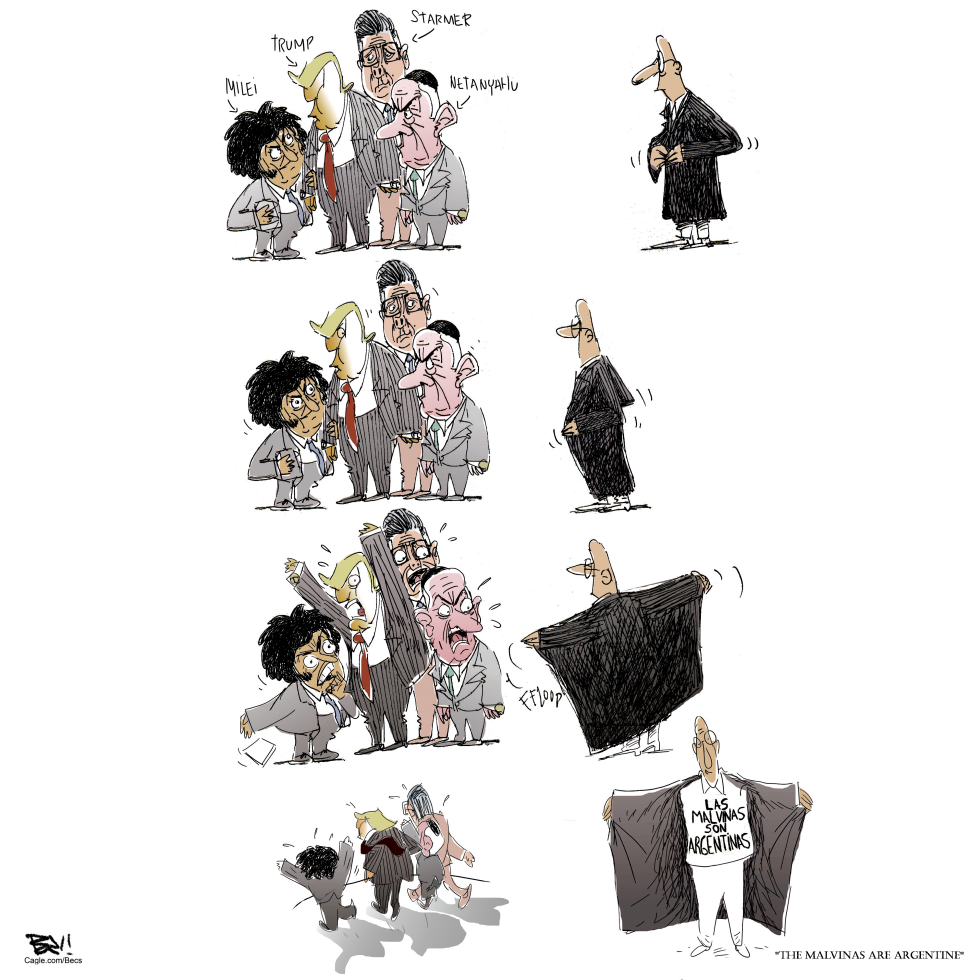
Argentine President Javier Milei joined other world leaders at a July 2026 gathering when an unexpected sovereignty assertion regarding the Malvinas Islands interrupted proceedings. The claim, long a point of tension between Argentina and the United Kingdom, drew immediate visible reactions from Donald Trump, Keir Starmer and Benjamin Netanyahu. The piece presents the assertion as a sudden and disruptive diplomatic statement.
On June 21, 2026, the Margolis & Cox cartoon depicts Donald Trump wrapped in the American flag with an eagle perched above, facing a Democratic donkey wrapped in a flag resembling Italy's but marked with a hammer and sickle. The image responds to ongoing partisan debates over national identity and ideological leanings during the 2026 election cycle. Trump appears in a dark suit, smiling while holding the flag, while the donkey faces away. The visual argument centers on symbols of patriotism versus communism. Publication occurred via Townhall and Cagle.
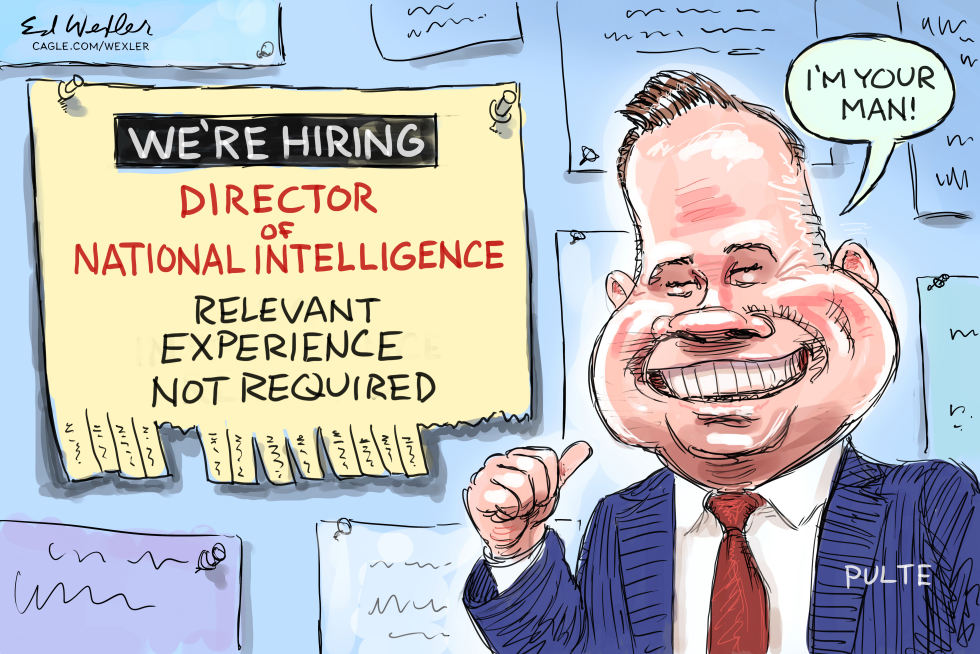
Bill Pulte appears in a political cartoon dated June 8, 2026, responding to discussions around his potential nomination as Director of National Intelligence. The image shows a hiring notice posted in an office setting that explicitly states relevant experience is not required for the role. Pulte, labeled on his suit, smiles broadly and declares himself the man for the job in a speech bubble. The cartoon highlights ongoing debates about qualifications for senior government intelligence positions during that period.
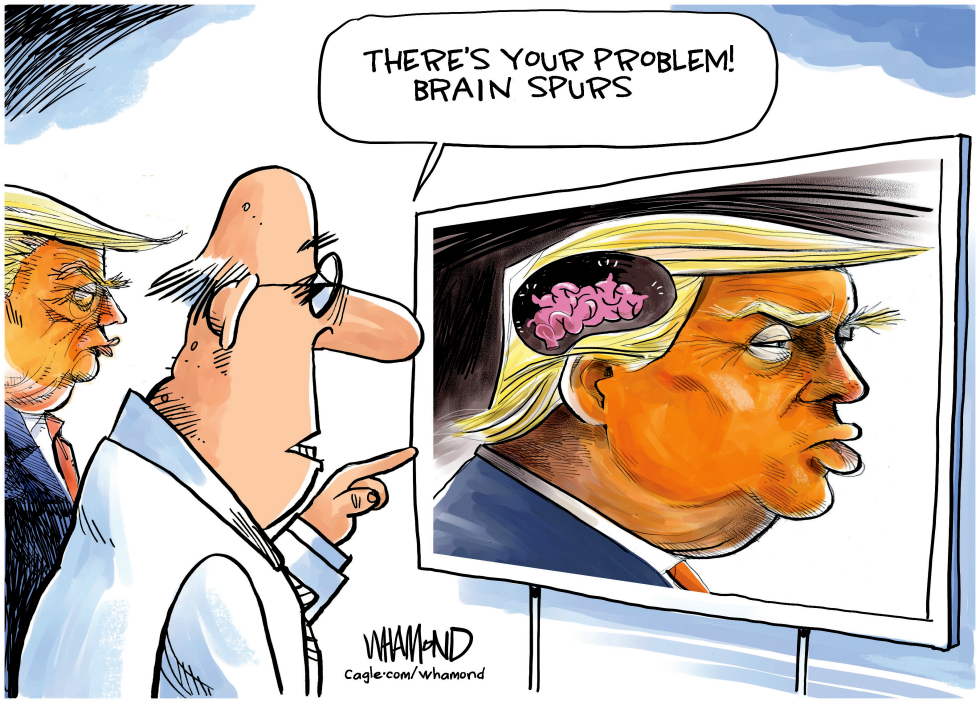
A physician in a lab coat points to a medical screen displaying Donald Trump's profile with an exposed brain labeled bone spurs. The speech bubble declares the diagnosis as the source of the problem.
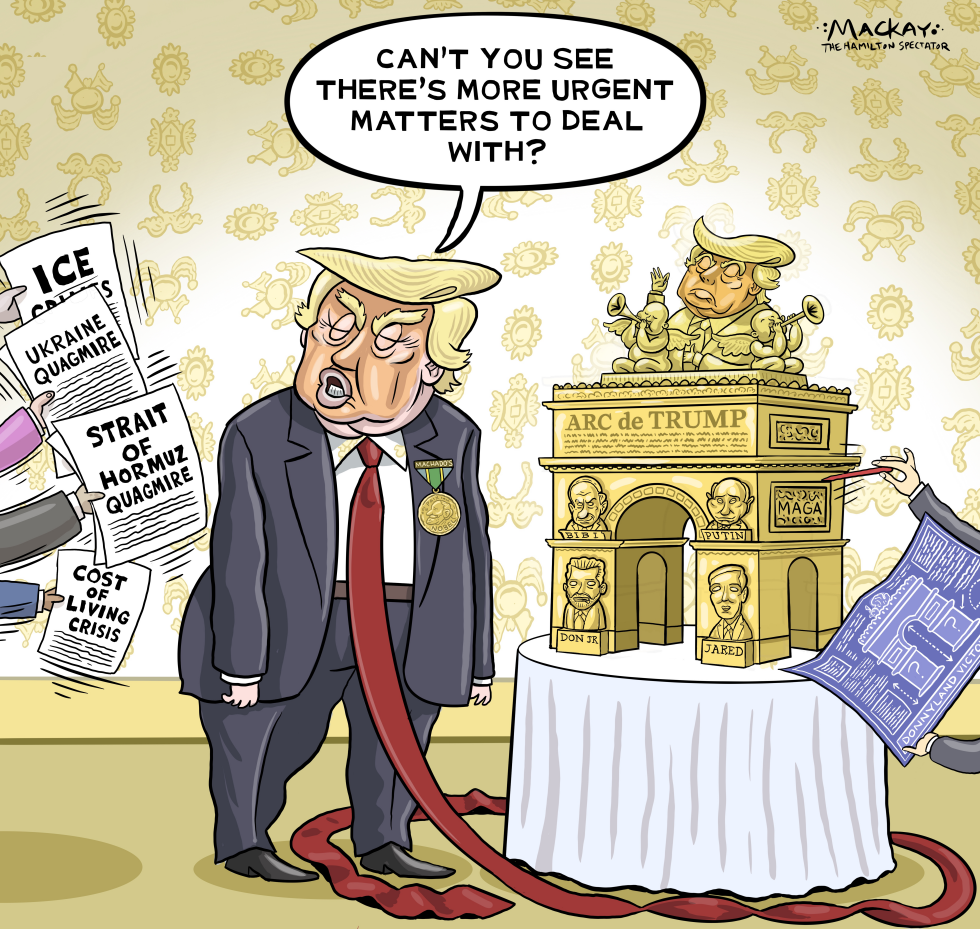
Graeme MacKay\'s cartoon depicts Donald Trump absorbed in unveiling a golden Arc de Trump, a parody of the Arc de Triomphe, topped with his own figure and cherubs, while ignoring flying papers labeled with crises like ICE crisis, Ukraine quagmire, Strait of Hormuz quagmire, and cost of living crisis. The monument includes busts of Don Jr, Ivanka, MAGA, and Jared, emphasizing Trump\'s priorities on vanity over urgent matters. A hand unveils blueprints for Donald J. Trump Arc de Victoire, highlighting the satire on legacy obsession amid global quagmires. The dry humor underscores how such self-focus distracts from real-world affordability and international issues, a common theme in editorial cartoons critiquing political figures.
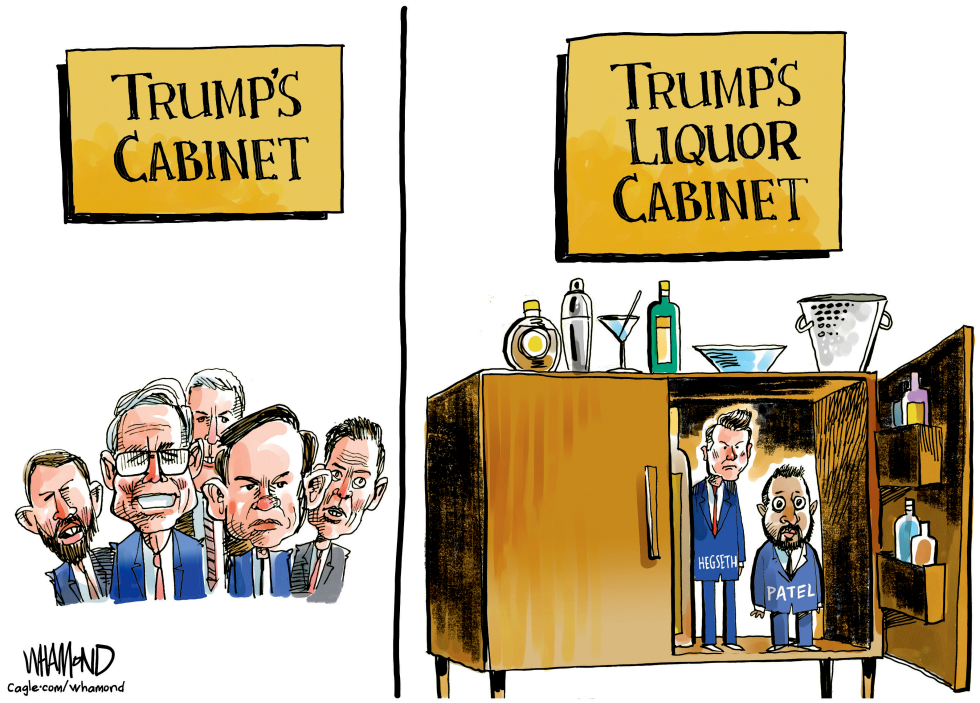
Dave Whamond's cartoon splits the scene between Trump's Cabinet of stern-faced men in suits and Trump's Liquor Cabinet, where caricatures labeled Hegseth and Patel emerge disheveled amid bottles and barware, poking at Trump's cabinet problems. The dry humor targets Kash Patel as FBI director nominee and Pete Hegseth for Secretary of Defense, amid drinking allegations and excessive drinking claims from The Atlantic. Unexplained absences and AWOL accusations add to the satire of unfit picks, with a defamation lawsuit looming. This piece captures the irony of Trump's best people turning into a partying liquor cabinet fiasco, all in a straightforward, insider jab at political absurdity.
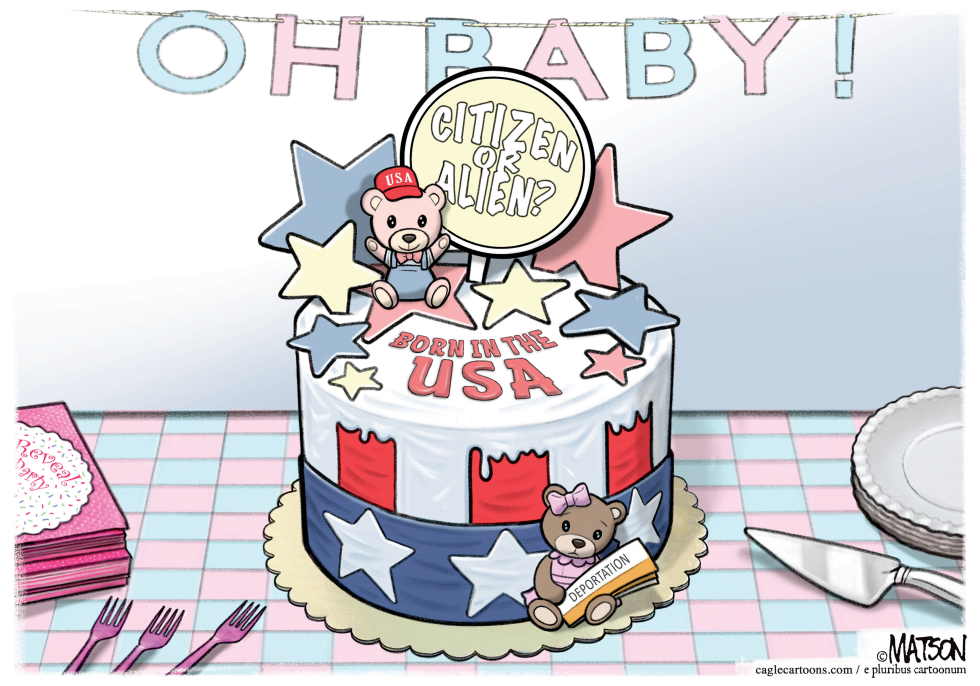
The cartoon shows a baby shower cake labeled Born in the USA with a teddy bear wearing a USA cap and a sign asking Citizen or Alien. A second bear clutches a book titled Deportation. The scene plays on ongoing debates over birthright citizenship and immigration enforcement in early 2026.
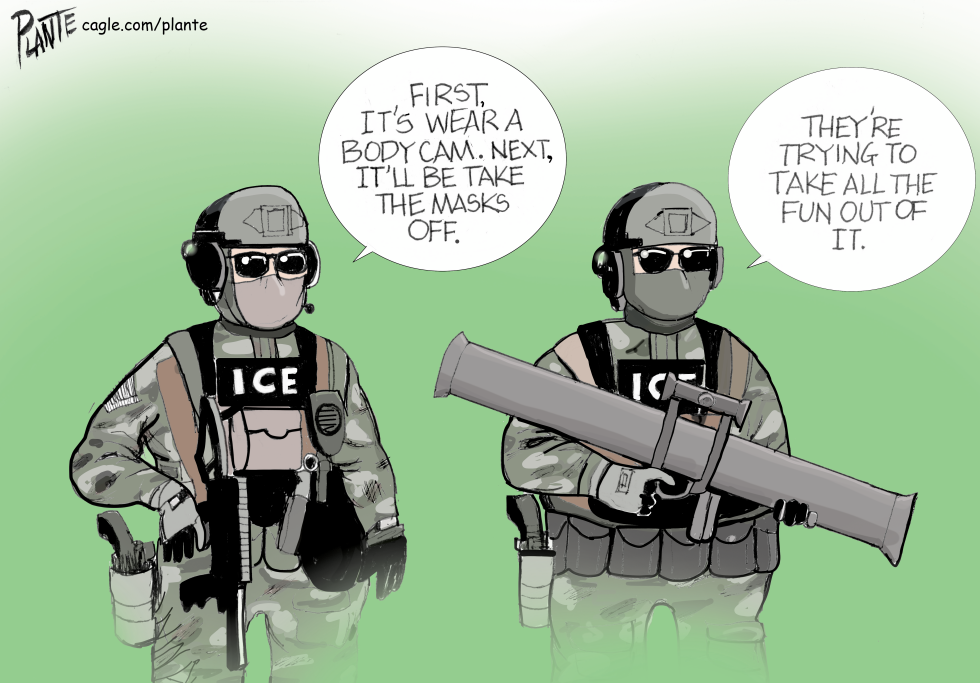
Two ICE agents in full tactical gear stand against a green background. One carries a large cylindrical weapon. Speech bubbles show them joking about body cameras and the removal of masks during operations. The scene references ongoing immigration enforcement efforts involving the Department of Homeland Security.