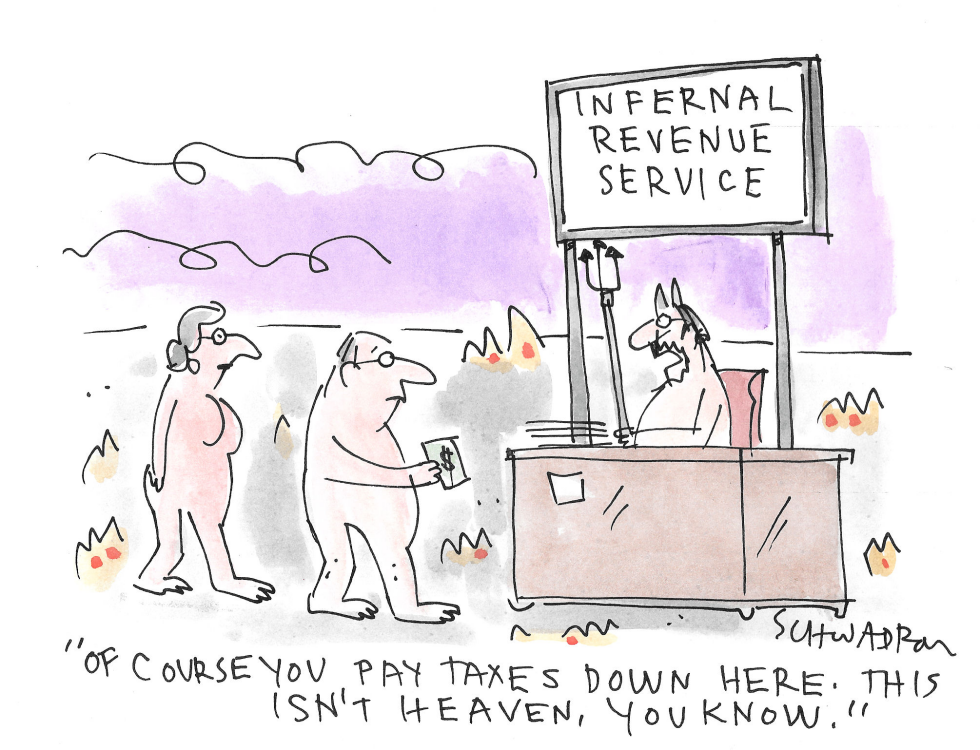
The long-standing adage that only death and taxes are certain receives fresh treatment in a cartoon depicting an IRS outpost operating in hell. No specific policy change or ruling prompted the piece, which instead plays on the enduring public frustration with tax collection as an inescapable force. The editorial stance pokes at bureaucratic persistence, suggesting the tax man follows citizens beyond the grave with the same relentless efficiency seen in life.
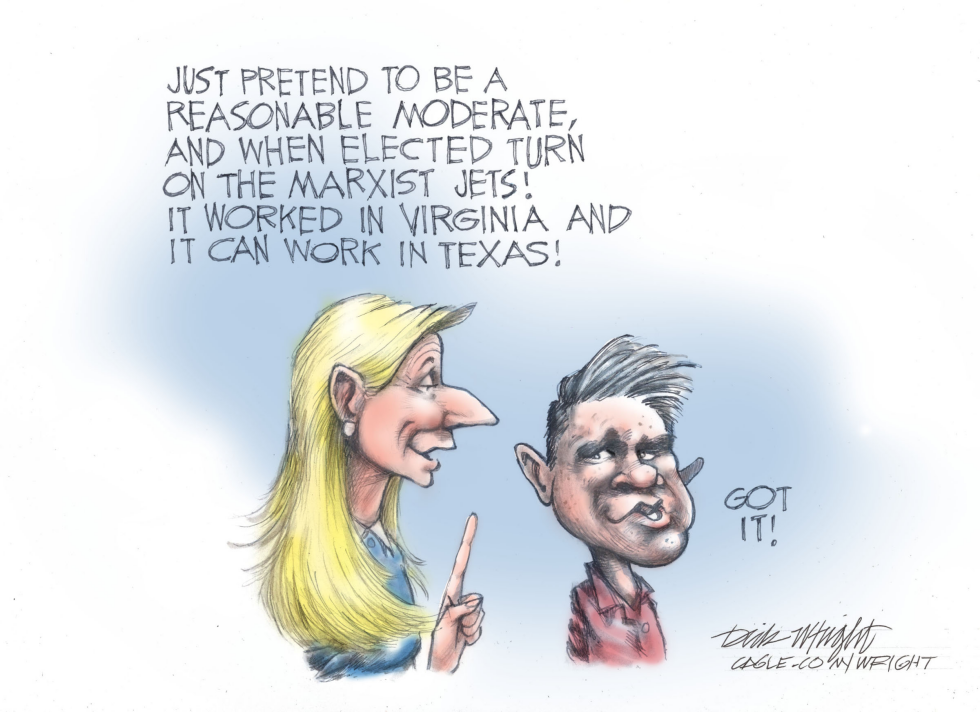
A Texas political candidate is depicted receiving advice to campaign as a moderate before revealing a more radical agenda after election, modeled on Abigail Spanberger's Virginia approach. The cartoon highlights concerns over deceptive campaign strategies in the 2026 cycle and questions the authenticity of centrist positioning by progressive candidates.
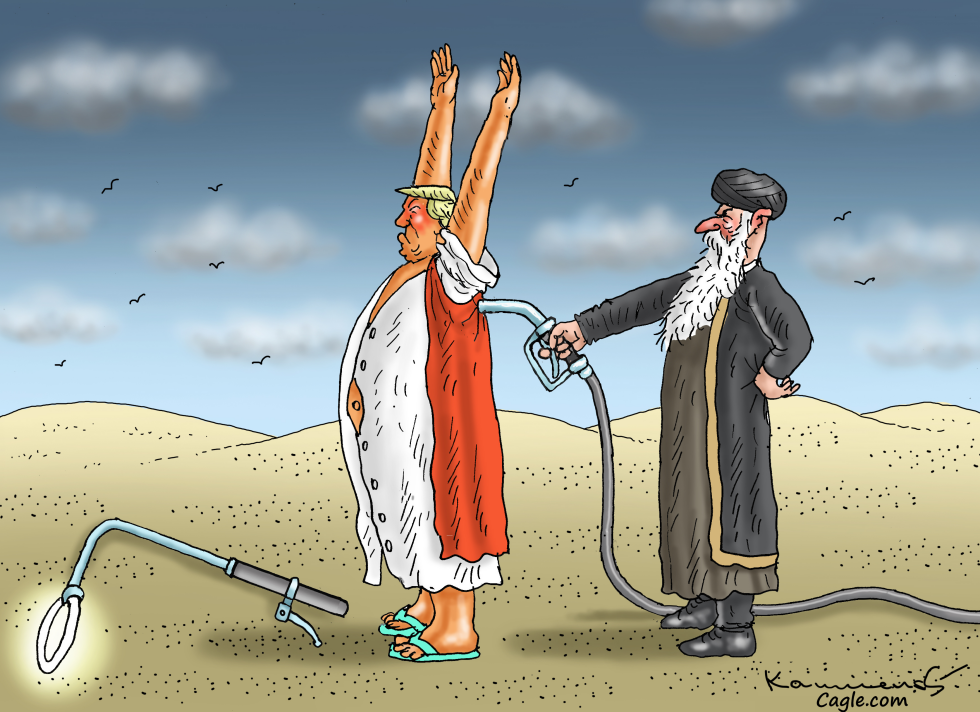
Marian Kamensky's cartoon captures a surreal scene in the desert where a figure resembling Trump, dressed in white and red robes with arms raised skyward, has a gas pump nozzle inserted into his side by a bearded man in dark robes and turban. The image plays on themes of Trump, Iran, Hormuz, fascism, MAGA terror, and oil war, blending religious imagery with modern geopolitical tensions. Birds fly in a cloudy sky over sandy dunes, emphasizing isolation and absurdity. The signature and Cagle.com mark confirm its syndication roots. This piece skewers the intersections of politics, religion, and resource dependency without words, relying on visual punch for impact. Such cartoons thrive in editorial pages for their sharp commentary on current events.
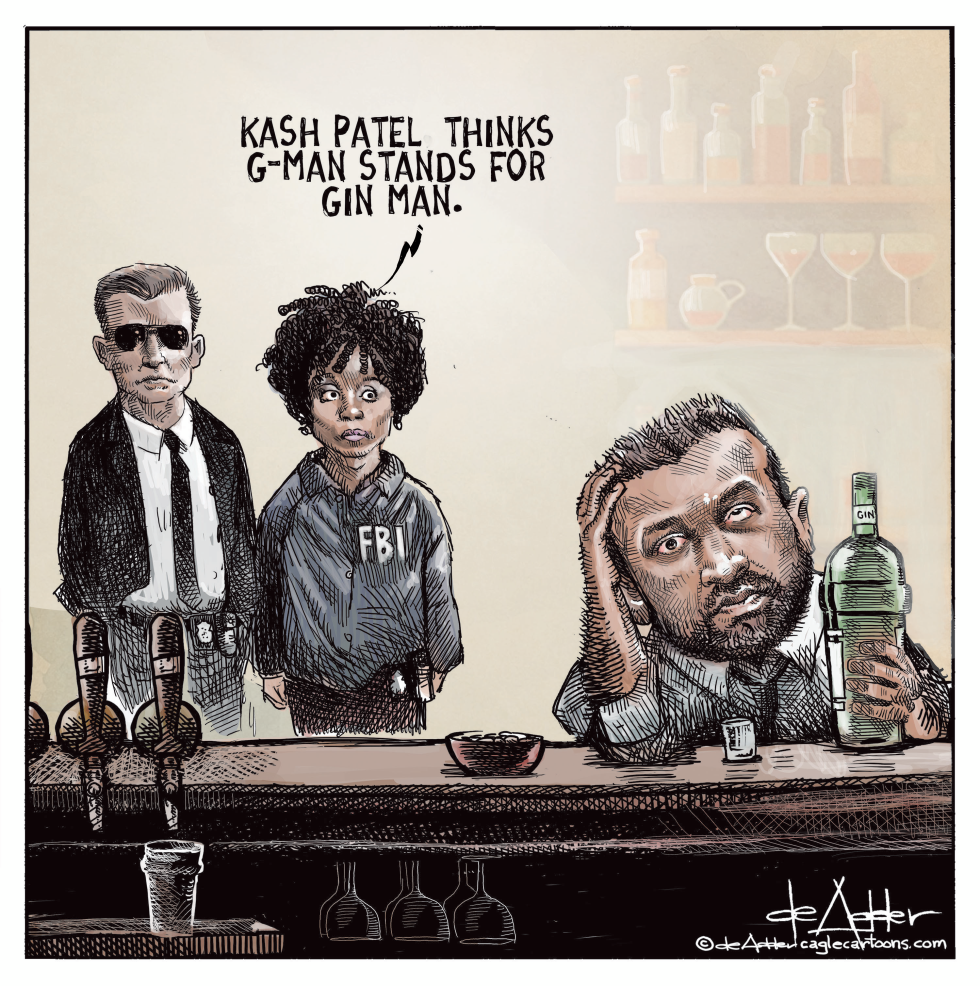
Michael de Adder's cartoon depicts a bearded man at a bar, hand on forehead, holding a green gin bottle, looking inebriated. Two figures stand behind: one in a suit with sunglasses, another in an FBI jacket. The text reads 'Kash Patel thinks G-man stands for gin man.' Bottles line the shelf, beer taps and glasses on the counter. Tags like Kash Patel, FBI, gin, drinking, alcohol, drunk underscore the visual pun on FBI agents as 'G-men' versus a 'gin man' in a bar setting. The scene captures a straightforward satirical jab without deeper layers visible.
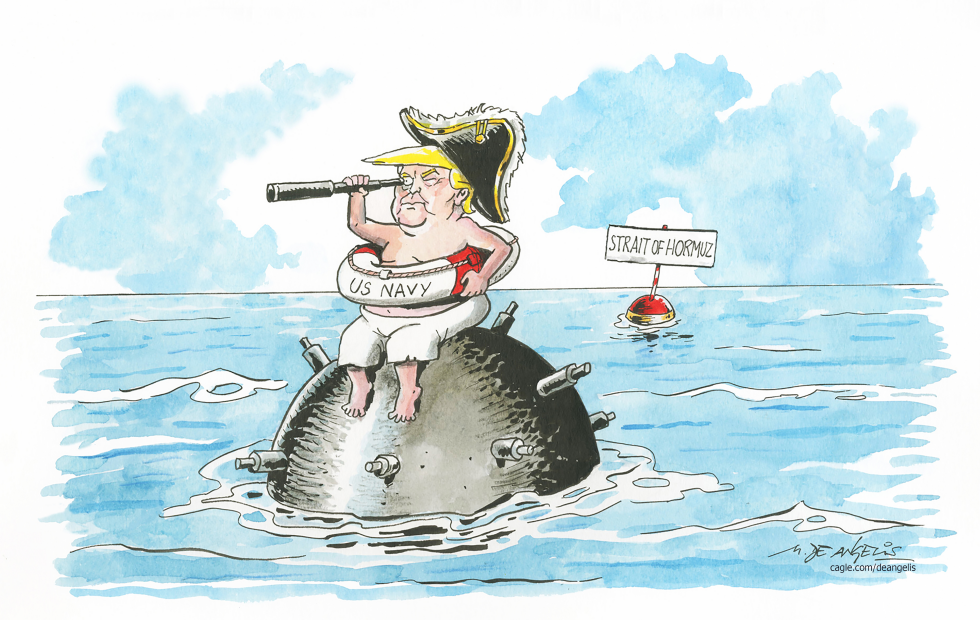
Marco De Angelis draws a caricature resembling Donald Trump, shirtless with a US NAVY life preserver, white shorts, and pirate hat, sitting on a large mine bobbing in blue waters. He holds a telescope to his eye, gazing out, while a small buoy nearby bears a Strait of Hormuz sign. The scene tags USA, IRAN, HORMUZ, NAVY, MINES, OIL, NEGOTIATIONS, FLEET, ALONE, ADMIRAL, MIDDLE EAST, WAR, capturing a sense of solitary watch in troubled seas. The dry humor underscores the absurdity of one man embodying an entire fleet, floating precariously on explosive hardware. Cartoons like this thrive on exaggeration, turning geopolitical standoffs into visual punchlines that newspapers love for their sharability.
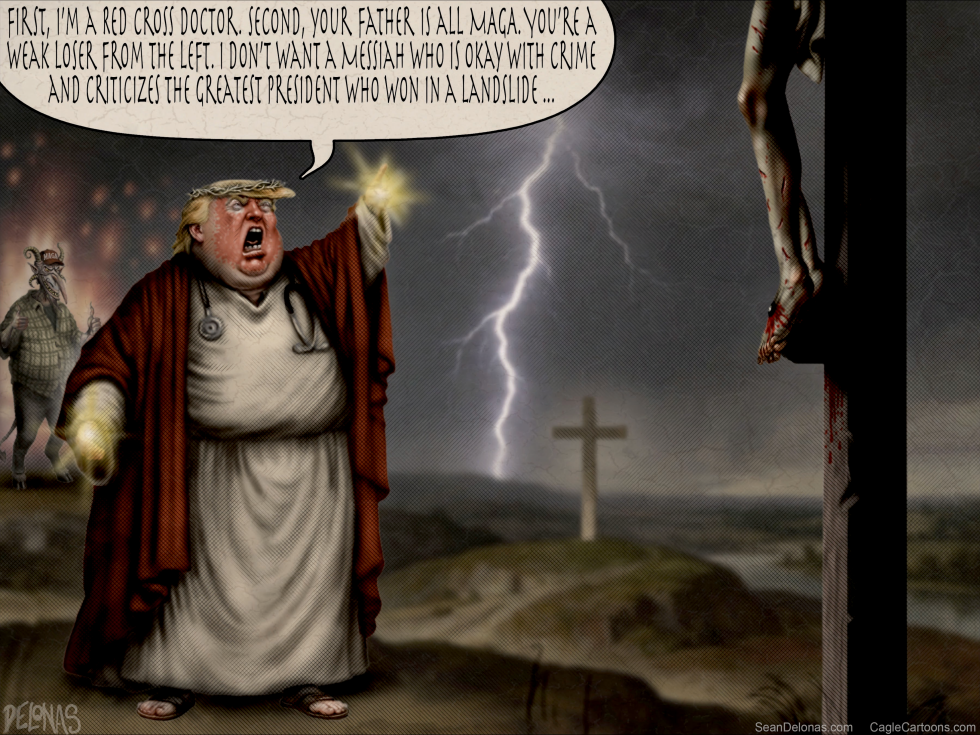
Delonas places Trump in a crucifixion scene, robed with stethoscope, rejecting the messiah as a weak leftist. Stormy skies and a demon add drama, blending politics and religion for dry satire. Tags like Trump, Jesus, Crucifixion highlight the bold commentary on leadership cults.
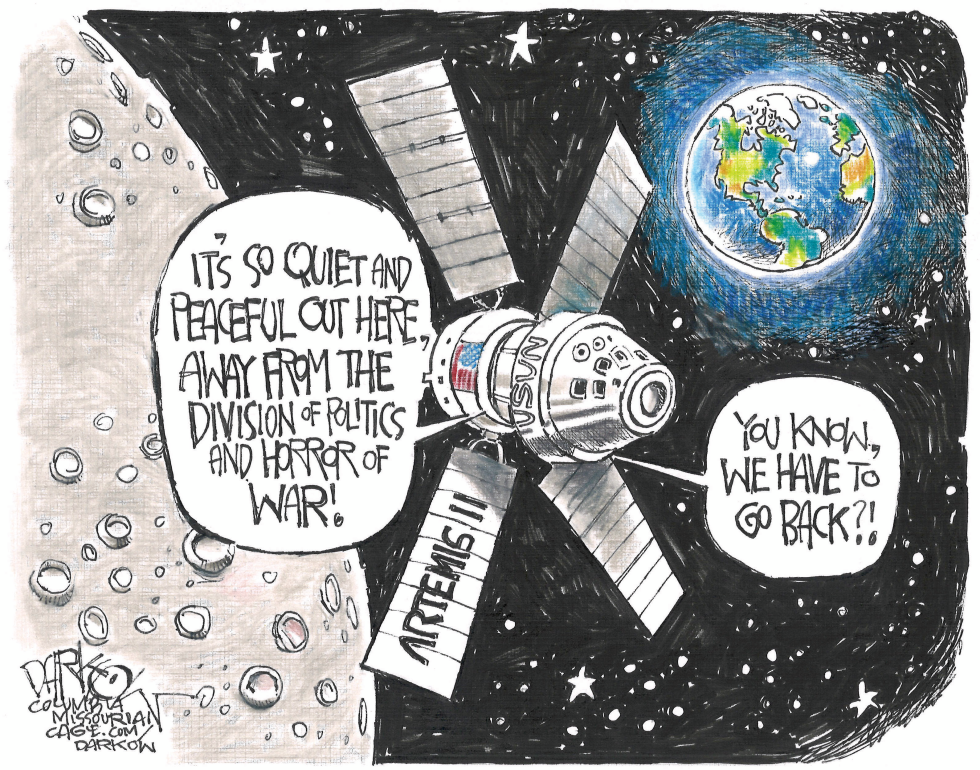
This Daryl Cagle political cartoon analysis features the Artemis II spacecraft floating in serene space, with Earth glowing in the background and the moon nearby. The left speech bubble extols the quiet peace away from division of politics and horror of war, while the right one resignedly notes the need to go back. It's a satirical cartoon on politics and war division, poking fun at how space exploration escaping earthly conflicts offers temporary respite. The NASA Artemis program humor illustration underscores the irony of advanced space missions contrasting with unresolved human divisions on Earth. Through this humorous take on returning to political division, the cartoon cleverly comments on the allure of peaceful space vs chaotic Earth without delving into specifics.
John Darkow's cartoon captures the sting of high gas prices amid inflation and war, showing a yellow vehicle at a station with unleaded fuel marked at 3.95 9/10 per gallon, pay in advance. Speech bubbles reveal a conversation where one asks about not going anywhere for spring break, and the reply puns on being 'Spring Broke' due to gas costs. The image underscores travel disruptions, with tags like gas prices, inflation, spring break, travel, war, and economic satire emphasizing how rising fuel expenses halt vacation plans. This straightforward drawing uses dry humor to point out everyday economic frustrations without overcomplicating the scene.
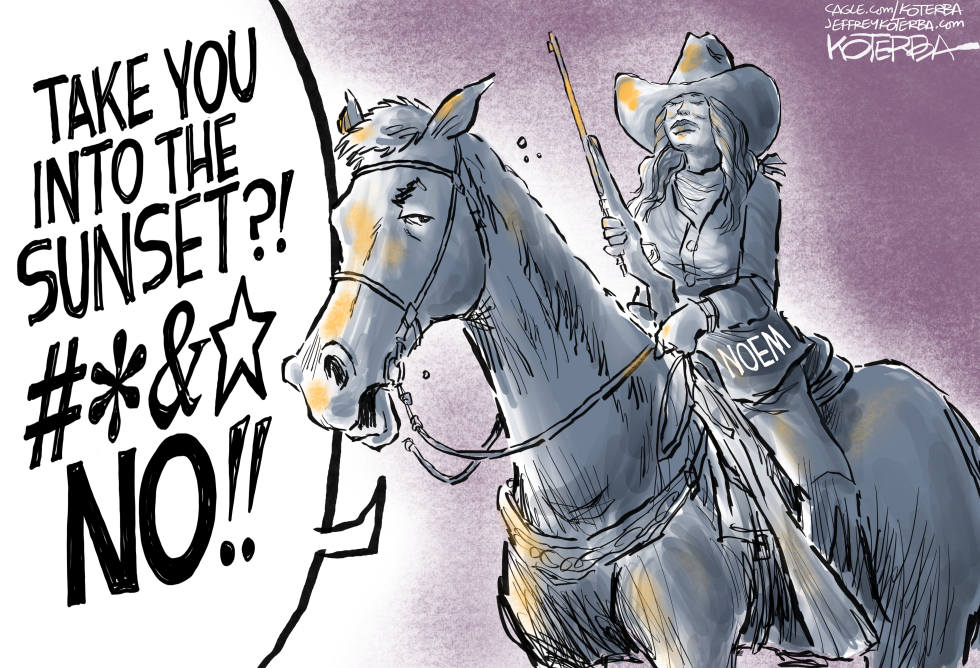
This Jeff Koterba political cartoon skewers Kristi Noem, the South Dakota governor embroiled in GOP scandal over her infamous dog-killing anecdote. Depicted as a cowgirl on a horse labeled 'NOEM,' the steed profanely refuses to 'take you into the sunset,' symbolizing the abrupt halt to her rising star in conservative politics, particularly her dashed hopes as a Trump VP pick. The humorous rejection underscores the backlash from animal cruelty revelations, blending satire with sharp commentary on Republican controversy and election humor. Viral potential lies in its irreverent take on political downfall, making it a shareable gem in American politics discourse.
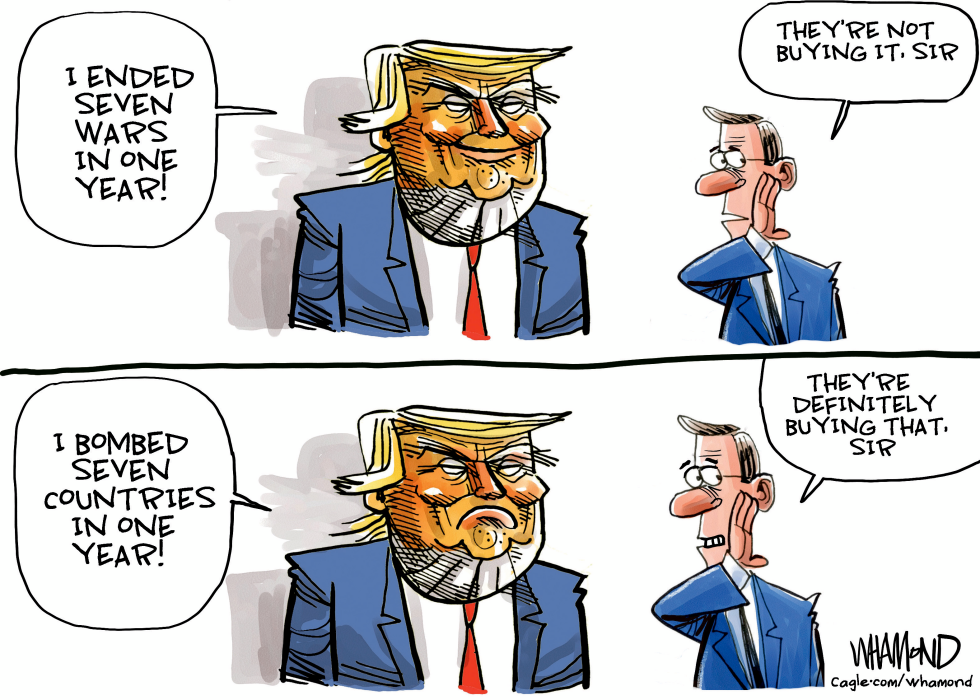
This Donald Trump cartoon masterfully captures the essence of satirical Trump presidency through political bombing humor. Trump boasts about ending seven wars, but his advisor notes the public's skepticism, leading to a pivot where he claims bombing seven countries instead, which the advisor says is 'definitely buying that.' The Trump wars satire underscores inconsistencies in Trump foreign policy cartoon style, poking fun at boastful claims versus reality. Created by Whamond, this political cartoon Whamond piece exemplifies humorous political analysis on US military satire, blending irreverent wit with insightful commentary on leadership and perception.
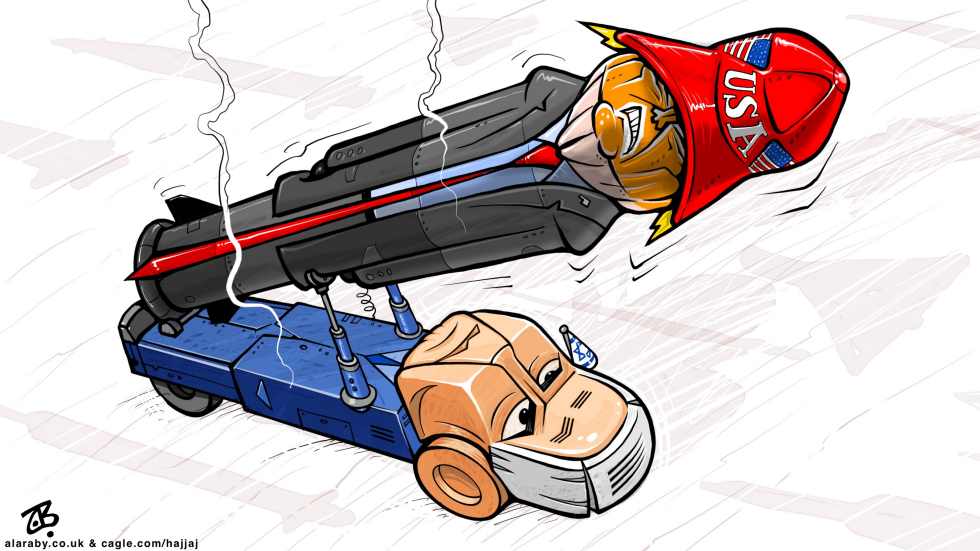
This viral cartoon captures the essence of US politics with Donald Trump morphed into a explosive rocket, complete with a patriotic USA hat, aggressively targeting a downtrodden Joe Biden as a blue, masked robot vehicle. The satirical missile embodies Trump’s bombastic style, while Biden’s robotic depiction hints at perceptions of frailty or mechanized leadership. Through political humor and cartoon warfare, the image skewers presidential satire, highlighting American rivalry in election humor. Artist Hajjaj’s work blends irreverent wit with insightful commentary on the Trump Biden clash, making it a sharable gem in political cartoon circles.
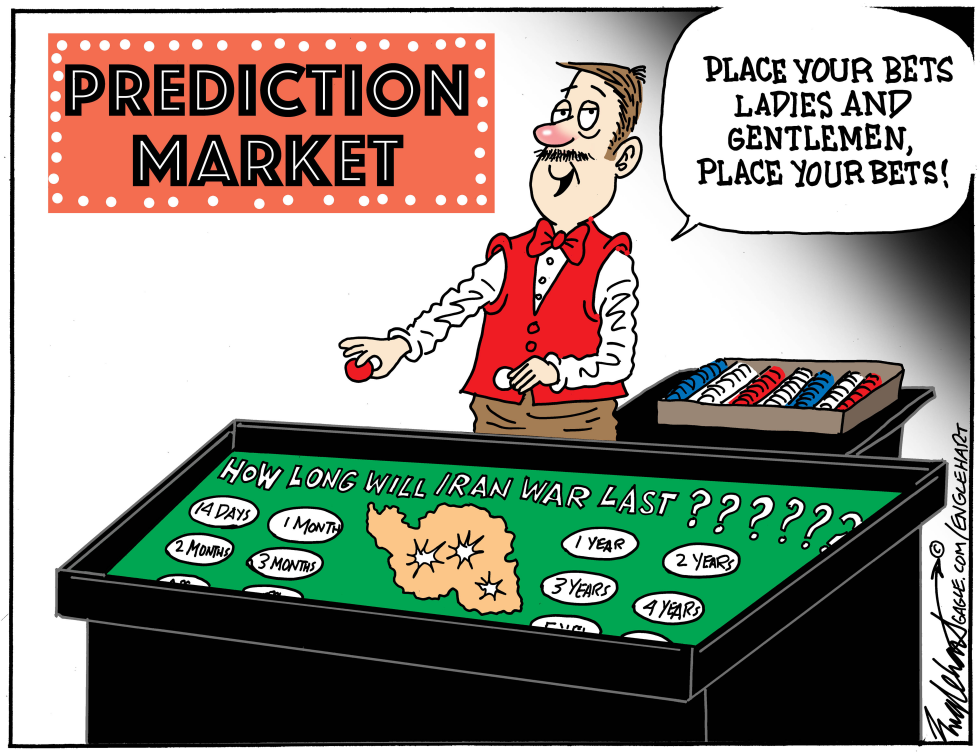
In a biting political cartoon, a smirking croupier oversees a prediction market table shaped like Iran, complete with explosion graphics, where punters can wager on war duration options ranging from 14 days to 5 years. This satirical take skewers the commodification of geopolitical betting, turning grave matters like Iran war into casino-style gambles. By blending elements of gambling on war with Middle East conflict, the artwork highlights the absurdity of prediction markets applied to real-world crises, offering humorous yet insightful commentary on how society speculates on political humor and potential catastrophes. The irreverent style underscores the folly of treating war length wager as just another market fluctuation.
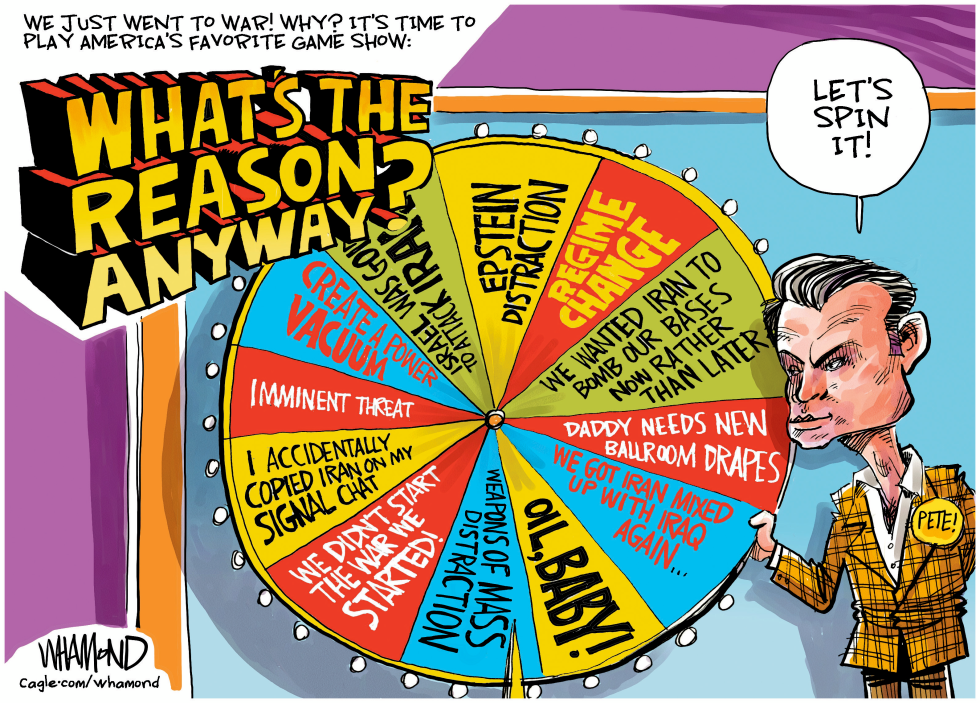
Dive into this biting political cartoon where America's war decisions are reduced to a game show parody wheel, featuring options like 'Imminent Threat,' 'Oil, Baby!,' and 'Regime Change.' The irreverent satire targets US foreign policy, highlighting how military interventions often spin on flimsy pretexts, from accidental escalations to resource grabs. With a host eagerly spinning the wheel, the artwork cleverly critiques the absurdity of war justifications, blending humor with insightful commentary on geopolitical cynicism. Tags like political cartoon, war justifications, and military intervention humor underscore its viral potential in today's polarized discourse.
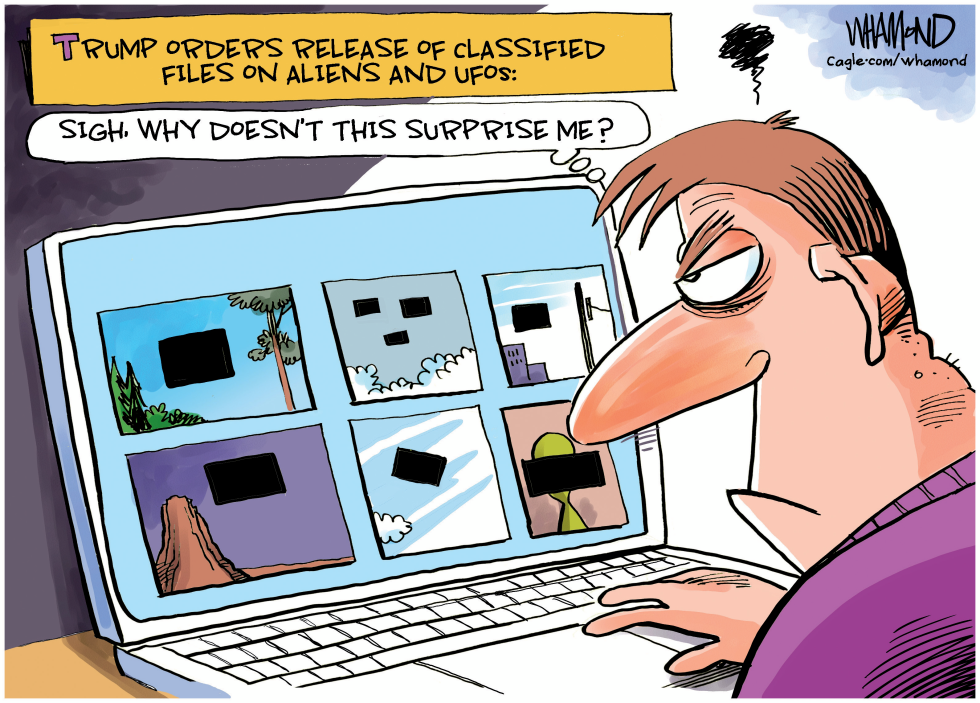
Dave Whamond draws a scene where a man views a laptop displaying Trump-ordered release of classified files on aliens and UFOs, all heavily redacted with black bars. The headline announces the declassification, but the images reveal nothing, from blurred landscapes to censored figures. The man sighs, saying it doesn't surprise him, highlighting themes of distractions and conspiracies. Tags like classified information, extraterrestrial life, UAP, flying saucers, CIA archives, and evidence of ET underscore the satire on empty revelations. The cartoon captures skepticism toward political maneuvers involving secret files.
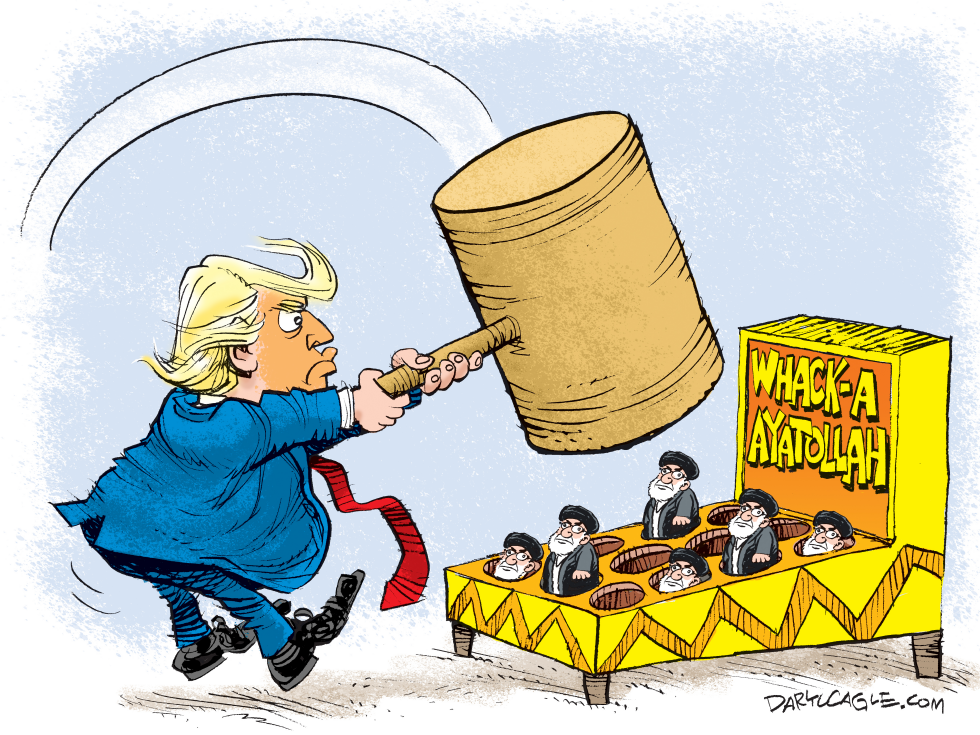
The cartoon shows Donald Trump in a blue suit swinging a massive wooden mallet at figures resembling Iranian Ayatollahs emerging from holes in a yellow arcade machine labeled Whack-A Ayatollah. The president appears mid-swing with motion lines indicating effort. The image comments on US policy toward Iran by framing the conflict as a repetitive carnival game where targets keep reappearing. Publication occurs during a period of heightened US-Iran tensions over nuclear issues and regional influence. The visual metaphor suggests difficulty in permanently resolving the challenge despite repeated attempts.