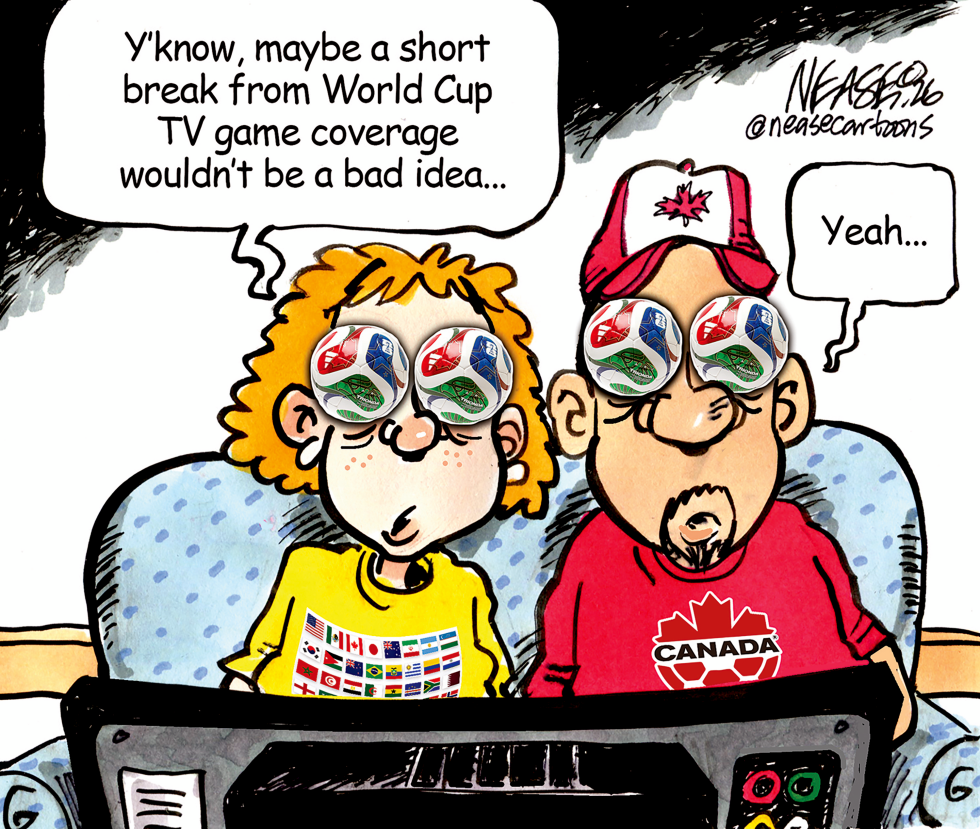
A man and woman sit on a couch with soccer balls for eyes while watching World Cup coverage on television. The woman in a yellow shirt covered in international flags suggests taking a short break from the nonstop games. The man wearing a red Canada shirt and cap responds with a half-hearted agreement.
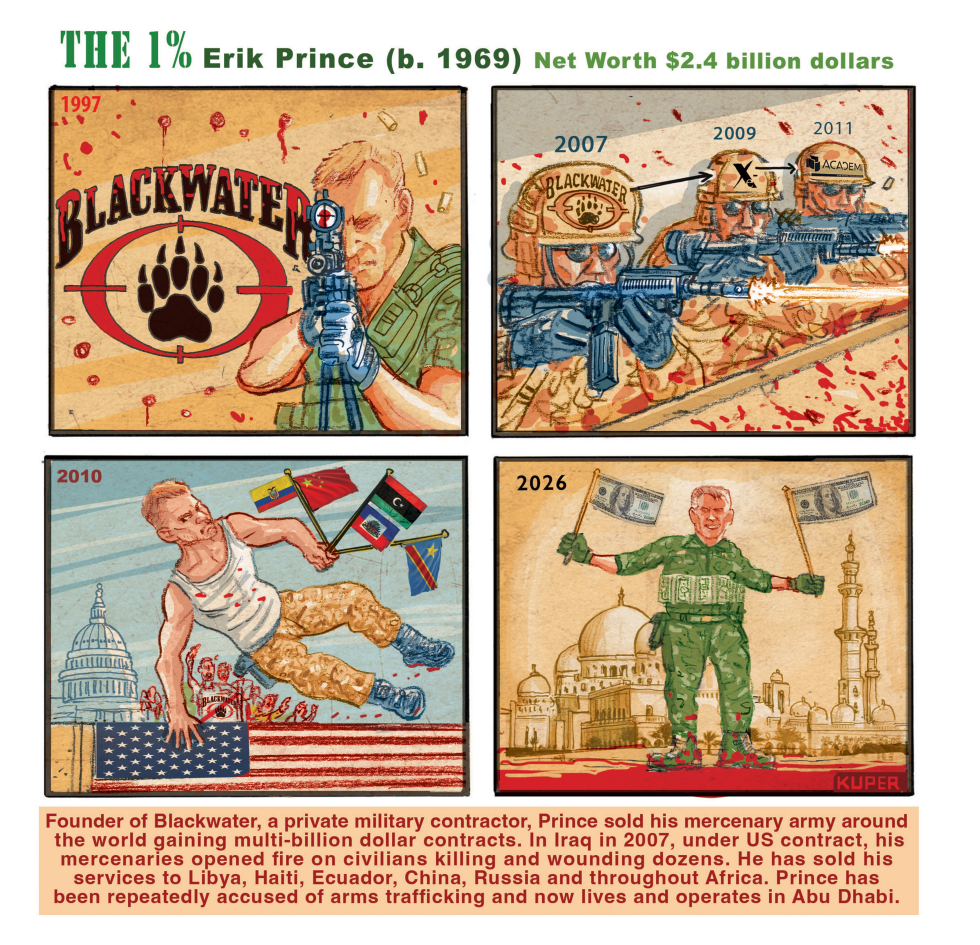
A four-panel illustration tracks Erik Prince from the 1997 launch of Blackwater through 2007 Iraq operations, 2010 foreign flag dealings, and a 2026 portrait of wealth in Abu Dhabi. The sequence highlights repeated accusations of civilian shootings under US contracts and arms trafficking claims while showing rebranding to Academi and continued global sales of paramilitary services.
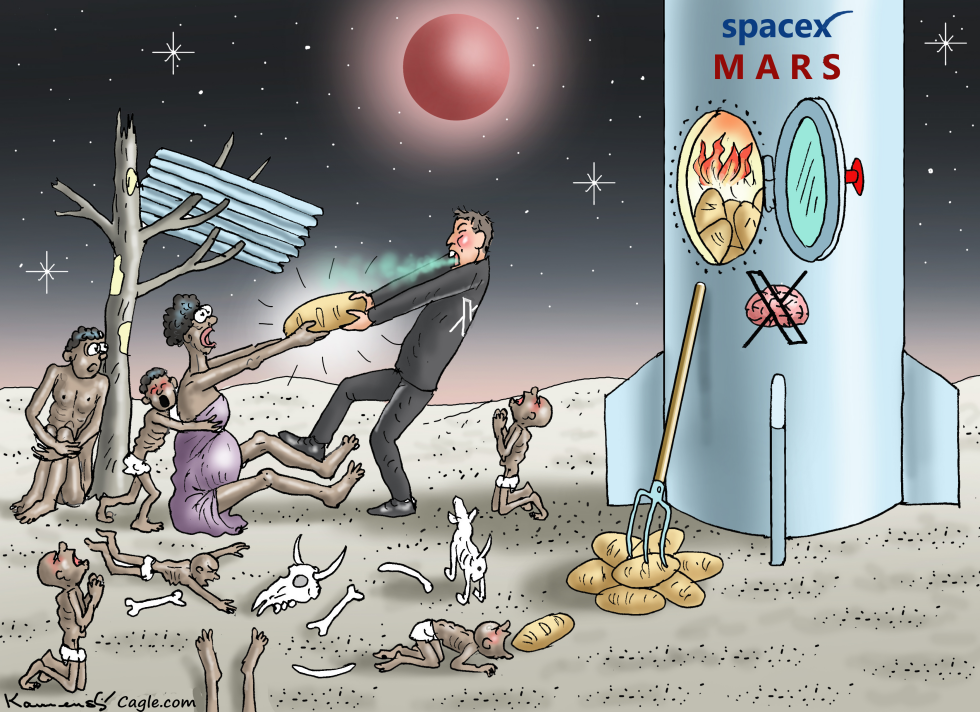
On the 2026 publication date the image shows Elon Musk on a Mars like surface beside a SpaceX labeled rocket. Emaciated figures reach for bread he holds while others lie amid bones and a pile of potatoes rests near a pitchfork.
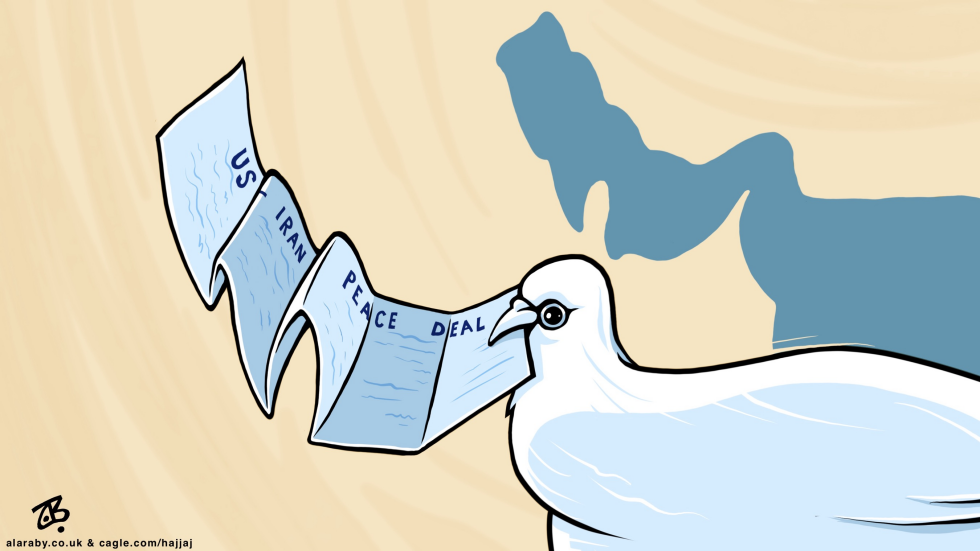
The image presents a white dove carrying a document marked US Iran Peace Deal. The scene includes a map outline of the Gulf region. This occurs on June 15 2026. The composition centers on the bird and the paper. It relates to ongoing discussions between the United States and Iran. The paper folds show separate words across segments. The map appears behind the dove on the right side.
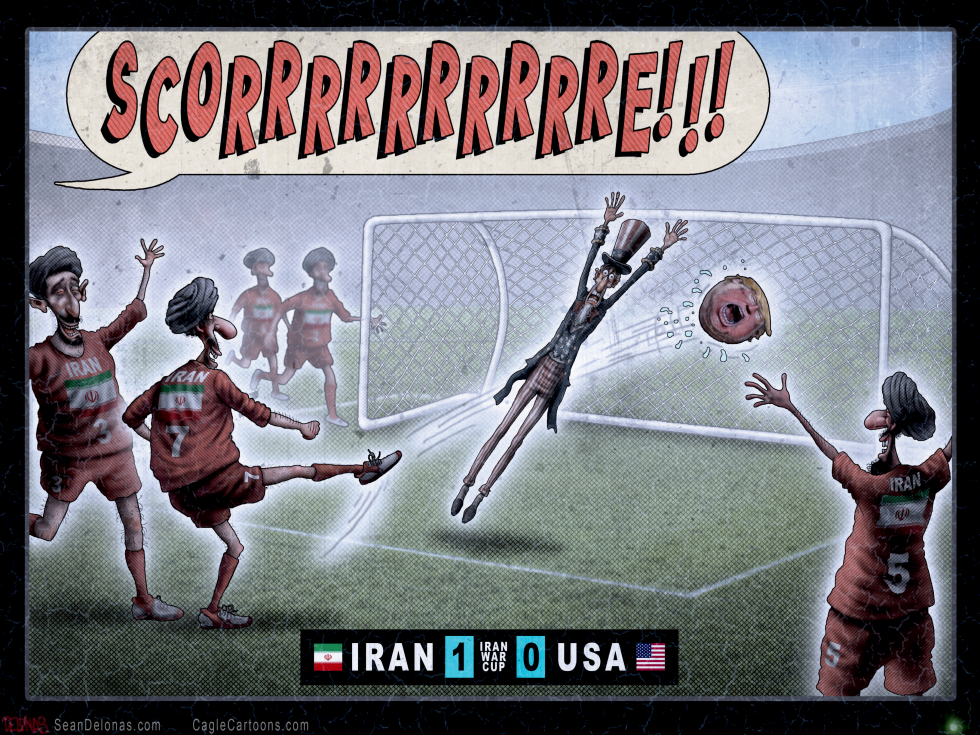
A soccer match on a green field features Iranian players in red jerseys celebrating as a tall figure in a top hat leaps toward the goal with its head detached and flying. The scoreboard reads Iran 1 USA 0 under the Iran War Cup title, with the date set in June 2026 amid ongoing Middle East tensions.
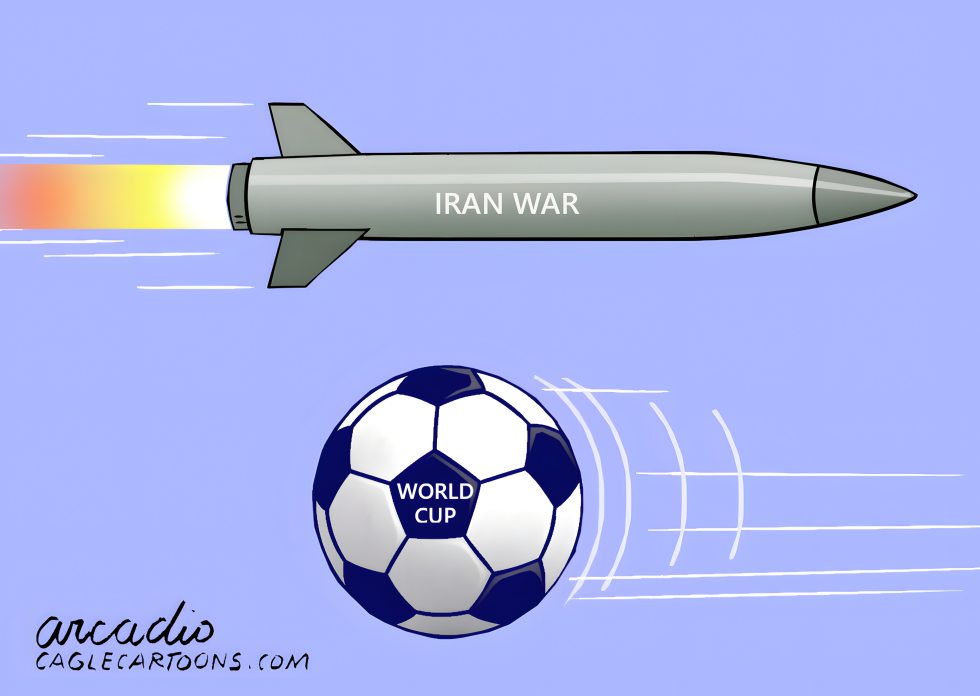
The image depicts a missile labeled Iran War flying above a soccer ball labeled World Cup on a light blue background. The missile moves forward with flames and speed lines while the ball shows curved motion trails. The scene contrasts military conflict with an international sports event.
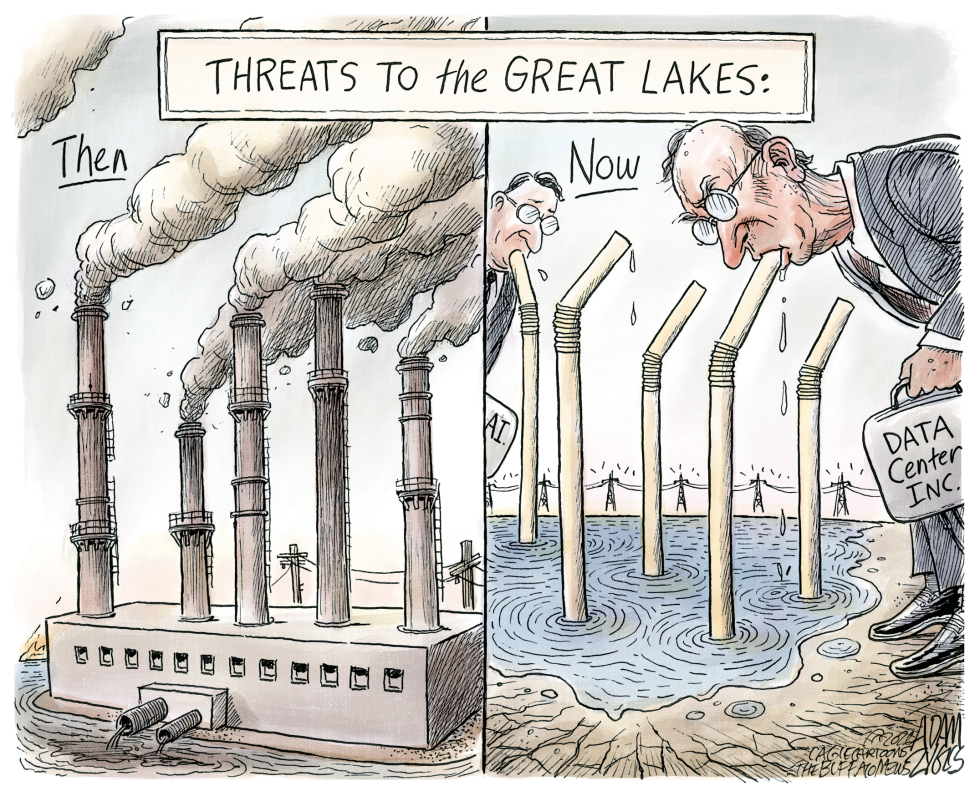
The cartoon contrasts historical industrial pollution of the Great Lakes with modern data center water consumption driven by artificial intelligence growth.
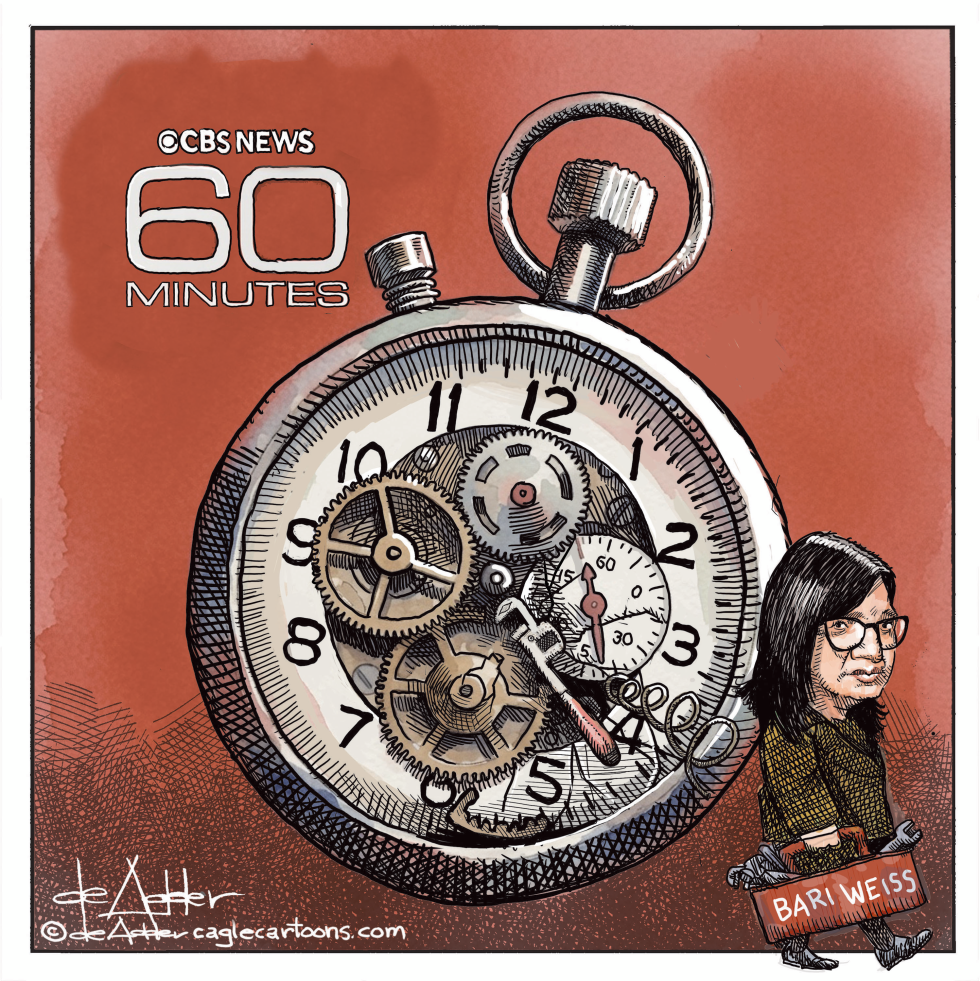
Bari Weiss stands beside a large CBS 60 Minutes pocket watch on June 4 2026. A wrench sits inside the exposed gears while she carries a toolbox. The scene shows the watch hands and internal parts in clear detail.
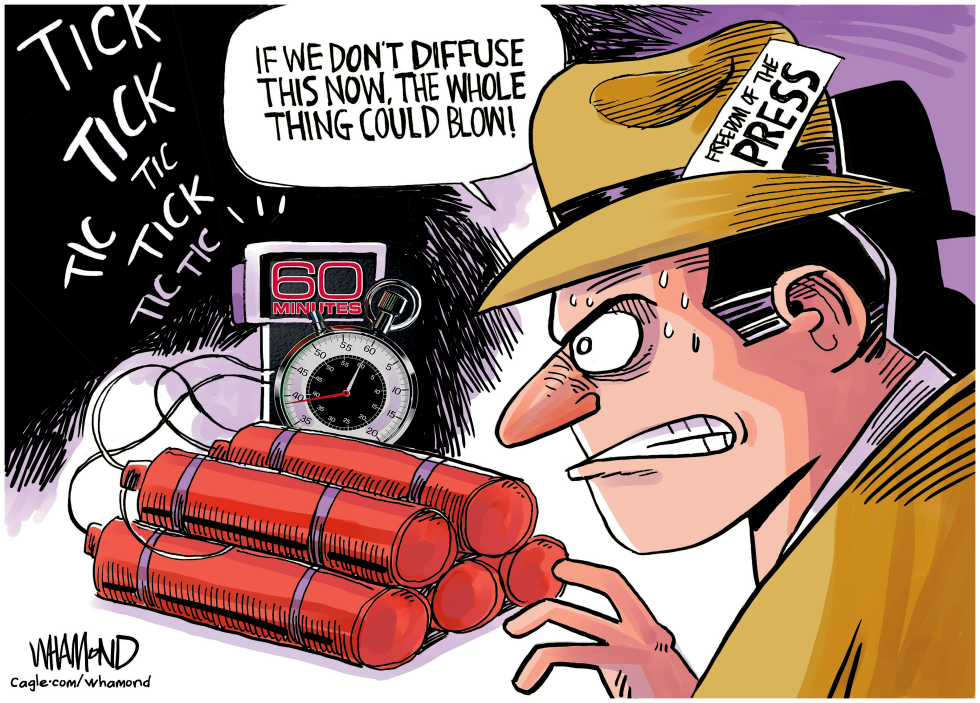
A sweating journalist wearing a Freedom of the Press hat leans over a bundle of dynamite sticks wired to a 60 Minutes timer. The timer ticks loudly as the figure warns in a speech bubble that failure to defuse the crisis will cause everything to blow. The image responds to reported turmoil at CBS News involving 60 Minutes correspondents and leadership changes at Paramount.
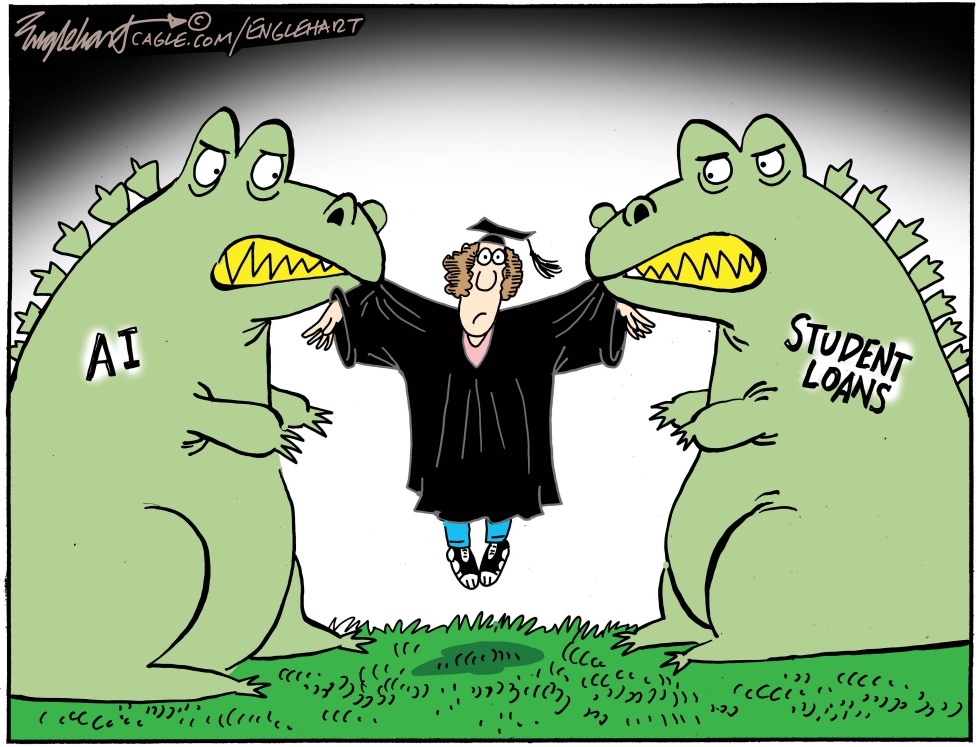
The cartoon shows a 2026 graduate caught between an AI alligator on the left and a student loans alligator on the right. Both creatures stand on green grass with open jaws. The graduate wears a black gown, blue socks and a mortarboard. Text labels identify each alligator clearly. The scene is simple with no additional figures or objects visible.
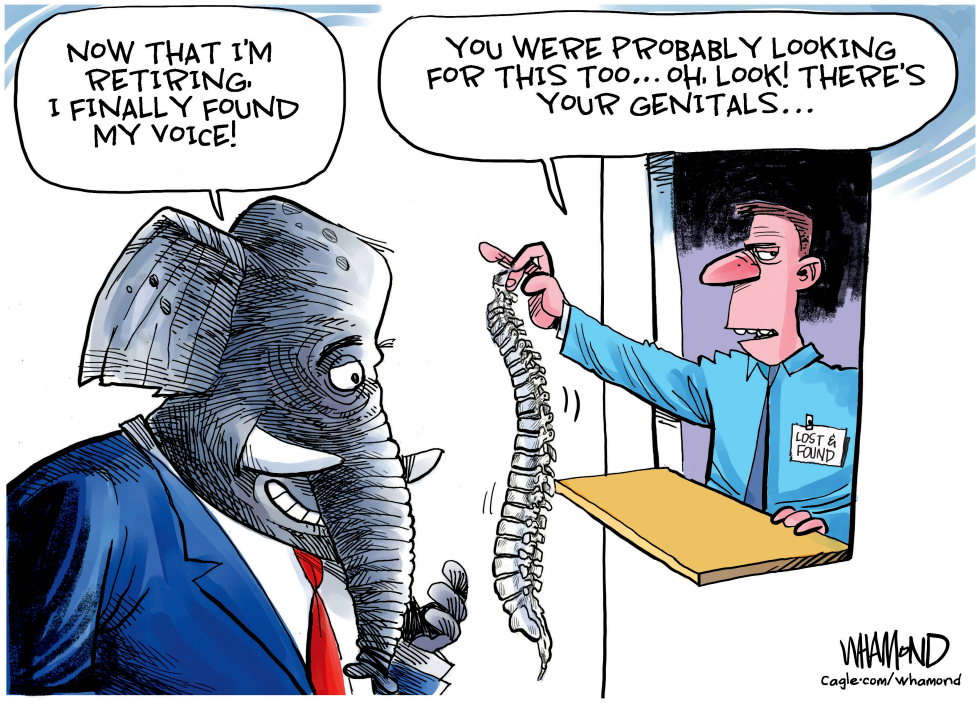
The image shows an elephant character in a suit next to a lost and found counter where a man holds a spine and a sign reads lost and found. Two speech bubbles contain text about retiring and finding a voice along with genitals.
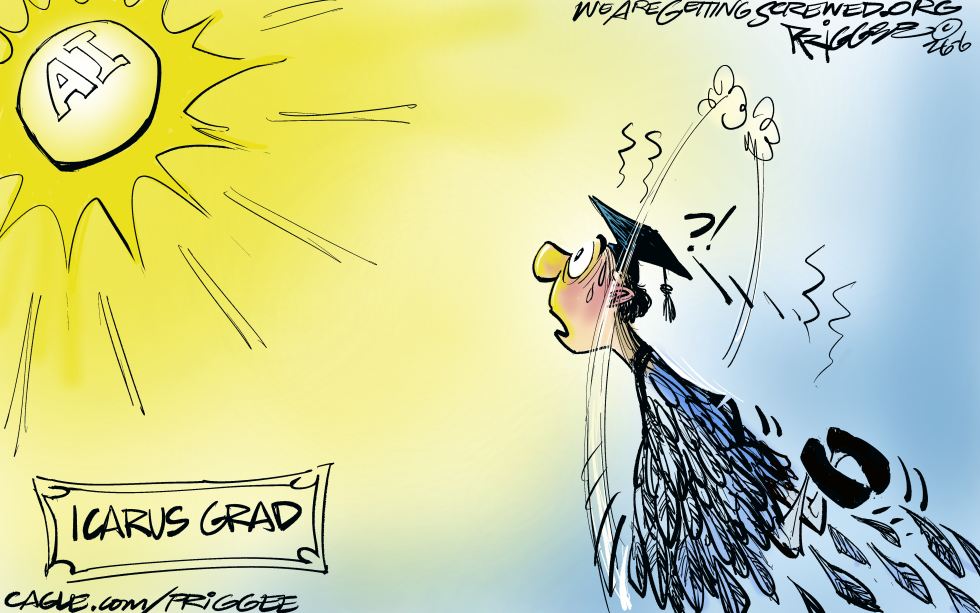
The cartoon depicts a recent college graduate wearing a mortarboard and feathered wings modeled on the Icarus myth. The graduate falls after flying too close to a bright sun labeled AI. Dollar signs and question marks trail behind while the figure looks upward in distress. The image responds to ongoing concerns in 2026 about artificial intelligence displacing entry-level positions traditionally filled by new graduates.
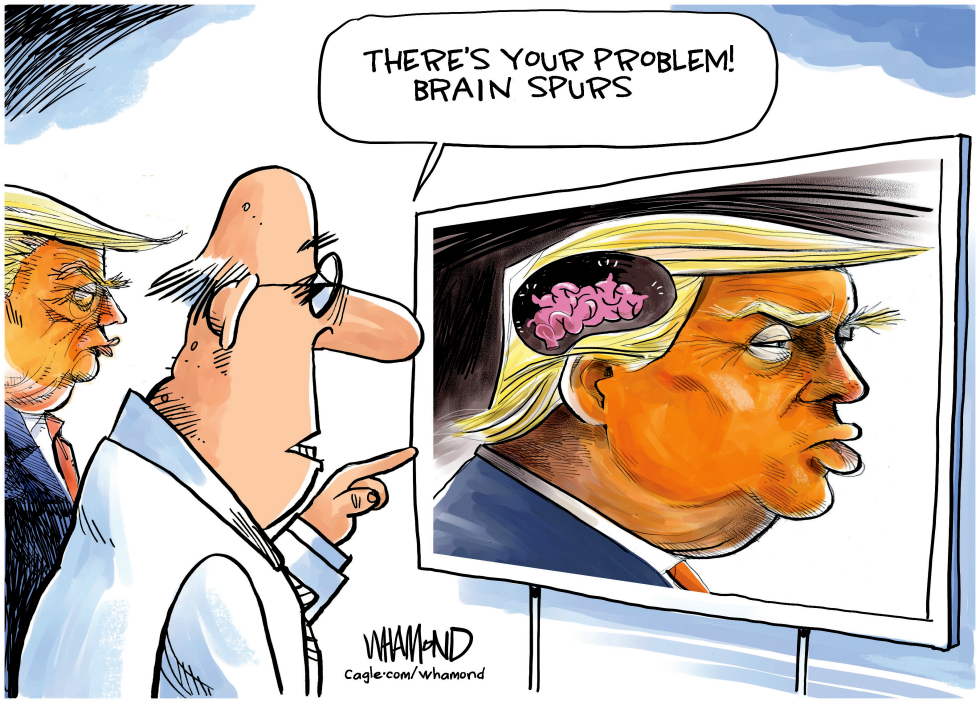
A physician in a lab coat points to a medical screen displaying Donald Trump's profile with an exposed brain labeled bone spurs. The speech bubble declares the diagnosis as the source of the problem.
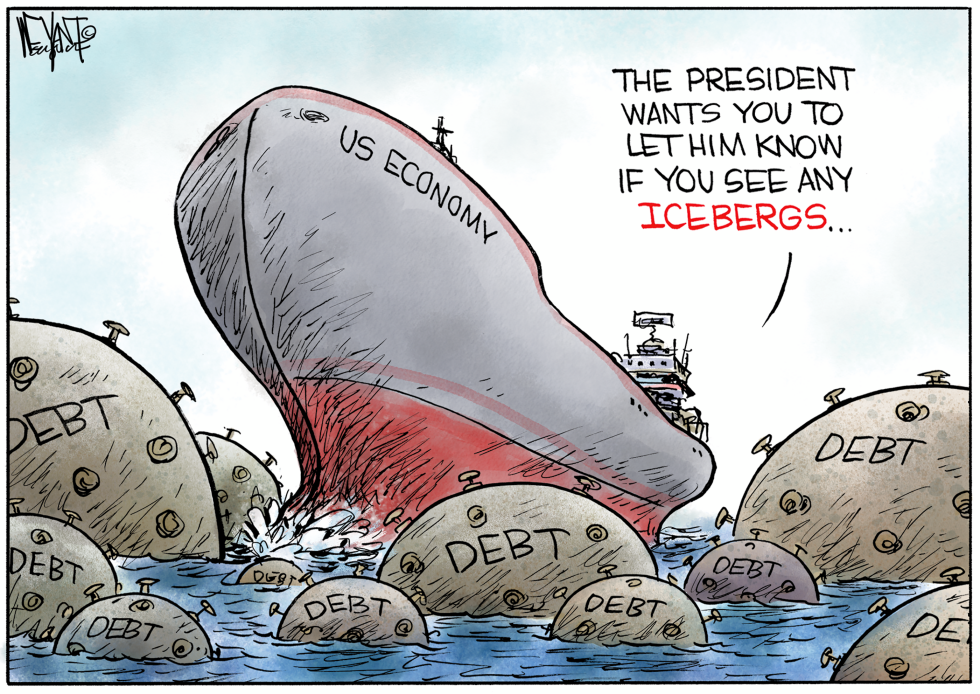
This political cartoon illustrates the US Economy as a massive ship labeled accordingly, dramatically sinking after colliding with numerous icebergs each marked 'DEBT.' A speech bubble from the ship warns to alert the president about icebergs, evoking the Titanic disaster in a clear metaphor for economic peril. Incorporating tags such as economy, debt, budget, inflation, prices, and costs, the image critiques fiscal irresponsibility. The artwork by Christopher Weyant uses simple lines and colors to emphasize the collision's impact, with water splashing and the ship's hull damaged. Such cartoons often highlight how mounting debt threatens stability, drawing parallels to historical maritime tragedies for satirical effect. The composition places the ship at an angle, surrounded by floating debt bergs, underscoring inevitable crisis if warnings go unheeded.
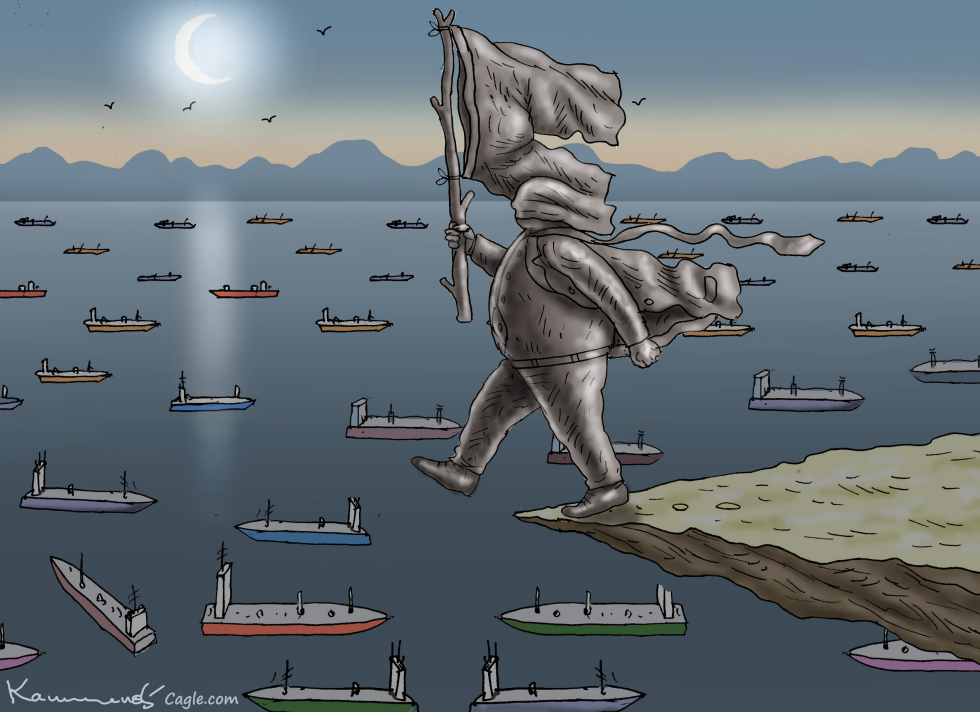
The cartoon shows a large, gray, statue-like figure with a hooded cloak, gripping a flag on a pole, as it steps forward off a cliff's edge. Below stretches a dark sea filled with many small ships of various colors, scattered across the water. In the background, mountains rise against a sky with a crescent moon and flying birds. The image, tagged with Banksy, Trumo, Hormuz, fascism, patriotism, and Maga terror, captures a moment of precarious advance. Artist Marian Kamensky signs it at the bottom left, linking to Cagle.com. This setup highlights a bold, unyielding march into potential downfall amid a busy maritime scene.