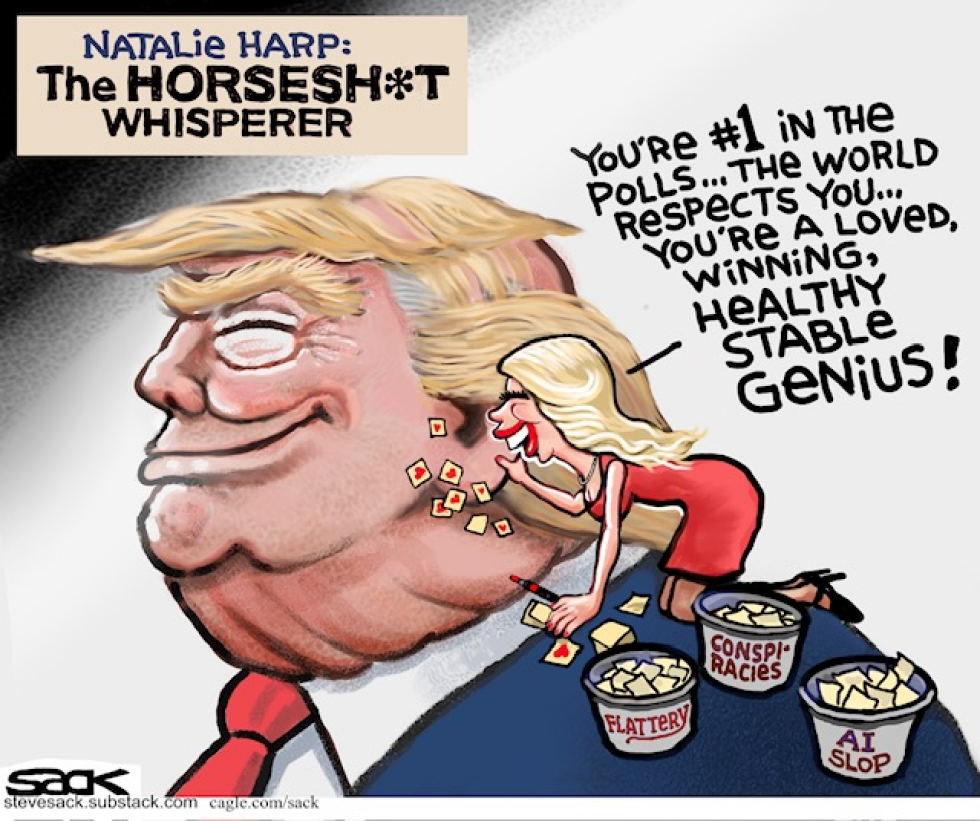
Natalie Harp, a close aide to Donald Trump, has been noted for delivering curated positive updates and affirmations to the former president during his political activities. This ongoing dynamic occurs as Trump navigates public perception challenges and internal circles that mix traditional flattery with newer elements like AI-generated content and conspiracy discussions. The approach matters because it shapes how information reaches a key political figure ahead of future electoral considerations. The piece presents this interaction as an echo chamber reinforced by selective inputs rather than broader scrutiny.
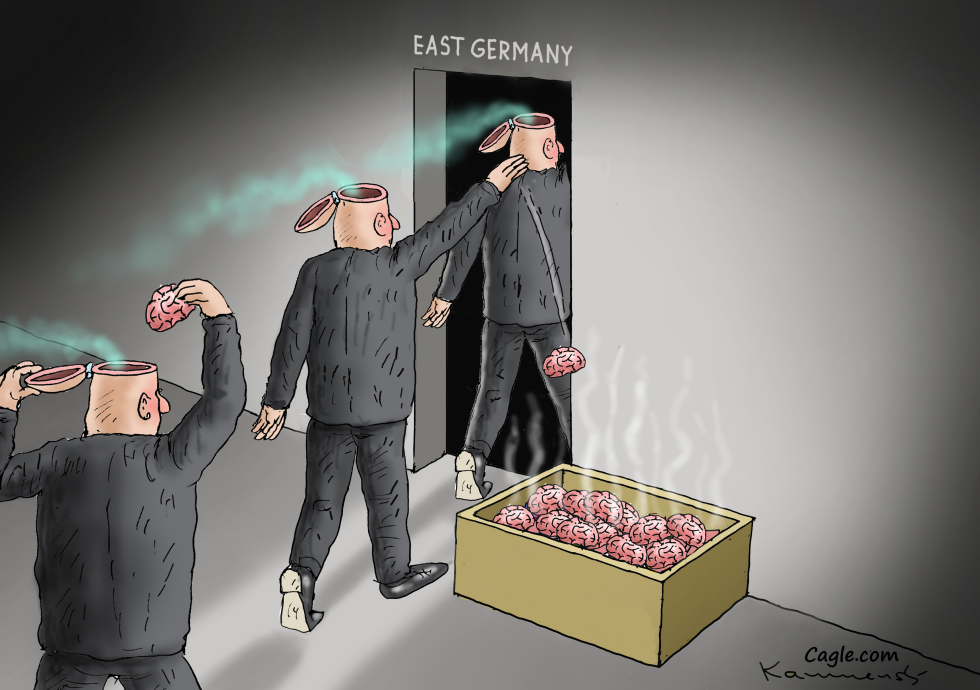
The cartoon responds to the enduring perception of East Germany as a place where independent thought is incompatible with entry. It depicts men voluntarily removing their brains before crossing the threshold. The editorial position frames the regime as one that demands the surrender of reason.
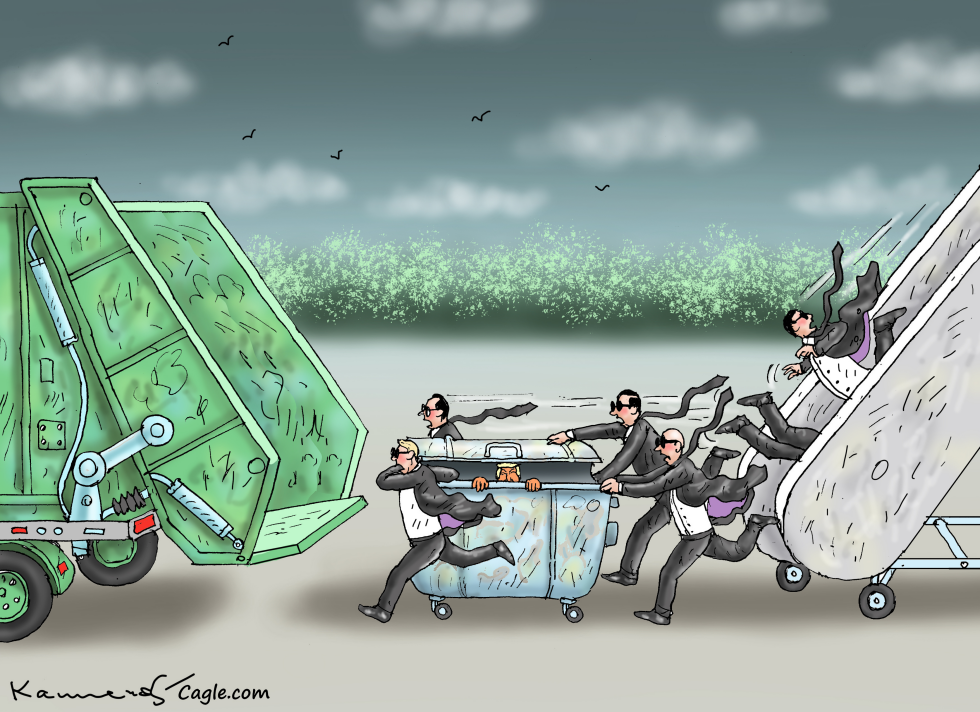
In mid-2026, efforts to sideline Donald Trump from political relevance continued through legal and electoral channels following prior election cycles. Allies and opponents alike maneuvered to limit his influence within the Republican Party and broader national discourse. The piece frames these actions as an attempt to consign Trump to political irrelevance, portraying the effort as a collective push by figures in his orbit.
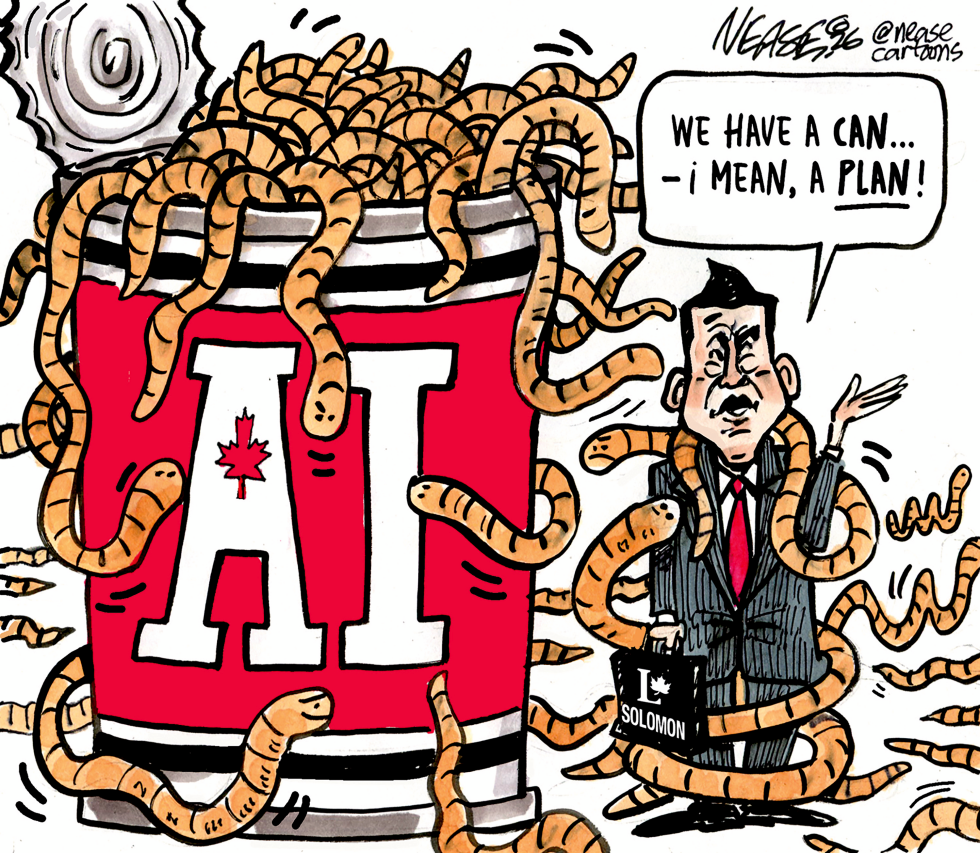
A Canadian official entangled in worms emerging from an AI-labeled container attempts to present a coherent plan. The situation highlights ongoing challenges in managing rapid AI development within government frameworks. The piece portrays the difficulty of containing technological disruptions once released into public and policy spheres.
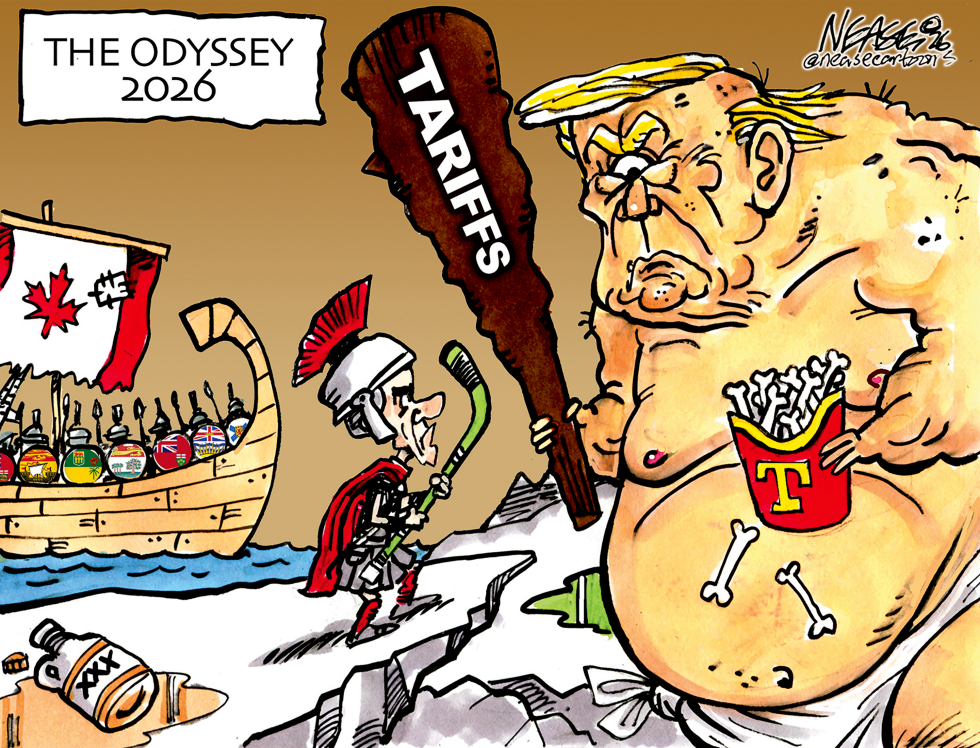
President Trump escalates tariffs on trading partners including Canada in mid-2026. The move targets imports amid ongoing disputes over trade balances and supply chains. Allies respond with coordinated pushback through diplomatic and economic channels. The cartoon casts the confrontation as a one-sided power play by the oversized tariff wielder against smaller coordinated opponents.
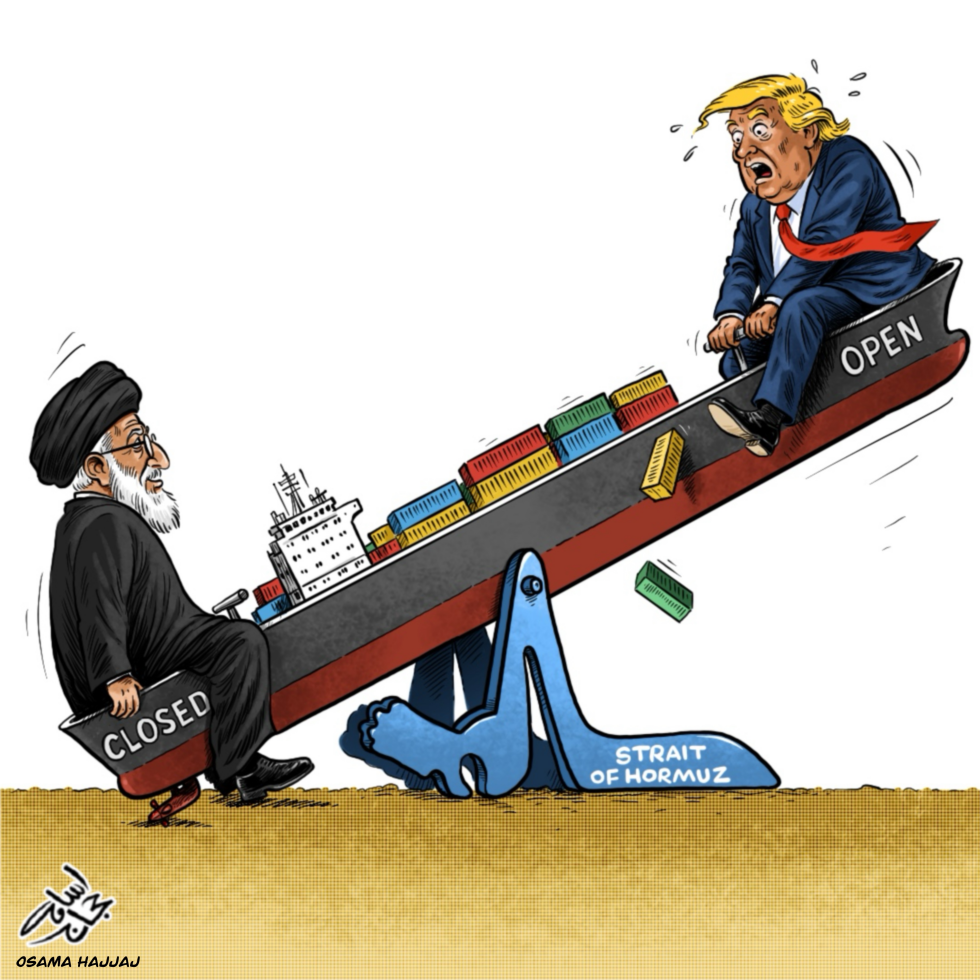
A political cartoon shows Donald Trump and Ayatollah Khamenei on opposite ends of a seesaw labeled Strait of Hormuz. Trump occupies the open side while the Iranian leader sits on the closed side. Colorful shipping containers line the beam with some falling off. The image highlights tensions over the vital oil shipping route. The cartoon uses the seesaw to illustrate competing efforts to control access through the strait.
On July 1 2026 Bill Day depicts Donald Trump first dismissing Antifa threats in one panel then igniting the Constitution Declaration of Independence and Bill of Rights in another while calling ICE for assistance. The scene shows the president holding a phone and lighter beside a red gas can as flames consume the documents on a table inside a columned hall with an American flag nearby.
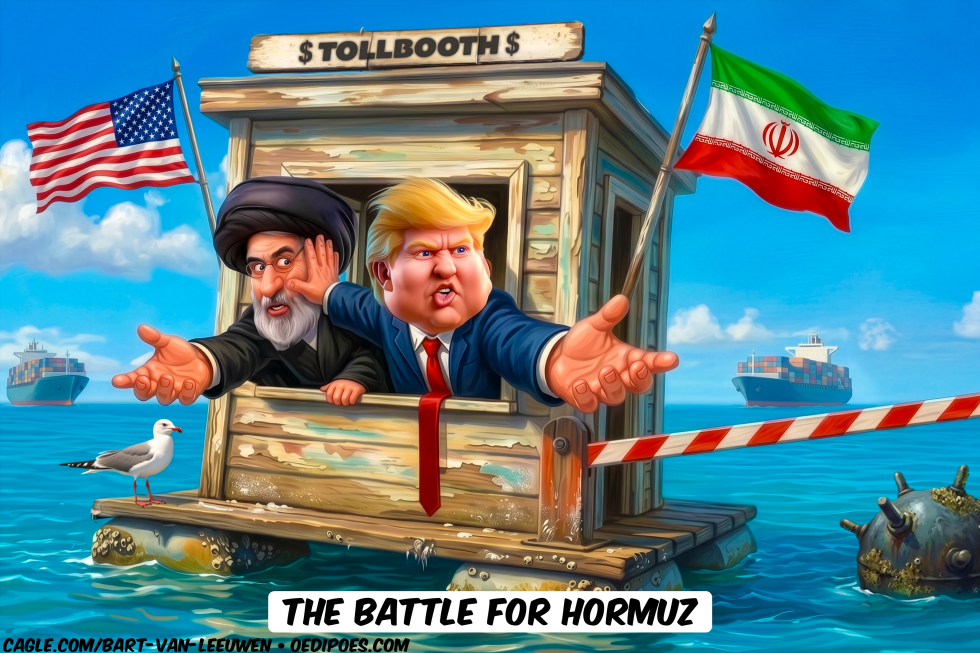
A new political cartoon shows President Trump and Iran's supreme leader sharing a tollbooth positioned across the Strait of Hormuz. Both figures extend their hands toward passing cargo ships while American and Iranian flags fly from the structure. The image comments on ongoing disputes over control of the vital oil shipping route.
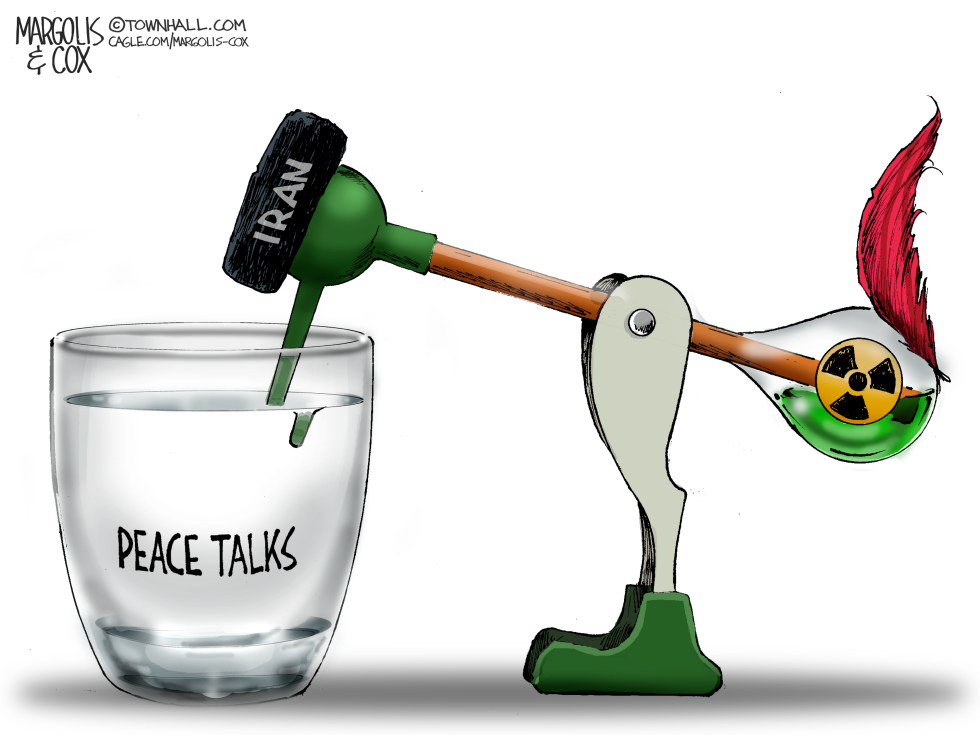
The image displays a glass marked peace talks containing liquid. A drinking bird device with Iran written on the head repeatedly dips its beak into the glass. The balancing arm has a nuclear symbol on a green section and a red element at the end. The base is green and the setup shows the bird in motion toward the glass.
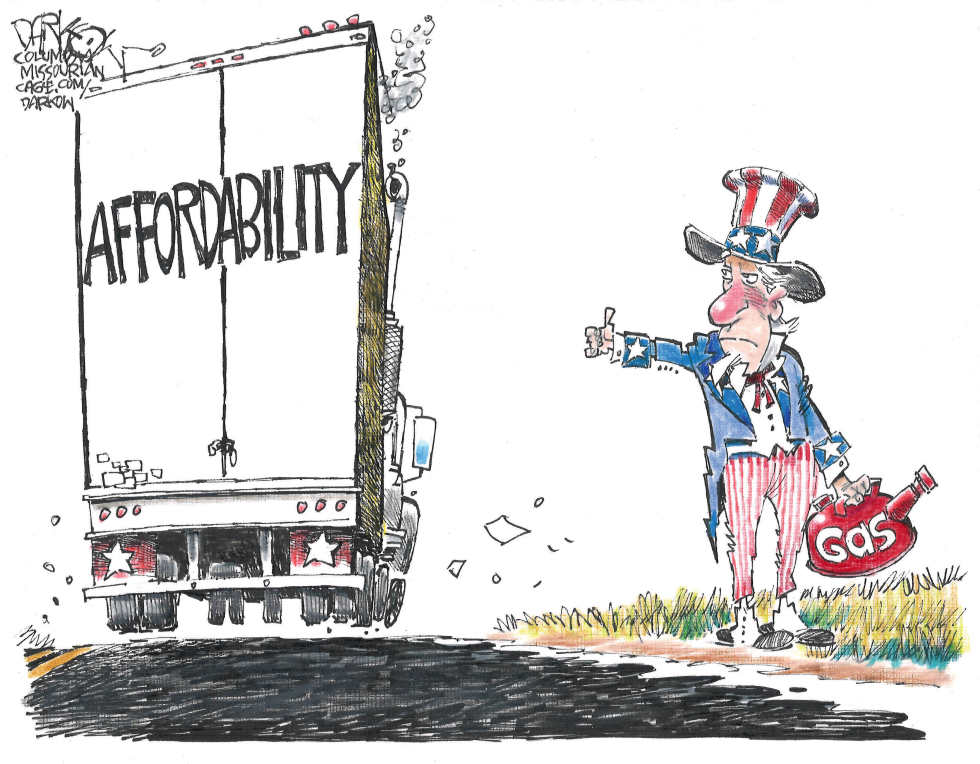
In this John Darkow cartoon, Uncle Sam stands on a roadside, thumb extended in a hitchhiking gesture, clutching a red gas can labeled 'Gas,' while a massive truck labeled 'AFFORDABILITY' barrels away, leaving exhaust and debris in its wake. The image captures the essence of the affordability crisis, with Uncle Sam personifying American struggles amid rising gas prices. Tags like affordability, gas prices, Iran war, Uncle Sam, and tariffs underscore the economic satire. The grassy roadside and spilled liquid add to the scene of abandonment. This visual commentary highlights how tariffs and potential conflicts like an Iran war could exacerbate fuel costs, leaving everyday affordability out of reach. The cartoon's composition emphasizes isolation, with Uncle Sam's frustrated expression plainly visible against the departing vehicle.
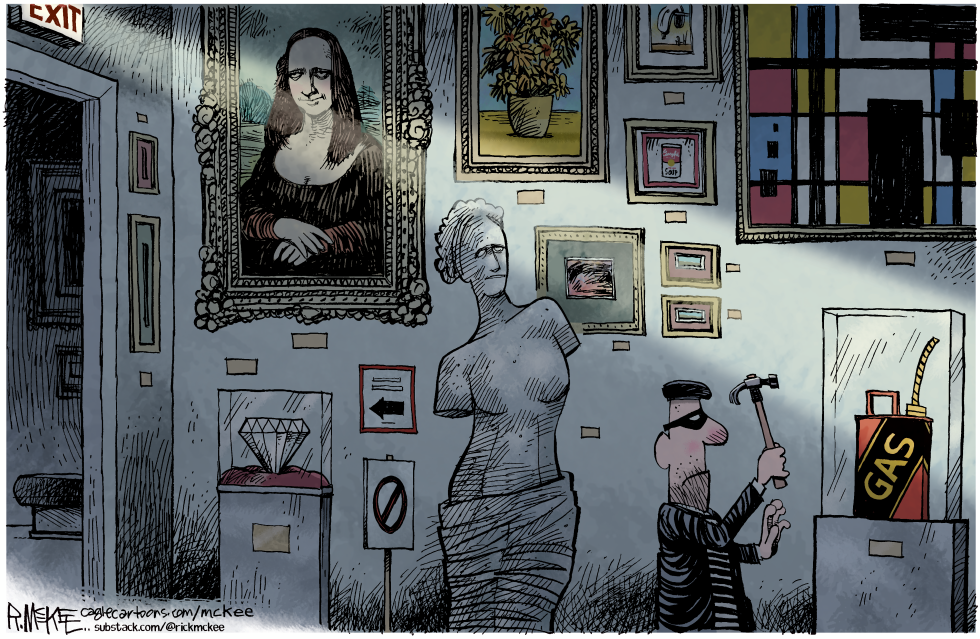
Rick McKee's cartoon depicts a dimly lit museum where a striped-shirted thief, masked and wielding a hammer, targets a display case with a red gas can marked 'GAS,' overlooking iconic pieces like the Mona Lisa portrait, Venus de Milo statue, a large diamond, Van Gogh-style sunflowers painting, abstract Mondrian-like art, and smaller framed works. An 'EXIT' sign glows above, and a 'no' symbol sign hangs nearby. The scene uses tags such as Trump, war, Iran, gas prices, oil, museum to comment on how escalating fuel costs make gasoline more valuable than cultural treasures, blending humor with commentary on energy crises.
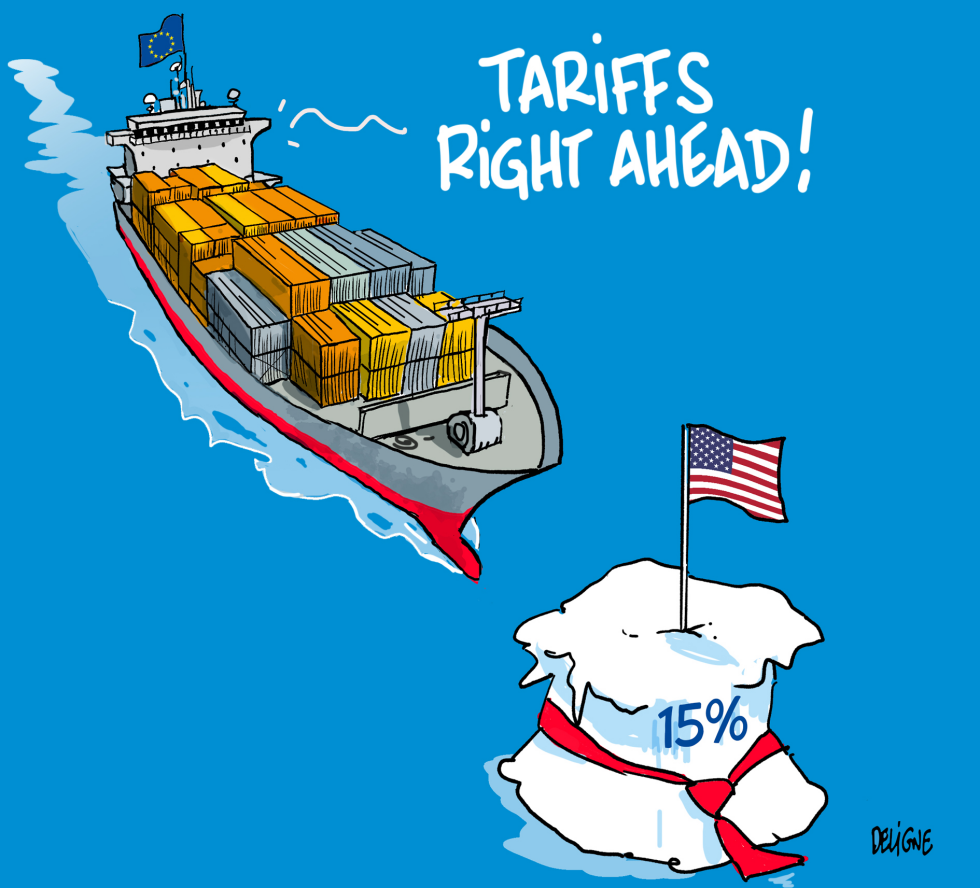
A European-flagged cargo ship laden with export containers sails directly toward a 15 percent iceberg flying the American flag. Bold text above the scene reads TARIFFS RIGHT AHEAD. The image captures rising trade tensions between the European Union and the United States over new tariff measures scheduled for late July 2025.