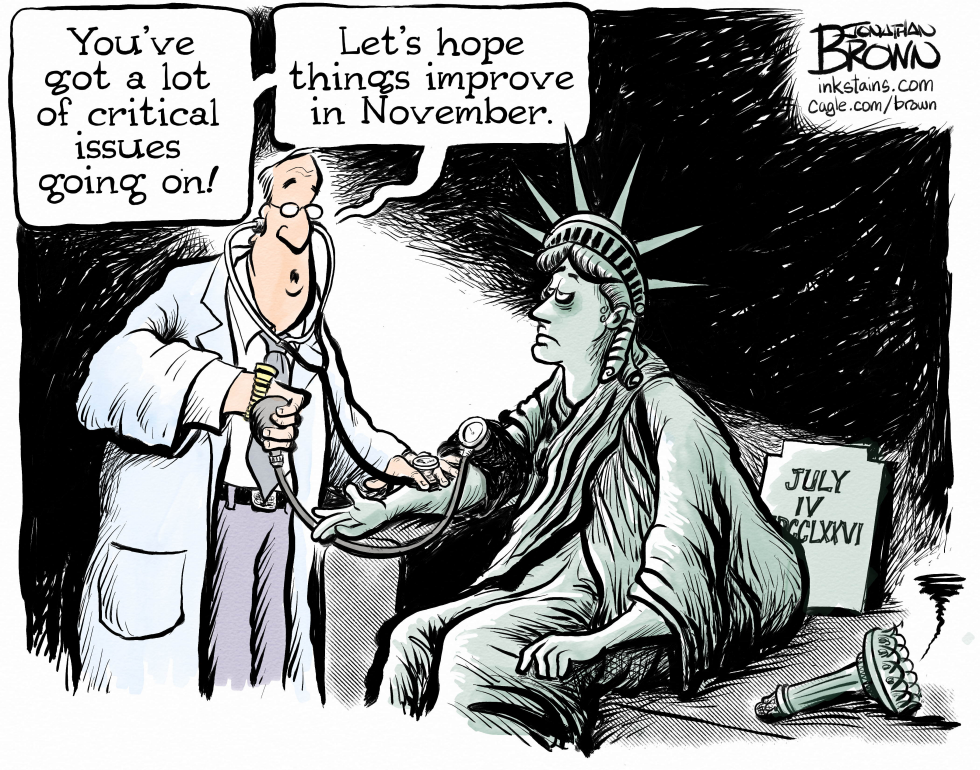
The cartoon depicts a doctor examining the Statue of Liberty's blood pressure and noting numerous critical issues. The Statue responds with hope that things will improve in November. A sign references July 4, 1776, and a broken torch rests on the ground. Published on September 15, 2026, the image uses the iconic figure to comment on the state of the nation ahead of upcoming elections. The visual metaphor highlights concerns about American institutions and public sentiment.
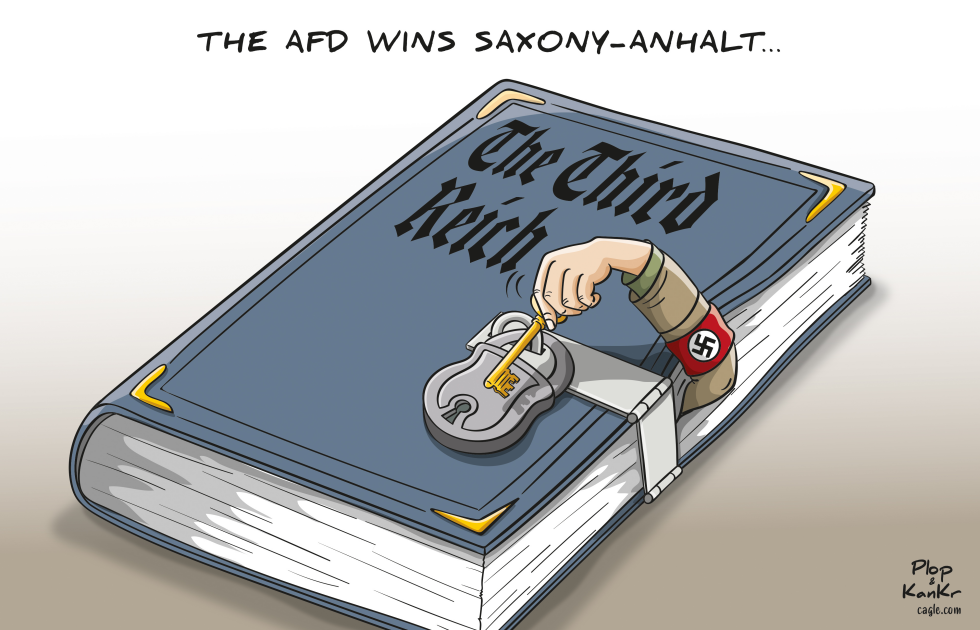
The cartoon responds to the AfD's reported victory in the Saxony-Anhalt state election by showing a hand in a Nazi armband using a key to unlock a large book titled The Third Reich. The image suggests the win revives dangerous historical precedents from Germany's past. It uses the visual metaphor of opening a locked volume to imply that far-right electoral gains could restore authoritarian elements associated with the Nazi era. The publication date places the piece in the context of ongoing debates about the AfD's rising influence in eastern German states.
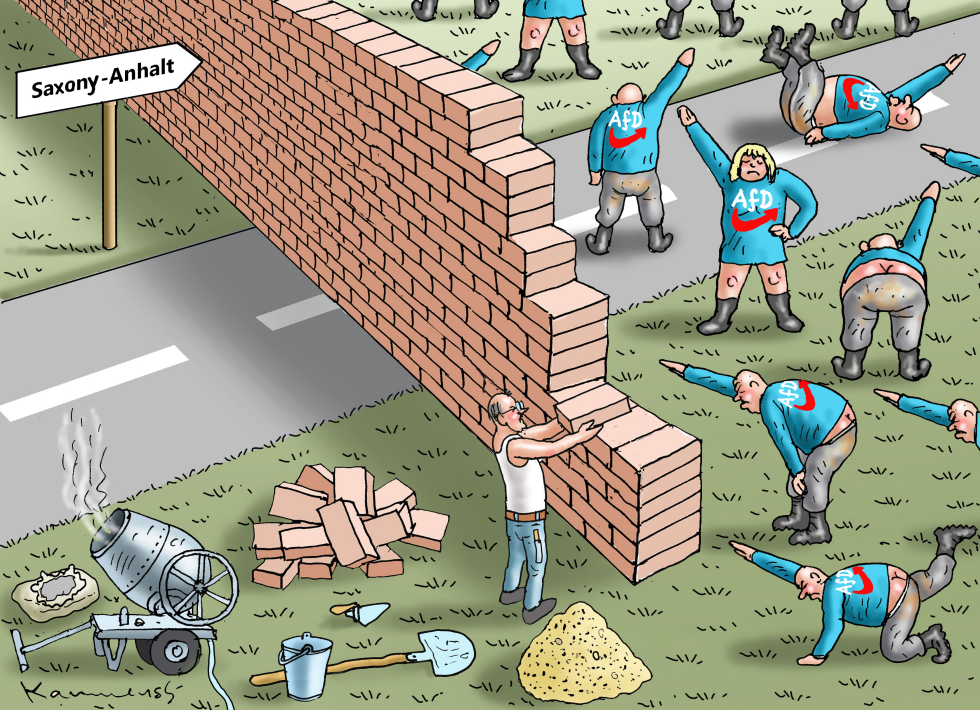
Friedrich Merz has positioned himself as a bulwark against Alternative for Germany advances ahead of state elections in Saxony-Anhalt. The cartoon depicts Merz personally laying bricks for a wall labeled for the eastern state while AfD figures in branded shirts struggle to cross it. The image underscores the CDU leader's strategy of containment rather than engagement with the far-right party. It reflects ongoing debates within German center-right circles about how to address AfD electoral strength without legitimizing its platform. The editorial stance presents the wall-building as a necessary, if blunt, defensive measure.
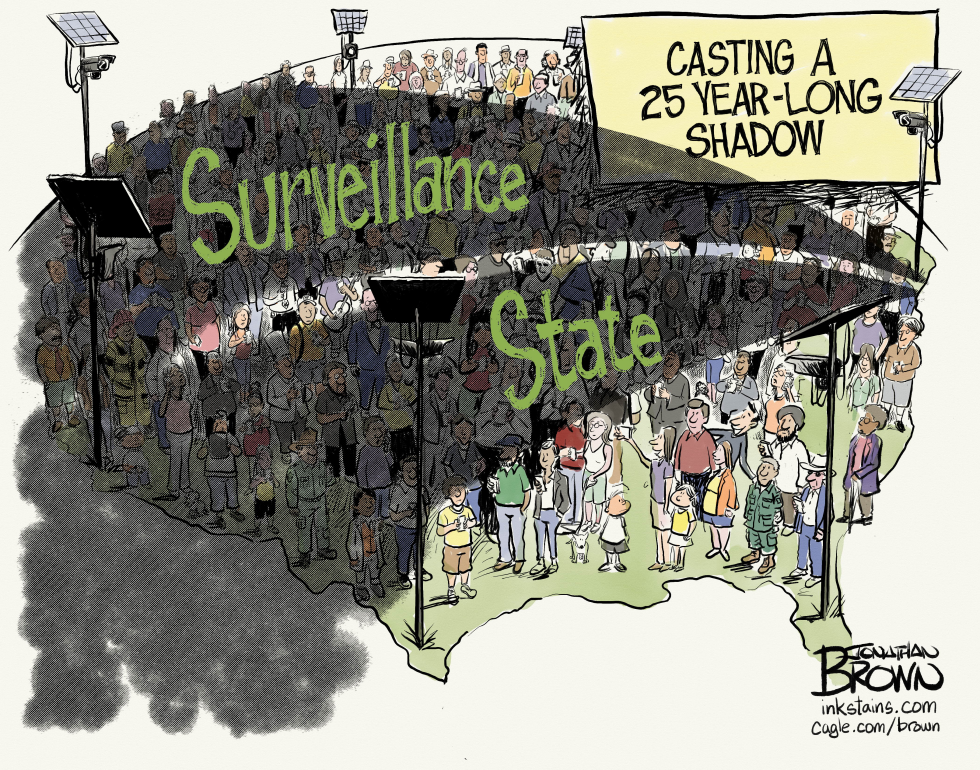
The cartoon depicts a dense crowd of Americans standing on a map of the United States, partially obscured by a large dark shadow cast by surveillance cameras mounted on poles. The words 'Surveillance State' appear prominently in green lettering across the scene, while a sign in the upper right reads 'CASTING A 25 YEAR-LONG SHADOW.' The image comments on the lasting effects of expanded government surveillance programs that began after the September 11 attacks, now spanning a quarter century. It illustrates how these measures continue to influence daily life and public spaces in 2026.
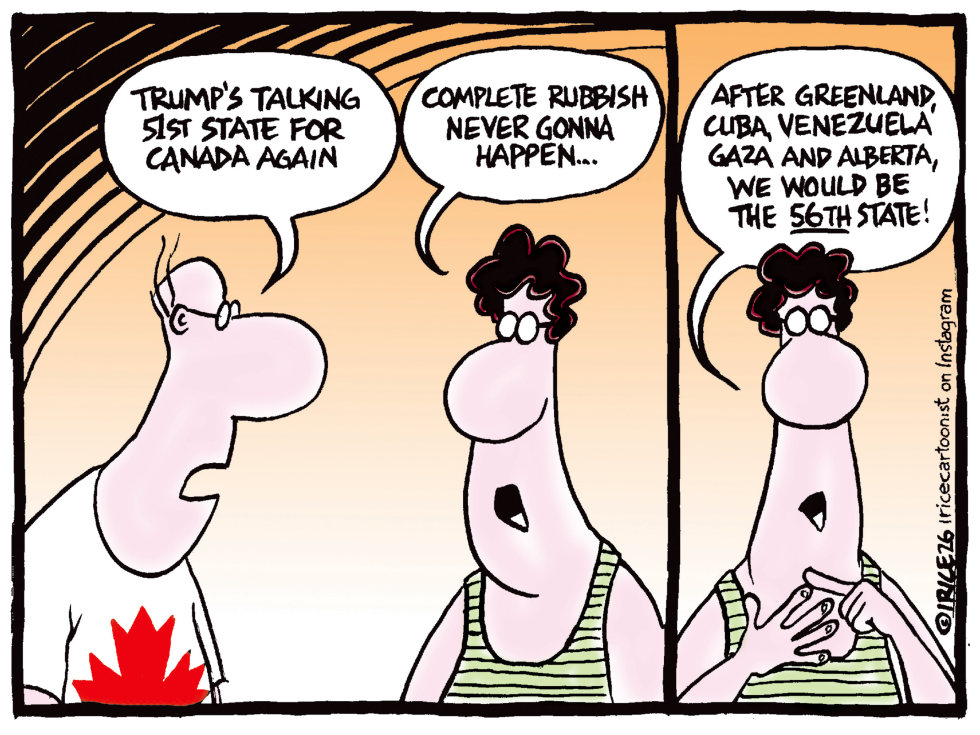
On June 26 2026 two figures appear in a three-panel exchange. The left panel shows a man in a maple leaf shirt noting renewed talk of Canada as the 51st state. The middle panel features a second man calling the notion complete rubbish. The right panel continues the exchange with the second man counting Greenland Cuba Venezuela Gaza and Alberta as prior additions that would make Canada the 56th state.
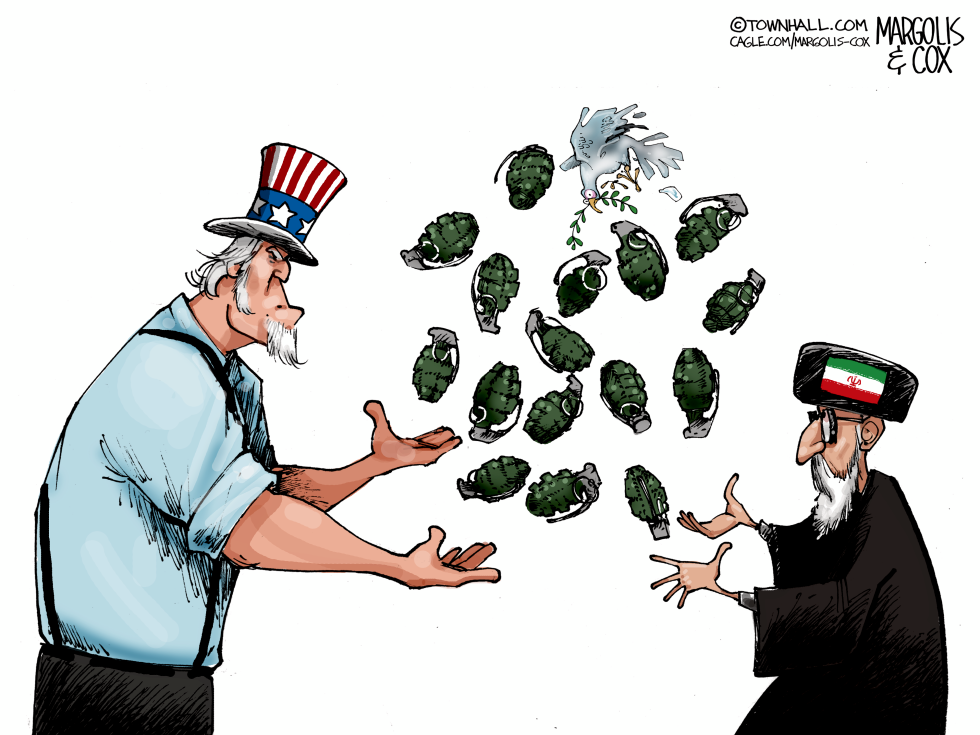
On June 16, 2026, the Margolis & Cox cartoon depicts Uncle Sam and an Iranian leader juggling grenades while a peace dove is struck mid-flight. The image responds to ongoing US-Iran tensions over nuclear issues and regional conflicts in the Middle East. The visual shows the two figures facing each other with outstretched hands as explosives arc between them. A wounded dove drops its olive branch above the scene. The cartoon highlights the precarious nature of diplomacy between Washington and Tehran at that moment.
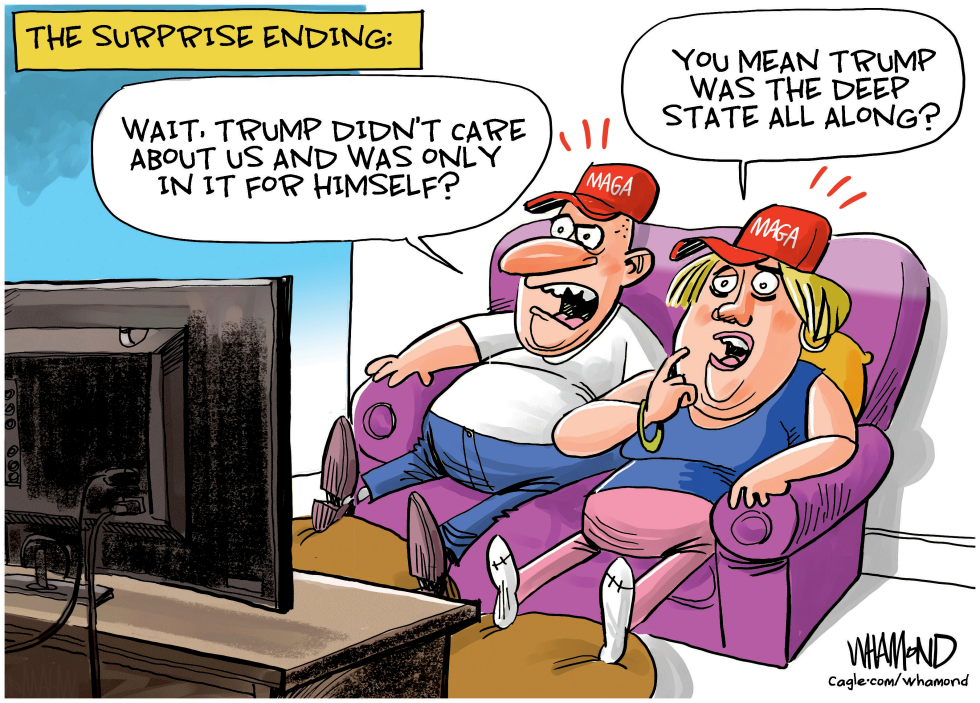
Image shows man and woman seated on purple couch wearing red caps labeled MAGA. One speech bubble reads about Trump not caring. Another mentions deep state. Television set stands in front. Artist name appears at bottom right. Scene is indoors with simple furniture visible.
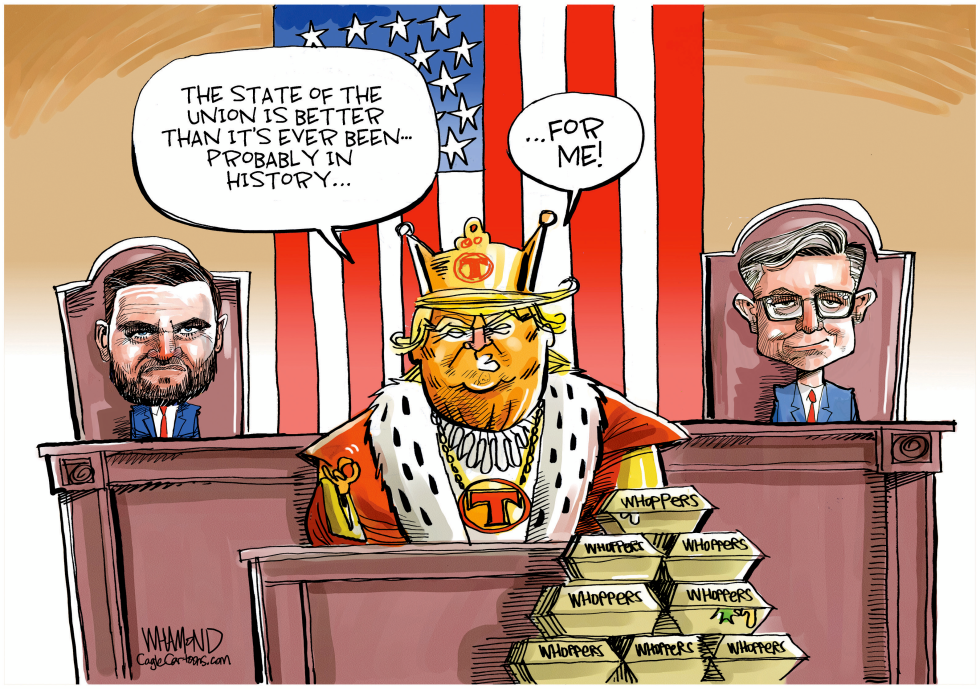
This political cartoon depicts a central figure dressed as a king, complete with a crown marked 'T,' seated at a podium with an American flag backdrop. He speaks in a bubble: 'The state of the Union is better than it's ever been... Probably in history...' while a smaller bubble adds '...For ME!' A tall stack of items labeled 'Whoppers' sits on the desk. Two other men flank him, one bearded on the left, one bespectacled on the right, both in suits. The scene uses tags like State of the Union, Trump, King, Congress, lies, and whoppers to satirize exaggerated claims in a straightforward, visible manner without hidden inferences.
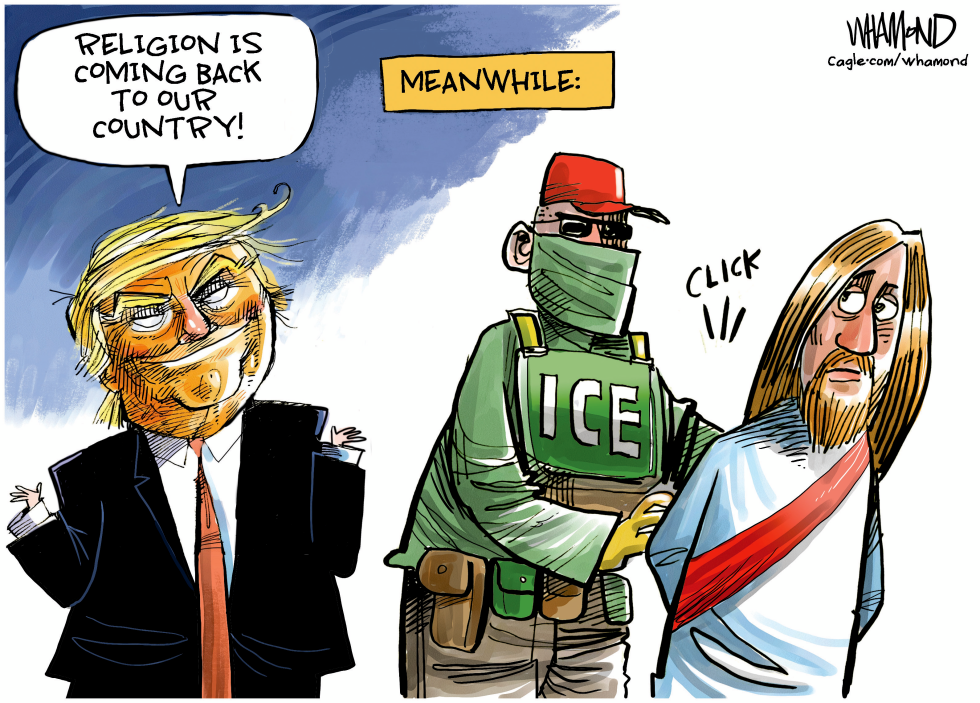
Dave Whamond's cartoon captures Trump religion cartoon essence with the former president boldly stating religion's return to America. Meanwhile, an ICE agent is shown handcuffing a figure resembling Jesus, complete with long hair, beard, and robes, in a clear ICE deporting Jesus satire. This piece dives into political cartoon religion America themes, poking at immigration policy religion hypocrisy. The dry humor shines through the contrast between Trump's proclamation and the 'meanwhile' scene of deportation. Such satirical take on US immigration and faith often sparks debate on religious revival and deportation. Overall, it's a pointed commentary on blending faith with strict border controls.
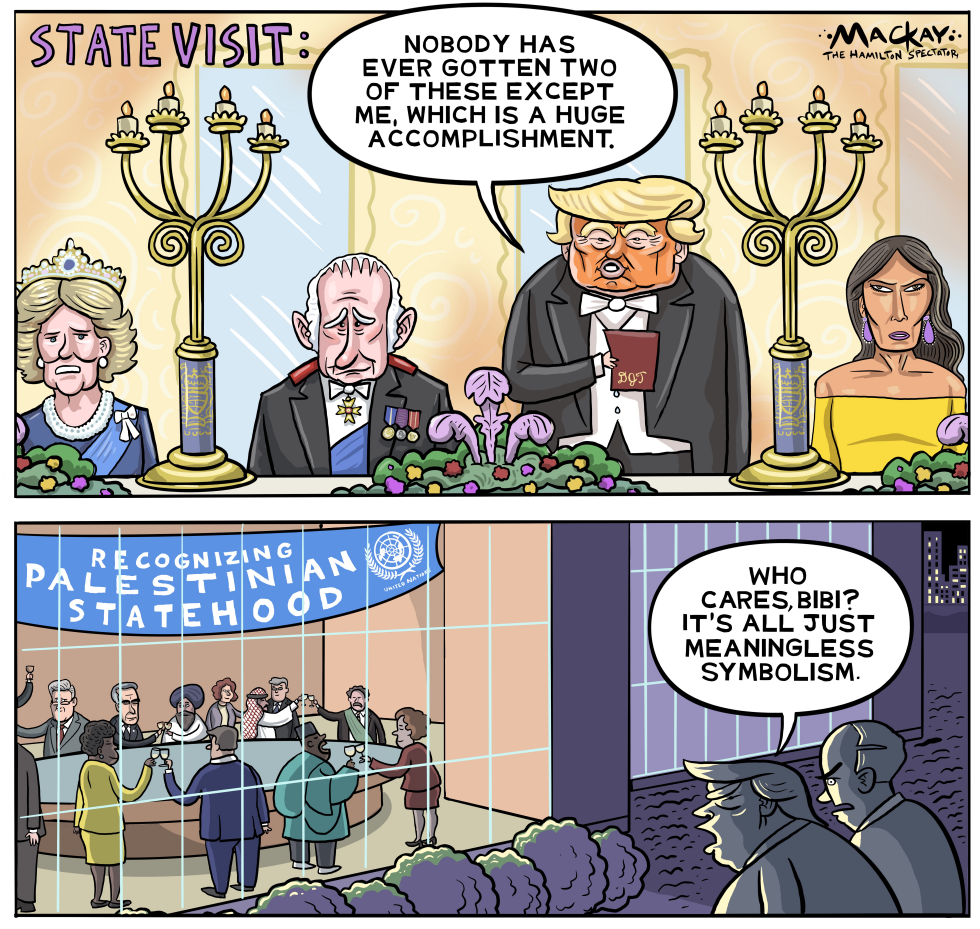
Graeme MacKay's cartoon captures a state visit dinner scene with figures at a table adorned with candelabras, where a caricature resembling Donald Trump boasts about unique accomplishments. The lower panel shifts to a United Nations setting with a banner reading 'Recognizing Palestinian Statehood,' showing delegates toasting, while outside, Trump and another figure, addressed as Bibi, dismiss the event as meaningless symbolism. Incorporating tags like Allies, Palestine, United Nations, Statehood, Recognition, and Peace, the artwork highlights contrasts in diplomatic perceptions. The composition uses split panels to juxtapose formal pomp with cynical realpolitik, emphasizing themes of symbolic gestures versus substantive policy in the Israel-Gaza conflict context.
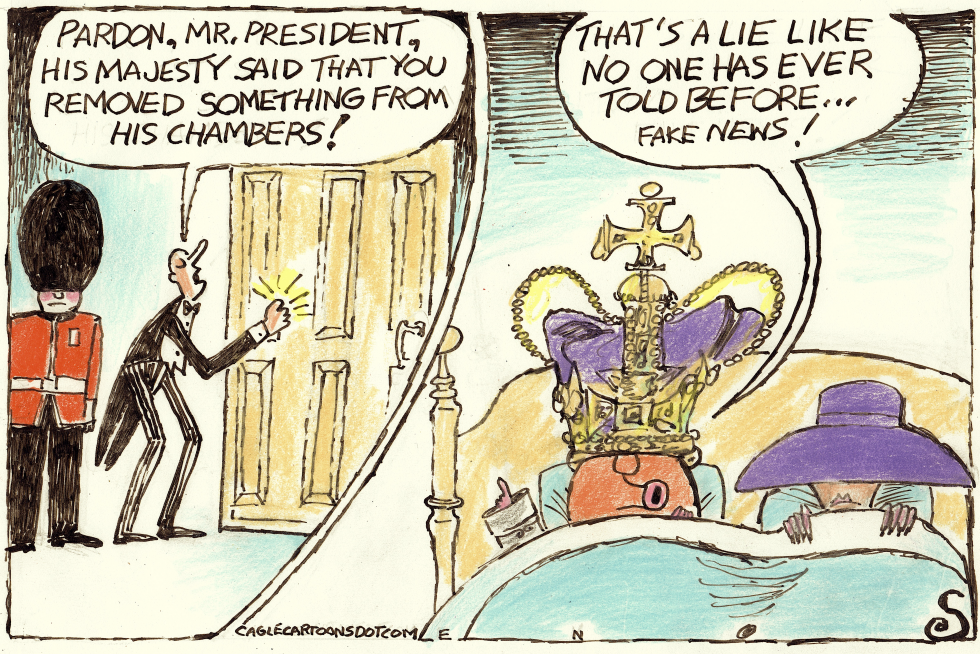
Randall Enos captures Donald Trump in a state visit to England, caricatured as King Trump lounging in bed with Melania, donning a massive crown while dismissing a servant's accusation of removing something from King Charles' chambers as 'fake news.' The cartoon cleverly merges Trump's signature phrases with royal pomp, highlighting the absurdity of his denials in a foreign, majestic context. Tags like state visit, King Charles, and fake news underscore the humor in blending American politics with British monarchy, making it a sharp commentary on Trump's larger-than-life persona.
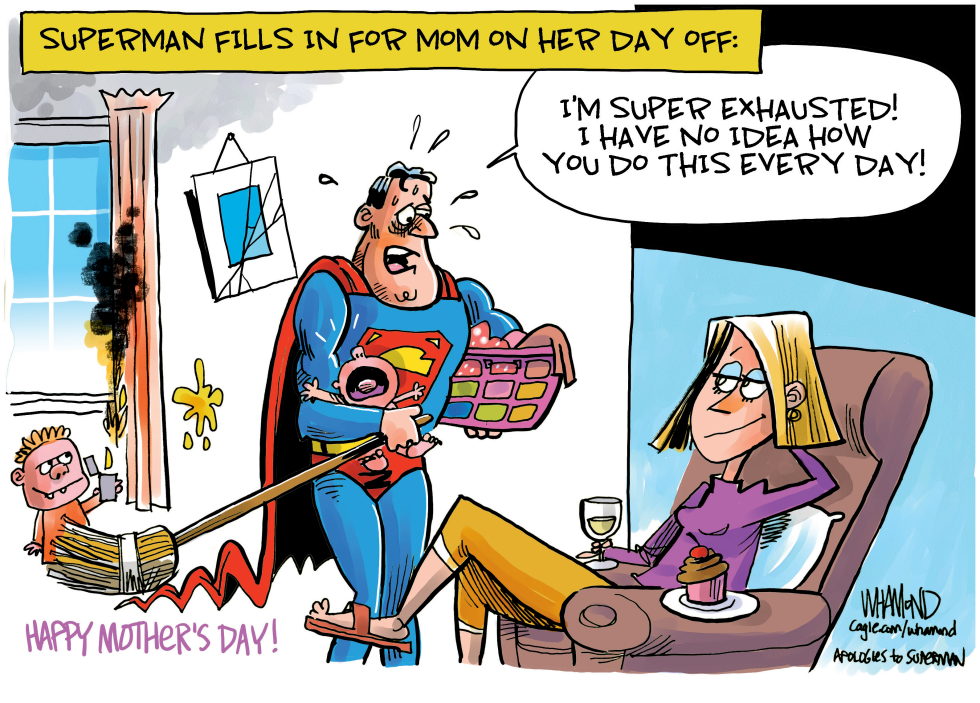
Dave Whamond's cartoon captures Superman filling in for mom on her day off, looking utterly worn out while holding a baby in a mini-Superman outfit, a tray of food, and dragging a broom. The scene, set in a home with smoke from a burnt spot and a child nearby, underscores appreciation for mothers as the real superheroes. Mom lounges with a wine glass and cupcake, smirking at Superman's exhaustion. Tags like Mother's Day, mom is a real superhero, not all superheroes wear capes, children, family, and hard work highlight the tribute to everyday maternal feats over DC's iconic figure.