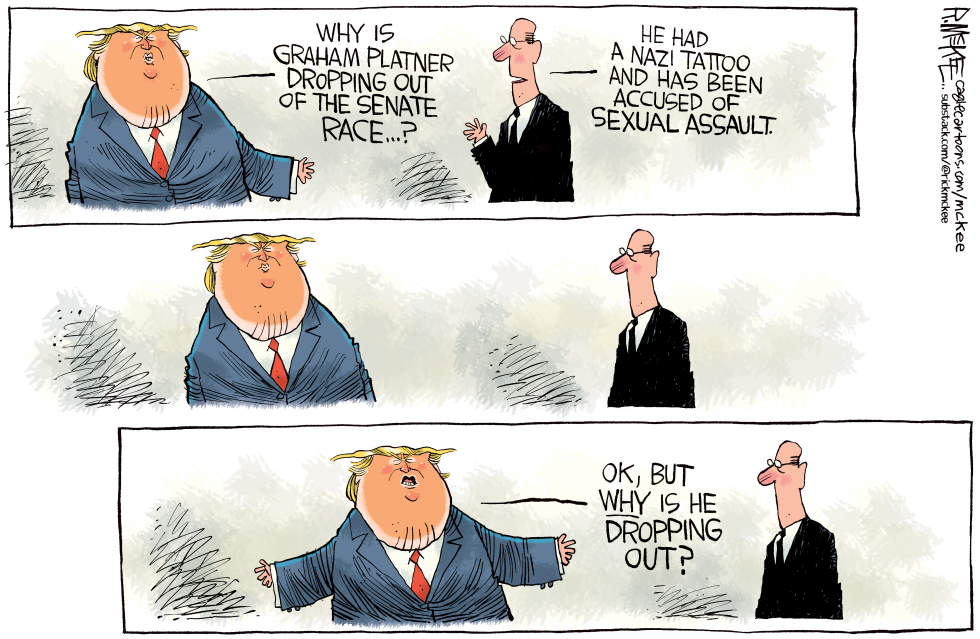
On July 10 2026 Rick McKee depicts Donald Trump questioning an aide about Graham Platner dropping out of a Senate race. The aide cites a Nazi tattoo and sexual assault accusation as reasons. Trump responds by asking again why the candidate is leaving the race. The exchange highlights the former president's focus on the withdrawal itself rather than the underlying controversies. Publication occurs during the 2026 election cycle when candidate viability and scandal impacts remain central topics in Senate contests.
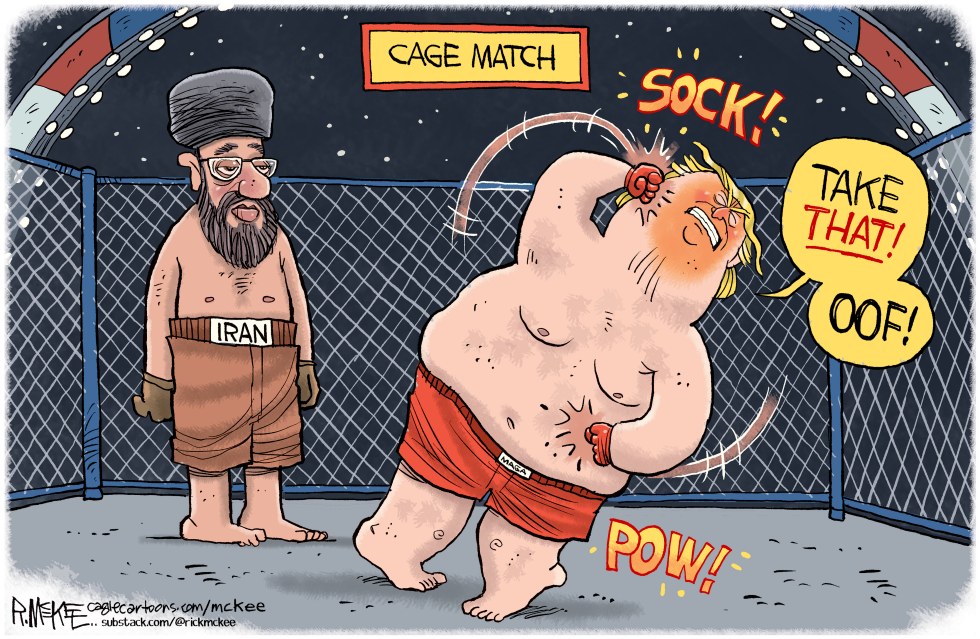
A political cartoon published June 12, 2026, portrays a cage match between a caricature of Donald Trump labeled America and a figure labeled Iran. Trump appears to be on the receiving end of punches with onomatopoeic sound effects. The image uses the fighting ring setting to illustrate the confrontational nature of relations between the United States and Iran during this period.
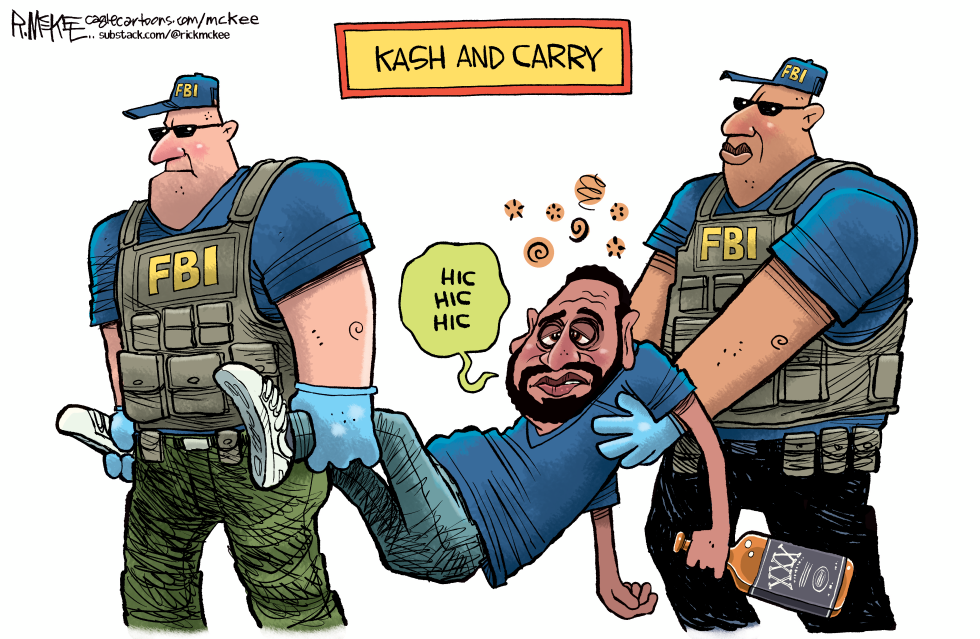
Rick McKee's cartoon shows two stern FBI agents in vests and caps, carrying a limp, bearded man who's clearly intoxicated, complete with hiccups and swirling symbols overhead, clutching a bottle marked XXX. The sign above reads 'Kash and Carry,' a clear pun tying into Kash Patel, the figure depicted. This piece tags into FBI, Federal Bureau of Investigation, drunk, alcohol, agents, criminal justice, and domestic policy, poking at the idea of leadership in a haze. The dry humor lands on the absurdity of carrying someone unfit, visually straightforward without hidden layers. Newspapers love this kind of sharp, unambiguous satire that comments on current events without overcomplicating the message.
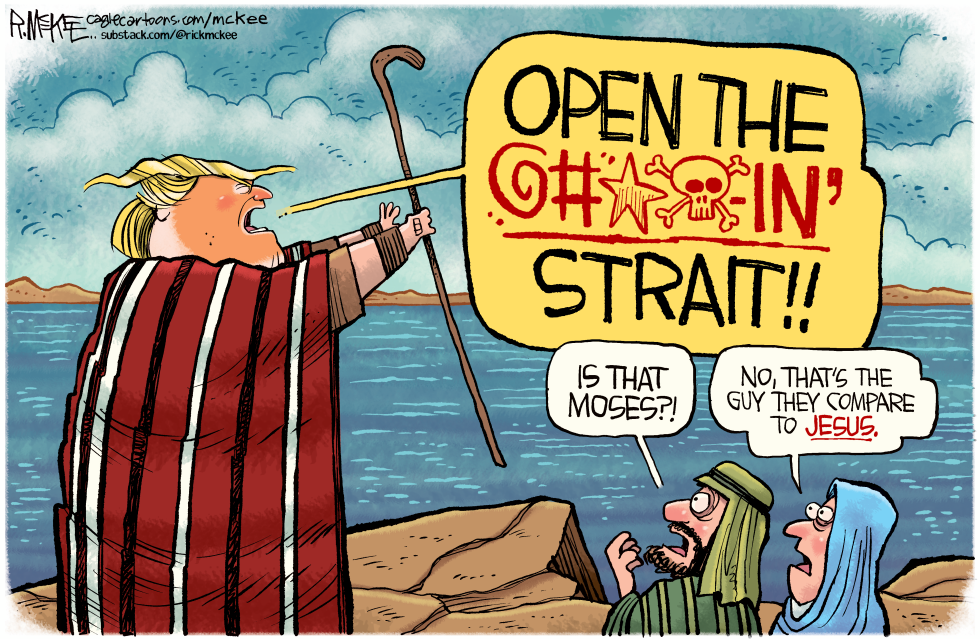
Rick McKee's cartoon depicts a blond-haired man resembling Donald Trump, dressed in red robes, holding a staff and yelling 'OPEN THE C@#*in' STRAIT!!' at a body of water, evoking the Moses parting the Red Sea scene. In the foreground, two ancient-dressed figures converse: one asks if it's Moges, the other clarifies it's the guy compared to Jesus. The image ties into tags like Trump, Easter, Iran, Israel, war, Strait of Hormuz, blending biblical imagery with modern political satire on Trump's self-comparisons and international tensions. The censored profanity adds a layer of obscenity to the parody, set against a desert landscape with clouds.
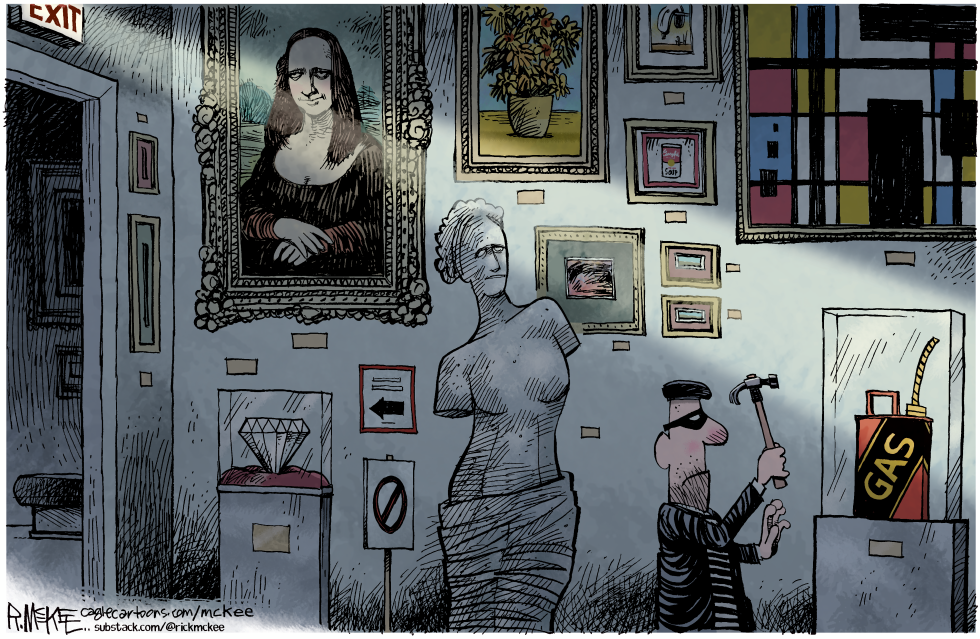
Rick McKee's cartoon depicts a dimly lit museum where a striped-shirted thief, masked and wielding a hammer, targets a display case with a red gas can marked 'GAS,' overlooking iconic pieces like the Mona Lisa portrait, Venus de Milo statue, a large diamond, Van Gogh-style sunflowers painting, abstract Mondrian-like art, and smaller framed works. An 'EXIT' sign glows above, and a 'no' symbol sign hangs nearby. The scene uses tags such as Trump, war, Iran, gas prices, oil, museum to comment on how escalating fuel costs make gasoline more valuable than cultural treasures, blending humor with commentary on energy crises.
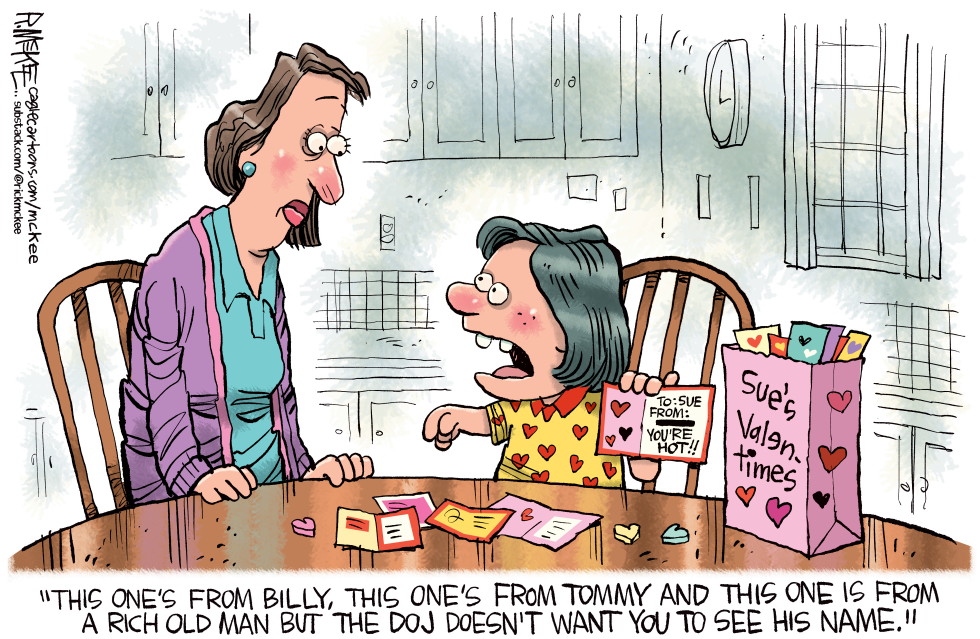
Rick McKee's cartoon captures a domestic scene where a young girl excitedly lists her Valentines from Billy, Tommy, and a rich old man whose name the DOJ conceals, tying into tags like Epstein, Trump, Bondi, DOJ, Kash Patel, FBI. The image, set in a kitchen with cards and a pink bag labeled 'Sue's Valen Times,' uses humor to poke at ongoing scandals in criminal justice and domestic policy. Hearts and exclamations add a light touch to the heavy undertones of secrecy in GOP and Republicans circles, even touching on stocks and economy implications. This piece blends holiday cheer with pointed satire on hidden truths.
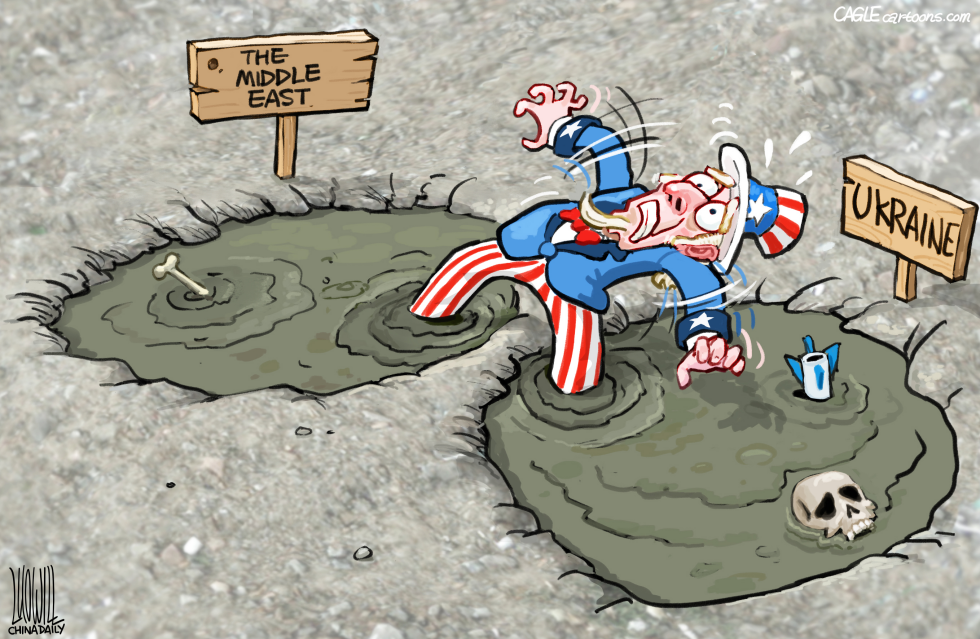
On January 18, 2024, a cartoon by Luojie shows Uncle Sam trapped waist-deep in two separate mud pits. One pit is marked The Middle East and contains a bone. The other is marked Ukraine and holds a skull along with a small object. The figure reaches out with a distressed expression while signs point to each location. The image highlights simultaneous US entanglements in separate conflicts at that time.
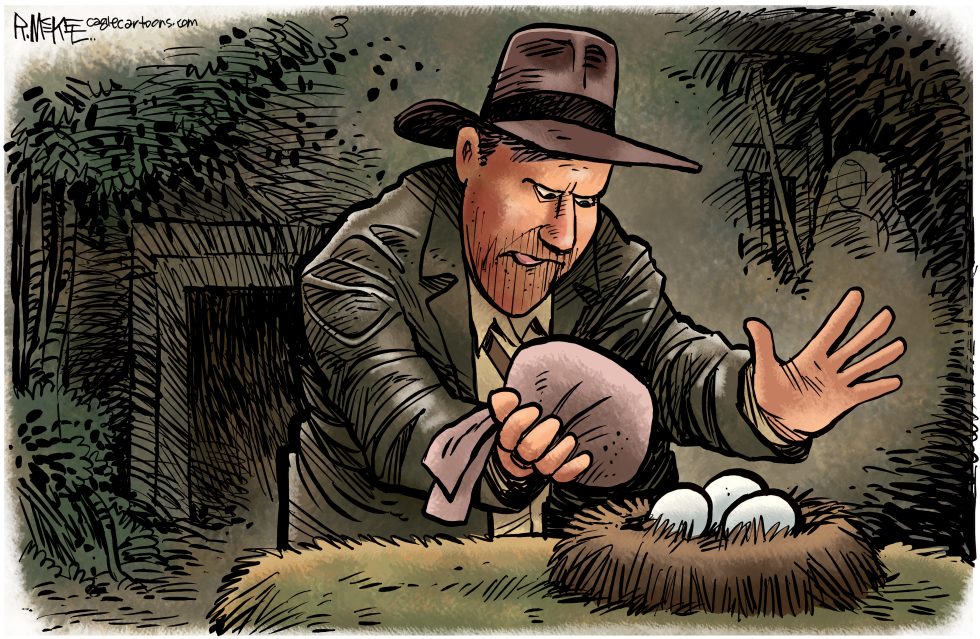
On January 27, 2023, Rick McKee depicts Indiana Jones carefully exchanging a large speckled egg for smaller white ones in a jungle nest. The scene references the ongoing avian flu outbreak that drove up egg prices across the United States that winter. McKee uses the Raiders of the Lost Ark hero to illustrate consumer frustration with sudden grocery cost increases tied to poultry disease.
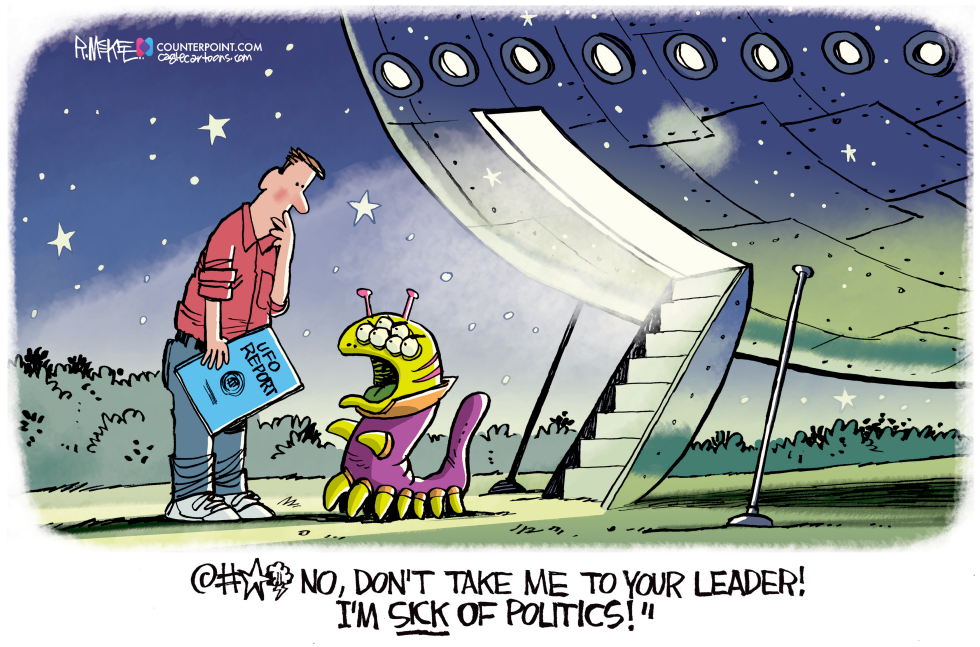
Rick McKee's cartoon captures a classic sci-fi trope with a timely twist, showing a man with a UFO report confronting a small, antennae-sporting alien emerging from a spaceship under a starry night sky. The alien, with a yellow head and purple body, shouts in refusal, declaring it's sick of politics and won't be taken to any leader. This piece satirizes the 2021 government UFO report buzz, poking fun at how even extraterrestrials might be weary of Earth's political circus. The humor lands dryly, emphasizing universal exhaustion with leadership drama amid real-world discussions on unidentified aerial phenomena. Composition is clean, with the spaceship's ramp and the man's thoughtful pose adding to the absurdity.
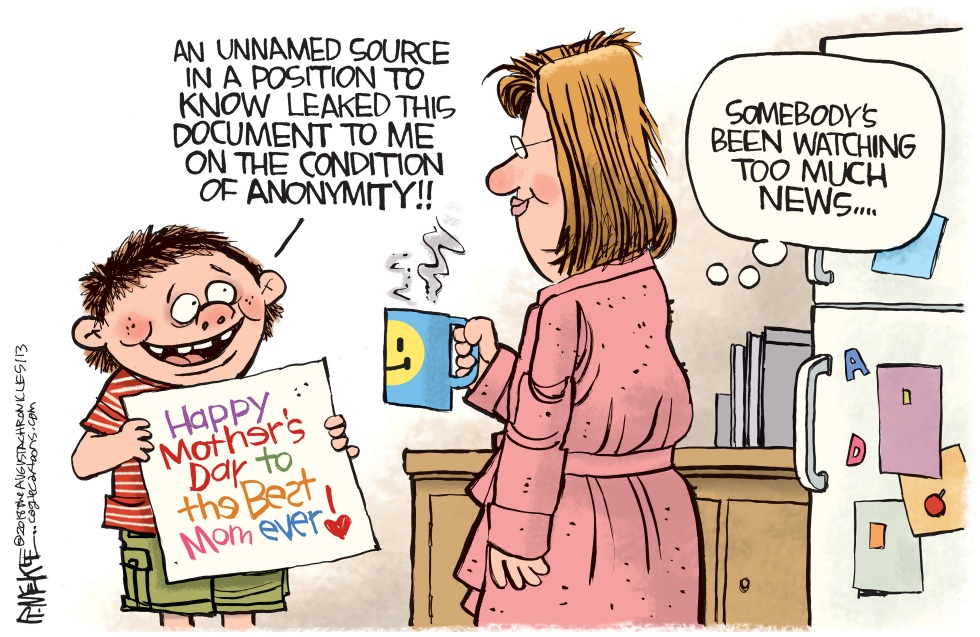
Rick McKee's Mother's Day cartoon shows a young boy in a striped shirt holding a handmade sign that reads 'Happy Mother's Day to the Best Mom Ever' in rainbow letters with a heart. He declares it a leaked document from an unnamed source on condition of anonymity, while the mom in a pink robe holds a blue mug with a yellow smiley face and remarks that somebody's been watching too much news. The scene unfolds in a kitchen with a fridge, books, and magnets visible. This political satire captures media influence on children, blending family holiday with journalistic tropes like anonymous sources and leaks. The dry humor underscores how news permeates everyday life.
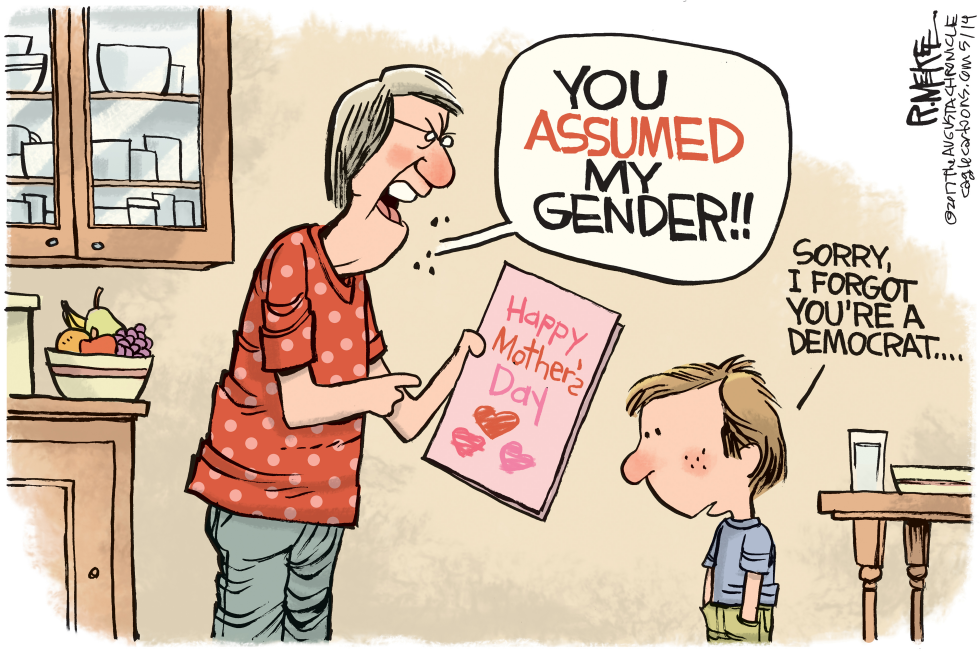
Rick McKee's cartoon captures a kitchen moment where a young boy presents a Happy Mother's Day card to an older woman, who shouts 'YOU ASSUMED MY GENDER!!' The boy responds apologetically, 'Sorry, I forgot you're a DEMOCRAT...' This piece uses tags such as mother's day, gender assumption, democrat, political correctness, family humor, and satire to poke fun at contemporary debates on identity and politics. The domestic setting with fruit bowl and cabinets grounds the scene in everyday life, making the exaggeration more relatable. Published in 2017, it reflects ongoing cultural tensions without delving into specifics beyond the visible dialogue and actions.
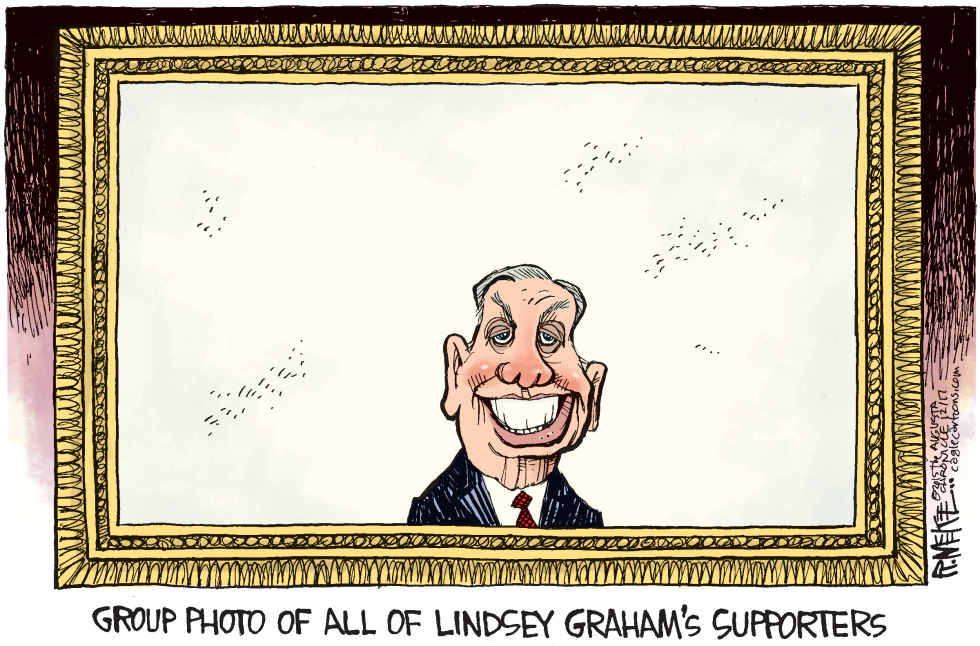
A political cartoon by Rick McKee published December 16, 2015, depicts a large ornate frame containing only the head and shoulders of Sen. Lindsey Graham. The bottom caption reads Group Photo of All of Lindsey Graham's Supporters. The image appeared during the early 2016 Republican presidential primary season when Graham's campaign registered minimal polling support. The composition places Graham at the bottom center of the vast empty interior to emphasize isolation. McKee's signature appears on the right edge alongside the caglecartoons.com credit.
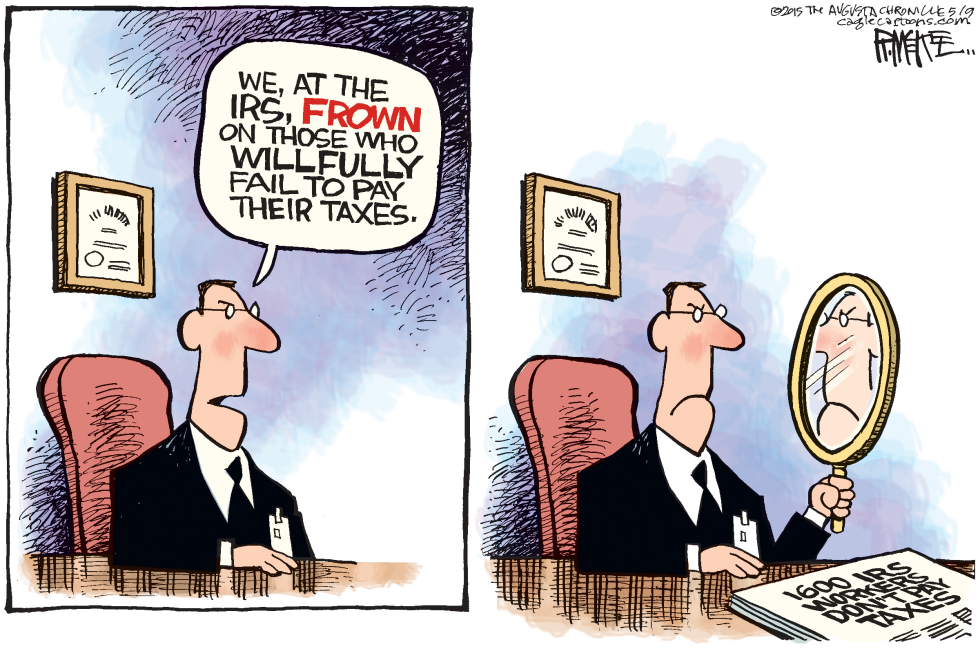
Rick McKee's 2015 cartoon captures IRS hypocrisy cartoon through two panels: an agent at his desk declares that the IRS frowns on those who willfully fail to pay taxes, surrounded by office certificates. In the next panel, the same agent holds a magnifying glass to a thick book titled '1600 IRS Workers Don't Pay Taxes,' underscoring tax evasion satire and government tax failure humor. The artwork uses simple lines and colors to emphasize the ironic contrast between official stance and internal reality, making it a classic political cartoon IRS workers example of satirical take on IRS policy and bureaucratic irony illustration. This piece highlights federal agency double standards in a straightforward, humorous way that resonates with viewers frustrated by government inconsistencies.
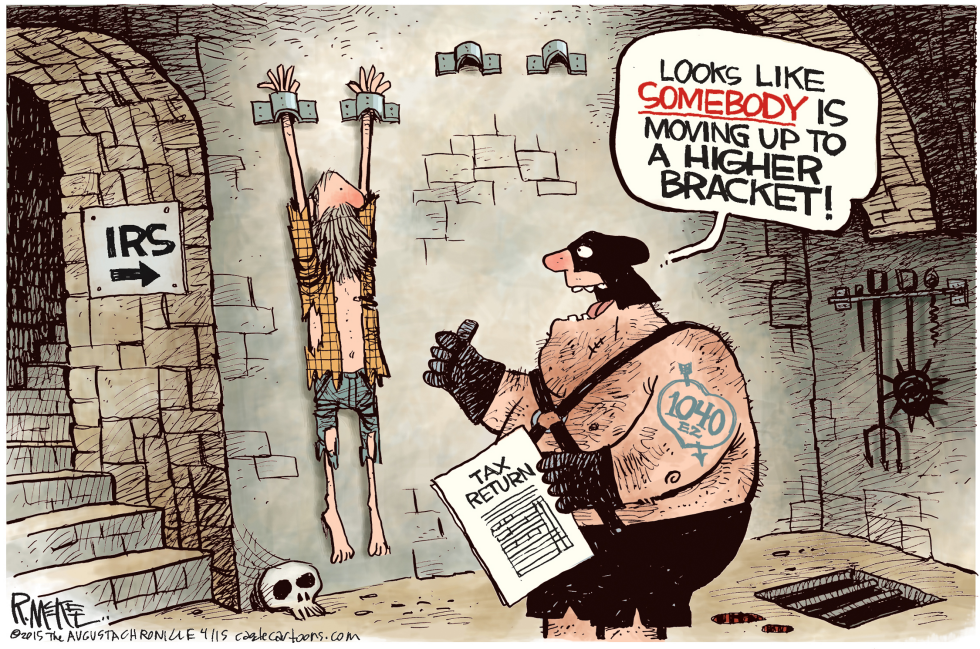
Rick McKee's 2015 cartoon depicts a dungeon scene with an IRS sign pointing to a chained, ragged figure hanging from the wall, his bare feet above a skull on the ground. A muscular executioner, masked and gloved, bears a heart-shaped 1040 EZ tattoo on his arm and holds a tax return document, delivering the punchline about moving to a higher bracket. Tools of torture adorn the stone walls, emphasizing the satirical take on tax burdens. This IRS tax bracket cartoon captures the dread of tax day with dry humor, portraying fiscal policy as medieval punishment. The composition highlights the power imbalance between taxpayer and system, using exaggeration for effect in this tax return executioner cartoon.