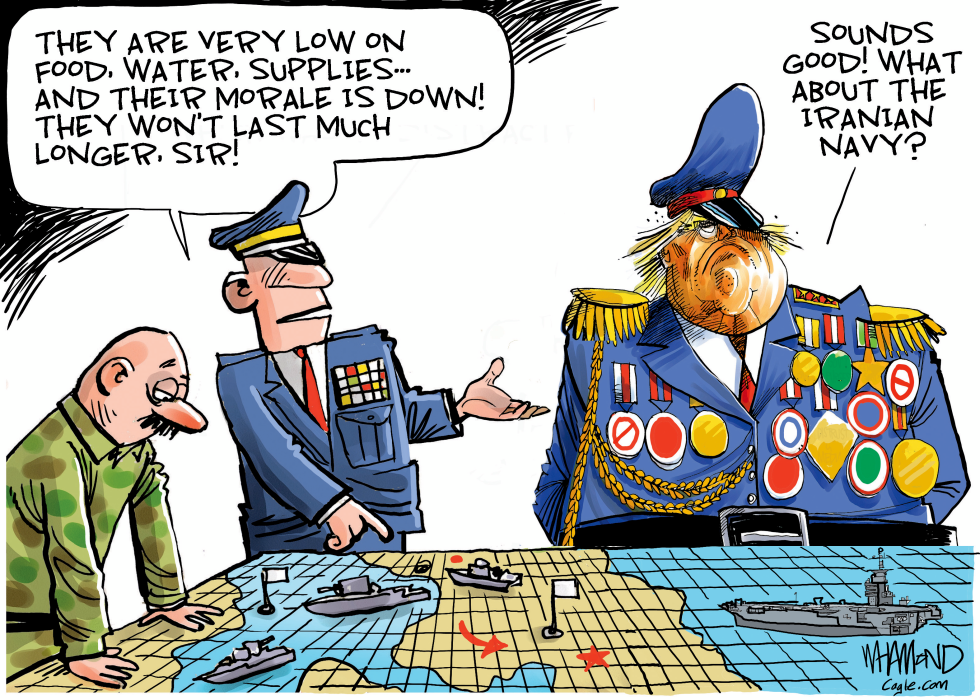
A U.S. Navy carrier faces reported shortages of food, water and supplies along with declining morale in mid-2026. Senior officers brief the president on the situation. The president responds by inquiring about the Iranian Navy instead. The piece portrays the administration as detached from operational readiness concerns in the region.
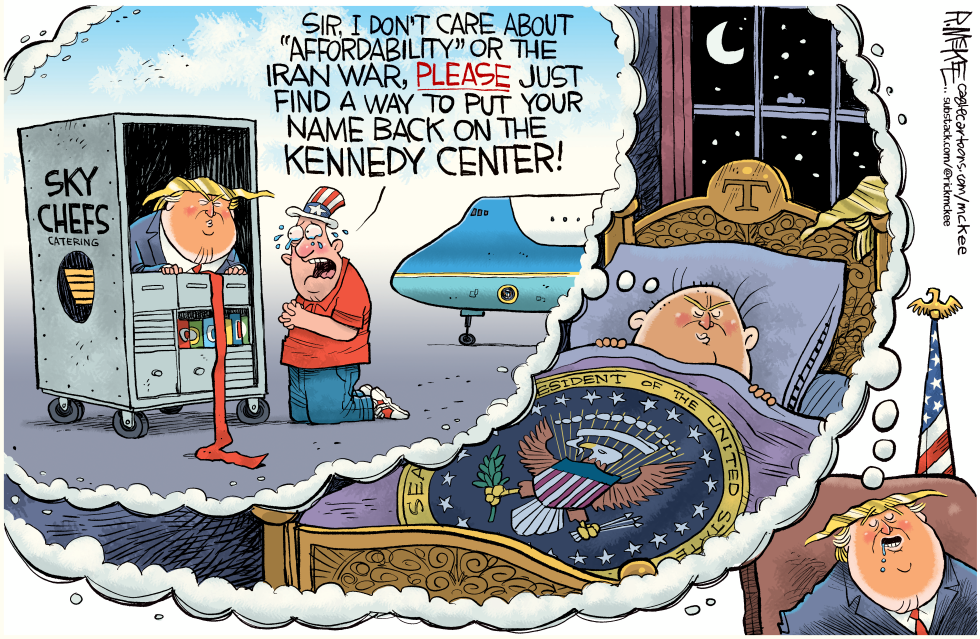
Donald Trump has repeatedly expressed interest in attaching his name to prominent public institutions. The Kennedy Center, a major arts venue in Washington, has drawn his attention as a potential target for rebranding. Critics argue such moves distract from pressing national issues including foreign conflicts and domestic spending. The cartoon depicts this fixation as a nighttime preoccupation that sidelines other responsibilities.
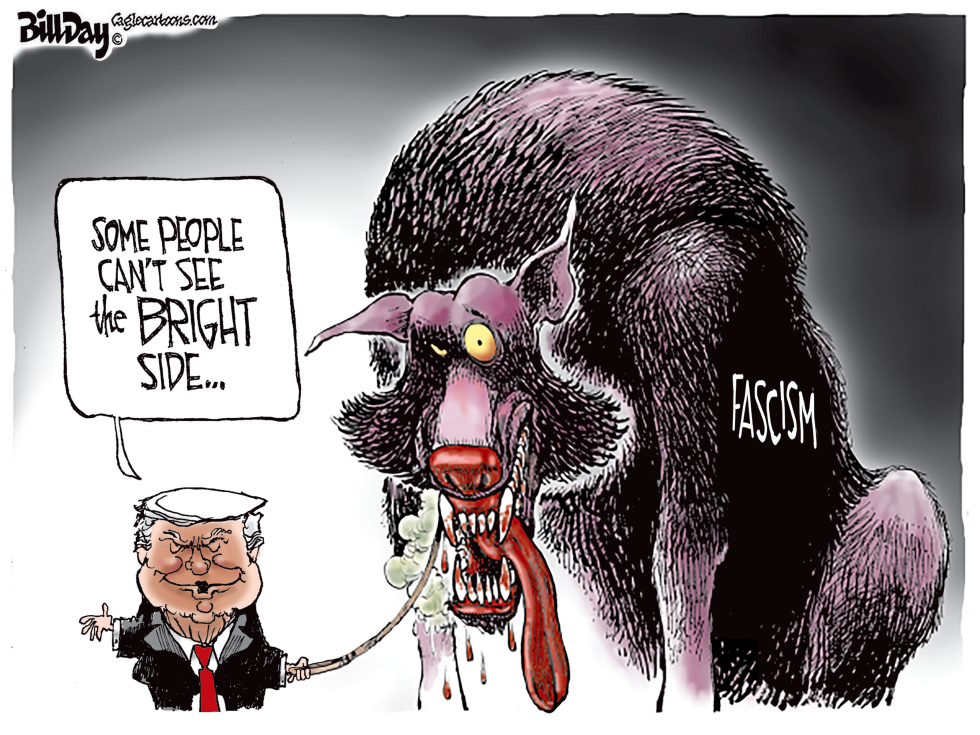
Donald Trump appears in public comments framing his actions in optimistic terms amid ongoing debates over authoritarian tendencies in American politics. The depiction shows him restraining a creature explicitly labeled fascism. Critics argue such rhetoric downplays real institutional risks while supporters view it as resistance to overreach. The piece takes the position that Trump actively manages or embodies the threat rather than opposing it.
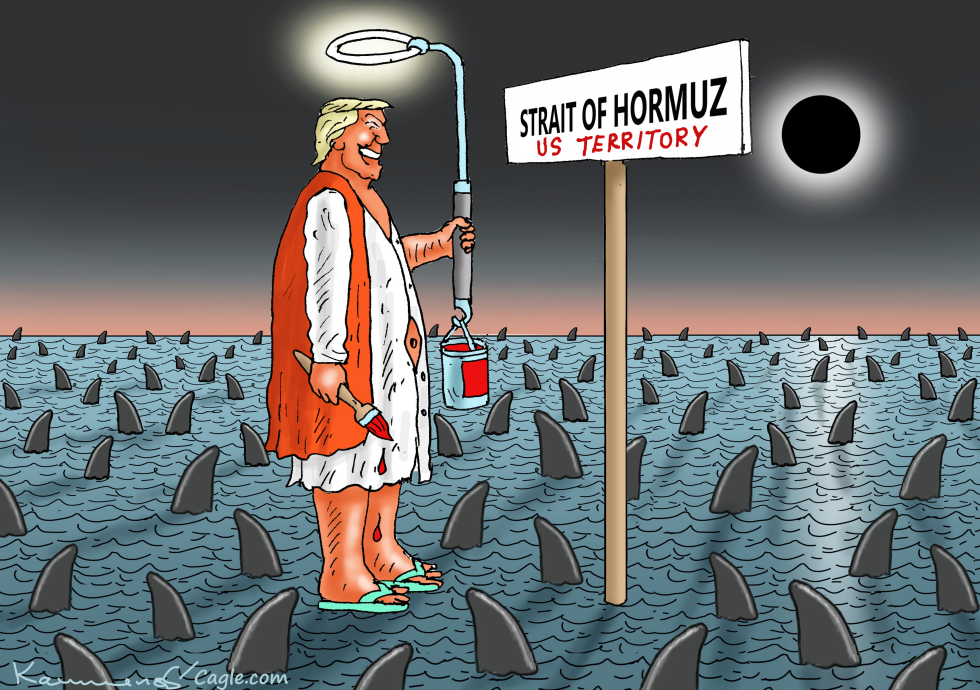
Donald Trump has asserted US sovereignty over the Strait of Hormuz, a critical waterway for global oil shipments. The move comes amid ongoing friction with Iran and other regional actors over navigation rights and energy security. Such a claim challenges established international maritime law and risks escalating tensions with multiple nations that rely on the passage. The editorial takes the position that the assertion is reckless and ignores the practical dangers and diplomatic fallout involved.
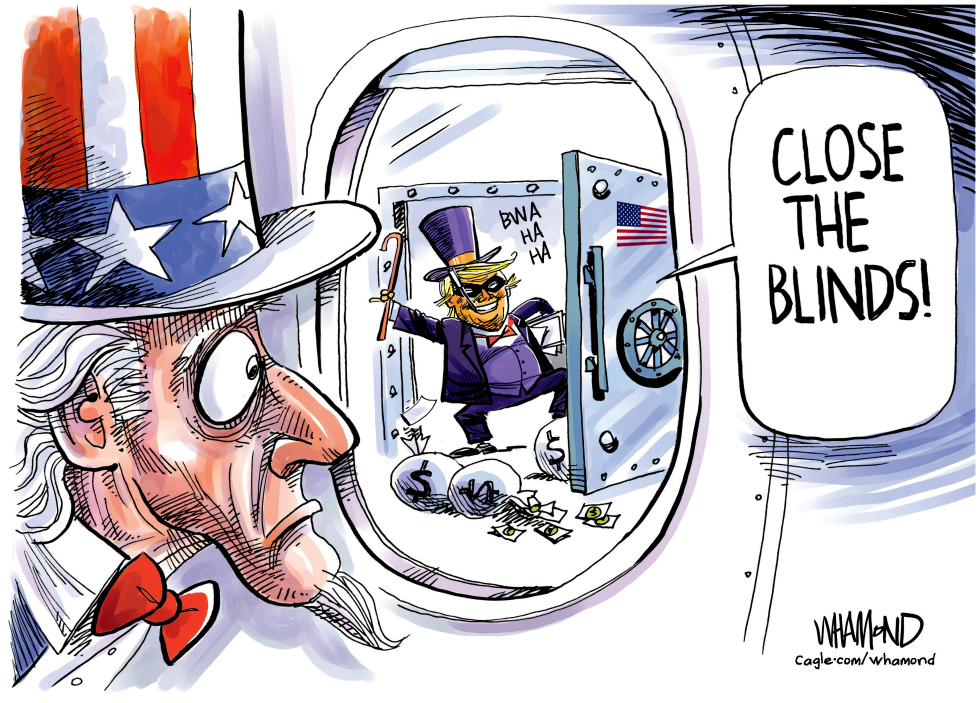
Donald Trump appears inside an open government vault surrounded by spilling money bags and orders the blinds closed. The scene highlights concerns over financial secrecy and lack of transparency in high office. The piece takes the position that such actions undermine public trust in how funds are handled.
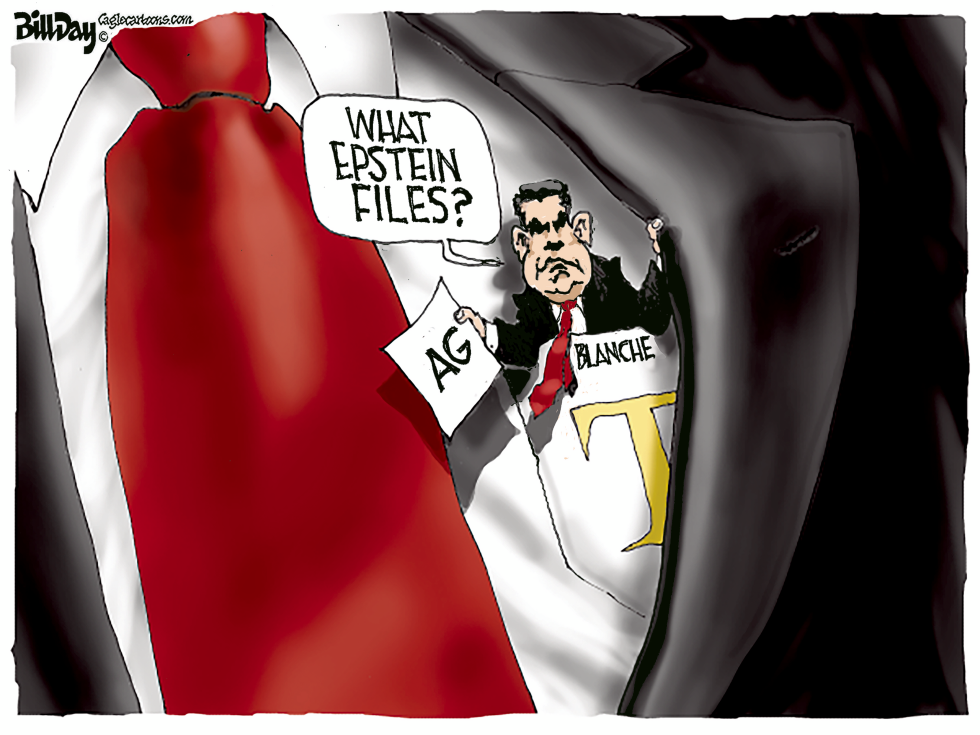
Todd Blanche, serving as attorney general in the Trump-aligned administration, has raised questions about the handling of Jeffrey Epstein-related files. The inquiry comes as legal and political scrutiny intensifies over past associations and document access. The piece portrays the questioning as occurring in close proximity to Trump symbols and influence.
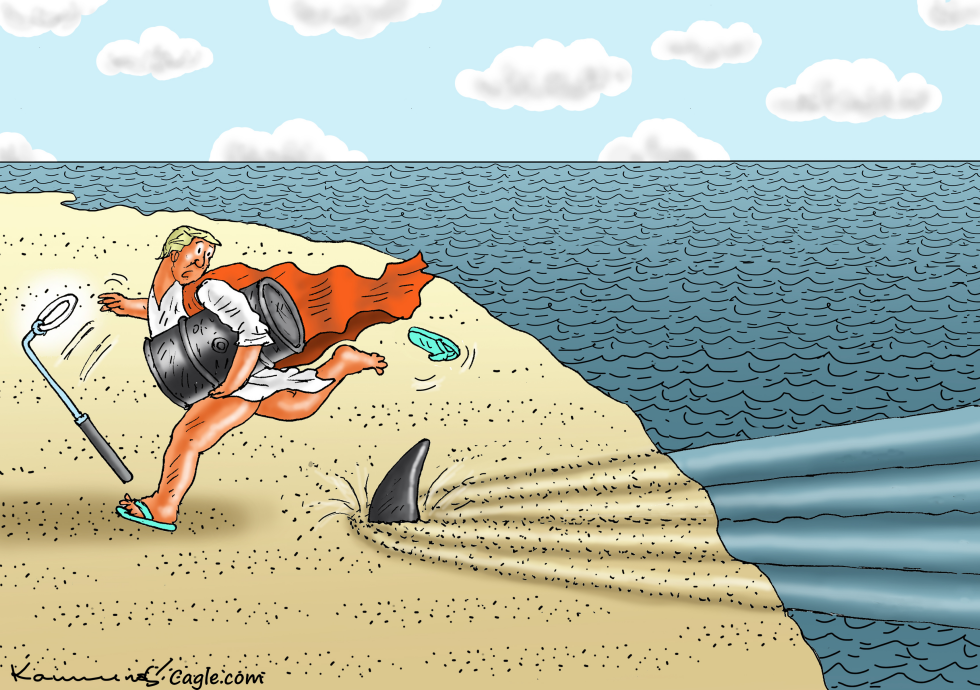
Donald Trump appears in a beach scene fleeing an emerging shark fin while equipped with a metal detector and a large barrel. The image captures him mid-stride with a flowing cape and one flip-flop airborne. No specific verifiable news event from the days before August 14 2026 ties directly to this depiction. The piece frames an ongoing dynamic of public scrutiny around the former president through exaggerated personal peril imagery.
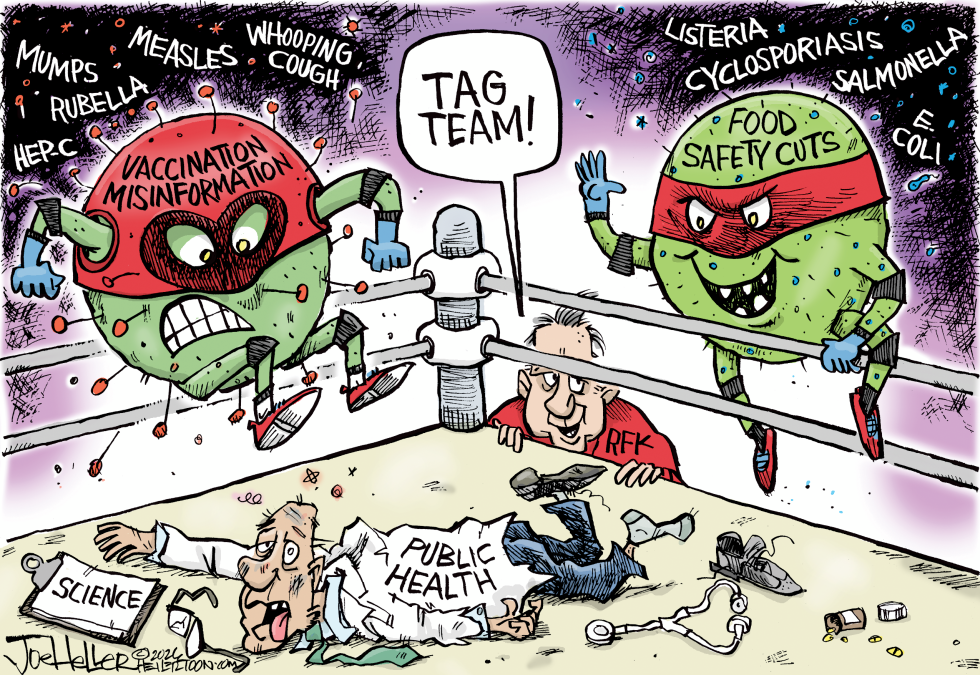
Robert F. Kennedy Jr., serving as a senior health official in 2026, has promoted vaccine skepticism and supported reductions in food safety oversight. These positions coincide with rising cases of preventable diseases and foodborne illnesses. The developments raise concerns about weakened federal protections for public health. The cartoon depicts these elements as a coordinated assault that leaves core safeguards defeated.
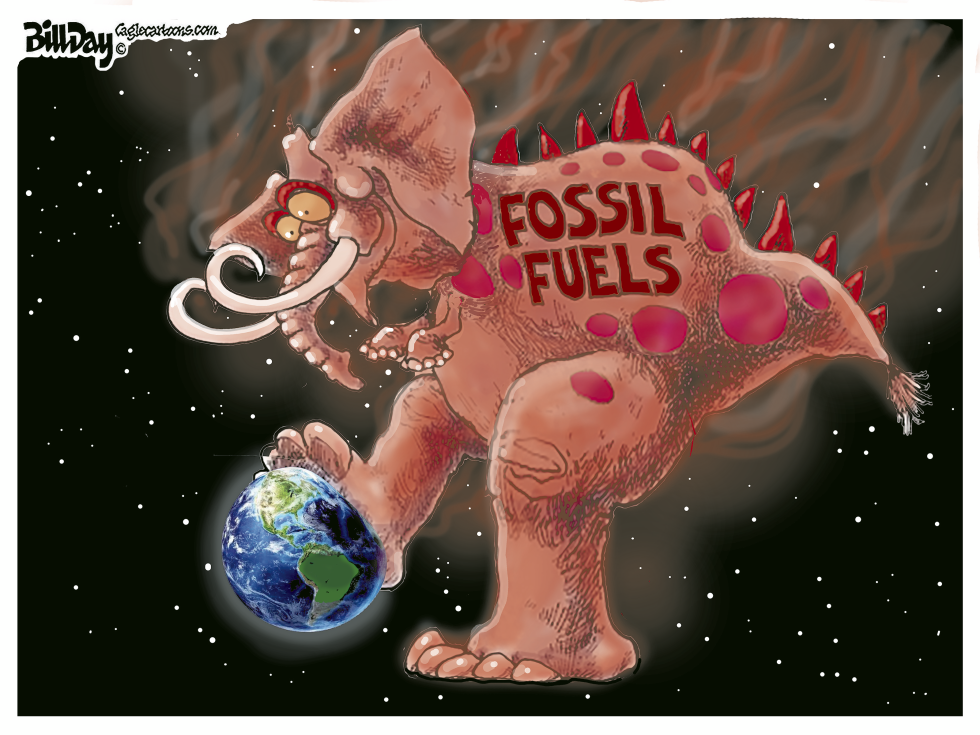
Fossil fuel dependence continues to drive global emissions and accelerate planetary warming. The ongoing reliance on oil, coal and gas extraction sustains economic activity but heightens risks of extreme weather and ecosystem collapse. The piece frames fossil fuels as an oversized destructive force that endangers the planet's future.
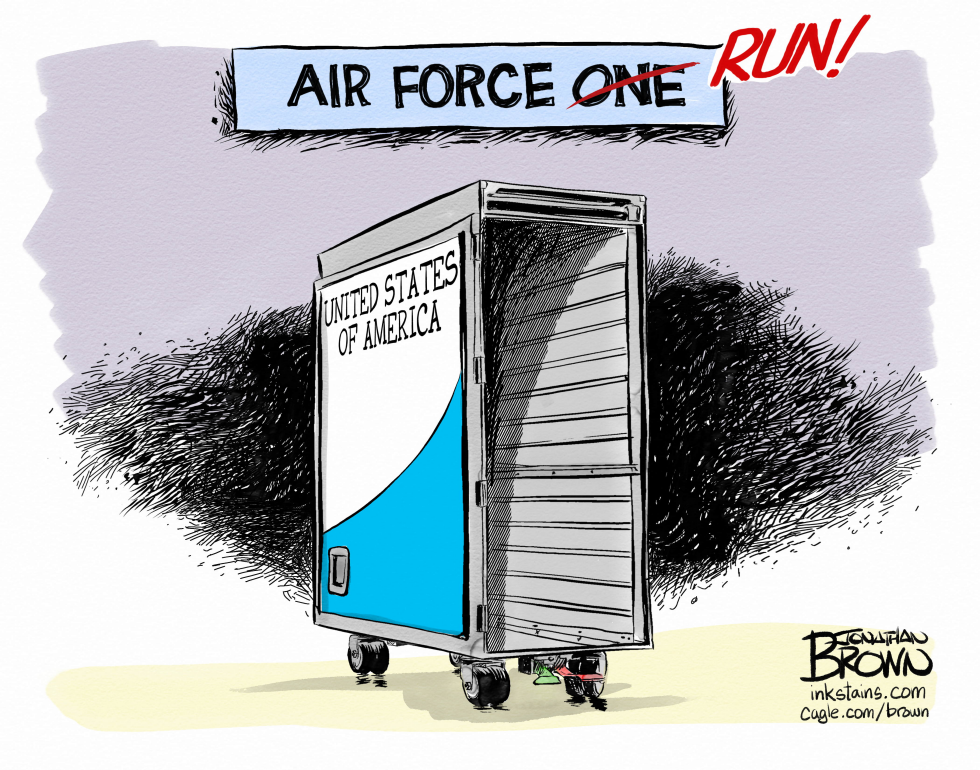
A wheeled airline catering cart occupies the center of the frame, painted in the livery of the presidential aircraft: white upper body, curved blue lower panel, and UNITED STATES OF AMERICA lettered down the side. Its full height door hangs open on empty wire shelving. Above it a pale blue placard reads AIR FORCE ONE, with ONE struck through in red and RUN! added beside that word in the same color. Two neckties poke out from between the casters underneath, one of them the long red tie Donald Trump is known for, the only trace of the men folded up inside. The drawing responds to reports that Trump sheltered in an airline galley cart against an assassination threat traced to Iran, turning the most recognizable branding in presidential aviation into an instruction to flee. Jonathan Brown signed the lower right corner alongside inkstains.com and Cagle.com/brown.
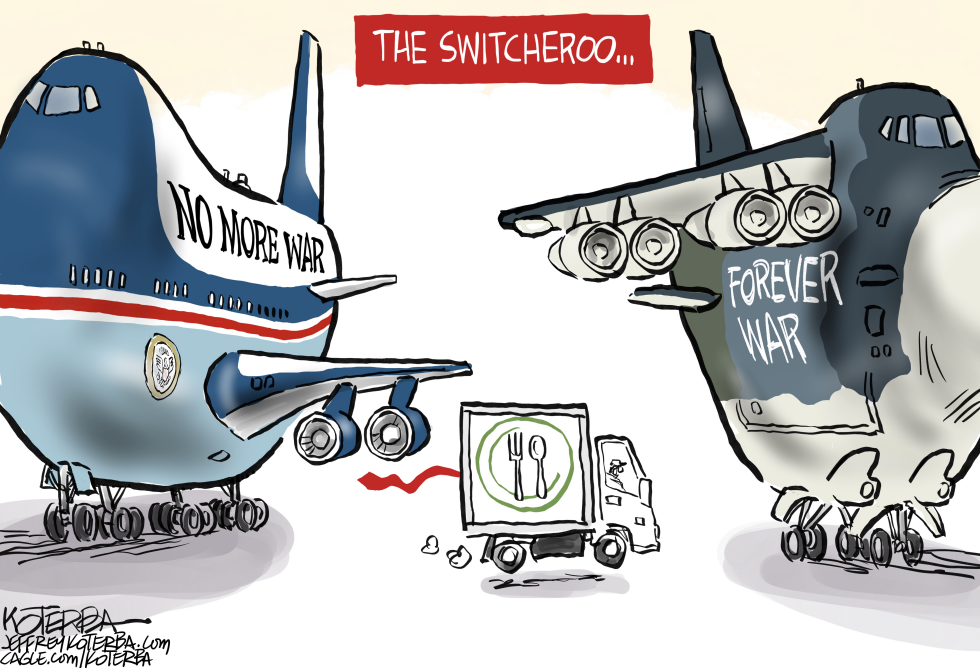
A political shift in military posture draws attention as commitments move from ending wars to sustaining them indefinitely. The editorial critiques the reversal as a cynical about-face on foreign engagements.
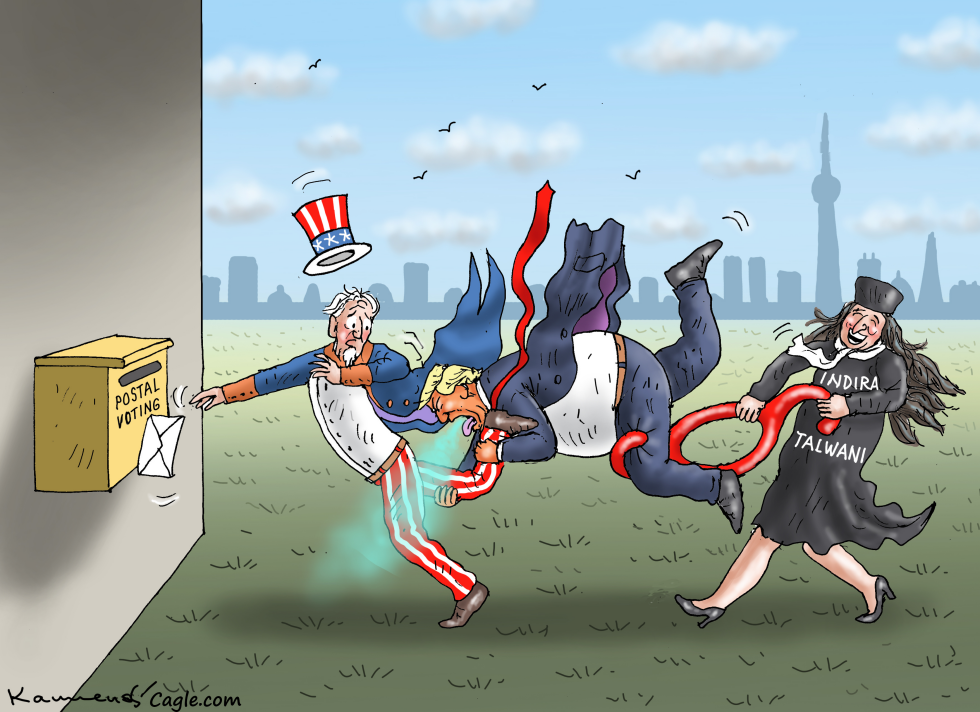
U.S. District Judge Indira Talwani issued a ruling blocking expanded postal voting measures sought by former President Donald Trump in a key election case. The decision highlights ongoing legal battles over ballot access and voting procedures. The piece portrays the conflict as a direct physical struggle between the judge, Trump, and the symbol of American government.
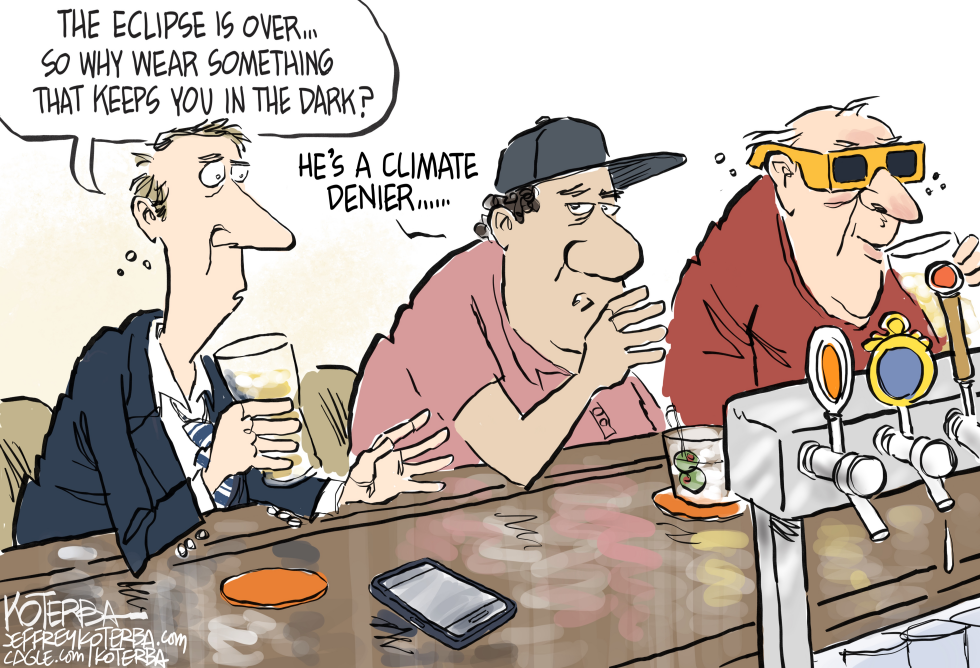
A man continues wearing eclipse glasses well after a solar eclipse passes, prompting his companions at a bar to label him a climate denier. The scene underscores how some individuals persist in rejecting established climate science despite clear evidence. The editorial position criticizes this refusal to acknowledge reality as a form of willful ignorance that hinders progress on environmental issues.
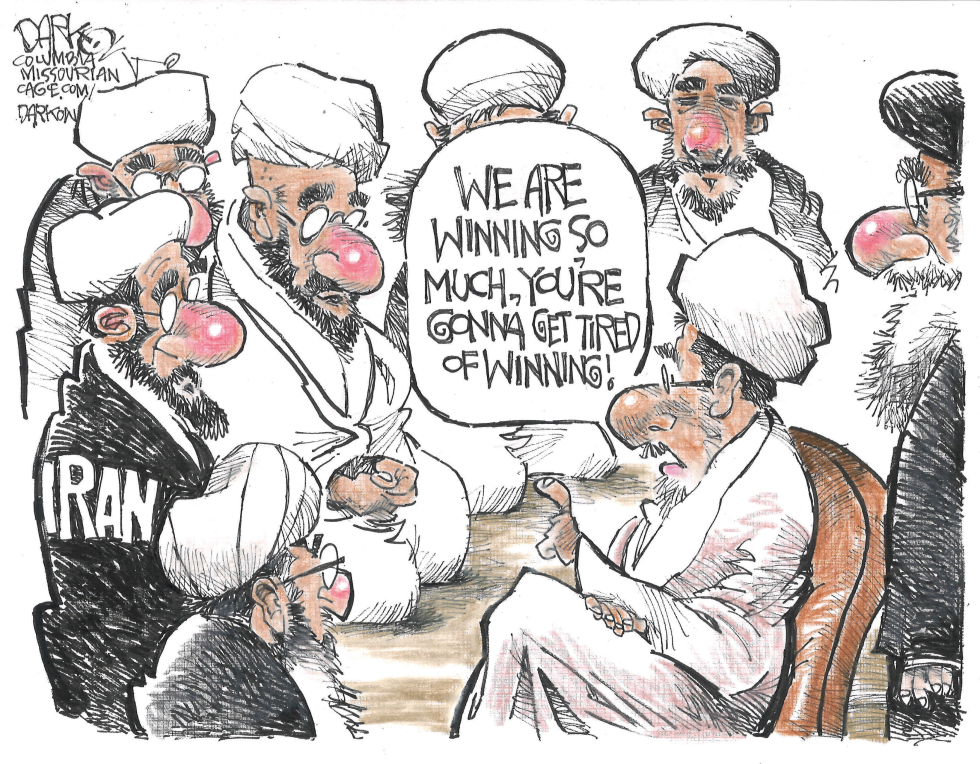
Iranian leaders have repeatedly asserted military and political successes in public statements despite international sanctions and regional conflicts. The claims come as the country navigates tensions with Western powers and neighbors over nuclear issues and proxy activities. Such messaging aims to project strength to domestic audiences. The piece portrays these assertions as overstated and tiresome, drawing a parallel to familiar political rhetoric to underscore their lack of credibility.