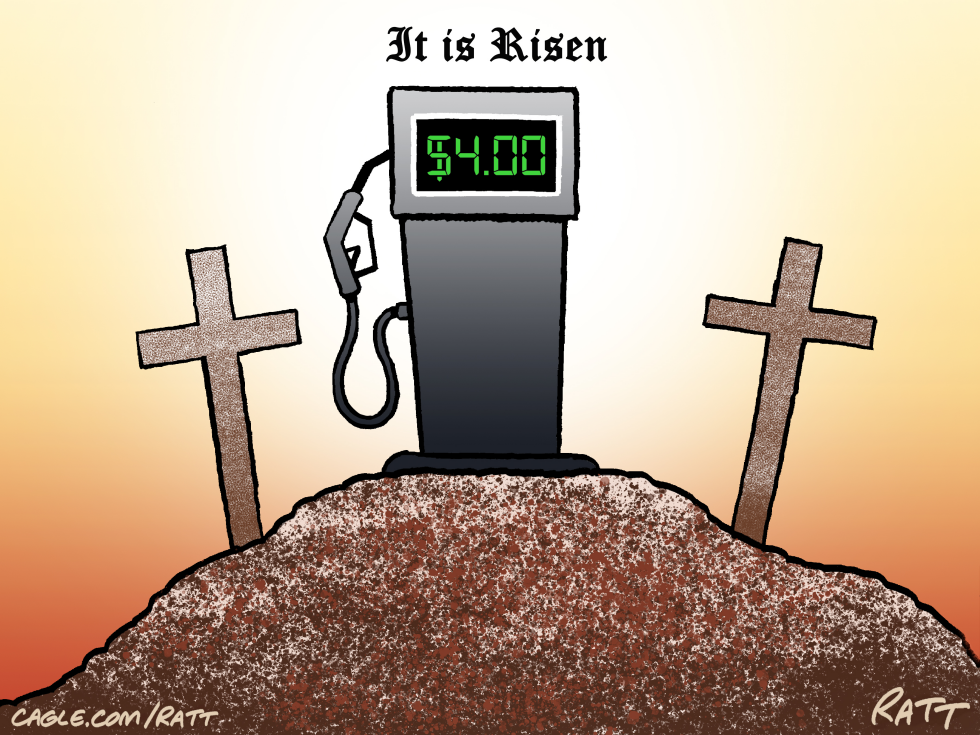
Ratt's cartoon captures Easter in America 2026 with a gas pump standing in for the central cross on a Calvary hill, showing $4.00 on its display and the text 'It is Risen' above, playing on rising gas prices. Tags like Easter, gas prices, oil, Iran war, and Strait of Hormuz suggest a future where geopolitical tensions drive fuel costs skyward. The artwork uses simple lines and a sunset background to evoke the biblical scene, but replaces resurrection with economic pain. This satire highlights how global events, including potential conflicts in the Strait of Hormuz, could lead to exorbitant oil prices by 2026. The dry humor underscores American dependence on foreign oil, making the cartoon timely and shareable amid ongoing energy debates.
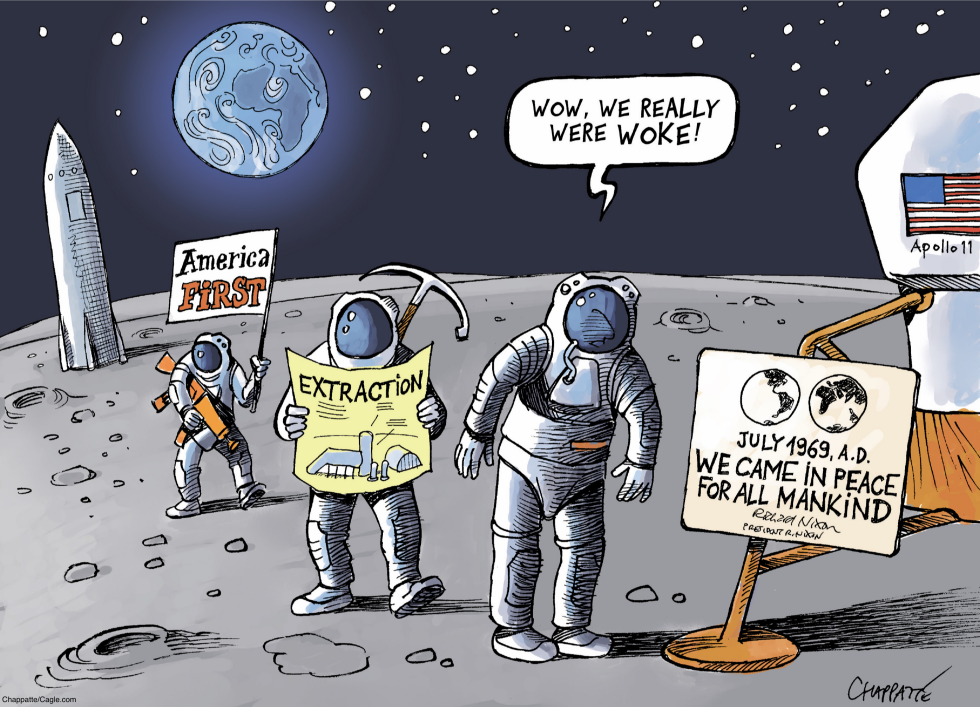
The cartoon shows three astronauts on the moon\\\\\\\'s surface, with Earth visible in the background. One holds a sign reading America First while carrying a weapon, another grips a document titled Extraction with a mining diagram, and the third wields a pickaxe next to a plaque stating We came in peace for all mankind from July 1969 A.D. near the Apollo 11 lander flagged with the US stars and stripes. A speech bubble declares Wow, we really were woke! The scene captures space race satire, lunar exploration humor, political cartoon commentary on shifting priorities from global peace to nationalistic resource grabs, all in Patrick Chappatte\\\\\\\'s style.
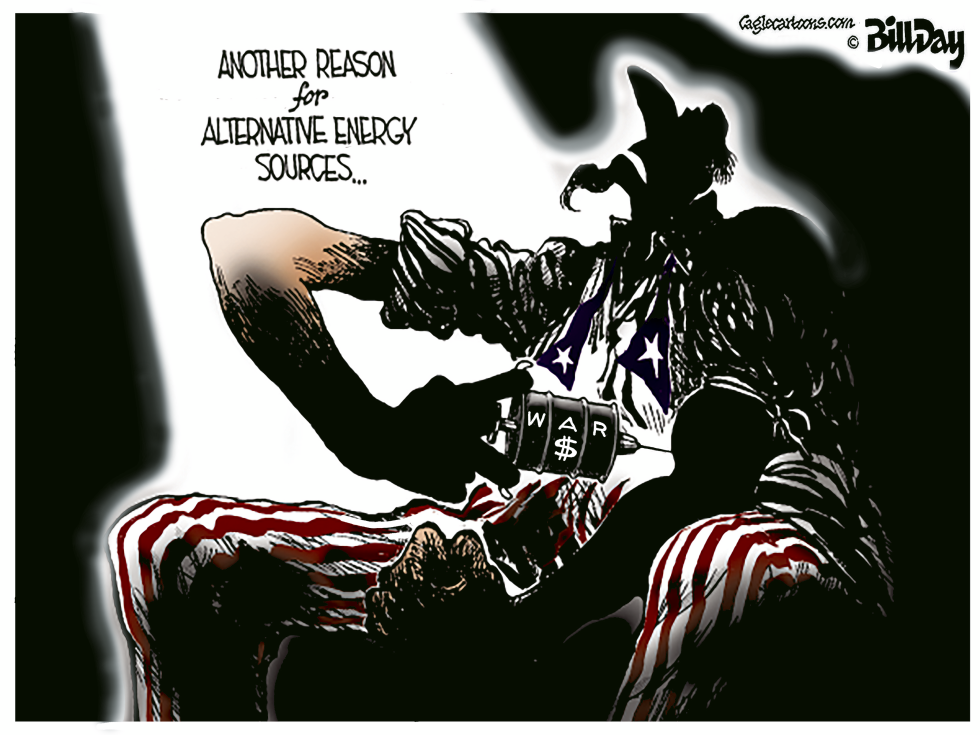
Bill Day's cartoon shows a figure in red-and-white stripes, resembling national colors, self-injecting a syringe marked 'WAR' and '$', with text pleading for alternative energy sources. The dark, shadowy style underscores the grim addiction to oil, tying into tags like war, oil prices, Gulf of Hormuz, global warming, climate change, and addiction. This visual metaphor pushes for wind energy and solar panels as escapes from the cycle of dependency that leads to conflict and environmental harm. The composition is stark, with the arm and syringe dominating, emphasizing the self-destructive habit amid calls for renewable shifts.
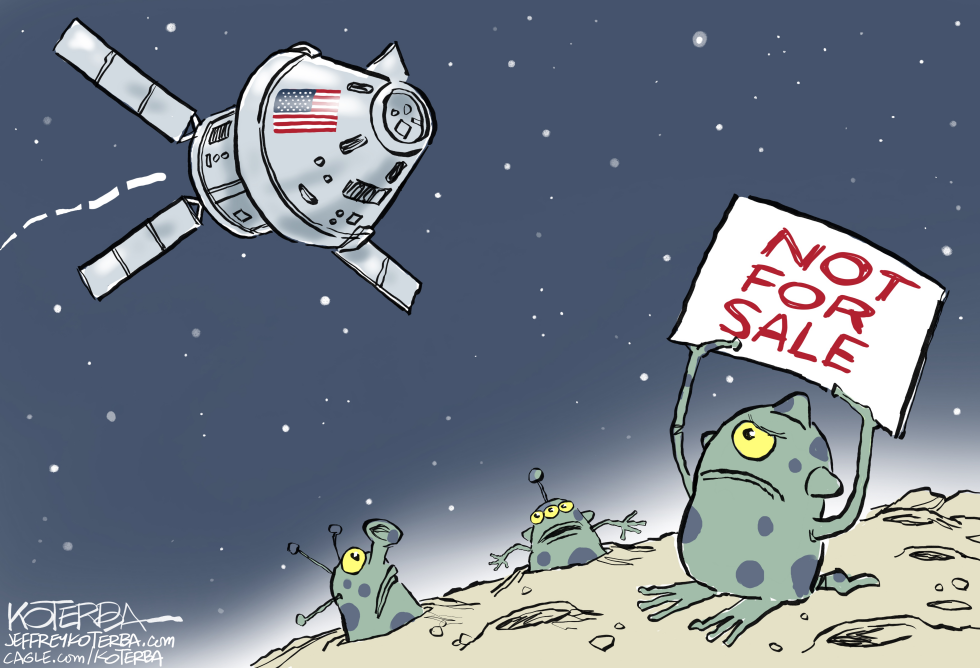
This political cartoon depicts green aliens on a sandy, moon-like surface, with one holding a \'NOT FOR SALE\' sign in red letters, facing a flying spacecraft adorned with an American flag and solar panels. The starry night sky background enhances the space exploration satire, while the trail behind the ship suggests approach. Incorporating elements like cartoon monsters, property rights protest, and US imperialism humor, the image offers an irreverent take on cosmic real estate. The artist\'s signature in the bottom left adds authenticity to this insightful editorial illustration, poking fun at human ambitions in outer space.
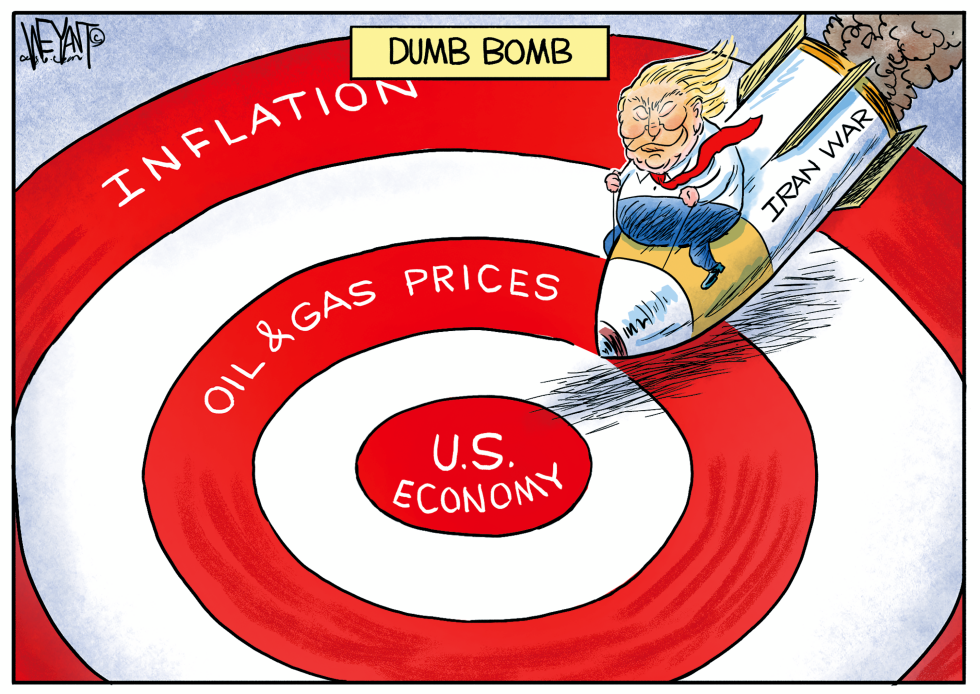
Christopher Weyant's cartoon shows a Donald Trump caricature astride a 'Dumb Bomb' labeled 'Iran War,' plummeting toward a red-and-white bullseye. The target's rings are inscribed with 'Inflation,' 'Oil & Gas Prices,' and at the center, 'U.S. Economy.' This setup highlights concerns over foreign policy decisions affecting domestic finances. The dry humor underscores the risks of impulsive actions in international affairs, with Trump's windswept hair and determined expression adding to the satirical edge. Tags like political cartoon, Trump Iran war, US economy satire, inflation oil prices, dumb bomb cartoon, and Christopher Weyant emphasize the image's relevance to current events.
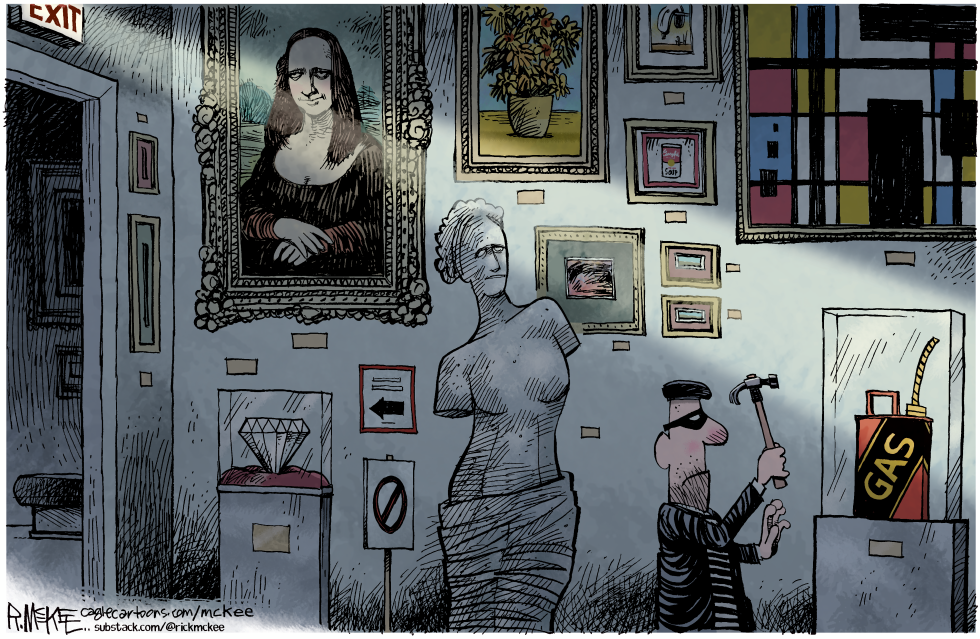
Rick McKee's cartoon depicts a dimly lit museum where a striped-shirted thief, masked and wielding a hammer, targets a display case with a red gas can marked 'GAS,' overlooking iconic pieces like the Mona Lisa portrait, Venus de Milo statue, a large diamond, Van Gogh-style sunflowers painting, abstract Mondrian-like art, and smaller framed works. An 'EXIT' sign glows above, and a 'no' symbol sign hangs nearby. The scene uses tags such as Trump, war, Iran, gas prices, oil, museum to comment on how escalating fuel costs make gasoline more valuable than cultural treasures, blending humor with commentary on energy crises.
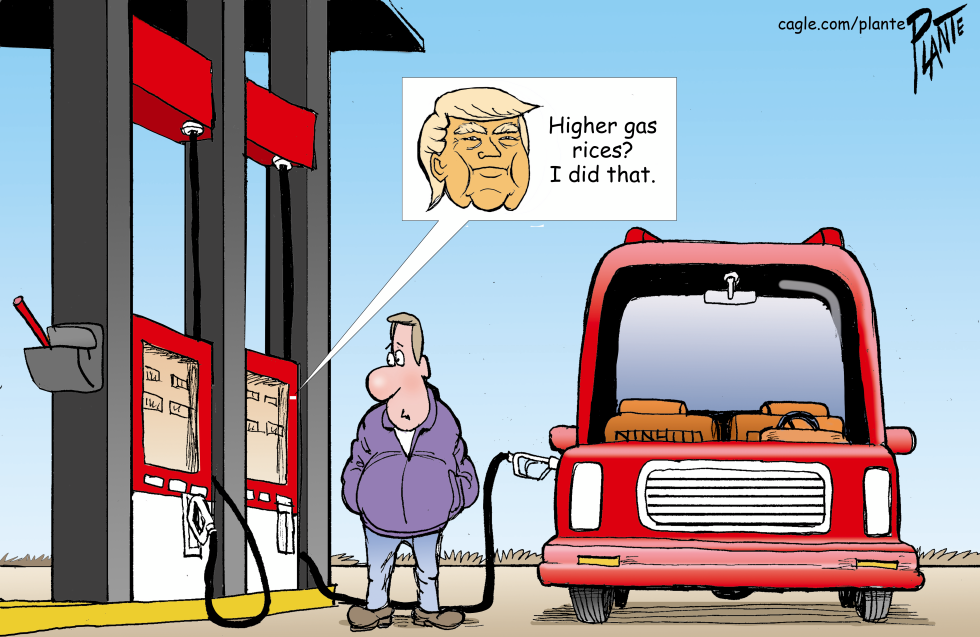
Bruce Plante's cartoon shows a gas pump topped with President Donald J. Trump's head, smirking as it says, 'Higher gas rices? I did that,' while a driver fuels his red truck. The image ties into tags like higher gas prices, war, Iran, Israel, Middle East, and energy crisis, poking at Trump's potential role in escalating fuel costs through foreign policy missteps. It's a straightforward jab, clear in its satire without overcomplicating the visuals. The dry humor lands on the absurdity of a politician claiming credit for economic pain at the pump. With tags covering UAE, Saudi Arabia, and other regional players, the cartoon nods to broader geopolitical tensions driving oil prices up. Editors see these kinds of cartoons circulate well when gas prices spike, reminding readers of the human cost in everyday routines.
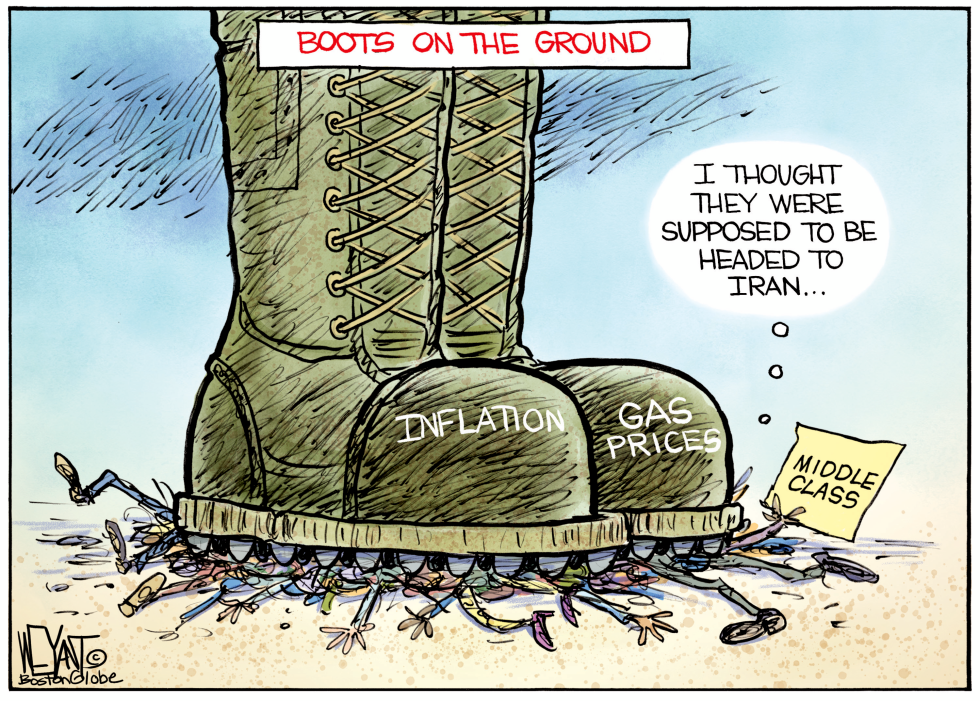
The cartoon shows a pair of massive military boots dominating the scene, one labeled 'Inflation' and the other 'Gas Prices,' as they crush small human figures on the ground, with a sign reading 'Middle Class' among them. A speech bubble from one of the crushed figures says, 'I thought they were supposed to be headed to Iran...' The title 'Boots on the Ground' sits at the top. This setup uses dry humor to highlight misplaced priorities in war, economy, inflation, gas prices, middle class, and Iran. The sandy ground and stormy sky add to the chaotic feel, tying into tags like Trump, negotiation, Strait of Hormuz, and domestic policy impacts.
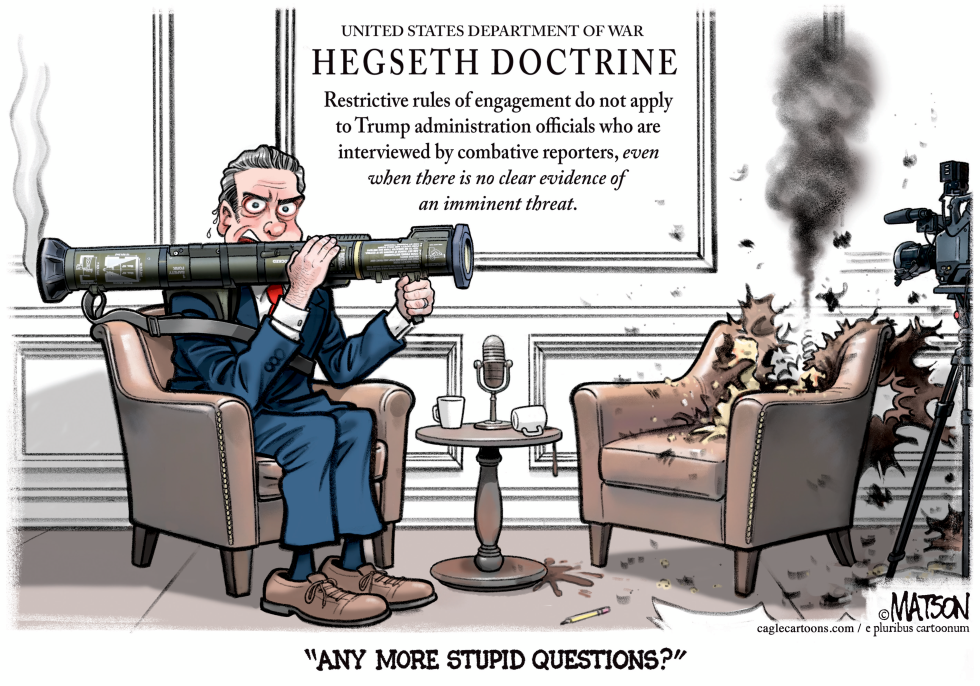
R.J. Matson's cartoon depicts a stern-faced official in a formal setting, wielding a massive rocket launcher that has just obliterated the interviewer's chair, smoke billowing from the debris. The header proclaims the 'Hegseth Doctrine' under the 'United States Department of War,' stating that restrictive rules of engagement don't apply to Trump administration officials facing combative reporters, even without clear evidence of an imminent threat. The official snarls, 'Any more stupid questions?' as a camera topples amid the chaos. This setup skewers the notion of overreactive defenses in political interviews, blending dry humor with sharp commentary on media relations. Tags like Hegseth Doctrine, Trump administration satire, press interview violence, combative reporters parody, imminent threat joke, and political cartoon Matson capture the essence of this visually punchy critique.
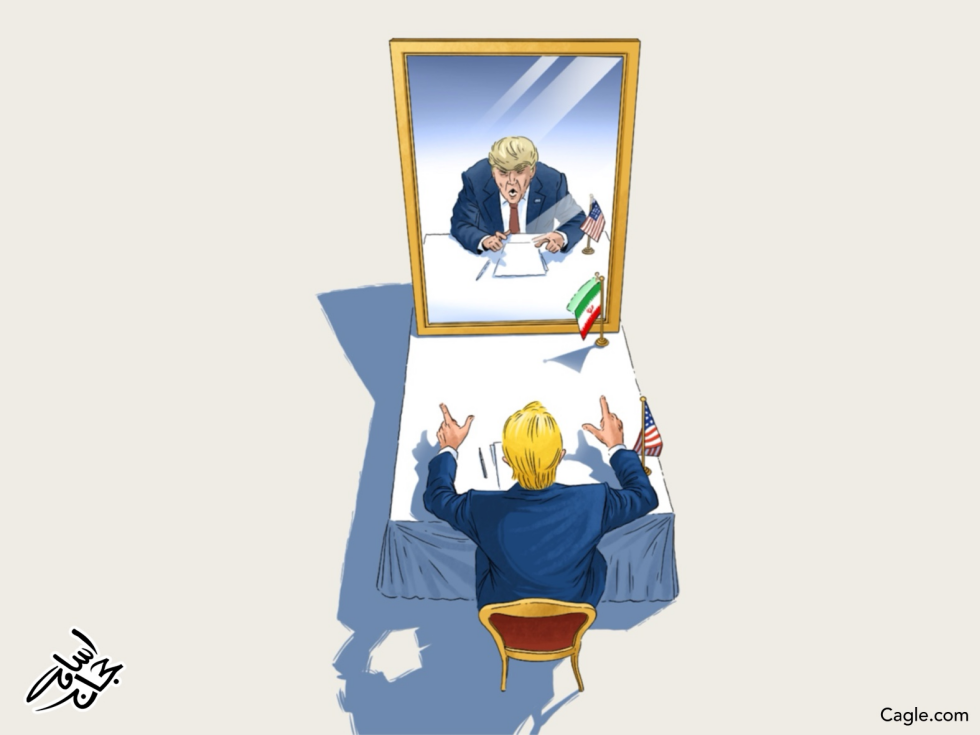
This humorous political cartoon depicts a figure with distinctive yellow hair and a blue suit seated at a table, pointing accusingly at a large mirror. In the reflection, an identical figure points back, but with an Iran flag instead of the US flag beside him. The setup cleverly satirizes self-negotiation or internal conflict in international relations, using mirror imagery for ironic effect. Elements like the pointing fingers, national flags, and desk setup emphasize bilateral tensions. As a satirical piece from Cagle.com, it offers insightful commentary on diplomatic absurdities, blending humor with political critique in a visually striking composition.
Bruce Plante's cartoon depicts a typical American driver at a gas station, his purple car parked under the canopy, as he reacts with censored profanity to a coin-operated viewer. The sign reads 'TO SEE GAS PRICES DEPOSIT 25¢,' cleverly satirizing how #HighGasPrices have soared beyond easy visibility, like distant sights needing magnification. The man's USA shirt and coffee cup add a relatable everyman touch, emphasizing consumer shock. This piece fits into ongoing #FuelCosts debates, blending #InflationHumor with #EconomicSatire. Plante's style, straightforward and punchy, targets #EnergyPrices and their impact on daily life, making it shareable for #PoliticalCartoons enthusiasts. The dry humor underscores the absurdity without overstatement, a hallmark of syndicated work.
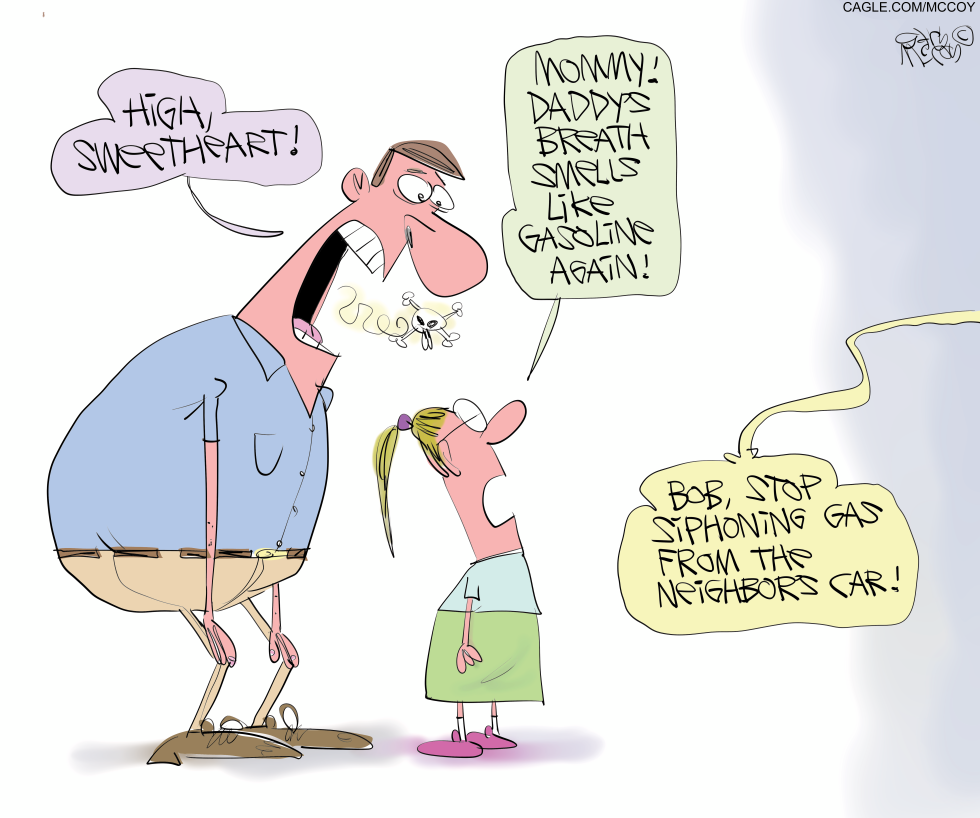
Gary McCoy nails the absurdity of high gas prices in this political cartoon where a dad's breath smells like gasoline after siphoning from the neighbor's car. The daughter's complaint to mommy and the wife's scolding of Bob bring dry humor to economic hardship. Satire on fuel costs and inflation hits home, showing family reactions to desperate measures. Theft due to rising expenses gets a witty twist, making the cartoon sharable amid 2026 gas crisis talks. Cartoonists like McCoy keep it real with straightforward jabs at everyday struggles.
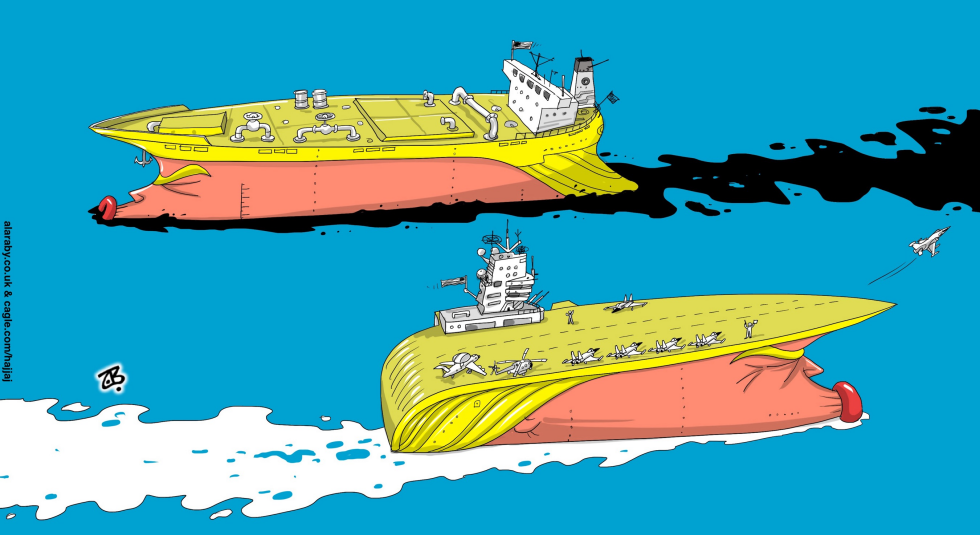
This political cartoon features two yellow vessels stylized as pigs with pink undersides. The upper one, resembling a tanker, emits a black trail from its curly tail-like rear. Below, an aircraft carrier version shows deck equipment, tiny figures, and a fighter jet flying toward it, while the vessel tilts downward into white foam. The satirical illustration employs humorous cartoon elements to depict maritime mishaps, with porcine vessels highlighting absurdity in a blue background. Insightful satire underscores the leaking pig tanker and sinking pig carrier, blending editorial art with irreverent drawing for a visually striking commentary on potential disasters.
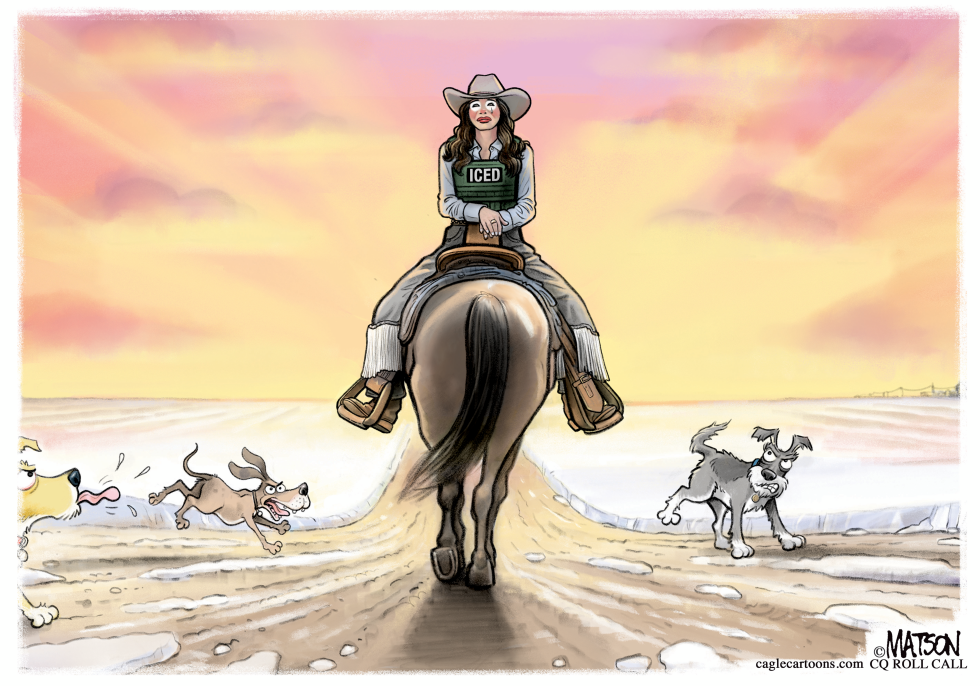
This sharp political cartoon captures an ICE agent, styled as a plucky cowgirl in a cowboy hat, galloping into a pastel sunset on her trusty horse, while a pack of frantic dogs—stand-ins for coyote smugglers—scatter in disarray. The 'ICED' vest adds a punny twist, perhaps nodding to the agency being put on ice amid heated immigration debates. With tags like political satire, border security, ICE criticism, cartoon dogs, western theme, and immigration policy, the image skewers the often chaotic world of enforcement, where even the bad guys (or dogs) get a comedic getaway. Matson's irreverent style shines through in this insightful jab at bureaucratic rodeos.
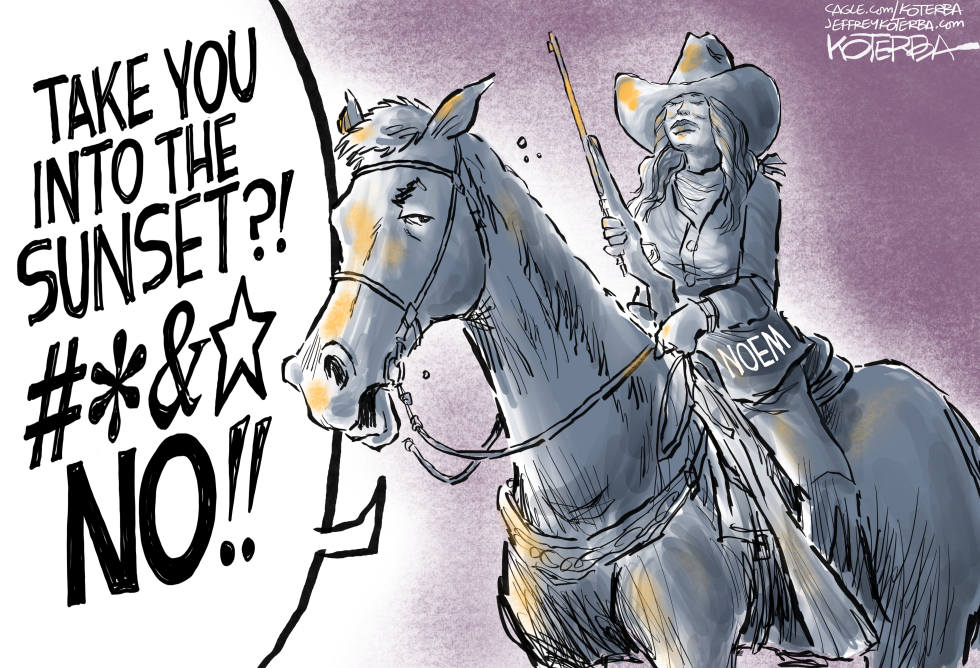
This Jeff Koterba political cartoon skewers Kristi Noem, the South Dakota governor embroiled in GOP scandal over her infamous dog-killing anecdote. Depicted as a cowgirl on a horse labeled 'NOEM,' the steed profanely refuses to 'take you into the sunset,' symbolizing the abrupt halt to her rising star in conservative politics, particularly her dashed hopes as a Trump VP pick. The humorous rejection underscores the backlash from animal cruelty revelations, blending satire with sharp commentary on Republican controversy and election humor. Viral potential lies in its irreverent take on political downfall, making it a shareable gem in American politics discourse.