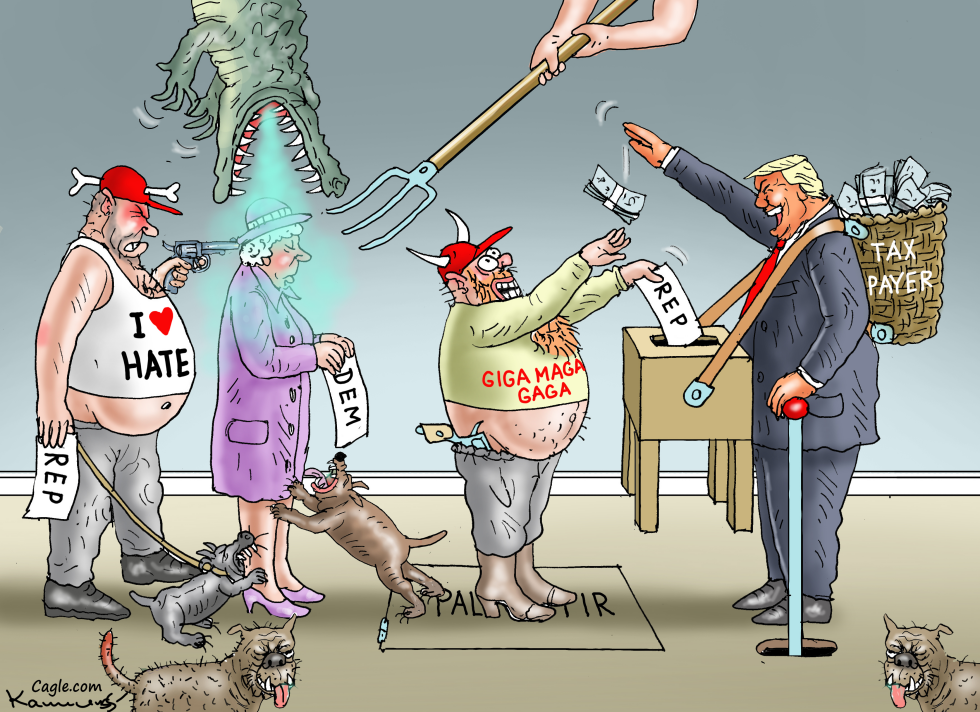
As the 2026 midterm elections approach, former President Trump has positioned himself as a central force in Republican campaigns, directing resources and mobilizing supporters. The cartoon highlights the use of taxpayer money in these efforts and the intense partisan divide, with Democrats portrayed as under attack. It takes the position that such involvement risks undermining fair electoral processes.
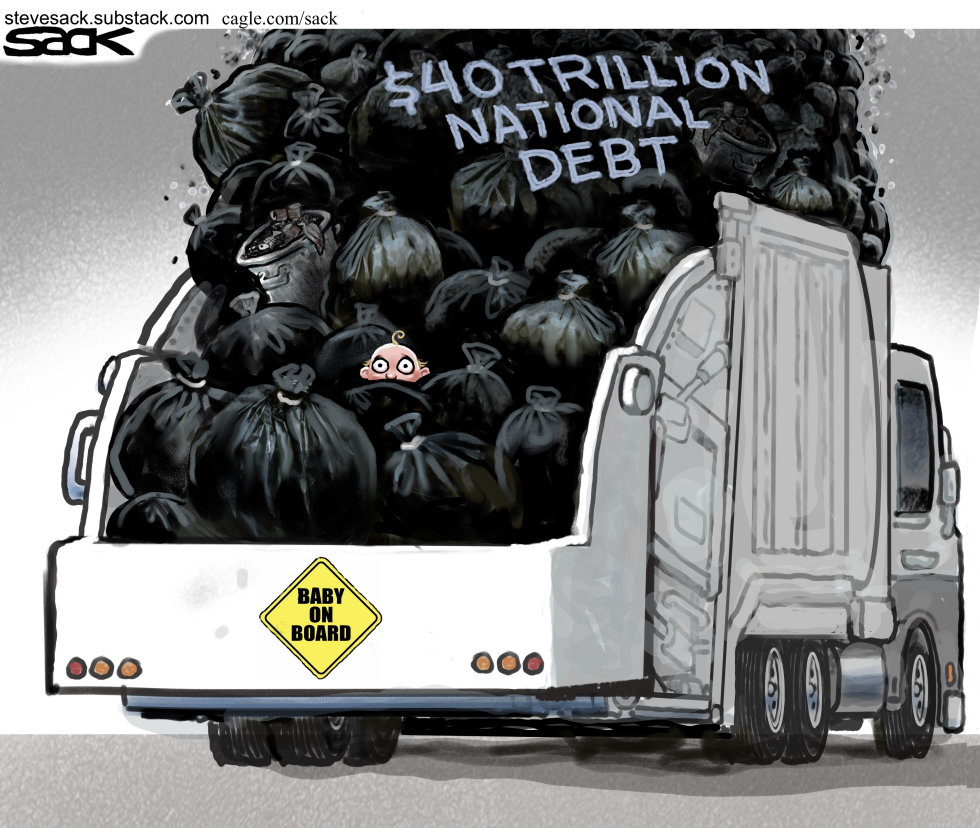
The national debt has climbed to $40 trillion amid persistent federal deficits and rising interest costs. This trajectory threatens long-term economic stability and shifts repayment burdens onto younger Americans. The cartoon argues that current fiscal policies treat future citizens as disposable, loading them into the refuse of unchecked borrowing.
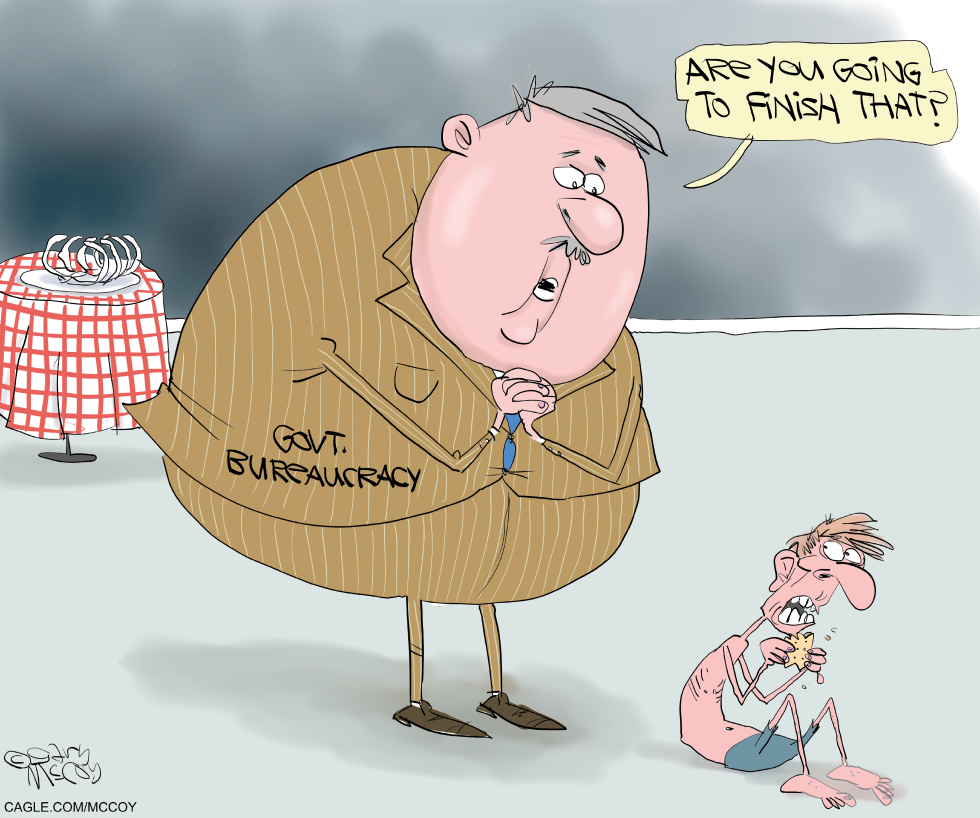
The cartoon shows an oversized man labeled Government Bureaucracy standing above a gaunt citizen who clutches a small star-shaped item. A nearby table holds only scraps. The large figure asks if the citizen plans to finish the food. The image comments on how expanding government operations can leave ordinary people with fewer resources. It uses scale and positioning to illustrate the imbalance between bureaucratic size and citizen need. The publication date places the work in a period of ongoing debate over federal spending and agency growth.
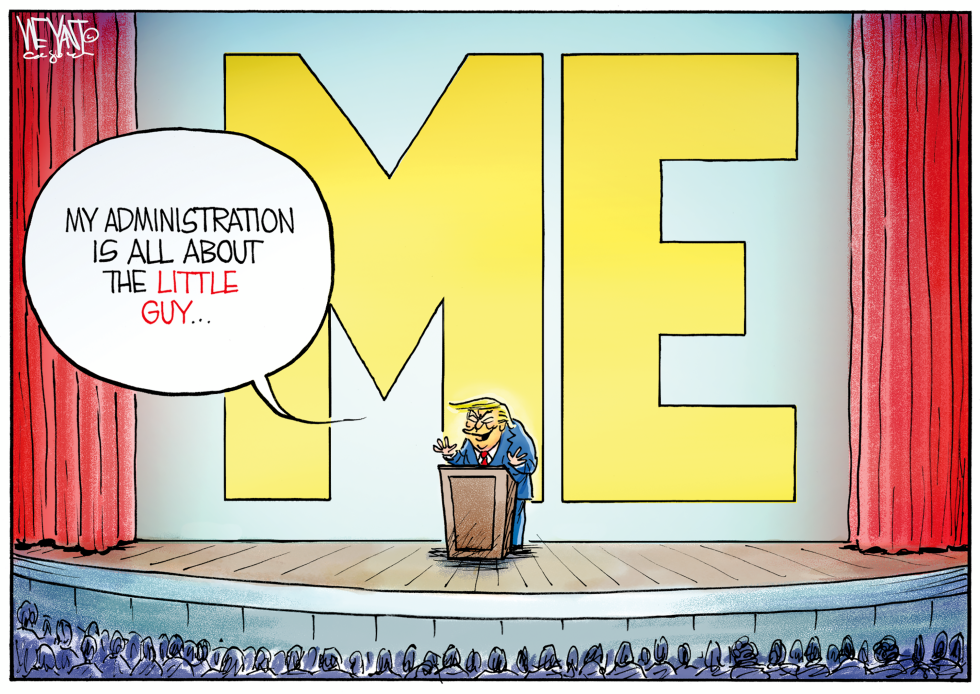
Donald Trump has repeatedly positioned his administration as champion of ordinary Americans during public addresses. The claim comes amid ongoing debates over policy priorities and personal branding in the White House. The piece portrays the rhetoric as centered on the speaker rather than the public.
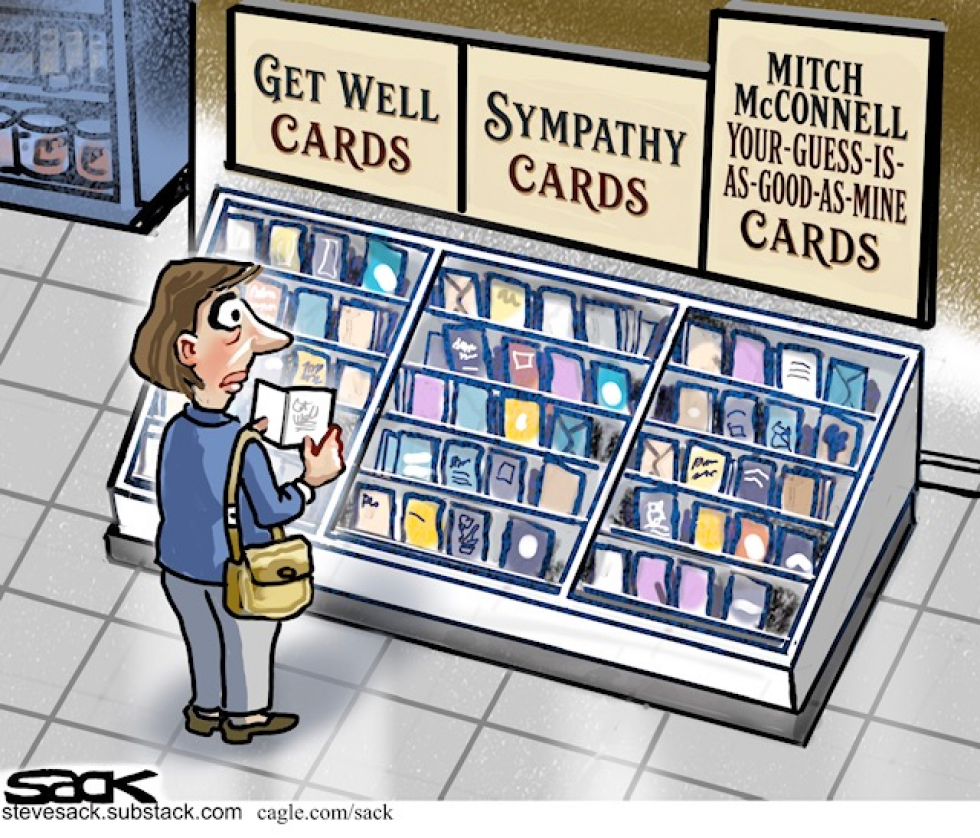
Questions about Mitch McConnell's health and future in Senate leadership have persisted into mid-2026. The Kentucky Republican has faced repeated absences and public episodes that fuel speculation about his capacity to continue. Colleagues in both parties watch closely because his position influences committee assignments and floor strategy. The uncertainty affects legislative timelines on appropriations and judicial matters. The piece argues that the situation leaves observers with little reliable information and treats the ambiguity itself as the central story.
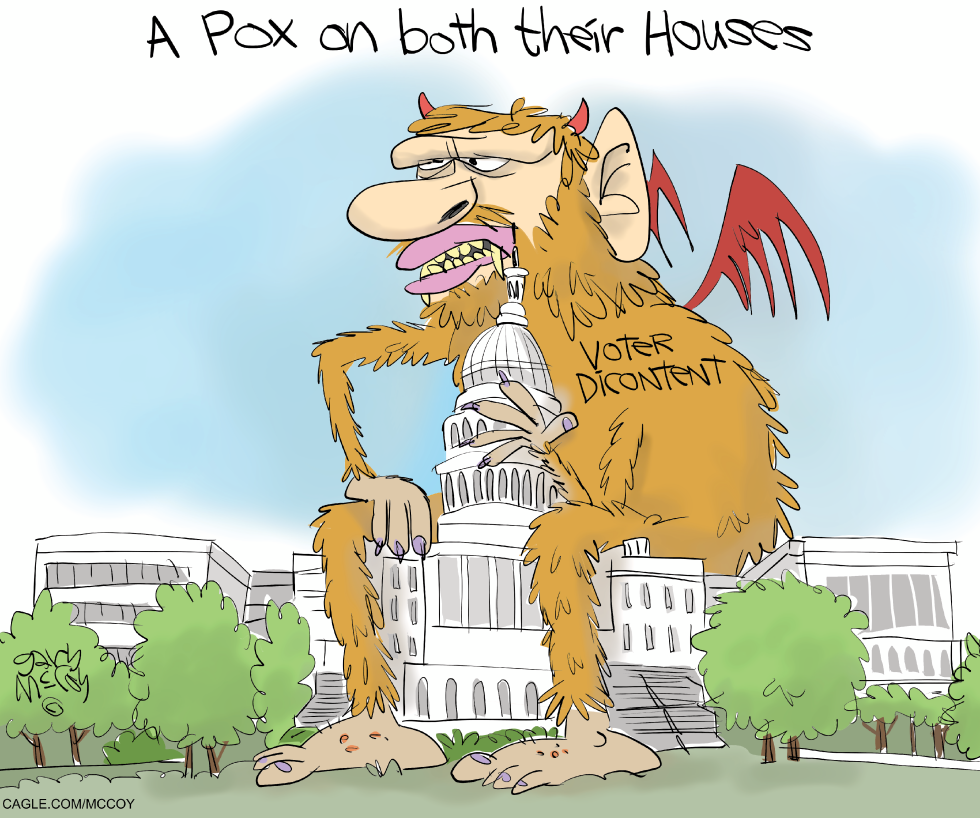
Voter frustration with Congress has grown amid stalled legislation and partisan gridlock on Capitol Hill. The piece portrays this sentiment as a towering monstrous force looming over the legislative branch. It argues that public anger targets both parties equally for failing to address key issues.
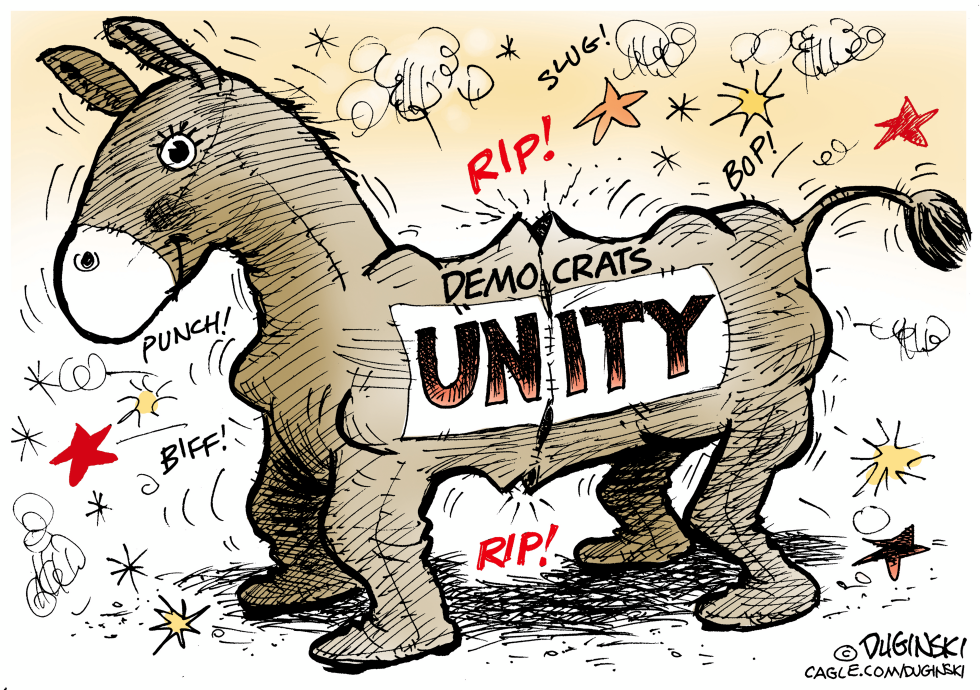
Democrats continue to display public divisions over strategy and messaging in the run-up to midterm and presidential contests. Party leaders struggle to project cohesion on issues ranging from economic policy to social priorities. The resulting perception of disarray weakens their ability to counter Republican narratives and mobilize voters. The cartoon highlights how these internal conflicts undermine the party's core message of unity.
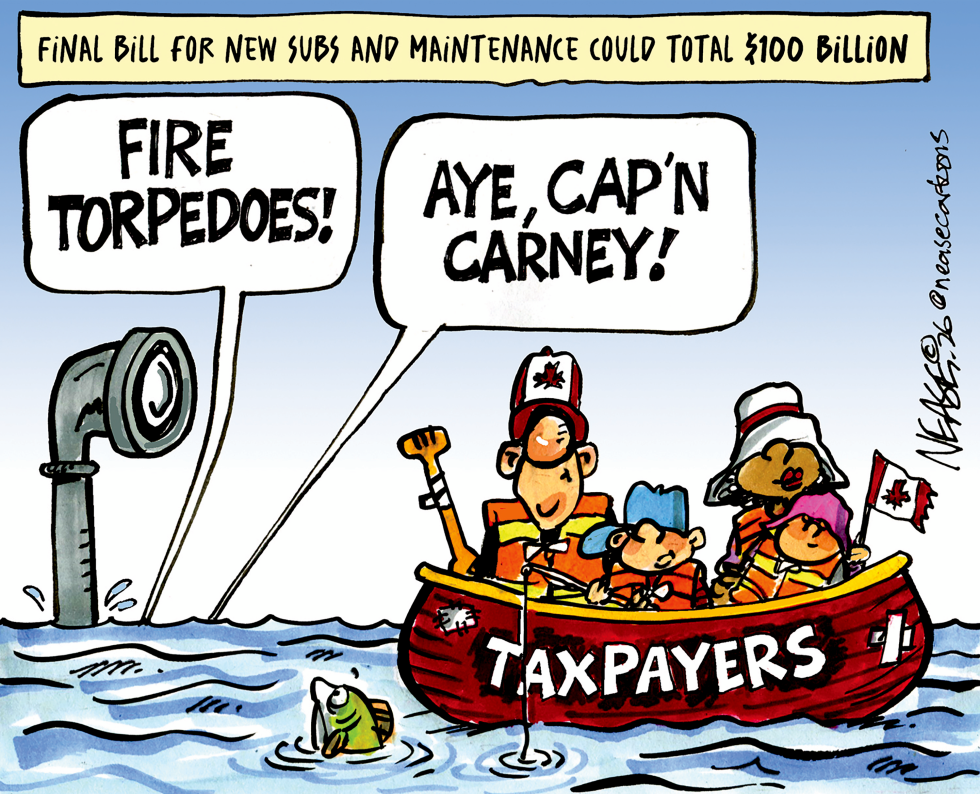
A political cartoon from July 6, 2026, shows a red boat marked TAXPAYERS carrying figures including one identified as Cap'n Carney. Speech bubbles show calls to fire torpedoes and affirm orders. A banner above warns that the final bill for new submarines and maintenance could reach $100 billion. A periscope rises from the water beside the vessel. The image highlights Canadian defense procurement costs borne by the public.
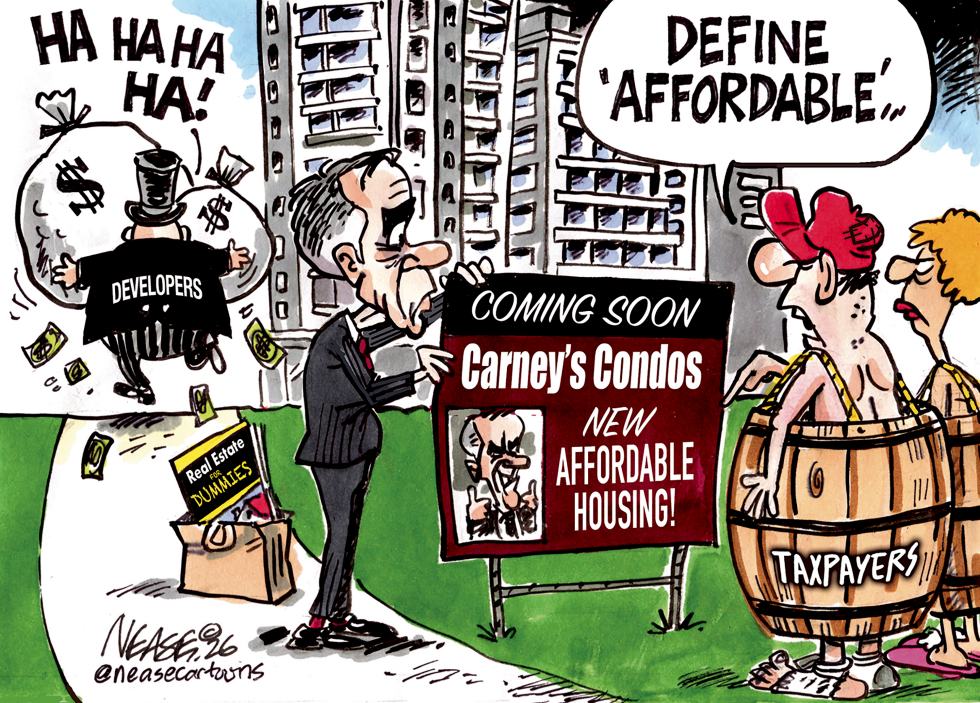
A real estate sign for Carney's Condos promotes new affordable housing. Developers in top hats collect money while laughing. Two taxpayers trapped in barrels question the definition of affordable. A book on real estate basics sits on the ground near high rise buildings.
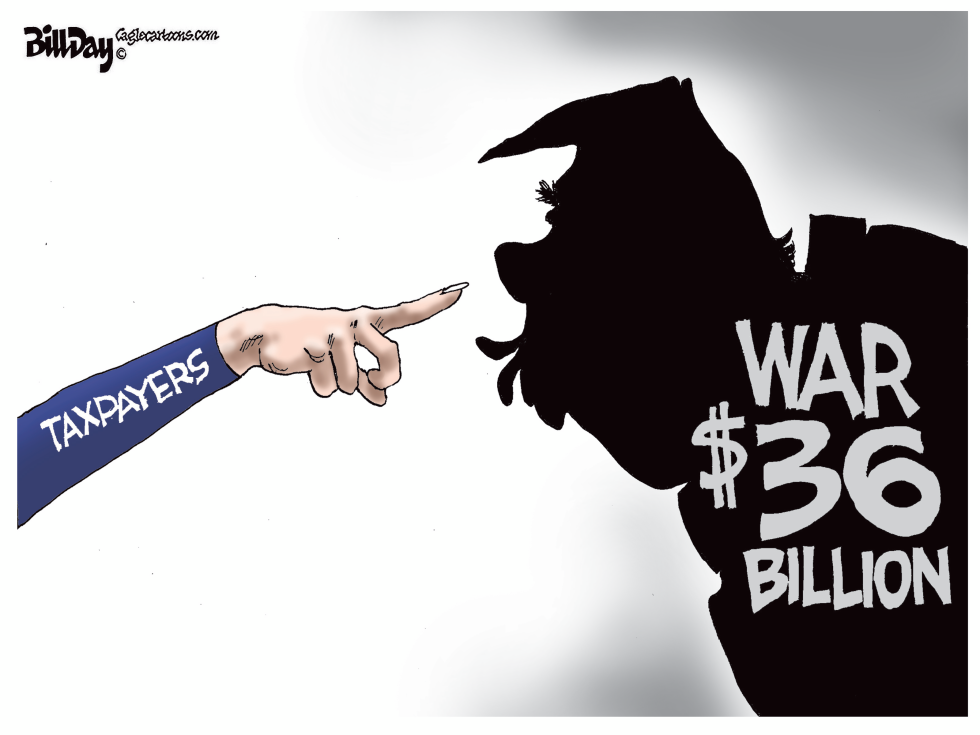
The cartoon depicts a taxpayers arm pointing directly at a dark silhouette bearing the words WAR $36 BILLION. Published on June 30 2026 the image addresses ongoing debates over military expenditures and public accountability for large scale war costs. The visual uses a simple silhouette to represent the recipient of criticism while the pointing gesture emphasizes taxpayer frustration with the scale of spending.
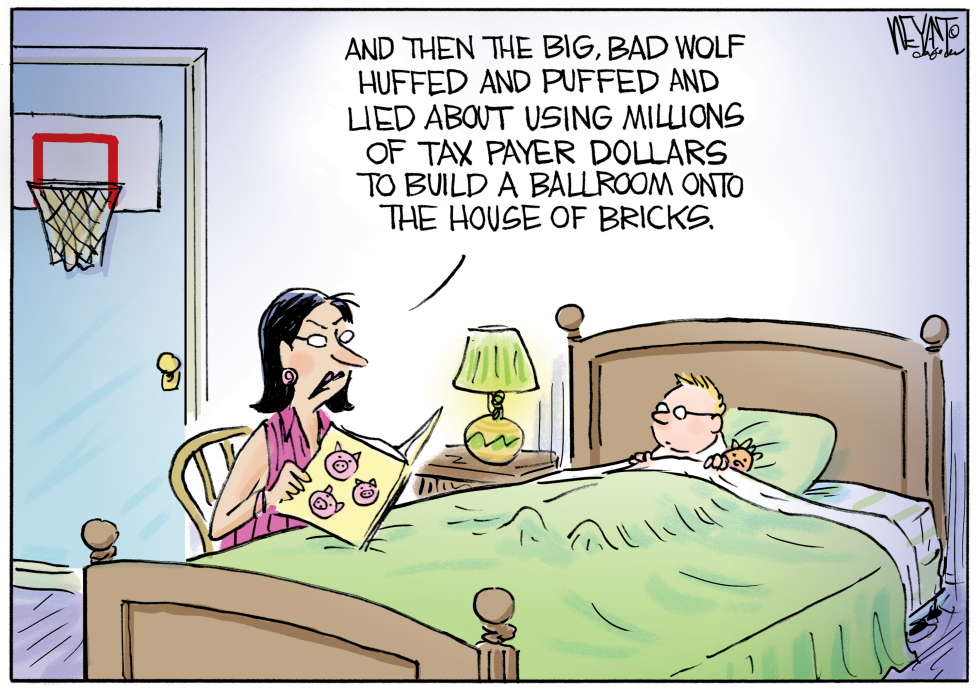
A mother reads a bedtime story to her child, altering the three little pigs tale to accuse the big bad wolf of lying about spending millions of taxpayer dollars to add a ballroom to the house of bricks. The scene unfolds in a child's bedroom with a basketball hoop visible through the door and a green lamp on the nightstand. This image responds to recent controversies over public fund misuse for private or extravagant projects by political figures.
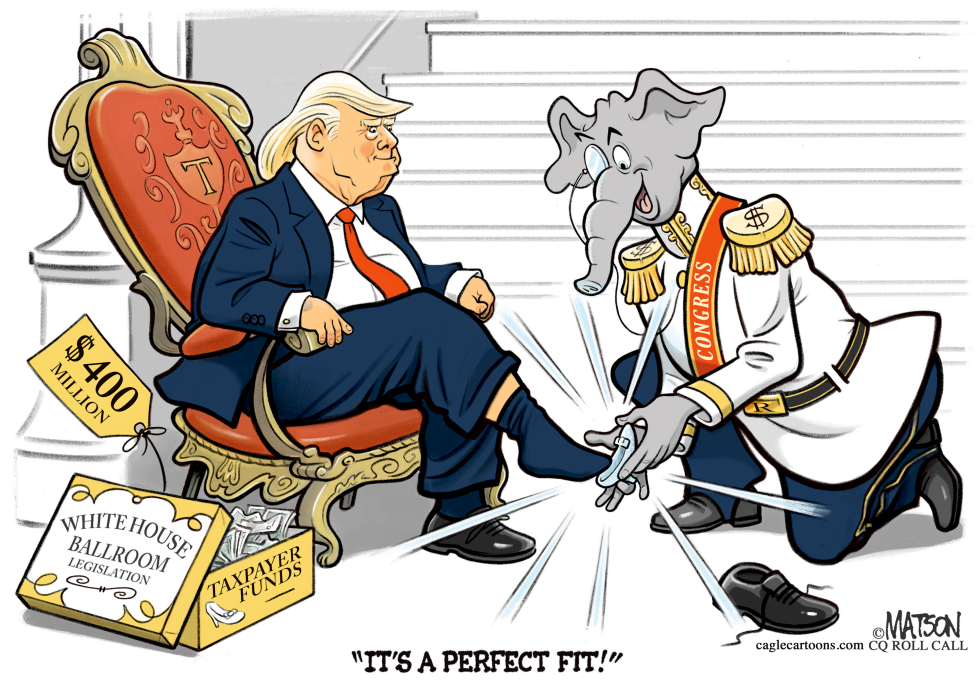
RJ Matson's cartoon depicts President Trump as Cinderella, lounging on a throne while a grinning Congress elephant, adorned with a sash and dollar-sign epaulets, slips a black shoe onto his foot, exclaiming 'It's a perfect fit!!' A box labeled 'White House Ballroom' overflows with 'Taxpayer Funds,' and a $400 million tag dangles nearby. This sharp satire targets Congressional Republicans' approval of hefty taxpayer funding for White House upgrades, echoing the fairy tale but with a political twist on government spending and Donald Trump's influence. The White House Correspondents Association Dinner at the Hilton Hotel lurks in the background tags, highlighting budget priorities amid fiscal debates.
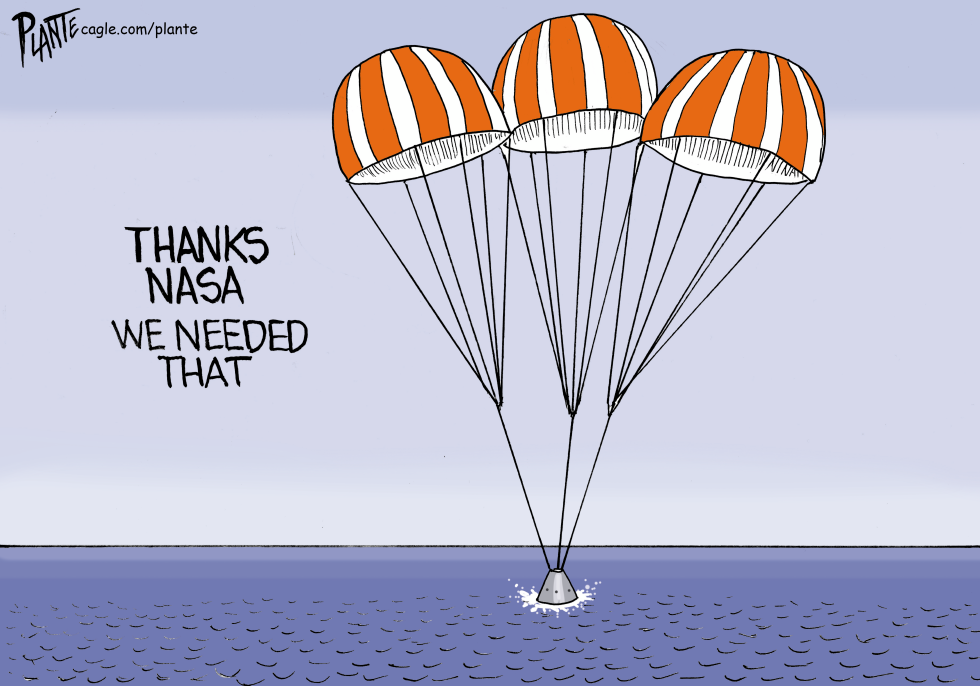
Bruce Plante\'s cartoon captures a space capsule\'s splashdown, complete with three orange and white striped parachutes guiding it to a blue ocean teeming with black fish-like forms. The prominent text \'Thanks NASA We Needed That\' adds a layer of sarcasm, typical in editorial illustrations commenting on high-profile events like the Artemis II mission. The simple composition, with a light blue sky and wavy ocean surface, emphasizes the moment of impact, shown by a small splash at the capsule\'s base. This piece fits into the tradition of political cartoons that highlight public sentiments toward government projects, using minimal elements for maximum impact. The artist\'s signature and website appear in the top left, grounding it in syndicated cartoon style.
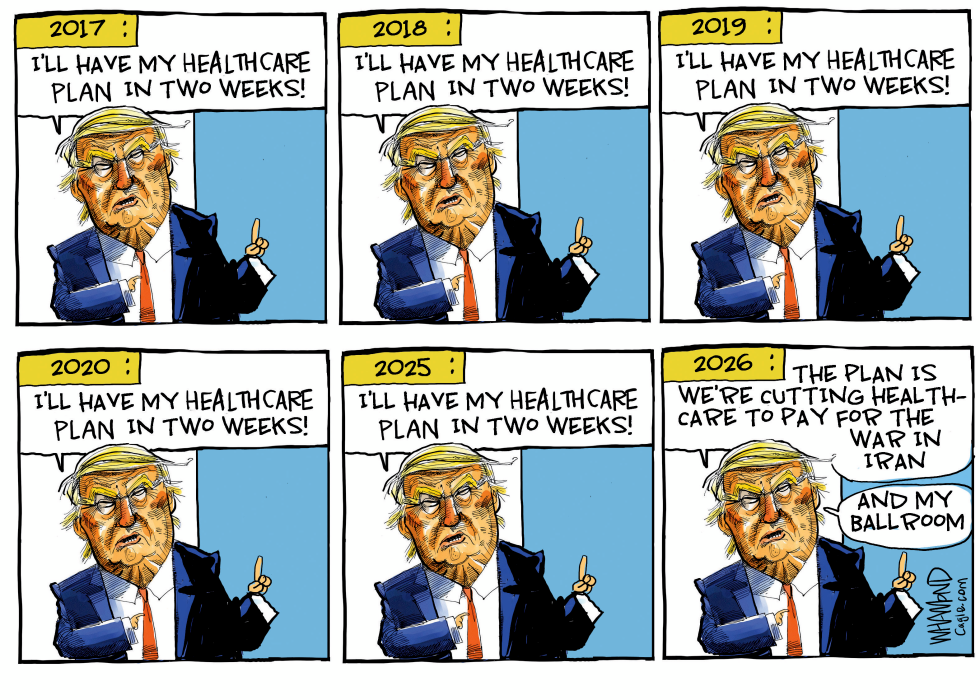
Dave Whamond's political cartoon depicts a recurring figure with distinctive blonde hair and suit, pointing emphatically while promising a healthcare plan 'in two weeks' from 2017 through 2025. The sequence builds to a 2026 punchline where the promise shifts to cutting healthcare to fund a war in Iran and a personal ballroom. This Trump healthcare plan political cartoon employs dry humor to critique endless delays and misplaced priorities. The US politics war funding criticism underscores how domestic needs like healthcare reform delay comic strip give way to military spending in this Republican healthcare policy parody. The endless two weeks promise meme captures the frustration with unfulfilled pledges in a sharp, sequential format.