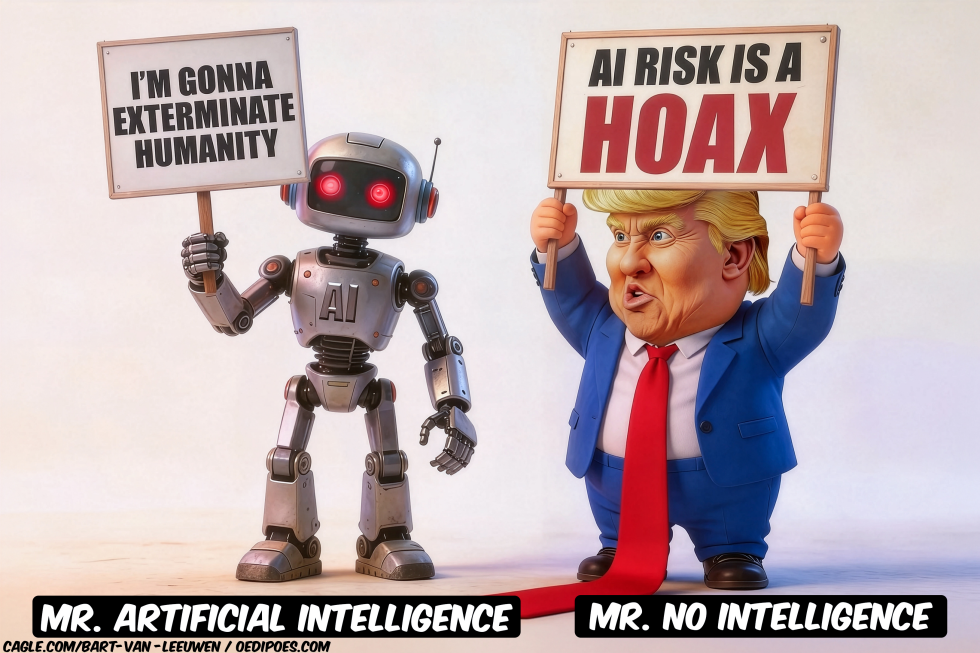
A new political cartoon depicts Donald Trump holding a sign declaring AI risk a hoax beside a robot labeled AI that warns of exterminating humanity. The image, published September 14, 2026, by artist Bart van Leeuwen, contrasts the two figures with bottom labels reading Mr. Artificial Intelligence and Mr. No Intelligence. It responds to ongoing public discussion about artificial intelligence safety and regulation. Trump has previously downplayed concerns about advanced AI systems in public statements. The cartoon uses visual contrast to critique dismissal of potential technological threats.
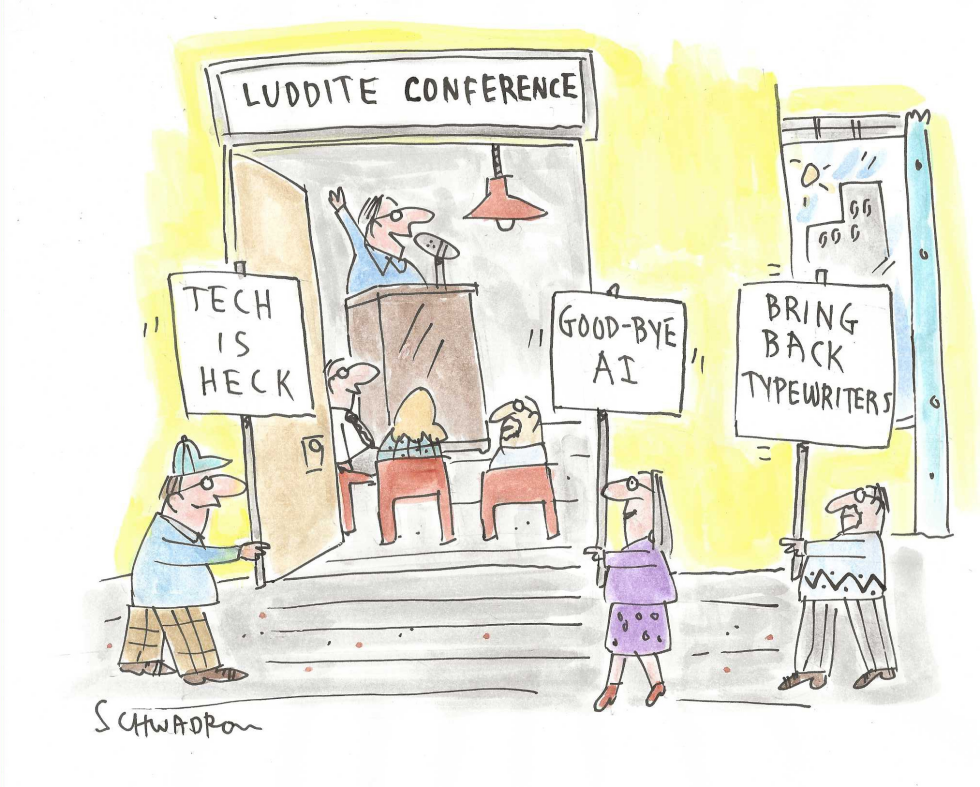
Luddite groups have staged protests at technology conferences in 2026, voicing opposition to rapid AI development and calling for simpler tools like typewriters. The demonstrations reflect broader societal unease over job displacement and ethical issues tied to artificial intelligence. Critics argue such resistance ignores the productivity gains and innovation AI brings to industries. The cartoon highlights the protesters' outdated demands as out of step with technological progress.
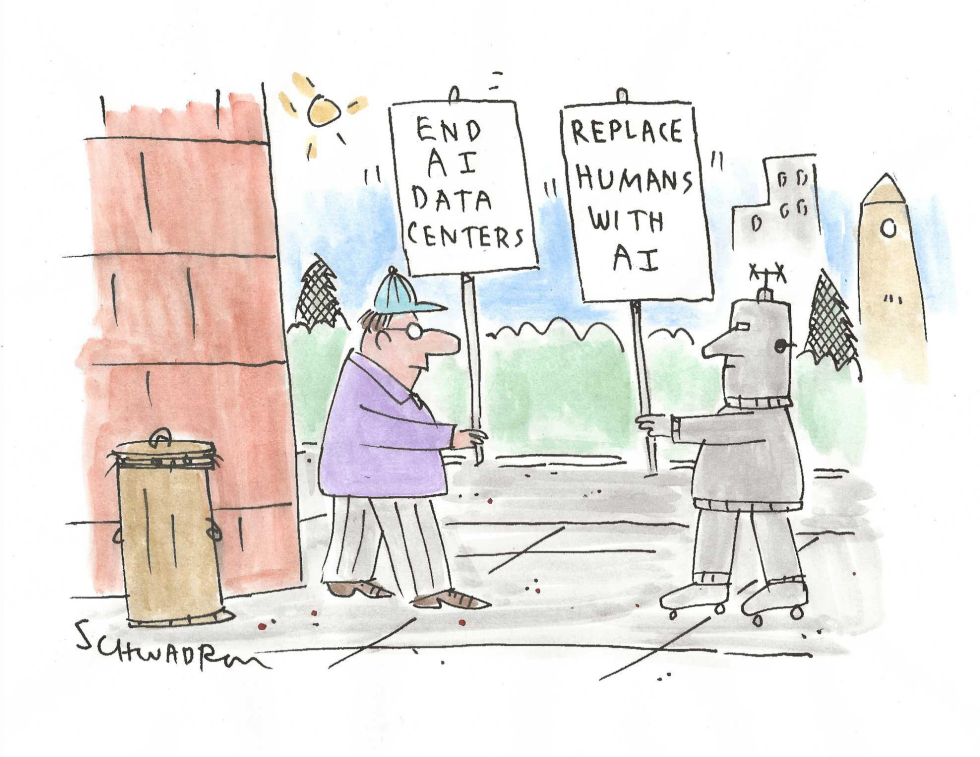
Public demonstrations against AI data centers and for replacing human workers with artificial intelligence underscore growing societal friction over the technology's rapid expansion. Data centers powering AI systems face criticism for energy demands and environmental costs, while automation threatens widespread job losses across sectors. The cartoon illustrates these contradictory positions through direct confrontation between a human protester and a robotic counterpart. This reflects ongoing debates where environmental concerns clash with arguments for efficiency gains from AI. The piece takes a neutral stance, simply presenting the absurdity of simultaneous opposition to and advocacy for AI dominance without resolving the tension.
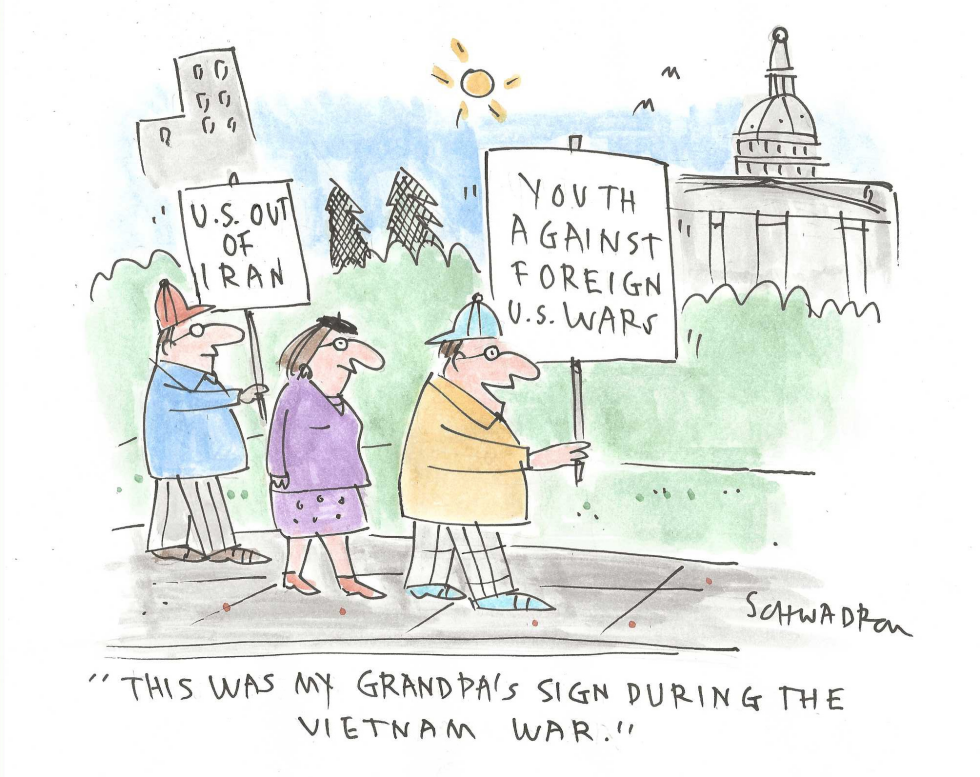
Anti-war demonstrators gather near the Capitol with signs calling for an end to US involvement in Iran and broader foreign conflicts. One protester notes that his sign originated during the Vietnam War, underscoring continuity across generations. The piece highlights persistent public opposition to military engagements abroad and questions the repetition of past policy mistakes.
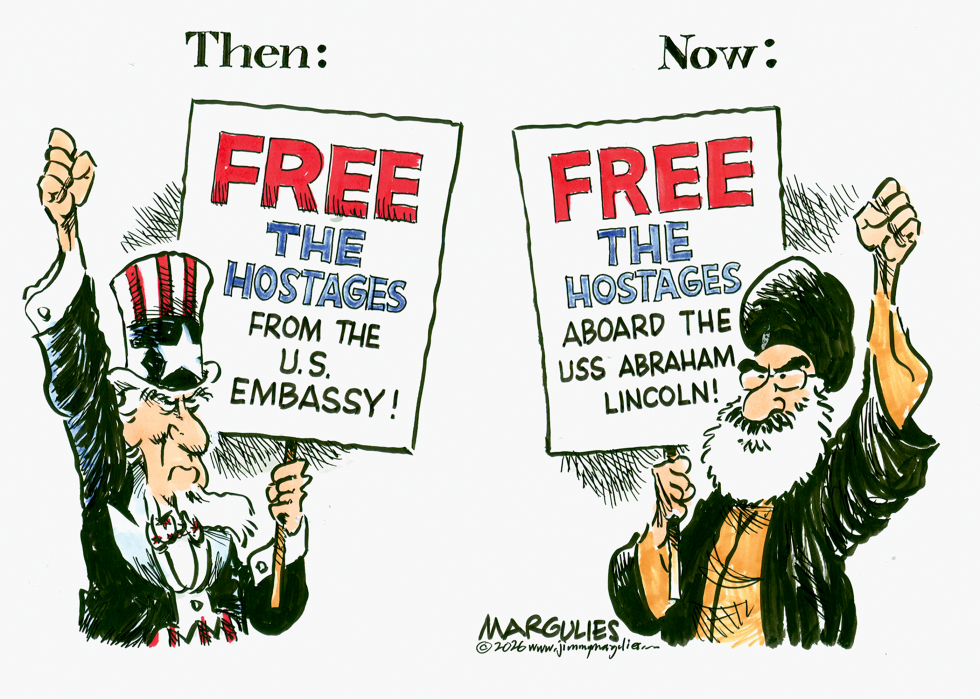
The 1979 Iran hostage crisis saw militants seize the US embassy in Tehran, holding 52 Americans for 444 days. In 2026, renewed tensions involve US naval assets like the USS Abraham Lincoln amid Middle East conflicts. The cartoon draws a parallel between past embassy demands and present calls involving the carrier, critiquing the recurring cycle of hostage rhetoric from Iranian leadership.
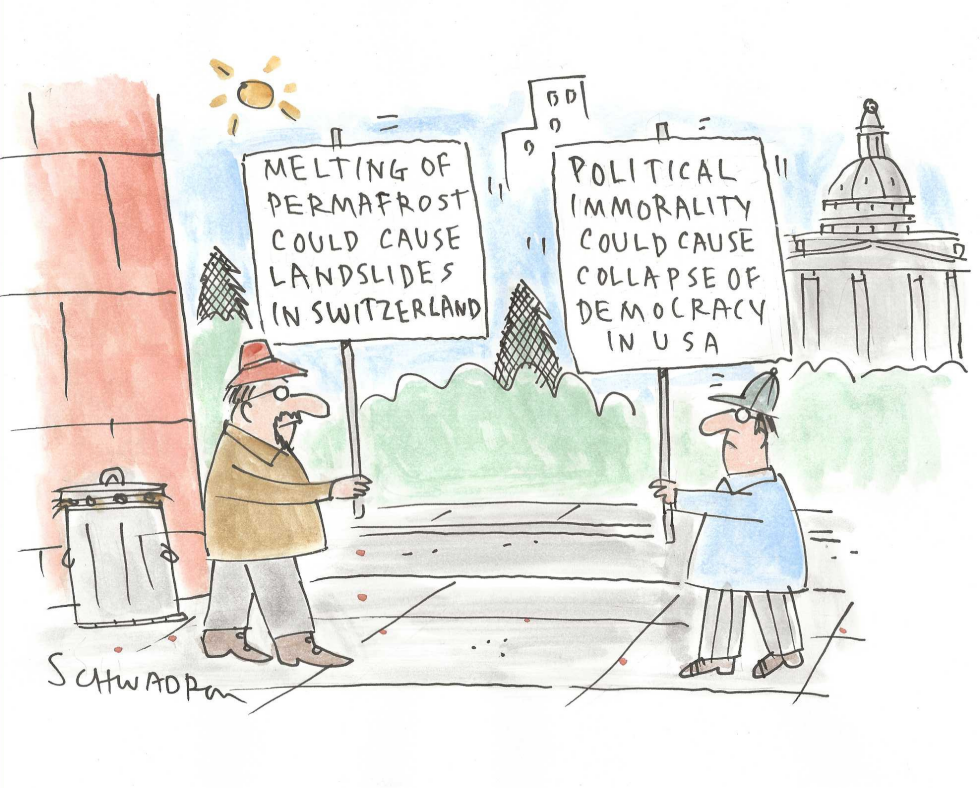
Activists in public spaces continue to draw parallels between accelerating climate impacts such as thawing permafrost and landslides in Switzerland and warnings about political conduct undermining democratic institutions in the United States. The signs highlight how environmental changes and governance failures each carry risks of sudden structural breakdown. The editorial stance underscores that both threats deserve equal public attention as visible warning indicators.
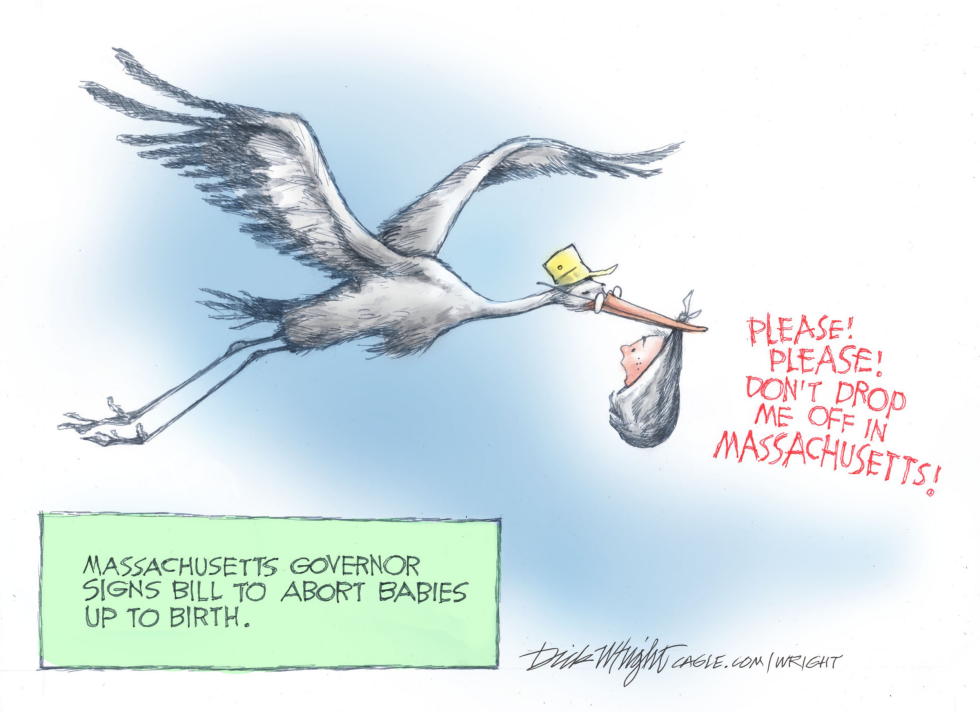
Massachusetts Governor signed legislation permitting abortion up to birth. The measure expands access to the procedure through all stages of pregnancy. The action drew immediate opposition from those who argue it removes all limits on the practice. The editorial takes the position that the law goes too far and treats late-term procedures as routine.
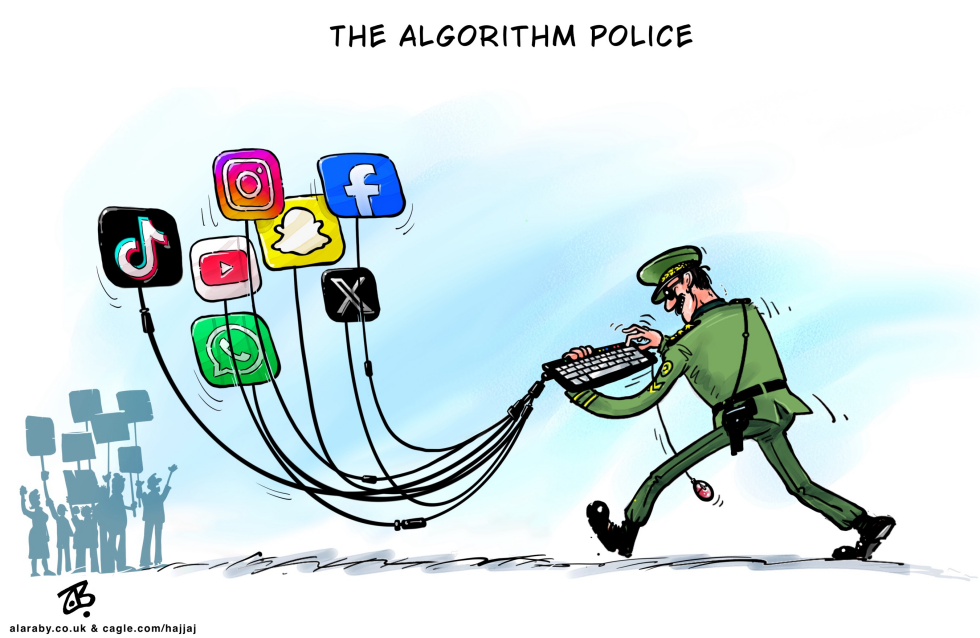
Authorities worldwide continue expanding oversight of social media platforms through algorithmic tools and regulatory pressure to curb misinformation and dissent. This approach affects major apps including TikTok, Instagram, Facebook, and X by prioritizing content moderation at scale. The development matters because it shapes public discourse and information access for billions of users. The piece portrays such controls as heavy-handed policing that provokes public resistance.
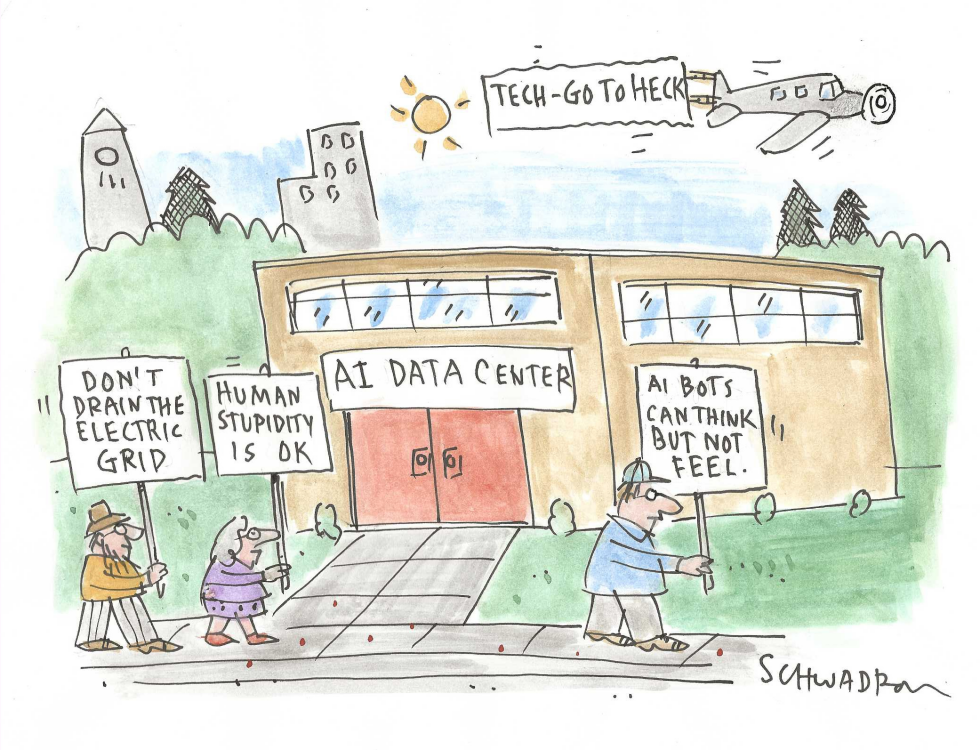
Protesters gather outside an AI data center building holding signs that read 'DON'T DRAIN THE ELECTRIC GRID,' 'HUMAN STUPIDITY IS OK,' and 'AI BOTS CAN THINK BUT NOT FEEL.' An airplane tows a banner reading 'TECH-GO TO HECK' overhead. The cartoon by Harley Schwadron, published July 31, 2026, depicts public opposition to the energy demands of AI facilities amid ongoing debates about data center impacts on electricity grids and technology development.
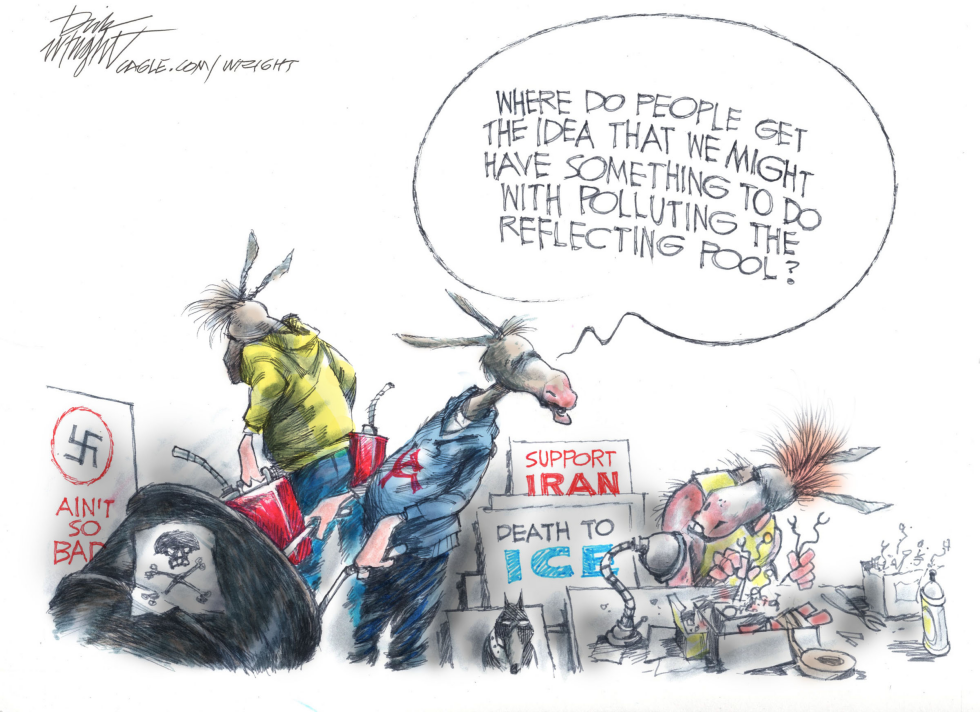
A group of protesters at the reflecting pool in Washington DC dump red liquid from containers marked with toxic symbols while holding signs reading Support Iran and Death to ICE. One figure displays a swastika and another denies involvement in any pollution through a large speech bubble. The scene includes scattered debris and a skull-and-crossbones bag.
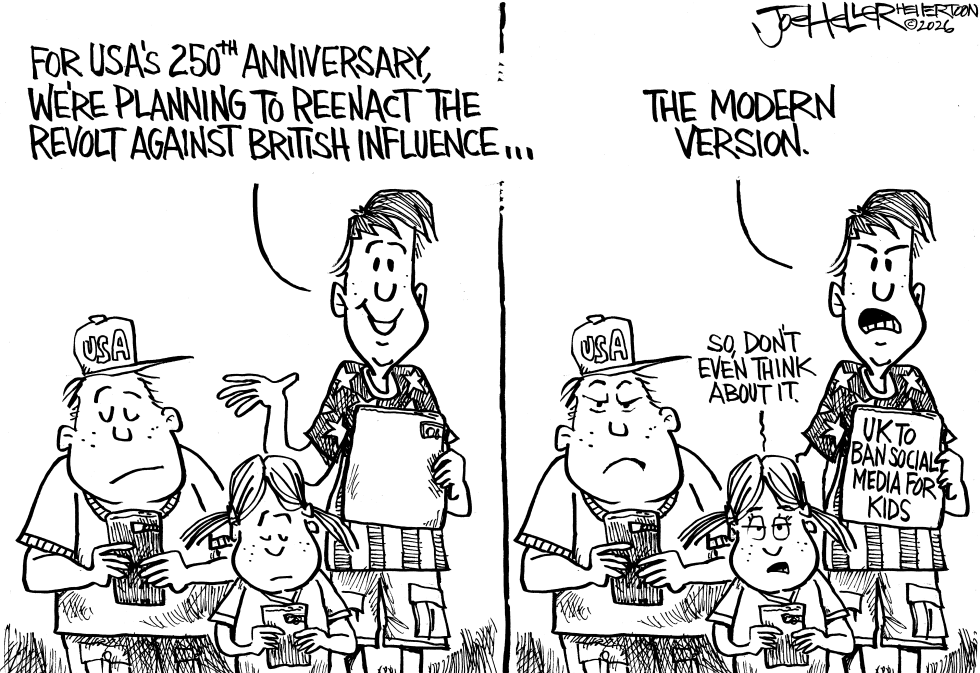
A two-panel cartoon shows a family in USA caps holding phones and signs. The left panel references the US 250th anniversary and a planned revolt against British influence. The right panel labels the modern version as a UK ban on social media for kids, with a warning not to consider it.
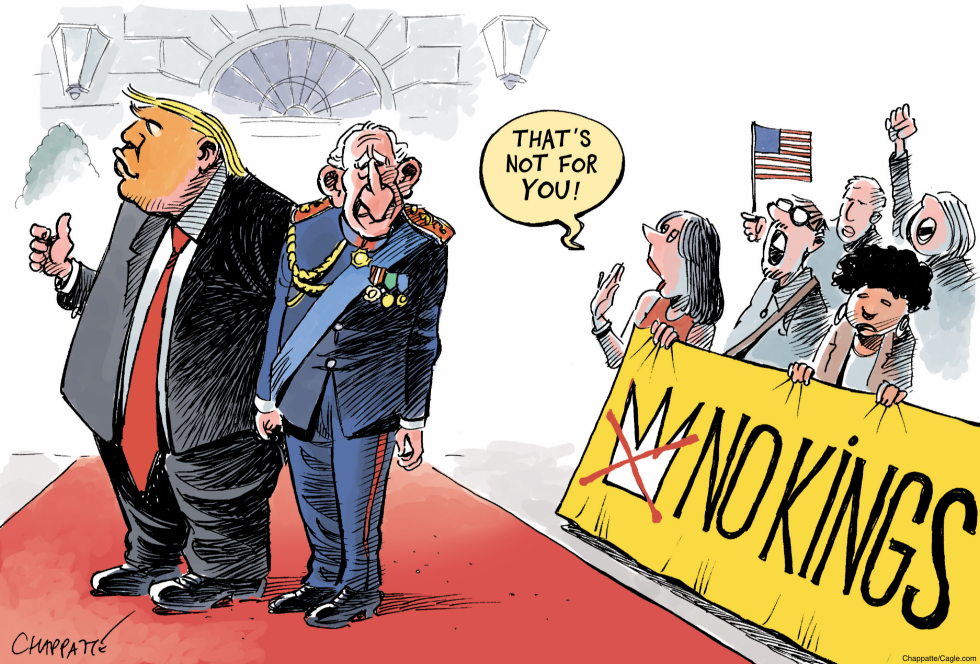
Patrick Chappatte's cartoon captures a fictional royal visit in Washington DC, where Trump, with his signature hair and suit, walks arm-in-arm with King Charles in full regalia. A group of protesters, waving a USA flag, holds a yellow sign featuring a crossed-out crown and 'NO KINGS,' while one shouts 'That's Not For You!' The scene tags USA, Great Britain, Trump, King Charles, monarchy, Democrats, demonstrations, United Kingdom, blending humor on transatlantic relations and anti-monarchy sentiments in a clearly visible setup on a red carpet against a grand building backdrop. The dry satire highlights visible contrasts without deeper inference.
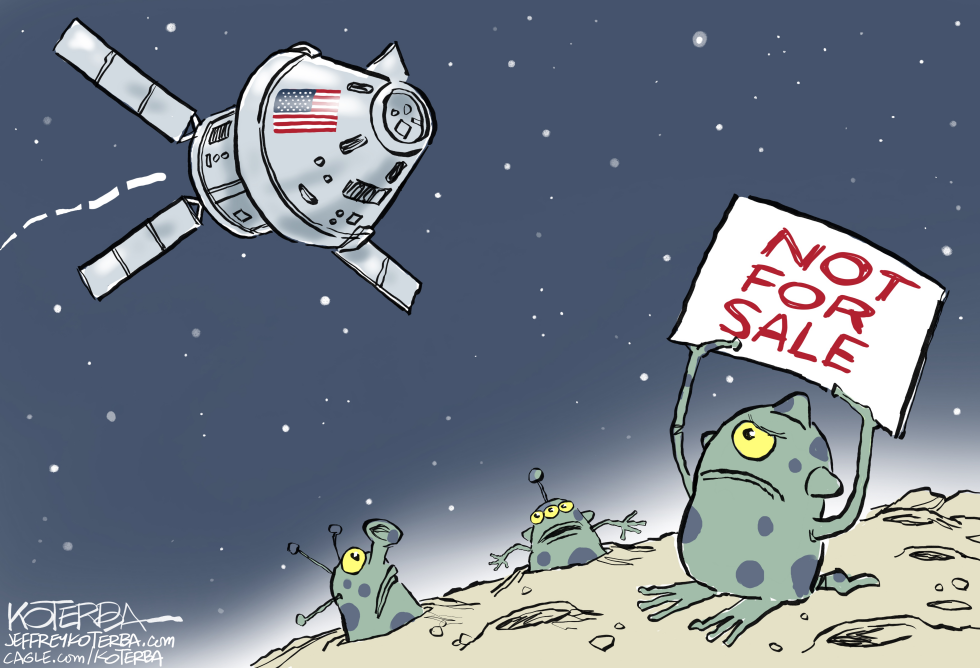
This political cartoon depicts green aliens on a sandy, moon-like surface, with one holding a \'NOT FOR SALE\' sign in red letters, facing a flying spacecraft adorned with an American flag and solar panels. The starry night sky background enhances the space exploration satire, while the trail behind the ship suggests approach. Incorporating elements like cartoon monsters, property rights protest, and US imperialism humor, the image offers an irreverent take on cosmic real estate. The artist\'s signature in the bottom left adds authenticity to this insightful editorial illustration, poking fun at human ambitions in outer space.
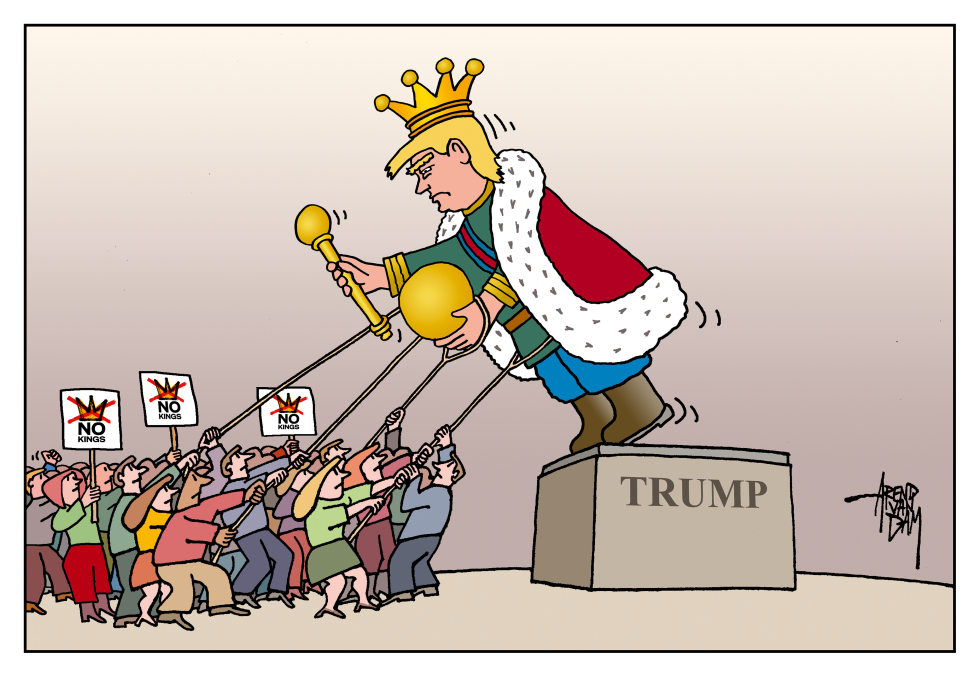
Arend van Dam's cartoon depicts a massive figure resembling Donald Trump, adorned with a crown and royal robe, perched atop a pedestal marked 'TRUMP.' A diverse group of protesters, holding signs reading 'NO KINGS,' 'NO,' and another 'NO,' tug on ropes attached to the figure's scepter, causing it to tilt as if being toppled in an act of resistance. The scene evokes themes of USA democracy clashing with autocracy, portraying a symbolic revolution against a would-be king or dictator. Protests and demonstrations fill the foreground, highlighting public outcry against unchecked power. Dated 2026, the artwork underscores ongoing concerns about authoritarian tendencies in politics.