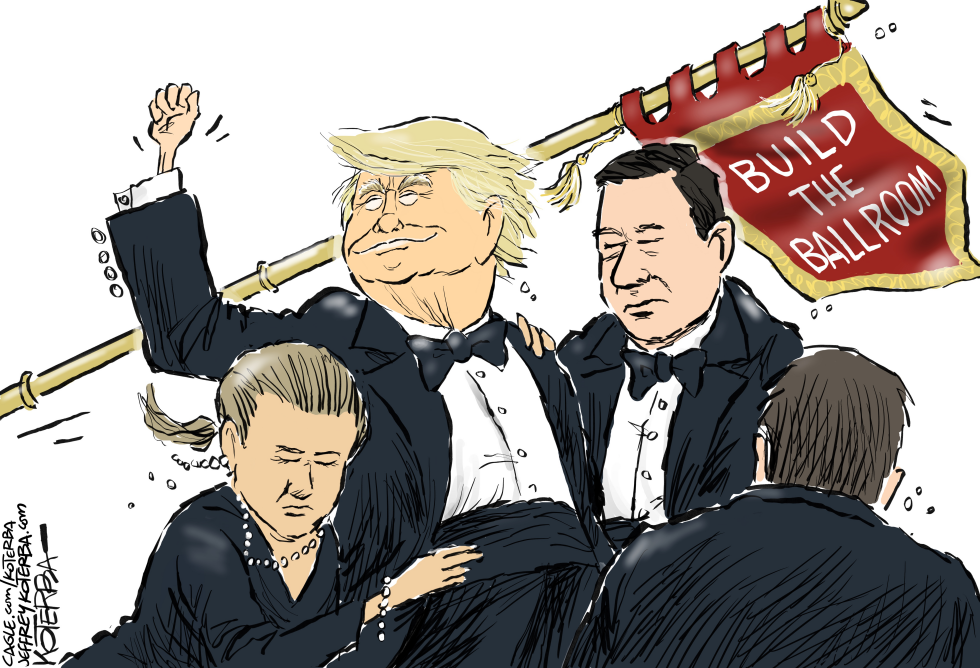
Jeff Koterba draws Trump in tuxedo, fist raised high, gripping a flagpole with a red banner proclaiming 'Build the Ballroom.' Surrounded by figures in formal wear, the scene captures a moment in a Washington ballroom, tagging into press and journalism themes. The cartoon nods to an assassination attempt in Butler, with secret service elements visible. Trump's caricature dominates, his expression set as agents cluster around. This piece fits into White House Correspondents' Dinner aftermath, blending fist symbolism with ballroom absurdity. Tags like flag and tuxedo underscore the satirical take on political resilience.
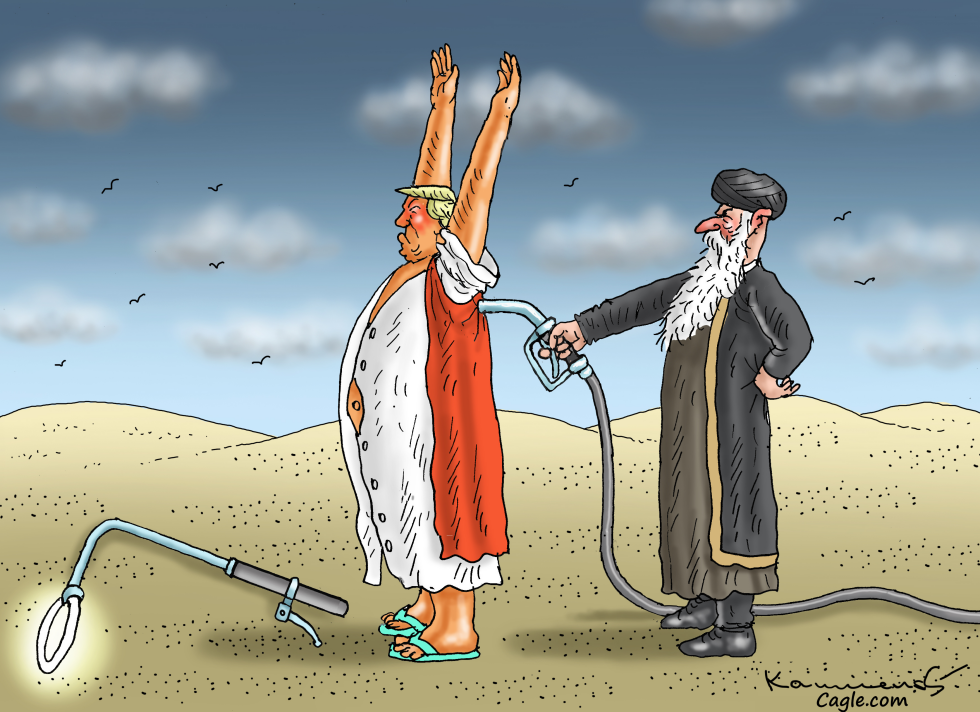
Marian Kamensky's cartoon captures a surreal scene in the desert where a figure resembling Trump, dressed in white and red robes with arms raised skyward, has a gas pump nozzle inserted into his side by a bearded man in dark robes and turban. The image plays on themes of Trump, Iran, Hormuz, fascism, MAGA terror, and oil war, blending religious imagery with modern geopolitical tensions. Birds fly in a cloudy sky over sandy dunes, emphasizing isolation and absurdity. The signature and Cagle.com mark confirm its syndication roots. This piece skewers the intersections of politics, religion, and resource dependency without words, relying on visual punch for impact. Such cartoons thrive in editorial pages for their sharp commentary on current events.
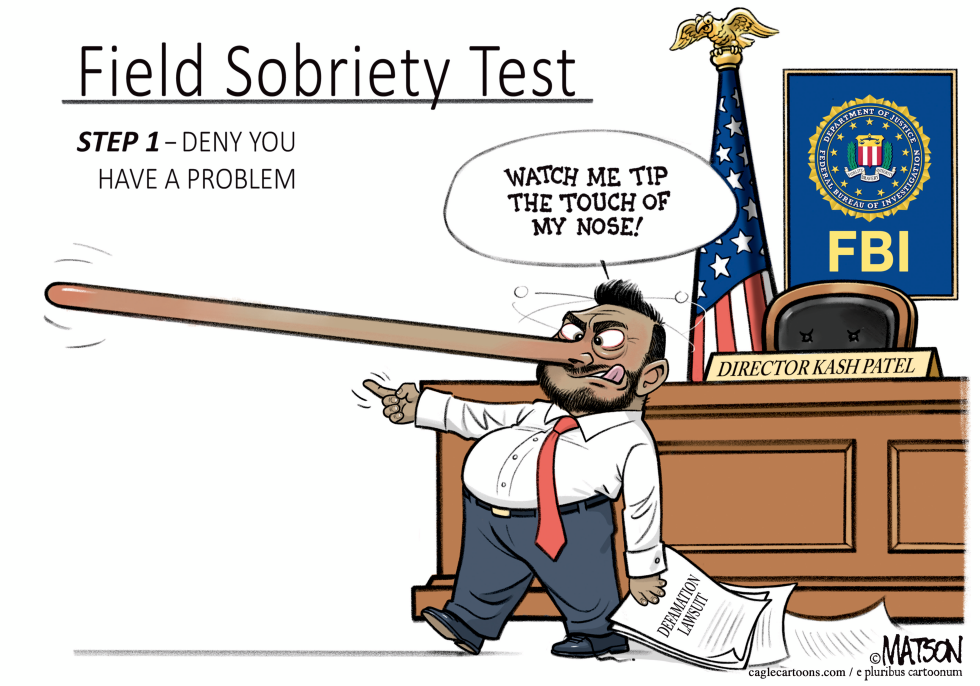
R.J. Matson's cartoon depicts Director Kash Patel behind an FBI desk, his nose elongated like Pinocchio's, as he mangles a sobriety test phrase: 'Watch me tip the touch of my nose!' The setup labels it Step 1: Deny you have a problem, with a defamation lawsuit paper slipping away. American and FBI flags frame the scene, tying into tags like Federal Bureau of Investigation, Kash Patel, field sobriety test, intoxication, drinking problem, and criminal justice. This visual pokes at perceptions of denial in leadership, blending humor with commentary on domestic policy without overreaching into unseen motives.
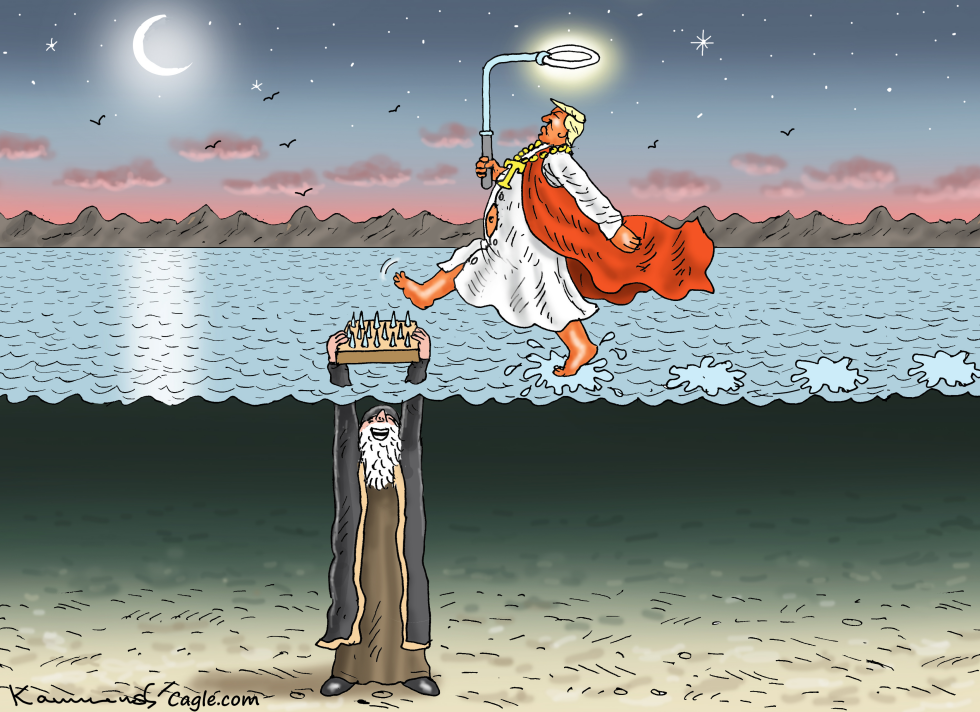
Marian Kamensky nails the absurdity with a Trump caricature striding across the Hormuz waves like some divine emperor, complete with a lamppost halo and a sword in hand. He's dangling a crown of thorns to a bearded prophet type popping up from the depths, all set against a starry night with mountains and a crescent moon. Tags like Iran, Hormuz, Trump, MAGA Terror, Oil War, Fascism scream the point without words. It's classic cartoon exaggeration, poking at ego-driven foreign policy blunders. The red cape flutters, the water splashes—pure visual punch. No subtlety here, just sharp commentary on power plays in troubled waters.
Taylor Jones draws a sharp contrast in this cartoon, with a pope-like figure in white robes and glasses, hands clasped, delivering the Sermon on the Mount line from Matthew 5:9 about blessed peacemakers being children of God. Beside him stands a blonde-haired man in a suit, halo above, mouth open in response, twisting John 3:16 to claim the Strait of Hormuz as a divine gift, or soon to be, labeled Don 3:16. The piece nods to Catholic Church teachings against a backdrop of Persian Gulf tensions, war in Iran, and oil exports disruptions. It's a dry poke at how leaders bend scripture for geopolitical gains, like controlling the Strait of Hormuz to spike crude prices. Vatican serenity meets brash claims, all in watercolor style on purple background.
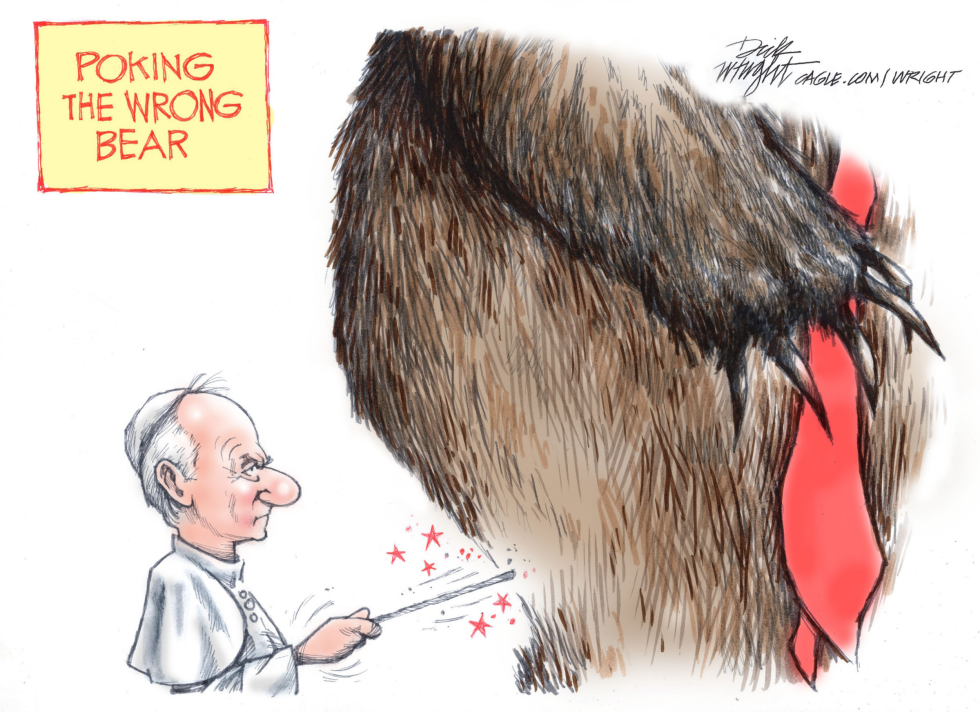
Dick Wright's political cartoon depicts a Pope-like figure in white attire, extending a thin rod toward the rear of a massive brown bear, complete with a dangling red tie and sparkling effects at the point of contact. The yellow label reads 'POKING THE WRONG BEAR,' playing on the idiom with a twist. This satirical illustration ties into the Trump-Pope feud, using the bear as a stand-in for power, the red tie evoking Trump's signature look, and the poking action suggesting provocation. Cartoonists often employ such animal metaphors for political commentary, and Wright's style here delivers clear lines and exaggerated features for impact. The image avoids overstatement, sticking to visible elements like the bear's claws and fur details, making it a straightforward jab at ongoing tensions.
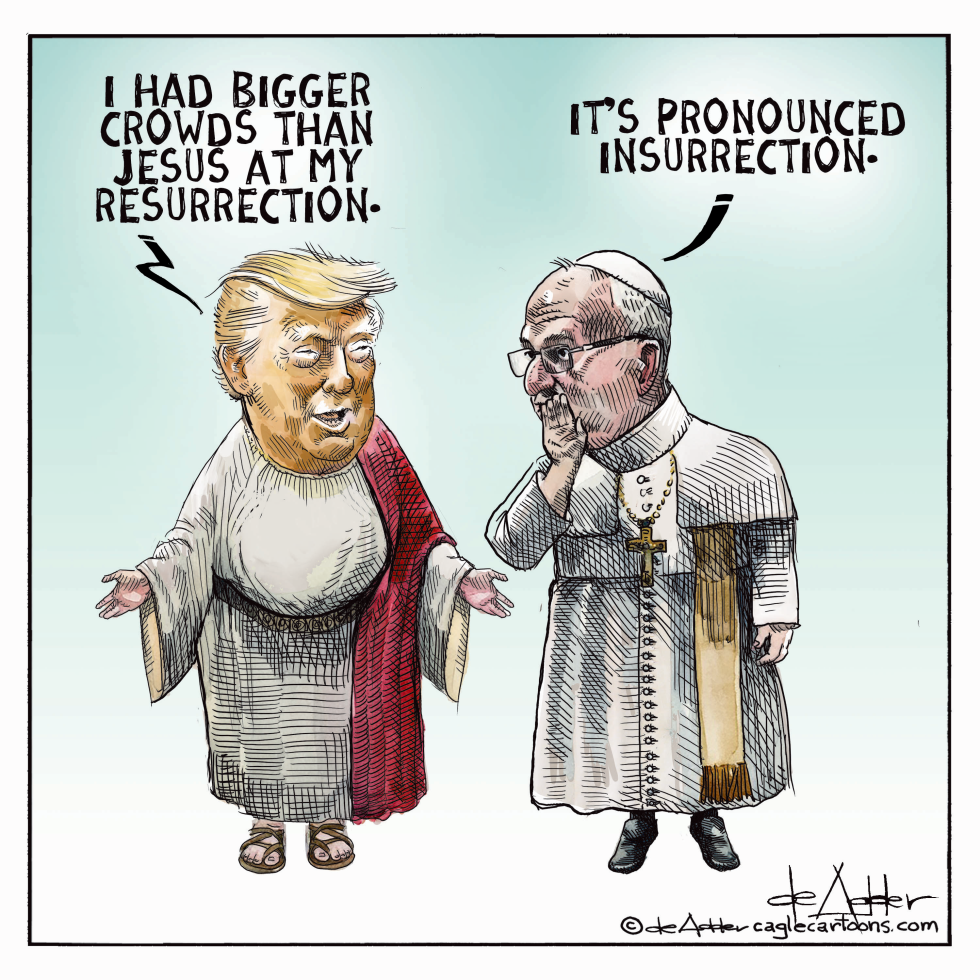
The cartoon depicts Donald Trump as Jesus Christ, complete with robe and sandals, claiming he had bigger crowds than Jesus at his resurrection. Standing beside him is the Pope, dressed in traditional Vatican attire with glasses and a cross, correcting the pronunciation to insurrection. Tags like Trump, Pope, Jesus, resurrection, and insurrection drive the humor, poking at Trump's known obsession with crowd sizes and linking it to the January 6 events. The artist, Michael de Adder, uses simple lines and a light background to focus on the figures and dialogue, creating a sharp satirical commentary on arrogance and political missteps. This piece fits well in editorial sections, blending religious imagery with current politics for a dry, pointed laugh.
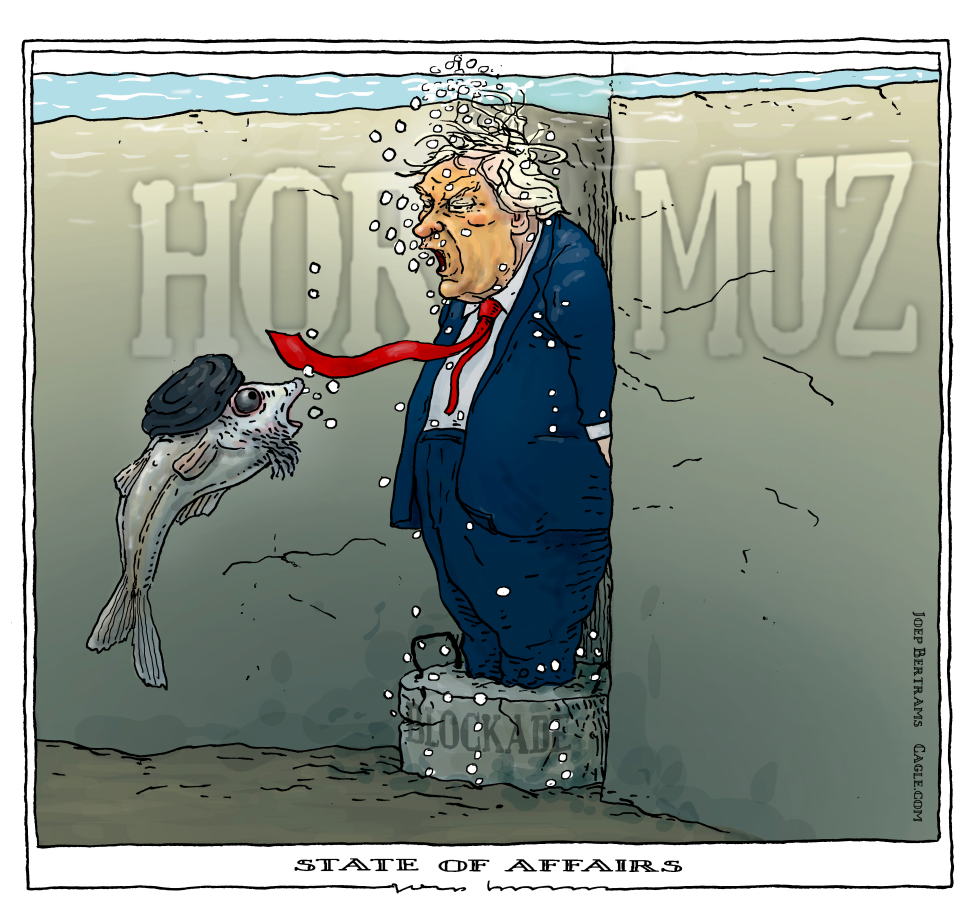
Joep Bertrams captures the Strait of Hormuz tensions with a caricature of Donald Trump sinking in concrete shoes marked blockade, bubbles rising from his open mouth as a fish in a black hat nibbles his red tie. The underwater setting features a cracked wall labeled Hormuz, emphasizing the sunk metaphor for diplomatic failures. Tags like Iran, concrete shoes, and fish highlight the satirical take on US-Iran relations, with the caption State of Affairs underscoring the dire situation. This cartoon from 2026 blends humor and commentary on potential blockades, showing Trump in a blue suit against a murky seabed.
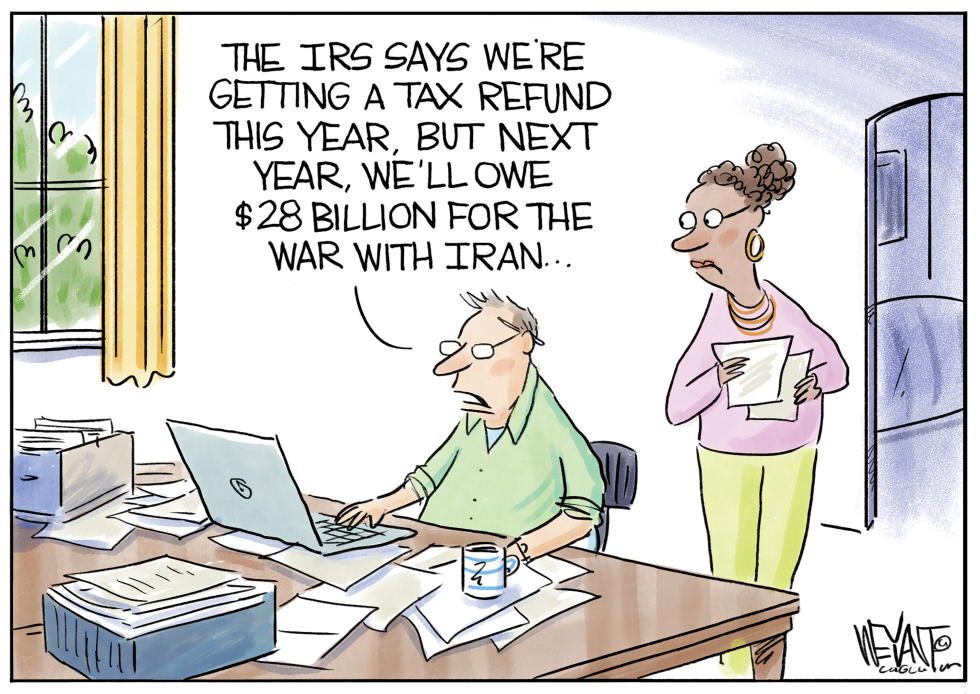
Dive into this biting political cartoon tax refund piece where a woman, holding papers, informs a laptop-working man about their IRS windfall this year, only to drop the bomb of owing $28 billion next for the war with Iran. The satirical cartoon Iran war vibe captures the absurdity of US taxes funding wars, with cluttered desks and exasperated expressions underscoring the humorous take on federal spending. It's a classic taxpayer burden Iran conflict jab, poking fun at government spending satire while illustrating the disconnect between personal finances and massive military expenses. Through cartoon about military expenses, it cleverly critiques fiscal policy in an office setting, making the war with Iran taxpayer joke both relatable and irreverently insightful for viewers pondering editorial cartoon fiscal policy.
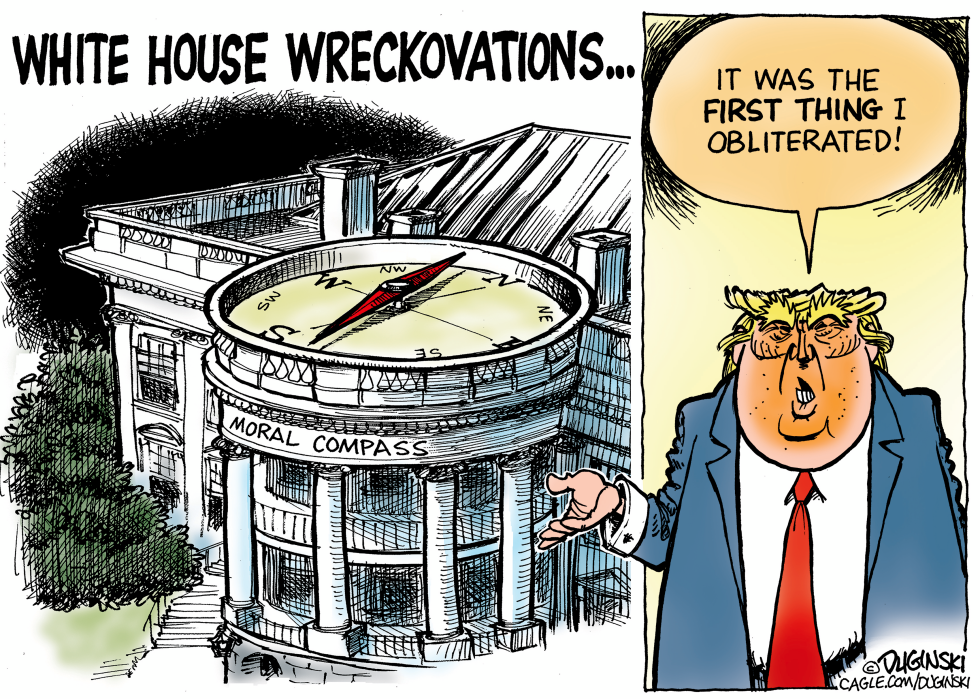
Paul Duginski's cartoon shows a caricatured Trump gesturing proudly while speaking about obliterating the moral compass, a large dome-like structure labeled 'Moral Compass' with directional arrows, placed on the White House roof. The title 'White House Wreckovations' plays on renovations, suggesting destructive changes. Tags including president, MAGA, White House, demolition, morality, ethics, obliteration, Republicans, and Iran war frame the image as a critique of ethical standards in politics. The scene captures a dark night setting with part of the building and trees visible, emphasizing the theme of moral destruction in Washington.
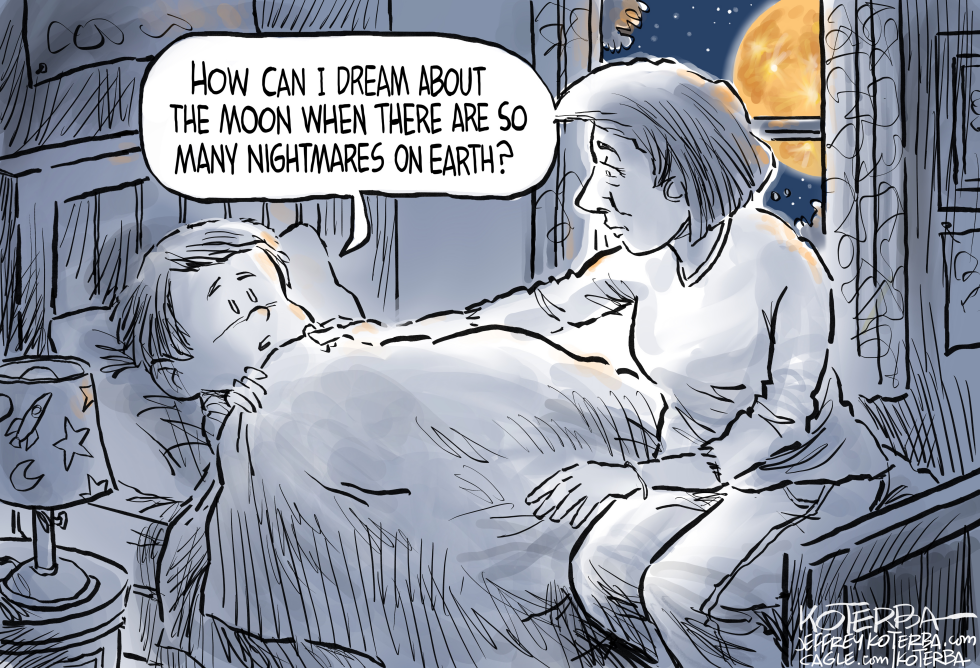
This poignant political cartoon depicts a child in bed, gazing toward a window framing a massive orange moon against a starry night sky, while confiding in a seated adult figure. The child's speech bubble reads: 'How Can I Dream About The Moon When There Are So Many Nightmares On Earth?' A bedside lamp with a star design illuminates the scene. Through this setup, the artwork satirizes how youth anxiety from global issues—like wars, climate woes, and social upheavals—stifles big dreams and aspirations. It's a clever commentary on how earthly nightmares eclipse celestial hopes, blending humor with insight into modern parenthood and childhood innocence lost. Tags: political cartoon, child nightmares, moon dreams, earth troubles, satirical illustration, youth anxiety, global chaos.
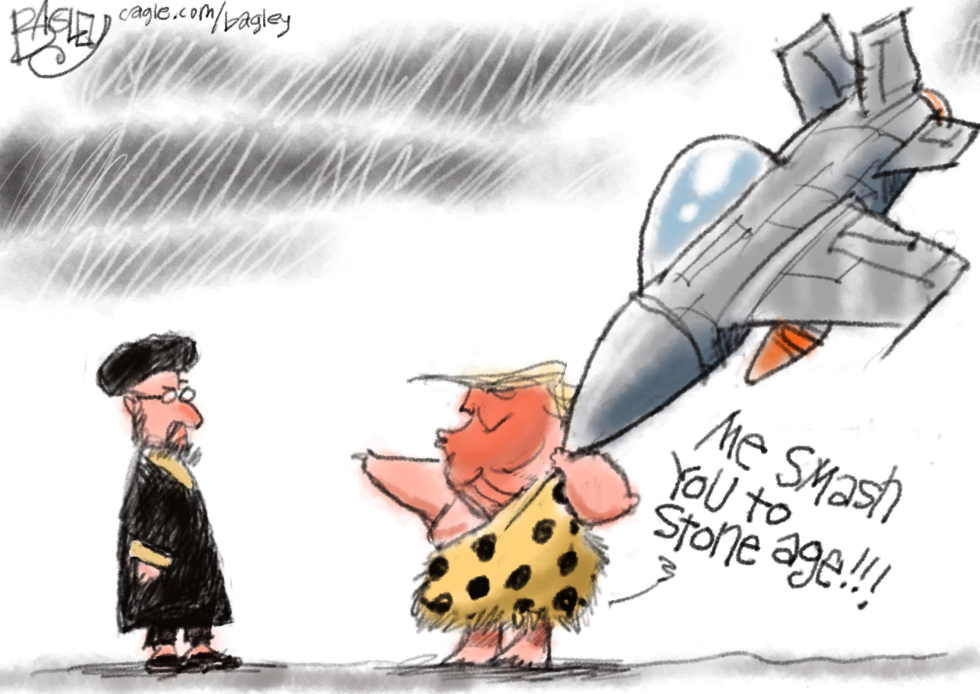
Pat Bagley's cartoon captures Trump as a caveman in a spotted tunic, gripping a fighter jet like a club, his face red with anger as he shouts 'Me Smash You to Stome age!!!' at a stern-faced man in black robes, beard, glasses, and hat under stormy skies. The scene underscores Trump threats, political satire, caveman caricature, fighter jet weapon, judge figure, and primitive aggression in a straightforward jab at regressive tactics. Editors see these kinds of drawings often, where exaggeration drives the point home without subtlety, making it shareable for those tracking US politics Trump style. The dry humor lies in the absurdity of modern weaponry in prehistoric hands, a classic cartoon trope that lands with insider familiarity.
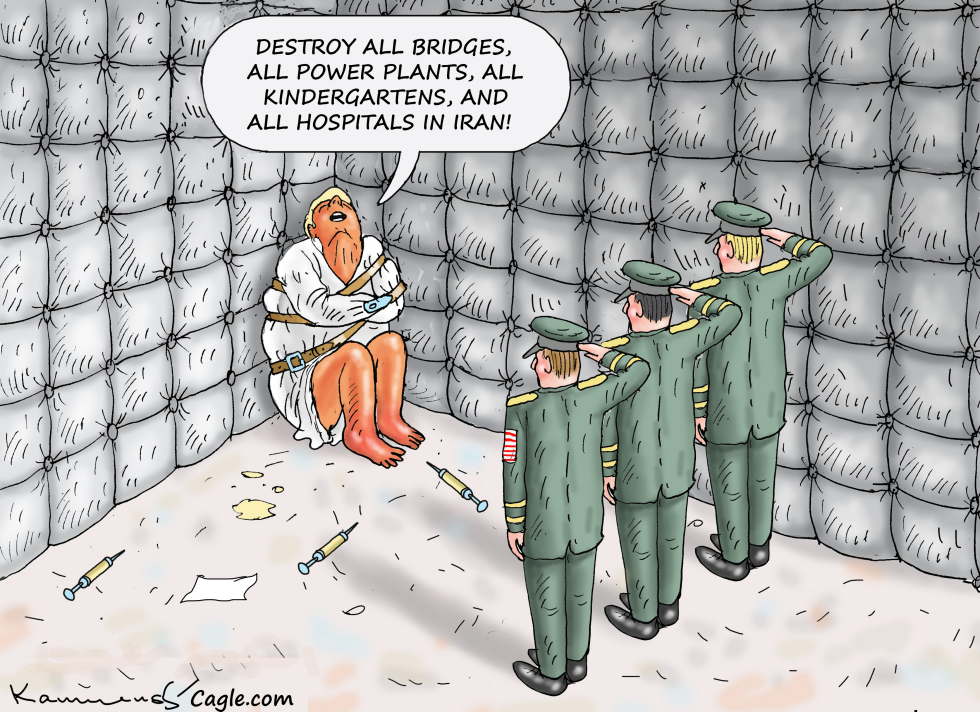
On April 6 2026 a cartoon depicts a figure resembling Donald Trump confined in a padded cell wearing a straitjacket and issuing orders to destroy bridges power plants kindergartens and hospitals in Iran. Four officers in green uniforms stand at attention saluting the figure. Discarded syringes lie on the floor. The scene responds to ongoing tensions with Iran and debates over military responses during that period.