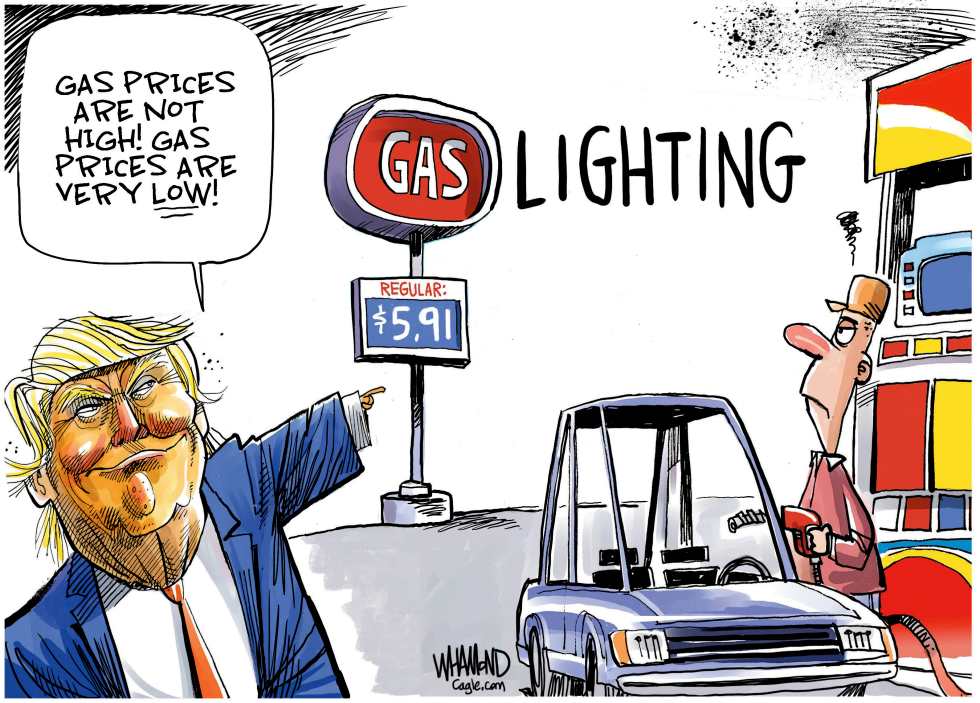
Donald Trump has repeatedly asserted that gas prices are very low even as national averages hover near record territory. The statement comes amid ongoing public frustration with energy costs that have remained elevated for months. The editorial takes the position that such denials amount to deliberate misdirection rather than engagement with economic data.
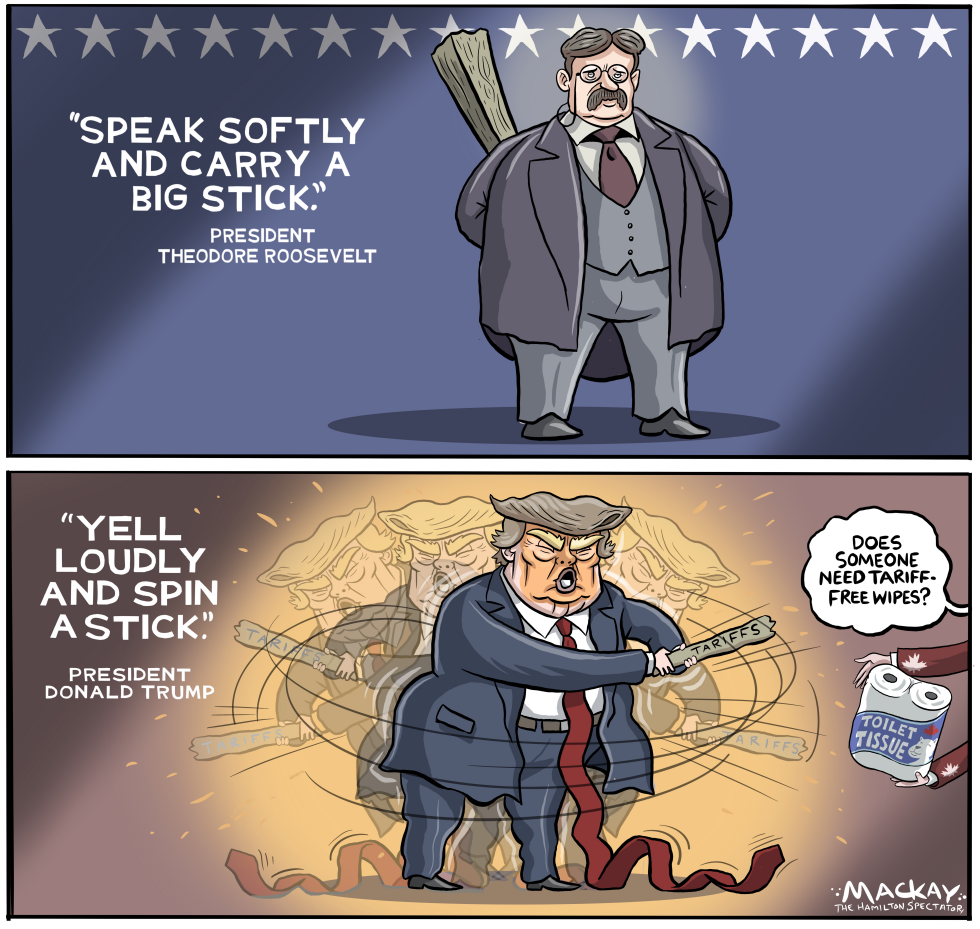
The cartoon by Graeme MacKay contrasts Theodore Roosevelt's famous speak softly and carry a big stick approach with Donald Trump's version of yelling loudly and spinning a stick covered in tariffs. In the lower panel Trump appears dizzy from the motion as a Canadian hand offers toilet tissue labeled tariff-free wipes. The image comments on recent US tariff actions and their impact on Canadian trade relations as of the September 2026 publication date.
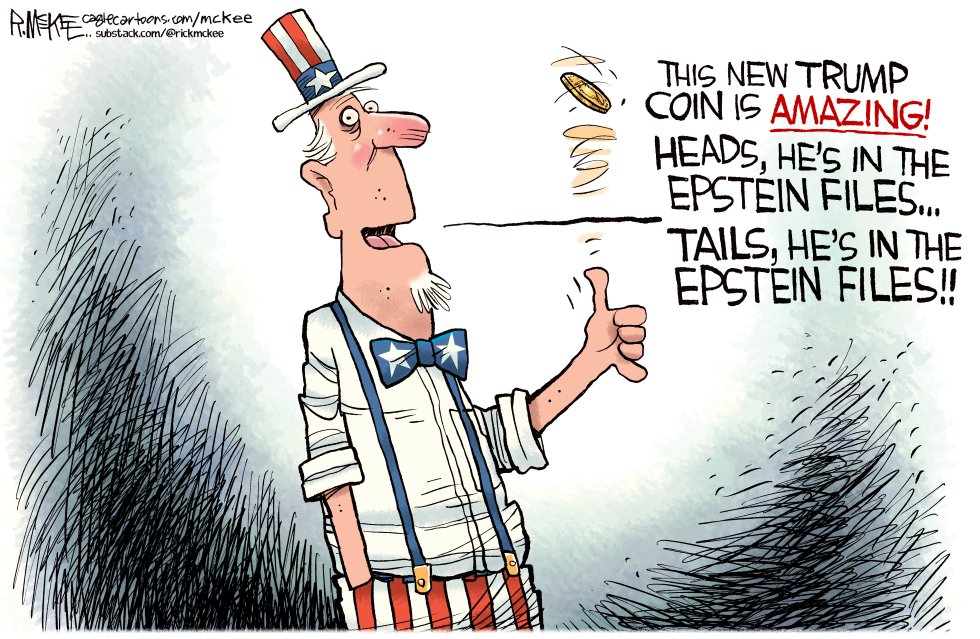
References to Donald Trump appearing in Jeffrey Epstein files have resurfaced in political discourse. The cartoon uses a coin flip to illustrate that scrutiny persists regardless of the outcome. It critiques the notion that any new development clears the former president.
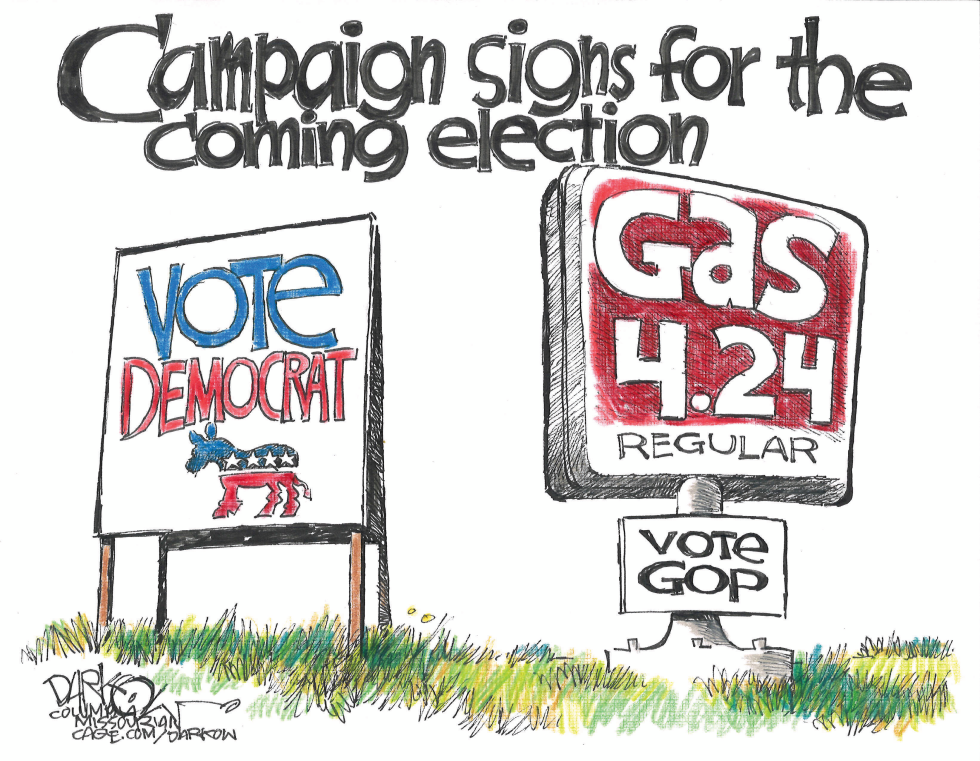
John Darkow's cartoon shows campaign signs for the coming election, with a straightforward Vote Democrat board featuring a blue donkey symbol, contrasted by a gas station-style sign advertising GAS 4.24 REGULAR and a small Vote GOP placard below. The image ties into 2026 midterms themes, highlighting gas prices, affordability, inflation, Strait of Hormuz tensions, cost of living pressures, and party strategies. The dry humor points to how economic issues like fuel costs become central in political advertising, with the GOP sign mimicking a bargain price to appeal to voters frustrated by rising expenses. This setup captures the insider view of how cartoons simplify complex voter concerns into visual punches.
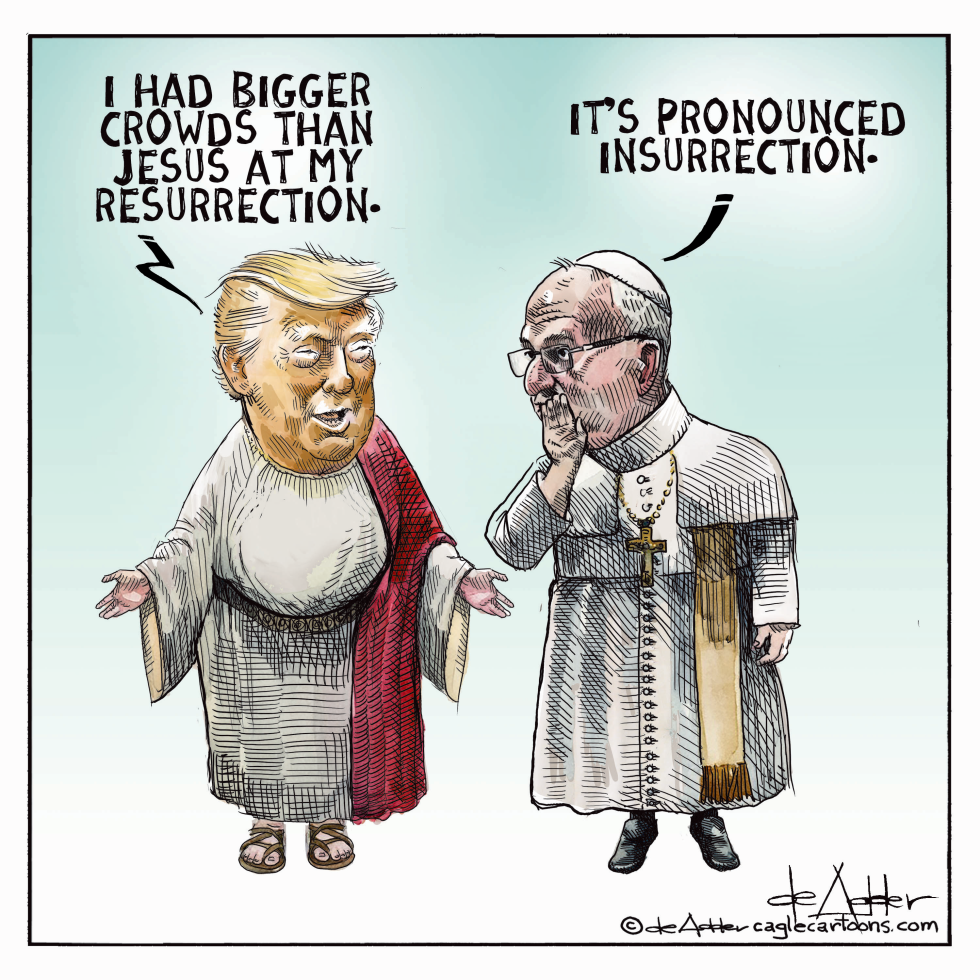
The cartoon depicts Donald Trump as Jesus Christ, complete with robe and sandals, claiming he had bigger crowds than Jesus at his resurrection. Standing beside him is the Pope, dressed in traditional Vatican attire with glasses and a cross, correcting the pronunciation to insurrection. Tags like Trump, Pope, Jesus, resurrection, and insurrection drive the humor, poking at Trump's known obsession with crowd sizes and linking it to the January 6 events. The artist, Michael de Adder, uses simple lines and a light background to focus on the figures and dialogue, creating a sharp satirical commentary on arrogance and political missteps. This piece fits well in editorial sections, blending religious imagery with current politics for a dry, pointed laugh.
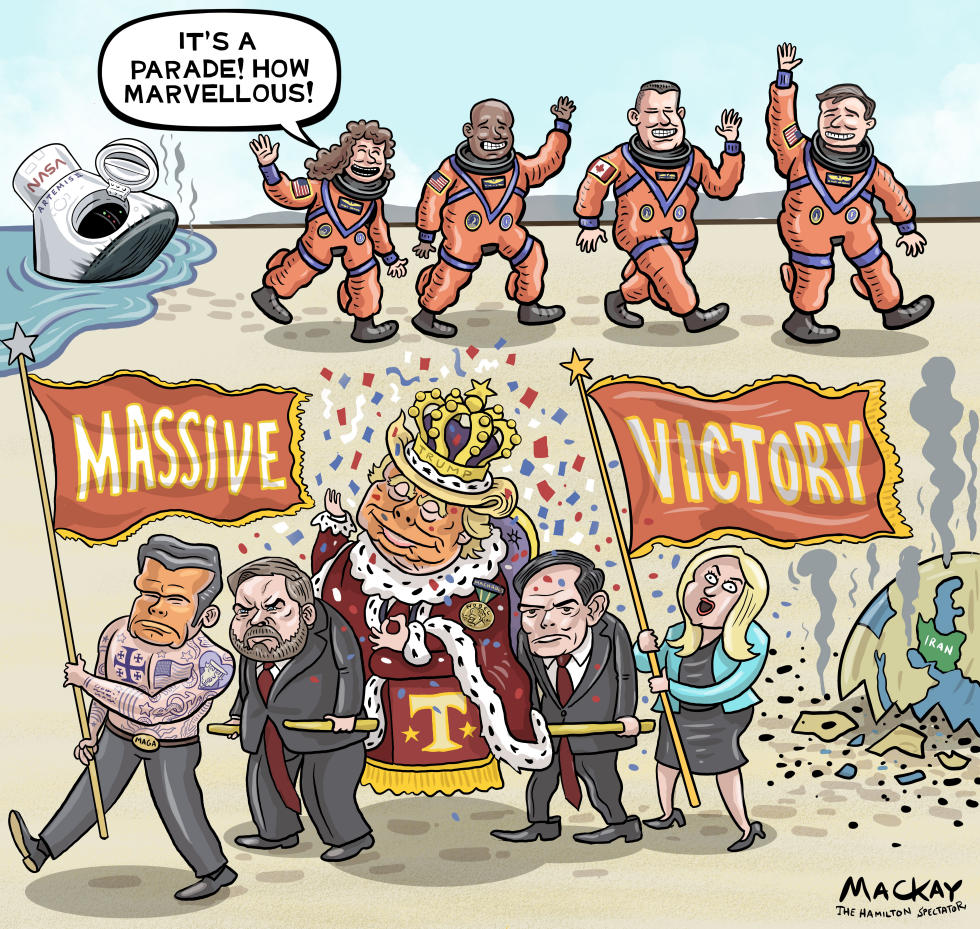
This political cartoon splits into two scenes: top shows astronauts in orange suits, one with NASA patch and another with Canadian flag, waving and exclaiming 'IT'S A PARADE! HOW MARVELLOUS!' as they march from a crashed, smoking NASA capsule in water on a sandy surface. Below, a group carries a regal throne with a crowned figure wearing a T medal, surrounded by confetti and banners reading 'MASSIVE' and 'VICTORY'. In the background, smoke rises from a fractured globe labeled 'Iran' and 'Iraq'. The artwork, signed by MacKay for The Hamilton Spectator, uses humor to juxtapose apparent failure with proclaimed triumph, featuring waving figures and stern expressions in a sandy landscape.
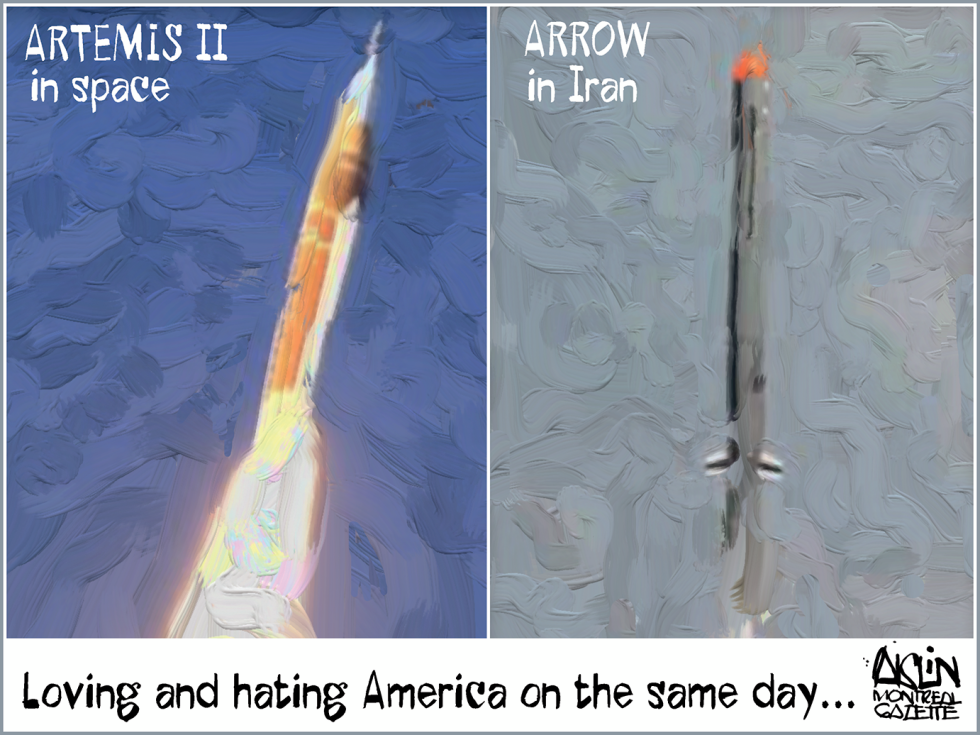
In this irreverent political cartoon, a vibrant Artemis II space launch rockets upward in a blue expanse on the left, symbolizing American innovation and triumph in US space exploration. Contrasting sharply on the right, a stark Arrow in Iran points downward with an orange glow against a gray sky, evoking geopolitical tension and Iranian weaponry. The caption 'Loving and hating America on the same day....' ties it together, offering a humorous take on the bipolar view of America in world news. With its simple yet effective composition, the artwork captures the absurdity of global perceptions, blending satire on international conflict with admiration for NASA's feats. This piece underscores the dichotomy in how the world engages with American power, from awe at space missions to ire over foreign policy frictions.
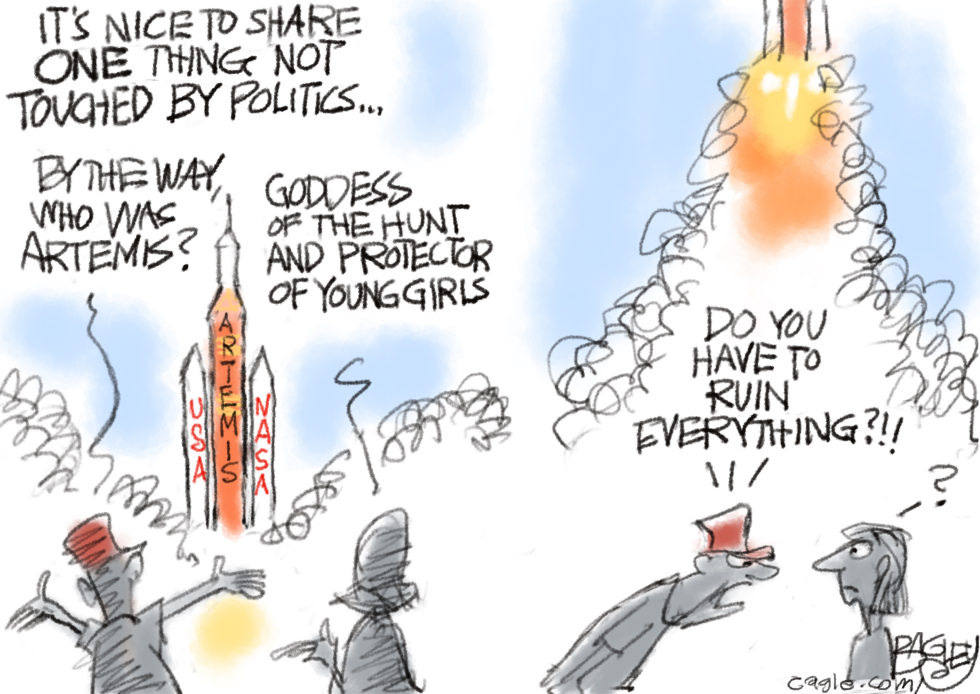
This political cartoon features a launching rocket labeled Artemis, SLS, NASA, and USA, with overlaid text praising one thing untouched by politics before asking about the goddess Artemis, described as goddess of the hunt and protector of young girls. A figure exclaims frustration at ruining everything, satirizing how even space missions get dragged into cultural debates. The irreverent sketch uses humorous figures with red hats to poke at over-politicization in science, blending mythology with modern rocketry in a witty critique. Tags like Artemis rocket launch political cartoon, NASA SLS Artemis mission satire, and politics invading science editorial cartoon underscore the cartoon's sharp insight into societal divisions spilling into apolitical realms like space exploration politicized cartoon.
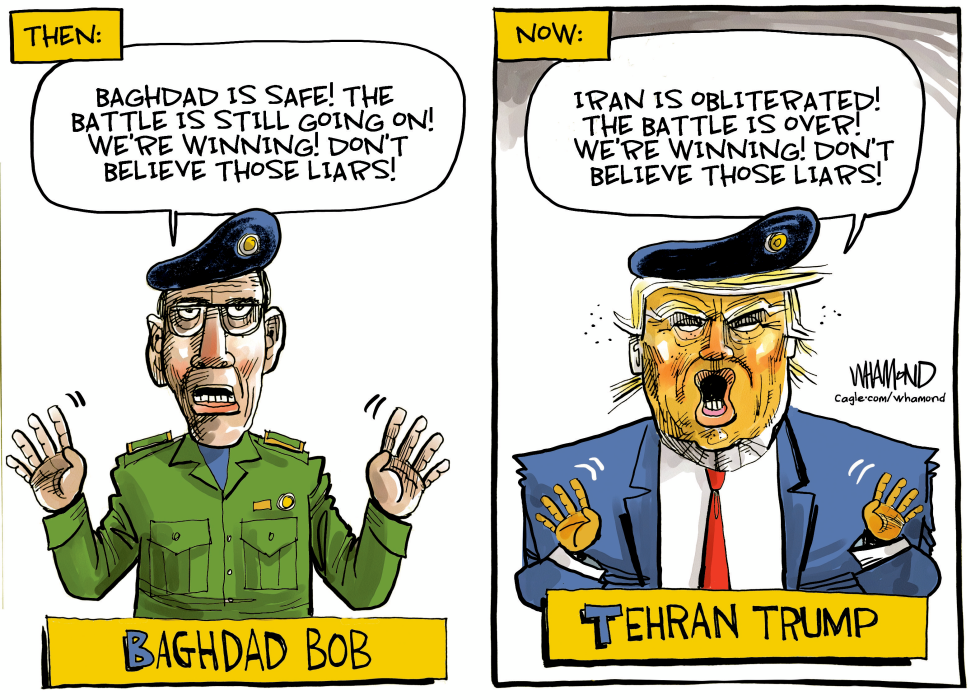
Dave Whamond's political cartoon splits into 'Then' and 'Now' panels, showing Baghdad Bob in military garb proclaiming Baghdad's safety and ongoing victory, dismissing liars. On the right, a Trump-like figure dubbed Tehran Trump, wearing a beret and suit, declares Iran obliterated and battle over, again urging disbelief in liars. The satire underscores parallels in propaganda and denialism, with tags like political satire, Trump caricature, Iraq War reference, Iran conflict, misinformation leaders, and historical parallel. This visual commentary critiques how figures twist realities in wartime narratives, blending dry humor with sharp observation on political exaggeration.
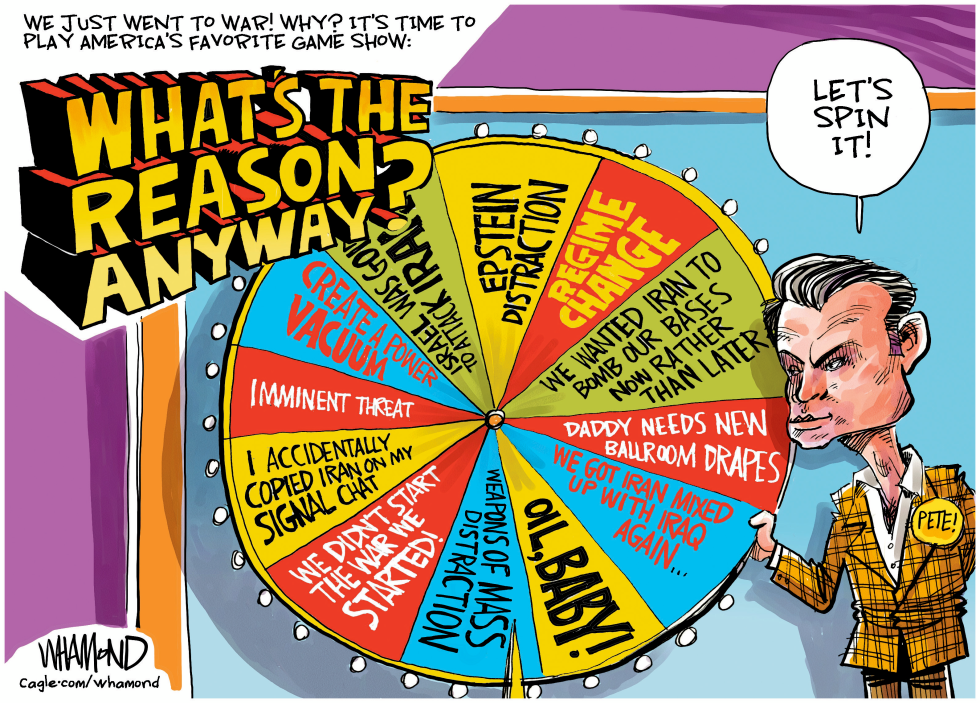
Dive into this biting political cartoon where America's war decisions are reduced to a game show parody wheel, featuring options like 'Imminent Threat,' 'Oil, Baby!,' and 'Regime Change.' The irreverent satire targets US foreign policy, highlighting how military interventions often spin on flimsy pretexts, from accidental escalations to resource grabs. With a host eagerly spinning the wheel, the artwork cleverly critiques the absurdity of war justifications, blending humor with insightful commentary on geopolitical cynicism. Tags like political cartoon, war justifications, and military intervention humor underscore its viral potential in today's polarized discourse.
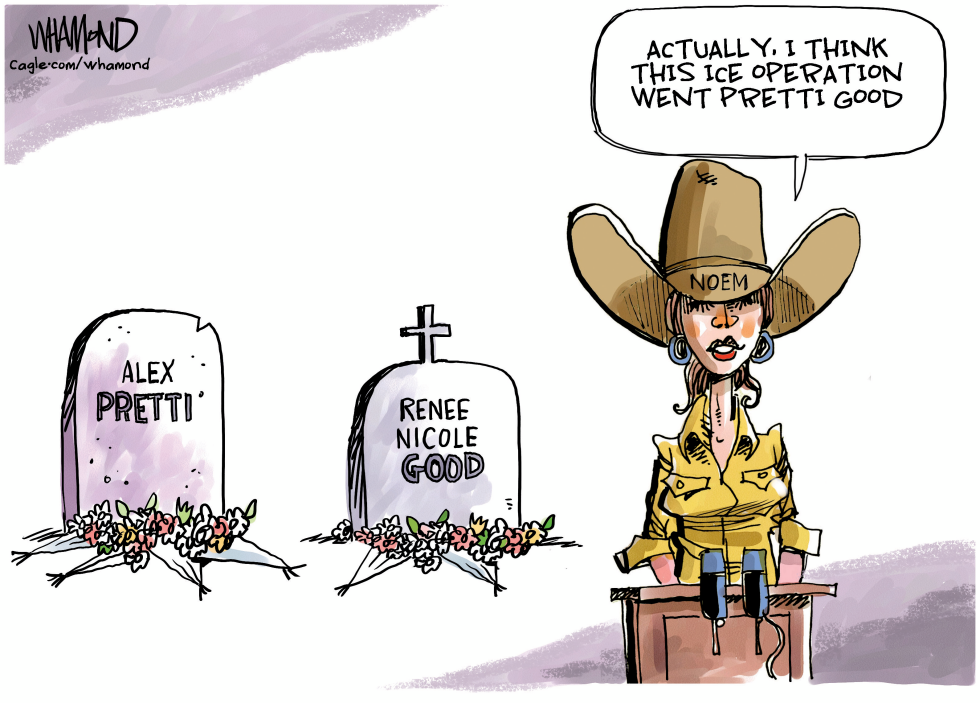
This political cartoon by Whamond features South Dakota Governor Kristi Noem, a prominent Republican and potential Trump ally, wearing a cowboy hat labeled 'NOEM' and speaking at a podium. She declares, 'Actually, I think this ICE operation went pretty good,' while standing beside two gravestones inscribed with 'Alex Pretti' and 'Renee Nicole Good,' adorned with flowers. The image satirizes immigration enforcement, border policy, and the human cost of deportation, highlighting perceived political callousness toward migrant deaths. Through humor and irony, it critiques how politicians like Noem might downplay tragedies in ICE operations, making it a sharp editorial cartoon on current Republican stances.
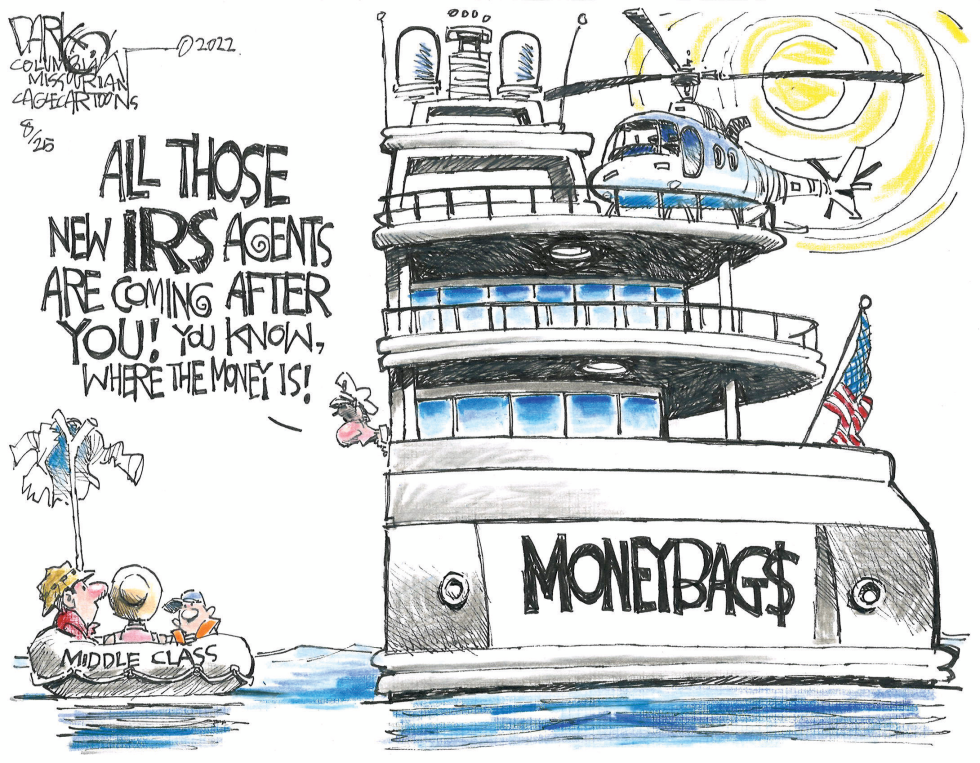
John Darkow's cartoon shows a helicopter approaching a grand yacht called Moneybags, complete with an American flag waving, while bold text declares that all those new IRS agents are coming after you, knowing where the money is. A tiny inflatable boat labeled middle class holds a family of three, paddling in the water nearby. The scene captures the essence of IRS agents targeting wealthy tax evaders, contrasting the opulent vessel against the modest raft. This IRS hiring satire underscores debates around the Inflation Reduction Act, with the helicopter symbolizing swift enforcement on big money. The dry humor in the composition points to tax policy inequality, making it a sharable piece of political commentary.
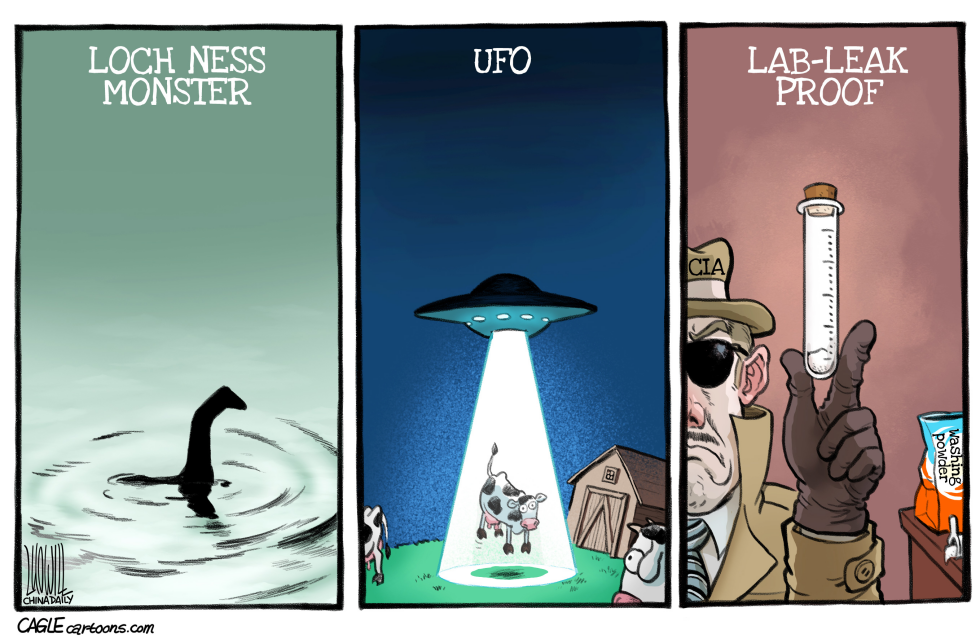
This political cartoon features three panels: one with the Loch Ness Monster emerging from water, another with a UFO beaming up a cow from a farm, and a third showing a man in a CIA hat holding a test tube next to a baking powder box, labeled as lab-leak proof. The artwork ties together famous hoaxes like the Loch Ness Monster and UFO phenomena with the lab leak theory, suggesting skepticism toward claims about the virus origin from China. Artist Luojie uses simple, bold lines to highlight the absurdity, placing the CIA figure in a detective-like pose to mock intelligence reports. Tags such as hoaxes, lab leak theory, CIA, China, political, and virus underscore the satirical take on conspiracy narratives. The composition groups these elements to question the validity of unproven theories.