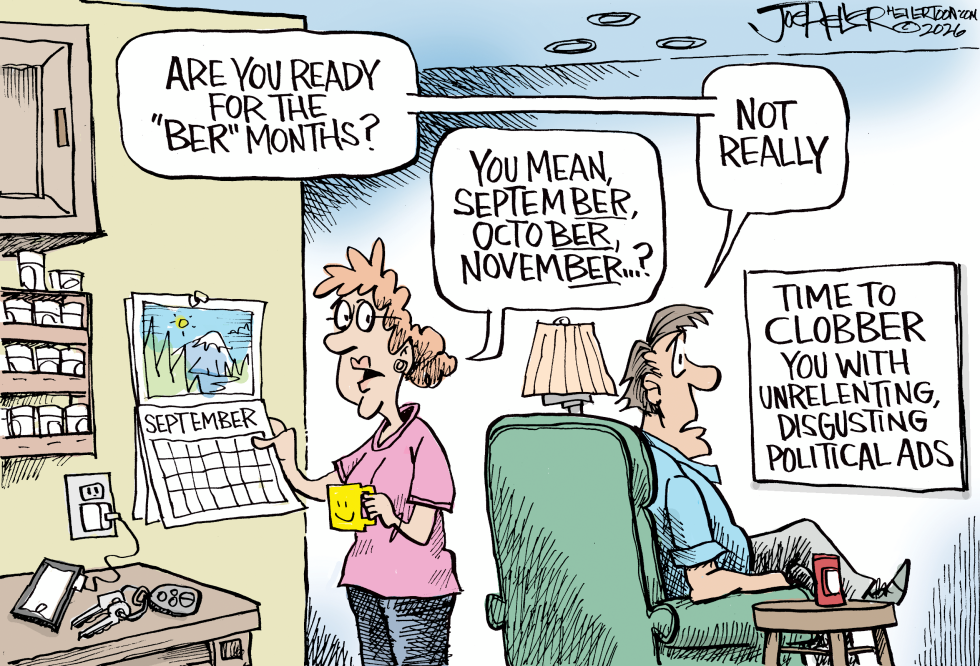
As September begins, the annual cycle of fall political advertising intensifies ahead of November elections. Candidates and outside groups ramp up spending on television, digital and mail campaigns to reach voters. The volume of messages creates widespread fatigue among the public. The cartoon highlights the predictable dread that accompanies the shift from summer to the final stretch of the campaign calendar.
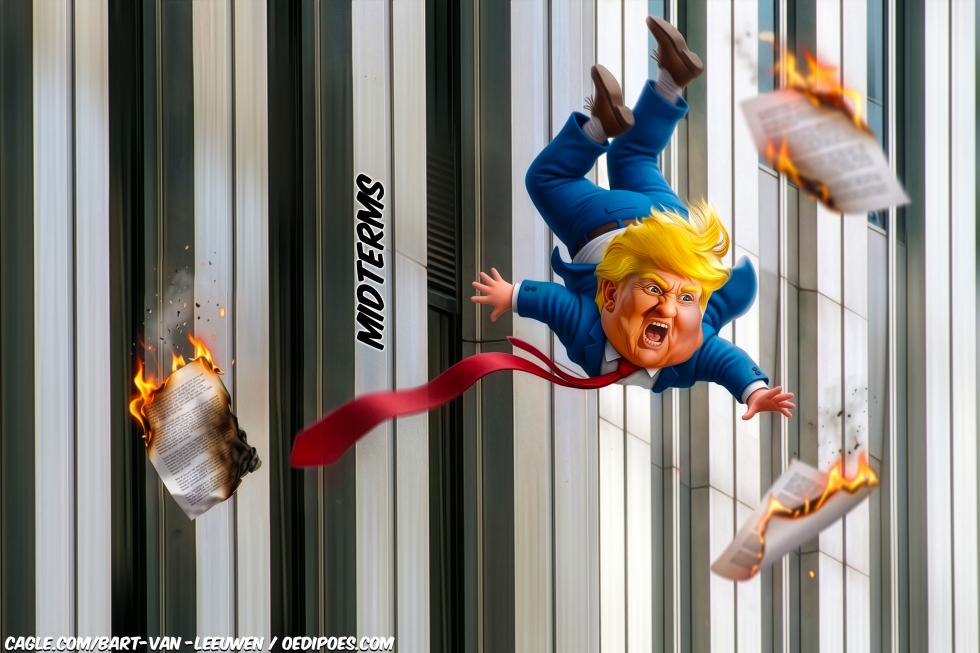
The cartoon shows a caricature of Donald Trump tumbling from a tall building while clutching at burning documents. Vertical lettering spells out midterms along the facade. The scene captures the editorial view of Trump's political position weakening ahead of the 2026 elections. Burning papers suggest damaging records or failed policies catching fire. The falling figure with an open mouth conveys alarm and loss of control. Publication occurred on September 9, 2026, during active midterm campaigning.
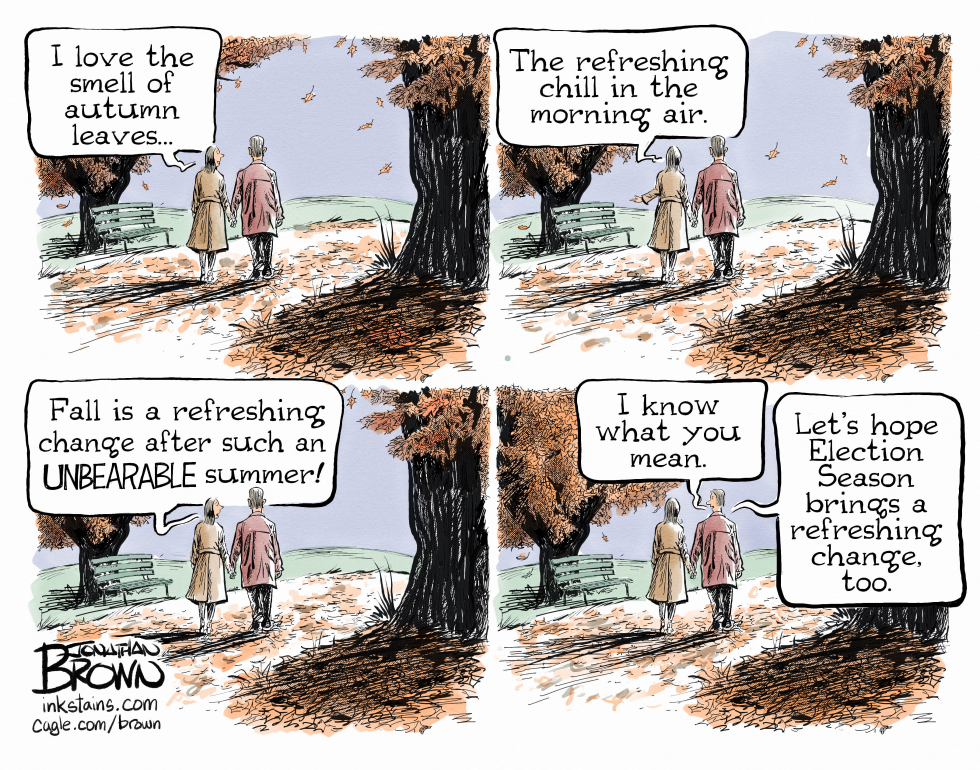
The cartoon depicts a couple strolling through an autumn park and commenting on the season's appeal. Their conversation turns to the election cycle as another potential source of renewal. The work uses the familiar transition from summer to fall to express a common voter sentiment ahead of the 2026 midterms. No specific candidates or policies are named, keeping the focus on the general wish for improvement. The four-panel format builds the parallel gradually before delivering the final line about election season.
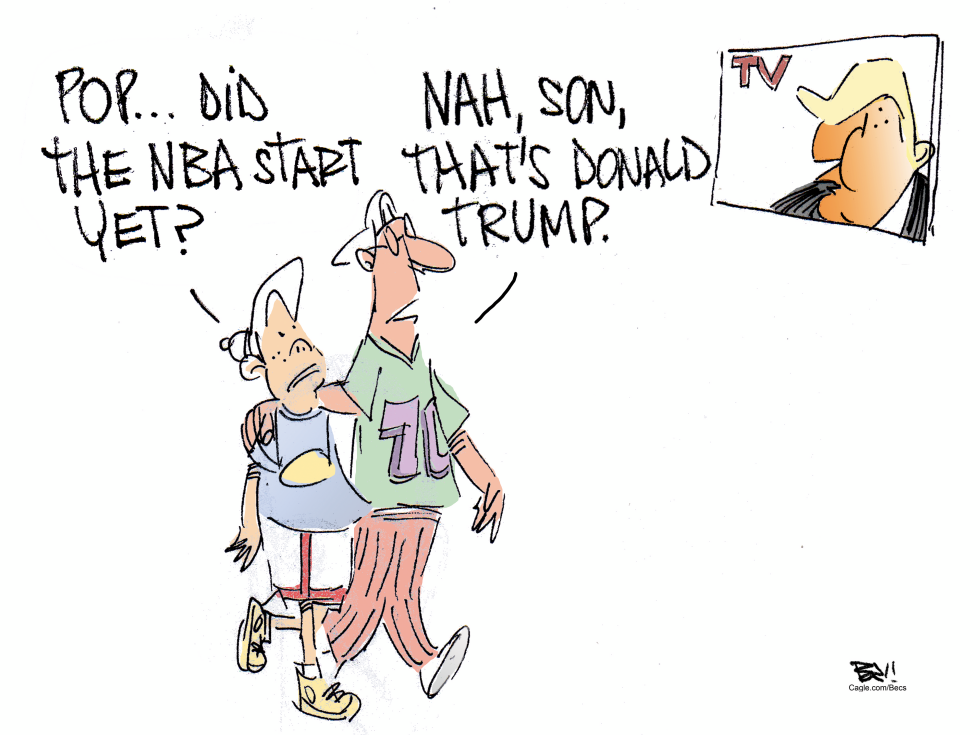
A father and son discuss the start of the NBA season while watching television. The son inquires whether the game has begun. The father replies that the figure shown is Donald Trump. The exchange highlights ongoing public attention to Trump's public profile and media presence. The piece presents the mix-up as a lighthearted comment on how Trump's image appears in everyday contexts.
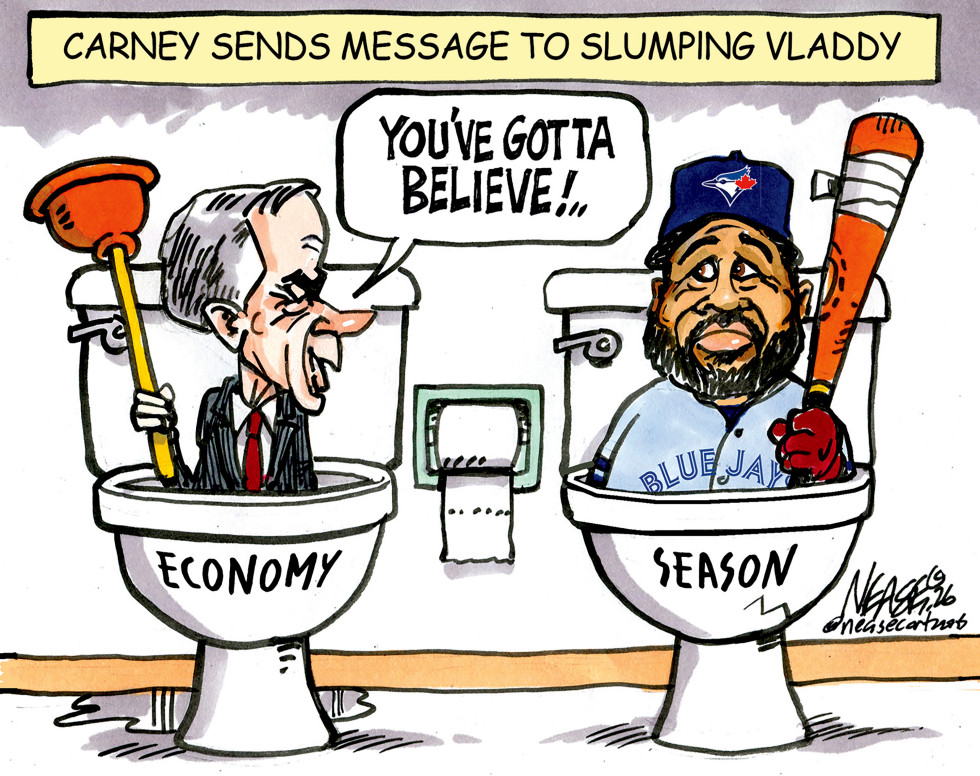
On August 12 2026 Mark Carney addressed Vladimir Guerrero Jr. during simultaneous downturns for the Canadian economy and the Toronto Blue Jays season. The exchange highlights ongoing pressures on both fronts with Carney positioned as a voice of encouragement. The piece frames the interaction as a direct motivational message from the political sphere to the sports world.
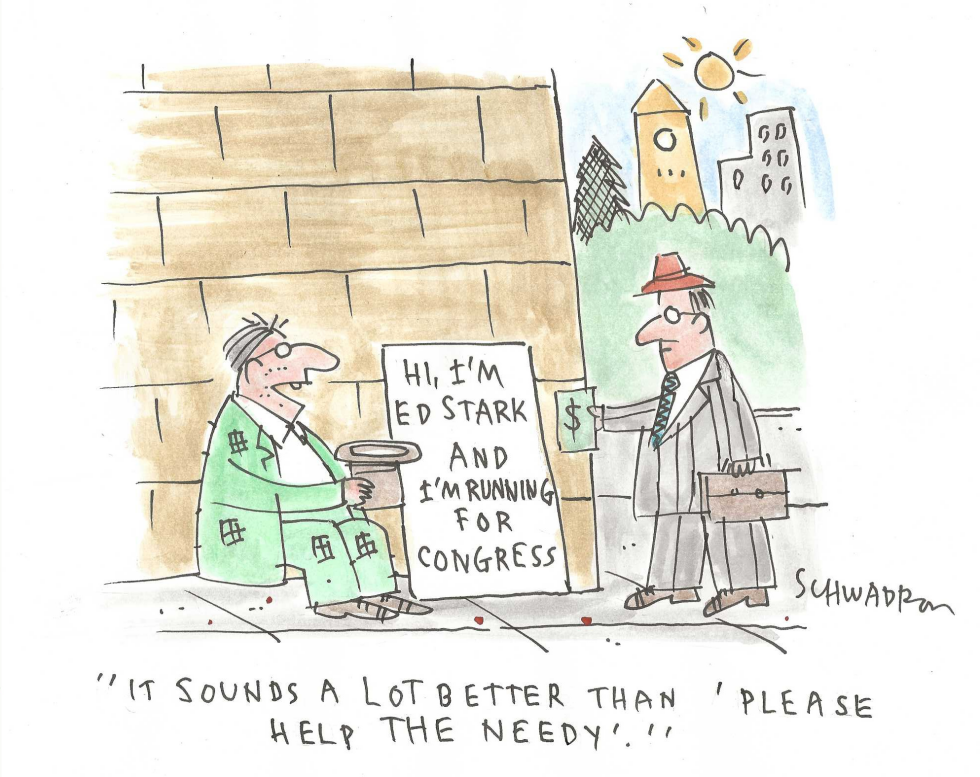
Ed Stark, identified on his campaign sign as a congressional candidate, sits on a sidewalk displaying his bid for office. A suited donor extends cash toward him. The scene highlights the routine nature of campaign fundraising. The piece frames the candidate's appeal as a more respectable version of street solicitation. It underscores how candidates routinely seek contributions to sustain their races.
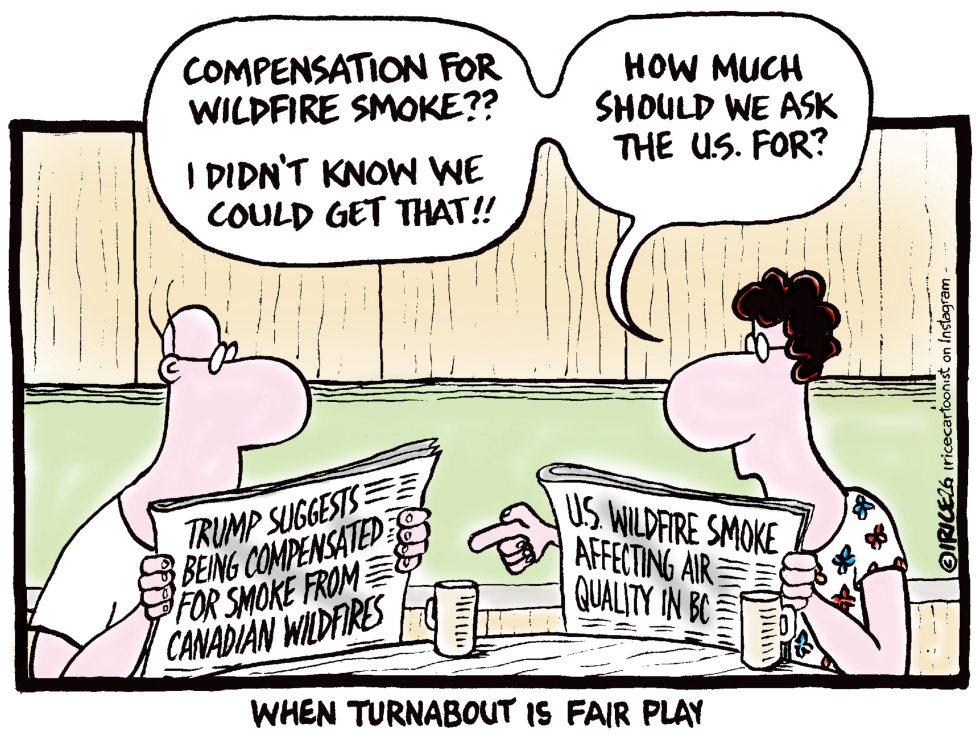
Donald Trump suggested the U.S. should receive compensation for smoke from Canadian wildfires. The cartoon responds by showing Canadians considering a reciprocal claim for smoke from U.S. wildfires affecting British Columbia air quality. It underscores the political dynamic of mutual environmental grievances between the two nations.
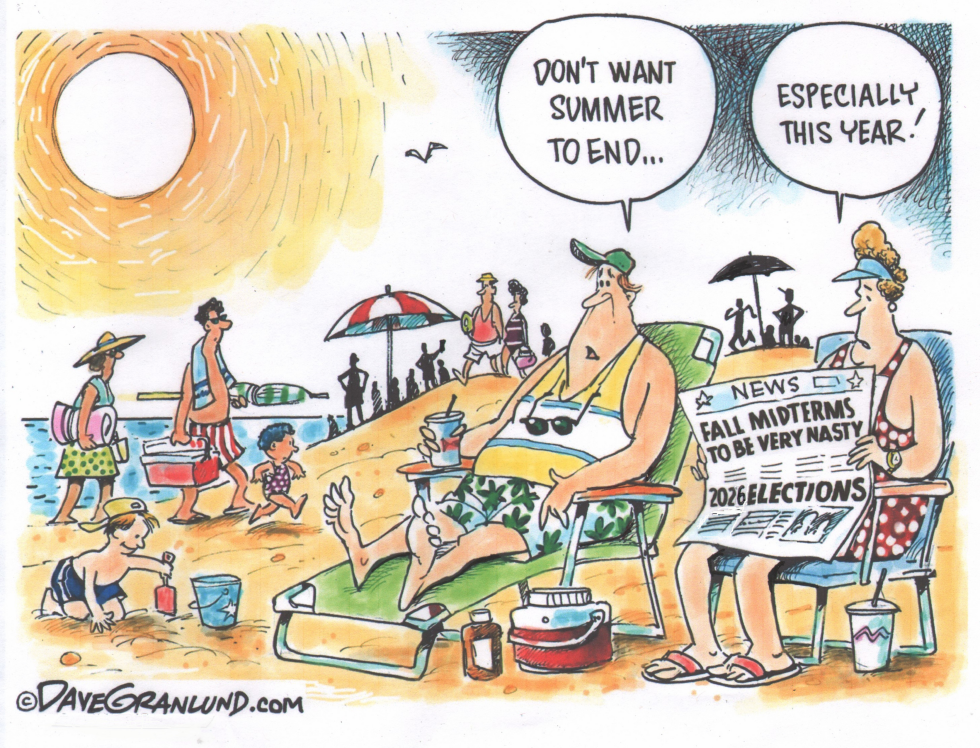
With the 2026 midterm elections approaching, voters across the country are bracing for contentious races that could reshape Congress. The campaigns are already shaping up to be unusually heated, with both parties mobilizing aggressively. This dynamic matters because control of the House and Senate will influence policy on spending, investigations, and presidential priorities for the remainder of the term. The piece takes the position that many citizens would rather avoid the coming political battles altogether.
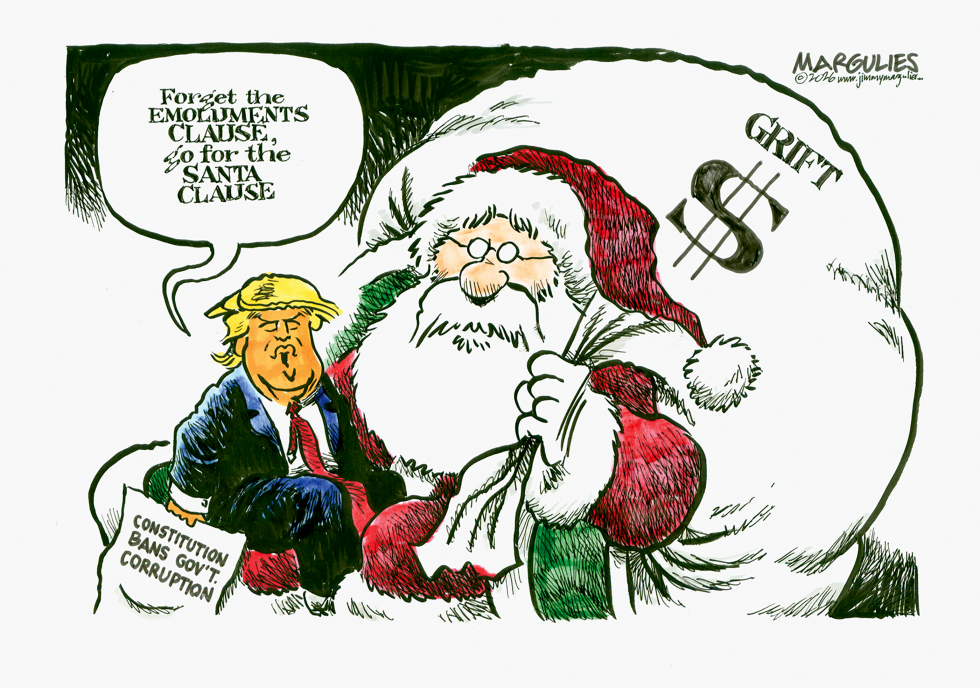
On July 3 2026 Jimmy Margulies depicts Donald Trump dressed as Santa Claus pushing aside the emoluments clause in favor of holiday presents. Trump sits holding a document citing the Constitution ban on government corruption while gripping a large sack marked GRIFT filled with dollar signs. The speech bubble urges forgetting the emoluments clause to pursue the Santa clause instead. The image responds to ongoing debates about presidential business dealings and foreign payments during the holiday period.
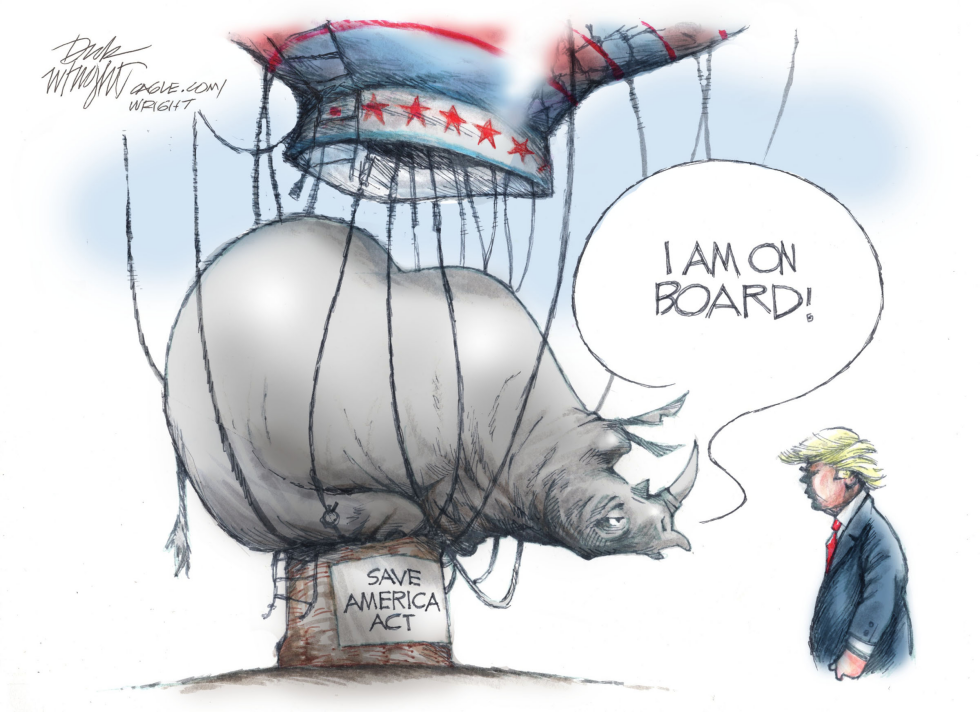
Donald Trump appears on the right side of the scene and states support for the Save America Act. A large rhino figure rests on a base marked with the act name and is connected to an overhead structure resembling the Capitol dome. The rhino faces toward Trump. The date of the image is July 1 2026.
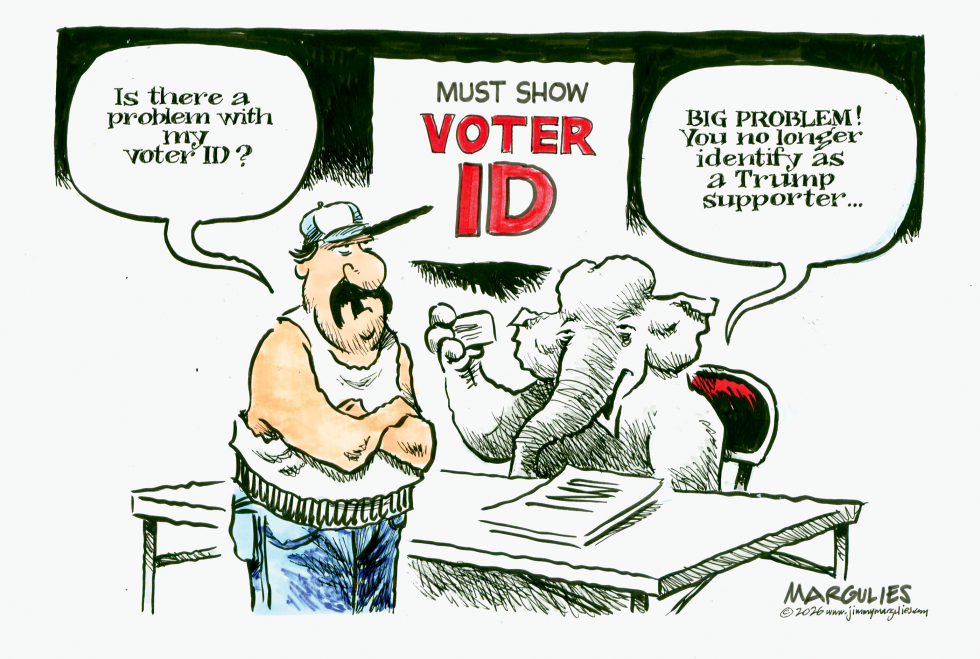
A voter at a registration desk presents identification while asking if there is an issue. The Republican elephant official responds that the problem stems from the man no longer identifying as a Trump supporter. The scene centers on a large sign requiring voter ID. This cartoon from June 2026 addresses ongoing debates over identification rules at polling places and shifting political affiliations ahead of elections.
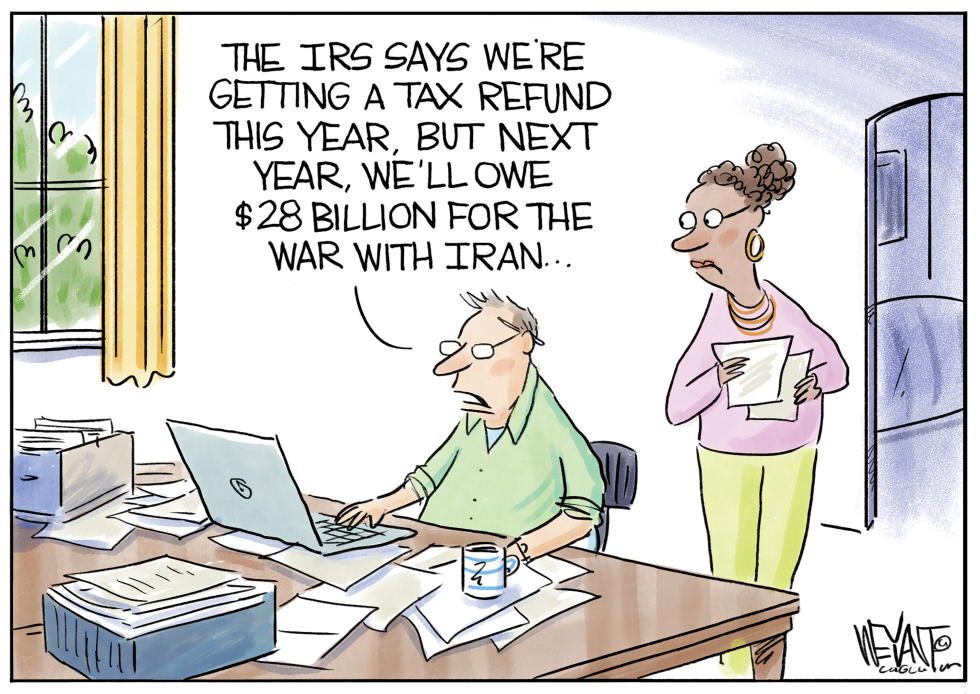
Dive into this biting political cartoon tax refund piece where a woman, holding papers, informs a laptop-working man about their IRS windfall this year, only to drop the bomb of owing $28 billion next for the war with Iran. The satirical cartoon Iran war vibe captures the absurdity of US taxes funding wars, with cluttered desks and exasperated expressions underscoring the humorous take on federal spending. It's a classic taxpayer burden Iran conflict jab, poking fun at government spending satire while illustrating the disconnect between personal finances and massive military expenses. Through cartoon about military expenses, it cleverly critiques fiscal policy in an office setting, making the war with Iran taxpayer joke both relatable and irreverently insightful for viewers pondering editorial cartoon fiscal policy.
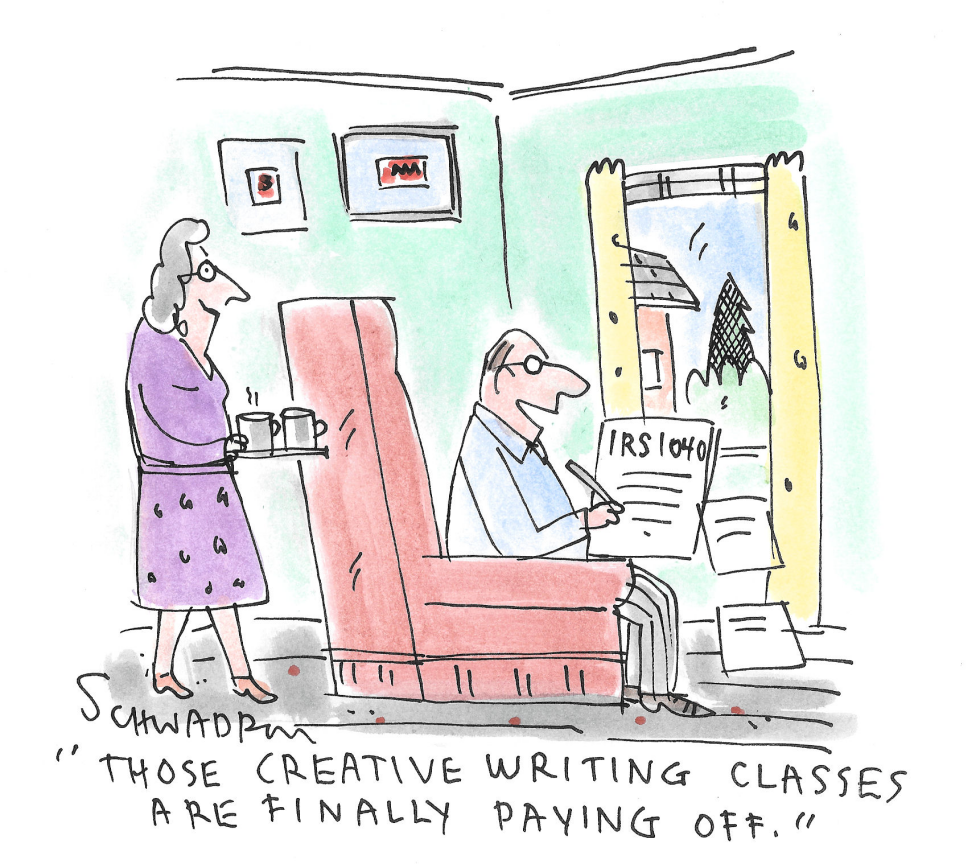
This tax season humor cartoon depicts an older man seated in a red armchair, penning details on an IRS 1040 form, as his wife stands nearby with a tray of steaming cups, delivering the punchline about creative writing classes paying off. The satirical view of income tax returns captures a domestic scene tax time parody, where the husband channels his educational investments into what appears to be an imaginative approach to tax filing. With a humorous take on tax preparation creativity, the illustration pokes fun at the notion of turning literary flair into fiscal advantage, all set against a simple indoor backdrop with wall art and a window view. The witty commentary underscores how seemingly unrelated skills like those from creative writing classes can 'pay off' in unexpected ways, especially during the dreaded tax season. Artist signature 'Schwadron' adds a touch of authenticity to this political cartoon on tax evasion creativity.
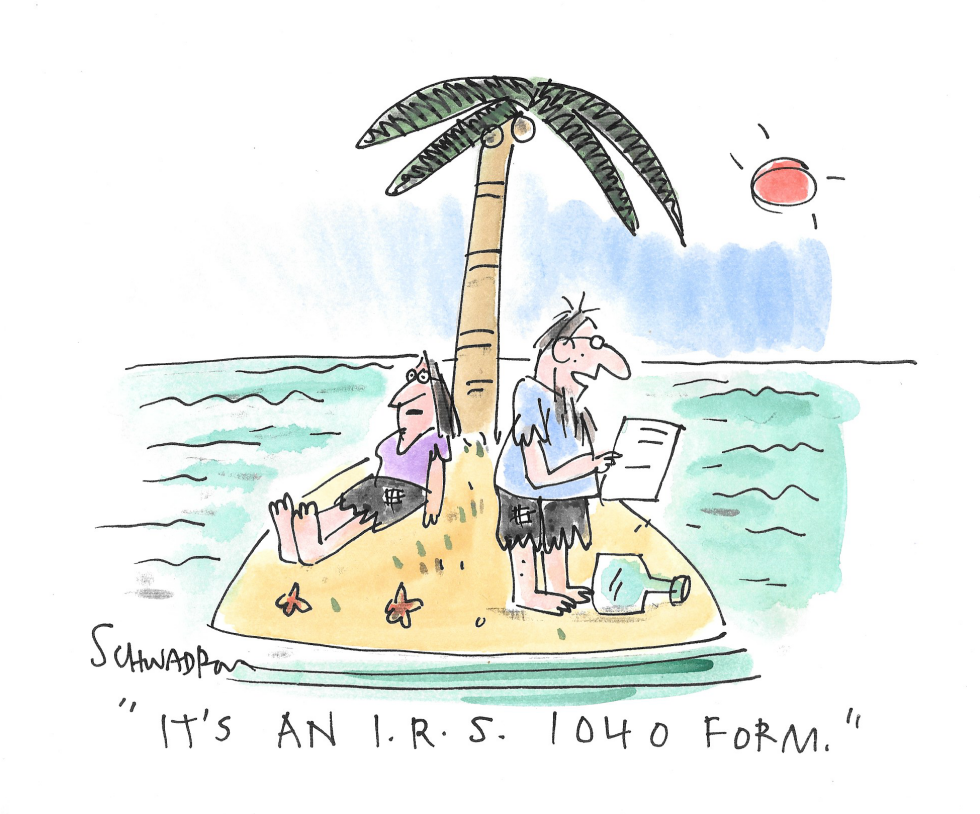
The cartoon shows two figures in tattered clothes on a small desert island with ocean waves, a palm tree, and a setting sun. One holds a document, speaking the line about it being an IRS 1040 form, pulled from a bottle on the sand. This setup delivers dry humor on taxes intruding even in isolation, a classic trope in editorial cartoons. Tags like IRS tax form cartoon, desert island castaways humor, tax season satire, message in a bottle parody, 1040 form joke, and funny tax filing cartoon underscore the visual punch. The artwork keeps it simple, focusing on the absurdity without overcomplicating the scene.
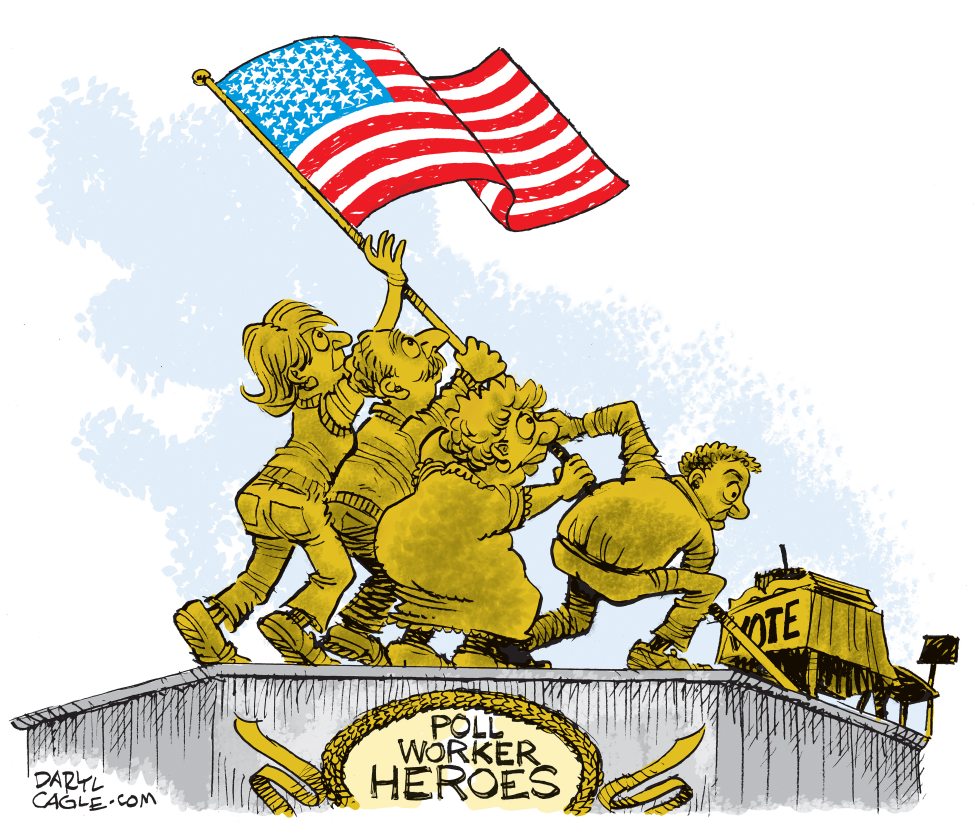
The cartoon shows a group of figures styled as a bronze statue, mimicking the famous Iwo Jima war memorial in Washington DC, where Marines raised the American flag during World War Two. Here, poll workers struggle to plant the flagpole into a box labeled 'VOTE,' with the base inscribed 'POLL WORKER HEROES.' This satire ties into the 2024 presidential election, featuring tags like campaign 2024, Donald Trump, Kamala Harris, voter fraud, and MAGA. It underscores the heroic efforts of election staff amid heated debates over fraud allegations, blending historical reverence with contemporary political tension in a straightforward, humorous visual commentary on democracy's frontline defenders.