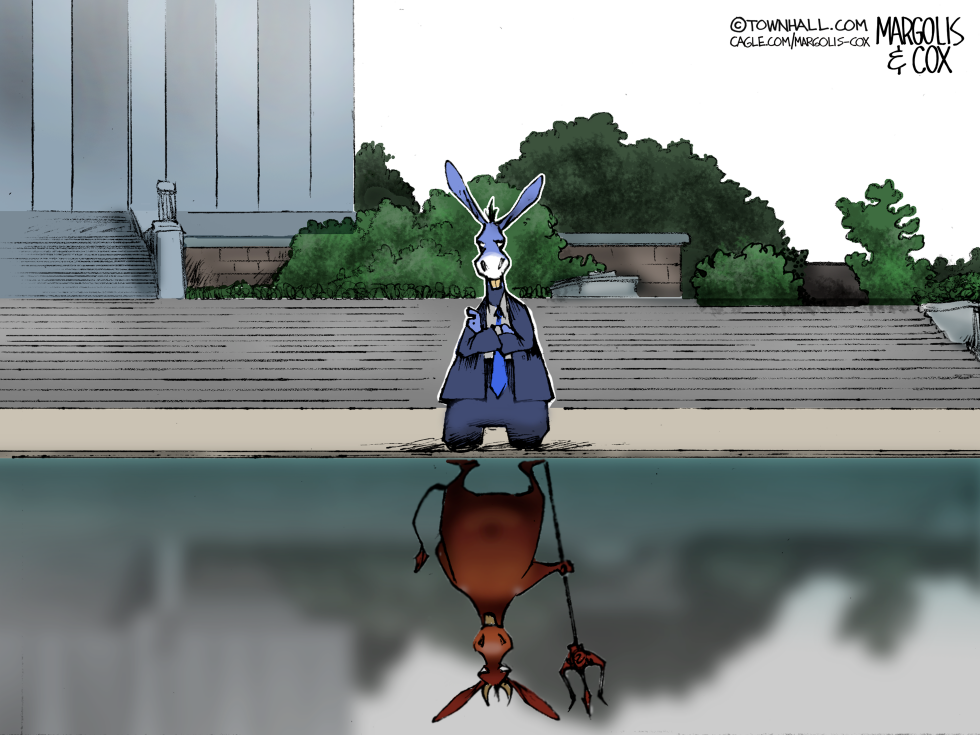
A donkey wearing a blue suit and tie stands with arms crossed on stone steps before a government-style building. Its reflection in the foreground water transforms into a red devil complete with horns, tail and pitchfork. The image from Margolis & Cox dated June 26 2026 uses the classic Democratic Party symbol to present an internal self-view. No specific legislation or election from the prior month is referenced in the visual. The composition places the figure centrally against trees and columns with the credit line in the upper right.
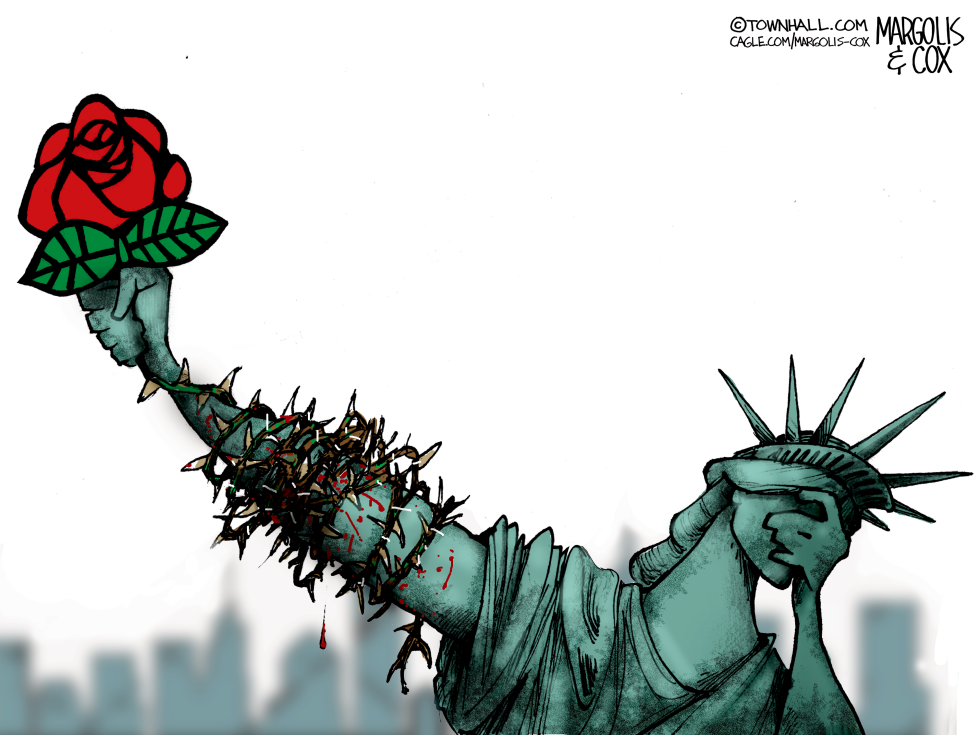
The image shows the Statue of Liberty with her raised arm entangled in barbed wire that draws blood, holding a large red rose in place of the traditional torch. Her other hand covers her face as the New York skyline fades behind her. The work responds to ongoing debates over socialist symbolism in American public imagery on the June 2026 date. The visual replaces the torch with the rose, a traditional emblem of socialism, while the barbed wire suggests entrapment or harm. Artist credit appears in the upper right corner.
The cartoon shows the Democratic donkey clutching a handgun labeled uncritical Israel support. A box overhead reads Bibi Gun. The donkey wears a suit and tie. The image responds to ongoing debates over US policy toward Israel and Benjamin Netanyahu in June 2026.
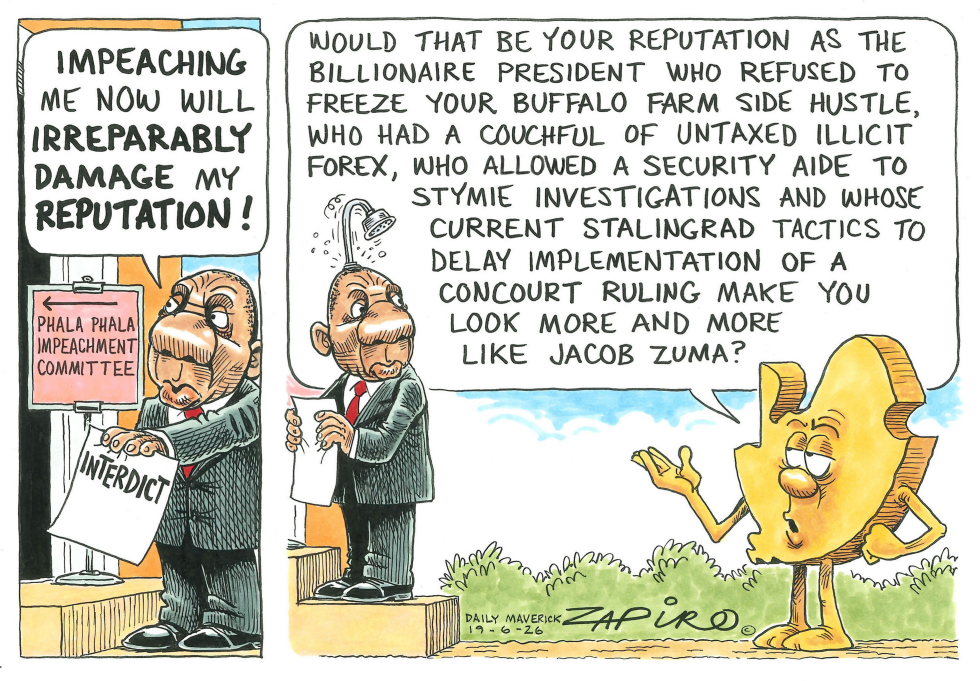
South African President Cyril Ramaphosa seeks a court interdict to halt impeachment proceedings tied to the Phala Phala farm scandal. The June 2026 cartoon depicts him warning of reputation damage while a Swiss-cheese figure highlights alleged forex issues, stalled investigations and ConCourt ruling delays that echo Jacob Zuma tactics.
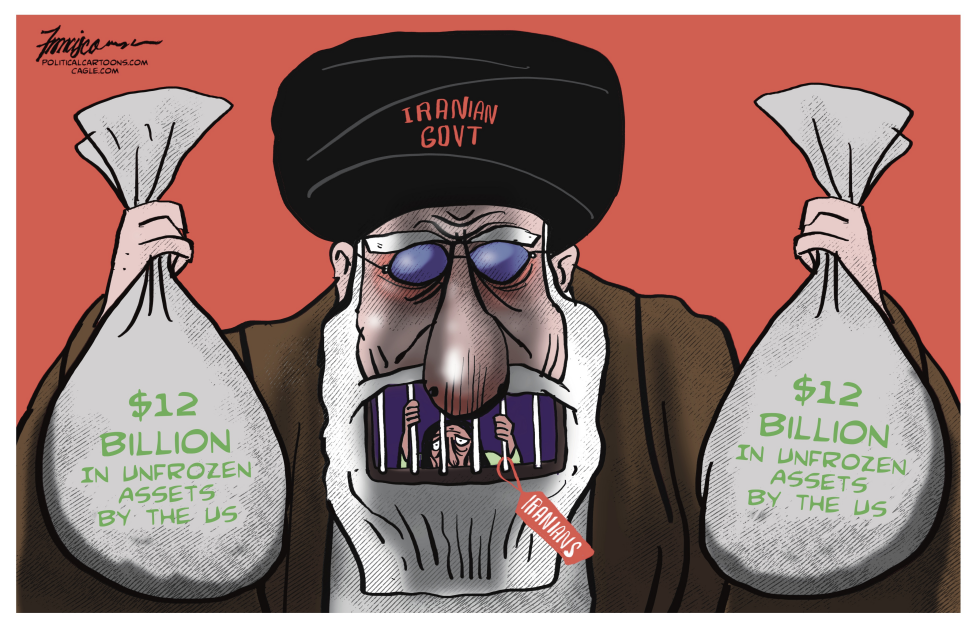
A political cartoon dated June 19, 2026, shows a figure representing the Iranian government holding two large sacks labeled $12 billion each in unfrozen US assets. The figure wears a black turban marked Iranian Govt. Small figures appear behind bars inside the mouth area, one tagged Iranians. The image responds to ongoing discussions about US policy on releasing Iranian government funds held abroad. It illustrates the contrast between the leadership receiving the money and the situation for ordinary citizens.
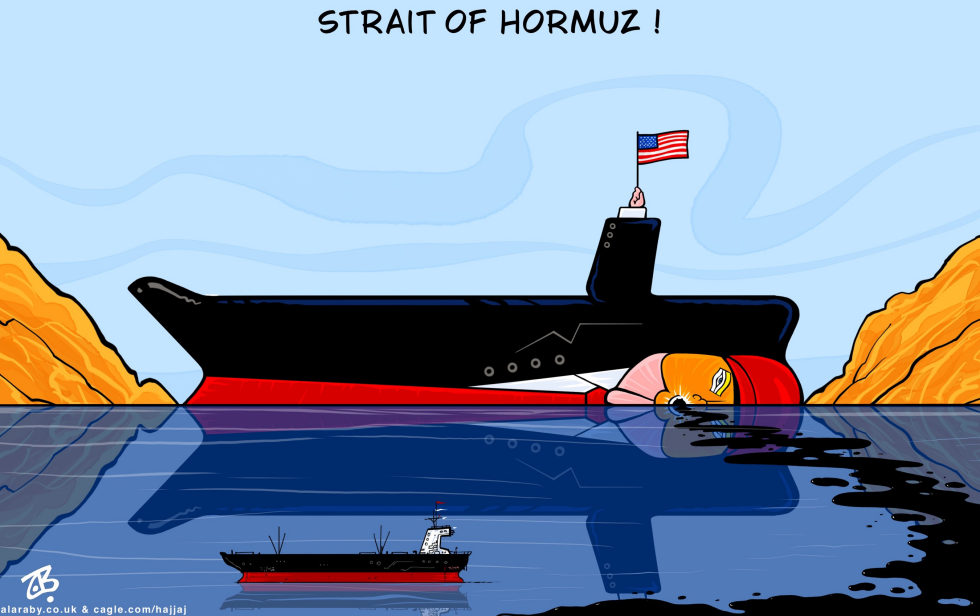
Emad Hajjaj's cartoon depicts a large black submarine with a red hull, stuck between orange landmasses in the Strait of Hormuz, its bow featuring an orange face with yellow hair and a red tie, clearly caricaturing Donald Trump. An American flag flies atop the vessel, while black oil spills into the blue water, reflecting the ship. Below, a smaller black tanker with a white figure onboard sails through the oily sea, tagged with Persian, Gulf, Sea, Tanker, Oil, War. The image satirizes US involvement in Middle East conflicts, particularly Iran war scenarios, without overreaching into hidden meanings. The composition is straightforward, with clear lines and bold colors emphasizing the blockage.
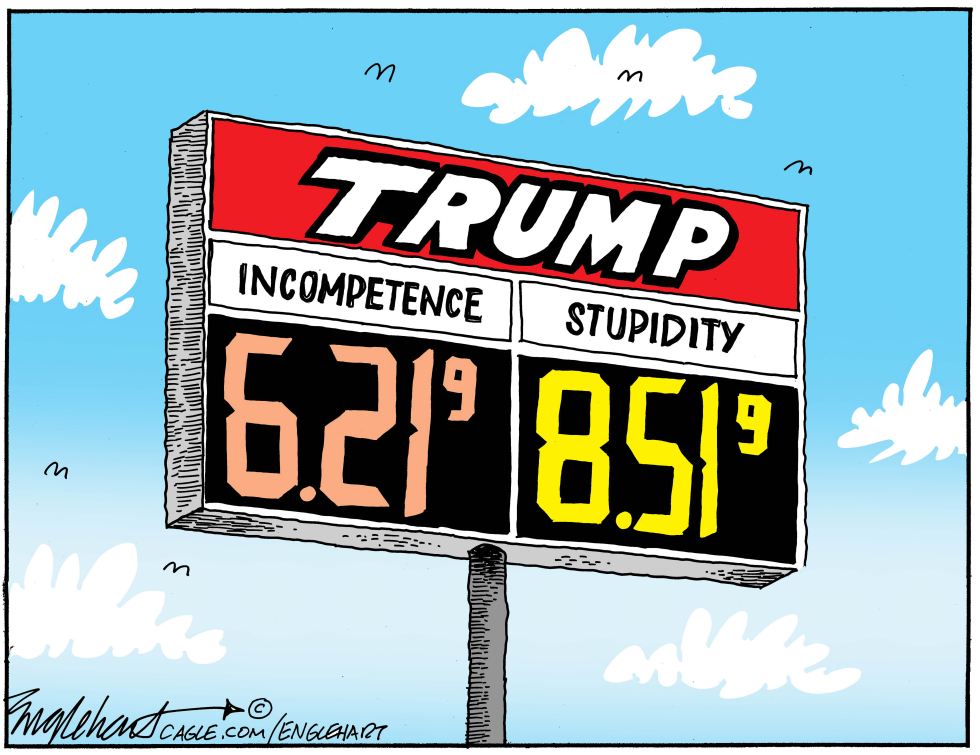
Bob Englehart's cartoon features a gas station sign with Trump at the top, showing prices for incompetence at 6.21⁹ and stupidity at 8.51⁹ against a blue sky with clouds. The tags Trump, Iran War, gas prices, gasoline, and gallon frame the visual pun. Such cartoons often tie political figures to everyday economic pains like fuel costs. The dry humor lands on how leadership flaws inflate prices, making it relatable for readers hit by pump shocks. With no characters, just the sign, it keeps the message direct. Tags like incompetence and stupidity drive the satire home, poking at perceived policy missteps without overcomplicating the scene.
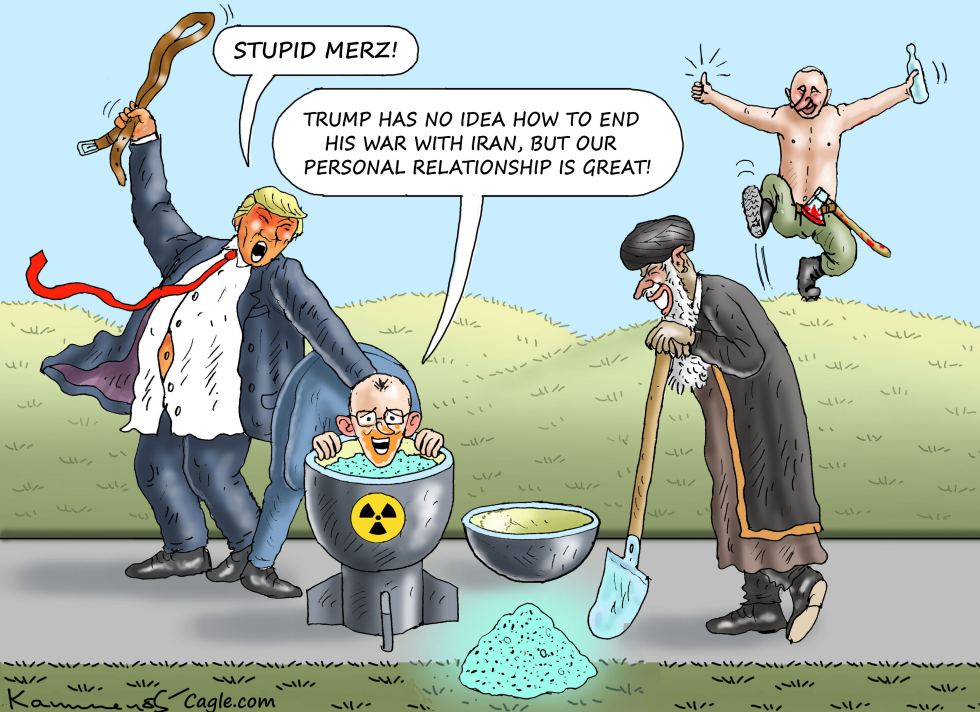
The cartoon depicts a red-faced Trump, tie askew, raising a belt to strike a bald, bespectacled man labeled Merz whose head pokes from a nuclear bomb-shaped vat of blue liquid. An elderly bearded man in turban and robe uses a shovel to scoop more blue material from a bowl, while a shirtless, axe-wielding figure resembling Putin jumps in approval, bottle in hand, speech bubble praising the great personal relationship amid Trump's cluelessness on ending his Iran war. Tags like Trump, Merz, Iran War, Middle East, Fascism, Maga Terror, Hormuz underscore the satirical jab at geopolitical follies, with dry humor poking at failed diplomacy and bizarre alliances in this Kamensky creation for Cagle.com.
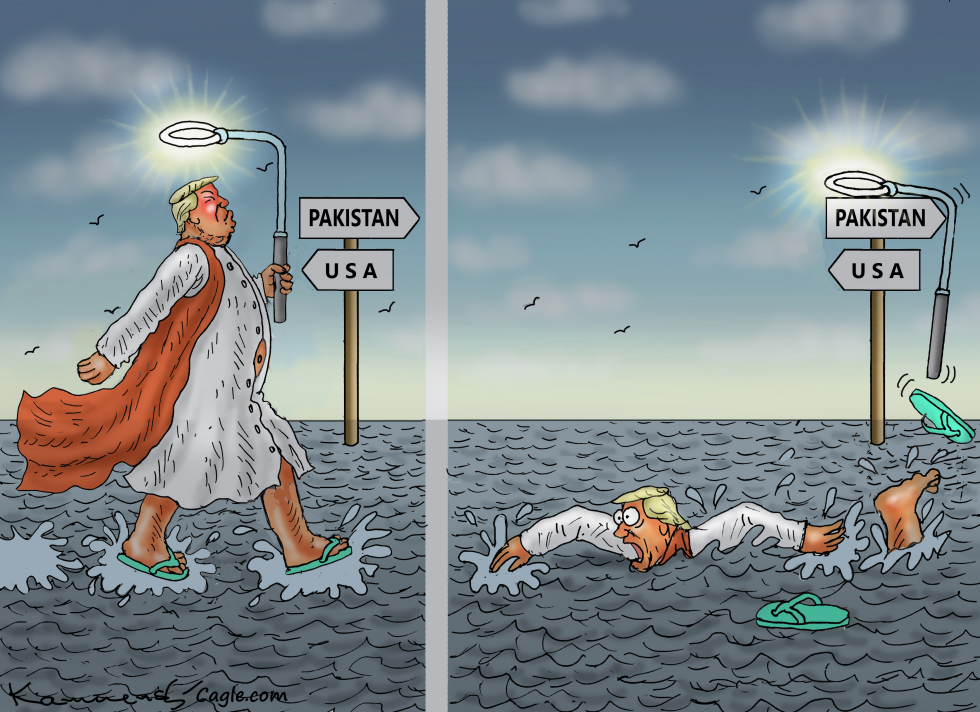
Marian Kamensky\'s cartoon captures Trump with a halo, striding across the sea in robes and flip-flops toward signs pointing to Pakistan and USA, evoking peace talks amid Hormuz strife. The satire turns sharp as Trump, embodying fascism and MAGA terror, plunges into the waves, desperately swimming while his flip-flop floats away and the signpost topples. This two-panel setup underscores the hubris of political figures tackling international relations, blending humor with critique of overreaching ambitions in U.S.-Pakistan dynamics. The artwork\'s clean lines and exaggerated expressions amplify the dry wit, making it a pointed commentary on failed diplomacy and self-proclaimed savior complexes in global politics.
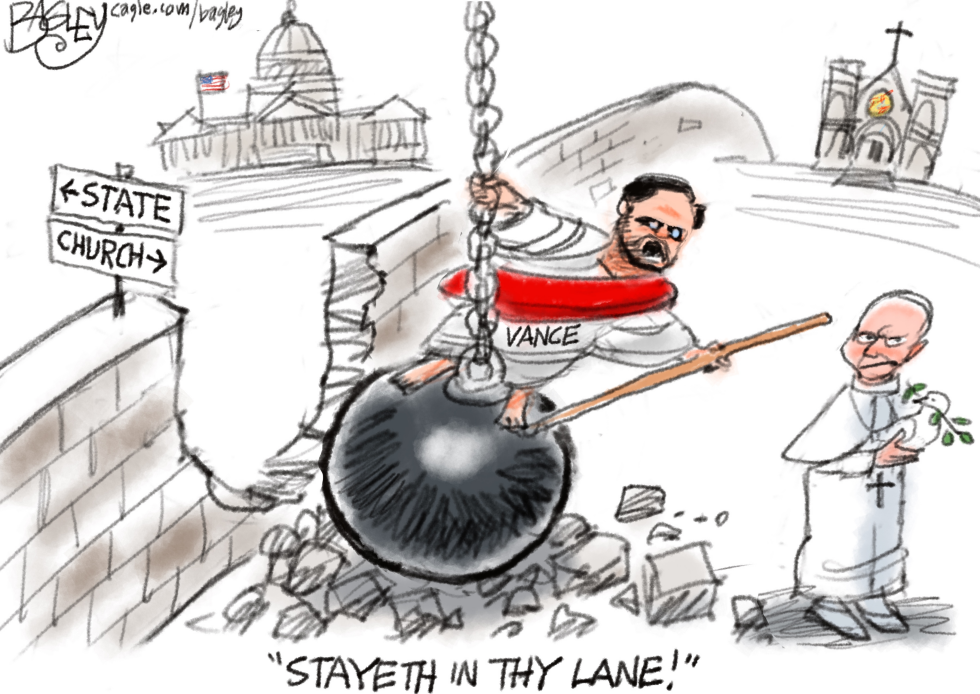
Pat Bagley's cartoon shows JD Vance dressed as Jesus, labeled 'VANCE,' swinging a massive wrecking ball to shatter a brick wall marked with signs pointing to 'STATE' and 'CHURCH.' He shouts 'STAYETH IN THY LANE!' at a figure resembling the Pope, who holds an olive branch and dove, symbols of peace. In the background, the U.S. Capitol flies an American flag, while a church with a cross represents the Vatican. Tags like war, peace, JD Vance, religion, Trump, and scripture underscore the satire on blurring lines between church and state, with Vance enforcing boundaries ironically through destruction. The image critiques political figures invoking religion amid Capitol politics.
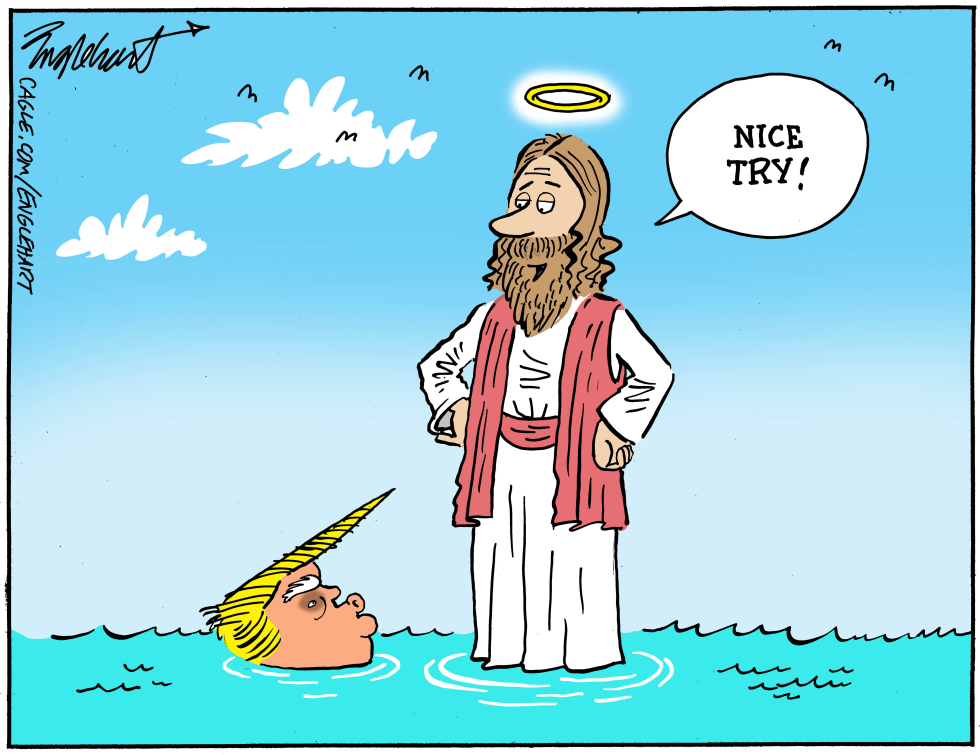
Bob Englehart's cartoon features a Jesus-like figure with a halo and robe, standing effortlessly on blue water under a clear sky, hands on hips, saying 'NICE TRY!' in a speech bubble. Below, a caricature head with exaggerated blonde hair sinks, eyes squinted, mouth open. Birds fly above fluffy clouds. Tags include political cartoon Trump Jesus comparison, satirical illustration Donald Trump biblical reference, Bob Englehart cartoon Trump walking on water fail, humorous depiction Trump messiah complex, editorial cartoon Trump self-comparison to Christ, and cartoon Trump sinking in water Jesus standing. The image pokes fun at overreaching self-images without deeper inference.
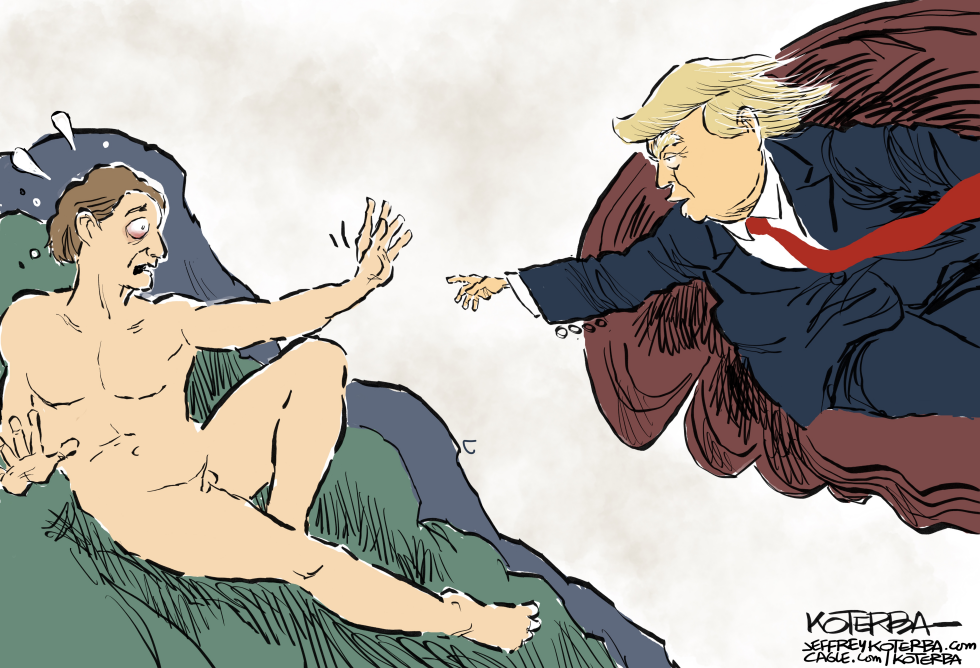
Jeff Koterba's cartoon reimagines Michelangelo's Creation of Adam, placing a Trump-like figure in the role of God, clad in a suit and red tie, floating in a red cloak while reaching toward a nude, shocked man resembling Adam on greenish rocks. The image captures satirical elements of presidential hubris, with tags including Trump caricature, political satire, divine parody, ego commentary, artistic homage, and cartoon humor. Such visuals often spark discussions on leadership perceptions, blending historical art with contemporary politics in a straightforward, humorous critique.
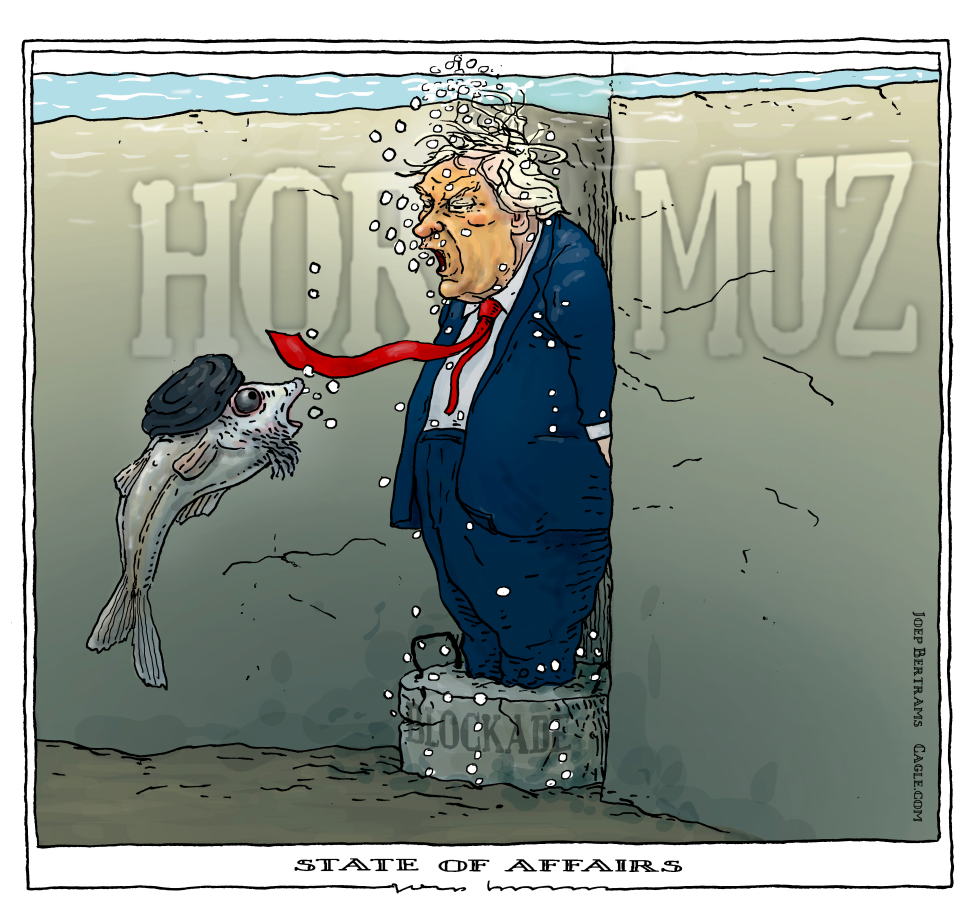
Joep Bertrams captures the Strait of Hormuz tensions with a caricature of Donald Trump sinking in concrete shoes marked blockade, bubbles rising from his open mouth as a fish in a black hat nibbles his red tie. The underwater setting features a cracked wall labeled Hormuz, emphasizing the sunk metaphor for diplomatic failures. Tags like Iran, concrete shoes, and fish highlight the satirical take on US-Iran relations, with the caption State of Affairs underscoring the dire situation. This cartoon from 2026 blends humor and commentary on potential blockades, showing Trump in a blue suit against a murky seabed.
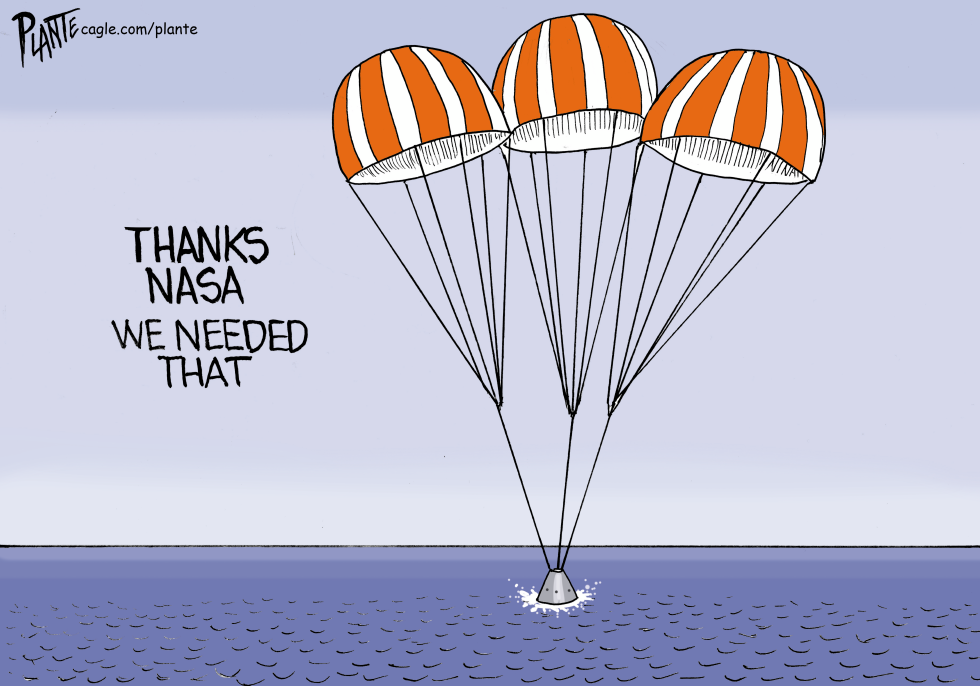
Bruce Plante\'s cartoon captures a space capsule\'s splashdown, complete with three orange and white striped parachutes guiding it to a blue ocean teeming with black fish-like forms. The prominent text \'Thanks NASA We Needed That\' adds a layer of sarcasm, typical in editorial illustrations commenting on high-profile events like the Artemis II mission. The simple composition, with a light blue sky and wavy ocean surface, emphasizes the moment of impact, shown by a small splash at the capsule\'s base. This piece fits into the tradition of political cartoons that highlight public sentiments toward government projects, using minimal elements for maximum impact. The artist\'s signature and website appear in the top left, grounding it in syndicated cartoon style.
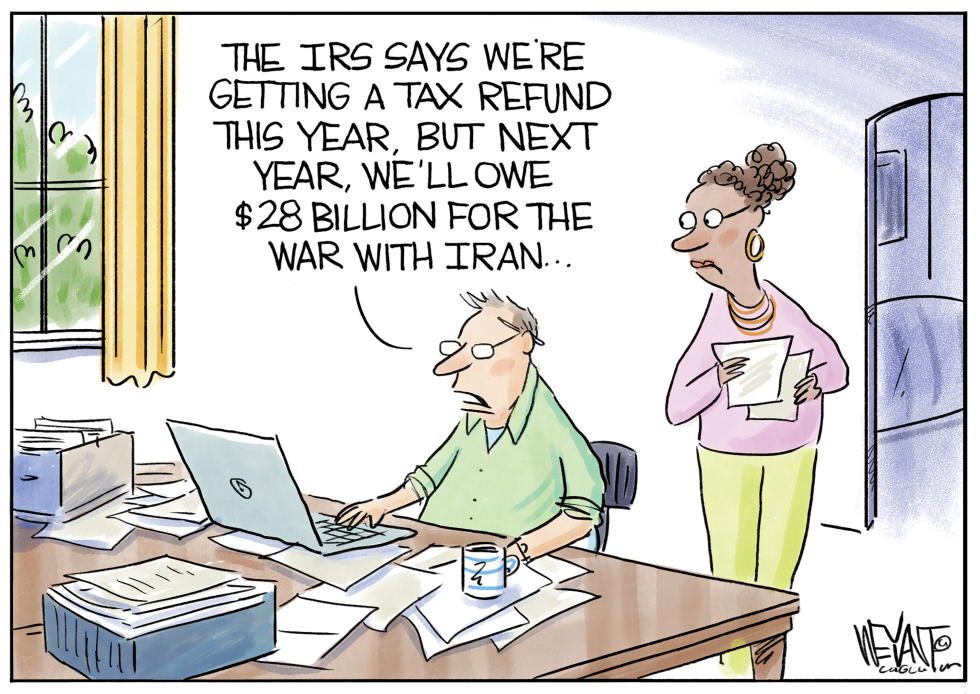
Dive into this biting political cartoon tax refund piece where a woman, holding papers, informs a laptop-working man about their IRS windfall this year, only to drop the bomb of owing $28 billion next for the war with Iran. The satirical cartoon Iran war vibe captures the absurdity of US taxes funding wars, with cluttered desks and exasperated expressions underscoring the humorous take on federal spending. It's a classic taxpayer burden Iran conflict jab, poking fun at government spending satire while illustrating the disconnect between personal finances and massive military expenses. Through cartoon about military expenses, it cleverly critiques fiscal policy in an office setting, making the war with Iran taxpayer joke both relatable and irreverently insightful for viewers pondering editorial cartoon fiscal policy.