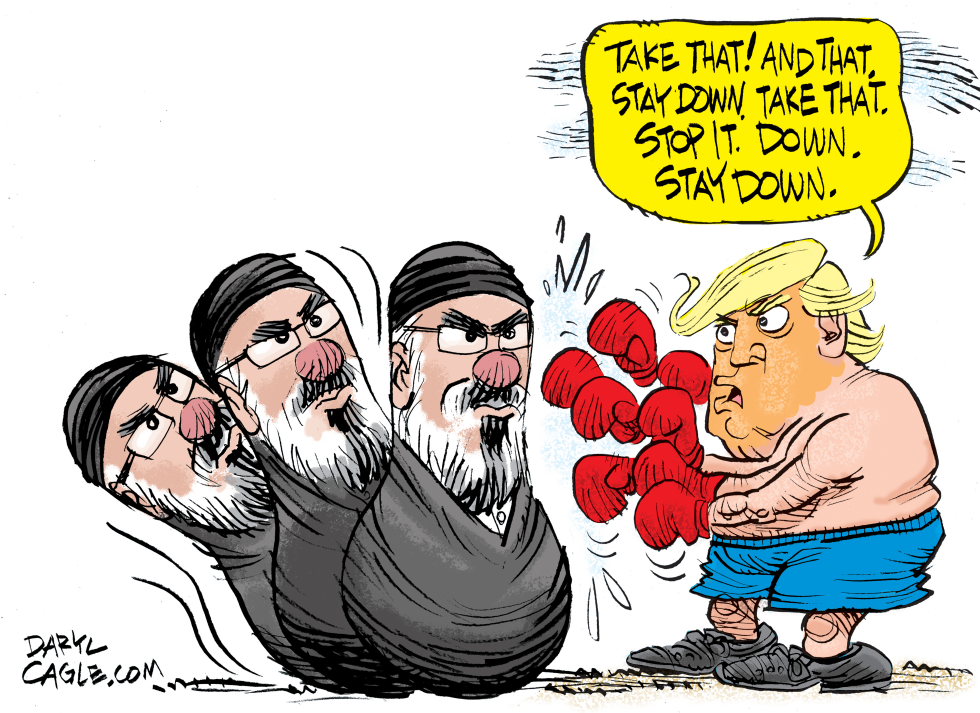
The cartoon shows Donald Trump, shirtless and wearing boxing gloves, repeatedly striking a large bop bag shaped like an Iranian cleric. Multiple faces of bearded men in turbans appear on the bag, which rebounds after each punch. A speech bubble captures Trump's frustrated commands for the figure to stay down. The image responds to reports of a new Iranian supreme leader and U.S. efforts against the regime in early 2026. It highlights the perceived futility of direct confrontations with Iran's leadership structure.
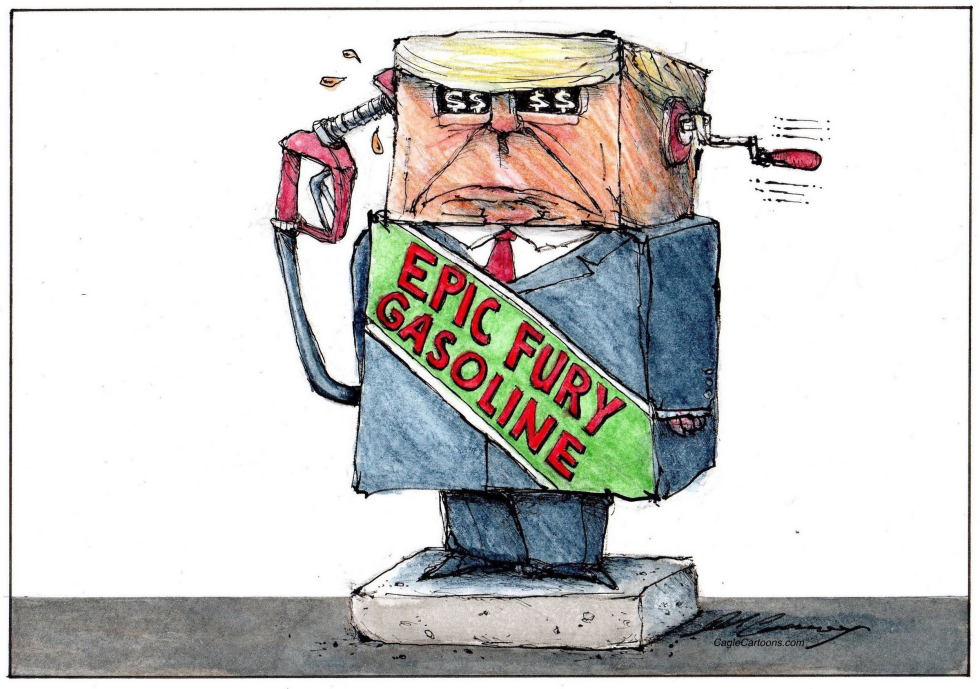
Dale Cummings draws Trump as a boxy gas pump, head topped with a dripping nozzle and $5.55 price tag, frowning in a suit with a green sash screaming Epic Gasoline Fury. Standing on a pedestal, the figure captures the essence of high gas prices tied to War in Iran and Operation Epic Fury. The cartoon skewers oil prices and Strait of Hormuz affordability, blending humor with commentary on economic fallout. It's a straightforward jab at political decisions driving up costs at the pump, rendered in watercolor style for punchy effect. Tags like War in Iran, Operation Epic Fury, oil prices, gas prices, Strait of Hormuz affordability, and affordability underscore the timely critique.
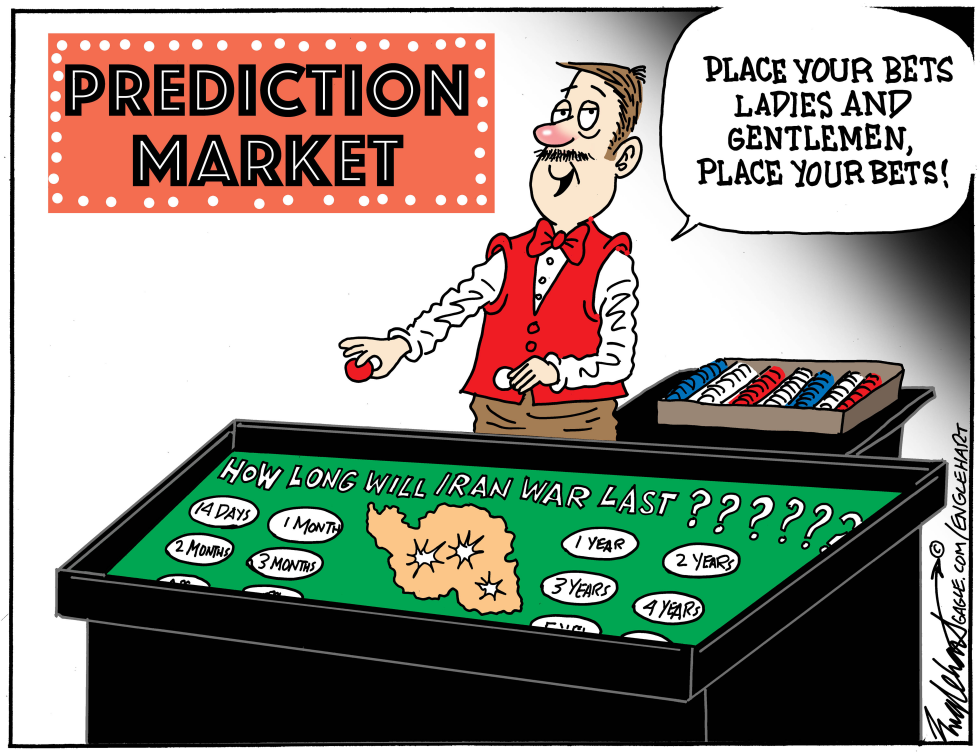
In a biting political cartoon, a smirking croupier oversees a prediction market table shaped like Iran, complete with explosion graphics, where punters can wager on war duration options ranging from 14 days to 5 years. This satirical take skewers the commodification of geopolitical betting, turning grave matters like Iran war into casino-style gambles. By blending elements of gambling on war with Middle East conflict, the artwork highlights the absurdity of prediction markets applied to real-world crises, offering humorous yet insightful commentary on how society speculates on political humor and potential catastrophes. The irreverent style underscores the folly of treating war length wager as just another market fluctuation.
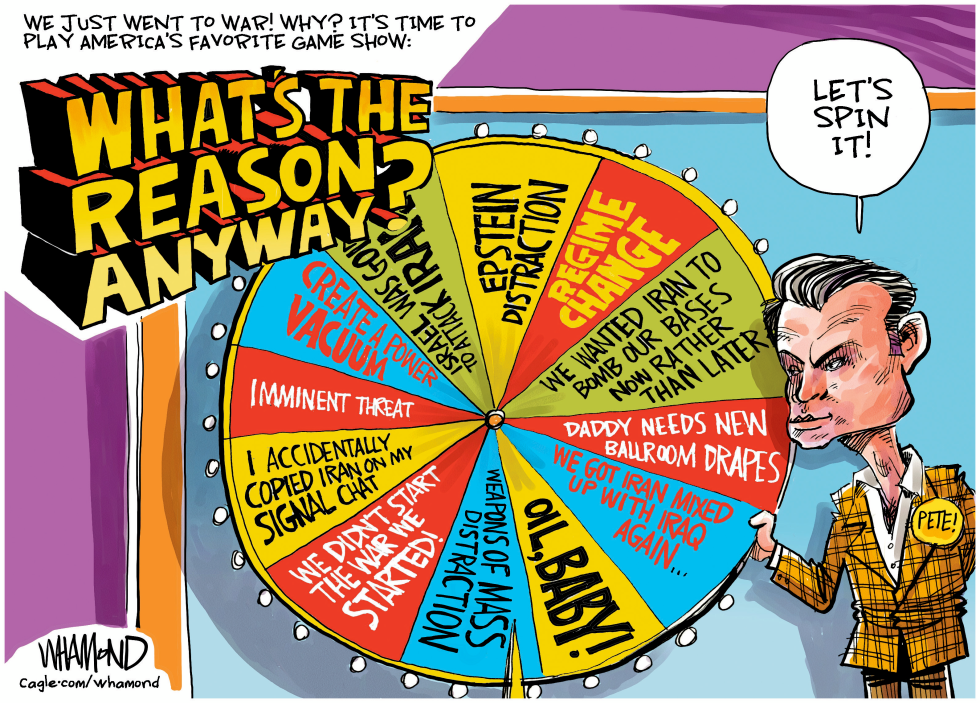
Dive into this biting political cartoon where America's war decisions are reduced to a game show parody wheel, featuring options like 'Imminent Threat,' 'Oil, Baby!,' and 'Regime Change.' The irreverent satire targets US foreign policy, highlighting how military interventions often spin on flimsy pretexts, from accidental escalations to resource grabs. With a host eagerly spinning the wheel, the artwork cleverly critiques the absurdity of war justifications, blending humor with insightful commentary on geopolitical cynicism. Tags like political cartoon, war justifications, and military intervention humor underscore its viral potential in today's polarized discourse.
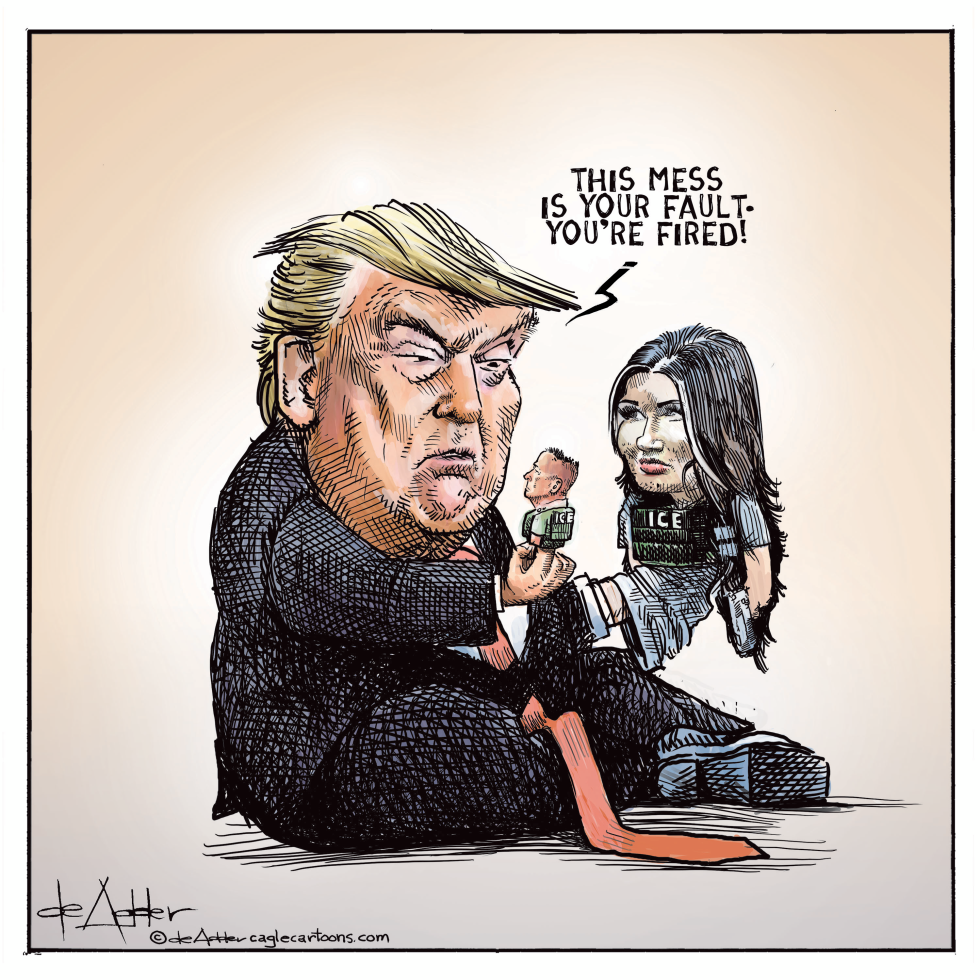
This biting political cartoon by Michael de Adder captures Donald Trump in a childish tantrum, holding and firing a diminutive Kirstjen Nielsen as an ICE agent clutching a separated baby, symbolizing the border crisis and family separation policies. The image skewers the Trump administration's immigration policy failures, with Trump shifting blame for the humanitarian mess at the US border. Through exaggerated caricature, it highlights themes of accountability, political satire, and the human cost of harsh enforcement, making it a viral-worthy jab at leadership in US politics.
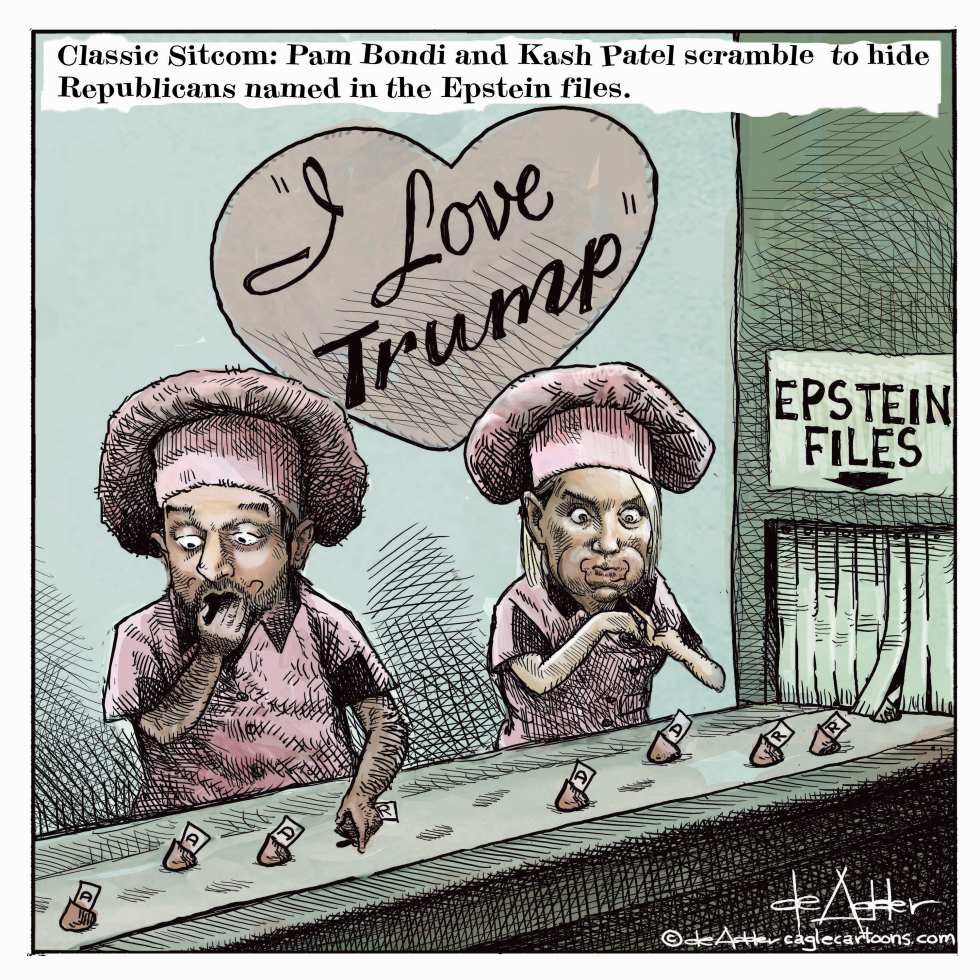
Michael de Adder's cartoon shows Pam Bondi and Kash Patel in chef hats, mimicking a classic sitcom assembly line, where they frantically point at and handle small objects marked with letters like R and D on a conveyor belt. A heart-shaped sign declares 'I Love Trump,' while a label reads 'Epstein Files' in the background. The scene draws on familiar TV tropes to comment on efforts to conceal names, using straightforward lines and shading for a humorous yet pointed critique. Tags like political cartoon, Epstein scandal, Trump loyalty, Republican cover-up, satirical parody, and editorial humor underscore the image's timely jab at current events, making it shareable in newspaper syndication circles.
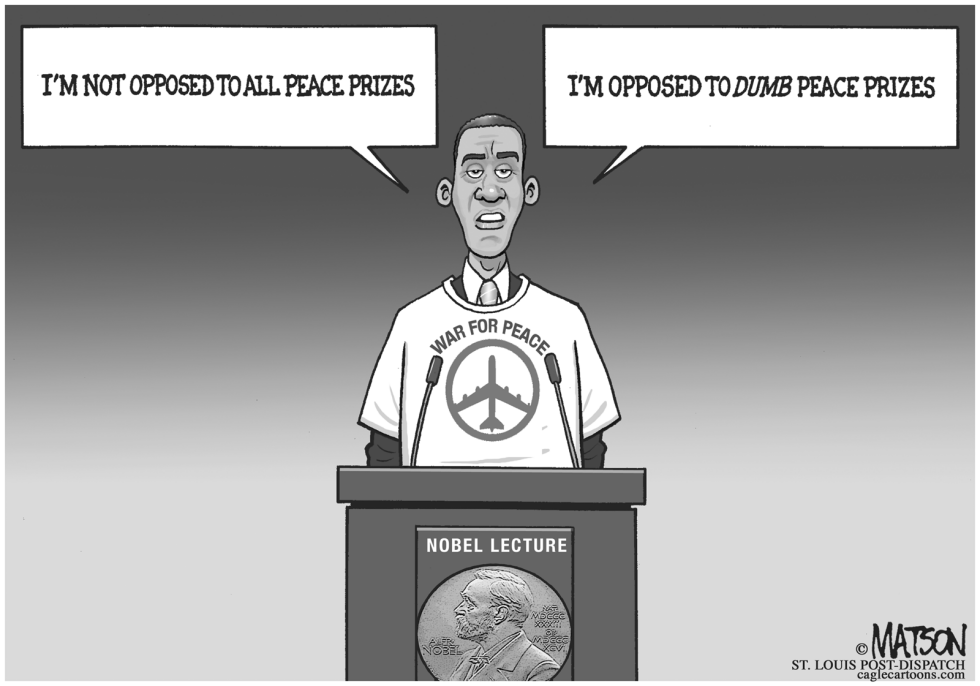
This Obama Nobel Peace Prize cartoon from 2009 captures a moment of political satire on Obama peace prize, with the central figure standing at a podium labeled Nobel lecture, delivering lines in speech bubbles: 'I'm not opposed to all peace prizes' and 'I'm opposed to dumb peace prizes.' The figure wears a t-shirt emblazoned with 'War for Peace' and a modified peace symbol featuring an airplane, emphasizing the irony. Created by R.J. Matson for the St. Louis Post-Dispatch, this piece joins the ranks of Cagle Cartoons Obama satire, highlighting the juxtaposition in the dumb peace prizes Obama speech bubble. The grayscale illustration keeps it simple, focusing on the podium with a medal-like emblem and the artist's signature in the corner, making it a classic example of 2009 Obama Nobel acceptance cartoon.