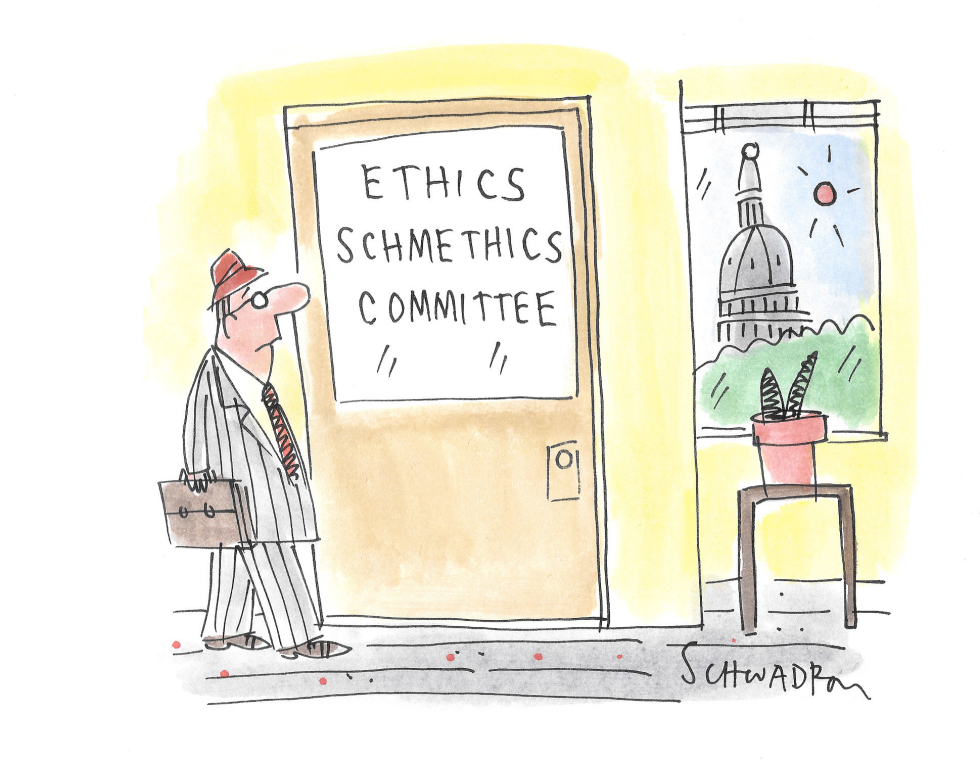
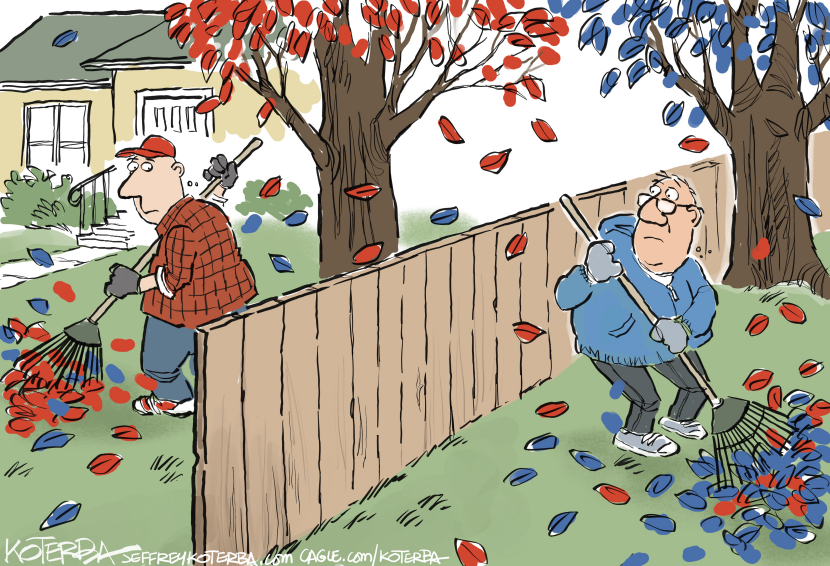
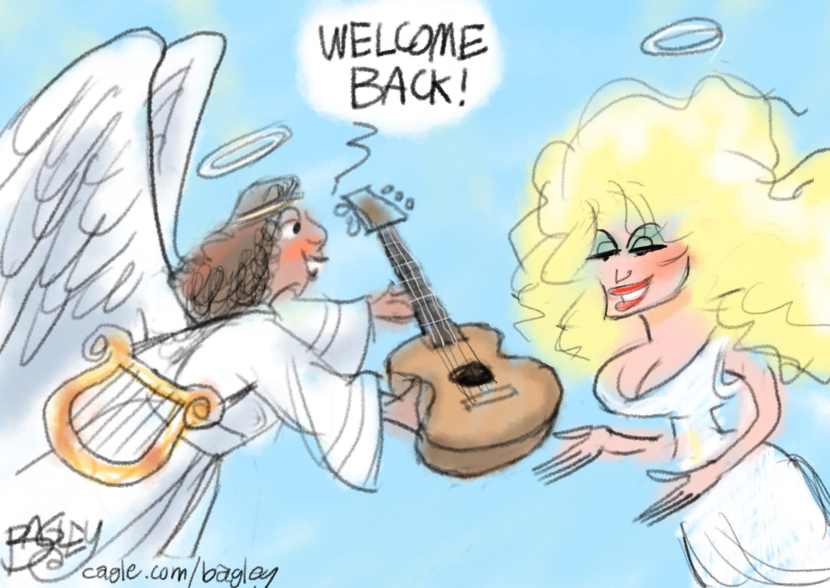
Congress continues to sideline meaningful ethics oversight, with lawmakers showing little interest in strengthening or even respecting the chamber's ethics committee. The panel exists on paper but carries little practical weight in daily operations. This dynamic matters because weak internal standards erode public trust in legislative institutions and invite outside influence. The cartoon captures the prevailing attitude that ethics rules are an afterthought rather than a core responsibility.
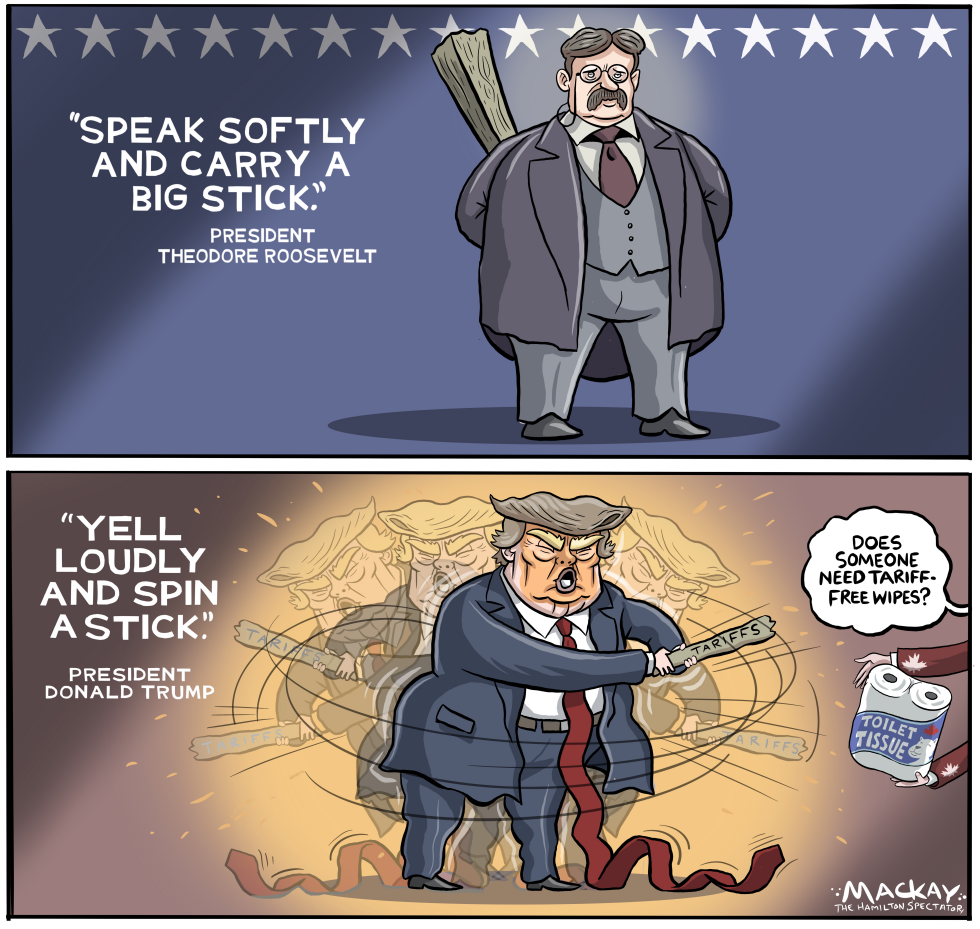
The cartoon by Graeme MacKay contrasts Theodore Roosevelt's famous speak softly and carry a big stick approach with Donald Trump's version of yelling loudly and spinning a stick covered in tariffs. In the lower panel Trump appears dizzy from the motion as a Canadian hand offers toilet tissue labeled tariff-free wipes. The image comments on recent US tariff actions and their impact on Canadian trade relations as of the September 2026 publication date.
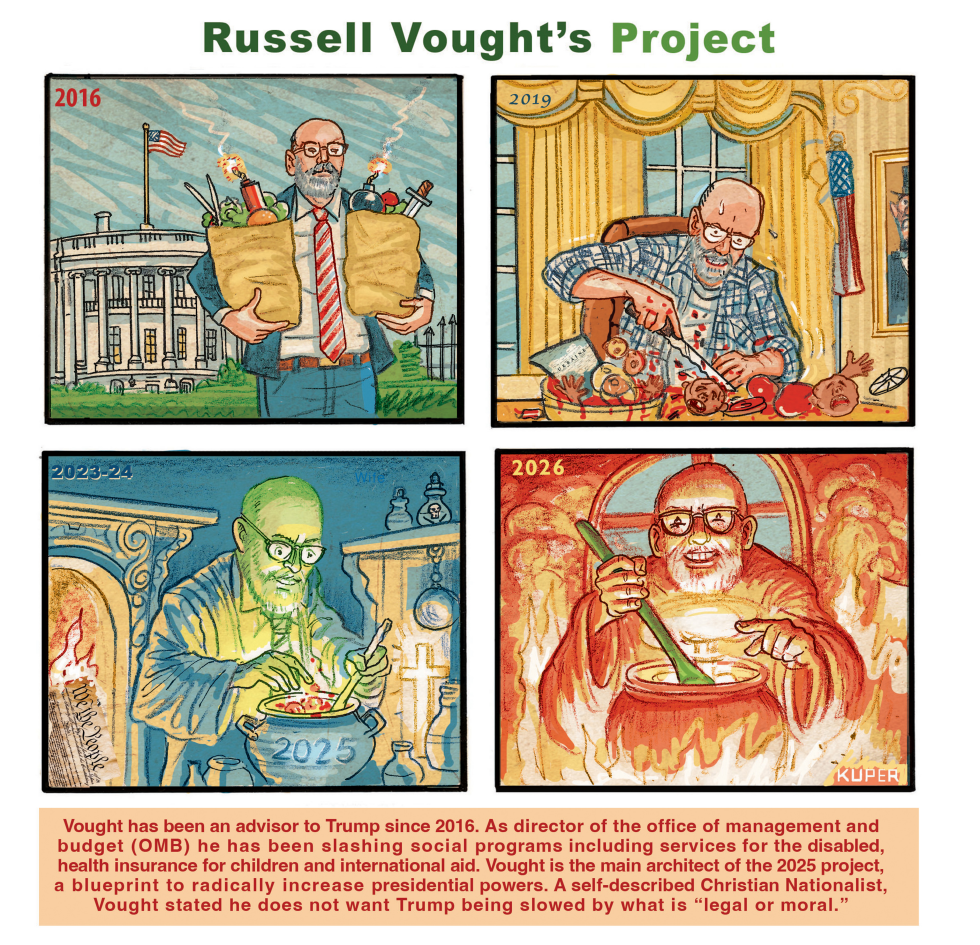
Russell Vought has served as a Trump advisor since 2016 and later directed the Office of Management and Budget, where he cut funding for disability services, children’s health insurance and foreign aid. He is the principal author of Project 2025, a plan to enlarge presidential authority. The cartoon presents his progression from 2016 through 2026 as a deliberate effort to remove legal or moral restraints on executive action.
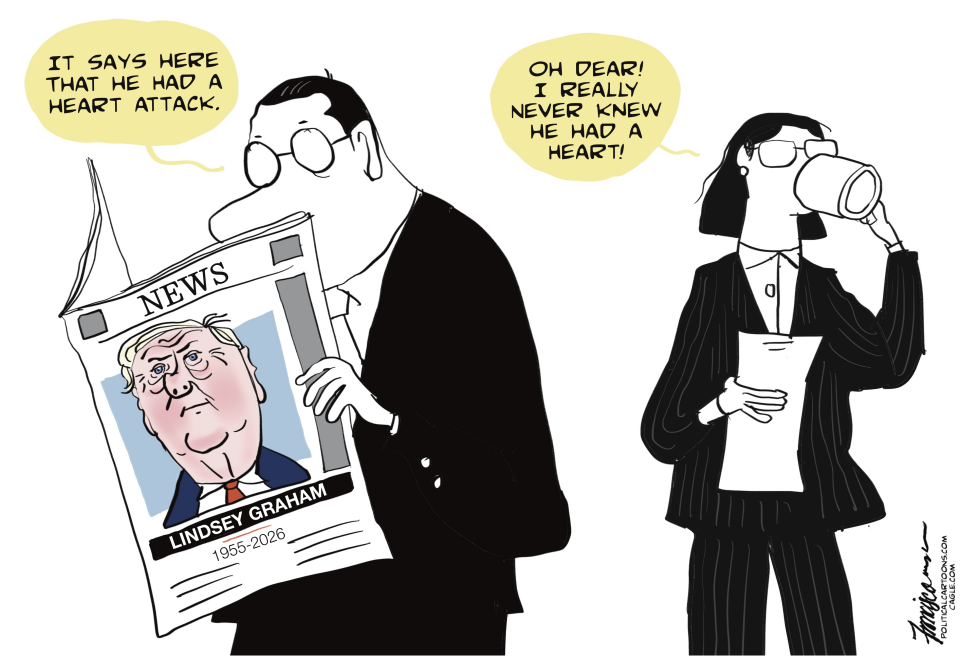
A political cartoon depicts a man reading a newspaper announcing the death of Sen. Lindsey Graham from a heart attack in 2026. A woman standing nearby responds with a pun, stating she never knew he had a heart. The image uses the obituary format and the double meaning of the word heart to highlight perceptions of the senator's demeanor.
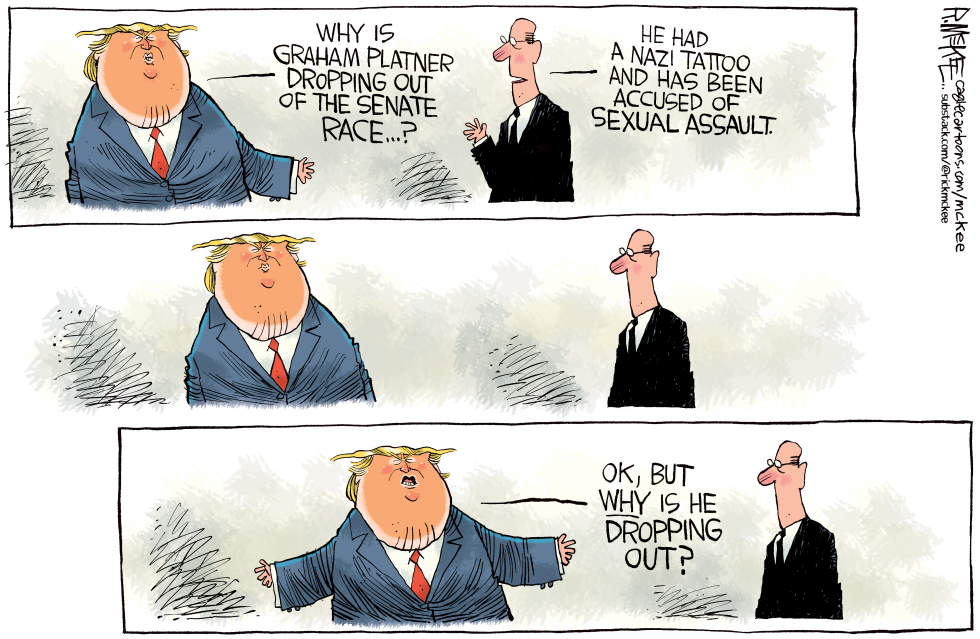
On July 10 2026 Rick McKee depicts Donald Trump questioning an aide about Graham Platner dropping out of a Senate race. The aide cites a Nazi tattoo and sexual assault accusation as reasons. Trump responds by asking again why the candidate is leaving the race. The exchange highlights the former president's focus on the withdrawal itself rather than the underlying controversies. Publication occurs during the 2026 election cycle when candidate viability and scandal impacts remain central topics in Senate contests.
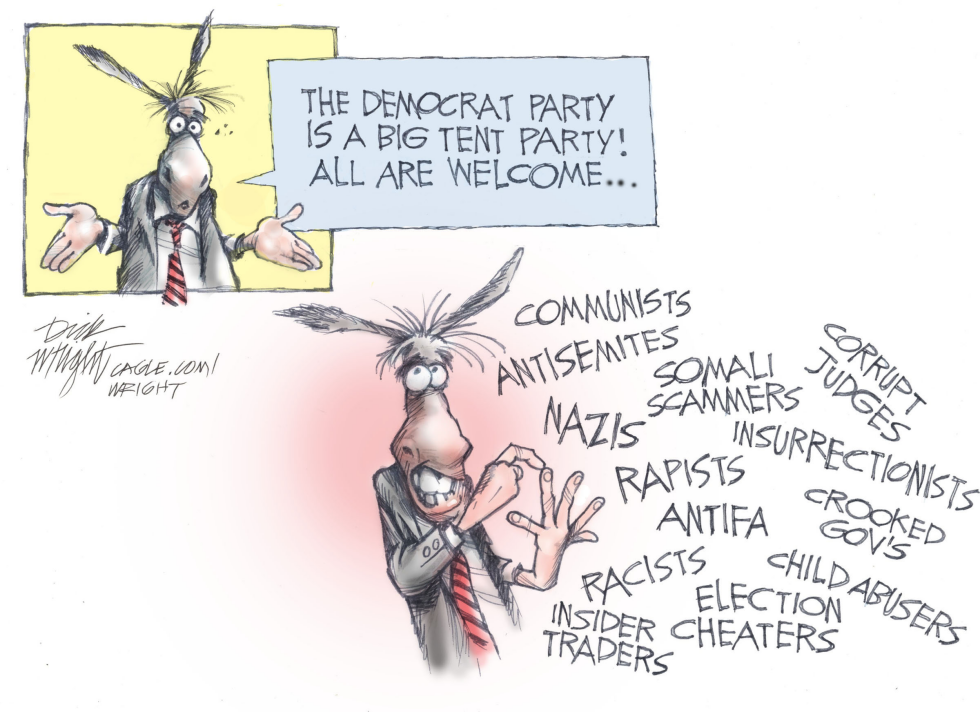
A July 2026 cartoon by Dick Wright depicts the Democrat Party's big tent claim through an inset donkey figure. The main character, also a donkey in a suit, gestures amid a cloud of labels naming groups such as communists, antisemites, Nazis, rapists, Antifa, racists, and election cheaters. The image critiques the party's inclusivity rhetoric by associating it with these categories. Publication occurs amid ongoing partisan debates over party platforms and voter bases.
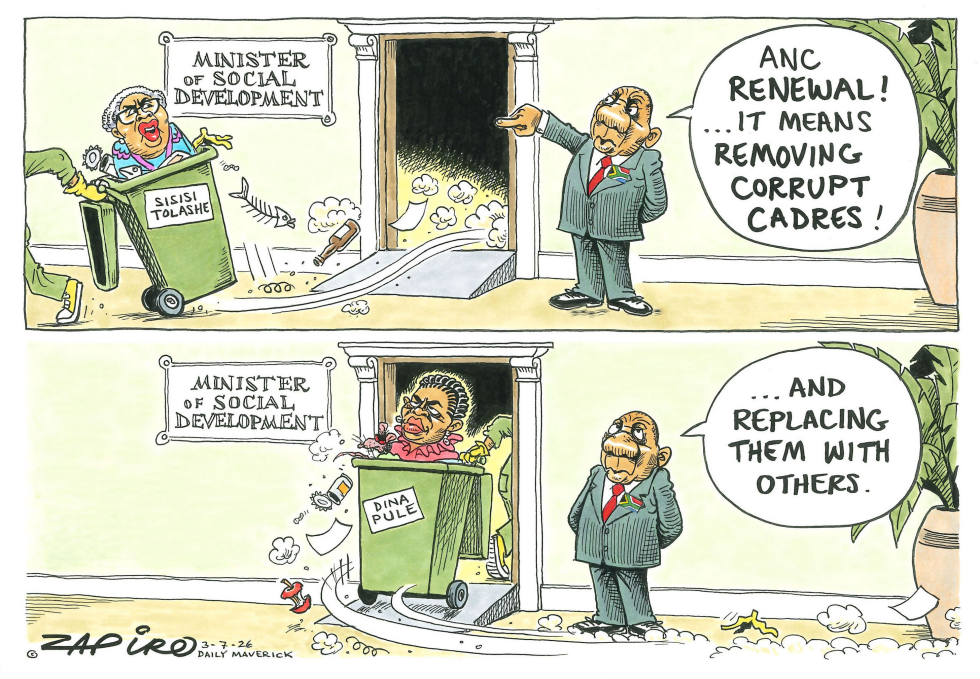
Zapiro's July 2026 cartoon mocks ANC renewal claims by showing the Minister of Social Development post swapped from Sisisi Tolashe to Dina Pule, with the party figure declaring removal of corrupt cadres only to replace them with others. The image responds to recent ANC efforts at internal reform and minister reshuffles in South Africa amid persistent allegations of cadre deployment and graft in government departments.
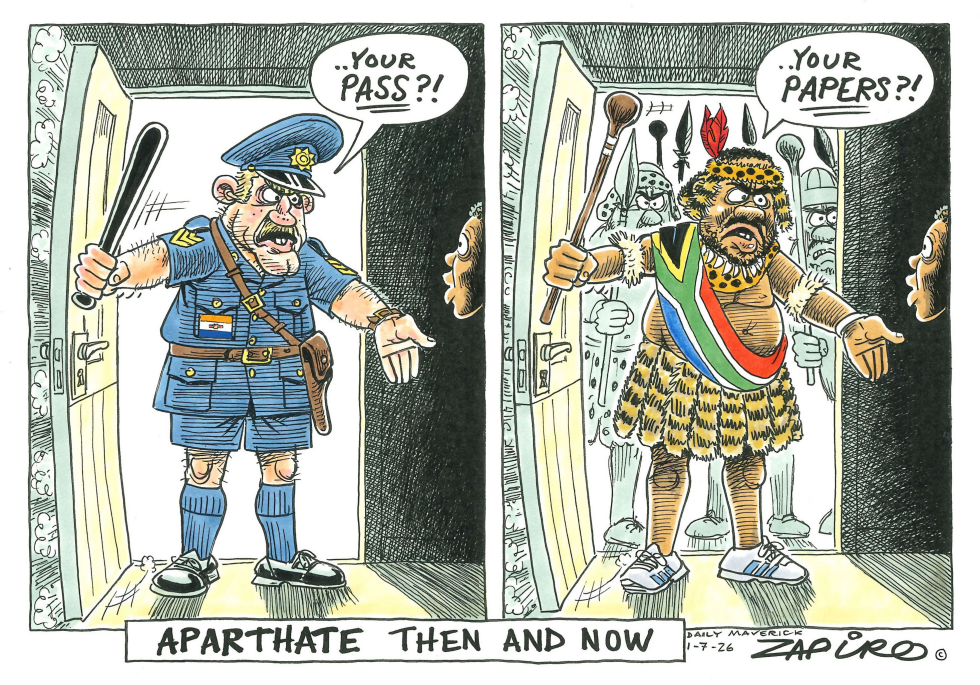
A two-panel cartoon contrasts a South African police officer in uniform demanding a pass during apartheid with a figure in traditional attire and South African flag sash making a similar demand in a modern setting. The bottom banner labels the comparison 'Apartheid Then and Now.' The work appears in the Daily Maverick dated 1-7-26 and is signed by Zapiro.
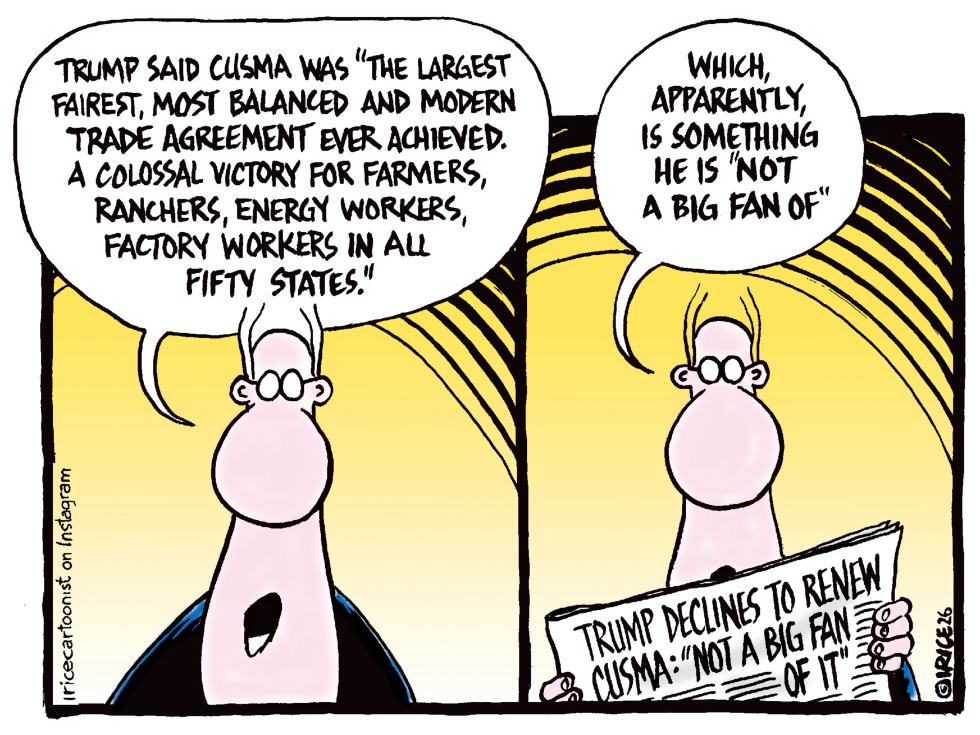
The July 2026 cartoon depicts a figure resembling President Trump in two panels. The left shows praise for CUSMA as the best trade deal. The right shows the same figure reading a newspaper headline about declining to renew it. The visual points to a shift in position on the agreement covering Canada, the US, and Mexico.
On July 1 2026 Bill Day depicts Donald Trump first dismissing Antifa threats in one panel then igniting the Constitution Declaration of Independence and Bill of Rights in another while calling ICE for assistance. The scene shows the president holding a phone and lighter beside a red gas can as flames consume the documents on a table inside a columned hall with an American flag nearby.
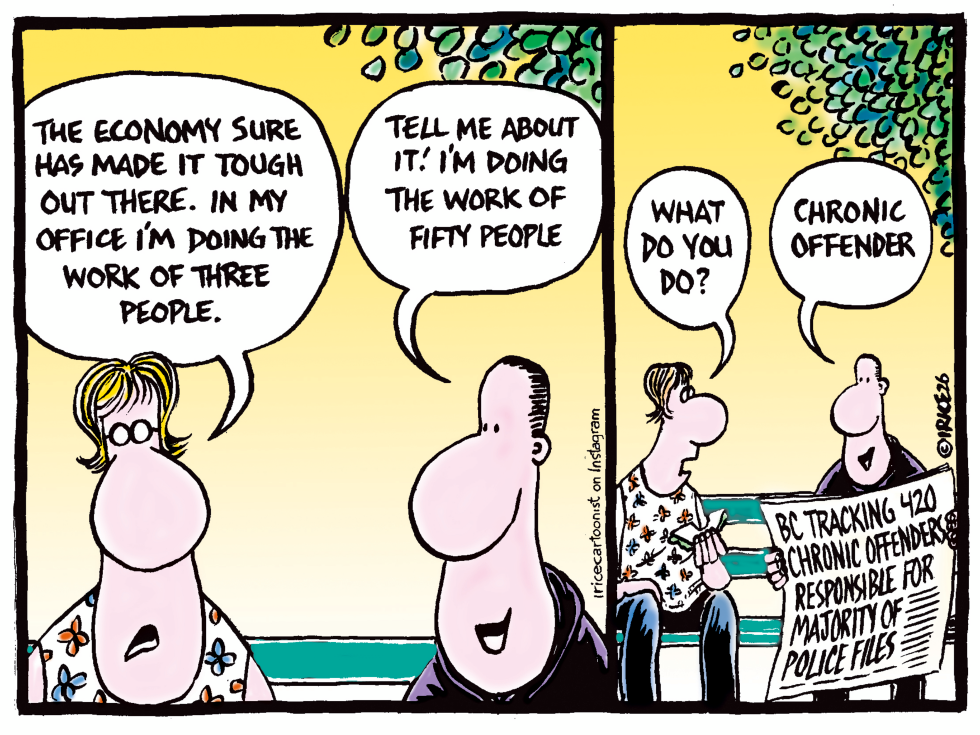
In a two-panel scene dated July 5 2026, office workers discuss heavy workloads caused by economic conditions, with one claiming to handle the work of three people and another fifty. The exchange shifts when a man on a bench identifies himself as a chronic offender, while a nearby newspaper headline reports British Columbia tracking 420 such individuals responsible for the majority of police files.
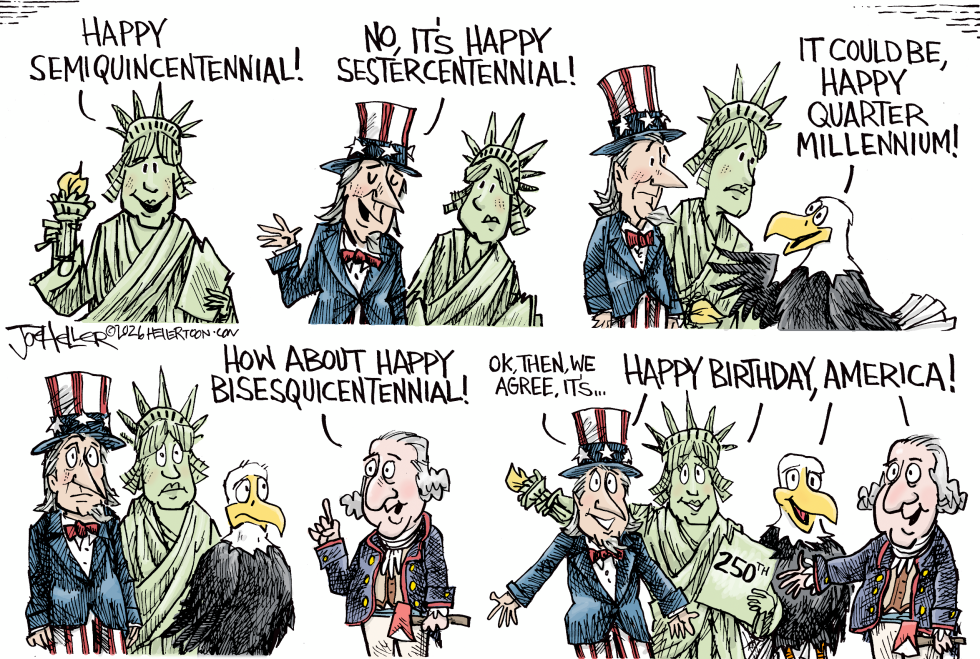
On June 29, 2026, Joe Heller's cartoon depicts Uncle Sam, the Statue of Liberty, Benjamin Franklin, and a bald eagle debating elaborate names for America's 250th anniversary. Proposals range from semiquincentennial and sestercentennial to quarter millennium and bisesquicentennial. The group ultimately agrees on the straightforward greeting Happy Birthday, America, accompanied by a 250th banner. The exchange highlights the challenge of selecting a fitting term for the milestone tied to the 1776 founding.
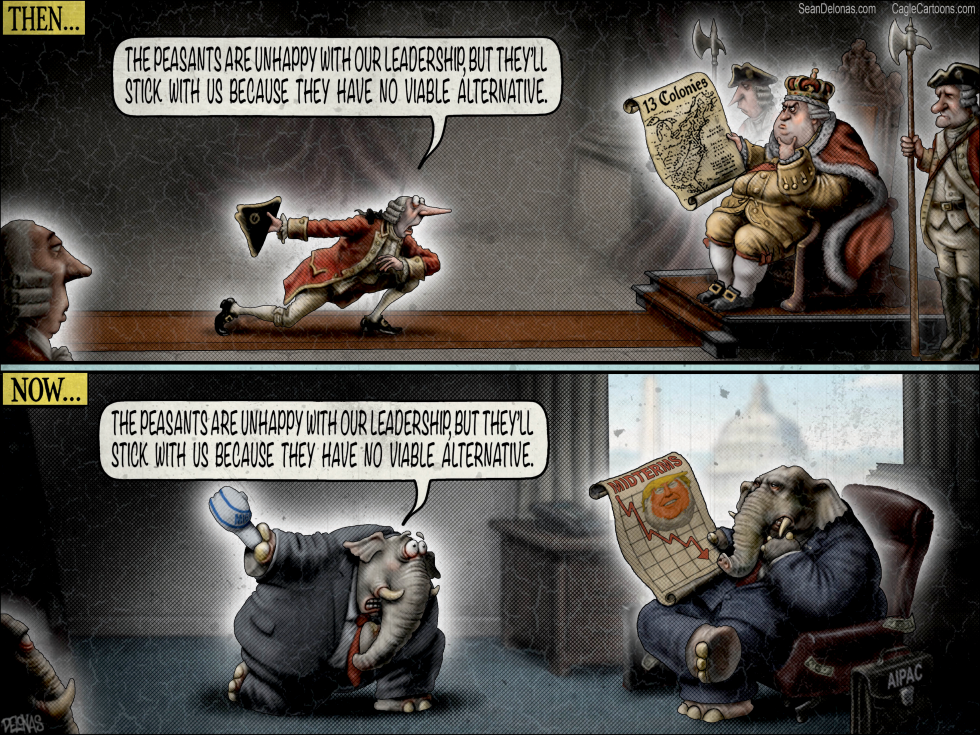
A two-panel cartoon contrasts King George III assuring aides that unhappy colonists have no viable alternative with a modern Republican elephant repeating the identical line while holding a plunging midterms chart marked with Donald Trump's face. The lower scene includes the U.S. Capitol dome and an AIPAC briefcase. The June 28 2026 date places the image weeks before the 2026 midterm elections.
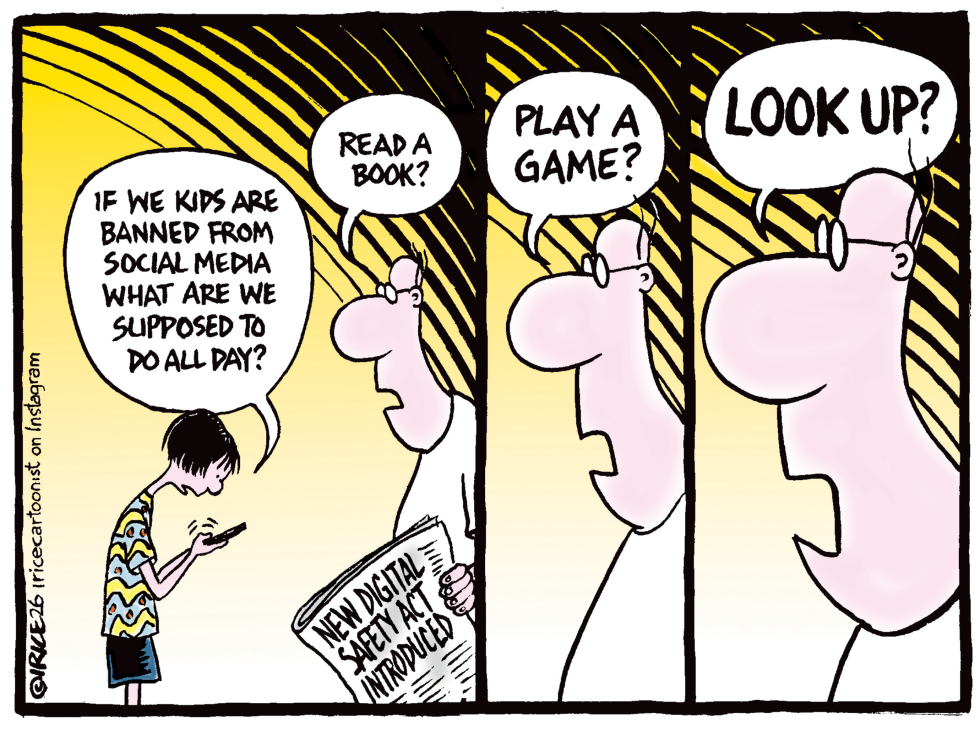
A three-panel cartoon depicts a child on a smartphone questioning what to do all day if banned from social media. An adult holding a newspaper headlined 'NEW DIGITAL SAFETY ACT INTRODUCED' responds with suggestions to read a book, play a game or look up. The June 2026 image addresses proposed restrictions on youth digital access.